



Overview
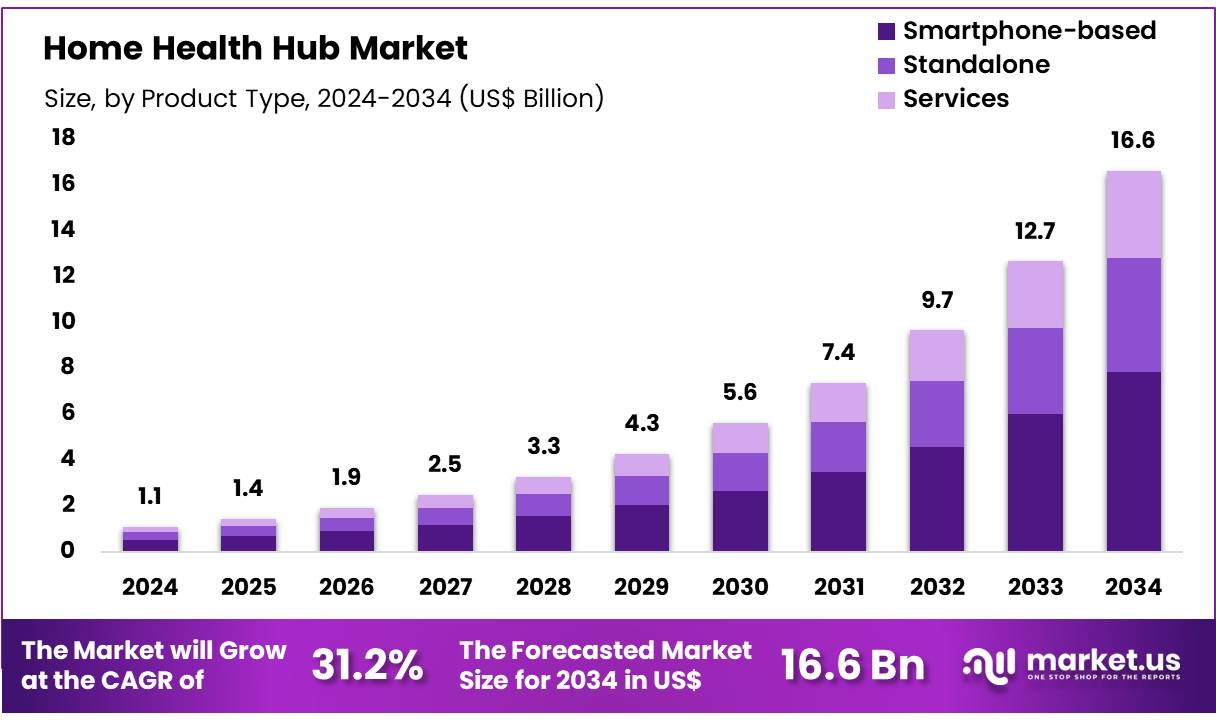
Global Home Health Hub Market size is expected to be worth around US$ 16.6 Billion by 2034 from US$ 1.1 Billion in 2024, growing at a CAGR of 31.2% during the forecast period 2025 to 2034. In 2024, North America led the market, achieving over 39.5% share with a revenue of US$ 0.4 Billion.
The Home Health Hub market is gaining momentum as healthcare systems increasingly shift toward connected, patient-centered care delivered in the home. Rising prevalence of chronic diseases, an aging global population, and the growing adoption of remote patient monitoring technologies are encouraging healthcare providers to expand home-based care models.
Governments and healthcare organizations are also supporting digital health initiatives that improve care coordination, reduce unnecessary hospital visits, and enhance patient outcomes through connected medical devices and virtual care platforms. The U.S. Food and Drug Administration (FDA) launched its Home as a Health Care Hub initiative to promote innovation in integrated home-based medical technologies, highlighting the growing importance of connected healthcare environments.
The Centers for Medicare & Medicaid Services (CMS) continues to strengthen home healthcare through quality reporting programs, Medicare-certified home health agency standards, and expanded digital health guidance. CMS also recognizes the role of remote patient monitoring and telehealth technologies in supporting patient-specific care plans, while maintaining quality and safety requirements for home health services.
According to the U.S. Centers for Disease Control and Prevention (CDC), the United States had approximately 11,500 home health agencies in 2022, serving nearly 3.3 million patients during the year. These figures demonstrate the growing scale of home-based healthcare services and the increasing need for integrated digital platforms that connect patients, caregivers, clinicians, and medical devices.
Advancements in artificial intelligence, cloud-based health platforms, wearable devices, and interoperable healthcare systems are expected to further accelerate adoption of home health hubs. As healthcare providers prioritize preventive care, continuous monitoring, and personalized treatment, home health hubs are becoming a critical component of modern healthcare delivery, improving patient engagement while supporting efficient and coordinated care across the continuum.
Key Takeaways
- The global Home Health Hub market was valued at US$ 1.1 billion in 2024 and is projected to reach US$ 16.6 billion by 2034, expanding at a CAGR of 31.2% during the forecast period.
- By product type, the market is categorized into smartphone-based, standalone, and services, with the smartphone-based segment leading the market, accounting for 47.3% of the total share in 2024.
- Based on patient monitoring type, the market is segmented into high-acuity, moderate-acuity, and low-acuity. Among these, the high-acuity segment dominated with a 42.8% market share in 2024.
- In terms of end users, the market is divided into hospitals, home care agencies, and healthcare payers. The hospitals segment held the largest market share, capturing 53.6% of the total revenue in 2024.
- North America emerged as the leading regional market, accounting for 39.5% of the global Home Health Hub market share in 2024.
Statistical Information
- More than 1.01 million Home Health Care CAHPS surveys were completed nationally in the latest CMS reporting period, providing one of the largest patient experience datasets for home healthcare services.
- According to CMS, 89% of home health patients reported that their care team treated them in a professional manner during home healthcare visits.
- 86% of patients stated that home health providers communicated well with them, reflecting strong patient-provider engagement in home-based care.
- 85% of surveyed patients gave their home health agency an overall rating of 9 or 10 out of 10, indicating high patient satisfaction with home healthcare services.
- 79% of patients reported they would definitely recommend their home health agency to friends and family, according to the national CMS HHCAHPS survey.
- CMS publicly compares the quality of Medicare-certified home health agencies through its Care Compare platform, enabling consumers to evaluate providers using standardized quality and patient experience measures.
- CMS requires Medicare-certified home health agencies to collect the Outcome and Assessment Information Set (OASIS) for adult patients, supporting nationwide quality measurement and coordinated home-based care.
- CMS measures home healthcare performance using outcome indicators such as improvements in walking, mobility, bathing, and self-care, demonstrating the increasing focus on functional recovery in the home setting.
- Home Health CAHPS is the first national standardized public survey that measures patients’ experiences with Medicare-certified home health agencies, supporting transparency and consumer choice.
- CMS updates Home Health Care quality and patient survey data quarterly, allowing healthcare providers and patients to track performance using current information.
Regional Analysis
North America dominated the Home Health Hub Market in 2024, accounting for 39.5% of the global revenue share. The region’s leadership is driven by widespread adoption of digital health technologies, a well-established healthcare infrastructure, and increasing demand for home-based care among older adults.
The U.S. Food and Drug Administration (FDA) is advancing its Home as a Health Care Hub initiative to encourage the development of connected medical devices and integrated home healthcare solutions that improve patient outcomes. At the same time, the Centers for Medicare & Medicaid Services (CMS) continue to strengthen home healthcare through quality reporting programs and Medicare-certified home health agencies.
CMS reports that the United States has 11,474 Medicare-certified home health agencies serving approximately 3 million Medicare fee-for-service beneficiaries, highlighting the strong foundation for home healthcare adoption.
Asia Pacific is projected to register the fastest CAGR during the forecast period, supported by rapid population aging, rising healthcare digitalization, and expanding telehealth services.
Countries such as Japan are investing in community-based and home-centered care to address the growing elderly population, while governments across the region are promoting digital health initiatives to improve healthcare accessibility and chronic disease management. These developments are expected to accelerate the adoption of home health hubs and connected care solutions.
Emerging Trends
- Connected home ecosystems are becoming the new care model. The U.S. FDA’s Home as a Health Care Hub initiative encourages integration of multiple medical devices into a single home environment instead of standalone systems. This trend improves coordinated care, supports chronic disease management, and enhances patient convenience through connected digital health technologies.
- Remote patient monitoring is expanding rapidly through connected devices. CMS requires eligible remote patient monitoring devices to digitally transmit patient data and collect at least two readings every 30 days, enabling clinicians to monitor chronic and acute conditions without frequent in-person visits.
- Quality reporting is becoming increasingly data-driven. CMS now includes measures such as COVID-19 vaccination status, transfer of health information, medication review, and patient-reported outcomes in its Home Health Quality Reporting Program, encouraging providers to improve care quality using standardized digital reporting.
- Interoperability is strengthening home healthcare delivery. The CDC’s National Electronic Health Records Survey continues tracking physician adoption of interoperable electronic health records, supporting secure health information exchange between hospitals, physicians, and home healthcare providers for better continuity of care.
- Regulators are emphasizing safe consumer-operated medical devices. The FDA continues expanding guidance for home-use medical devices, focusing on products that patients can safely operate outside hospitals while maintaining clinical performance, supporting greater adoption of home-based healthcare technologies.
Use Cases
- Chronic disease management at home is one of the largest applications. Patients with hypertension, diabetes, or heart disease use connected blood pressure monitors, glucose monitors, and weight scales that automatically send health data to clinicians for continuous treatment decisions.
- Post-discharge recovery monitoring helps reduce unnecessary hospital readmissions. Home health hubs enable clinicians to remotely monitor recovery, medication adherence, and patient progress after discharge while maintaining regular communication through connected healthcare devices.
- Elderly care and aging in place is a major use case. FDA research highlights the need for integrated home technologies that support older adults with multiple chronic conditions, allowing them to live independently while remaining connected with caregivers and healthcare providers.
- Medication and treatment adherence is improving through connected home platforms. CMS quality programs require medication reviews and follow-up when issues are identified, enabling home health agencies to detect treatment gaps early and improve patient safety.
- Virtual home-based clinical care is expanding through Medicare-certified home health agencies. CMS continues supporting home healthcare programs with standardized certification, quality reporting, and value-based purchasing initiatives, encouraging providers to deliver more coordinated care outside traditional hospital settings.
Conclusion
The Home Health Hub market is poised for strong growth as healthcare providers increasingly shift toward connected, patient-centered care delivered in the home. Rising adoption of remote patient monitoring, digital health platforms, artificial intelligence, and interoperable medical devices is transforming how chronic diseases and post-acute care are managed.
Government initiatives, including the FDA’s Home as a Health Care Hub program and CMS home health quality reporting standards, continue to support innovation and wider adoption of home-based healthcare solutions. As healthcare systems prioritize preventive care, improved patient engagement, and coordinated clinical services, Home Health Hubs are expected to become an essential component of modern healthcare delivery, improving accessibility, care quality, and long-term health outcomes worldwide.




















