


Report Overview
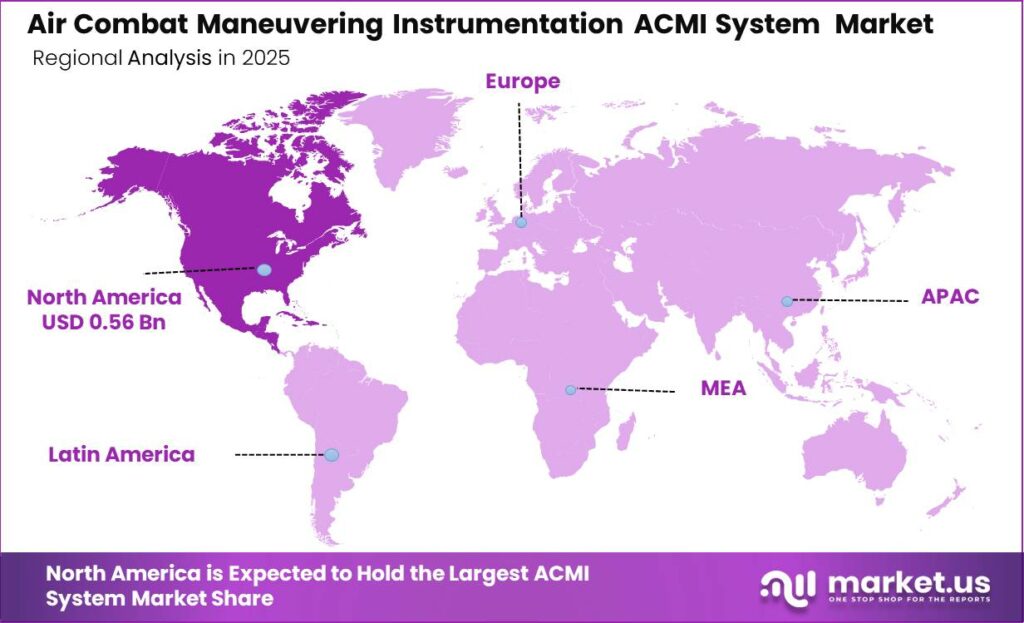
In 2025, the Air Combat Maneuvering Instrumentation ACMI System Market was valued at US$1.48 billion, and between 2026 and 2035, this market is estimated to register a CAGR of 7.50%, reaching about US$2.99 billion by 2035. North America held a dominant market position, capturing more than 38.5% share, holding USD 0.56 billion in revenue.
The global Air Combat Maneuvering Instrumentation (ACMI) System Market is expanding rapidly due to near-peer geopolitical rivalry and rigid defense regulations. The requirement of integrating fourth-generation legacy aircraft with fifth-generation stealthy aircraft, such as the F-35, is a key reason why there is a 24% increase in investments for reusable hardware equipment in order to safeguard sensitive radar signature information. Additionally, the defence technologies evaluated in 2026 indicate that newly launched SSU kit systems can deliver a 300% jump in terms of bandwidth capacity. On the other hand, trade tariffs on the supply chain act as a significant constraint.
Key Takeaways
- The Air Combat Maneuvering Instrumentation ACMI System Market was valued at US$1.48 billion in 2025.
- The Air Combat Maneuvering Instrumentation ACMI System Market is projected to grow at a CAGR of 7.5% and is estimated to reach US$2.99 billion by 2035.
- Ground Exploitation (Debriefing) Stations command the majority of the market share at 62.6%, proving that software-heavy analytics platforms outweigh individual Airborne Instrumentation Systems (AIS) at 37.4%.
- Real-Time ACMI Systems overwhelmingly lead the market at 72.3%, reflecting the critical defence demand for immediate, active telemetry links over legacy Non Real-Time options (27.7%).
- 4th-Gen Fighter Jets dominate at 54.5%, driving the need for secure encryption hardware retrofits (SSU kits) to keep older airframes operational alongside 5th-gen stealth fighters.
- The Air Force stands as the largest commercial vertical, driving 48.5% of all market procurement, followed by lower-tier segments like Naval, Army, and R&D organizations.
- North America remains the primary geographic hub, holding a dominant 38.5% regional market share, heavily supported by massive defence spending and extensive joint exercises.
This market expansion is accelerated by the urgent military necessity for real-time tracking and telemetry data during complicated aerial drills, which prioritizes live monitoring over delayed post-mission downloads to enable prompt tactical course corrections. Furthermore, because legacy 4th-generation fighter jets still make up the vast bulk of active global military fleets, defense frameworks are investing extensively in advanced, external airborne subsystems to maintain these older weapons relevant in modern war scenarios. Air forces frequently deploy external ACMI pods during massive multinational exercises like Red Flag to allow legacy aircraft to securely connect to ground exploitation networks and practice real-time combat tactics alongside next-generation stealth assets without jeopardizing classified fleet capabilities.
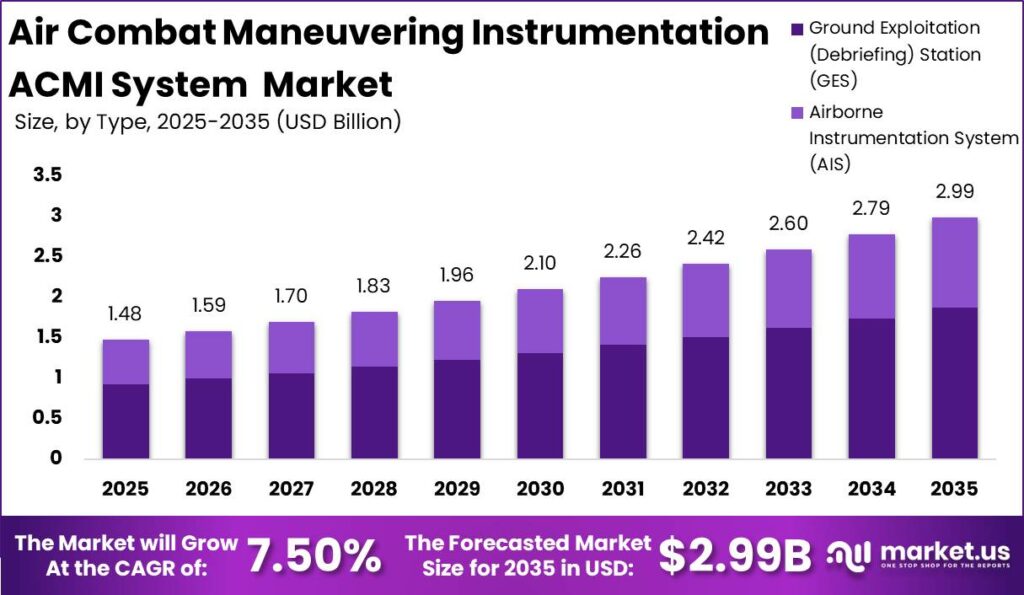
The scope of the market involves airborne pods, ground stations, and debriefing software in autonomous and fixed-range configurations. The biggest area of growth in terms of demand drivers is in live, virtual, and constructive (LVC) environments. The digital evolution reduces the cost of training by reducing the cost of training from $45,000 to $12,000 per flight hour. Future trends are pegged on rapid AI incorporation within the analysis pipeline of the missions. Sophisticated algorithms automate the weapon adjudication process while cutting down after-action review periods.
Global Air Combat Maneuvering Instrumentation ACMI System Market Scope
Type Analysis
Ground Exploitation (Debriefing) Stations Offer Truth-in-Training Standardization
In 2026, the Ground Exploitation (Debriefing) Stations segment dominated the market, accounting for 62.6%. This supremacy arises from the growing requirement for high-capacity data processing following complex military operations, outperforming Airborne Instrumentation Systems, which handle physical data collecting. Modern Large Force Exercises create millions of telemetry packets every minute, resulting in analytical bottlenecks that only ground-based infrastructure can overcome.
Ground stations provide the underlying architecture needed to absorb, analyze, and depict the huge influx of data into realistic 3D tactical replay profiles. The extensive historical use of these platforms is due to a universal military demand to establish consistent After Action Reviews while implementing stringent, long-term cost-cutting measures across training commands. During large-scale coalition drills, numerous squadrons return with different data logs. Ground exploitation stations serve as the one source of truth, combining these disparate inputs into a uniform interactive replay that enables instructors to quickly identify tactical errors without the need for extra flight hours.
These complex software-based systems are the future of combat training, enabling real airplanes in the sky to engage with synthetic threats. The primary motive behind this technological advancement is the expensive physical process involved with the flight of enemy “aggressor” squadrons. Using the synthetic inject hardware system, the defense organizations can integrate synthetic bubbles for surface-to-air missiles within the cockpit’s view of pilots. Although the development engineering costs for the initial phase may be high, the future logistics benefits are encouraging this trend among the leading air forces worldwide.
System Type Analysis
Real-Time ACMI Networks Coordinate Dynamic Flight Telemetry
Real-Time ACMI Systems lead the Air Combat Maneuvering Instrumentation ACMI System Market with 72.3% market share in the base year. The key reason behind this market share is the indispensable requirement of real-time data flow in multi-aircraft exercises. With real-time telemetry, ground-based range safety officers can determine exact altitude, speed, and heading information of aircraft at any time. This technology-based system architecture plays a crucial role in preventing any kind of disastrous mid-air collision. Additionally, real-time systems offer RTKN data to pilots instantaneously.
The key factor behind the growth of this particular domain is the swift pace of obsolescence of legacy ground-based towers. ACMI devices resolves this issue, since satellite navigation along with pod-to-pod wireless data transmission systems do not suffer from such vulnerability. By introducing intelligent software network layers in the training pod, the system can neutralize radio signal disruption without losing any important data packets.
For instance, when fighter jets fly in isolated mountain ranges or low-altitude routes where traditional ground tower signals are completely obstructed by terrain, pod-to-pod mesh networks seamlessly pass tracking data from aircraft to aircraft. This continuous data daisy-chain means that the ground exploitation station has a perfect, uninterrupted view of the exercise without the need for expensive physical tower installations on the ground.
Platform Analysis
4th Generation Fighter Aircraft Dominate Global Instrumentation Training Platform Market
Fighter Jets (4th Generation), which include existing legacy platforms such as F-16, F-15, Su-30, and Eurofighter Typhoon, dominate the market with the largest share at 54.5%. The main factor contributing to this market dominance is the huge number of 4th generation fighter aircraft that are still in use worldwide. Due to tight military budget limits and lengthy development timeframes, air forces cannot instantly replace all of their existing assets with superior 5th-generation stealth platforms. As a result, there is a high need for retrofittable hardware kits and modular ACMI pods that will keep these older aircraft technologically current and fully compatible with modern, data-intensive training situations.
For instance, Air forces regularly confront electronic integration delays while attempting to conduct simulated combat rehearsals between aging aircraft and modern stealth fighters. By outfitting a fourth-generation fighter jet with a modern ACMI training pod, the aircraft can securely receive and transmit high-bandwidth telemetry data across encrypted networks. This enables an older F-16 to effortlessly participate in the same Live, Virtual, and Constructive (LVC) training network as an F-35, safely replicating modern missile engagements and radar interactions without the need for costly, permanent structural upgrades to the legacy aircraft.
The driving force behind such rapid growth comes from the worldwide manufacturing and integration of the F-35 Lightning II in allied countries’ defense infrastructures around the globe. By design, 5th generation platforms collect a tremendous amount of highly sophisticated data through their onboard sensor fusion technologies.
The future trend in platforms would revolve around UCAVs and “loyal wingmen” drones, expected to be widely integrated with training from 2030 to 2035. The new segment would necessitate special-purpose ACMI solutions, capable of synchronizing the flight trajectories of unmanned and autonomous vehicles with those of manned fighter planes. Designing such sophisticated tracking devices would entail considerable advancements in software, enabling safe aircraft separation, autonomous weapon targeting, and inter-aircraft data sharing.
End Use Analysis
Air Force Units Account for the Majority Share of Spending on Military Training
The Air Force is the clear market leader among the final consumers, possessing an overwhelming share of 48.5% of total market purchases during the base year. This dominance is due to the critical operational mandate of air force units, which manage primary national air defense, long-range strike operations, and pilot training pipelines. Consequently, air force procurement relies on long-term defense contracts spanning multiple years to deliver thousands of tracking pods and complex ground command networks. These large-scale hardware and software acquisitions are secured by stable, multi-year government budget allocations.
Joint Allied and Multi-National forces are the fastest-growing user vertical market segment. The main reason why joint Allied forces continue to grow at a robust pace is because of more extensive joint Allied military exercises such as the NATO Red Flag exercise or the Indo-Pacific Pitch Black exercises. Modern wars show that individual countries do not usually engage in combat operations on their own, but instead form coalitions to participate in warfare. In order to achieve this, it is crucial to have training instruments that facilitate this kind of training for all involved nations.
Another rising industry in the field of end users would be Naval Aviation that is set to experience an increase in its procurement cycles from 2030 through 2035 owing to increased demands for operations carried out on carriers. This category needs ACMI systems designed with great precision to ensure they do not suffer any form of interference or loss of signals in saltwater, marine-based operations. One of the primary factors responsible for this growth will be the evolving priorities of the international community toward oceanic areas such as the Indo-Pacific region. To achieve readiness in oceanic theaters, there will be huge investments in satellite-enabled, autonomous tracking pods.
For example, during huge multi-national training events like as the US Air Force’s Red Flag exercises, hundreds of aircraft must be instrumented at the same time. The Air Force uses its massive budget to deploy thousands of interconnected ACMI pods and multi-level ground exploitation networks across vast test ranges, allowing varied squadrons to securely replicate high-density combat tactics in real time without depleting live missile inventories.
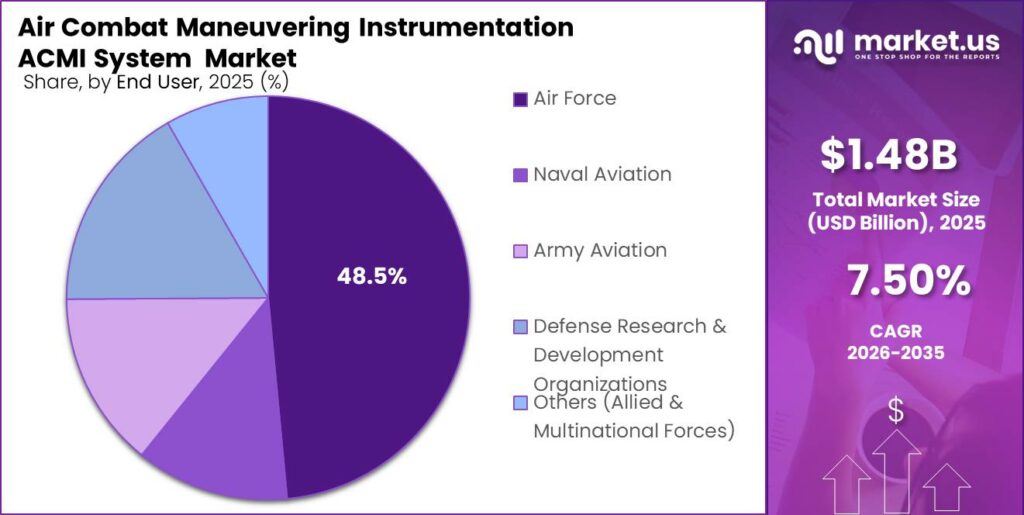
Key Market Segments
By Type
- Ground Exploitation (Debriefing) Station (GES)
- Airborne Instrumentation System (AIS)
By System Type
- Real-Time ACMI Systems
- Non Real-Time ACMI System
By Platform
- Fighter Jets (4th Generation)
- Helicopter
- Trainer Aircraft
By End User
- Air Force
- Naval Aviation
- Army Aviation
- Defense Research & Development Organizations
- Others (Allied & Multinational Forces)
Regional Analysis
North America Held the Largest Share of Air Combat Maneuvering Instrumentation ACMI System Market
The North America region held the leading market share of 38.5% in 2026. This share is mainly due to the fact that the U.S. holds the highest national defense budget in the world, which means large investments in specialized training equipment for its air force. The region stands out as the central location for conducting intense and multidomain combat simulation missions, such as those by the U.S. Air Force Red Flag program and the U.S. Navy Topgun program, which require constant updating of instrumentation pods and tracking systems.
The dominance is further driven by the incorporation of the next generation of F-35 Lightning II aircraft in the fleet. This leads to the need for advanced System Security Update (SSU) kits that are highly encrypted to prevent any stealth tracking data surveillance by near-peers.
In addition, market growth in North America will grow as a result of rapid shifts towards LVC training solutions that are implemented over extensive domestic testing grounds. In order to counteract sophisticated electronic warfare capacities of potential near-peer adversaries, the current generation of unsecured telemetry systems will be quickly phased out by the U.S. Department of Defense. New MLS system deployments will enable various branches of joint forces to securely exchange telemetry information and perform simulation of mass missile attacks on large test grounds while keeping classified data secure.
For example, within modern joint forces training operations conducted over the extensive Nevada Test and Training Range, pilots utilize not only stealth fighters and conventional bombers, but also deploy various electronic jamming systems. All of these components become interconnected through North American-specific ACMI solutions, featuring advanced software-based data connections. As a result, it becomes possible for commanders to analyze pilots’ actions in the course of electronic warfare against state-of-the-art threat profiles.
Key Regions and Countries Covered in this Report
- North America
- The US
- Canada
- Europe
- Germany
- France
- The UK
- Spain
- Italy
- Russia & CIS
- Rest of Europe
- APAC
- China
- Japan
- South Korea
- India
- ASEAN
- Rest of APAC
- Latin America
- Brazil
- Mexico
- Rest of Latin America
- Middle East & Africa
- GCC
- South Africa
- Rest of MEA
Market Drivers
Intensifying combat readiness training demand
Rising geopolitical flashpoints and increased operational tempo in air forces have driven a measurable surge in live air combat training sorties, with annual fast-jet training hours for leading NATO air forces rising by around 15–20% between 2024 and 2026 according to NATO defence planning data, which directly raises demand for high-fidelity ACMI systems to instrument larger portions of each training range.
This training intensity has translated into procurement programs where, per US Department of Defense budget justifications for fiscal years 2025 and 2026, allocations to aircrew training and range modernization have grown by roughly 8–10% annually, with ACMI and associated telemetry infrastructure capturing a meaningful share of that incremental spend, effectively adding an estimated +2.3% to the ACMI system market CAGR above the baseline.
As reflected in European Defence Agency statistics, more than 60% of recent fixed-wing training modernization projects specify networked ACMI as a required capability, shifting OEMs and integrators toward recurring revenue models—such as multi-year service & data packages—where margins of around 20–25% on software and analytics, versus low double-digit margins on hardware, are compressing up-front hardware discounting but improving lifetime contract value, thereby structurally anchoring ACMI as a core element of air forces’ readiness doctrine rather than a discretionary add-on.
| Driver | (~) % Impact on CAGR Forecast | Geographic Relevance | Impact Timeline |
|---|---|---|---|
| Intensifying combat readiness training demand | +2.3% | North America, Europe, Asia-Pacific | Short term ( 2 years or less) |
| Defense budget expansion for air training systems | +1.6% | North America, Asia-Pacific, Middle East | Medium term (2 to 4 years) |
| Modernization of legacy training ranges | +1.1% | Europe, North America | Medium term (2 to 4 years) |
| Adoption of LVC-integrated ACMI architectures | +0.9% | North America, Europe | Long term (4 years or more) |
| Continuous fighter fleet recapitalization | +0.8% | Asia-Pacific, Middle East | Long term (4 years or more) |
| Data-driven training analytics embedded in ACMI | +0.7% | Global | Medium term (2 to 4 years) |
Market Restraints
Spectrum & range infrastructure regulatory constraints
Stricter radio-frequency spectrum management and environmental permitting for live-fire ranges are directly constraining the deployment of new ACMI infrastructure, with national telecom regulators in Europe reallocating portions of the L and S bands to commercial 5G services—per European Commission spectrum policy communications—forcing militaries to redesign or delay ACMI systems that rely on those frequencies and effectively reducing near-term market growth by an estimated -1.9% versus the baseline.
In North America, according to US Federal Communications Commission and Bureau of Land Management filings between 2024 and 2026, average permitting lead times for expanding instrumented air combat training ranges have risen from roughly 18 months to over 30 months, pushing multi-million-dollar ACMI range upgrades one or two budget cycles out and creating direct revenue deferrals for system integrators.
As noted in national defence audit reports from several European states, these regulatory delays compress margins as contractors absorb cost inflation of around 5–7% per year on materials and specialized labour without corresponding price escalation clauses, while air forces increasingly resort to smaller-scale upgrades or software-only enhancements, shrinking immediate hardware volumes and pushing ACMI providers to reprofile capital expenditure plans and working-capital buffers around elongated cash-conversion cycles.
| Restraint | (~) % Impact on CAGR Forecast | Geographic Relevance | Impact Timeline |
|---|---|---|---|
| Spectrum & range infrastructure regulatory constraints | -1.9% | North America, Europe | Short term ( 2 years or less) |
| High upfront capital intensity for instrumented ranges | -1.4% | Emerging markets, Latin America, parts of Asia-Pacific | Medium term (2 to 4 years) |
| Export control limitations on advanced ACMI payloads | -1.2% | Global, with focus on restricted regions | Long term (4 years or more) |
| Competing allocation to higher-priority weapon systems | -1.0% | Global | Short term ( 2 years or less) |
| Cybersecurity certification hurdles for networked ACMI | -0.9% | North America, Europe | Medium term (2 to 4 years) |
| Limited availability of instrumented training airspace | -0.8% | Europe, densely populated regions | Short term ( 2 years or less) |
Market Challenges
Interoperability across mixed fighter fleets
The coexistence of legacy fourth-generation fighters with newly inducted fifth-generation platforms is creating persistent technical friction for ACMI providers, as each aircraft type carries distinct avionics buses, encryption schemes, and data link protocols; according to NATO Support and Procurement Agency fleet data, more than 40% of combat aircraft in service as of 2026 are still pre-digital or partially modernized, requiring custom interface units that add roughly 10–15% to per-aircraft ACMI integration costs and drag potential market growth by an estimated -1.7% versus an unconstrained scenario.
US Air Force and allied procurement documentation shows that multi-platform exercises routinely involve mixed fleets of 4–6 aircraft types, each needing certification and safety case approvals, which per national airworthiness authorities can take 6–12 months per configuration, slowing roll-out of fully networked ACMI across squadrons even when budgets are available.
As reflected in major defence OEM annual reports, this interoperability burden is pushing suppliers toward modular open systems approaches and standardization consortia, but in the near term it forces ACMI vendors to absorb higher engineering headcount—often growing specialized systems engineering roles by around 20% over 3 years—and to accept lower operating margins in the mid-teens on integration-heavy contracts, while air forces restructure long-term support agreements and multi-squadron deployment plans to smooth the impact of these integration bottlenecks on readiness objectives.
| Challenge | (~) % CAGR Friction Drag | Geographic Relevance | Mitigation Horizon |
|---|---|---|---|
| Interoperability across mixed fighter fleets | -1.7% | Global | Medium term (2 to 4 years) |
| Complex integration with command systems | -1.5% | North America, Europe | Long term (4 years or more) |
| Shortage of specialized test & range engineers | -1.3% | Global | Long term (4 years or more) |
| Obsolescence risk from rapid avionics evolution | -1.1% | Asia-Pacific, North America | Medium term (2 to 4 years) |
| Data governance and secure telemetry handling | -1.0% | Global | Long term (4 years or more) |
| Cost pressure from modular open systems standards | -0.9% | North America | Medium term (2 to 4 years) |
Market Opportunities
Subscription-based ACMI data & analytics services
While ACMI hardware is already procured for many front-line fighter fleets, the systematic monetization of the high-volume telemetry they generate through subscription analytics platforms remains largely untapped, with only a minority of air forces running fully integrated flight data analytics environments; according to US Government Accountability Office and NATO training modernization reviews, more than 50–60% of captured training data is still underutilized, creating white-space for ACMI vendors to offer software-as-a-service packages that can add an estimated +2.0% upside to market CAGR by shifting revenue into higher-margin recurring streams.
Per defence ministry budget documents in several advanced economies, digital training and analytics line-items have been increasing at roughly 12–15% per year since 2024, yet this spend often goes to generic simulation or command systems rather than tightly coupled ACMI analytics, suggesting that re-bundling ACMI telemetry with debrief tools and performance dashboards could lift unit economics from mid-teens margins on hardware to 25–30% margins on software subscriptions, while reducing per-sortie analysis costs by perhaps 20–30% compared to bespoke contractor-led debriefing.
As highlighted in leading defence OEM investor presentations, such subscription models also smooth revenue volatility and lower capital intensity, allowing ACMI providers to reallocate up to 5–10% of annual CapEx from bespoke on-premises deployments toward scalable cloud or private-cloud analytics stacks, which in turn enhances overall return on invested capital and captures a sizable portion of currently unmonetized training data across a global installed base.
| Opportunity | (~) % Potential CAGR Upside | Geographic Relevance | Execution Window |
|---|---|---|---|
| Subscription-based ACMI data & analytics services | +2.0% | Global | Medium term (2 to 4 years) |
| Expansion into joint air-naval training instrumentation | +1.7% | North America, Europe, Asia-Pacific | Long term (4 years or more) |
| Emerging market air forces’ training modernization | +1.5% | Asia-Pacific, Middle East, Africa | Medium term (2 to 4 years) |
| Integration of AI-assisted debriefing tools | +1.3% | Global | Short term ( 2 years or less) |
| M&A roll-ups of regional range service providers | +1.1% | North America, Europe | Long term (4 years or more) |
| Leveraging ACMI architectures for unmanned air training | +1.0% | Global | Long term (4 years or more) |
The international ACMI system market demonstrates very concentrated oligopoly tendencies, with only a few multi-billiondollar defense firms accounting for over 85% of all active training grids. Extremely high barriers to entry underlie such concentration tendencies. Such barriers include very rigorous NSA Type-1 encryption requirements, very stringent ITAR export regulations, and very high initial R&D capital costs. Since air forces must have perfect security clearance to ensure that their signals cannot be exploited by stealth aircraft, multinational militaries always favor tried-and-tested tier-one prime contractors over new entrants.
Cubic Defense holds an undisputed leadership position in the market with a market share of around 45%, which can be attributed to its globally acclaimed system known as the P5 Combat Training System (P5CTS). This technology acts as the tactical training norm in the armed forces of the United States and has been adopted by more than two dozen allied nations in the globe. Coming second on the list is the strategic business alliance between Leonardo DRS and Collins Aerospace with a significant market share of 25%. They are able to hold onto this share through their Joint Strike Fighter Airborne Instrumentation Subsystem (JSAS).
After an international air force spends a lot of money investing CAPEX on a certain company’s Ground Exploitation (Debriefing) Station system, it becomes highly difficult to shift to another firm due to the high switching cost involved. This will ensure steady profits for decades to come from the constant updating and retrofitting software.
Key Players
- Cubic Corporation (Cubic Defense)
- BAE Systems plc
- L3Harris Technologies, Inc.
- Elbit Systems Ltd.
- Leonardo S.p.A.
- Lockheed Martin Corporation
- Saab AB
- Thales Group
- Collins Aerospace (RTX Corporation)
- Northrop Grumman Corporation
- Indra Sistemas S.A.
- Leonardo DRS
- CAE Inc.
- Rheinmetall AG
- Prescient Systems & Technologies Pte Ltd.
Key Development
- In May 2026, Cubic Defense signed a lucrative follow-up deal with Lockheed Martin to supply 140 P5 Internal Subsystem (IS) units for Lot 21 F-35 advanced stealth fighter jets. This crucial technology combination enables both legacy 4th-generation and next-generation 5th-generation fleets to conduct combined live training operations via securely encrypted ACMI telemetry networks. The embedded internal subsystems enable stealth fighters to transmit real-time data to ground exploitation stations without the need for external pods, preserving their low-observable radar signatures and protecting classified tactics, techniques, and procedures (TTPs) from external electronic eavesdropping.
- In March 2026, Leonardo DRS is among 13 prime defense contractors awarded under a vehicle known as Indefinite Delivery, Indefinite Quantity (IDIQ), which has a ceiling value of USD 25 billion in a ten-year time frame. This large IDIQ is used for production purposes as it provides a contracting channel for fast development and rollout of electronic warfare and military computing solutions. Through this huge fund vehicle, Leonardo DRS will be able to receive task orders related to the integration of its ACTS technology into multi-domain network architectures.
Geopolitical Impact Analysis
From Peacetime Training to Combat Readiness: The 2026 War-Driven ACMI Evolution
Ongoing military engagements in Eastern Europe and the Middle East have dramatically shifted the 2026 ACMI system market from a peacetime luxury to a tactical necessity. Severe ordnance attrition and airframe strain are forcing global air forces to divert funding toward ACMI networks to maximize pilot training density without consuming real ammunition or flight hours. Because dense A2/AD bubbles, widespread electronic jamming, and GPS-denied combat conditions have rendered legacy, land-based tracking towers obsolete, defense ministries are aggressively demanding infrastructure-free Autonomous ACMI (AACMI) networks that utilize secure satellite links and pod-to-pod mesh data streams.
Simultaneously, geopolitical issues have created the need for strict requirements for interoperable Multi-Level Secure (MLS) systems in international coalitions. The emerging need has been met with heavy macroeconomic friction, considering the fact that wartime chip shortages and trade tariffs have increased production periods of sophisticated transmitters beyond 12 months. AACMI networks uses satellite communication and pod-to-pod data exchange technology are becoming the industry norm.
Report Scope
| Report Features | Description |
|---|---|
| Market Value (2025) | US$1.48 Bn |
| Forecast Revenue (2035) | US$2.99 Bn |
| CAGR (2026-2035) | 7.5% |
| Base Year for Estimation | 2025 |
| Historic Period | 2020-2024 |
| Forecast Period | 2026-2035 |
| Report Coverage | Revenue Forecast, Market Dynamics, Competitive Landscape, Recent Developments |
| Segments Covered | By Type (Ground Exploitation (Debriefing) Station (GES), Airborne Instrumentation System (AIS)), By System Type (Real-Time ACMI Systems, Non Real-Time ACMI System), By Platform (Fighter Jets (4th Generation), Helicopter, Trainer Aircraft), By End User (Air Force, Naval Aviation, Army Aviation, Defense Research & Development Organizations, Others (Allied & Multinational Forces)) |
| Regional Analysis | North America – The US & Canada; Europe – Germany, France, The UK, Spain, Italy, Russia & CIS, Rest of Europe; APAC- China, Japan, South Korea, India, ASEAN & Rest of APAC; Latin America- Brazil, Mexico & Rest of Latin America; Middle East & Africa- GCC, South Africa, & Rest of MEA |
| Competitive Landscape | Cubic Corporation (Cubic Defense), BAE Systems plc, L3Harris Technologies, Inc., Elbit Systems Ltd., Leonardo S.p.A., Lockheed Martin Corporation, Saab AB, Thales Group, Collins Aerospace (RTX Corporation), Northrop Grumman Corporation, Indra Sistemas S.A., Leonardo DRS, CAE Inc., Rheinmetall AG, Prescient Systems & Technologies Pte Ltd. |
| Customization Scope | Customization for segments, region/country-level will be provided. Moreover, additional customization can be done based on the requirements. |
| Purchase Options | We have three licenses to opt for: Single User License, Multi-User License (Up to 5 Users), Corporate Use License (Unlimited Users and Printable PDF) |





































