


Report Overview
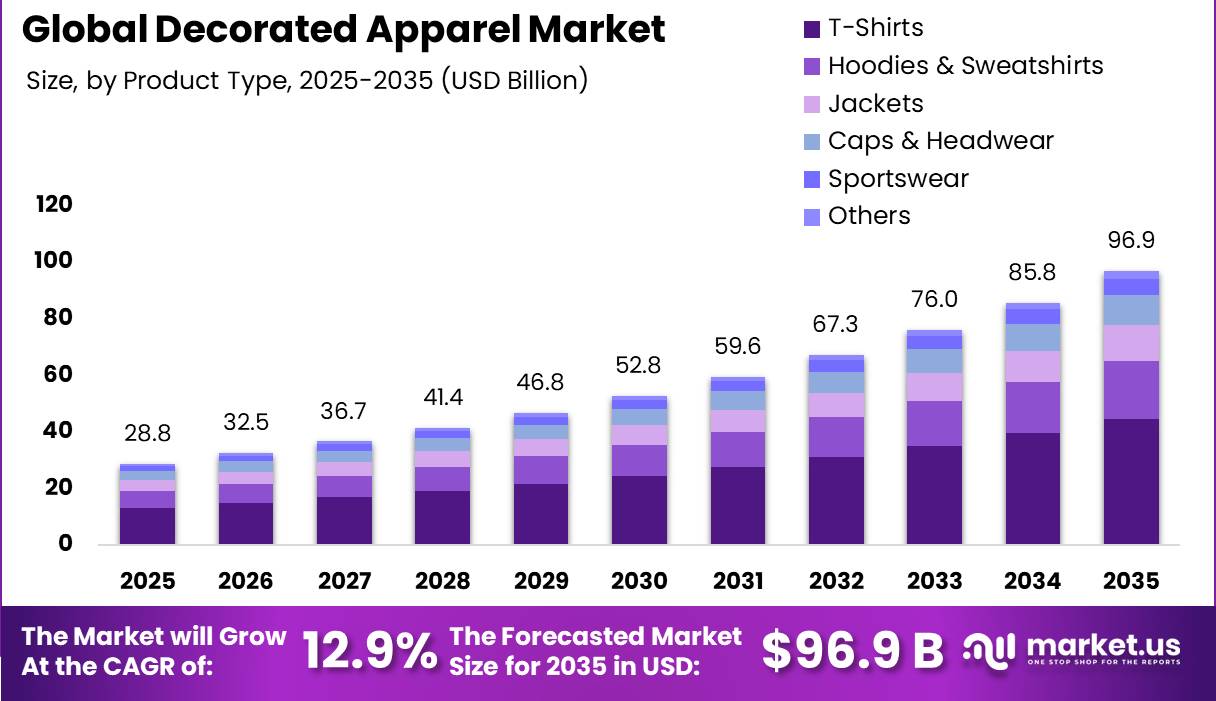
Global Decorated Apparel Market size is expected to be worth around USD 96.9 Billion by 2035 from USD 28.8 Billion in 2025, growing at a CAGR of 12.9% during the forecast period 2026 to 2035. This pace signals strong buyer appetite across corporate, sports, and consumer decoration channels.
Decorated apparel refers to garments enhanced through printing, embroidery, or transfer techniques for branding, promotional, or personal expression purposes. The market spans product types, decoration methods, end users, and distribution channels. Consequently, manufacturers and decorators compete on speed, customization depth, and channel reach to win diverse buyer segments.
Government trade policy and compliance standards increasingly shape sourcing decisions across the decorated apparel supply chain. Decorators adjust production footprints to manage import costs and sustainability requirements. Therefore, companies operating flexible, multi-region manufacturing bases gain an edge over rigid single-region operators facing cost pressure.
As reported by thecannatareport, a survey of 137 apparel decorators found annual sales ranging from under USD 250,000 to over USD 20 Million. This spread shows decorators of every size remain active participants. This signals a fragmented market where equipment efficiency gains matter for competitive survival.
Officially licensed NFL player merchandise generated more than USD 1.9 Billion in retail sales during the 2025 to 2026 reporting period, based on NFLPA data. This figure highlights strong consumer demand for licensed sports apparel. Epson unveiled a new textile and garment decoration printing solution at Impressions Expo 2026 in January 2026, expanding production options for decorators serving this demand.
Key Takeaways
- The Decorated Apparel Market is valued at USD 28.8 Billion in 2025 and is projected to reach USD 96.9 Billion by 2035.
- The market is set to expand at a CAGR of 12.9% between 2026 and 2035.
- T-Shirts dominate the By Product Type segment with a 46.2% share.
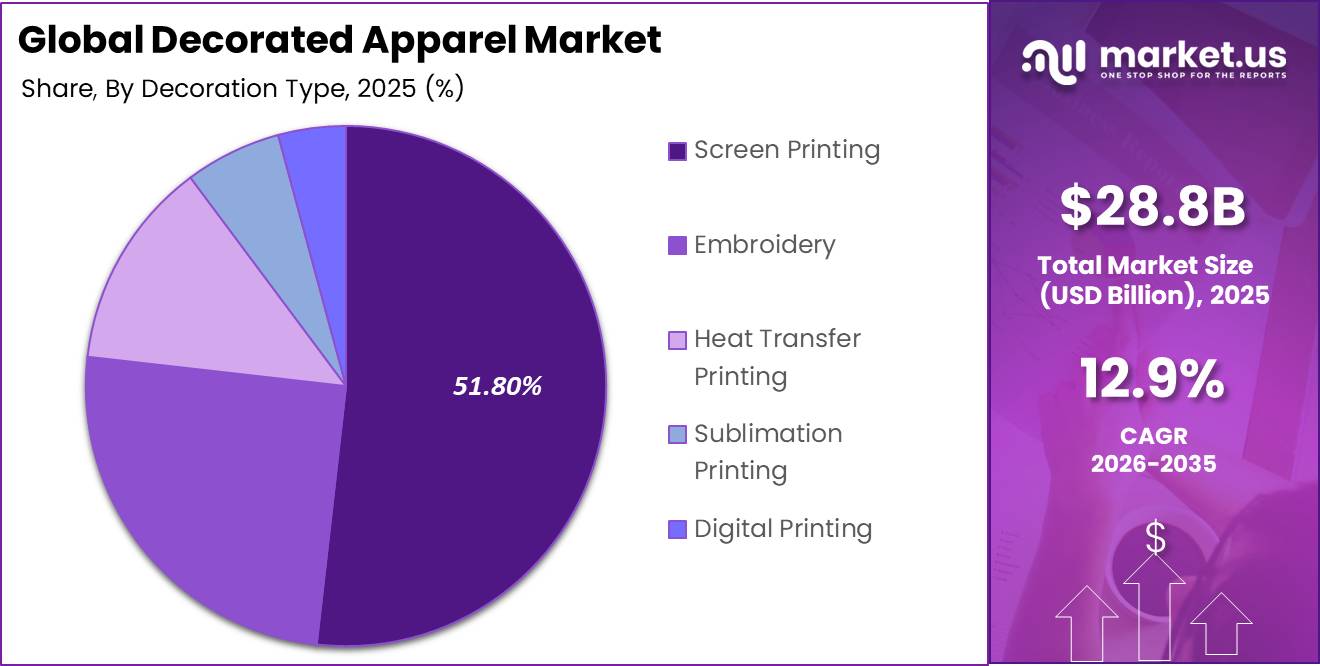
- Screen Printing leads the By Decoration Type segment with a 51.8% share.
- Men dominate the By End User segment with a 52.6% share.
- Promotional Wear leads the By Application segment with a 43.9% share.
- Offline Retail Stores lead the By Distribution Channel segment with a 58.7% share.
- Cotton dominates the By Fabric Type segment with a 44.3% share.
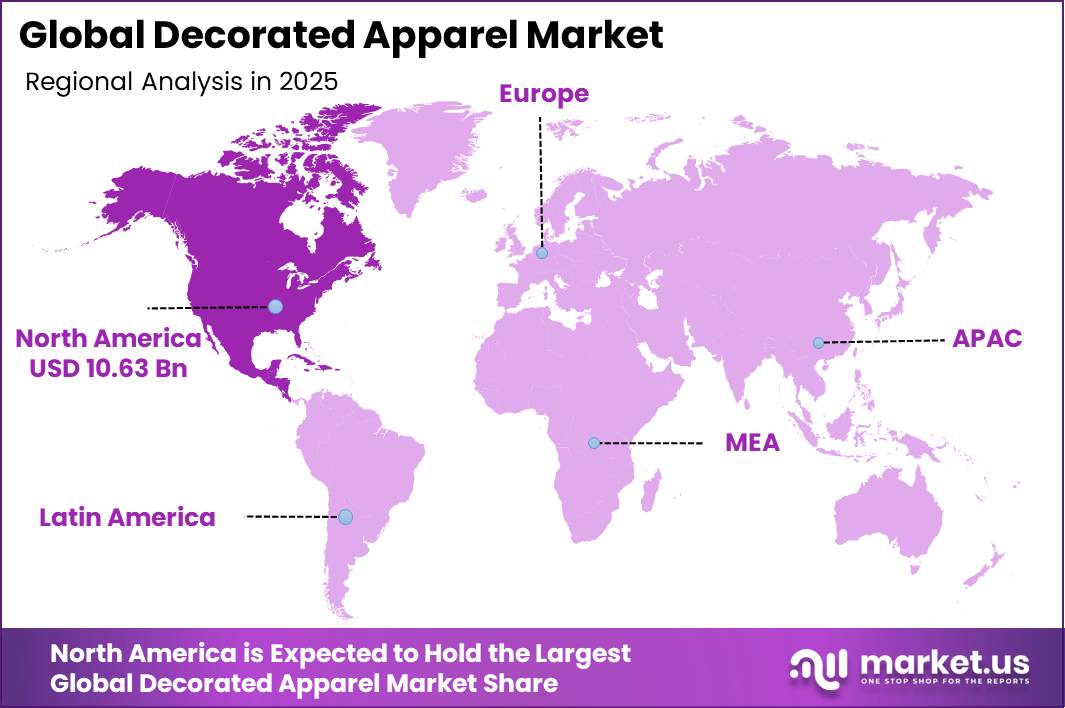
- North America dominates the market with a 36.9% share, valued at USD 10.63 Billion.
Product Type Analysis
T-Shirts dominates with 46.2% due to broad demand across promotional and casual wear.
In 2025, T-Shirts held a dominant market position in the By Product Type segment of Decorated Apparel Market, with a 46.2% share. Brands favor T-Shirts for low production cost and fast decoration turnaround. This makes the category the default entry point for Custom T-Shirt Printing providers. Sportswear ranks as the fastest growing product type, pointing decorators toward athletic-focused investment.
Decoration Type Analysis
Screen Printing dominates with 51.8% due to low per-unit cost at scale.
In 2025, Screen Printing held a dominant market position in the By Decoration Type segment of Decorated Apparel Market, with a 51.8% share. Bulk buyers such as corporate and event organizers rely on this method for cost efficiency. Therefore, decorators who master Screen Printing retain pricing power on large orders. Screen Printing also ranks as the fastest growing decoration type.
End User Analysis
Men dominates with 52.6% due to higher volume purchases in workwear and sportswear.
In 2025, Men held a dominant market position in the By End User segment of Decorated Apparel Market, with a 52.6% share. This group drives volume through corporate uniforms and sports merchandise orders. Consequently, decorators targeting Men’s apparel access steadier repeat order volumes. Men also represent the fastest growing end user group, extending this lead further.
Application Analysis
Promotional Wear dominates with 43.9% due to steady corporate and event branding demand.
In 2025, Promotional Wear held a dominant market position in the By Application segment of Decorated Apparel Market, with a 43.9% share. Businesses order Promotional Wear consistently for branding and event giveaways, supporting Merchandise Designing work across decorators. This reflects a stable, repeat-order revenue base. Fashion & Lifestyle ranks as the fastest growing application, signaling rising personalization demand.
Data from Licensing International shows global licensed merchandise sales reached USD 369.6 Billion in 2024, up from USD 356.5 Billion in 2023. Figures from Licensing International also show sales climbed to USD 389.8 Billion in 2025, up 5.45% year over year. This steady climb signals durable demand for licensed sports and entertainment apparel within this segment.
Distribution Channel Analysis
Offline Retail Stores dominates with 58.7% due to established buyer trust in physical fitting and quality checks.
In 2025, Offline Retail Stores held a dominant market position in the By Distribution Channel segment of Decorated Apparel Market, with a 58.7% share. Buyers still prefer physical stores for bulk corporate and team orders. However, Online Retail through E Commerce Apparel platforms ranks as the fastest growing channel, signaling a gradual shift toward digital-first ordering.
Fabric Type Analysis
Cotton dominates with 44.3% due to comfort and print compatibility across decoration methods.
In 2025, Cotton held a dominant market position in the By Fabric Type segment of Decorated Apparel Market, with a 44.3% share. Cotton remains the default substrate for screen printing and embroidery work. Kornit Digital introduced new AI-powered workflow and production automation capabilities for its digital textile ecosystem in September 2025, aimed at increasing throughput across fabric types. Polyester Blends rank as the fastest growing fabric type.
Key Market Segments
By Product Type
- T-Shirts
- Hoodies & Sweatshirts
- Jackets
- Caps & Headwear
- Sportswear
- Others
By Decoration Type
- Screen Printing
- Embroidery
- Heat Transfer Printing
- Sublimation Printing
- Digital Printing
By End User
- Men
- Women
- Kids
By Application
- Promotional Wear
- Corporate Uniforms
- Sports Teams & Clubs
- Fashion & Lifestyle
By Distribution Channel
- Offline Retail Stores
- Online Retail (E-commerce)
- Direct Sales
By Fabric Type
- Cotton
- Polyester Blends
- Polyester
- Others
Regional Analysis
North America Dominates the Decorated Apparel Market with a Market Share of 36.9%, Valued at USD 10.63 Billion
North America leads the decorated apparel market with a 36.9% share, valued at USD 10.63 Billion. Strong corporate branding culture and dense promotional apparel demand support this position. SanMar announced a strategic partnership with Richardson Sports in October 2025 to distribute Richardson headwear through its network beginning in 2026, expanding decoration-ready offerings across the region.
Europe stands out as the fastest growing region within the decorated apparel market. Rising demand for Luxury Apparels and premium branded merchandise pushes decorators toward higher-margin customization work. This trajectory positions Europe as a priority expansion market for decorators seeking premium-tier corporate and event clients.
Asia-Pacific plays a growing role in the decorated apparel market as digital printing technology adoption extends across regional decorators. Manufacturers in the region benefit from expanding production capacity and DTG or DTF equipment access. This positions Asia-Pacific as a manufacturing and sourcing hub supporting global decorated apparel supply chains.
Latin America contributes to the decorated apparel market through nearshore production capacity that serves North American demand. CAFTA-DR trade access supports duty-free apparel exports from the region. This nearshore advantage strengthens Latin America’s role as a cost-competitive production base for decorators facing tariff pressure.
Middle East and Africa represents an emerging segment within the decorated apparel market. Corporate gifting and promotional merchandise demand extend into GCC markets alongside broader regional apparel consumption. This positioning gives decorators an early-mover opportunity ahead of wider regional demand formalization.
Key Regions and Countries
North America
- US
- Canada
Europe
- Germany
- France
- The UK
- Spain
- Italy
- Rest of Europe
Asia Pacific
- China
- Japan
- South Korea
- India
- Australia
- Rest of APAC
Latin America
- Brazil
- Mexico
- Rest of Latin America
Middle East and Africa
- GCC
- South Africa
- Rest of MEA
Drivers
Digital printing technology adoption pushes the decorated apparel market forward as DTG and DTF systems replace analog decoration methods. Equipment costs fell sharply between 2020 and 2024, lowering entry barriers for small decorators. This shift compresses minimum order quantities and unlocks single-unit fulfillment for buyers and sellers alike.
DTF systems now support nearly all substrate types, removing the cotton-only limitation that constrained DTG. The digital textile printing segment reached USD 4.5 Billion in 2025, growing at a 9.32% CAGR. Decorators cut per-unit cost by up to 35% on short production runs, giving investors added confidence in the category.
| Driver | (~) % Impact on CAGR Forecast | Geographic Relevance | Impact Timeline |
|---|---|---|---|
| Digital Printing Technology Adoption (DTG & DTF) | +3.2% | North America, Western Europe, Asia-Pacific | Short term (≤ 2 years) |
| Personalization & Mass-Customization Consumer Demand | +2.8% | Global, led by North America & Europe | Short term (≤ 2 years) |
| E-Commerce & Print-on-Demand Platform Expansion | +2.4% | Global, especially South & Southeast Asia | Short term (≤ 2 years) |
| Athleisure & Sportswear Adoption Driving Decoration Volume | +2.0% | North America, India, GCC, Latin America | Medium term (2–4 years) |
| Corporate Gifting & Promotional Merchandise Demand | +1.5% | North America, Europe, India, GCC | Short term (≤ 2 years) |
| AI-Assisted Design Workflow Automation | +1.0% | Global, accelerating in digitally mature markets | Medium term (2–4 years) |
Restraints
Rising United States import tariffs slow decorated apparel market activity as duty rates on apparel imports nearly doubled through 2025. China-origin blank garments face tariff exposure above 50%, pushing import volumes down sharply. Decorators absorb higher landed costs, compressing margins on budget-tier decorated products for sellers and buyers.
Nearshore alternatives from Mexico and Central America remain costlier than pre-tariff China pricing despite duty-free access. Market participants face a structural cost squeeze of 8 to 14 percentage points on blank garment margins. This pressure forces decorators to renegotiate supplier contracts or pass costs to buyers.
| Restraint | (~) % Impact on CAGR Forecast | Geographic Relevance | Impact Timeline |
|---|---|---|---|
| U.S. Import Tariff Escalation on Apparel & Substrate Inputs | -2.5% | United States, cascading to global sourcing networks | Short term (≤ 2 years) |
| EU Ecodesign & Extended Producer Responsibility (EPR) Compliance Cost | -1.6% | European Union, UK, Germany | Medium term (2–4 years) |
| Ink & Chemical Input Cost Inflation (Plastisol, Reactive, Discharge Inks) | -1.2% | Global, most acute in North America & South Asia | Short term (≤ 2 years) |
| High Capital Intensity of Industrial-Scale Digital Equipment | -0.9% | Emerging markets, SME-dominated sectors in South & Southeast Asia | Medium term (2–4 years) |
| Volatile Blank Garment Pricing from Cotton & Polyester Feedstock Swings | -0.8% | Global | Short term (≤ 2 years) |
Challenges
A skilled decorator talent shortage limits production throughput across the decorated apparel market. Screen printing, embroidery, and DTF pre-press roles require up to 36 months of training, restricting rapid workforce scaling. Understaffed operations run at reduced capacity, creating new revenue streams for training providers and automation vendors.
Fewer than 200 accredited garment decoration programs exist in the United States, limiting new talent supply. Quality reject rates climb sharply when undertrained staff operate complex equipment. This gap opens an opportunity for AI-assisted pre-press tools that lower the skill floor required per decoration method.
| Challenge | (~) % CAGR Friction Drag | Geographic Relevance | Mitigation Horizon |
|---|---|---|---|
| Skilled Decorator Talent Deficit | -1.8% | North America, Western Europe, India | Long term (≥ 4 years) |
| Apparel Supply Chain Concentration Risk | -1.4% | Global, most acute in U.S. & EU import-dependent operators | Medium term (2–4 years) |
| Color Consistency Across Multi-Method Decoration | -0.9% | Global, especially premium/corporate apparel segments | Medium term (2–4 years) |
| Greenwashing Regulatory Scrutiny | -0.8% | EU, UK, Canada, U.S. state-level | Short term (≤ 2 years) |
| Equipment Maintenance & Downtime Friction | -0.7% | Global SME decorators | Short term (≤ 2 years) |
Opportunities
Nearshore and domestic blank-to-finished vertical integration offers early movers a durable cost advantage. Tariff restructuring narrowed the cost gap between China-origin and nearshore blank garments to near parity. Decorators who build Blank Apparel production capability capture the market ahead of competitors dependent on tariffed import sourcing.
India’s decorated apparel market was valued at approximately USD 1,850.7 Million in 2023 and is projected to reach USD 5,194.5 Million by 2030. Decorators building this capability can capture an incremental 18 to 28% gross margin. Early entrants gain insulation from ongoing input cost volatility.
| Opportunity | (~) % Potential CAGR Upside | Geographic Relevance | Execution Window |
|---|---|---|---|
| Nearshore & Domestic Blank-to-Finished Vertical Integration | +2.2% | United States, Mexico, Central America, India | Medium term (2–4 years) |
| B2B Digital Storefront & Web-to-Print SaaS Platforms | +1.9% | North America, Europe, India, GCC | Short term (≤ 2 years) |
| Sustainable & Certified Decoration (Waterless, OEKO-TEX, GOTS) | +1.5% | EU, UK, North America, premium Asia-Pacific | Medium term (2–4 years) |
| Emerging Market Formalization (India, Southeast Asia, GCC) | +1.8% | India, Vietnam, Indonesia, GCC (Saudi Arabia, UAE) | Medium term (2–4 years) |
| M&A Roll-Up of Regional Decorator Networks | +1.1% | North America, Europe | Long term (≥ 4 years) |
Key Company Insights
Printful operates as a leading print-on-demand platform linking independent designers with fulfillment infrastructure. Its model removes inventory risk for small creators entering the decorated apparel space. Brother International showcased new DTG and DTF printing technologies at Impressions Expo Long Beach 2026 in February 2026, giving platforms like Printful access to faster production equipment options.
Custom Ink built its position through direct group ordering for schools, teams, and small businesses. As reported by Licensing International, its 2025 study analyzed data from 935 companies across 56 countries. Licensing International indicates that new properties accounted for 20% of Entertainment and Characters licensing revenue in 2024, a trend Custom Ink can tap through fresh licensed designs.
Key Players
- Printful
- Custom Ink
- Vistaprint
- Teespring
- Spreadshirt
- Zazzle
- CafePress
- Printify
- RushOrderTees
- Stitch Fix
- Threadless
- Cotton On Custom
- Nike By You
- Adidas Custom
- Decathlon Custom Services
Recent Developments
- May 2026 – SanMar entered into a definitive agreement to acquire BELLA+CANVAS, a leading premium blank apparel manufacturer, strengthening its position in the imprintable and decorated apparel supply chain.
- June 2026 – Crystal DTF launched its Summer 2026 Ready to Press Design Collection, expanding its portfolio of DTF transfer products for apparel decorators and custom garment businesses.
- January 2025 – STAHLS’ launched Fulfill Engine, a software platform designed to automate print on demand order routing, production management, and fulfillment processes for apparel decorators.
- April 2025 – Roland DGA introduced the VersaSTUDIO BY-20 DTF transfer printer package, expanding its product lineup for apparel decorators entering the direct to film printing market.
Report Scope
| Report Features | Description |
|---|---|
| Market Value (2025) | USD 28.8 Billion |
| Forecast Revenue (2035) | USD 96.9 Billion |
| CAGR (2026-2035) | 12.9% |
| Base Year for Estimation | 2025 |
| Historic Period | 2020-2024 |
| Forecast Period | 2026-2035 |
| Report Coverage | Revenue Forecast, Market Dynamics, Market Opportunity Analysis, Technology and Innovation Landscape, Competitive Landscape, Recent Developments |
| Segments Covered | By Product Type (T-Shirts, Hoodies & Sweatshirts, Jackets, Caps & Headwear, Sportswear, Others), By Decoration Type (Screen Printing, Embroidery, Heat Transfer Printing, Sublimation Printing, Digital Printing), By End User (Men, Women, Kids), By Application (Promotional Wear, Corporate Uniforms, Sports Teams & Clubs, Fashion & Lifestyle), By Distribution Channel (Offline Retail Stores, Online Retail (E-commerce), Direct Sales), By Fabric Type (Cotton, Polyester Blends, Polyester, Others) |
| Regional Analysis | North America (US and Canada), Europe (Germany, France, The UK, Spain, Italy, and Rest of Europe), Asia Pacific (China, Japan, South Korea, India, Australia, and Rest of APAC), Latin America (Brazil, Mexico, and Rest of Latin America), Middle East and Africa (GCC, South Africa, and Rest of MEA) |
| Competitive Landscape | Printful, Custom Ink, Vistaprint, Teespring, Spreadshirt, Zazzle, CafePress, Printify, RushOrderTees, Stitch Fix, Threadless, Cotton On Custom, Nike By You, Adidas Custom, Decathlon Custom Services |
| Customization Scope | Customization for segments, region/country-level will be provided. Additional customization can be done based on requirements. |
| Purchase Options | We have three licenses to opt for: Single User License, Multi-User License (Up to 5 Users), Corporate Use License (Unlimited User and Printable PDF) |





































