


Report Overview
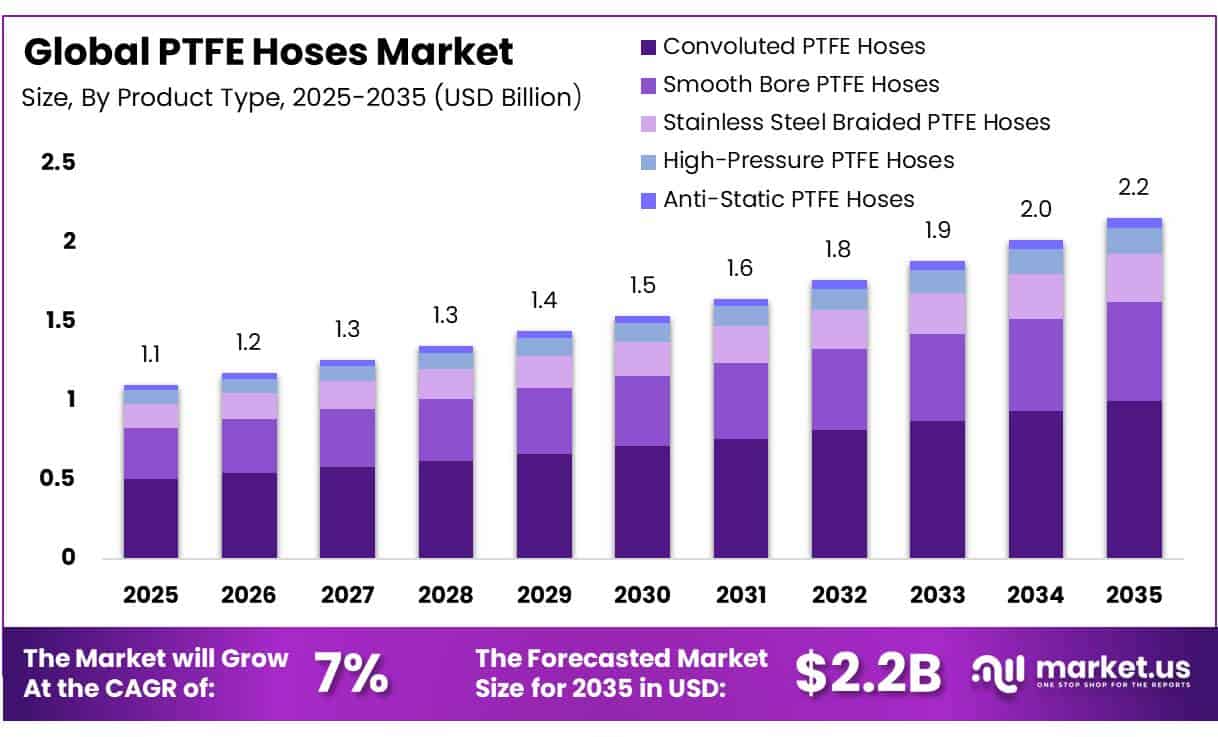
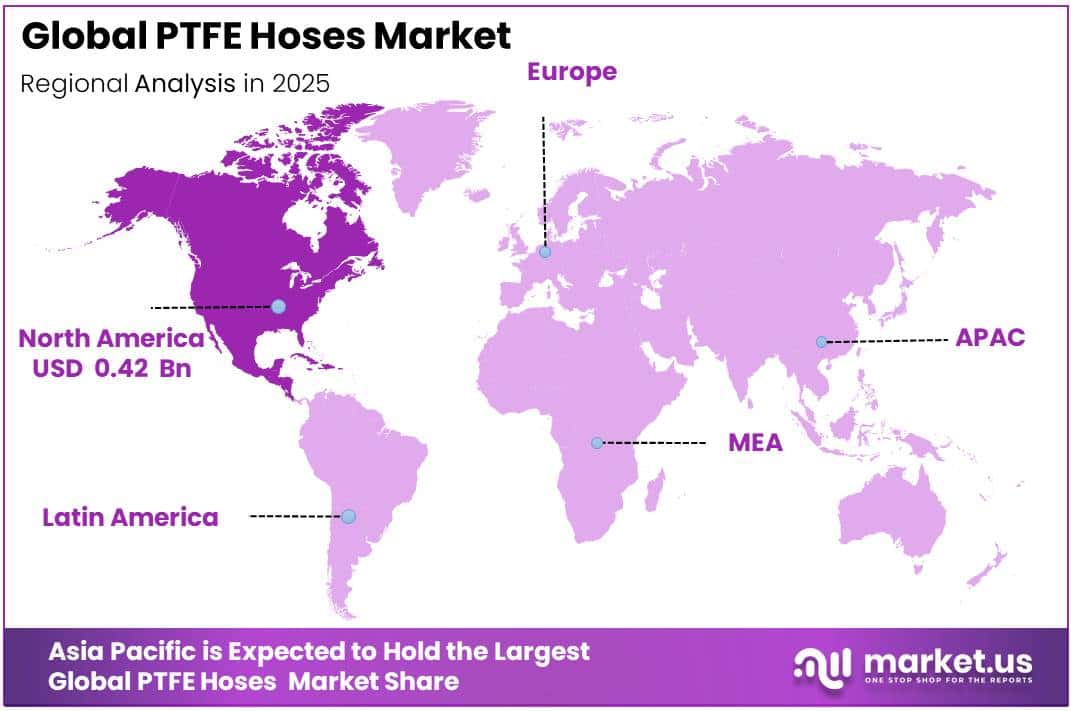
In 2025, the PTFE Hoses Market was valued at USD 1.1 Billion, and between 2026 and 2035, this market is estimated to register a CAGR of 7.0%, reaching about USD 2.2 Billion by 2035. North America held a dominant market position, capturing more than a 37.90% share, holding USD 0.42 Billion in revenue.
Polytetrafluoroethylene (PTFE) hoses are flexible tubular assemblies made from PTFE, a fluoropolymer valued for chemical inertness, a wide temperature range, low friction, and resistance to corrosive media. These hoses transfer aggressive chemicals, high purity gases, and high temperature fluids across chemical processing, semiconductor, pharmaceutical, aerospace, and automotive industries.
Demand for PTFE hoses is tied to capital investment in end use manufacturing sectors. Semiconductor Equipment and Materials International (SEMI), a global trade association, reported worldwide semiconductor manufacturing equipment billings reached 135.1 billion United States dollars (USD) in 2025, up 15% from 117.1 billion USD in 2024, reflecting expanding wafer fabrication capacity requiring ultra-pure chemical delivery systems, a core PTFE hose application. Chemical and pharmaceutical manufacturers also depend on these hoses for corrosive fluid transfer.
Key Takeaways
- The PTFE Hoses Market was valued at US$1.1 billion in 2025.
- The global market is projected to grow at a CAGR of 7.0% and is estimated to reach US$2.2 billion by 2035.
- On the basis of product type, Convoluted PTFE Hoses dominated the market, constituting 46.3% of the total market share.
- Based on the application, Chemical Transfer dominated the market, accounting for 34.8% of the total market share.
- Based on the end user, Chemical Industry dominated the market, accounting for 38.6% of the total market share.
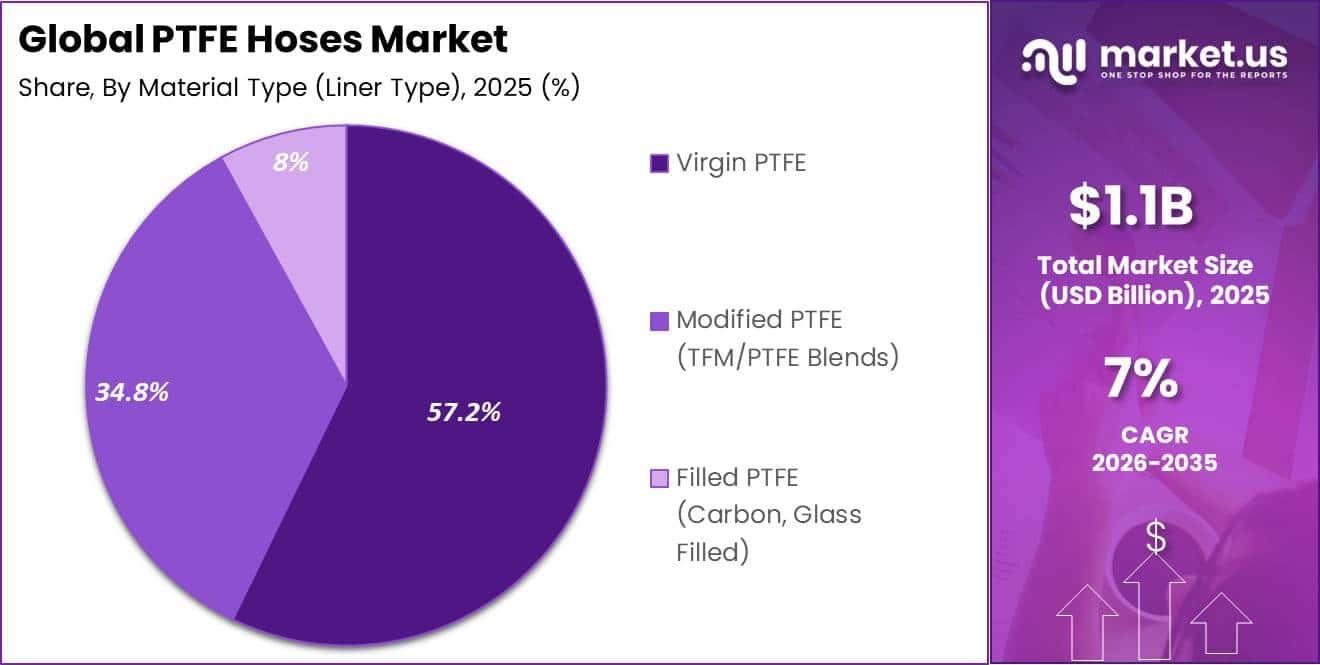
- Based on the material type (liner type), Virgin PTFE dominated the market, accounting for 57.2% of the total market share.
- Based on the pressure rating, Low Pressure PTFE Hoses dominated the market, accounting for 41.1% of the total market share.
- Based on the temperature range, Standard Temperature PTFE Hoses dominated the market, accounting for 49.4% of the total market share.
- Based on the distribution channel, Direct Sales (OEM & Industrial Contracts) dominated the market, accounting for 66.8% of the total market share.
- Based on the reinforcement type, Stainless Steel Braided dominated the market, accounting for 61.5% of the total market share.
- In 2025, North America was the most dominant region in the PTFE hoses market, accounting for 37.9% of the global market.
Growth opportunities stem from expanding aerospace, automotive, and electronics manufacturing, alongside rising installation of corrosion resistant piping in plants handling acids and solvents. Continued expansion of semiconductor fabrication investment, per SEMI’s billing figures, widens the addressable base for PTFE hose applications. Growing emphasis on leak prevention and worker safety encourages replacement of aging hoses with PTFE alternatives.
Regulatory developments are reshaping the fluoropolymer supply chain. The European Chemicals Agency (ECHA) received a proposal on 13 January 2023 to restrict per- and polyfluoroalkyl substances (PFAS) under the Registration, Evaluation, Authorisation and Restriction of Chemicals (REACH) regulation, estimating 4.5 million tonnes of PFAS could reach the environment over 30 years without intervention. The United States Environmental Protection Agency (EPA) finalized its PFAS Drinking Water Regulation on 10 April 2024, setting a limit of 4.0 parts per trillion for two PFAS compounds. The United States International Trade Commission sets a 5.8% duty on PTFE imports.
By Product Type
Convoluted PTFE Hoses dominates with 46.3% due to its flexibility and suitability for complex industrial routing.
In 2025, Convoluted PTFE Hoses held a dominant market position, capturing more than a 46.3% share. The segment maintained its leading position because of its ability to handle demanding industrial applications that require high flexibility and resistance to aggressive chemicals. Its corrugated design allows easier installation in confined spaces and around complex equipment layouts, making it a preferred choice across chemical processing, pharmaceutical manufacturing, industrial machinery, and fluid handling systems.
The material also performs reliably under elevated temperatures and challenging operating conditions, supporting its widespread industrial adoption. In 2025, continued investment in manufacturing facilities and process industries encouraged steady demand for durable hose solutions that reduce maintenance requirements and improve operational reliability. The combination of chemical resistance, long service life, and ease of installation helped this segment retain its dominant share throughout the year.
Smooth Bore PTFE Hoses emerged as the fastest-growing segment in 2025, supported by increasing demand for applications requiring smooth fluid transfer, low friction, and high cleanliness standards. Industries such as pharmaceuticals, food processing, semiconductor manufacturing, and precision chemical handling increasingly preferred smooth bore designs because they enable efficient flow while minimizing product retention and contamination risks.
By Application
Chemical Transfer dominates with 34.80% due to its extensive use in handling aggressive and corrosive fluids.
In 2025, Chemical Transfer held a dominant market position, capturing more than a 34.80% share. The segment secured its leading position because PTFE hoses are widely used for safely transporting corrosive chemicals, solvents, acids, and other hazardous fluids across industrial processing facilities. Their strong chemical resistance, low reactivity, and ability to operate under demanding temperatures make them suitable for continuous production environments where safety and reliability are essential.
Manufacturing plants and processing facilities continued to rely on PTFE hose systems to reduce the risk of contamination and equipment damage while supporting efficient fluid movement. In 2025, the continued focus on industrial safety, regulatory compliance, and reliable chemical handling practices helped maintain strong demand for PTFE hoses in chemical transfer applications, allowing the segment to retain its dominant share.
Oil & Gas emerged as the fastest-growing segment in 2025, supported by rising demand for hose systems capable of operating under high pressure and harsh environmental conditions. PTFE hoses are increasingly used for hydraulic systems, chemical injection, instrumentation, lubrication circuits, and specialty fluid transfer across upstream, midstream, and downstream operations.
By End User
Chemical Industry dominates with 38.60% due to its continuous need for safe and reliable chemical fluid handling.
In 2025, Chemical Industry held a dominant market position, capturing more than a 38.60% share. The segment remained the leading end user because chemical manufacturing facilities depend on PTFE hoses for the safe transfer of corrosive liquids, solvents, acids, and specialty chemicals throughout production processes. PTFE hoses are valued for their excellent chemical resistance, low contamination risk, and reliable performance under demanding operating conditions, making them suitable for continuous industrial use.
Their ability to maintain fluid purity while reducing maintenance requirements supported their broad adoption across chemical processing plants. In 2025, the ongoing expansion of industrial production, combined with strict workplace safety and process reliability requirements, helped sustain demand from the chemical industry, allowing this segment to maintain its dominant market position.
Oil & Gas Companies represented the fastest-growing end-user segment in 2025, driven by increasing demand for durable hose systems capable of handling fuels, hydraulic fluids, and process chemicals in challenging operating environments. PTFE hoses are being adopted across exploration, production, refining, and maintenance activities because they offer strong resistance to pressure, temperature changes, and chemical exposure. Their long service life and dependable performance make them suitable for critical operations where equipment reliability is essential. In 2026, continued development of energy infrastructure and modernization of industrial facilities are expected to support further growth in this end-user segment.
By Material Type
Virgin PTFE dominates with 57.2% due to its excellent chemical resistance and high material purity.
In 2025, Virgin PTFE held a dominant market position, capturing more than a 57.2% share. The segment secured its leading position because virgin PTFE provides outstanding resistance to corrosive chemicals, excellent thermal stability, and a non-reactive surface that supports reliable fluid transfer across critical industrial processes. It is widely preferred in chemical processing, pharmaceutical manufacturing, food production, and other applications where product purity and contamination control are essential.
Its consistent mechanical properties and long operational life make it suitable for demanding environments that require dependable hose performance. In 2025, industries continued to prioritize high-quality liner materials that improve operational safety, reduce maintenance needs, and ensure stable performance, helping virgin PTFE maintain its dominant position in the market.
Modified PTFE (TFM/PTFE Blends) emerged as the fastest-growing segment in 2025, driven by increasing demand for advanced liner materials that offer enhanced mechanical strength, smoother internal surfaces, and improved sealing performance. These materials are gaining wider acceptance in precision industrial applications where durability and process efficiency are becoming more important.
By Pressure Rating
Low Pressure PTFE Hoses dominate with 41.10% due to their wide use in routine industrial fluid transfer applications.
In 2025, Low Pressure PTFE Hoses held a dominant market position, capturing more than a 41.10% share. The segment led the market because these hoses are widely used in industrial processes where reliable chemical transfer is required without the need for high-pressure performance. They are commonly selected for handling acids, solvents, water, and other process fluids in manufacturing facilities due to their excellent chemical resistance, lightweight construction, and ease of installation.
Medium Pressure PTFE Hoses emerged as the fastest-growing segment in 2025, driven by increasing demand from industries requiring higher operating pressure while maintaining chemical resistance and long-term durability. These hoses are being adopted in industrial machinery, hydraulic systems, processing equipment, and automated production lines where moderate pressure performance is essential.
By Temperature Range
Standard Temperature PTFE Hoses dominate with 49.40% due to their broad suitability for everyday industrial operations.
In 2025, Standard Temperature PTFE Hoses held a dominant market position, capturing more than a 49.40% share. The segment remained the market leader because it meets the operating requirements of a wide range of industrial applications without the need for specialized temperature-resistant solutions. These hoses are extensively used for transferring chemicals, process fluids, and other industrial materials in manufacturing facilities where standard operating temperatures are maintained.
Their reliable chemical resistance, long service life, and compatibility with common industrial systems make them a practical choice across the chemical, pharmaceutical, food processing, and general manufacturing sectors. In 2025, steady industrial production and continued demand for dependable fluid handling solutions helped this segment maintain its dominant position in the market.
High Temperature PTFE Hoses emerged as the fastest-growing segment in 2025, supported by rising demand from industries operating under elevated thermal conditions. Applications involving heated chemicals, steam, hot fluids, and high-temperature processing equipment increasingly require hose systems that can maintain performance without compromising safety or durability.
By Distribution Channel
Direct Sales (OEM & Industrial Contracts) dominate with 66.80% due to strong long-term industrial procurement and customized supply agreements.
In 2025, Direct Sales (OEM & Industrial Contracts) held a dominant market position, capturing more than a 66.80% share. The segment led the market because large industrial buyers and original equipment manufacturers typically procure PTFE hoses directly from manufacturers to ensure consistent product quality, technical support, and compliance with application-specific requirements. Direct purchasing also allows customized hose configurations, better production planning, and dependable delivery schedules for critical industrial operations.
Distributors & Industrial Suppliers emerged as the fastest-growing segment in 2025, supported by increasing demand from small and medium-sized businesses that require quicker access to PTFE hose products without entering long-term supply contracts. Industrial distributors provide a broad product range, local inventory availability, and technical assistance, making them a practical choice for maintenance, repair, and replacement requirements.
By Reinforcement Type
Stainless Steel Braided dominates with 61.50% due to its superior strength and dependable performance in demanding industrial environments.
In 2025, Stainless Steel Braided held a dominant market position, capturing more than a 61.50% share. The segment maintained its leadership because stainless steel braiding provides added mechanical strength, improved pressure handling capability, and greater protection against external damage. It is widely used in industries where PTFE hoses are exposed to demanding operating conditions, including chemical processing, oil and gas, pharmaceuticals, and industrial manufacturing.
The reinforcement helps extend hose service life while maintaining flexibility and reliable performance during continuous operation. In 2025, growing industrial demand for durable fluid transfer systems and equipment designed for long-term use supported the continued preference for stainless steel braided PTFE hoses, allowing the segment to retain its dominant market position.
Fiber Reinforced PTFE Hoses emerged as the fastest-growing segment in 2025, driven by increasing demand for lightweight and flexible hose solutions across a range of industrial applications. These hoses are gaining acceptance where lower weight, easier installation, and adequate pressure performance are important for improving operational efficiency.
Key Market Segments
Product Type
- Convoluted PTFE Hoses
- Smooth Bore PTFE Hoses
- Stainless Steel Braided PTFE Hoses
- High-Pressure PTFE Hoses
- Anti-Static PTFE Hoses
Application
- Chemical Transfer
- Oil & Gas
- Pharmaceuticals
- Food & Beverage
- Automotive
- Aerospace & Defense
- Industrial Manufacturing
End User
- Chemical Industry
- Oil & Gas Companies
- Pharmaceutical Manufacturers
- Food Processing Companies
- Automotive OEMs
- Aerospace & Defense Organizations
Material Type
- Virgin PTFE
- Modified PTFE (TFM/PTFE Blends)
- Filled PTFE (Carbon, Glass Filled)
Pressure Rating
- Low Pressure PTFE Hoses
- Medium Pressure PTFE Hoses
- High Pressure PTFE Hoses
Temperature Range
- Standard Temperature PTFE Hoses
- High Temperature PTFE Hoses
- Extreme Temperature PTFE Hoses
Distribution Channel
- Direct Sales (OEM & Industrial Contracts)
- Distributors & Industrial Suppliers
- Online Industrial Platforms
Reinforcement Type
- Stainless Steel Braided
- Fiber Reinforced PTFE Hoses
- Rubber Jacketed PTFE Hoses
Geopolitical Impact Analysis
Geopolitical Tensions and Trade Disruptions Reshape the PTFE Hoses Market.
The PTFE hoses market is experiencing continued pressure from the Russia-Ukraine conflict and the ongoing Middle East crisis, particularly around the Strait of Hormuz. PTFE hoses depend on fluoropolymer resins, stainless steel braiding, fittings, and industrial chemicals that move through global shipping networks. Disruptions to energy trade have increased manufacturing and freight costs for industrial components.
- According to the International Energy Agency (IEA), around 20 million barrels per day of crude oil and oil products moved through the Strait of Hormuz in 2025, representing about 25% of global seaborne oil trade, while around 19% of global LNG trade also passed through the route. These disruptions have increased uncertainty for manufacturers that rely on stable raw material supplies.
In 2025 and continuing into 2026, PTFE hose manufacturers responded by diversifying suppliers, increasing regional inventories, and shifting procurement toward local production where possible. Longer shipping routes and higher transport costs have encouraged companies to strengthen supply chain resilience instead of depending on single-source imports. Industrial customers in the chemical, pharmaceutical, food processing, and energy sectors have also placed greater emphasis on reliable delivery schedules to avoid production interruptions.
Regional Analysis
Regional Analysis: North America.
North America represents the dominant region in the global PTFE hoses market, holding a 37.90% share valued at 0.42 billion United States dollars (USD), reflecting the region’s mature chemical processing, semiconductor, and pharmaceutical manufacturing base that relies heavily on corrosion resistant fluid handling equipment.
- According to the U.S. Census Bureau, Chemical Manufacturing value of shipments in the United States rose 22.4%, increasing from approximately 735.9 billion USD to 901.0 billion USD, driven by expanded industrial production within the pharmaceutical and medicine manufacturing segment, which depends on PTFE lined hoses for sterile and corrosive fluid transfer. The region’s semiconductor base also shapes demand.
Semiconductor Equipment and Materials International (SEMI), the global electronics manufacturing trade association, reported that North American semiconductor equipment billings declined 20% to 10.9 billion USD in 2025 amid moderating capacity expansion, a segment that remains a notable consumer of PTFE hoses for ultra-pure chemical delivery. Continued investment in chemical plant modernization, along with safety requirements enforced by federal regulatory bodies, sustains replacement and retrofit demand for PTFE hoses across the United States and Canada.
Production worker hours within pharmaceutical manufacturing rose from 270.1 million to 341.6 million between 2017 and 2022, per the U.S. Census Bureau, while employment of chemists and material scientists in chemical manufacturing grew approximately 24.8% over the same period, indicating expanding technical capacity at facilities using PTFE hoses. Supported by established manufacturing infrastructure, stringent regulatory compliance standards, and continuous capital deployment across chemical, semiconductor, and pharmaceutical processing facilities, North America is expected to retain its leading position in the global PTFE hoses market over the coming years.
Key Regions and Countries
- North America
- The US
- Canada
- Europe
- Germany
- France
- The UK
- Spain
- Italy
- Russia & CIS
- Rest of Europe
- APAC
- China
- Japan
- South Korea
- India
- ASEAN
- Rest of APAC
- Latin America
- Brazil
- Mexico
- Rest of Latin America
- Middle East & Africa
- GCC
- South Africa
- Rest of MEA
Key Players Analysis
Leading PTFE hose manufacturers focus on strengthening product performance, engineering capabilities, and manufacturing efficiency to remain competitive in industrial fluid handling applications. A major priority is continuous material innovation, including improvements in PTFE liner quality, anti-static designs, high-pressure hose assemblies, and reinforced constructions that enhance chemical resistance, flexibility, and operational reliability.
Companies continue investing in precision extrusion, automated braiding, advanced testing systems, and quality assurance processes to deliver consistent products for chemical processing, pharmaceuticals, food manufacturing, oil and gas, automotive, and aerospace industries. Many manufacturers also expand their portfolio of custom hose assemblies and engineered connection solutions to meet specific customer requirements while complying with strict industrial safety and performance standards.
Manufacturers including Parker Hannifin Corporation, Trelleborg AB, Eaton Corporation, Saint-Gobain Performance Plastics, Danfoss A/S, Aflex Hose Limited, Aflex Hose Group (Watson-Marlow), Swagelok Company, Gates Corporation, United Flexible, NORRES Group, Kuriyama of America, Manuli Hydraulics, Polyhose India Pvt. Ltd., and Crane Co. are expanding production capabilities, strengthening regional distribution networks, and improving supply chain resilience to support growing industrial demand. Companies are increasingly integrating hose manufacturing, reinforcement technologies, fittings, and assembly operations to improve delivery speed and product consistency.
The Major players in the industry
- Parker Hannifin Corporation
- Trelleborg AB
- Eaton Corporation
- Saint-Gobain Performance Plastics
- Danfoss A/S
- Aflex Hose Limited
- Aflex Hose Group (Watson-Marlow)
- Swagelok Company
- Gates Corporation
- United Flexible
- NORRES Group
- Kuriyama of America
- Manuli Hydraulics
- Polyhose India Pvt. Ltd.
- Crane Co.
Key Development
- In January 2026, Parker Hannifin Corporation reported its fiscal 2026 second quarter results (quarter ended December 31, 2025), with sales increasing 9% to a record 2 billion United States dollars (USD), driven by robust aerospace demand and a gradual recovery across industrial markets that include the company’s fluid conveyance hose and tubing business.
- In January 2026, Crane Company announced its fourth quarter 2025 financial results and initiated full year 2026 adjusted earnings per share guidance, reporting fourth quarter sales growth of 8%, including 5.4% core sales growth, with its Process Flow Technologies segment, which supplies engineered fluid handling equipment, contributing to record full year sales and operating profit.
- In February 2026, Eaton Corporation plc reported record fourth quarter 2025 results, with sales reaching a record 1 billion USD, up 13% from the fourth quarter of 2024, and issued full year 2026 guidance projecting further growth across its industrial and fluid power related businesses.
- In May 2026, The U.S. Environmental Protection Agency (EPA) advanced its comprehensive per- and polyfluoroalkyl substances (PFAS) strategy, announcing nearly 1 billion USD in new funding to states to address PFAS in drinking water and issuing two proposed rules addressing PFAS National Primary Drinking Water Regulation implementation, a regulatory development relevant to fluoropolymer based products including PTFE hoses.
Report Scope
| Report Features | Description |
|---|---|
| Market Value (2025) | US$1.1 Bn |
| Forecast Revenue (2035) | US$2.2 Bn |
| CAGR (2026 2035) | 7.0% |
| Base Year for Estimation | 2025 |
| Historic Period | 2020-2024 |
| Forecast Period | 2026-2035 |
| Report Coverage | Revenue Forecast, Market Dynamics, Competitive Landscape, Recent Developments |
| Segments Covered | By Product Type (Convoluted PTFE Hoses, Smooth Bore PTFE Hoses, Stainless Steel Braided PTFE Hoses, High-Pressure PTFE Hoses, Anti-Static PTFE Hoses), By Application (Chemical Transfer, Oil & Gas, Pharmaceuticals, Food & Beverage, Automotive, Aerospace & Defense, Industrial Manufacturing), By End User (Chemical Industry, Oil & Gas Companies, Pharmaceutical Manufacturers, Food Processing Companies, Automotive OEMs, Aerospace & Defense Organizations), By Material Type (Liner Type) (Virgin PTFE, Modified PTFE (TFM/PTFE Blends), Filled PTFE (Carbon, Glass Filled)), By Pressure Rating (Low Pressure PTFE Hoses, Medium Pressure PTFE Hoses, High Pressure PTFE Hoses), By Temperature Range (Standard Temperature PTFE Hoses, High Temperature PTFE Hoses, Extreme Temperature PTFE Hoses), By Distribution Channel (Direct Sales (OEM & Industrial Contracts), Distributors & Industrial Suppliers, Online Industrial Platforms), By Reinforcement Type (Stainless Steel Braided, Fiber Reinforced PTFE Hoses, Rubber Jacketed PTFE Hoses) |
| Regional Analysis | North America The US & Canada; Europe Germany, France, The UK, Spain, Italy, Russia & CIS, Rest of Europe; APAC China, Japan, South Korea, India, ASEAN & Rest of APAC; Latin America Brazil, Mexico & Rest of Latin America; Middle East & Africa GCC, South Africa, & Rest of MEA |
| Competitive Landscape | Parker Hannifin Corporation, Trelleborg AB, Eaton Corporation, Saint-Gobain Performance Plastics, Danfoss A/S, Aflex Hose Limited, Aflex Hose Group (Watson-Marlow), Swagelok Company, Gates Corporation, United Flexible, NORRES Group, Kuriyama of America, Manuli Hydraulics, Polyhose India Pvt. Ltd., and Crane Co. |
| Customization Scope | Customization for segments, region/country level will be provided. Moreover, additional customization can be done based on the requirements. |
| Purchase Options | We have three licenses to opt for: Single User License, Multi User License (Up to 5 Users), Corporate Use License (Unlimited Users and Printable PDF) |





































