



Overview
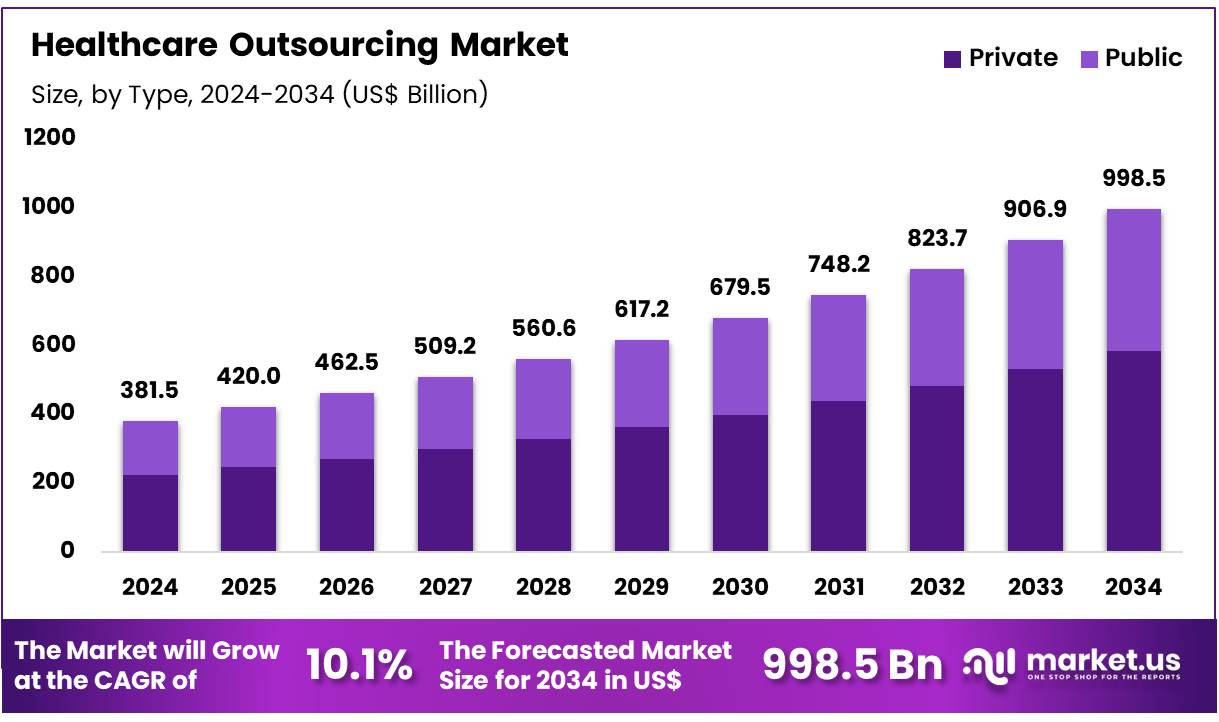
Global Healthcare Outsourcing Market size is expected to be worth around US$ 998.5 Billion by 2034 from US$ 381.5 Billion in 2024, growing at a CAGR of 10.1% during the forecast period 2025 to 2034. In 2024, North America led the market, achieving over 44.6% share with a revenue of US$ 170.1 Billion.
Healthcare outsourcing is becoming an essential strategy for healthcare providers, pharmaceutical companies, and medical device manufacturers seeking to improve efficiency while controlling operational costs. Organizations are increasingly outsourcing services such as revenue cycle management, medical coding, clinical research, pharmacovigilance, healthcare IT, and customer support, allowing internal teams to focus on patient care and innovation. The growing adoption of digital health technologies, cloud-based platforms, and artificial intelligence is further improving the quality, speed, and accuracy of outsourced healthcare services.
The increasing burden of chronic diseases, aging populations, and healthcare workforce shortages continues to drive demand for specialized outsourcing partners. According to the World Health Organization (WHO), the world is projected to face a shortage of approximately 11 million health workers by 2030, highlighting the need for external service providers to support healthcare systems and maintain care quality. This trend is encouraging healthcare organizations to adopt outsourcing solutions that offer skilled expertise and scalable operations.
Regulatory compliance and data security have also become key priorities, prompting outsourcing providers to invest in advanced cybersecurity, automation, and quality management systems. As healthcare systems continue their digital transformation, outsourcing partners are expanding capabilities in telehealth support, data analytics, electronic health record management, and clinical trial services. These developments are expected to strengthen operational resilience, improve patient outcomes, and support the long-term modernization of healthcare delivery across both developed and emerging markets.
Key Takeaways
- The global healthcare outsourcing market was valued at US$ 381.5 billion in 2024 and is projected to reach US$ 998.5 billion by 2034, expanding at a CAGR of 10.1% during the forecast period.
- By type, the market is segmented into public and private, with the private segment dominating the market by accounting for 58.6% of the total revenue in 2024.
- Based on service, the market comprises clinical services, healthcare IT, and other services. Among these, clinical services emerged as the leading segment, capturing 54.2% of the market share in 2024.
- North America maintained its leading position in the global healthcare outsourcing market, contributing 44.6% of the overall market revenue in 2024.
Statistical Information
- In 2024, the U.S. Food and Drug Administration (FDA) approved 50 novel drugs, increasing demand for outsourced clinical trials, pharmacovigilance, regulatory affairs, and medical writing services.
- The World Health Organization (WHO) estimates that 1 in every 6 people worldwide will be aged 60 years or older by 2030, creating greater demand for healthcare services and encouraging providers to outsource non-core operational and administrative functions.
- The U.S. Bureau of Labor Statistics projects that healthcare occupations will add 1.9 million new jobs between 2023 and 2033, highlighting workforce shortages that are driving greater adoption of outsourced healthcare services.
- The U.S. Department of Health and Human Services (HHS) reported that more than 169 million Americans were enrolled in public or private health insurance programs in 2024, increasing administrative workloads and boosting demand for outsourced claims processing and revenue cycle management.
- Nearly 70% of U.S. hospitals participated in all four domains of electronic health information exchange in 2023, increasing the need for outsourced IT integration, cybersecurity, and healthcare data management services.
- The Cybersecurity and Infrastructure Security Agency (CISA) continues to recognize the Healthcare and Public Health Sector as one of the nation’s critical infrastructure sectors, encouraging healthcare organizations to invest in outsourced cybersecurity and compliance services.
- The growing use of decentralized clinical trials and digital technologies in pharmaceutical research is increasing reliance on contract research organizations (CROs) for clinical operations, patient monitoring, and data management.
- Healthcare providers across the United States continue to expand adoption of cloud-based electronic health record (EHR) platforms, driving demand for outsourced cloud migration, system integration, and managed IT support services.
- The adoption of cloud and AI-powered healthcare platforms is increasing among hospitals and health systems, creating new opportunities for outsourcing implementation, infrastructure management, and digital transformation projects.
- According to the World Health Organization, strengthening digital health systems and secure health information infrastructure is becoming a global priority, supporting increased outsourcing of healthcare IT, analytics, and digital health services.
Regional Analysis
North America accounted for the largest share of the healthcare outsourcing market due to its advanced healthcare infrastructure, rising healthcare expenditures, and widespread adoption of digital health technologies. According to the U.S. Centers for Medicare & Medicaid Services (CMS), national health expenditures are projected to grow at an average annual rate of 5.4% between 2023 and 2032, increasing the need for healthcare providers to improve operational efficiency and reduce administrative costs.
The region has also witnessed broad implementation of electronic health records (EHRs), with the Office of the National Coordinator for Health Information Technology (ONC) reporting that nearly all non-federal acute care hospitals have adopted certified EHR systems. This digital maturity supports greater demand for outsourced IT, data management, and revenue cycle services.
Meanwhile, Asia Pacific is expected to register the fastest growth during the forecast period, driven by expanding healthcare infrastructure, government-led digital health programs, growing private healthcare investments, and increasing adoption of specialized outsourcing services to improve healthcare accessibility and operational efficiency.
Emerging Trends
- AI and Digital Health Are Expanding Outsourcing Demand: Healthcare organizations are increasingly outsourcing AI implementation, software management, and digital health support. In 2026, the FDA launched the Technology-Enabled Meaningful Patient Outcomes (TEMPO) Pilot to encourage safe adoption of digital health devices, creating new opportunities for specialized outsourcing providers.
- Healthcare Systems Are Modernizing Through Digital Infrastructure: In 2025, CMS introduced multiple initiatives, including an interoperable provider directory, expanded Blue Button 2.0 API, and enhanced health data exchange. These projects increase demand for outsourced cloud services, interoperability solutions, cybersecurity, and healthcare IT management.
- Secure Health Data Exchange Is Becoming a Priority: CMS reported that its healthcare programs provide coverage for more than 100 million people, requiring secure management of large healthcare datasets. This is accelerating outsourcing of health information management, data integration, compliance, and managed security services.
- Digital Health Technologies Are Moving Care Beyond Hospitals: The FDA states that digital health technologies, including telehealth, wearable devices, AI, and mobile health applications, are helping providers monitor patients remotely and improve healthcare efficiency. This trend is increasing outsourcing of remote monitoring platforms and technical support services.
- Public-Private Collaboration Is Driving Healthcare Innovation: By 2026, more than 700 organizations had pledged support for the CMS Health Technology Ecosystem, encouraging collaboration across providers, technology companies, and payers. This is creating greater demand for outsourced software development, systems integration, and healthcare data management services.
Use Cases
- Revenue Cycle Management (RCM): Hospitals increasingly outsource medical billing, coding, claims processing, and payment management to improve reimbursement accuracy, reduce administrative costs, and allow healthcare professionals to focus more on patient care and clinical activities.
- Healthcare IT and Cybersecurity Services: Healthcare organizations outsource electronic health record (EHR) management, cloud migration, cybersecurity monitoring, software maintenance, and technical support to strengthen data protection while meeting evolving regulatory and interoperability requirements.
- Clinical Research and Drug Development: Pharmaceutical and biotechnology companies outsource clinical trial management, patient recruitment, medical writing, pharmacovigilance, and regulatory documentation to specialized organizations that improve study efficiency and support faster product development.
- Remote Patient Monitoring and Telehealth Support: Healthcare providers outsource telehealth operations, virtual patient monitoring, call centers, and device support to improve healthcare access, especially for patients requiring continuous management of chronic diseases through connected digital technologies.
- Healthcare Data Analytics and Interoperability: Providers increasingly outsource healthcare analytics, data integration, and interoperability services to combine information from multiple systems, improve clinical decision-making, enhance operational efficiency, and support value-based healthcare delivery.
Conclusion
The healthcare outsourcing market is poised for strong long-term growth as healthcare organizations increasingly prioritize operational efficiency, digital transformation, and high-quality patient care. Rising healthcare expenditures, workforce shortages, expanding adoption of artificial intelligence, cloud computing, and electronic health records are encouraging providers to outsource specialized clinical and administrative functions.
Demand for services such as healthcare IT, revenue cycle management, clinical research, and data analytics is expected to remain robust. With North America maintaining market leadership and Asia Pacific emerging as a high-growth region, continued investments in digital health infrastructure, regulatory compliance, and secure data management will further strengthen the global healthcare outsourcing ecosystem over the coming decade.




















