


Report Overview
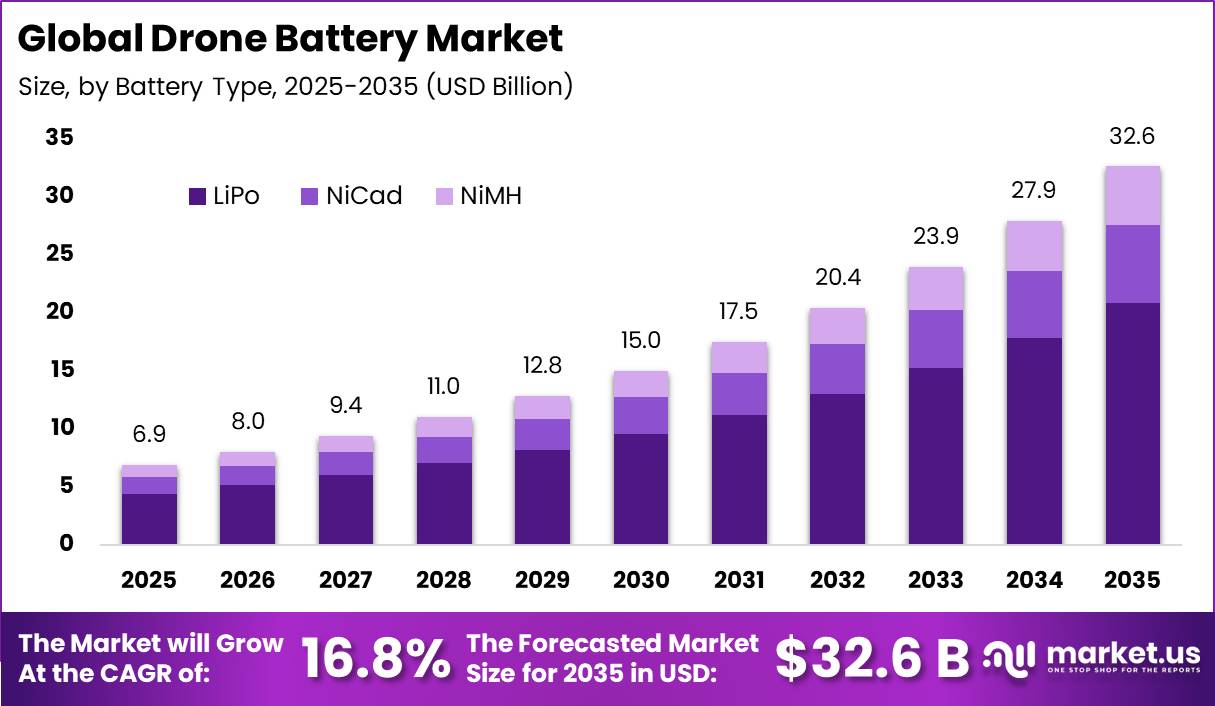
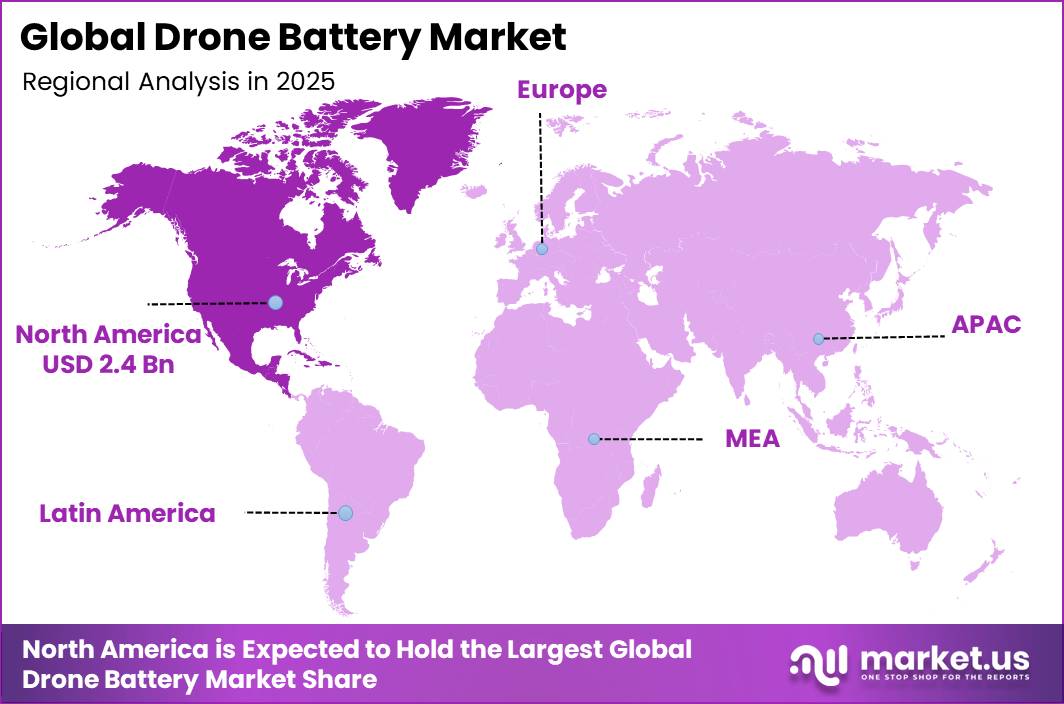
In 2025, the Global Drone Battery Market was valued at USD 6.9 billion. The market is projected to grow at a CAGR of 16.8% during 2026–2035, reaching approximately USD 32.6 billion by 2035. North America dominated the global market in 2025, accounting for more than 34.7% of the total market share and generating approximately USD 2.4 billion in revenue.
In the United States, the FAA expects the total small drone fleet, including commercial and recreational drones, to increase from around 1.9 million in 2025 through 2029. The commercial drone fleet alone is projected to exceed 1 million units by 2029, representing an increase of 22 percent from 2024 levels. As every drone requires a battery system, continued fleet expansion is expected to directly support battery demand.
Defense investment is also creating strong growth opportunities. SIPRI reported that global military expenditure reached USD 2,887 billion in 2025, rising 2.9 percent in real terms and recording an eleventh consecutive annual increase. Europe’s military spending increased 14 percent to USD 864 billion.
Rising deployment of drones for surveillance, logistics, reconnaissance, and combat support is increasing demand for high-performance batteries with longer operating life and faster charging capability. Commercial drone activity is strengthening replacement demand as well. FAA data showed commercial UAS registrations increased 12.5 percent annually to 453,635 units in late 2025, while certificated remote pilots increased 13.9 percent.
Key Takeaway
- The Drone Battery Market valued at USD 6.9 billion in 2025, projected to reach USD 32.6 billion by 2035 at a 16.8% CAGR.
- LiPo batteries lead by battery type with a 63.8% share.
- The 3,000–5,000 mAh capacity segment leads with a 42.7% share.
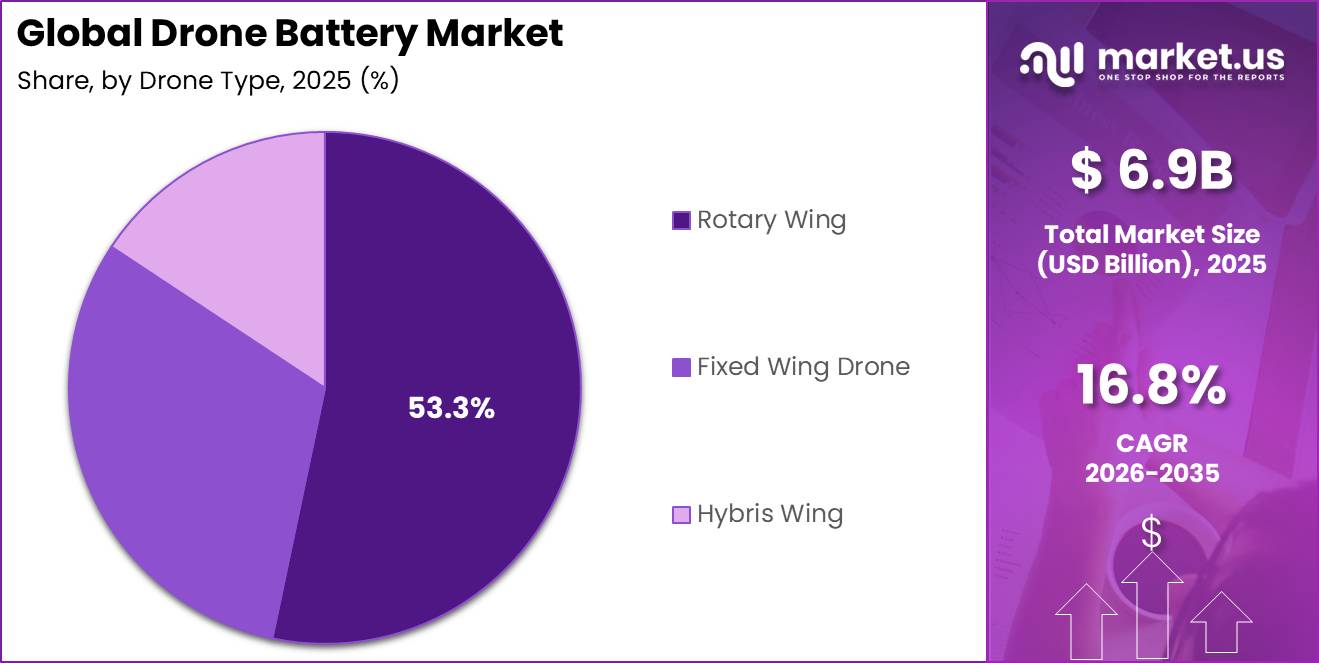
- Rotary-wing drones dominate with a 53.3% share; commercial drones lead applications with 57.1%.
- North America led with a 34.7% share and USD 2.4 billion in 2025 revenue.
Market Statistics and Data Insights
- The FAA reported that the U.S. commercial small-UAS fleet exceeded 1.1 million cumulative registrations at the end of 2025 and is projected to reach about 1.5 million by 2030. On an active-fleet basis, the FAA estimated 424,516 commercial/nonrecreational aircraft in 2025 and projects 540,845 by 2030.
- More than 126,000 new commercial UAS were registered during 2025, equal to about 10,500 new registrations per month. This compared with more than 135,000 registrations, or roughly 11,300 per month, during 2024.
- The U.S. Forest Service recorded 17,255 UAS flights in FY2024, up 69% from 10,205 in FY2023. Drone flight hours increased 78%, from 2,553 hours to 4,536 hours. Aerial-ignition missions alone accounted for about 855 hours, while imagery and video missions exceeded 1,304 hours.
- Forest Service drone-supported aerial ignition treated 188,986 acres and deployed 733,115 ignition spheres during FY2024. Aerial-ignition flight hours increased 241%, while imagery-acquisition hours increased 84% from FY2023. These figures demonstrate very intensive professional drone utilization and repeated battery cycling.
- Among 34,270 recreational respondents reporting registered-aircraft ownership, 52% owned more than 2 registered aircraft, while 48% had 2 or fewer. Multiple-aircraft ownership is relevant to battery demand because each aircraft typically creates demand for dedicated and spare packs.
- Emergency-response organizations owned an average of 4.4 drones and operated an average of 3.4. Quadcopters represented 88% of their aircraft, while another 7% were other rotary-wing designs. This strongly supports rotary-wing battery consumption.
- Among surveyed emergency-response organizations, 89% used drones for search and rescue, 80% for training, 61% for natural-disaster response, 59% for tactical support, 57% to search for wanted persons, 53% for firefighting support, 52% for public demonstrations, and 49% for crime-scene documentation.
- In 2026, the FAA approved environmental reviews for Amazon Prime Air expansion plans allowing up to 1,000 MK30 drone-delivery flights per operating day from individual delivery centers, equivalent to roughly 365,000 annual operations per center. The MK30 is electric-powered, weighs up to 83.2 lb, and has a maximum operating range of 7.5 miles.
- The proposed Prime Air Texas network includes 22 drone delivery centers. Each MK30 center can potentially serve an operating area of around 174 square miles, highlighting the scale that high-frequency battery-powered delivery fleets could reach.
- By 2035, the IEA expects China to still supply more than 60% of refined lithium and cobalt and around 80% of battery-grade graphite. These are key upstream materials for lithium-ion and lithium-polymer battery production.
- The Matrice 400 delivers up to 59 minutes of flight time and supports up to a 6 kg payload, showing the movement of enterprise drones toward substantially larger, higher-energy battery packs.
By Battery Type
The LiPo segment dominates the drone battery market with a 63.8% share, supported by its lightweight design, flexible shape, and strong power output. These features make LiPo batteries suitable for small and medium-sized drones where battery weight directly influences payload capacity, flight duration, and motor efficiency.
Compared with rigid battery formats, LiPo cells can be manufactured in thin and compact designs, allowing drone manufacturers to reduce overall aircraft weight while maintaining reliable power performance. According to NASA, LiPo batteries provide an energy density of 150–200 Wh/kg and use gel-like or solid electrolytes, which support flexible battery shapes and lower weight.
NASA’s UAV testing further recorded an energy density of 172.4 Wh/kg for 3C LiPo cells and 182.7 Wh/kg for 10C cells. This combination of energy density and high discharge capability supports demanding operations such as take-off, hovering, climbing, and powering cameras or sensors.
By Battery Capacity
The 3,000–5,000 mAh battery-capacity segment leads the drone battery market with a 42.7% share, mainly because it offers a practical balance between flight time, battery weight, payload capacity, and operating cost. A 5,000 mAh battery working at 22.8 V can store about 114 Wh of energy, based on the FAA formula of voltage multiplied by amp-hours.
This capacity is suitable for common drone applications such as inspection, mapping, photography, and public-safety operations, while keeping the aircraft lighter than systems using larger battery packs. NASA’s autonomous sUAS research used six 5,700 mAh, 22.8 V LiPo batteries and achieved 38 minutes of hover time without payload and 18 minutes at maximum payload.
These results show that batteries close to the 3,000–5,000 mAh range can support professional multirotor operations effectively. Batteries above 5,000 mAh may provide longer operating time, but the additional weight can increase motor load and reduce usable payload capacity. As a result, the 3,000–5,000 mAh segment remains widely preferred for consumer and commercial drones requiring repeatable flights, easy battery replacement, portable charging, and balanced performance.
By Drone Type
The Rotary-wing segment dominates the drone battery market with a 53.3% share, supported by its wide use in applications requiring vertical take-off, stable hovering, and close-range data collection. The U.S. Department of the Interior operated 581 small UAS aircraft and completed 7,833 flights in fiscal year 2024, representing a 27% increase from the previous year.
These drones are commonly used for mapping, research, natural-resource monitoring, and emergency-response activities, where rotary-wing platforms can operate from limited spaces and remain stable over specific locations. Their operating design also creates strong battery demand because multiple electric motors must continuously generate lift during flight.
By Application
The Commercial Drone segment dominates the drone battery market with a 57.1% share, mainly because these drones are used regularly for business and field operations rather than occasional recreational flights. The U.S. Forest Service recorded 17,255 drone flights and 4,536 flight hours in fiscal year 2024, increasing 69% and 78%, respectively, from the previous year.
Its drone-supported aerial ignition activities also covered 188,986 acres and deployed 733,115 ignition spheres, highlighting the scale of professional drone operations. Commercial applications such as mapping, inspection, emergency response, aerial imaging, and fire management require propulsion systems, cameras, sensors, and communication equipment to operate together, resulting in higher battery consumption.
Key Market Segments
By Battery Type
- NiCad
- NiMH
- LiPo
By Battery Capacity
- Below 3,000 mAh
- 3,000-5,000 mAh
- 5,000-10,000 mAh
- Above 10,000 mAh
By Drone Type
- Rotary Wing
- Fixed Wing Drone
- Hybrid Wing
By Application
- Commercial Drones
- Consumer Drones
- Military Drones
Geopolitical Impact Analysis
Geopolitical pressures are increasing both sourcing costs and supply-chain risks in the drone battery market. Lithium-polymer and lithium-ion batteries depend on processed lithium, cobalt, graphite, cathode materials, anodes, separators, and battery-management electronics. According to the International Energy Agency, China is the leading refiner for 19 of the 20 key energy minerals assessed, with an average market share of around 70%.
China also produces more than 98% of global lithium-iron-phosphate cathode materials and battery cells. This high concentration makes drone battery manufacturers more exposed to export restrictions, trade disputes, currency movements, and freight disruptions. In the United States, Section 301 tariffs on Chinese lithium-ion batteries not used in electric vehicles increased from 7.5% to 25% on January 1, 2026.
This represents an additional 17.5 percentage points in customs duty for affected imports before freight, insurance, testing, and distribution costs are added. Shipping disruptions are creating further pressure on battery supply chains. UNCTAD reported that longer shipping routes caused by Red Sea disruptions increased global container ton-miles by 17% in 2024.
The World Bank reported that traffic through the Suez Canal and Bab el-Mandeb fell by 75% from historical levels by late December 2024, while cargo travel times increased by as much as 45%. Delayed container capacity reached 2.3 million TEUs, more than twice the December 2023 level.
Regional Analysis
North America held the largest share of the global drone battery market in 2025, accounting for 34.7% of revenue and approximately USD 2.4 billion. The region’s strong position is supported by a large commercial drone base, growing public-sector use, advanced battery integration, and established operating rules. In the United States, the Federal Aviation Administration reported 481,760 registered drones as of September 2026.
Canada also contributes to regional demand. Transport Canada reported 116,304 registered drones, 128,888 Basic Pilot Certificates, 20,138 Advanced Pilot Certificates, and 368 active remotely piloted aircraft-system operator certificates as of December 2025. Expanded operating permissions are expected to support demand for reliable batteries capable of handling longer flights, heavier payloads, and safe reserve power.
Asia Pacific is expected to be the fastest-growing regional market, supported by increasing drone use across agriculture, manufacturing, logistics, urban services, and national-security applications. The region also benefits from a strong electronics and battery supply chain. Rising drone assembly, battery production, and commercial deployment are expected to strengthen demand for compact, high-discharge, and fast-charging battery systems.
Key Regions and Countries
North America
- US
- Canada
Europe
- Germany
- France
- The UK
- Spain
- Italy
- Rest of Europe
Asia Pacific
- China
- Japan
- South Korea
- India
- Australia
- Rest of APAC
Latin America
- Brazil
- Mexico
- Rest of Latin America
Middle East & Africa
- GCC
- South Africa
- Rest of MEA
Market Dynamics
Drivers
| Driver | (~) % CAGR | Geographic Relevance | Impact Timeline |
|---|---|---|---|
| Commercial fleet expansion | +3.2% | North America | Short term (2 years or less) |
| Industrial inspection adoption | +2.4% | Global | Medium term (2 to 4 years) |
| Public safety deployment | +1.8% | North America and Europe | Short term (2 years or less) |
| Replacement pack demand | +1.5% | Global | Short term (2 years or less) |
| High-discharge cell upgrades | +1.1% | Asia Pacific | Medium term (2 to 4 years) |
Commercial fleet expansion is a major growth driver for the drone battery market because professional operators often use multiple battery packs per aircraft. The FAA’s 2025 forecast placed the U.S. commercial small-UAS fleet at approximately 1.03 million registrations, with the base case projected to reach about 1.18 million by 2029.
More than 126,000 new commercial aircraft were registered during 2025, directly supporting demand for original batteries, spare packs, chargers, and replacement units. Commercial drones are increasingly used for inspection, mapping, surveying, imaging, and emergency-response operations, creating frequent charging and replacement cycles.
Transport Canada also reported nearly 108,000 registered small drones at the end of 2024, showing wider regulated adoption. This fleet-led demand could provide an estimated +3.2% incremental contribution to the baseline CAGR through recurring battery replacement and higher operational usage.
Restraints
| Restraint | (~) % CAGR | Geographic Relevance | Impact Timeline |
|---|---|---|---|
| China-origin battery tariffs | -2.7% | United States | Short term (2 years or less) |
| Hazardous-goods transport limits | -1.8% | Global | Short term (2 years or less) |
| Restricted foreign-drone procurement | -1.5% | United States | Medium term (2 to 4 years) |
| Certification cost burden | -1.2% | Europe and North America | Medium term (2 to 4 years) |
| High replacement-pack pricing | -0.9% | Global | Short term (2 years or less) |
China-Origin Battery Tariffs
China-origin battery tariffs are a major restraint for the U.S. drone battery market. The U.S. Trade Representative increased Section 301 tariffs on covered Chinese non-EV lithium-ion batteries from 7.5% to 25% from January 2026, representing an increase of 17.5 percentage points and directly raising landed costs for imported cells and battery packs.
Supply diversification also remains difficult because China processes around 70%–95% of key lithium, cobalt, phosphate, and graphite supply chains. Higher tariffs, sourcing costs, and domestic assembly requirements could create an estimated -2.7% drag on the baseline CAGR by reducing distributor margins and delaying purchases among price-sensitive drone operators.
Challenges
| Challenge | (~) % CAGR | Geographic Relevance | Mitigation Horizon |
|---|---|---|---|
| Critical mineral concentration | -2.3% | Global | Long term (4 years or more) |
| Battery thermal safety | -1.9% | Global | Medium term (2 to 4 years) |
| Cell qualification cycles | -1.4% | Asia Pacific and North America | Medium term (2 to 4 years) |
| Freight-route volatility | -1.2% | Europe and Middle East | Short term (2 years or less) |
| Battery technician shortage | -0.8% | North America and Europe | Medium term (2 to 4 years) |
Critical Mineral Concentration
Critical mineral concentration remains a major challenge for the drone battery market because lithium, graphite, cobalt, nickel, phosphate, and processed electrode materials are supplied by a limited number of countries.
The IEA reported that China held an average refining share of about 70% across major energy-transition minerals and more than 80% of battery-grade graphite processing. The IEA also expects China to supply over 60% of refined lithium and cobalt and around 80% of battery-grade graphite by 2035. At the same time,
UNCTAD reported that shipping disruptions increased global container ton-miles by approximately 17% in 2024. These supply and logistics risks could create an estimated -2.3% drag on maximum market growth by increasing safety-stock, supplier-qualification, and working-capital requirements.
Opportunities
| Opportunity | (~) % CAGR | Geographic Relevance | Execution Window |
|---|---|---|---|
| Battery-as-a-service networks | +3.0% | North America, Europe and Asia Pacific | Medium term (2 to 4 years) |
| Drone delivery charging hubs | +2.4% | Asia Pacific and North America | Long term (4 years or more) |
| Certified battery refurbishment | +1.8% | Global | Medium term (2 to 4 years) |
| Localized pack assembly | +1.6% | North America and Europe | Medium term (2 to 4 years) |
| Hybrid mission power systems | +1.2% | Global | Long term (4 years or more) |
Battery-as-a-Service Networks
Battery-as-a-service networks remain an emerging opportunity because most drone operators still purchase and manage batteries internally. The FAA expects the U.S. commercial small-drone fleet to exceed 1 million units, creating potential demand for subscription batteries, managed charging, battery-health monitoring, and rapid field-swapping services.
Managed battery services could also reduce operating costs and improve battery utilization. A subscription model could lower upfront spare-battery purchases by around 20%–30% while increasing supplier pack utilization by approximately 15%–25%. Combined with recurring service revenue and battery-health analytics, this model could contribute up to 3.0% additional upside to the baseline CAGR.
Key Players Analysis
The drone battery market includes a concentrated drone-platform segment and a wider cell and battery-pack supplier base. Tier-1 leaders include DJI, Amperex Technology Limited (ATL), Panasonic, Samsung SDI, and LG Chem, supported by their capabilities in drone platforms, lithium-cell technology, battery materials, and large-scale manufacturing.
DJI remains a major ecosystem player, but as a privately held company, it does not publish audited revenue, R&D spending, or drone-battery sales. ATL, Autel Robotics, Yuneec, Tattu/Grepow, MaxAmps, and Tadiran Batteries also do not separately disclose drone-battery revenue.
Among public companies, Samsung SDI reported revenue of KRW 13.27 trillion in 2025, with R&D expenditure of KRW 1.4 trillion, equal to about 10.6% of revenue, and capital expenditure of KRW 3.3 trillion. LG Chem recorded consolidated revenue of KRW 45.93 trillion in 2025. Its R&D expenditure reached KRW 575.0 billion in the first quarter of 2025, compared with KRW 521.9 billion a year earlier.
Tier-2 challenger Parrot provides a useful public drone-platform benchmark. Its professional micro-UAV business generated EUR 47.9 million in 2025, representing 60% of group revenue. Total R&D spending reached EUR 44.8 million, or 56.2% of consolidated revenue, while 283 employees, representing 69% of staff, worked in R&D. Competition is increasingly based on battery safety, fast charging, battery-management software, and aircraft-pack compatibility rather than publicly disclosed market-share percentages.
Top Key Players in the Market
- Amperex Technology Limited
- Autel Robotics
- DJI
- LG Chem
- MaxAmps
- Panasonic
- Parrot
- Samsung SDI
- Tadiran Batteries
- Tattu (Shenzhen Grepow Battery Co., Ltd)
- Yuneec International Co. Ltd.
Recent Developments
- In 2026, Samsung SDI acquired General Motors’ entire 49.9% interest in SynergyCells in August, increasing Samsung SDI’s ownership from 50.01% to 100% and creating its first independently operated battery-production base in North America. The New Carlisle, Indiana facility was established under an approximately USD 3.5 billion investment plan with an initial annual production capacity of 27 GWh.
- In 2025, Panasonic Energy began mass production at its new Kansas lithium-ion battery factory in July following an approximately USD 4 billion investment. The facility covers around 1.2 million m² of land and approximately 440,000 m² of building space, targets an annual production capacity of about 32 GWh, and is expected to support up to 4,000 jobs. Combined with Panasonic’s approximately 41 GWh Nevada operation, U.S. capacity could reach around 73 GWh, strengthening the North American cylindrical-cell supply base.
Report Scope
| Report Features | Description |
|---|---|
| Market Value (2025) | USD 6.9 Billion |
| Forecast Revenue (2035) | USD 32.6 Billion |
| CAGR (2026-2035) | 16.8% |
| Base Year for Estimation | 2025 |
| Historic Period | 2020-2024 |
| Forecast Period | 2026-2035 |
| Report Coverage | Revenue Forecast, Market Dynamics, Competitive Landscape, Recent Developments |
| Segments Covered | By Battery Type (NiCad, NiMH, LiPo); By Battery Capacity (Below 3,000 mAh, 3,000-5,000 mAh, 5,000-10,000 mAh, Above 10,000 mAh); By Drone Type (Rotary Wing, Fixed Wing Drone, Hybrid Wing); By Application (Commercial Drones, Consumer Drones, Military Drones) |
| Regional Analysis | North America – US, Canada; Europe – Germany, France, The UK, Spain, Italy, Rest of Europe; Asia Pacific – China, Japan, South Korea, India, Australia, Singapore, Rest of APAC; Latin America – Brazil, Mexico, Rest of Latin America; Middle East & Africa – GCC, South Africa, Rest of MEA |
| Competitive Landscape | Amperex Technology Limited (ATL), Autel Robotics, DJI, LG Chem, MaxAmps, Panasonic, Parrot, Samsung SDI, Tadiran Batteries, Tattu (Shenzhen Grepow Battery Co., Ltd), Yuneec International Co. Ltd. |
| Customization Scope | We will provide customization for segments and region/country levels. Additional customization can be done based on requirements. |
| Purchase Options | We have three licenses to opt for: Single User License, Multi-User License (Up to 5 Users), Corporate Use License (Unlimited Users and Printable PDF) |





































