


Report Overview
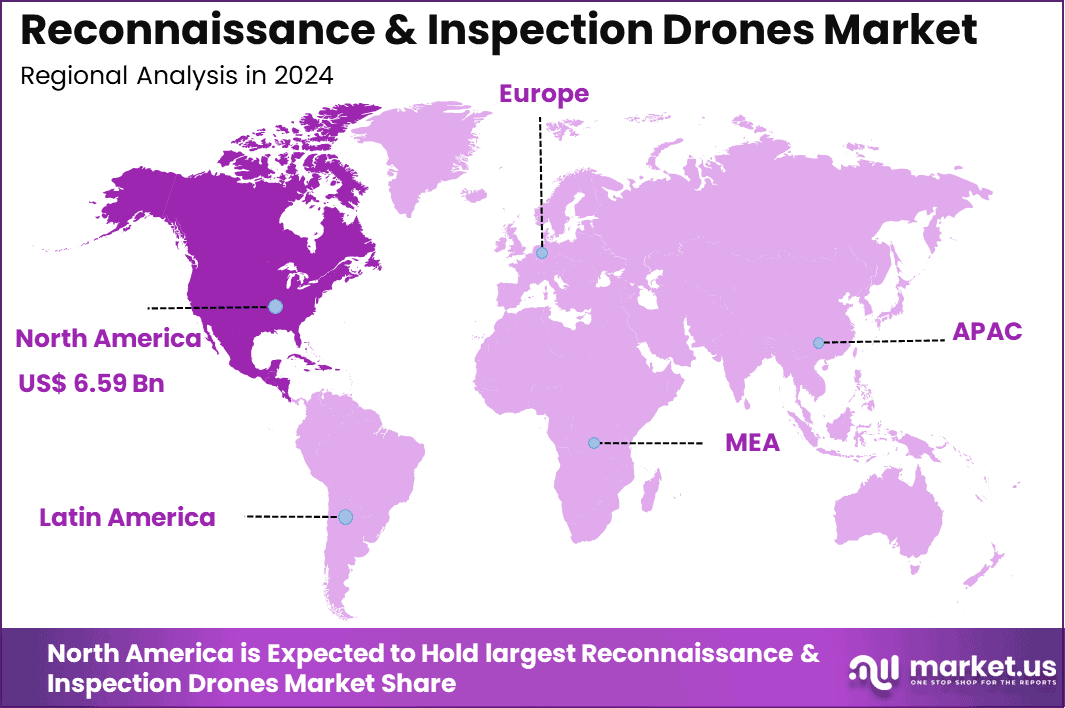
The Global Reconnaissance and Inspection Drones Market generated USD 15.6 billion in 2024 and is predicted to register growth from USD 18.7 billion in 2025 to about USD 93.4 billion by 2034, recording a CAGR of 19.6% throughout the forecast span. In 2024, North America held a dominant market position, capturing more than a 42.3% share, with USD 6.59 billion in revenue.
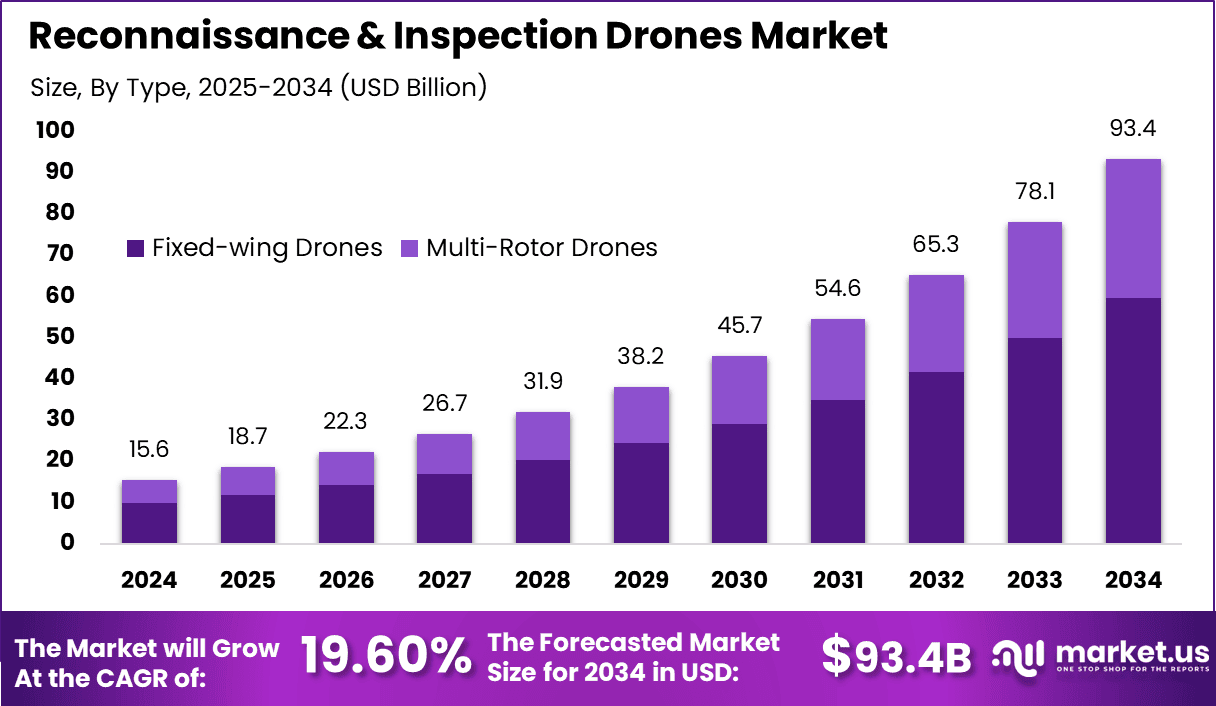
Key driving factors include technological advancements in sensors and AI-enabled automation, growing regulatory support for unmanned aerial vehicles (UAVs), and heightened safety requirements. For example, drones reduce the risk of accidents by eliminating the need for humans to physically climb or enter dangerous inspection sites.
Approximately 33% efficiency improvements and 50% cost reductions have been recorded in industries using drone inspections. The market also benefits from increasing start-ups and innovation focused on developing drones with longer flight times, enhanced payload capacities, and improved data analytics capabilities.
The Reconnaissance & Inspection Drones Market is witnessing rapid growth as industries and governments adopt drone technology for safer, more efficient inspection and monitoring of infrastructure, assets, and environments. Drones provide access to hard-to-reach or hazardous areas while delivering high-quality visual and sensor data, which human inspectors cannot match. This trend is supported by increasing demand across sectors such as oil & gas, utilities, agriculture, construction, and defense.
Demand analysis shows the oil & gas sector accounts for nearly 30% of inspection drone usage, primarily for pipeline, well, and infrastructure monitoring. Utilities closely follow, using drones for power line and solar panel inspections. Agriculture and construction sectors also represent significant demand drivers, with drones facilitating crop monitoring and precise infrastructure assessments. The adoption of multirotor drones, which hold about 38% market share due to their stability and ease of use, is expanding rapidly among users.
Top Market Takeaways
- By drone type, fixed-wing drones dominate with a 61.5% market share. These drones offer longer flight endurance and higher payload capacity, making them suitable for extended surveillance and reconnaissance missions.
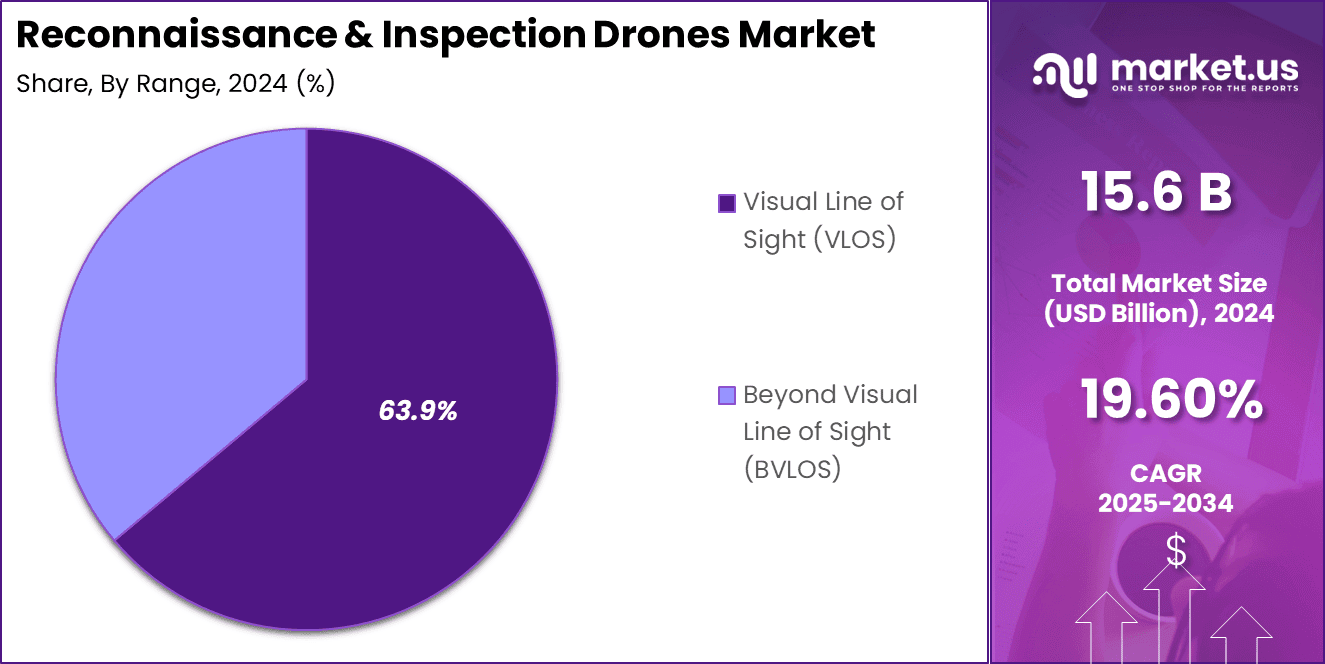
- By range, Visual Line of Sight (VLOS) operations account for a 63.9% share, favoring missions where pilots maintain direct visual contact, mainly for tactical military reconnaissance and security applications.
- By application, military reconnaissance leads with 41.8% market share, driven by demand for advanced ISR (Intelligence, Surveillance, and Reconnaissance) capabilities in defense.
- By end-user, defense and security represent 52.6%, reflecting extensive use in border security, battlefield monitoring, and national defense.
- In North America, the market holds approximately 42.3% of the global share.
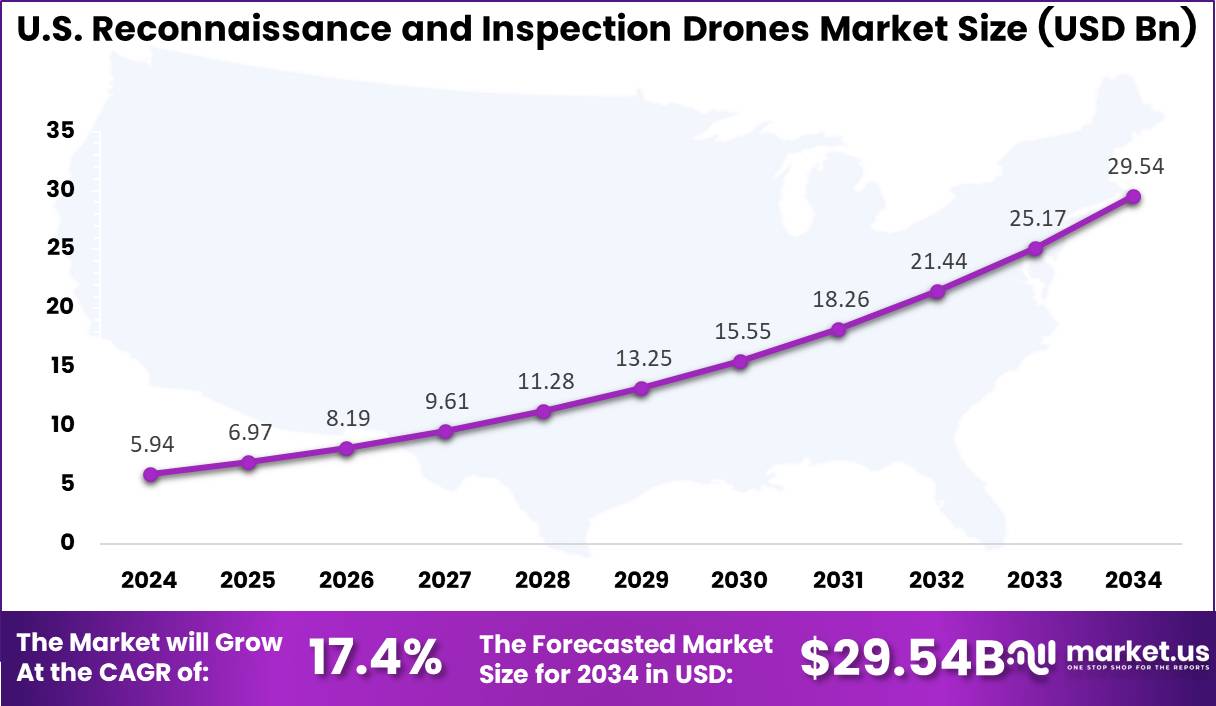
- The U.S. market size is estimated at USD 5.94 billion in 2025.
By Type
Fixed-wing drones dominate the reconnaissance and inspection drone market with a share of 61.5%. Their longer flight endurance and broader coverage capabilities make them ideal for extended missions requiring detailed aerial surveillance. These drones are favored in military, border security, and large-scale infrastructure inspections where covering extensive distances efficiently is crucial.
Their aerodynamic design supports high speeds, enabling timely data collection across vast areas. Fixed-wing drones provide crucial advantages in scenarios where time-sensitive and large-area monitoring is necessary, making them indispensable in reconnaissance applications.
By Range
Visual Line of Sight (VLOS) operations hold a strong position with 63.9% of the market share. VLOS remains popular due to regulatory frameworks and operational ease, allowing drone pilots to maintain direct visual contact with their drones during missions.
This mode suits many commercial and defense reconnaissance tasks where flight paths are relatively straightforward and risk assessment manageable. While Beyond Visual Line of Sight (BVLOS) operations are growing, VLOS’s reliability and safety continue to sustain its dominance for many use cases.
By Application
Military reconnaissance is the leading application segment with 41.8% market share. Drones provide real-time intelligence, surveillance, and reconnaissance (ISR) to support military operations, border patrol, and target tracking. Their ability to carry advanced sensors and cameras allows armed forces to gather critical situational awareness without risking personnel safety. The increasing need for precise and timely battlefield data drives continuous innovation and adoption of drones in military reconnaissance missions.
By End-User
Defense and security entities account for the largest end-user share at 52.6%. Governments worldwide invest heavily in drones for surveillance, threat detection, and tactical reconnaissance. The demand arises from expanding security challenges that require rapid and flexible aerial monitoring across urban and remote areas.
Drones help agencies respond effectively to emerging threats, manage borders, and enhance public safety. Ongoing technological advancements in AI and sensor technologies further strengthen drones’ role in national security strategies.
Key Market Segments
By Type
- Fixed-Wing Drones
- Multi-Rotor Drones
By Range
- Visual Line of Sight (VLOS)
- Beyond Visual Line of Sight (BVLOS)
By Application
- Military Reconnaissance
- Infrastructure Inspection
- Environmental Monitoring
- Public Safety
- Others
By End-User
- Defense & Security
- Agriculture
- Construction
- Energy & Utilities
- Government
- Others
Emerging Trends
The reconnaissance and inspection drones market is seeing some strong trends that are clearly shaping its growth. One major trend is the rise of hybrid drones, which combine the vertical takeoff and landing ability of multirotor drones with the long flight endurance of fixed-wing designs. This hybrid approach allows inspections over large areas without frequent recharging or complicated launch setups, which is a big plus in industries like oil and gas, energy, and infrastructure maintenance.
Another important trend is the growing use of advanced sensor technologies, including thermal cameras, LiDAR, and multispectral imaging, which provide richer and more accurate data to detect issues early and improve decision-making.
Growth Factors
Growth is fueled by the increasing demand for safer and more efficient inspections in hard-to-reach or hazardous locations. Companies are keen to use drones as they reduce the need for manual inspections, which can be risky and time-consuming. The ability to quickly gather detailed data helps detect problems like structural damage, corrosion, or leaks before they become serious.
The drive toward automation also plays a big role, as integrating AI and machine learning enables drones to analyze data in real-time and predict maintenance needs. Furthermore, expanding regulatory support for drone operations beyond the visual line of sight is opening new possibilities for broad and continuous coverage.
Regional Analysis
North America holds a commanding 42.3% share in the global reconnaissance and inspection drones market, driven by extensive adoption in defense and security sectors. Fixed-wing drones dominate with 61.5% due to their longer flight endurance and range, making them ideal for military reconnaissance missions, which account for 41.8% of applications.
The region benefits from strong government and military investments, advanced drone manufacturing capabilities, and well-established R&D centers contributing to technological innovations in drone payloads, AI-powered analytics, and secure communication systems. These factors position North America as a global leader in reconnaissance drone technology and deployment.
The U.S. market specifically is valued at USD 5.94 billion in 2025 and is projected to grow at a CAGR of 17.4%. The U.S. is the biggest contributor within North America due to heavy defense spending, strategic UAV program developments, and operational adoption by military and homeland security agencies.
The country’s advanced aerospace industry, supportive regulatory environment including the FAA’s drone policies, and strong collaborations between government, defense contractors, and tech firms accelerate market growth.
Technologies like real-time data transmission, high-resolution imaging, and stealth features are increasingly integrated into drones deployed for intelligence, surveillance, and reconnaissance missions. This robust ecosystem makes the U.S. a central hub driving the North American market’s expansion in reconnaissance and inspection drones.
Key Regions and Countries
- North America
- US
- Canada
- Europe
- Germany
- France
- The UK
- Spain
- Italy
- Russia
- Netherlands
- Rest of Europe
- Asia Pacific
- China
- Japan
- South Korea
- India
- Australia
- Singapore
- Thailand
- Vietnam
- Rest of APAC
- Latin America
- Brazil
- Mexico
- Rest of Latin America
- Middle East & Africa
- South Africa
- Saudi Arabia
- UAE
- Rest of MEA
Market Dynamics
Driver - Rising Demand for Infrastructure Safety and Efficiency
The reconnaissance and inspection drones market is largely driven by the growing need for efficient and safe infrastructure monitoring across sectors such as energy, transportation, and construction. Traditional inspection methods often involve high costs, long timeframes, and safety risks due to difficult access conditions. Drones address these challenges by providing rapid, high-resolution, and real-time data collection that significantly reduces inspection times and enhances worker safety.
These drones help prevent catastrophic failures by allowing frequent and detailed structural assessments without physical intervention. Increasing government regulations mandating regular inspections, along with the expansion of renewable energy infrastructure like wind farms and solar panels, also boost the market growth, making drone-based inspection an essential technology for maintaining critical assets.
Restraint - Regulatory Constraints and Privacy Concerns
Despite technological advantages, regulatory restrictions on drone flights and privacy concerns limit the growth of reconnaissance and inspection drones. Operators must comply with strict aviation rules that vary significantly across regions, especially concerning flying beyond visual line of sight and in urban settings, complicating operational deployment.
Public apprehension regarding aerial surveillance raises privacy debates, leading to tighter regulations and operational restrictions. These factors increase compliance costs and slow adoption, particularly among commercial operators who face challenges in obtaining flight permissions and ensuring data protection in sensitive environments.
Opportunity - AI Integration and Expansion into New Industries
Emerging opportunities stem from integrating artificial intelligence with drone platforms for enhanced data analysis and autonomous operations. AI enables real-time anomaly detection, predictive maintenance, and improved decision-making by processing vast amounts of visual and sensor data efficiently. This reduces human error and operational costs while increasing inspection accuracy.
Additionally, growing adoption in new industries such as agriculture, mining, and environmental monitoring presents significant market expansion potential. Enhanced payload versatility and longer flight endurance drones further broaden application possibilities. Partnerships between drone manufacturers and software developers are expected to unlock innovative solutions and accelerate growth in this dynamic sector.
Challenge - Technical Expertise and Data Management Complexity
A key challenge is the complexity of operating advanced drones and managing the large volumes of inspection data generated. Skilled personnel capable of piloting drones, maintaining equipment, and interpreting analytical results are in limited supply. This technical barrier slows adoption and increases training costs.
Competitive Analysis
The reconnaissance and inspection drones key factors driving this market growth include advancements in drone propulsion systems (such as electric and hybrid engines), lightweight materials, enhanced battery technologies, and integration of sophisticated multispectral, thermal, and LiDAR sensors enabling comprehensive environmental intelligence.
Companies like AeroVironment, Insitu (a Boeing subsidiary), Teledyne FLIR, Lockheed Martin, Elbit Systems, Israel Aerospace Industries, Autel Robotics, Skydio, Yuneec, senseFly, PrecisionHawk, DJI, Parrot, Delair, and Microdrones are pivotal players innovating in this space.
These companies are focusing on next-generation drone capabilities including extended flight endurance, vertical takeoff and landing (VTOL), advanced AI-driven autonomy for obstacle avoidance and real-time data analytics, and modular payloads customizable for diverse reconnaissance and inspection applications ranging from defense and security to energy infrastructure and agriculture.
Strategic initiatives include partnerships, targeted acquisitions, and investments in embedded edge computing to enable in-flight anomaly detection and predictive maintenance workflows.
Top Key Players in the Market
- AeroVironment
- Insitu (Boeing)
- Teledyne FLIR
- Lockheed Martin
- Elbit Systems
- Israel Aerospace Industries
- Autel Robotics
- Skydio
- Yuneec
- senseFly
- PrecisionHawk
- DJI
- Parrot
- Delair
- Microdrones
- Others
Recent Developments
- In October 2025, AeroVironment (AV) was awarded a $499 million contract by the U.S. Air Force Research Laboratory to advance electromagnetic spectrum survivable materials and received $246 million in task orders to continue its development of next-generation aerial systems optimized for reconnaissance and inspection missions.
- In August 2025, Teledyne FLIR announced the end of sales for its SIRAS inspection drone to focus on thermal imaging sensor technology and embedded AI decision-support software, emphasizing its role as a leading supplier of sensor payloads rather than drone platforms.
Report Scope
| Report Features | Description |
|---|---|
| Market Value (2024) | USD 15.6 Bn |
| Forecast Revenue (2034) | USD 93.4 Bn |
| CAGR(2025-2034) | 19.6% |
| Base Year for Estimation | 2024 |
| Historic Period | 2020-2023 |
| Forecast Period | 2025-2034 |
| Report Coverage | Revenue forecast, AI impact on Market trends, Share Insights, Company ranking, competitive landscape, Recent Developments, Market Dynamics and Emerging Trends |
| Segments Covered | By Type (Fixed-Wing Drones, Multi-Rotor Drones), By Range (Visual Line of Sight (VLOS), Beyond Visual Line of Sight (BVLOS)), By Application (Military Reconnaissance, Infrastructure Inspection, Environmental Monitoring, Public Safety, Others), By End-User (Defense & Security, Agriculture, Construction, Energy & Utilities, Government, Others) |
| Regional Analysis | North America – US, Canada; Europe – Germany, France, The UK, Spain, Italy, Russia, Netherlands, Rest of Europe; Asia Pacific – China, Japan, South Korea, India, New Zealand, Singapore, Thailand, Vietnam, Rest of Latin America; Latin America – Brazil, Mexico, Rest of Latin America; Middle East & Africa – South Africa, Saudi Arabia, UAE, Rest of MEA |
| Competitive Landscape | AeroVironment, Insitu (Boeing), Teledyne FLIR, Lockheed Martin, Elbit Systems, Israel Aerospace Industries, Autel Robotics, Skydio, Yuneec, senseFly, PrecisionHawk, DJI, Parrot, Delair, Microdrones, Others |
| Customization Scope | Customization for segments, region/country-level will be provided. Moreover, additional customization can be done based on the requirements. |
| Purchase Options | We have three licenses to opt for: Single User License, Multi-User License (Up to 5 Users), Corporate Use License (Unlimited Users and Printable PDF) |





































