


Report overview
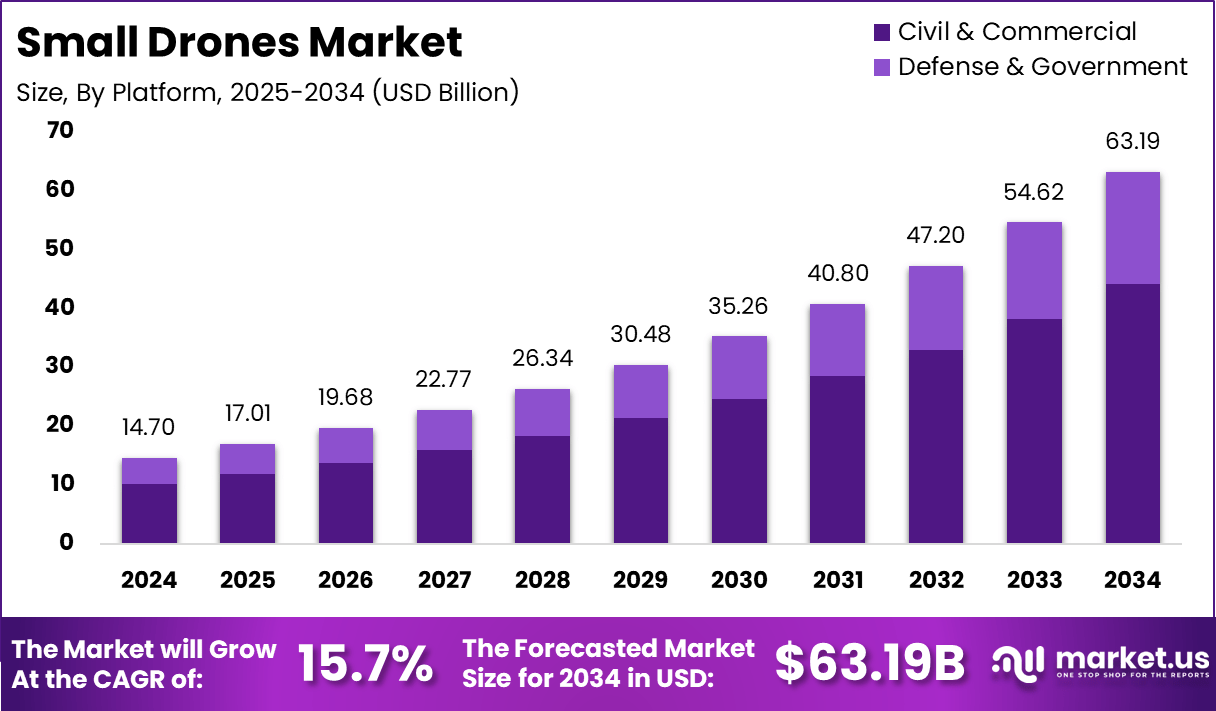
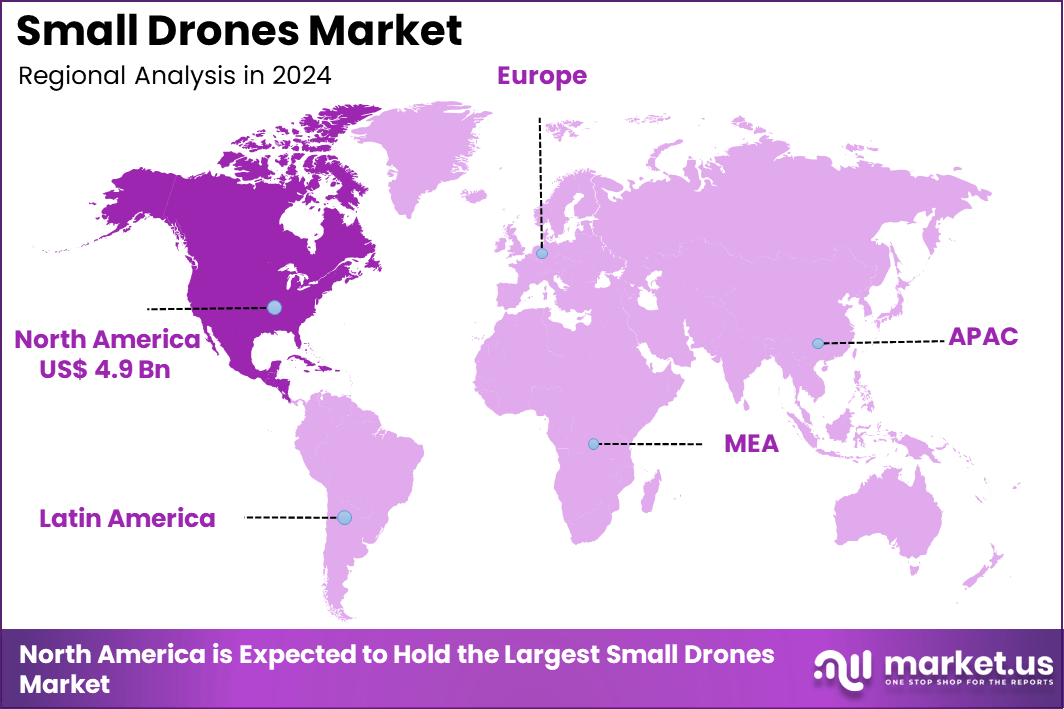
In 2024, the Global Small Drones Market was valued at USD 14.7 billion. The market is projected to grow at a CAGR of 15.7% during 2025–2034, reaching approximately USD 63.1 billion by 2034. North America dominated the global market in 2024, accounting for more than 35.0% of the total market share and generating approximately USD 4.9 billion in revenue.
According to the Federal Aviation Administration, the U.S. commercial drone fleet was expected to exceed 1 million aircraft in 2025 and reach 1.118 million by 2029, which is 22% above the 2024 level. This fleet growth supports recurring demand from power utilities, construction firms, farms, insurers, mining operators, and media companies. These users deploy drones for roof checks, site surveys, crop spraying, thermal imaging, and asset monitoring.
The International Energy Agency reports that lithium-ion battery costs have declined by about 90% since 2010, helping drone makers offer lighter and lower-cost electric systems. North America region combines deep enterprise demand, advanced aviation rules, defense procurement, and strong software capability. According to NASA, the FAA in July 2024 authorized multiple commercial operators to fly drones in the same airspace without continuous visual observation by the pilot, supporting wider delivery and inspection operations.
Key Takeaways
- The Global Small Drones Market was valued at USD 14.7 billion in 2024 and is projected to reach USD 63.1 billion by 2034, growing at a 15.7% CAGR.
- Civil and Commercial led the platform segment with a 70.0% share, supported by growing inspection and mapping applications.
- Commercial applications dominated with a 53.0% share, driven by strong returns from paid inspection contracts.
- Rotary Wing drones accounted for 65.0% of the market due to vertical takeoff and precise hovering capabilities.
- Remotely Piloted drones held a 70.0% share, supported by visual line-of-sight regulations and simpler operator training.
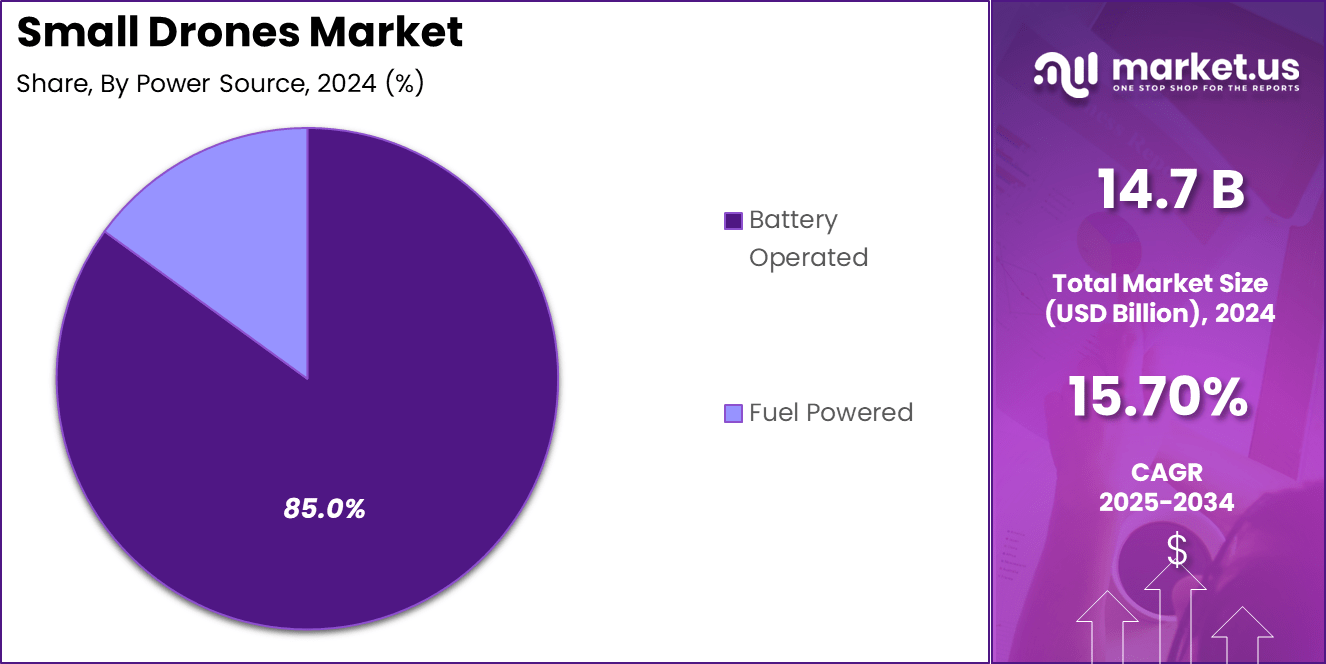
- Battery-operated drones dominated with an 85.0% share due to low-cost swappable battery packs and quieter motors.
- North America dominated the market in 2024 with more than a 35.0% share and approximately USD 4.9 billion in revenue.
By Platform
Civil and Commercial dominates with 70.0% due to daily business inspection and mapping work.
Civil and commercial buyers lead because ordinary businesses now fly drones every working day. United States registration records show the commercial small drone fleet reached about 1.1 million aircraft at the close of 2025, and regulators expect roughly 1.5 million by 2030.
Defense and government demand, though, climbs faster than any civil line. War has turned small drones into throwaway ammunition rather than durable equipment. Ukraine’s defence ministry reports output above 4 million drones during 2025 and plans more than 7 million for 2026, a jump no commercial use case can match.
By Application
Commercial dominates with 53.0% due to quick payback from paid inspection contracts.
Commercial work stays the biggest job because it pays back fast. Europe alone counts more than 1.6 million registered drone operators under one shared rulebook, and most of them earn money from inspection, mapping and photography contracts. A single flight can check a wind turbine blade or measure a quarry in minutes, replacing scaffolding, ladders and survey crews.
Farm support adds volume too: India’s agriculture ministry has funded over 240 subsidised Kisan Drones and more than 1,500 drone hiring centres so growers rent spraying services instead of buying hardware. Cheap sensors and simple flight software keep the training burden low, so small firms join easily. Government and law enforcement demand is now speeding up sharply.
American aviation authorities cleared Part 91 waivers for over 1,000 public safety agencies between April 2025 and February 2026, letting police and fire teams launch drones before officers arrive. Twelve more agencies recently won permission for one pilot to run several aircraft at once. Docked aircraft that answer emergency calls cut response times, and city budgets treat them as core kit, which locks in repeat orders.
By Type
Rotary Wing dominates with 65.0% due to vertical takeoff and precise hovering ability.
Rotary wing machines rule because they take off straight up and hover in place. That single ability suits crowded cities, rooftops, crime scenes, and small farm plots where no runway exists. Registry analysis in the United States estimates an active recreational fleet near 1.59 million small aircraft in 2025, drawn from 296,277 owners holding two or fewer Remote ID devices, and almost all of these are multirotors sold ready to fly.
Mass production of motors, propellers and flight controllers keeps unit prices low, so buyers rarely consider anything else. Hybrid designs, which lift like a helicopter then cruise on wings, climb quickest. Long routes expose the weakness of pure multirotors: short endurance. New American rules proposed in 2025 would open routine beyond-line-of-sight flying below 400 feet for aircraft weighing up to 1,320 pounds, which rewards machines able to cover long corridors without a runway.
By Mode of Operation
Remotely Piloted dominates with 70.0% due to visual line-of-sight rules and simple training.
Most flights still need a human at the controls, mainly because law demands it. European rules place everyday flying in the open category, limited to aircraft under 25 kilograms and heights of 120 metres, with the pilot keeping the aircraft in sight at all times. Insurers, employers and airports trust that setup, and training a pilot takes days rather than months.
Manual control also handles messy, changing sites better than any script, so inspection and camera crews keep it. Full autonomy is the fastest riser, however. Regulators have started approving remote, hands-off operations at scale: more than 1,100 public safety bodies hold shielded waivers allowing flights up to 200 feet above ground, and selected police units may let one pilot supervise four aircraft at once.
By Power Source
Battery-operated dominates with 85.0% due to cheap swappable packs and quiet motors.
Batteries dominate because they are cheap, simple, and everywhere. Lithium-ion pack prices have dropped about 90% since 2010 while energy density improved, so a small drone carries a swappable pack costing far less than any engine. Electric motors have few moving parts, run quietly, need almost no servicing, and start instantly in cold weather.
That changes long pipeline sweeps, border patrols, offshore checks and disaster mapping, where a 30-minute battery forces constant landings. Refuelling takes minutes instead of hours, so aircraft fly more sorties each day. Defence and utility buyers accept the extra hardware cost for that added range.
Key Market Segments
By Platform
- Civil and Commercial
- Defense and Government
By Application
- Commercial
- Inspection and Monitoring
- Remote Sensing
- Surveying and Mapping
- Product Delivery
- Aerial Imaging
- Industrial Warehousing
- Others
- Consumer
- Prosumers
- Hobbyists
- Military
- Unmanned Combat Aerial Vehicle
- Delivery
- Government and Law Enforcement
- Border Management
- Traffic Monitoring
- Firefighting and Disaster Management
- Search and Rescue
- Police Operations and Investigations
- Maritime Security
By Type
- Rotary Wing
- Fixed Wing
- Hybrid
By Mode of Operation
- Remotely Piloted
- Optionally Piloted
- Fully Autonomous
By Power Source
- Battery Operated
- Fuel Powered
Regional Analysis
The small drones market in North America holds a significant share, accounting for approximately 35% of the global market valued at around USD 4.9 billion in 2025, driven by robust government and military investments, widespread commercial adoption, and a strong technological ecosystem.
Factors such as progressive regulatory frameworks, significant R&D activities, and a high concentration of drone manufacturers and tech companies contribute to North America’s leadership in this sector. The region benefits from the use of small drones across defense, agriculture, logistics, infrastructure inspection, and public safety, making it a key market globally.
The North American small drones market is projected to grow at a compound annual growth rate (CAGR) of 13.4%, reflecting strong demand and continuous innovation. The surge in applications like drone delivery, surveillance, and industrial monitoring, combined with evolving regulatory support for expanded operations like beyond visual line of sight (BVLOS), fuels this growth.
Key Regions and Countries
- North America
- US
- Canada
- Europe
- Germany
- France
- The UK
- Spain
- Italy
- Russia
- Netherlands
- Rest of Europe
- Asia Pacific
- China
- Japan
- South Korea
- India
- Australia
- Singapore
- Thailand
- Vietnam
- Rest of APAC
- Latin America
- Brazil
- Mexico
- Rest of Latin America
- Middle East & Africa
- South Africa
- Saudi Arabia
- UAE
- Rest of MEA
Drivers
| Driver | (~) % CAGR Forecast | Geographic Relevance | Impact Timeline |
|---|---|---|---|
| Commercial inspection digitization | +2.4% | North America, Europe, Asia Pacific | Short term (2 years or less) |
| Defense attritable-drone procurement | +2.2% | North America, Europe, Middle East | Short term (2 years or less) |
| Farm service fleet growth | +1.6% | Asia Pacific, Latin America | Medium term (2 to 4 years) |
| Public-safety drone deployment | +1.3% | North America, Europe | Short term (2 years or less) |
| Remote-ID fleet renewal | +0.9% | United States | Short term (2 years or less) |
Commercial inspection digitization
Commercial inspection digitization is driving small-drone demand as asset owners increasingly use drone data for recurring inspection, mapping, and imaging. The U.S. commercial small-drone fleet exceeded 1 million aircraft in 2025 and is projected to reach 1.118 million by 2029, creating a large installed base for repeat commercial missions under FAA Part 107.
Remote ID enforcement began on March 16, 2024, encouraging operators to upgrade or retrofit non-compliant fleets. In Europe, more than 1.6 million registered drone operators support cross-border fleet services and standardized training, strengthening recurring demand for aircraft, sensors, software, maintenance, and inspection services.
Restraints
| Restraint | (~) % CAGR Forecast | Geographic Relevance | Impact Timeline |
|---|---|---|---|
| Airspace approval delays | -2.1% | North America, Europe | Short term (2 years or less) |
| Foreign supply restrictions | -1.8% | United States, allied markets | Medium term (2 to 4 years) |
| Public procurement compliance costs | -1.3% | North America, Europe | Short term (2 years or less) |
| Insurance and liability barriers | -1.0% | Global | Medium term (2 to 4 years) |
| Restricted urban flight zones | -0.8% | Global urban markets | Long term (4 years or more) |
Airspace approval delays
Airspace approval delays remain a major restraint because many high-value drone missions require operations beyond visual line of sight, over people, or near controlled airspace. FAA Part 107 waiver reviews can take up to 90 days, delaying inspection, agriculture, and public-safety deployments, while the proposed Part 108 framework published in 2025 is still being finalized.
In Europe, EASA’s open category generally limits routine low-risk operations to drones below 25 kilograms and altitudes up to 120 metres. These restrictions increase compliance costs, delay customer investment, reduce fleet utilization, and slow the transition from pilot projects to larger commercial drone deployments.
Challenges
| Challenge | (~) % CAGR | Geographic Relevance | Mitigation Horizon |
|---|---|---|---|
| Component sourcing concentration | -1.7% | Global | Medium term (2 to 4 years) |
| Skilled pilot shortages | -1.2% | North America, Europe, Asia Pacific | Medium term (2 to 4 years) |
| Battery endurance limits | -1.1% | Global | Long term (4 years or more) |
| Cybersecurity assurance burdens | -0.9% | North America, Europe | Medium term (2 to 4 years) |
| Data workflow fragmentation | -0.7% | Global | Medium term (2 to 4 years) |
Component sourcing concentration
Component sourcing concentration remains a major challenge because small-drone manufacturers depend on global supplies of cameras, motors, batteries, flight controllers, radio systems, and software. In January 2025, the U.S. Bureau of Industry and Security opened a supply-chain review covering unmanned aircraft systems, while the U.S. Department of Defense expanded Replicator selections during 2024 to support deployment of multiple thousands of autonomous systems by August 2025.
Lithium-ion battery pack costs have fallen by around 90% since 2010, but manufacturers remain exposed to material-price volatility and shipment disruptions. As a result, companies must qualify alternative suppliers, hold additional inventory, redesign components, and audit software sources, increasing working capital and engineering costs while putting pressure on margins.
Opportunities
| Opportunity | (~) % CAGR Upside | Geographic Relevance | Execution Window |
|---|---|---|---|
| Autonomous dock network services | +2.0% | North America, Europe, Asia Pacific | Medium term (2 to 4 years) |
| Hydrogen endurance platforms | +1.5% | North America, Middle East, Australia | Long term (4 years or more) |
| Drone-data subscription services | +1.3% | Global | Medium term (2 to 4 years) |
| Medical logistics corridors | +1.1% | Rural and island markets | Long term (4 years or more) |
| Counter-drone systems integration | +0.9% | North America, Europe, Middle East | Medium term (2 to 4 years) |
Autonomous dock network services
Autonomous dock network services offer strong untapped potential because most drone fleets still require pilots to travel to each site for launch, battery replacement, and data collection. The FAA proposed Part 108 in 2025 to support more routine beyond-visual-line-of-sight operations, while more than 1,000 public-safety agencies received relevant operational waivers between April 2025 and February 2026.
EASA’s common framework covers more than 1.6 million registered drone operators, creating a broad base for remotely supervised fleet services. Docked operations can reduce travel labour, improve aircraft utilization, and support recurring monitoring subscriptions, while bundled hardware, maintenance, data review, and compliance services could expand gross margins by an estimated 10%–20% compared with aircraft-only sales.
Key Players Analysis
The Small Drones Market is led by Tier-1 specialists DJI, AeroVironment, Skydio, and Parrot. Their estimated competitive influence is 30–35% for DJI, 8–10% for AeroVironment, 5–7% for Skydio, and 2–3% for Parrot. DJI had more than 600,000 agricultural drones operating globally by the end of 2025.
AeroVironment reported FY2026 revenue of USD 1.977 billion, while Q4 Autonomous Systems revenue reached USD 492.4 million. The company also reported a funded backlog of USD 1.2 billion, bookings of USD 2.7 billion, and completed the approximately USD 4.1 billion BlueHalo acquisition.
Skydio has delivered more than 60,000 drones and reports nine-figure annual revenue. In April 2026, the company raised USD 110 million in Series F financing at a valuation of USD 4.4 billion. Parrot generated EUR 47.9 million from professional micro-UAVs in 2025 and sold more than 4,000 premium ISR micro-drones.
Tier-2 challengers include Teledyne, Northrop Grumman, BAE Systems, Draganfly, EHang, Autel, and DELAIR. Teledyne’s Digital Imaging segment generated USD 3.164 billion in 2025 sales and invested USD 187.5 million, or 5.9%, in R&D, while unmanned-air-system sales increased by USD 35.1 million. Northrop Grumman’s Aeronautics Systems generated USD 12.992 billion, with group CapEx of USD 1.45 billion, while BAE Systems’ Air segment recorded GBP 9.299 billion in 2025 sales and a GBP 32.6 billion backlog.
Top Key Players in the Market
- SZ DJI Technology Co., Ltd.
- Parrot Drone SAS
- Teledyne Technologies Incorporated
- Northrop Grumman Corporation
- AeroVironment Inc.
- Draganfly Innovations Inc.
- Guangzhou EHang Intelligent Technology Co. Ltd
- 3DR, Inc.
- BAE Systems plc
- Autel Robotics Co., Ltd.
- Yuneec – ATL Drone
- Skydio, Inc.
- DELAIR SAS
- Other Key Players
Recent Developments
- In March 2026, Skydio secured a more than USD 52 million U.S. Army order for over 2,500 X10D small drones, representing the Army’s largest single-vendor tactical sUAS procurement. The contract moved from bid to award in less than 72 hours, while each X10D manufactured at Skydio’s Hayward, California facility undergoes 550 individual production and testing checkpoints.
- In February 2026, AeroVironment received a USD 186 million U.S. Army delivery order for Switchblade 600 Block 2 and Switchblade 300 Block 20 loitering unmanned systems. The procurement was placed under the Army’s existing 5-year, USD 990 million IDIQ Lethal Unmanned Systems contract and represented the first Army procurement of AeroVironment’s next-generation Switchblade product line.
Report Scope
| Report Features | Description |
|---|---|
| Market Value (2024) | USD 14.7 Bn |
| Forecast Revenue (2033) | USD 63.19 Bn |
| CAGR (2024-2033) | 15.7% |
| Base Year for Estimation | 2024 |
| Historic Period | 2020-2023 |
| Forecast Period | 2025-2034 |
| Report Coverage | Revenue Forecast, Market Dynamics, COVID-19 Impact, Competitive Landscape, Recent Developments |
| Segments Covered | By Platform (Civil and Commercial, Defense and Government), By Application (Commercial, [Inspection and Monitoring, Remote Sensing, Surveying and Mapping, Product Delivery, Aerial Imaging, Industrial Warehousing, Others], Consumer, [Prosumers, Hobbyists], Military, [Unmanned Combat Arial Vehicle, Delivery], Government and Law Enforcement, [Border Management, Traffic Monitoring, Firefighting and Disaster Management, Search and Rescue, Police Operations and Investigations, Maritime Security]), By Type (Fixed Wing, Rotary Wing, Hybrid), By Mode of Operation (Remotely Piloted, Optionally Piloted, Fully Autonomous), By Power Source (Battery Operated, Fuel Powered) |
| Regional Analysis | North America – US, Canada; Europe – Germany, France, The UK, Spain, Italy, Russia, Netherlands, Rest of Europe; Asia Pacific – China, Japan, South Korea, India, New Zealand, Singapore, Thailand, Vietnam, Rest of APAC; Latin America – Brazil, Mexico, Rest of Latin America; Middle East & Africa – South Africa, Saudi Arabia, UAE, Rest of MEA |
| Competitive Landscape | SZ DJI Technology Co., Ltd., Parrot Drone SAS, Teledyne Technologies Incorporated, Northrop Grumman Corporation, AeroVironment Inc., Draganfly Innovations Inc., Guangzhou EHang Intelligent Technology Co. Ltd,3DR, Inc., BAE Systems plc, Autel Robotics Co., Ltd., Yuneec – ATL Drone, Skydio, Inc., DELAIR SAS, Other Key Players |
| Customization Scope | Customization for segments, region/country-level will be provided. Moreover, additional customization can be done based on the requirements. |
| Purchase Options | We have three licenses to opt for: Single User License, Multi-User License (Up to 5 Users), Corporate Use License (Unlimited Users and Printable PDF) |





































