Report Overview
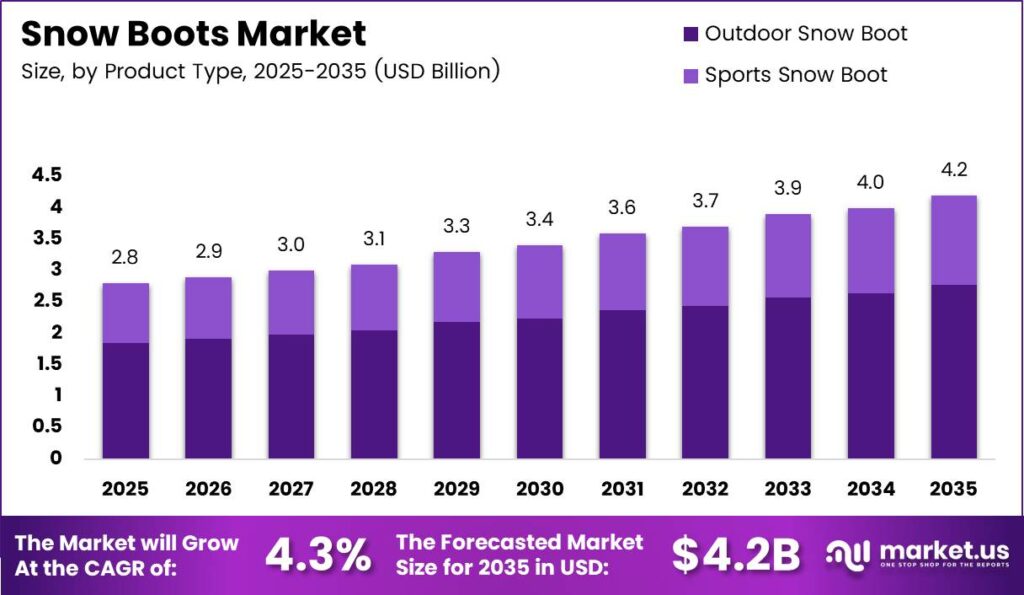
Global Snow Boots Market size is expected to be worth around USD 4.2 Billion by 2035 from USD 2.8 Billion in 2025. The planning scenario uses a CAGR of 4.3% during 2026 to 2035, although that rate requires reconciliation with the stated endpoints. These market estimates remain unverified, so investors should treat them as planning assumptions rather than independently established measurements. Snow boots combine insulation, moisture protection, and traction for cold-weather mobility.
Key Takeaways
- The 2025 Snow Boots Market size is USD 2.8 Billion.
- The 2035 forecast Snow Boots Market size is USD 4.2 Billion.
- The CAGR assumption is 4.3% for 2026 to 2035, subject to reconciliation with the market-value endpoints.
- Outdoor Snow Boot leads Product Type with a 65.78% share in 2025 and carries the fastest-growing designation.
- Men lead Application with a 42.54% share in 2025 and carry the fastest-growing designation.
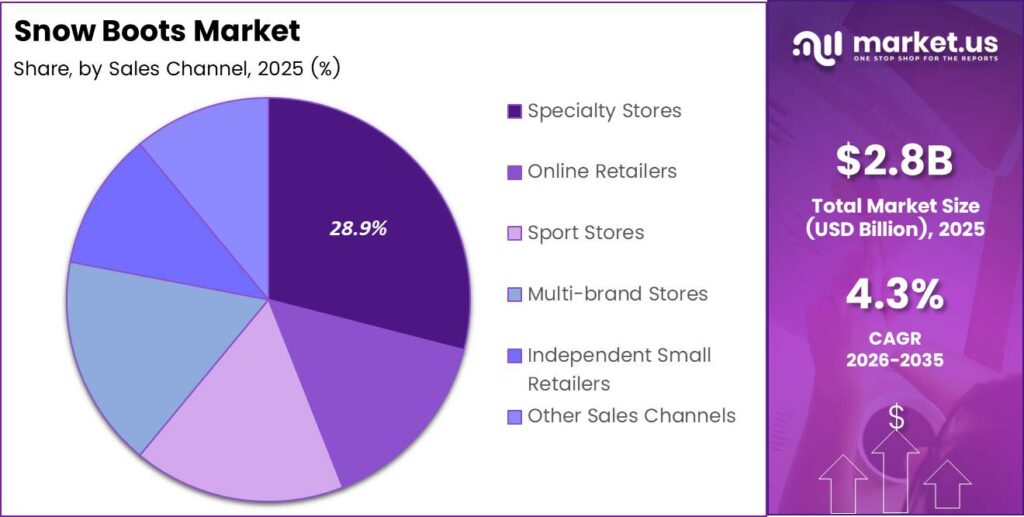
- Specialty Stores lead Sales Channel with a 28.90% share in 2025; Online Retailers carry the fastest-growing designation.
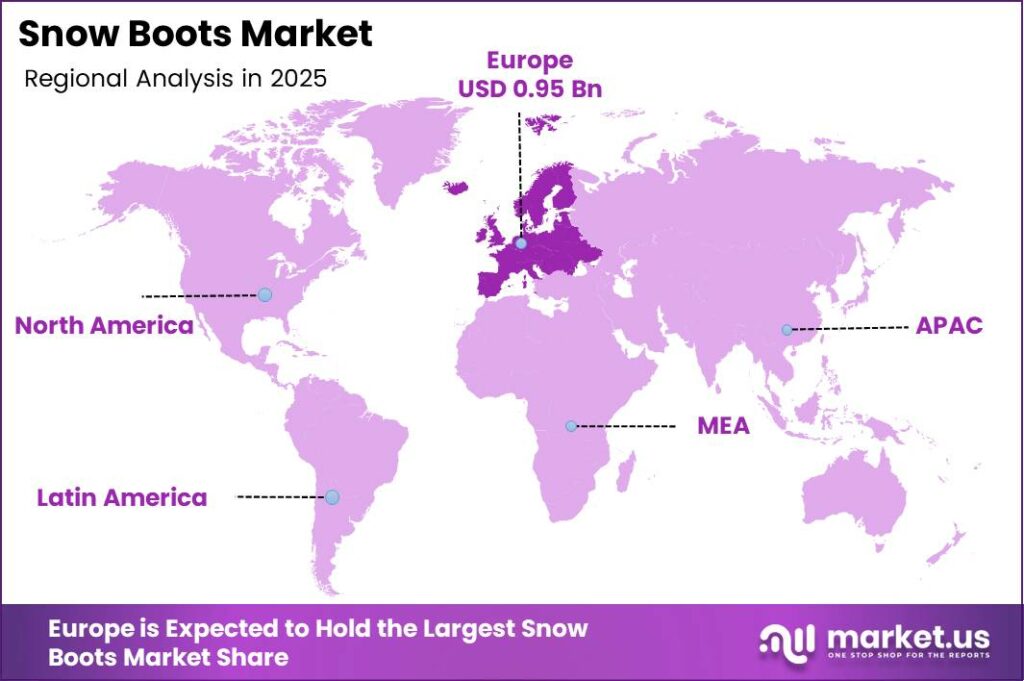
- Europe leads the regional estimates with a 34.78% share and a stated USD 0.95 Billion value in 2025.
- North America carries the fastest-growing regional designation.
- The forecast period covers 2026 to 2035.
Consumer households, outdoor recreation users, and cold-exposed workers form distinct purchasing groups, making product function more important than a single winter-fashion proposition. According to Eurostat, 78% of EU internet users aged 16 to 74 purchased online in 2025, supporting broad digital access. Online access can reduce shopping friction, but sellers still need clear fit guidance and credible protection claims. Investors should assess conversion quality rather than equating general online adoption with snow-boot sales.
Supply concentration makes import compliance and supplier oversight material operating considerations, even though the evidence does not quantify government spending on this category. As reported by Adidas, Asia accounted for 92% of its sourcing volume in 2025, illustrating concentrated manufacturing exposure. This company-wide example supports careful supplier mapping, not a global snow-boots sourcing estimate. Buyers should evaluate documentation, delivery alternatives, and component compatibility before committing capital to distant production networks.
Distribution expansion can broaden customer access without requiring a matching network of owned stores, reducing the fixed-cost burden of geographic entry. Data from Baffin shows an April 2025 shipping expansion into four European markets: France, Germany, the United Kingdom, and Italy. Direct fulfillment offers a practical route to test local interest before deeper investment. Sellers should compare delivery economics, returns, and repeat purchases before expanding country-specific inventory or marketing commitments.
Europe holds the leading position in the 2025 planning estimates, with a 34.78% share and a stated value of USD 0.95 Billion. The share and value require reconciliation because they do not align exactly with the stated global market estimate. Cold-weather mobility and mountain recreation offer plausible commercial foundations, but those factors do not independently establish regional leadership. Investors should distinguish the regional positioning assumption from verified operating evidence when sizing country-level opportunities.
Product Type Analysis
Outdoor Snow Boot leads with a 65.78% share in 2025, reflecting practical cold-weather mobility and recreation positioning.
In 2025, Outdoor Snow Boot held a 65.78% share in the Product Type segment of the Snow Boots Market. Figures from Eurostat show EU residents made nearly 1.2 billion overnight tourism trips in 2024, providing broad travel context rather than winter-footwear sales evidence. Trips involving cold, wet conditions can require insulated footwear, but ordinary travel does not establish snow-boot conversion. Retailers should target destination exposure and trip purpose rather than total traveler volume.
Sports Snow Boot serves buyers who prioritize secure fit, grip, and protection during winter recreation rather than everyday commuting alone. According to the International Olympic Committee, Milano Cortina’s 2026 Winter Olympic programme contained 116 events, creating a substantial winter-sports visibility platform. That visibility can support category discovery, but technical ski and snowboard boots remain distinct products. Sellers should define intended activities clearly and avoid treating event coverage as evidence of recreational snow-boot purchases.
Application Analysis
Men lead with a 42.54% share in 2025, reflecting practical winter-use and recreation positioning.
In 2025, Men held a 42.54% share in the Application segment of the Snow Boots Market. As reported by WHO, 29% of adult men worldwide were insufficiently physically active in 2022, describing participation conditions rather than footwear purchasing. Active winter use can create functional needs for insulation and traction, while commuting can sustain purchases outside recreational activity. Brands should separate everyday protection from sports positioning instead of assuming one message reaches all male buyers.
Women represent a functional winter-footwear customer group whose purchasing priorities can span commuting, recreation, fit, and styling rather than a single activity profile. Data from WHO shows 34% of adult women worldwide were insufficiently physically active in 2022, not that they lacked winter-footwear needs. Cold-weather mobility can require protection regardless of exercise frequency, separating everyday use from participation statistics. Sellers should test fit and intended use directly instead of treating inactivity as a purchasing forecast.
Kids require age-appropriate fit and practical winter protection, while household purchasing decisions also depend on climate exposure, school routines, and replacement timing. The US Census Bureau found that the population younger than 18 reached 73.1 million in 2024, establishing a demographic denominator rather than category users. Changing fit can create replacement needs even when boots remain serviceable, making size availability commercially important. Retailers should align replenishment with household shopping periods and local weather exposure.
Sales Channel Analysis
Specialty Stores lead with a 28.90% share in 2025, reflecting fit assistance and product-selection support.
In 2025, Specialty Stores held a 28.90% share in the Sales Channel segment of the Snow Boots Market. Based on Deckers annual-report data, UGG operated 137 company-owned retail stores at fiscal year-end, illustrating brand-owned specialty distribution rather than independent-store coverage. In-person fitting can help buyers compare sock allowance, closure systems, and walking comfort before purchase. Retailers should justify their service premium through fit support and product matching rather than assortment breadth alone.
Online Retailers widen geographic access and enable product comparison, but buyers must choose fit and protection levels without trying footwear before ordering. The US Census Bureau indicates that e-commerce represented 17.1% of seasonally adjusted US retail sales in 2026’s second quarter, demonstrating channel scale across categories. Product pages therefore need precise sizing and intended-use guidance to convert access into suitable purchases. Investors should track retained revenue after returns rather than headline order volume.
Sport Stores connect winter footwear with activity-led shopping, giving buyers a setting to compare boots against the needs of a planned outing. Figures from Adidas show a company-operated network of 2,022 stores in 2025, illustrating sporting-goods brand distribution rather than multi-brand store totals. Activity-specific merchandising can improve product matching when staff distinguish casual snow walking from technical winter sports. Retailers should prioritize credible use-case advice over broad claims that every boot suits every activity.
Key Market Segments
By Product Type
- Outdoor Snow Boot
- Sports Snow Boot
By Application
- Men
- Women
- Kids
By Sales Channel
- Specialty Stores
- Online Retailers
- Sport Stores
- Multi-brand Stores
- Independent Small Retailers
- Other Sales Channels
Regional Analysis
Europe holds the leading planning position in 2025 with a market share of 34.78% and a stated value of USD 0.95 Billion.
Europe’s commercial case combines everyday cold-weather mobility with destination-based recreation, but national weather exposure makes uniform inventory allocation a weak operating approach. According to Eurostat, EU accommodation establishments recorded 3.14 billion overnight stays in 2025, providing broad tourism context rather than winter-specific boot demand. Cold-destination trips can create practical footwear needs, while warm-season visits may contribute nothing to the category. Distributors should allocate stock by destination conditions rather than aggregate tourism totals.
North America’s fastest-growing designation remains a planning assumption, while retail conditions provide a separate measure of the spending environment confronting sellers. As reported by the US Census Bureau, total US retail sales increased 3.5% in 2025, offering a US-only backdrop rather than regional footwear growth. Category performance still depends on winter exposure, pricing, and purchase timing, so general retail expansion cannot establish snow-boot momentum. Investors should compare local sell-through and inventory turnover before expanding distribution.
Key Regions and Countries
North America
- US
- Canada
Europe
- Germany
- France
- The UK
- Spain
- Italy
- Rest of Europe
Asia Pacific
- China
- Japan
- South Korea
- India
- Australia
- Rest of APAC
Latin America
- Brazil
- Mexico
- Rest of Latin America
Middle East and Africa
- GCC
- South Africa
- Rest of MEA
Market Dynamics
Winter exposure creates practical footwear needs, but recreation-led positioning cannot assume that a larger population automatically produces a larger active customer base. Data from WHO shows global adult inactivity increased approximately five percentage points between 2010 and 2022, presenting a participation-related constraint. Commuting and essential outdoor work can remain relevant even when recreational activity weakens, separating functional purchasing from sports participation. Brands should balance everyday protection with activity-specific products rather than relying on one growth narrative.
Drivers
Outdoor participation broadens the pool of potential winter-footwear buyers, but conversion still requires cold exposure, suitable activities, and a reason to purchase. According to the Outdoor Industry Association figures accompanying the scenario, American hikers numbered 63.4 million in 2024, representing 20.5% of people aged 6 and older. These participation figures support activity-specific merchandising rather than a direct sales forecast. Sellers should focus on winter walking and destination needs instead of treating every hiker as a snow-boot customer.
The driver model assumes 2.0% participant growth, 25% incremental conversion, and 80% retention after substitution, yielding roughly 0.40 percentage point of annual support. These assumptions describe a scenario, not an observed causal estimate or independently validated market elasticity. The complete driver allocation totals 1.15 percentage points, already embedded within the baseline rather than added above it. Investors should test conversion and repeat use before assigning value to participation-led expansion.
| Driver | (~) % Impact on CAGR Forecast | Geographic Relevance | Impact Timeline |
|---|---|---|---|
| Expanding outdoor recreation participation | +0.40% | North America; Northern Europe | Short term (≤ 2 years) |
| Essential winter commuting demand | +0.25% | Canada; Nordic countries; Northern United States; Northeast Asia | Short term (≤ 2 years) |
| Children’s size-driven replacement purchases | +0.20% | Cold-climate household markets | Short term (≤ 2 years) |
| Existing online assortment accessibility | +0.15% | North America; Europe; Northeast Asia | Short term (≤ 2 years) |
| Performance-led premium product mix | +0.15% | Affluent cold-climate markets | Medium term (2–4 years) |
Restraints
Mild weather can cancel discretionary purchases by removing the immediate need for insulated footwear, leaving retailers with stock that requires later clearance. As reported by NOAA in the scenario evidence, the contiguous US averaged 34.1°F during December 2024 through February 2025, 1.9°F above average. Those observations demonstrate weather exposure rather than a measured global sales response. Retailers should differentiate commitments by climate and avoid treating one national average as a universal purchasing signal.
The restraint scenario assumes weather-sensitive purchases represent 25% of category sales and that this subset falls 7% below plan, creating a 1.75% shortfall. The model spreads that sales-level effect across five years, approximating 0.35 percentage point of annualized drag rather than a recurring annual loss. The full restraint allocation totals 1.00 percentage point and remains embedded in baseline growth. Buyers should protect cash through conservative initial orders and targeted replenishment instead of uniform seasonal commitments.
| Restraint | (~) % Impact on CAGR Forecast | Geographic Relevance | Impact Timeline |
|---|---|---|---|
| Mild-winter purchase cancellation | -0.35% | Temperate North America; Northern Europe; Lower-elevation Asia | Long term (≥ 4 years) |
| Discretionary household budget compression | -0.25% | North America; Europe; Price-sensitive importing markets | Short term (≤ 2 years) |
| Noncompliant PFAS product sales bans | -0.15% | California; Affected textile-footwear assortments | Short term (≤ 2 years) |
| Durable adult-boot replacement deferral | -0.15% | Mature cold-climate markets | Medium term (2–4 years) |
| Retailer purchasing-budget limits | -0.10% | Independent winter-footwear retail channels | Short term (≤ 2 years) |
Challenges
Ocean routing disruption can delay seasonal stock and tie up cash before products reach stores, even when customer interest remains intact. Data from UNCTAD’s 2024 review describes a midyear 70% fall in Suez tonnage and an 89% increase in Cape of Good Hope arrivals. Those historical benchmarks do not establish unchanged conditions through 2026, but they illustrate exposure to longer routes. Manufacturers should evaluate delivery reliability alongside freight price when choosing production and shipping arrangements.
The operating scenario adds 10 to 15 days to a 90-day procurement cycle, increasing pipeline inventory requirements by approximately 11% to 17%. The model then exposes 20% of sales to a 6% seasonal miss, producing a 1.2% sales-level shortfall. Annualization across five years approximates 0.25 percentage point of friction; the full challenge allocation totals 0.73 percentage point. Sellers should protect delivery windows through earlier bookings and selective replenishment rather than simply increasing every inventory buffer.
| Challenge | (~) % CAGR Friction Drag | Geographic Relevance | Mitigation Horizon |
|---|---|---|---|
| Ocean freight routing disruption | -0.25% | Asian sourcing routes to Europe and North America | Short term (≤ 2 years) |
| Fit related return handling | -0.18% | Online footwear channels globally | Medium term (2–4 years) |
| Cold performance validation complexity | -0.12% | Global technical-footwear manufacturing | Medium term (2–4 years) |
| Size assortment production imbalance | -0.10% | Global multi-size footwear supply chains | Medium term (2–4 years) |
| Specialized tooling supplier concentration | -0.08% | Asian manufacturing clusters; Global importers | Long term (≥ 4 years) |
Opportunities
Managed occupational contracts offer a potential route from fragmented purchases toward organized fitting, delivery, and replacement for cold-exposed workers. OSHA indicates that insulated, waterproof boots suit cold environments, establishing a practical use case rather than a universal employer purchasing mandate. Contract economics therefore depend on additional account wins and service efficiency, not merely relabeling existing work-boot sales. Suppliers should confirm occupational performance requirements before pursuing workforce agreements that create new costs or liability.
The contract scenario reduces selling expense from 12% to 7% of revenue, then adds 2% for services, improving contribution margin by approximately 3 percentage points. An additional revenue run rate of 1.5% by year five supports roughly 0.30 percentage point of CAGR upside within this illustration. Combined opportunities contribute a conditional 0.85 percentage point, taking baseline growth from 4.3% to approximately 5.15%. Investors should require genuinely additional purchases and exclude rental activity that only replaces new-pair sales.
| Opportunity | (~) % Potential CAGR Upside | Geographic Relevance | Execution Window |
|---|---|---|---|
| Managed occupational winter-footwear contracts | +0.30% | North America; Northern Europe; Cold-climate industrial markets | Medium term (2–4 years) |
| Adaptive senior-access winter footwear | +0.20% | Japan; Europe; Canada | Medium term (2–4 years) |
| Domestic mountain-market distribution expansion | +0.15% | Himalayan regions; Central Asia; Andes | Long term (≥ 4 years) |
| Resort-based visitor rental fleets | +0.12% | Alpine resorts; Hokkaido; Canadian Rockies | Medium term (2–4 years) |
| Connected heated-footwear platforms | +0.08% | Premium cold-climate consumer markets | Long term (≥ 4 years) |
Key Company Insights
Adidas AG
Adidas brings corporate scale to the competitive landscape, but group revenue does not establish leadership in snow boots or isolate winter-footwear performance. Figures from Adidas show consolidated net sales of EUR 24,811 million in 2025, demonstrating resources beyond this specific product category. Corporate scale can support development and distribution, while category success still requires suitable products and convincing customer positioning. Investors should evaluate winter-footwear execution separately rather than assigning the group’s overall strength directly to this market.
Adidas announced approximately EUR 100 million of planned fourth-quarter reinvestment in October 2026, targeting initiatives intended to improve future operating efficiency. According to the company’s announcement, that allocation applied across the business rather than a dedicated snow-boots programme, requiring careful interpretation of category relevance. Investment can support future competitiveness, but a group-wide budget does not prove winter-footwear capacity expansion. Buyers should seek product-specific commitments before treating this announcement as evidence of additional cold-weather assortment support.
Asics Corporation
ASICS provides a useful example of substantial footwear-sector resources, although its financial scale cannot establish a measured share of snow-boots revenue. As reported by ASICS, consolidated net sales reached JPY 810.9 billion in 2025, reflecting company-wide operations rather than this narrow category. Group resources can support product development and customer access, but suitable cold-weather products remain the necessary link to category participation. Investors should separate broad footwear performance from evidence of a defensible winter-protection proposition.
ASICS unveiled NOVABLAST 6 in May 2026, announcing July availability and a USD 150 launch price within its running-footwear portfolio. Data from the company announcement describes an adjacent product innovation rather than a snow-boot launch, so the development does not establish winter-footwear expansion. The announcement demonstrates continued product renewal, but category relevance depends on suitable applications rather than shared branding alone. Investors should avoid counting unrelated running-shoe introductions as additional snow-boots revenue opportunities.
Key Players
- Adidas AG
- Asics Corporation
- Bata Limited
- Columbia Sportswear Company
- Crocs, Inc.
- DC Shoe Company
- Deckers Outdoor Corporation
- Deichmann SE
- Honeywell International Inc.
- Jack Wolfskin GmbH & Co
- Kamik Company
- Michael Kors Holdings Ltd.
- New Balance Athletics, Inc.
- Nike, Inc.
- Other Key Players
Recent Developments
2026
- October 2026: Baffin product-line expansion introduced additional ICE CREW Safety Toe & Plate options, including women’s sizes 6 to 11, at CAD 200 and USD 216. The development concerns cold-weather industrial footwear. According to Baffin’s company-issued announcement, the expansion added women’s fit and further colour options.
- September 2026: Baffin product launch introduced MIST women’s winter boots in sizes 6 to 11, with announced prices of CAD 185 and USD 192. As reported by Baffin through Cision, the launch expanded its Ease Collection.
- September 2026: Baffin product launch introduced B-TEK THERMAL INSOLE at CAD 30 and USD 30, with women’s sizes 6 to 11 and men’s sizes 7 to 15. Data from Baffin identifies an aftermarket accessory introduction rather than a boot launch.
- April 2026: Baffin product launch introduced RECOVERY CLOG in four colourways at CAD 70 and USD 72. Baffin indicates that the product entered the recovery-footwear category, making it adjacent post-hike footwear rather than winter-protective equipment.
- March 2026: UGG product launch introduced its Spring Heritage Utility offering, including two explicitly named sneaker styles, Axoid and Knoll. Figures from Deckers show an adjacent transitional-weather introduction; the named-style count does not represent a complete SKU total.
2025
- October 2025: Baffin product launch introduced GAITERS at CAD 90 and USD 96, extending its offering into outdoor accessories. According to Baffin’s company-issued release, the development concerned protective accessories rather than new boot capacity.
- August 2025: Baffin product launch introduced the Terrain Collection with two styles, following testing across three continents and five expeditions. As reported by Baffin, announced prices were CAD 250 and USD 250; the collection serves adjacent multi-season hiking uses.
- May 2025: Skechers acquisition agreement with 3G Capital established a cash offer of USD 63 per share, carrying a stated 30% premium against the announcement’s reference price measure. Data from Skechers identifies broader footwear-sector consolidation rather than a snow-boots-specific transaction.
- May 2025: Baffin product launch introduced DETOUR Metatarsal Guard protective boots in unisex sizes 5 to 15, priced at CAD 250 and USD 235. Baffin indicates that the product targets mining applications, placing it in an adjacent industrial-footwear category.
- April 2025: ANTA Sports acquisition agreement covered 100% ownership of the company operating Jack Wolfskin for base cash consideration of USD 290 million, subject to adjustments. According to ANTA’s HKEX announcement, the transaction concerned the outdoor business; the agreement and closing are not counted separately here.
2024
- October 2024: Baffin product launch introduced the Hero Collection, including a Safety Toe & Plate option at CAD 320 and USD 290. As reported by Baffin through Cision, the offering targeted protective applications for technical and emergency-service workers rather than recreational snow use alone.
Geopolitical Impact Analysis
Trade conflict and transport uncertainty can alter procurement plans for manufacturers importing rubber outsoles, synthetic uppers, insulation, and fastening components into seasonal selling markets. Data from the WTO’s October 2026 update forecasts merchandise trade volume growth of 3.9% in 2026 and 4.1% in 2027. The later forecast depends on timely resolution of the Middle East conflict, making the figures conditional rather than evidence of uninterrupted trade. Snow-boot manufacturers should not translate aggregate trade expansion into guaranteed component availability, stable landed costs, or additional category sales. Distributors should instead compare supplier delivery commitments, import exposure, and seasonal receipt dates before accepting inventory obligations that depend on predictable cross-border movement.
Maritime rerouting exposes snow-boot supply chains to longer journeys for finished footwear and components, potentially separating factory completion dates from commercially useful delivery dates. Figures from UNCTAD show seaborne trade volume increased 2.2% in 2024, while transport measured in ton-miles increased 5.9%, reflecting longer-distance movement. The difference illustrates why expanding transport activity can absorb shipping resources without delivering a proportional increase in goods available to buyers. Rubber soles, textile uppers, and insulation can therefore face scheduling pressure even when suppliers continue producing, although these figures do not quantify footwear-specific costs. Manufacturers should assess consolidated shipping, alternative routing, and selective stock buffers against the cash cost of holding products before winter sell-through.
Report Scope
| Report Features | Description |
|---|---|
| Market Value (2025) | USD 2.8 Billion, planning estimate |
| Forecast Revenue (2035) | USD 4.2 Billion, planning estimate |
| CAGR (2026-2035) | 4.3%, planning assumption requiring reconciliation with endpoint values |
| Base Year for Estimation | 2025 |
| Historic Period | 2021-2025; complete historic market-size series not established in this report |
| Forecast Period | 2026-2035 |
| Report Coverage | Revenue Forecast Assumptions, Market Dynamics, Market Opportunity Analysis, Technology and Innovation Context, Competitive Landscape, Recent Developments |
| Segments Covered | By Product Type (Outdoor Snow Boot, Sports Snow Boot), By Application (Men, Women, Kids), By Sales Channel (Specialty Stores, Online Retailers, Sport Stores, Multi-brand Stores, Independent Small Retailers, Other Sales Channels) |
| Regional Analysis | Detailed contextual analysis: Europe and North America. Geographic taxonomy: North America (US and Canada), Europe (Germany, France, The UK, Spain, Italy, and Rest of Europe), Asia Pacific (China, Japan, South Korea, India, Australia, and Rest of APAC), Latin America (Brazil, Mexico, and Rest of Latin America), Middle East and Africa (GCC, South Africa, and Rest of MEA). |
| Competitive Landscape | Adidas AG, Asics Corporation, Bata Limited, Columbia Sportswear Company, Crocs, Inc., DC Shoe Company, Deckers Outdoor Corporation, Deichmann SE, Honeywell International Inc., Jack Wolfskin GmbH & Co, Kamik Company, Michael Kors Holdings Ltd., New Balance Athletics, Inc., Nike, Inc., Other Key Players. |
| Evidence Treatment | Market values and shares remain unverified planning estimates. Primary-source company and macroeconomic figures retain their original scope. Adjacent product developments do not establish snow-boots revenue. |
| Customization Scope | Segment and country-level customization requires agreement on coverage, evidence requirements, and deliverables. |
| Purchase Options | Commercial licensing terms require confirmation with the publisher. This draft does not establish license availability, user limits, or purchase rights. |