


Report Overview
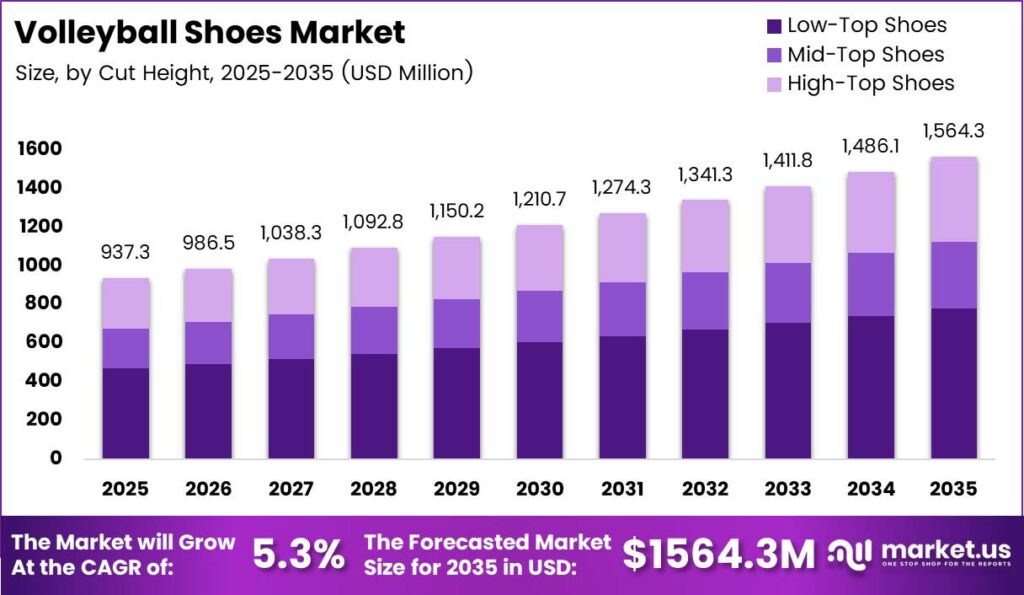
Global Volleyball Shoes Market size is expected to be worth around USD 1,564.3 Million by 2035 from USD 937.3 Million in 2025, growing at a CAGR of 5.3% during the forecast period 2026 to 2035. This trajectory reflects steady sport participation growth, rising consumer preference for performance-specific footwear, and expanding retail access across both developed and emerging markets over the decade.
The volleyball shoes market covers footwear engineered specifically for indoor court play, designed to support lateral movement, jump mechanics, and landing stability. Products span entry-level club shoes, mid-tier training models, and elite competition footwear, segmented by cut height, end consumer, and distribution channel. Brands compete on cushioning technology, outsole grip, and weight reduction to meet the demands of competitive and recreational players globally.
Key Takeaways
- Volleyball Shoes Market value in 2025 stands at USD 937.3 Million, projected to reach USD 1,564.3 Million by 2035 at a CAGR of 5.3%.
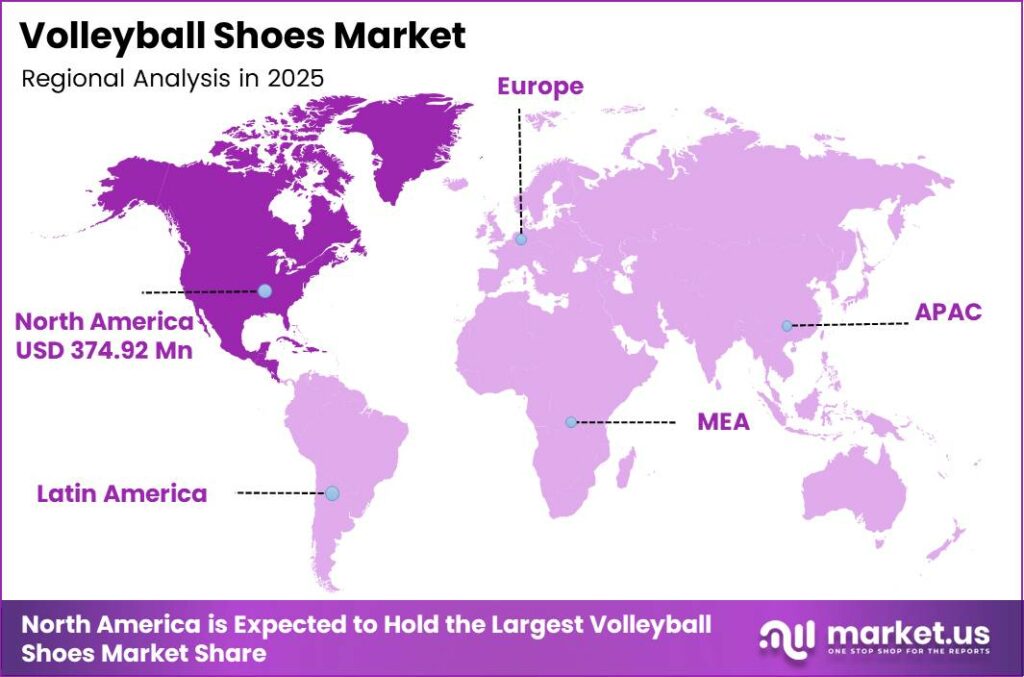
- North America holds the dominant regional share at 40.21%, valued at USD 374.92 Million.
- Latin America is the fastest-growing region across the forecast period.
- Low-Top Shoes lead the Cut Height segment with a 42.45% share; Mid-Top Shoes are the fastest-growing sub-segment.
- Adults account for 64.56% of consumer demand; Kids represent the fastest-growing consumer sub-segment.
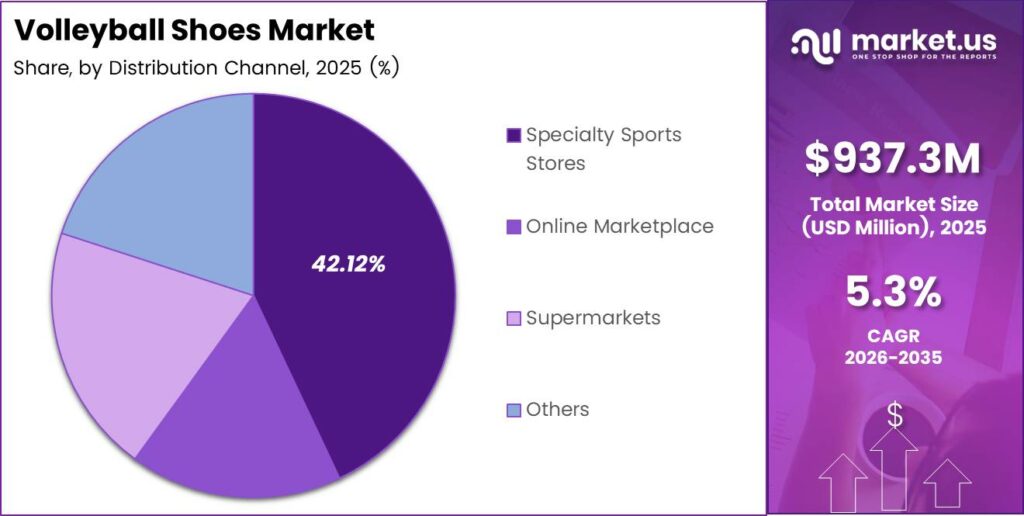
- Specialty Sports Stores command 42.12% of distribution channel share; Online Marketplace is the fastest-growing channel.
- Key players include ASICS, Mizuno, Nike, Adidas, Under Armour, Puma, New Balance, and Yonex, among others.
Government investment in school sports infrastructure and national volleyball federation programs directly expands the base of active players purchasing sport-specific shoes. Several national bodies across Asia and Africa have formalized youth volleyball development frameworks, creating institutional demand pipelines that replace one-time purchases with predictable seasonal replenishment cycles. Brands aligned with federation programs gain early access to emerging player cohorts before general retail channels reach them.
Mizuno launched the Wave Lightning Elite volleyball shoe in Japan in December 2025 at ¥18,700, reporting approximately 5 g lower weight per shoe and approximately 17% higher outsole grip than its predecessor. This level of incremental specification improvement reflects the premium product development pace that keeps performance buyers in upgrade cycles. Vendors who demonstrate measurable biomechanical gains in published testing can justify price premiums and reduce the substitution risk from multipurpose athletic footwear.
Cut Height Analysis
Low-Top Shoes dominate with 42.45% due to lightweight court mobility preference.
In 2025, Low-Top Shoes held a dominant market position in the By Cut Height segment of the Volleyball Shoes Market, with a 42.45% share. Low-cut designs reduce material weight and allow greater ankle mobility, directly matching the lateral shuffle and rapid direction-change demands of competitive volleyball. A 2025 biomechanical study recorded ankle inversion moment during countermovement-jump landings at 0.20 N·m/kg in RIP-IT shoes versus 0.15 N·m/kg in Adidas models, showing that sole and upper construction choices measurably affect rotational load. Brands offering low-top platforms with validated lateral support will capture the largest share of repeat competitive buyers.
Mid-Top Shoes represent the fastest-growing sub-segment in the cut height category, gaining share from players who prioritize ankle stability during high-frequency training sessions. This profile attracts club and recreational players who train multiple times per week and seek injury-risk reduction without the full weight penalty of a high-cut design. The segment benefits directly from brands expanding their mid-cut lines, as Mizuno did in March 2026 with the MIZUNO NEO JUMP, which featured an ankle-cut height positioned between low-cut and mid-cut designs at a retail price of ¥22,000.
High-Top Shoes serve a smaller but loyal player base prioritizing maximum ankle enclosure during rehabilitation or post-injury return-to-play protocols. Players managing chronic ankle instability accept higher shoe weight in exchange for structural confinement during aggressive lateral cutting. This sub-segment, alongside mid-top and high-top designs collectively, holds the remaining share below the low-top dominant position, with commercial volumes concentrated in specialist sports retail channels rather than mass market outlets.
Consumer Analysis
Adult consumers dominate with 64.56% due to competitive play and team purchasing volume.
In 2025, Adult consumers held a dominant market position in the By Consumer segment of the Volleyball Shoes Market, with a 64.56% share. Adult players across recreational leagues, club teams, and professional programs drive repeat purchase behavior tied to seasonal training schedules and competition calendars. A 2025 study measured peak ankle internal rotation during countermovement-jump landings at 9.57° in RIP-IT shoes, 7.53° in Mizuno shoes, and 6.58° in Adidas shoes, with all three pairwise comparisons statistically significant. Adult buyers who interpret biomechanical test results are more likely to select model-specific footwear, supporting higher average selling prices in this segment. Mizuno extended its partnership with Volleyball World through 2026 in May 2025, covering the Volleyball Nations League and FIVB Volleyball World Championships, reinforcing brand association with the adult competitive tier.
The Kids sub-segment is the fastest-growing consumer category, driven by structured school programs, junior club enrollment, and federation grassroots initiatives expanding participation from an early age. Parents purchasing for junior players prioritize fit, durability, and court grip over premium cushioning technology, which shifts average selling prices lower but drives higher unit volumes per household over multiple growth cycles. Brands offering dedicated junior sizing ranges and entry-performance models gain early brand loyalty that converts to adult-segment purchases as players mature through competition levels.
Distribution Channel Analysis
Specialty Sports Stores dominate with 42.12% due to expert fitting and brand assortment depth.
In 2025, Specialty Sports Stores held a dominant market position in the By Distribution Channel segment of the Volleyball Shoes Market, with a 42.12% share. These outlets offer gait analysis, in-person fit consultation, and full model range access that general retailers cannot replicate. In April 2025, All Volleyball was appointed as the official ASICS Team Package provider, offering coordinated team orders for volleyball footwear including the women’s Upcourt 6 and GEL-Rocket 11 and the men’s Sky Elite FF 3 and GEL-Tactic 12. This type of specialist channel agreement confirms that institutional buyers route team purchases through dedicated sports retail partners rather than mass-market platforms, reinforcing the channel’s structural share advantage.
Online Marketplace is the fastest-growing distribution channel, benefiting from wider model availability, price comparison tools, and direct-to-consumer brand stores that bypass traditional wholesale margins. Club coaches and individual players increasingly source specialist models through brand websites and sporting goods platforms, particularly for sizes or colorways unavailable in local specialty retail. This channel shift creates margin improvement opportunities for brands operating their own e-commerce infrastructure while pressuring wholesale-dependent specialty retailers to differentiate on service and fitting expertise.
Supermarkets and other channels collectively hold the remaining share below specialty and online, serving primarily recreational and entry-level buyers for whom price and convenience outweigh technical specification. These channels stock limited SKUs focused on general athletic footwear that carries partial volleyball utility. As a result, they contribute disproportionately to the Kids sub-segment and economy price tier, where brand specificity matters less than accessibility and value.
Key Market Segments
By Cut Height
- Low-Top Shoes
- Mid-Top Shoes
- High-Top Shoes
By Consumer
- Adult
- Kids
By Distribution Channel
- Specialty Sports Stores
- Online Marketplace
- Supermarkets
- Others
Regional Analysis
North America Dominates the Volleyball Shoes Market with a Market Share of 40.21%, Valued at USD 374.92 Million
North America commands 40.21% of the global volleyball shoes market, valued at USD 374.92 Million in 2025. The region’s dominance reflects deep sport infrastructure, a large base of school and collegiate volleyball programs, and high consumer willingness to pay for performance footwear. Specialty retail density and direct-to-consumer brand investments support premium average selling prices. In August 2025, adidas signed Nebraska volleyball outside hitter Harper Murray to a name, image, and likeness endorsement agreement, subsequently including her in the Crazyflight 7 footwear rollout in June 2026, reinforcing North American athlete marketing as a key demand-activation strategy.
Latin America is the fastest-growing regional market across the forecast period. Brazil’s established professional league structure and Mexico’s expanding club network provide the foundational participation base for accelerating shoe purchases. Rising middle-class consumer spending across the region increases the addressable market for mid-tier and premium volleyball footwear above entry-level price points. Brands entering Latin America through e-commerce and specialty retail partnerships will capture first-mover share before multinational incumbents fully localize their distribution infrastructure.
Europe, Asia Pacific, the Middle East and Africa, together hold the remaining share of the global market. Asia Pacific contributes meaningfully through Japan’s strong volleyball culture and China’s growing participation base, with Mizuno’s domestic product launches in Japan, including multiple new models across late 2025 and early 2026, reflecting the region’s premium product consumption potential. European markets provide stable institutional demand through club and school programs, while Middle East and Africa represent longer-horizon opportunity tied to infrastructure development and federation investment.
Key Regions and Countries
North America
- US
- Canada
Europe
- Germany
- France
- The UK
- Spain
- Italy
- Rest of Europe
Asia Pacific
- China
- Japan
- South Korea
- India
- Australia
- Rest of APAC
Latin America
- Brazil
- Mexico
- Rest of Latin America
Middle East and Africa
- GCC
- South Africa
- Rest of MEA
Market Dynamics
Market Opportunity Analysis - Underserved consumers, emerging regions, and adjacent sport channels offer entry points for new players
The Kids sub-segment represents a structurally underexploited growth pocket within the consumer segment. As per our research, kids account for the fastest-growing consumer tier while adults hold 64.56% of current share, indicating that the youth segment is underpenetrated relative to its participation growth rate. Brands with dedicated junior sizing ranges and entry-performance pricing will capture long-cycle brand loyalty before premium competitors establish category presence. Peak knee external rotation during countermovement-jump landings averaged 13.48° in RIP-IT shoes versus 11.86° in Mizuno shoes, suggesting biomechanical differentiation arguments can support category-specific product development investment for youth buyers.
Latin America’s fastest-growing regional status combined with a current low absolute share base creates an early-entry window for brands willing to invest in regional distribution before the market matures. Brazil’s professional league infrastructure and Mexico’s expanding club base provide institutional anchor points for specialist retail partnerships. By contrast, North America’s dominant 40.21% share signals a saturated competitive environment where new entrants face higher acquisition costs and established brand loyalty barriers. This means Latin America offers disproportionate return on market development investment relative to the capital required to gain incremental share in North America.
Online Marketplace is the fastest-growing distribution channel while Specialty Sports Stores hold 42.12%, indicating that digital channels remain structurally underweight relative to their participation growth trajectory. Brands that invest in direct-to-consumer e-commerce infrastructure ahead of full channel maturity will capture margin advantages unavailable through wholesale-dependent specialty retail models. Peak knee valgus during the three-step approach’s plant/loading phase averaged 7.54° in Mizuno shoes versus 6.05° in Adidas shoes, demonstrating that technical differentiation arguments can be communicated effectively in digital product content to convert online browsers into specification-driven buyers.
The Mid-Top Shoes sub-segment is growing faster than the dominant Low-Top category, yet remains below the 42.45% low-cut share, marking it as an underdeveloped product tier for brands with existing low-cut and high-cut lines. Players seeking ankle stability without full weight penalty represent a distinct buyer profile that current assortments incompletely address. Mizuno’s March 2026 launch of the MIZUNO NEO JUMP at ¥22,000 with an intermediate ankle-cut height signals commercial validation of this positioning. New entrants or challenger brands developing purpose-built mid-cut platforms can occupy category space before market leaders complete their own mid-cut range expansions.
Technology and Innovation Landscape - Biomechanical validation and cushioning system evolution define the next competitive frontier
Published biomechanical testing now provides quantifiable performance benchmarks that brands can use to differentiate products beyond marketing claims. A 2025 study published in Frontiers in Sports and Active Living measured countermovement-jump height at 39.07 cm in RIP-IT shoes, 38.80 cm in Mizuno shoes, and 38.63 cm in Adidas shoes, with no statistically significant difference between conditions. This finding confirms that jump height alone does not differentiate competitive volleyball shoe models, shifting the innovation battleground toward injury-risk mechanics, landing biomechanics, and ankle load management where measurable differences between brands do exist.
Ankle dorsiflexion mechanics during landing represent a measurable differentiator between current shoe platforms. During countermovement-jump landings, peak ankle dorsiflexion averaged 25.71° in RIP-IT shoes, 28.21° in Mizuno shoes, and 26.88° in Adidas shoes, with Mizuno differing significantly from both RIP-IT and Adidas. During the plant/loading phase of the three-step approach, RIP-IT permitted significantly less dorsiflexion at 14.71° versus 18.29° in Mizuno shoes and 17.03° in Adidas shoes. Brands whose shoe geometry produces dorsiflexion values aligned with injury-prevention benchmarks gain a defensible clinical argument for premium pricing in performance and rehabilitation market segments.
Knee flexion mechanics during landing provide a second biomechanical axis of differentiation. Peak knee flexion during countermovement-jump landings averaged 79.11° in RIP-IT shoes versus 75.76° in Mizuno shoes and 75.63° in Adidas shoes, with RIP-IT producing significantly greater knee bending than both competitors. Greater knee flexion at landing distributes impact force across a longer deceleration path, which influences patellar tendon loading in high-frequency training contexts. Shoe brands that commission independent biomechanical studies and publish peer-reviewed findings create a technical moat that purely design-led competitors cannot replicate without equivalent testing investment.
Cushioning system innovation in Japan demonstrates the commercial cadence of technology-driven product cycling. Mizuno launched three distinct volleyball shoe models between December 2025 and March 2026, each incorporating different combinations of MIZUNO ENERZY, MIZUNO ENERZY CORE, and MIZUNO ENERZY xp insole systems at price points from ¥9,900 to ¥22,000. This tiered cushioning architecture allows a single brand to address entry, performance, and elite buyers within one platform family, reducing development cost per price tier while maintaining differentiation across the range. Competitors without proprietary cushioning systems face higher commodity component costs and reduced ability to justify premium price positioning on material performance grounds.
Drivers
Structured school and community volleyball programs create a recurring base of footwear buyers tied to seasonal participation cycles rather than one-time spectator interest. The FIVB Volleyball Foundation reported in May 2025 that the Brahmaputra Volleyball League had introduced more than 10,000 children to volleyball, while a late-2024 Bhubaneswar festival drew 5,000 youth participants. This documented participation expansion favors brands investing in entry-performance ranges and school partnership channels, where seasonal replenishment demand is more predictable than athlete-led retail spikes.
Performance-led footwear premiumization reflects buyers moving from general athletic shoes to specialist models with validated court-specific properties. Training frequency drives replacement demand independently of participation growth, as competitive players replace shoes based on cushioning degradation and outsole wear rather than participation milestones. Specialist online channels accelerate model discovery in Europe, North America, and urban Asia, converting informed buyers who might otherwise default to multipurpose alternatives. Professional competition exposure reinforces brand visibility in Europe, East Asia, and Brazil, extending the commercial return from federation sponsorships into retail sales.
| Driver | (~) % Impact on CAGR Forecast | Geographic Relevance | Impact Timeline |
|---|---|---|---|
| Organized youth participation expansion | +0.40% | North America; Asia; selected African markets | Short term (≤ 2 years) |
| Performance-led footwear premiumization | +0.25% | North America; Europe; Japan | Short term (≤ 2 years) |
| Training-related replacement demand | +0.20% | Established indoor volleyball markets | Short term (≤ 2 years) |
| Specialist online assortment accessibility | +0.15% | Europe; North America; urban Asia | Short term (≤ 2 years) |
| Professional competition merchandising exposure | +0.10% | Europe; East Asia; Brazil | Medium term (2–4 years) |
Restraints
Import duties create a direct affordability barrier when brands pass border costs into shelf prices, particularly where players weigh specialist footwear against postponing a purchase. The US Harmonized Tariff Schedule classifies sports footwear by upper material, sole construction, and value, meaning no single duty rate applies uniformly across volleyball shoe models. A 10-percentage-point increase in duties applied to customs values representing 35–45% of retail price produces a direct cost burden of 3.5–4.5% of that price, with assumed demand elasticity of -0.8 to -1.2 generating approximately 1.7–4.3% lower affected-market volume. Brands must absorb costs, reduce entry-level specifications, or accept weaker conversion in duty-intensive markets.
Multipurpose athletic shoe substitution limits specialist volleyball footwear penetration among recreational players who view court-specific features as non-essential. Household discretionary budget constraints in price-sensitive emerging markets amplify this substitution effect, as players opt for cross-training shoes that serve multiple sports at lower per-use cost. Limited indoor court access in rural and peri-urban markets further suppresses the immediate need for court-specific sole construction. Mandatory team-footwear purchasing restrictions in contracted schools and clubs reduce individual purchase autonomy, concentrating buying power in institutional decision-makers who prioritize unit cost over performance specification.
| Restraint | (~) % Impact on CAGR Forecast | Geographic Relevance | Impact Timeline |
|---|---|---|---|
| Import-duty-driven retail affordability barrier | -0.35% | United States; other duty-intensive importing markets | Short term (≤ 2 years) |
| Existing multipurpose-shoe substitution | -0.25% | Global recreational and entry-level segments | Short term (≤ 2 years) |
| Household discretionary-budget constraints | -0.20% | Price-sensitive emerging markets; lower-income households | Short term (≤ 2 years) |
| Limited indoor-court access | -0.15% | Underserved rural and peri-urban markets | Long term (≥ 4 years) |
| Mandatory team-footwear purchasing restrictions | -0.05% | Contracted schools; clubs; professional teams | Medium term (2–4 years) |
Challenges
Ocean-route disruption makes seasonal replenishment unreliable even when demand and production remain intact. UNCTAD reported that by mid-2024, tonnage transiting the Suez Canal had fallen by 70%, while Cape of Good Hope arrivals increased by 89%. A planning scenario adding 10–14 transit days to a standard 60-day replenishment cycle increases pipeline-stock requirements by approximately 17–23%, tying up working capital and raising markdown exposure when arrivals miss team-order windows. Brands with regional stock buffers and diversified routing absorb this friction better than those relying on single-lane replenishment.
Size-level inventory forecasting complexity creates stock imbalances that reduce sell-through rates and increase end-of-season markdown costs. Court-surface traction validation across different indoor floor coatings adds development time and testing cost to each new model release, lengthening go-to-market cycles. Specialist factory qualification constraints concentrate manufacturing capability in a limited number of Asian production hubs, reducing sourcing flexibility when capacity tightens. Material traceability data fragmentation across multi-tier supply chains creates compliance exposure for brands selling into European markets, where regulatory documentation requirements for finished goods are tightening.
| Challenge | (~) % CAGR Friction Drag | Geographic Relevance | Mitigation Horizon |
|---|---|---|---|
| Maritime replenishment lead-time volatility | -0.30% | Asia–Europe routes; globally distributed brands | Short term (≤ 2 years) |
| Size-level inventory forecasting complexity | -0.20% | Global specialist retail and wholesale | Medium term (2–4 years) |
| Court-surface traction validation complexity | -0.15% | Global indoor volleyball markets | Medium term (2–4 years) |
| Specialist factory qualification constraints | -0.10% | Asian manufacturing hubs; importing markets | Medium term (2–4 years) |
| Material traceability data fragmentation | -0.10% | Europe-facing supply chains; global exporters | Long term (≥ 4 years) |
Opportunities
Age-specific wider-fit volleyball shoes address an underserved segment where standard lasts exclude older adult players whose foot geometry diverges from younger-player norms. A 2024 study scanned the feet of 374 women active in racket and team sports across age groups from 18–29 to 70–79 years, finding that older groups showed greater foot width, ball circumference, and short-heel circumference than the youngest cohort. An illustrative pilot targeting a 3–5% price premium and a 2–3-percentage-point reduction in fit-related returns could generate approximately 1–2 percentage points of gross-margin improvement after incremental manufacturing costs. Brands restricting launch assortments and reusing compatible components reduce execution risk while testing commercial viability before full-range investment.
Institutional footwear-service contracts with universities, academies, and established club networks provide multi-season revenue predictability unavailable through standard retail channels. Adjacent court-sport platform licensing across Europe and Asia-Pacific enables brands to extend volleyball-specific sole and cushioning technology into badminton, handball, and indoor futsal, multiplying return on development investment. Adaptive seated-volleyball footwear for Paralympic and disability-sport ecosystems, combined with verified low-impact procurement ranges targeting European sustainability-led buyers, represents longer-horizon upside that rewards early product development investment ahead of regulatory and institutional procurement policy shifts.
| Opportunity | (~) % Potential CAGR Upside | Geographic Relevance | Execution Window |
|---|---|---|---|
| Age-specific wider-fit product platforms | +0.35% | Europe; North America; Japan | Medium term (2–4 years) |
| Institutional footwear-service contracts | +0.25% | Universities; academies; established club networks | Medium term (2–4 years) |
| Adjacent court-sport platform licensing | +0.20% | Europe; Asia-Pacific; North America | Medium term (2–4 years) |
| Adaptive seated-volleyball footwear development | +0.15% | Paralympic and disability-sport ecosystems | Long term (≥ 4 years) |
| Verified low-impact procurement ranges | +0.10% | European institutions; sustainability-led buyers | Long term (≥ 4 years) |
Key Company Insights
ASICS maintains structural advantage in the volleyball shoes market through its specialist product architecture, which concentrates technology investment in court-specific categories rather than distributing it across general athletic footwear. In April 2025, All Volleyball’s appointment as the official ASICS Team Package provider confirmed the brand’s institutional channel strategy, bundling team orders for the Upcourt 6, GEL-Rocket 11, Sky Elite FF 3, and GEL-Tactic 12. This multi-model team ordering capability reduces switching friction for club buyers and deepens account retention across recurring seasonal procurement cycles.
Mizuno demonstrates biomechanical product positioning that competitors must match on technical data rather than brand narrative alone. The 2025 study recorded peak ankle inversion during the plant/loading phase of the three-step approach at 6.05° in RIP-IT shoes and 8.15° in Mizuno shoes, while ankle dorsiflexion moment averaged 1.15 N·m/kg in Mizuno versus 1.04 N·m/kg in RIP-IT. In June 2026, adidas unveiled the Crazyflight 7 with a full-length LIGHTSTRIKE PRO midsole at €160 for the mid-cut version, signaling direct competitive pressure on Mizuno’s premium court-shoe positioning in Europe and Asia.
Key Players
- ASICS
- Mizuno
- Nike
- Adidas
- Under Armour
- Puma
- New Balance
- Li Ning
- Mizuno Corporation
- Yonex
- Adidas Performance
- Decathlon
- Wilson Sporting Goods
- Kappa
- Joma Sport
- Other Key Players
Recent Developments
- January 2025: Nike Volleyball and its globally authorized distributor, Athlete Performance Solutions, partnered with Atlanta Vibe as the team’s official footwear and accessories sponsor for the 2025 season, with the agreement also covering support and equipment for the Junior Vibe program.
- April 2025: All Volleyball was appointed as the official ASICS Team Package provider, offering coordinated team orders for volleyball footwear and equipment including the women’s Upcourt 6 and GEL-Rocket 11 and the men’s Sky Elite FF 3 and GEL-Tactic 12.
- July 2025: Mizuno launched the Wave Momentum Elite Wide volleyball shoe in Japan on July 4, featuring a 3E-equivalent wide fit, MIZUNO ENERZY cushioning, forefoot MIZUNO ENERZY CORE, and a removable MIZUNO ENERZY xp insole targeting stability and cushioning during takeoffs and landings.
- December 2025: Mizuno launched the Lightning Select volleyball shoe in Japan on December 12 at ¥9,900, featuring approximately 5 g lower weight per shoe, an expanded mesh area for ventilation, and a shaped cup insole replacing the previous flat insole.
- March 2026: Mizuno launched the MIZUNO NEO JUMP volleyball shoe in Japan on March 13 at ¥22,000 through its directly operated stores and selected retailers, combining MIZUNO ENERZY xp, MIZUNO ENERZY, and a MIZUNO ENERZY xp insole with a thicker sole and an ankle-cut height positioned between low-cut and mid-cut designs.
Geopolitical Impact Analysis
Trade policy shifts are raising landed costs for volleyball footwear manufactured in Asia and exported to North America, the market’s largest regional revenue base. The US Harmonized Tariff Schedule applies differentiated duty rates based on upper material and sole construction, meaning a product-level tariff increase of 10 percentage points translates to a retail price burden of 3.5–4.5% when customs value represents 35–45% of shelf price. According to WTO trade data, footwear remains among the most tariff-exposed consumer goods categories in bilateral US-Asia trade flows, limiting the speed at which brands can absorb or offset cost increases through supply chain adjustments.
Maritime route disruption continues to create inventory planning pressure for brands dependent on Asian manufacturing hubs. As reported by UNCTAD, Suez Canal tonnage fell by 70% by mid-2024, with Cape of Good Hope rerouting extending transit times by 10–14 days on Asia-Europe lanes. This transit extension increases working capital requirements by an estimated 17–23% per replenishment cycle for brands maintaining standard inventory buffers. Consequently, brands sourcing from Vietnam, China, or Indonesia face compounding pressure from both tariff-driven cost increases and logistics-driven stock management costs, reducing margin headroom across the market’s two largest consuming regions simultaneously.
Report Scope
| Report Features | Description |
|---|---|
| Market Value (2025) | USD 937.3 Million |
| Forecast Revenue (2035) | USD 1,564.3 Million |
| CAGR (2026-2035) | 5.3% |
| Base Year for Estimation | 2025 |
| Historic Period | 2020-2024 |
| Forecast Period | 2026-2035 |
| Report Coverage | Revenue Forecast, Market Dynamics, Market Opportunity Analysis, Technology and Innovation Landscape, Competitive Landscape, Recent Developments |
| Segments Covered | By Cut Height (Low-Top Shoes, Mid-Top Shoes, High-Top Shoes), By Consumer (Adult, Kids), By Distribution Channel (Specialty Sports Stores, Online Marketplace, Supermarkets, Others) |
| Regional Analysis | North America (US and Canada), Europe (Germany, France, The UK, Spain, Italy, and Rest of Europe), Asia Pacific (China, Japan, South Korea, India, Australia, and Rest of APAC), Latin America (Brazil, Mexico, and Rest of Latin America), Middle East and Africa (GCC, South Africa, and Rest of MEA) |
| Competitive Landscape | ASICS, Mizuno, Nike, Adidas, Under Armour, Puma, New Balance, Li Ning, Mizuno Corporation, Yonex, Adidas Performance, Decathlon, Wilson Sporting Goods, Kappa, Joma Sport, Other Key Players |
| Customization Scope | Customization for segments, region / country-level will be provided. Additional customization can be done based on requirements. |
| Purchase Options | We have three licenses to opt for: Single User License | Multi-User License (Up to 5 Users) | Corporate Use License (Unlimited User and Printable PDF) |





































