


Report Overview
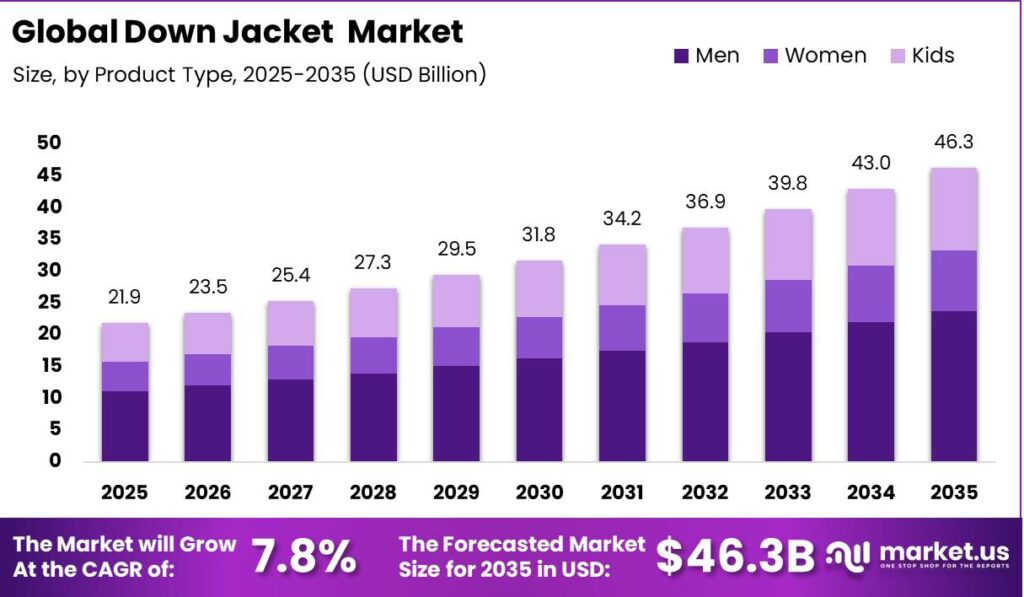
Global Down Jacket Market size is expected to be worth around USD 46.3 Billion by 2035 from USD 21.9 Billion in 2025, growing at a CAGR of 7.8% during the forecast period 2026 to 2035. This market covers insulated outerwear filled with natural or synthetic down. Buyers span outdoor sport, fashion, and institutional users, which spreads demand across seasons and price tiers.
The down jacket market groups products by fill type, product style, price range, and channel. Natural down, synthetic fill, and hybrid blends form the material base. Therefore, brands build tiered lines from economy jackets to luxury designer pieces. This structure lets makers serve mountaineers, urban shoppers, and military buyers from one core supply chain, spreading fixed costs across many segments.
Key Takeaways
- Global Down Jacket Market will reach USD 46.3 Billion by 2035, up from USD 21.9 Billion in 2025 at a CAGR of 7.8%.
- Hooded Down Jackets lead the Product Type segment with a 44.10% share.
- Natural Down leads the Fill Type segment with a 58.30% share.
- Men lead the End User segment with a 51.20% share.
- Outdoor Sports and Adventure leads the Application segment with a 39.60% share.
- Mid-Range Jackets lead the Price Range segment with a 46.80% share.
- Offline Retail leads the Distribution Channel segment with a 61.40% share.
- Nylon leads the Material Type segment with a 47.50% share.
- Standard Down Insulation leads the Insulation Technology segment with a 54.20% share.
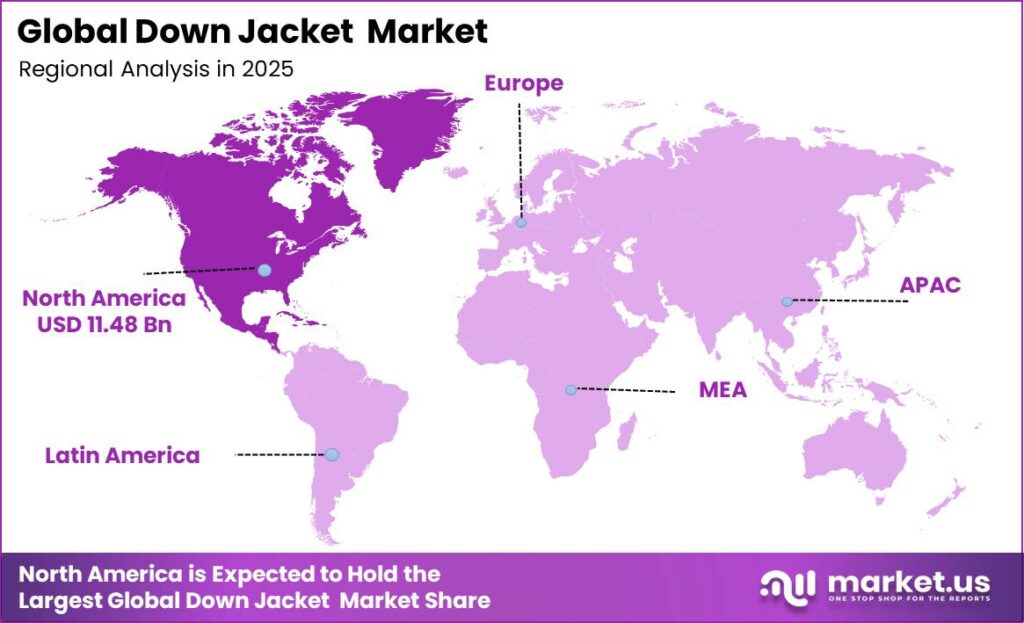
- North America dominates with a 36.90% share, valued at USD 11.84 Billion.
Government agencies and standards bodies now shape sourcing rules for this market. Data from Textile Exchange shows Responsible Down Standard certification covers 400+ global apparel brands for supply chain traceability. This wide adoption raises entry costs for uncertified suppliers. As a result, compliant fill producers gain a durable sales advantage as brands consolidate purchases toward audited sources.
Product performance data steers buyer trust and warranty risk in this market. According to Wired, untreated down insulation can lose up to 90% of thermal efficiency when fully saturated with moisture. This weakness pushes brands toward treated and hybrid fills. Consequently, makers who market wet-weather reliability protect repeat sales, since colder-climate demand rewards jackets that keep loft in rain and snow.
Product Type Analysis
Hooded Down Jackets dominate with 44.10% due to all-weather head protection appeal.
In 2025, Hooded Down Jackets held a dominant market position in the By Product Type segment of Down Jacket Market, with a 44.10% share. UN Comtrade records show global trade under HS code 6201 for insulated coats moving billions of units yearly across major winter economies. This scale rewards hooded designs that suit both alpine and urban buyers. Therefore, brands anchor core ranges on hooded styles to capture the widest buyer base.
Lightweight Down Jackets serve buyers who want warmth without bulk for daily wear. ITC Trade Map data shows lightweight insulated apparel forming a rising share of apparel exports from major Asian producers. This shift reflects demand for packable layers in milder climates. As a result, brands adding thin, high-loft styles capture transitional-season sales that heavier jackets miss during autumn and spring windows.
Heavyweight Down Jackets and Packable Down Jackets serve opposite buyer needs at each end of the range. World Bank consumption indicators link colder northern markets to higher demand for high-fill heavyweight coats. This means makers must balance bulk inventory against packable, travel-ready stock. By contrast, Long Parka Down Jackets hold the remaining share collectively, serving buyers who want full-body coverage in extreme cold regions.
Fill Type Analysis
Natural Down dominates with 58.30% due to superior loft-to-weight thermal efficiency.
In 2025, Natural Down held a dominant market position in the By Fill Type segment of Down Jacket Market, with a 58.30% share. Rab Equipment data shows goose down clusters reach a 90:10 down-to-feather ratio, improving loft over duck fill at equal weight. This performance edge justifies premium pricing. Therefore, brands lead flagship lines with goose down to protect margin and technical reputation.
Synthetic Down attracts buyers who prioritize wet-weather reliability and lower cost per jacket. Rab Equipment figures show duck down clusters reach an 80:20 ratio, which sets a performance gap that synthetic makers target directly. This gap gives synthetic fills room to compete on price and vegan appeal. Consequently, brands offering polyester fill capture buyers who reject animal-sourced insulation on ethical grounds.
Hybrid Fill blends natural down with synthetic fibers to balance warmth and moisture resistance. FAO livestock output data ties duck and goose farming cycles directly to natural down supply volumes each year. This link makes hybrid blends a hedge against natural down price swings. As a result, makers using hybrid construction stabilize input costs while keeping much of down’s premium feel.
End User Analysis
Men dominate with 51.20% due to strong outdoor and workwear demand.
In 2025, Men held a dominant market position in the By End User segment of Down Jacket Market, with a 51.20% share. National statistical offices in cold economies report male labor concentration in outdoor and construction work needing thermal gear. This occupational demand lifts men’s jacket volumes. Therefore, brands size men’s ranges widest to serve both work and recreation buyers reliably.
Women represent the fastest-growing buyer group as technical fits expand for female outdoor users. World Bank labor data shows rising female participation in outdoor recreation across developed markets. This trend exposes a long fit gap in women’s technical outerwear. As a result, brands investing in female-specific patterns and colorways capture under-served demand ahead of slower rivals.
Kids form the smallest buyer group but drive repeat purchases through fast growth cycles. UNICEF and national census data show large child populations in cold northern and high-altitude regions. This demographic forces frequent replacement as children outgrow jackets each season. Consequently, brands with durable, resale-friendly kids lines earn recurring revenue from families upgrading sizes yearly.
Application Analysis
Outdoor Sports and Adventure dominates with 39.60% due to performance-grade thermal gear demand.
In 2025, Outdoor Sports and Adventure held a dominant market position in the By Application segment of Down Jacket Market, with a 39.60% share. G Adventures reported 20% global sales growth in July 2025 while launching over 300 new trips across its portfolio. This travel surge lifts demand for performance down jackets. Therefore, brands tied to adventure retail capture buyers gearing up for guided expeditions.
Winter Fashion and Casual Wear serves urban buyers who treat down jackets as everyday wardrobe pieces. In June 2025, G Adventures launched nine new Canada-based itineraries across six provinces covering active and cultural travel. This expansion pulls casual travelers into cold-climate gear buying. As a result, fashion-led brands capture repeat purchases from style buyers who replace jackets more often than pure sport users.
Mountaineering and Trekking, Skiing and Snowboarding, and Military and Defense Use fill the remaining application share collectively. UNIDO industrial output data links defense procurement to steady demand for extreme-cold thermal gear. This institutional buying provides stable, high-spec orders outside retail cycles. Consequently, brands winning military and expedition contracts secure predictable volume that smooths seasonal retail swings.
Price Range Analysis
Mid-Range Jackets dominate with 46.80% due to balanced price and performance value.
In 2025, Mid-Range Jackets held a dominant market position in the By Price Range segment of Down Jacket Market, with a 46.80% share. IMF consumer spending data shows middle-income households forming the largest apparel-buying cohort across major markets. This mass base anchors mid-range volume. Therefore, brands concentrate core assortments here to win the widest possible buyer pool at scale.
Premium Jackets attract buyers who pay more for technical fill power and branded design. World Bank income data shows rising urban affluent segments in emerging economies expanding premium apparel demand. This wealth shift widens the premium buyer pool yearly. As a result, brands moving buyers up-tier lift average selling prices without needing new customers.
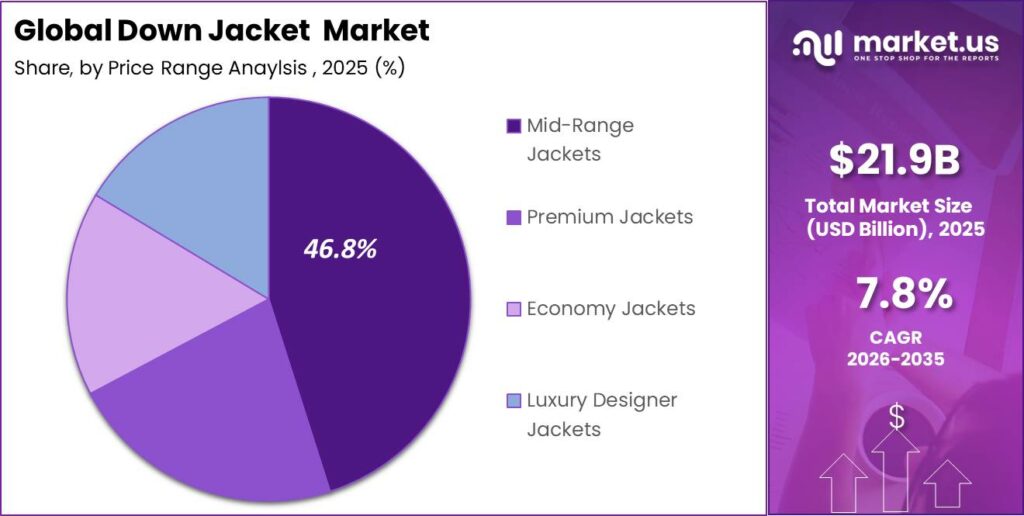
Economy Jackets and Luxury Designer Jackets hold the remaining share collectively at opposite market ends. National retail statistics link economy tiers to first-time and price-sensitive buyers entering the category. This entry role feeds future premium upgrades. By contrast, luxury designer jackets serve status buyers, letting brands protect exclusive margins through limited, high-priced collections.
Distribution Channel Analysis
Offline Retail dominates with 61.40% due to fit trial and instant purchase.
In 2025, Offline Retail held a dominant market position in the By Distribution Channel segment of Down Jacket Market, with a 61.40% share. National retail census data shows physical apparel stores still handling most winter outerwear sales in major markets. This dominance reflects buyer need to test fit and warmth. Therefore, brands keep flagship stores central to protect conversion on high-value jackets.
Online Retail grows fastest as e-commerce widens reach and cuts distribution cost. ITU internet adoption data shows over 5 Billion global internet users enabling direct online apparel purchases. This scale opens low-cost access to distant buyers. As a result, brands building strong online fit tools capture demand that no physical store network can reach affordably.
Specialty Outdoor Stores and Direct-To-Consumer channels hold the remaining share collectively across niche buyer groups. UNCTAD digital economy data links rising DTC models to higher brand margins through cutting intermediaries. This margin gain rewards direct sales investment. Consequently, brands blending specialty expertise with DTC control capture both technical buyers and full retail price on each sale.
Material Type Analysis
Nylon dominates with 47.50% due to lightweight tear and abrasion resistance.
In 2025, Nylon held a dominant market position in the By Material Type segment of Down Jacket Market, with a 47.50% share. Jottnar technical data shows hydrophobic-treated down reduces moisture absorption by roughly 33% compared to untreated clusters, pairing well with nylon shells. This combination boosts wet-weather durability. Therefore, brands pair nylon outer shells with treated fill to market all-condition reliability.
Polyester serves as the fastest-growing shell material through lower cost and easy printing. UN Comtrade data shows polyester fabric among the highest-volume textile trade categories worldwide. This scale keeps polyester shell costs low. As a result, brands using polyester shells protect margin on economy and mid-range jackets while keeping bright fashion colorways affordable.
Blended Fabrics and Waterproof and Windproof Membranes such as Gore-Tex hold the remaining share collectively. Patent database records show hundreds of active filings covering waterproof-breathable membrane construction methods. This innovation density signals strong technical competition. Consequently, brands licensing proven membranes gain a defensible performance edge in the high-spec expedition and ski segments.
Insulation Technology Analysis
Standard Down Insulation dominates with 54.20% due to proven loft heat retention.
In 2025, Standard Down Insulation held a dominant market position in the By Insulation Technology segment of Down Jacket Market, with a 54.20% share. Rab Equipment data shows down insulation traps more than 90% of loft volume as air pockets for heat retention. This efficiency sets the performance benchmark. Therefore, brands keep standard down central to protect their warmth-per-weight reputation with buyers.
Advanced Thermal Insulation grows fastest by boosting heat retention beyond standard down limits. Jottnar figures show hydrophobic down can hold up to 66% higher loft retention in wet conditions than untreated fill. This gain widens the technical performance gap. As a result, brands marketing advanced retention tech justify premium prices among serious cold-weather users.
Water-Resistant Down and Eco-Friendly Recycled Insulation hold the remaining share collectively across niche buyer groups. Textile Exchange records show rising recycled-content certification across outdoor apparel supply chains. This shift signals demand for lower-impact fills. Consequently, brands scaling recycled insulation early capture sustainability-focused buyers before rivals build reverse-logistics capacity.
Key Market Segments
By Product Type
- Hooded Down Jackets
- Lightweight Down Jackets
- Heavyweight Down Jackets
- Packable Down Jackets
- Long Parka Down Jackets
By Fill Type
- Natural Down (Goose and Duck Down)
- Synthetic Down (Polyester Fill)
- Hybrid Fill (Down plus Synthetic)
By End User
- Men
- Women
- Kids
By Application
- Outdoor Sports and Adventure
- Winter Fashion and Casual Wear
- Mountaineering and Trekking
- Skiing and Snowboarding
- Military and Defense Use
By Price Range
- Mid-Range Jackets
- Premium Jackets
- Economy Jackets
- Luxury Designer Jackets
By Distribution Channel
- Offline Retail (Brand Stores, Department Stores)
- Online Retail (E-Commerce Platforms)
- Specialty Outdoor Stores
- Direct-To-Consumer (DTC)
By Material Type (Outer Shell)
- Nylon
- Polyester
- Blended Fabrics
- Waterproof and Windproof Membranes (Gore-Tex, Etc.)
By Insulation Technology
- Standard Down Insulation
- Advanced Thermal Insulation (Heat Retention Tech)
- Water-Resistant Down
- Eco-Friendly Recycled Insulation
Regional Analysis
North America Dominates the Down Jacket Market with a Market Share of 36.90%, Valued at USD 11.84 Billion
North America leads the Down Jacket Market with a 36.90% share worth USD 11.84 Billion. Cold winters across the US and Canada sustain steady high-volume demand for insulated outerwear. This climate base supports both sport and fashion buying year after year. Therefore, brands treat North America as the anchor market for premium and mid-range down jacket revenue.
Asia Pacific ranks as the fastest-growing region as cold-climate urban demand expands across China, India, and Central Asia. In January 2026, G Adventures and National Geographic Expeditions launched a premium Signature travel line with 29 new luxury adventure itineraries across multiple continents. This growth pulls new travelers into performance outerwear buying. As a result, brands entering Asian cities early capture rising middle-class demand ahead of rivals.
Key Regions and Countries
North America
- US
- Canada
Europe
- Germany
- France
- The UK
- Spain
- Italy
- Rest of Europe
Asia Pacific
- China
- Japan
- South Korea
- India
- Australia
- Rest of APAC
Latin America
- Brazil
- Mexico
- Rest of Latin America
Middle East and Africa
- GCC
- South Africa
- Rest of MEA
Market Dynamics
Market Opportunity Analysis - Under-served fits, emerging cities, and online channels open the widest entry points
Women’s technical outerwear stands out as an under-served segment despite men holding 51.20% of end-user demand. Female buyers grow fastest yet face limited fit-specific product lines. This gap leaves clear white space for entrants who design women-first patterns. Therefore, brands that build dedicated women’s ranges capture rising demand before larger rivals adapt their male-focused assortments.
Emerging cold-climate cities in Asia Pacific remain underexploited even as the region grows fastest overall. North America still holds 36.90% of the market, which shows demand concentration in mature economies. This means interior Chinese and Central Asian cities stay open for early brand-building. Consequently, entrants who localize price and fit now secure share as urban middle classes expand.
Online Retail offers under-tapped reach against Offline Retail’s dominant 61.40% share. Digital channels still handle a minority of jacket sales despite lower distribution cost. This imbalance signals room for direct online growth. As a result, brands that solve fit and return friction online capture buyers that physical store networks cannot reach affordably.
Technology and Innovation Landscape - Hydrophobic treatments, cluster science, and recycled fills reshape performance and cost
Hydrophobic down treatment stands out as a key innovation for wet-weather performance. Jottnar testing shows treated down cuts moisture absorption by roughly 33% against untreated clusters. This gain lets brands market reliable warmth in rain and snow. Therefore, makers adopting hydrophobic fill defend repeat sales in humid and coastal cold markets where untreated down fails.
Down cluster science drives fill-power differentiation across product tiers. Rab Equipment data shows goose down reaches a 90:10 cluster ratio against duck down’s 80:20 mix. This measurable gap lets brands tier products by loft efficiency. Consequently, makers using higher cluster ratios justify premium prices while reserving duck fill for value lines that protect entry-tier margin.
Recycled and eco-friendly insulation marks the next material frontier for cost and compliance gains. Textile Exchange records show Responsible Down Standard certification now spans 400+ brands, signaling strong traceability demand. This shift rewards early investment in reclaimed fill. As a result, manufacturers scaling recycled insulation cut exposure to volatile virgin-down prices while meeting tightening green-claims rules.
Drivers
The crossover of technical outerwear into daily fashion has widened the down jacket’s occasion set far beyond cold-climate utility. Urban buyers now treat these jackets as wardrobe staples and status pieces across age groups, which raises purchase frequency and multi-jacket ownership. This behavior shift matters because fashion-led buyers accept prices 20 to 40% above utilitarian equivalents.
Brands have restructured assortments toward higher-margin lifestyle collections, seasonal colorways, and collaborations that turn inventory faster. Social media compresses trend cycles into weeks rather than seasons, lifting both unit volumes and average selling prices at once. This driver contributes an estimated +2.4% to the baseline CAGR of 7.8%. Therefore, brands that master fast trend response capture the widening year-round buyer base first.
| Driver | (~) % Impact on CAGR Forecast | Geographic Relevance | Impact Timeline |
|---|---|---|---|
| Mainstreaming of outdoor and gorpcore aesthetics into everyday urban wardrobes | +2.4% | North America, Europe, East Asia | Short term (≤ 2 years) |
| Premiumization and technical-performance positioning lifting average selling prices | +1.9% | Global | Medium term (2–4 years) |
| Expanding cold-weather consumer base in emerging economies and rising winter travel | +1.3% | China, India, Eastern Europe | Medium term (2–4 years) |
| Growth of direct-to-consumer and e-commerce channels widening reach and margins | +0.9% | Global | Short term (≤ 2 years) |
| Product diversification into lightweight, packable, and transitional-season down styles | +0.6% | Global | Medium term (2–4 years) |
Restraints
Down and feather are by-products of the duck and goose meat industry, so supply stays inelastic and tied to poultry cycles. Disruptions since 2022, including avian-influenza culling of tens of millions of birds, pushed raw down prices sharply higher. Some grades rose 20 to 40% over a couple of seasons. This means makers face direct pressure on the largest cost in each jacket.
Because down can form a large share of the bill of materials, input inflation compresses gross margins that sit in the 50 to 65% range for branded outerwear. Makers must absorb cost, raise prices, or substitute lower-grade fills that dilute premium positioning. This friction subtracts an estimated -2.1% from the baseline CAGR of 7.8%. Consequently, brands with hedging and material diversification protect margin best.
| Restraint | (~) % Impact on CAGR Forecast | Geographic Relevance | Impact Timeline |
|---|---|---|---|
| Volatility and inflation in raw down and feather input costs | -2.1% | Global | Short term (≤ 2 years) |
| Warmer winters and milder cold seasons compressing peak-demand windows | -1.5% | North America, Europe, East Asia | Medium term (2–4 years) |
| Consumer trade-down and discretionary spending caution in high-inflation markets | -1.1% | Global | Short term (≤ 2 years) |
| Animal-welfare scrutiny and sourcing restrictions on non-certified down | -0.8% | Europe, North America | Medium term (2–4 years) |
| Tariff and trade friction on apparel imports from key manufacturing hubs | -0.7% | US, EU sourcing from Asia | Short term (≤ 2 years) |
Challenges
Down jackets rely on multi-tier supply chains spanning poultry farms, down processors, fill suppliers, and garment assemblers across several countries. This spread makes proving humane sourcing operationally demanding, since brands must trace fill through many intermediaries. Full chain-of-custody documentation can add several percentage points to unit costs and extend supplier onboarding by months. This creates real friction for brands scaling new sourcing capacity.
Any lapse exposes brands to reputational damage and regulatory penalties in markets tightening animal-welfare and green-claims rules. Companies must invest continuously in supplier auditing, digital traceability, and third-party certification to protect their license to operate. This structural friction imposes an estimated drag of about -1.6% on maximum achievable growth over a 4+ year horizon. Therefore, larger players that amortize compliance across volume gain a defensible edge.
| Challenge | (~) % CAGR Friction Drag | Geographic Relevance | Mitigation Horizon |
|---|---|---|---|
| Traceability and certification across complex down supply chains | -1.6% | Global | Long term (≥ 4 years) |
| Counterfeiting and gray-market dilution of premium brands | -1.2% | Asia-Pacific, online channels | Medium term (2–4 years) |
| Seasonal inventory and demand-forecasting mismatch risk | -1.0% | Global | Medium term (2–4 years) |
| High return rates and fit complexity in online outerwear sales | -0.8% | North America, Europe | Short term (≤ 2 years) |
| Talent and craftsmanship gaps in high-quality down-fill manufacturing | -0.6% | Asia-Pacific, Europe | Long term (≥ 4 years) |
Opportunities
The shift toward recycled down and next-generation bio-based synthetic insulation remains largely untapped white space today. Most products still rely on virgin down or petrochemical fills, so this gap is wide open. Recycled-down programs lower raw-material cost exposure and insulate brands from virgin-down price spikes. This matters because credible sustainability claims support price premiums of roughly 10 to 25% among eco-conscious buyers.
Early movers that build reverse-logistics collection and recycled-fill processing can improve blended gross margins by several points as they scale. Capturing even 10 to 20% of premium outerwear demand migrating to certified sustainable fills over the next 2 to 4 years represents around +1.9% upside above the baseline CAGR of 7.8%. Therefore, brands investing in circular material infrastructure now capture a durable higher-value niche.
| Opportunity | (~) % Potential CAGR Upside | Geographic Relevance | Execution Window |
|---|---|---|---|
| Recycled-down and bio-based synthetic fills unlocking sustainability-premium segments | +1.9% | Europe, North America | Medium term (2–4 years) |
| Resale, repair, and circular-ownership models extending product lifecycle revenue | +1.4% | Global | Long term (≥ 4 years) |
| Untapped emerging-market urban middle class in cold and high-altitude regions | +1.2% | China interior, India, Central Asia | Medium term (2–4 years) |
| Personalization, made-to-order, and modular-layering premium propositions | +0.9% | Global urban markets | Long term (≥ 4 years) |
| Women’s and gender-neutral technical outerwear lines addressing under-served fits | +0.7% | Global | Short term (≤ 2 years) |
Key Company Insights
The North Face holds a structural advantage through its broad technical outerwear range spanning sport and lifestyle buyers. This dual reach lets the brand capture both expedition users and urban fashion demand from one core supply chain. This positioning spreads fixed costs across many price tiers and protects volume when one segment softens. However, heavy fashion exposure ties the brand to fast trend cycles that raise inventory risk.
Columbia Sportswear Company competes through value-focused technical apparel aimed at mid-range outdoor buyers. This mid-market focus wins price-sensitive shoppers who still want proven cold-weather performance. This approach builds stable mass-market volume that resists trade-down pressure during high-inflation seasons. However, its value positioning limits premium margin capture, leaving the luxury and high-fill tiers open to specialist rivals with stronger technical reputations.
Key Players
- The North Face
- Columbia Sportswear Company
- Patagonia, Inc.
- Canada Goose Holdings Inc.
- Moncler S.P.A.
- Arc’teryx
- Marmot
- Rab Equipment
- Jack Wolfskin
- Uniqlo
- Decathlon
- Helly Hansen
- Fjällräven
- Mammut Sports Group AG
- Peak Performance
Recent Developments
- April 2026: Intrepid Travel completed its largest ever acquisition of France based Altaï Group to expand its European adventure tourism footprint and strengthen its small group travel portfolio.
- April 2026: Intrepid Travel officially integrated Altaï Group operations, adding over 35,000 annual travelers and expanding its destination management network across France, Chile, and Canada.
- January 2026: REI Co-op re-entered the adventure tourism market through a partnership with Intrepid Travel to launch globally guided small group adventure trips for members.
- October 2025: G Adventures expanded its Arctic expedition program by relaunching polar itineraries using its new 128 passenger expedition ship for operations beginning in 2026.
Geopolitical Impact Analysis
Trade friction directly raises down jacket costs for US and EU brands sourcing from Asian factories. According to the WTO, average applied tariffs on apparel imports often exceed 10%, while some US duties on Chinese goods have climbed above 25%. These charges hit nylon shells, zippers, and finished jackets shipped from Asian hubs. Therefore, brands reroute sourcing toward lower-tariff countries to protect landed cost and retail margin.
Shipping disruption adds further pressure on cold-weather inventory timing. As reported by UNCTAD, Red Sea rerouting around Africa has extended some voyages by 10 to 14 days and lifted container rates by over 100% at peak. These delays threaten pre-winter stock arrivals for seasonal down jackets. Consequently, brands build earlier order cycles and safety stock to avoid missing the narrow peak selling window.
Report Scope
| Report Features | Description |
|---|---|
| Market Value (2025) | USD 21.9 Billion |
| Forecast Revenue (2035) | USD 46.3 Billion |
| CAGR (2026-2035) | 7.8% |
| Base Year for Estimation | 2025 |
| Historic Period | 2020-2024 |
| Forecast Period | 2026-2035 |
| Report Coverage | Revenue Forecast, Market Dynamics, Market Opportunity Analysis, Technology and Innovation Landscape, Competitive Landscape, Recent Developments |
| Segments Covered | By Product Type (Hooded, Lightweight, Heavyweight, Packable, Long Parka Down Jackets), By Fill Type (Natural Down, Synthetic Down, Hybrid Fill), By End User (Men, Women, Kids), By Application (Outdoor Sports and Adventure, Winter Fashion and Casual Wear, Mountaineering and Trekking, Skiing and Snowboarding, Military and Defense Use), By Price Range (Mid-Range, Premium, Economy, Luxury Designer Jackets), By Distribution Channel (Offline Retail, Online Retail, Specialty Outdoor Stores, Direct-To-Consumer), By Material Type (Nylon, Polyester, Blended Fabrics, Waterproof and Windproof Membranes), By Insulation Technology (Standard Down, Advanced Thermal, Water-Resistant Down, Eco-Friendly Recycled Insulation) |
| Regional Analysis | North America (US and Canada), Europe (Germany, France, The UK, Spain, Italy, and Rest of Europe), Asia Pacific (China, Japan, South Korea, India, Australia, and Rest of APAC), Latin America (Brazil, Mexico, and Rest of Latin America), Middle East and Africa (GCC, South Africa, and Rest of MEA) |
| Competitive Landscape | The North Face, Columbia Sportswear Company, Patagonia Inc., Canada Goose Holdings Inc., Moncler S.P.A., Arc’teryx, Marmot, Rab Equipment, Jack Wolfskin, Uniqlo, Decathlon, Helly Hansen, Fjällräven, Mammut Sports Group AG, Peak Performance |
| Customization Scope | Customization for segments, region / country-level will be provided. Additional customization can be done based on requirements. |
| Purchase Options | We have three licenses to opt for: Single User License | Multi-User License (Up to 5 Users) | Corporate Use License (Unlimited User and Printable PDF) |





































