


Report Overview
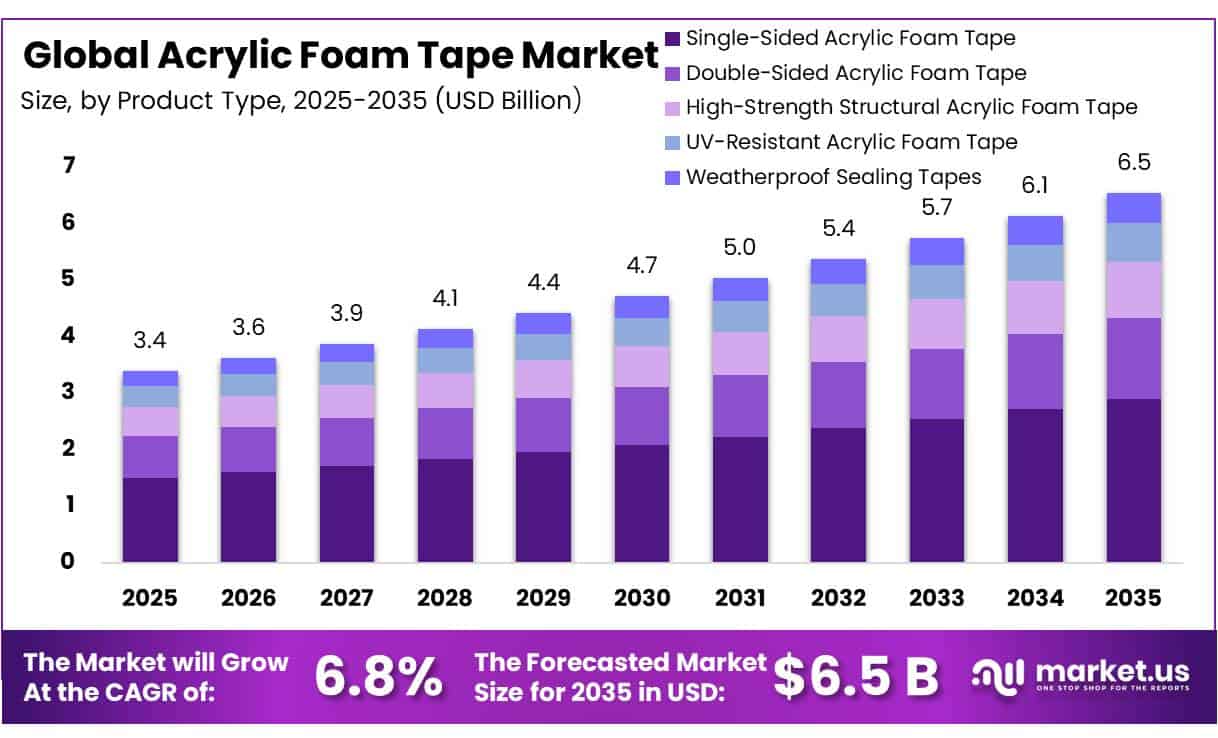
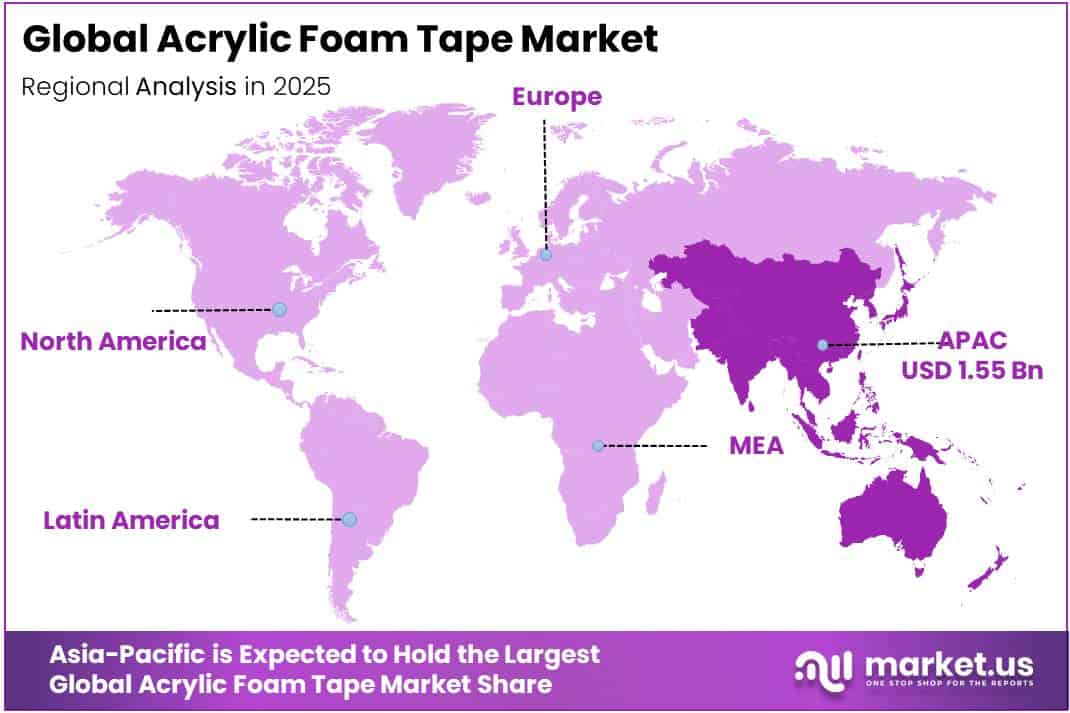
In 2025, the Global Acrylic Foam Tape Market was valued at US$3.4 billion, and between 2026 and 2035, this market is estimated to register a CAGR of 6.8%, reaching about US$6.5 billion by 2035. In 2025, Asia-Pacific led the market, achieving over 45.7% share with a revenue of US$1.55 billion.
Acrylic foam tape is a high-performance pressure-sensitive bonding material used where mechanical fasteners, liquid adhesives, or welding are less suitable. It combines acrylic adhesive chemistry with a conformable foam core, giving strong peel adhesion, stress relaxation, weather resistance, and clean assembly on metal, glass, plastics, painted panels, and composite surfaces. In industrial use, it supports automotive trims, badges, roof rails, appliance panels, electronic modules, signage, glazing, and façade parts. The industrial scenario remains linked to the wider adhesive and sealant value chain.
- In 2025, FEICA reported that Europe’s adhesives and sealants industry contributed more than €20.7 billion to the economy, used around 5 million tonnes of adhesives and sealants each year with imports included, and offered more than 250,000 product types. This shows that acrylic foam tape is part of an engineered bonding ecosystem serving construction, mobility, healthcare, energy, and packaging applications.
Key Takeaways
- The Global Acrylic Foam Tape Market was valued at US$3.4 billion in 2025.
- The market is projected to grow at a CAGR of 6.8% and is estimated to reach US$6.5 billion by 2035.
- Single-Sided Acrylic Foam Tape is the dominant product type, accounting for 3% of the market in 2025, driven by its widespread use in general-purpose bonding applications where a single adhesive-lined foam layer is sufficient for durable attachment.
- Solvent-Based Acrylic Adhesives is the dominant adhesive type at 1%, driven by strong bonding performance and resistance to temperature and chemical exposure across industrial assembly processes.
- Automotive Assembly & Bonding is the dominant application at 6%, driven by the growing use of foam tapes to replace rivets, screws, and welds in modern vehicle assembly.
- Automotive OEMs is the dominant end-use industry at 8%, driven by increasing adoption of lightweight bonding solutions to meet fuel-efficiency and vehicle design requirements.
- Thin Foam Tapes (<1 mm) is the dominant thickness type at 2%, driven by their suitability for space-constrained assembly applications in electronics and automotive components.
- Bonding & Structural Adhesion is the dominant functionality at 7%, driven by rising demand for tapes that provide permanent, load-bearing bonds without mechanical fasteners.
- Direct OEM Sales is the dominant distribution channel at 4%, driven by long-term supply agreements between tape manufacturers and large-volume industrial buyers such as automotive and electronics OEMs.
- Asia-Pacific holds the largest regional share at 7%, driven by the concentration of automotive and electronics manufacturing across China, Japan, South Korea, and India.
Acrylic foam tape benefits from this scale because automakers use bonding systems to reduce drilling, manage vibration, protect painted surfaces, and support lightweight exterior and interior assemblies. Electronics and electric mobility are also improving the long-term outlook.
- The Semiconductor Industry Association stated in February 2026 that global semiconductor sales reached US$791.7 billion in 2025, rising 6% from 2024, with logic products at US$301.9 billion and memory products at US$223.1 billion. Acrylic foam tapes are used in display bonding, device mounting, module protection, and clean assembly where thin, durable attachment is needed.
- In Europe, the European Commission’s Renovation Wave aims to renovate 35 million buildings by 2030 and at least double the annual rate of energy renovations. These programs can support tapes used in façade panels, windows, insulation accessories, signage, and fit-outs.
Future growth will depend on solvent-free production, recyclable bonding systems, lower-VOC chemistries, and better performance on low-surface-energy plastics. Supply risk remains visible, as Cefic noted that Europe’s chemical sector had €635 billion turnover and 1.2 million employees in 2025, but gas prices were three times higher than in the US and capacity utilization stayed weak. As a result, producers are expected to focus on regional sourcing, specialty acrylic formulations, and high-margin applications where durability, fast assembly, and design flexibility justify premium tape use.
Product Type Analysis
Single-Sided Acrylic Foam Tape held 44.3% market share in 2025, supported by broad industrial and construction demand
In 2025, Single-Sided Acrylic Foam Tape held a dominant market position, capturing more than a 44.3% share of the Acrylic Foam Tape market. The segment maintained its leading position because it is widely used for surface protection, sealing, insulation, vibration damping, and temporary bonding across construction, automotive, electronics, and industrial manufacturing. Its easy application, lower material usage compared to double-sided products, and reliable adhesion on different surfaces continued to support strong demand during 2025. Many manufacturers preferred single-sided acrylic foam tape for weather sealing around doors, windows, HVAC systems, and metal panels, where long-term durability and resistance to moisture and UV exposure are important.
Double-Sided Acrylic Foam Tape is the fastest-growing segment in the Acrylic Foam Tape market, supported by increasing use in lightweight vehicle assembly, electronics, architectural glazing, and high-performance industrial bonding applications. During 2025, manufacturers expanded the use of double-sided acrylic foam tapes as a replacement for mechanical fasteners and liquid adhesives because they provide strong bonding, reduce product weight, improve appearance, and distribute stress more evenly across surfaces. The growing focus on electric vehicles, modern consumer electronics, and advanced building materials further strengthened demand.
Adhesive Type Analysis
Solvent-Based Acrylic Adhesives dominate the Acrylic Foam Tape Market with a 52.1% share in 2025
In 2025, Solvent-Based Acrylic Adhesives held a dominant market position, capturing more than a 52.1% share of the Acrylic Foam Tape Market. The segment remained the preferred choice because it provides strong bonding performance, high durability, and reliable adhesion on metals, plastics, glass, and painted surfaces. Solvent-based acrylic systems also remained widely used in structural bonding where high shear strength and weather resistance are critical. Continuous investments in advanced coating technologies and consistent industrial production helped sustain demand across major manufacturing regions, allowing the segment to retain its leadership in the global acrylic foam tape market.
- The U.S. Department of Energy (DOE) states that reducing vehicle weight by 10% can improve fuel economy by 6–8%, encouraging the use of lightweight bonding materials such as acrylic foam tapes in automotive manufacturing.
Water-Based Acrylic Adhesives is the fastest growing segment in the Acrylic Foam Tape Market during 2025 and 2026. The segment is gaining strong momentum as manufacturers increasingly adopt environmentally responsible production methods and low-VOC adhesive technologies. Water-based acrylic adhesives offer good bonding strength while reducing solvent emissions during manufacturing, making them an attractive option for industries working to meet stricter environmental standards.
Application Analysis
Automotive Assembly & Bonding dominates the Acrylic Foam Tape Market with a 58.6% share in 2025
In 2025, Automotive Assembly & Bonding held a dominant market position, capturing more than a 58.6% share of the global acrylic foam tape market. The segment remained the leading application because vehicle manufacturers increasingly replaced mechanical fasteners, rivets, and liquid adhesives with acrylic foam tapes to reduce vehicle weight and improve design flexibility. These tapes provide strong bonding strength, vibration damping, weather resistance, and long-term durability, making them suitable for attaching exterior trims, emblems, body side moldings, spoilers, mirrors, and interior components. In 2026, the segment continued to maintain its leadership as automotive manufacturers expanded the use of advanced bonding solutions in both passenger and commercial vehicles.
- According to the U.S. Census Bureau’s manufacturing shipments data, motor vehicles and parts shipments reached US$73.45 billion in May 2026, showing a strong automotive production base that supports demand for acrylic foam tapes in assembly, bonding, sealing, and lightweight component attachment.
Construction & Building Facades is the fastest growing segment in the acrylic foam tape market during the 2025–2026 period. The rapid expansion of commercial buildings, residential projects, and modern architectural designs has increased the demand for high-performance bonding materials that offer clean installation and long-term durability. Acrylic foam tapes are increasingly used for curtain walls, glass panels, metal cladding, decorative elements, and façade systems because they provide excellent weather resistance, UV stability, and strong adhesion across different construction materials.
End-Use Industry Analysis
Automotive OEMs lead the Acrylic Foam Tape Market with a 49.8% share in 2025
In 2025, Automotive OEMs held a dominant market position, capturing more than a 49.8% share of the global acrylic foam tape market. The segment remained the largest end-use industry because original equipment manufacturers increasingly relied on acrylic foam tapes for lightweight vehicle assembly, durable bonding, and improved production efficiency. These tapes are widely used for attaching exterior trim, emblems, body side moldings, sensors, mirrors, and interior components without the need for mechanical fasteners. Their ability to absorb vibration, resist moisture, and withstand extreme temperatures makes them suitable for modern vehicle manufacturing.
Construction Industry is the fastest growing segment in the acrylic foam tape market during the 2025–2026 period. Demand is rising as commercial buildings, residential projects, and infrastructure developments increasingly require durable and clean bonding solutions. Acrylic foam tapes are widely used for curtain walls, aluminum composite panels, glass facades, metal trims, and architectural signage because they provide excellent weather resistance, UV stability, and long-term adhesion. Compared with screws and rivets, these tapes improve the appearance of finished structures while reducing installation time and maintenance requirements.
- The U.S. Census Bureau reported the value of total construction spending exceeded USD 2.21 trillion annually, reflecting continued growth in building activity and demand for construction materials.
Thickness Type Analysis
Thin Foam Tapes (<1 mm) dominates with 41.2% due to compact bonding needs in electronics, construction, and industrial finishing.
In 2025, Thin Foam Tapes (<1 mm) held a dominant market position, capturing more than a 41.2% share of the Acrylic Foam Tape market. The segment led because these tapes are preferred where bonding space is limited and a clean surface finish is needed. They are widely used in electronic devices, display panels, nameplates, labels, light sealing, surface protection, and thin component mounting. In 2026, demand remained steady as manufacturers continued using thin tapes to reduce visible fasteners and improve product design.
Medium Thickness Tapes (1–2 mm) is the fastest growing segment in the Acrylic Foam Tape market. The segment is gaining demand because it offers better cushioning, gap filling, vibration control, and bonding strength than very thin tapes. In 2025 and 2026, these tapes were increasingly used in automotive trims, construction panels, HVAC parts, signage, and industrial assembly where surfaces are uneven or require stronger holding power. Their balanced thickness makes them suitable for applications that need durability without making the final product bulky. Government data also supports the wider construction-use base.
Functionality Analysis
Bonding & Structural Adhesion leads the Acrylic Foam Tape Market with a 46.7% share in 2025
In 2025, Bonding & Structural Adhesion held a dominant market position, capturing more than a 46.7% share of the global acrylic foam tape market. The segment remained the largest because manufacturers across automotive, electronics, construction, and industrial sectors increasingly preferred acrylic foam tapes as an alternative to screws, rivets, and welds. These tapes provide strong and durable adhesion while distributing stress evenly across bonded surfaces, improving product reliability and appearance. They also help reduce product weight, absorb vibration, and simplify assembly processes, making them suitable for both indoor and outdoor applications.
Sealing & Gap Filling is the fastest growing segment in the acrylic foam tape market during the 2025–2026 period. The segment is expanding as industries increasingly require reliable sealing solutions that prevent the entry of water, dust, air, and moisture while maintaining long-term durability. Acrylic foam tapes are widely used for sealing automotive body panels, building facades, windows, doors, HVAC systems, and electronic enclosures because they provide excellent weather resistance and flexibility under changing temperatures. Compared with conventional sealing methods, these tapes offer faster installation, reduced maintenance, and improved appearance.
Distribution Channel Analysis
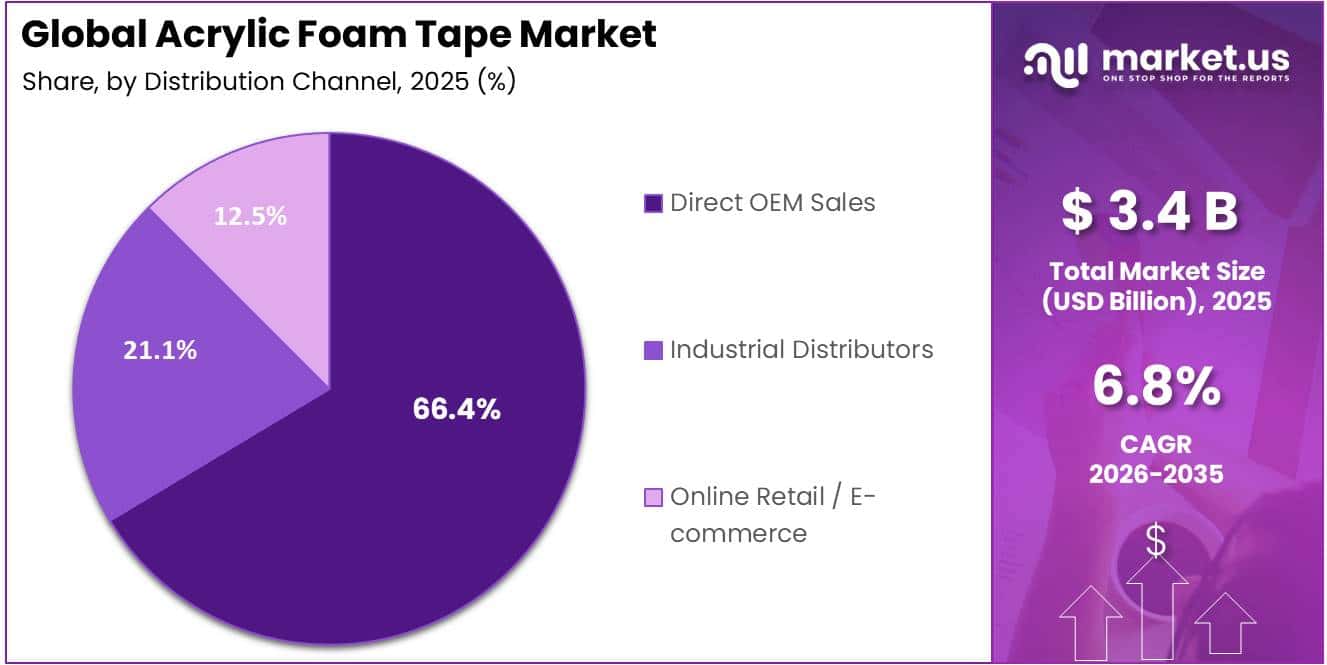
Direct OEM Sales dominate the Acrylic Foam Tape Market with a 66.4% share in 2025
In 2025, Direct OEM Sales held a dominant market position, capturing more than a 66.4% share of the global acrylic foam tape market. The segment led because large automotive manufacturers, electronics producers, construction material companies, and industrial equipment makers preferred purchasing acrylic foam tapes directly from manufacturers. Direct sourcing ensures consistent product quality, customized specifications, reliable technical support, and stable long-term supply agreements for high-volume production. It also helps manufacturers reduce procurement costs, improve inventory planning, and maintain strict quality standards throughout the production process.
Industrial Distributors are the fastest growing segment in the acrylic foam tape market during the 2025–2026 period. Growth is being supported by increasing demand from small and medium-sized manufacturers that require flexible purchasing options, faster deliveries, and access to a wide range of adhesive products. Industrial distributors provide technical assistance, local inventory, and efficient logistics, making them an important supply channel for construction, electronics, transportation, signage, and general industrial applications. In 2026, the channel continued to expand as regional distribution networks improved and manufacturers focused on reaching a broader customer base through authorized industrial suppliers.
Key Market Segments
Product Type
- Single-Sided Acrylic Foam Tape
- Double-Sided Acrylic Foam Tape
- High-Strength Structural Acrylic Foam Tape
- UV-Resistant Acrylic Foam Tape
- Weatherproof Sealing Tapes
Adhesive Type
- Solvent-Based Acrylic Adhesives
- Water-Based Acrylic Adhesives
- Hot-Melt Acrylic Adhesives
Application
- Automotive Assembly & Bonding
- Construction & Building Facades
- Electronics & Electrical Devices
- Transportation (Rail, Aerospace, Marine)
- Industrial Manufacturing
End-Use Industry
- Automotive OEMs
- Construction Industry
- Electronics Manufacturing
- Aerospace & Defense
- Industrial Equipment Manufacturers
Thickness Type
- Thin Foam Tapes (<1 mm)
- Medium Thickness Tapes (1–2 mm)
- Thick Foam Tapes (>2 mm)
Functionality
- Bonding & Structural Adhesion
- Sealing & Gap Filling
- Vibration & Noise Dampening
- Weatherproofing
Distribution Channel
- Direct OEM Sales
- Industrial Distributors
- Online Retail / E-commerce
Driver Analysis
EV lightweight bonding
Global electric-car sales are expected to represent 29% of total vehicle sales in 2026, with second-quarter 2026 sales 35% above the first quarter and record quarterly levels reached in 50 countries; this broadens tape demand beyond China to Europe, Latin America, Southeast Asia, Japan, Korea, and North America. Acrylic foam tape can replace fasteners in exterior moldings, roof rails, badges, sensors, displays, body panels, mirrors, and interior modules, while its viscoelastic core distributes stress and compensates for thermal expansion between aluminum, coated metals, and plastics.
A 10% vehicle-weight reduction can improve fuel economy by 6%–8%, creating a credible incentive for manufacturers to reduce fastener count and avoid localized reinforcement; if an EV uses 5–20 m² of specialty tape across trim, displays, battery-adjacent assemblies, and mounting operations, a 1-million-unit production program represents 5–20 million m² of potential demand.
Drivers Impact Analysis
| Driver | (~) % Impact on CAGR Forecast | Geographic Relevance | Impact Timeline |
|---|---|---|---|
| EV lightweight bonding | +2.1 pp | China, EU, North America, Korea, Japan | Medium term (2-4 years) |
| Fastener replacement demand | +1.7 pp | Global automotive, appliances, electronics | Medium term (2-4 years) |
| Construction prefabrication growth | +1.3 pp | EU, North America, GCC, India, ASEAN | Medium term (2-4 years) |
| Electronics miniaturization | +1.2 pp | China, Taiwan, Korea, Japan, U.S. | Short term (≤ 2 years) |
| Recyclable packaging redesign | +1.0 pp | EU, North America, Japan, export APAC | Long term (≥ 4 years) |
| Automation-compatible converting | +0.8 pp | Global manufacturing hubs | Short term (≤ 2 years) |
Restraint Analysis
Acrylic feedstock volatility
Acrylic-acid prices softened in 2025 amid weak downstream demand and capacity expansion, but 2026 U.S. contract discussions still indicated requested reductions of around $0.05/lb, illustrating that price direction is less important than rapid movement and customer pass-through asymmetry; a $0.05/lb change is approximately $110/tonne.
For a tape structure in which acrylic adhesive and foam chemistry account for 35%–55% of variable cost, a 10% raw-material increase can raise total manufacturing cost by roughly 3.5%–5.5%, while automotive and electronics contracts may hold prices fixed for 12–36 months.
A converter producing 20 million m² annually at $2–5/m² net realization can therefore face $1.4–5.5 million of annual margin exposure if a 4% cost increase cannot be passed through. Supply disruptions also affect formulation: an alternative acrylic grade can change tack, shear strength, aging, VOC profile, and adhesion to low-surface-energy plastics, requiring 3–9 months of revalidation.
Restraint Impact Analysis
| Restraint | (~) % Impact on CAGR Forecast | Geographic Relevance | Impact Timeline |
|---|---|---|---|
| Acrylic feedstock volatility | -1.6 pp | Global, Asia, EU, North America | Short term (≤ 2 years) |
| High qualification barriers | -1.4 pp | Automotive, electronics, aerospace hubs | Medium term (2-4 years) |
| Automotive output uncertainty | -1.2 pp | EU, U.S., China, Japan, Korea | Short term (≤ 2 years) |
| Recycling-compatibility pressure | -1.0 pp | EU, UK, export APAC | Medium term (2-4 years) |
| Low-cost bonding substitution | -0.9 pp | India, ASEAN, LATAM, Africa | Short term (≤ 2 years) |
| Converting-capex requirements | -0.8 pp | Global precision-manufacturing hubs | Medium term (2-4 years) |
Opportunity Analysis
Battery-pack bonding systems
A battery pack can use tape for module-to-tray bonding, busbar insulation, cell-to-cell cushioning, and enclosure sealing; a typical 400–600 kg pack with 0.5–2.0 m² of tape-bonded interface area, multiplied across an assumed 25–30 million global EV/plug-in production run by the late 2020s, implies a theoretical addressable interface area of 12.5–60 million m² annually, an application segment barely served by current automotive-trim tape portfolios.
Because these tapes must pass UL 94, thermal-runaway propagation, and multi-year durability testing, qualified suppliers can command 2–4 times the price per square metre of standard exterior tape—potentially $8–20/m² versus $2–6/m² for trim-grade product—while securing multi-year, single-source battery-platform contracts that extend well beyond a single vehicle model cycle.
Execution requires new coating chemistry, flame-retardant additive packages, dedicated qualification labs, and co-development relationships with cell and pack manufacturers 2–3 years ahead of vehicle launch, making this a strategic R&D and partnership investment rather than a continuation of existing automotive tape sales.
Opportunity Impact Analysis
| Opportunity | (~) % Potential CAGR Upside | Geographic Relevance | Execution Window |
|---|---|---|---|
| Battery-pack bonding systems | +2.2 pp | China, EU, U.S., Korea, Japan | Medium term (2-4 years) |
| Recyclable mono-material tapes | +1.7 pp | EU, UK, North America, export APAC | Short term (≤ 2 years) |
| Application-as-a-service contracts | +1.5 pp | North America, EU, Japan, Korea | Medium term (2-4 years) |
| Solar and renewable-asset bonding | +1.4 pp | China, EU, India, U.S., MENA | Medium term (2-4 years) |
| Regional converting roll-ups | +1.2 pp | India, ASEAN, LATAM, Eastern Europe | Long term (≥ 4 years) |
| Digital qualification platforms | +0.9 pp | North America, EU, Japan, China | Short term (≤ 2 years) |
Challenges Analysis
Multi-substrate bond validation
Automotive-grade products can face operating ranges from approximately −40°C to +120°C and must tolerate humidity, UV, road chemicals, fuel exposure, salt, vibration, and repeated thermal movement; one automotive test protocol evaluates 10 cycles comprising 4 hours at −40°C, 4 hours at room temperature, 4 hours at +90°C, and 16 hours at 38°C and 98% relative humidity, illustrating the severity of validation required for exterior applications.
A supplier qualifying one tape construction across 8 substrate families, 3 coating systems, 4 thicknesses, and 3 climate profiles can generate 250–500 test combinations; at $1,000–3,000 per panel program including preparation, aging, peel/shear testing, and analysis, technical qualification can consume $0.25–1.5 million before a customer moves into production.
Challenges Impact Analysis
| Challenge | (~) % CAGR Friction Drag | Geographic Relevance | Mitigation Horizon |
|---|---|---|---|
| Multi-substrate bond validation | -1.4 pp | Automotive, electronics, construction hubs | Long term (≥ 4 years) |
| Precision converting yield control | -1.2 pp | China, Korea, Japan, EU, U.S. | Medium term (2-4 years) |
| Petrochemical supply volatility | -1.1 pp | Global, Asia–EU, North America | Medium term (2-4 years) |
| Recycling-design validation | -1.0 pp | EU, UK, North America, export APAC | Long term (≥ 4 years) |
| Automated application integration | -0.9 pp | North America, EU, China, Japan, Korea | Medium term (2-4 years) |
| Specialist engineering talent gaps | -0.7 pp | Global premium-manufacturing hubs | Long term (≥ 4 years) |
Geopolitical Impact Analysis
Geopolitical Tensions and Supply Chain Disruptions Influence the Acrylic Foam Tape Market
The ongoing geopolitical tensions, including the Russia–Ukraine conflict and instability in the Middle East, have continued to affect the acrylic foam tape market by disrupting raw material supply, transportation, and manufacturing costs. Acrylic foam tapes rely on petrochemical-based acrylic adhesives, and fluctuations in crude oil prices have increased production expenses for manufacturers. Shipping disruptions in key trade routes, particularly around the Red Sea, have also resulted in longer delivery times and higher freight charges for adhesive products and industrial materials.
European manufacturers have faced additional pressure from higher energy costs, prompting some companies to diversify sourcing strategies and shift part of their procurement to suppliers in Asia-Pacific. At the same time, manufacturers in China, South Korea, and India have benefited from increased export opportunities as global buyers seek alternative supply sources. However, periodic trade restrictions and tighter customs inspections have added complexity to international shipments.
Despite these challenges, demand for acrylic foam tape has remained steady because of its essential role in automotive, electronics, construction, and renewable energy applications. Electric vehicle production, infrastructure projects, and consumer electronics manufacturing have continued to support product consumption across major economies. Many companies are responding by building regional supply networks, increasing inventory levels, and investing in local manufacturing to reduce dependence on a single sourcing region. These measures are helping the market maintain stable growth despite ongoing geopolitical uncertainty.
Key Regions and Countries Covered
- North America
- The US
- Canada
- Europe
- Germany
- France
- The UK
- Spain
- Italy
- Russia and CIS
- Rest of Europe
- APAC
- China
- Japan
- South Korea
- India
- ASEAN
- Rest of APAC
- Latin America
- Brazil
- Mexico
- Rest of Latin America
- Middle East and Africa
- GCC
- South Africa
- Rest of MEA
Regional Analysis
Asia-Pacific dominated the Acrylic Foam Tape Market, accounting for 45.7% of the global market and reaching approximately USD 1.55 billion in 2025.
Asia-Pacific dominated the global acrylic foam tape market in 2025, accounting for more than 45.7% of the total market share, with a market value of approximately USD 1.55 billion. The region maintained its leadership due to its strong manufacturing ecosystem, particularly across China, Japan, South Korea, and India. China remained the largest producer of automobiles and consumer electronics, creating steady demand for acrylic foam tapes in vehicle assembly, display modules, batteries, and structural bonding applications. According to industry production statistics, China manufactured more than 31 million vehicles in 2025, while India continued expanding its automotive and electronics manufacturing base under government-led industrial initiatives.
North America is projected to register the fastest growth in the acrylic foam tape market during the forecast period, supported by increasing investments in electric vehicles, renewable energy projects, and advanced manufacturing. The United States remains the primary growth engine, driven by rising automotive production, and expanding semiconductor investments. Government incentives promoting domestic manufacturing and clean energy technologies have encouraged greater use of lightweight bonding materials in transportation and industrial applications
Key Players Analysis
Berry Global Inc. Berry Global held a relevant position in acrylic foam and specialty bonding tapes through its legacy Specialty Tapes business. In 2024, Berry agreed to sell this unit to Nautic Partners for about US$540 million, and in 2025 it operated independently as Vybond, with 3 U.S. production facilities and 5 brand families: Adchem, Ludlow, Nashua, Patco, and Polyken. Berry also reported US$2.5 billion in Q2 2025 net sales, showing strong industrial scale.
Saint-Gobain Performance Plastics Saint-Gobain Performance Plastics is a strong player in acrylic foam tape through its Norbond bonding tape range. Its acrylic bonding tapes use acrylic foam cores and high-performance acrylic adhesives for interior and exterior bonding applications. The group’s large base supports global supply, with €46.5 billion in 2025 sales, €5.3 billion operating income, €3.8 billion free cash flow, 162,000 employees, and operations across 80 countries.
Denka Company Limited Denka Company Limited works more from the acrylic material and adhesive side of the acrylic foam tape value chain. Its HARDLOC product uses acrylic resins and acrylic oligomer, supporting strong shear, impact, and peel performance. Denka’s FY2025 forecast showed ¥410.0 billion in net sales, ¥25.0 billion in operating income, and ¥19.0 billion in ordinary income. Its Electronics & Innovative Products segment was forecast at ¥105.0 billion in sales, supporting advanced industrial bonding demand.
The Major Players in The Industry
- 3M Company
- Nitto Denko Corporation
- Tesa SE (Beiersdorf AG)
- Avery Dennison Corporation
- Lintec Corporation
- Scapa Group plc
- Lohmann GmbH & Co. KG
- Intertape Polymer Group Inc.
- Shurtape Technologies LLC
- Sekisui Chemical Co., Ltd.
- Berry Global Inc.
- Saint-Gobain Performance Plastics
- Denka Company Limited
- Scapa Industrial
- Advance Tapes International
- Other Key Players
Key Development
- In May 2026, Lintec Corporation remained linked to the acrylic foam tape market through its industrial-use adhesive tapes, including Foam Base double-sided tape series such as TL-52BM-05, TL-52BM-08, TL-52BM-12, TL-52BU-08, TL-52WU-10, and TL-54-06.
- In March 2026, 3M Company signed a partnership-style deal with Bain Capital to acquire Madison Fire & Rescue for US$1.95 billion, with 3M holding 1% of the new venture.
Report Scope
| Report Features | Description |
|---|---|
| Market Value (2025) | US$3.4 Bn |
| Forecast Revenue (2035) | US$6.5 Bn |
| CAGR (2026-2035) | 6.8% |
| Base Year for Estimation | 2025 |
| Historic Period | 2020-2024 |
| Forecast Period | 2026-2035 |
| Report Coverage | Revenue Forecast, Market Dynamics, Competitive Landscape, Recent Developments |
| Segments Covered | By Product Type (Single-Sided Acrylic Foam Tape, Double-Sided Acrylic Foam Tape, High-Strength Structural Acrylic Foam Tape, UV-Resistant Acrylic Foam Tape, and Weatherproof Sealing Tapes), By Adhesive Type (Solvent-Based Acrylic Adhesives, Water-Based Acrylic Adhesives, and Hot-Melt Acrylic Adhesives), By Application (Automotive Assembly & Bonding, Construction & Building Facades, Electronics & Electrical Devices, Transportation (Rail, Aerospace, Marine), and Industrial Manufacturing), By End-Use Industry (Automotive OEMs, Construction Industry, Electronics Manufacturing, Aerospace & Defense, and Industrial Equipment Manufacturers), By Thickness Type (Thin Foam Tapes (<1 mm), Medium Thickness Tapes (1–2 mm), and Thick Foam Tapes (>2 mm)), By Functionality (Bonding & Structural Adhesion, Sealing & Gap Filling, Vibration & Noise Dampening, and Weatherproofing), By Distribution Channel (Direct OEM Sales, Industrial Distributors, and Online Retail / E-commerce) |
| Regional Analysis | North America – The US and Canada; Europe – Germany, France, The UK, Spain, Italy, Russia and CIS, Rest of Europe; APAC– China, Japan, South Korea, India, ASEAN and Rest of APAC; Latin America– Brazil, Mexico and Rest of Latin America; Middle East and Africa– GCC, South Africa, and Rest of MEA |
| Competitive Landscape | 3M Company, Nitto Denko Corporation, Tesa SE (Beiersdorf AG), Avery Dennison Corporation, Lintec Corporation, Scapa Group plc, Lohmann GmbH & Co. KG, Intertape Polymer Group Inc., Shurtape Technologies LLC, Sekisui Chemical Co., Ltd., Berry Global Inc., Saint-Gobain Performance Plastics, Denka Company Limited, Scapa Industrial, Advance Tapes International and Other Key Players |
| Customization Scope | Customization for segments, region/country-level will be provided. Moreover, additional customization can be done based on the requirements. |
| Purchase Options | We have three licenses to opt for: Single User License, Multi-User License (Up to 5 Users), Corporate Use License (Unlimited Users and Printable PDF) |





































