


Report Overview
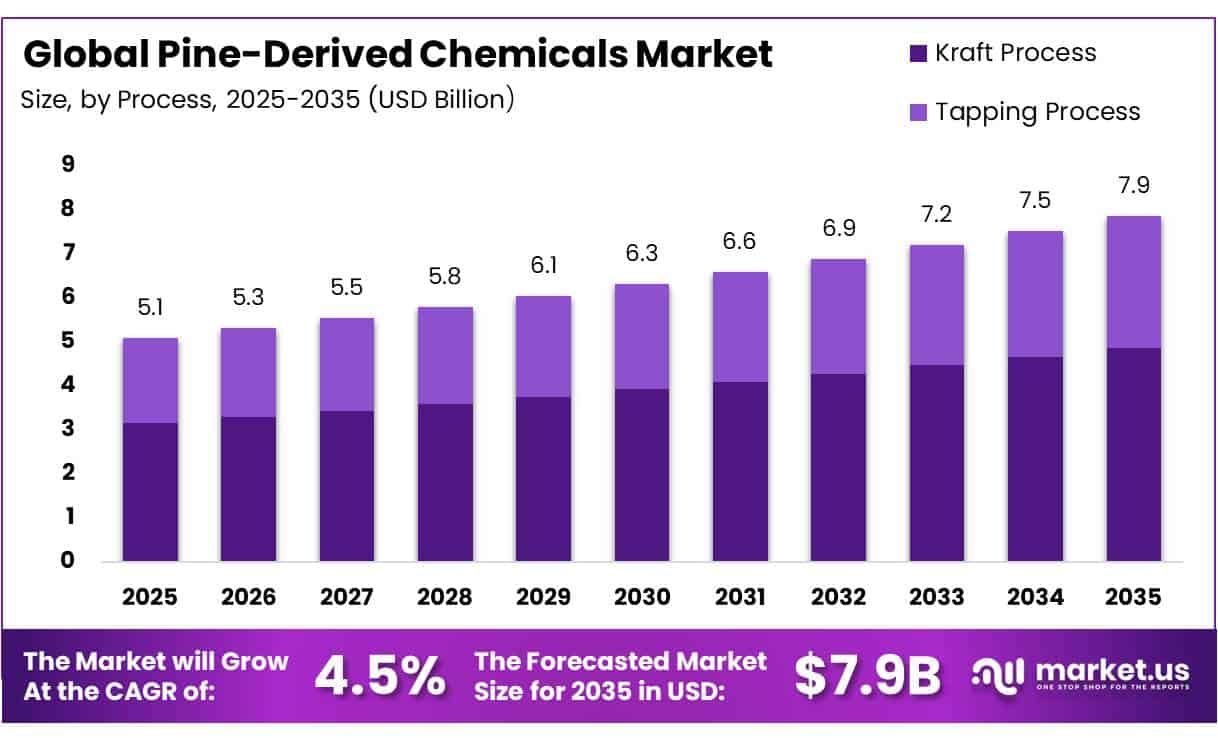
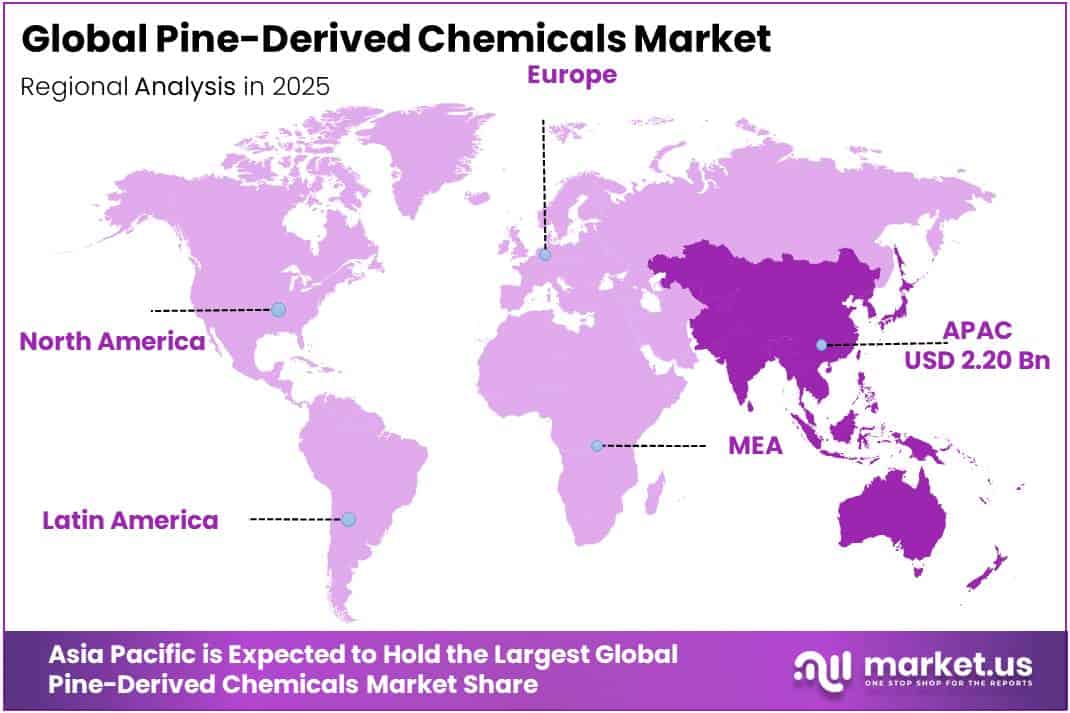
In 2025, the Global Pine-Derived Chemicals Market valued at USD 5.1 billion, and between 2026 and 2035, this market is estimated to register a CAGR of 4.5%, reaching about USD 7.9 billion by 2035. Asia Pacific held a dominant market position, capturing more than a 43.20% share, holding USD 2.20 billion in revenue.
The pine-derived chemicals industry converts renewable forest resources and kraft pulping by-products into tall oil, rosin, turpentine, sterols, and pitch used across adhesives, coatings, inks, surfactants, construction, packaging, automotive, and personal care applications.
- In 2026, the United States Department of Agriculture reported Southern pulpwood production of 52.1 million cords, including 38.2 million cords of roundwood, while 66 pulp mills operated across the region. This feedstock base supports downstream pine chemical recovery and processing at scale.
Key Takeaways
- The global pine-derived chemicals market was valued at USD 5.1 billion in 2025.
- The global market is projected to grow at a CAGR of 4.5% and is estimated to reach USD 7.9 billion by 2035.
- On the basis of type, rosin dominated the market, constituting 38.00% of the total market share.
- Based on the process, the kraft process dominated the pine-derived chemicals market, with a substantial market share of around 62.00%.
- Based on the source, by-products of sulphate pulping led the market, comprising 48.00% of the total market.
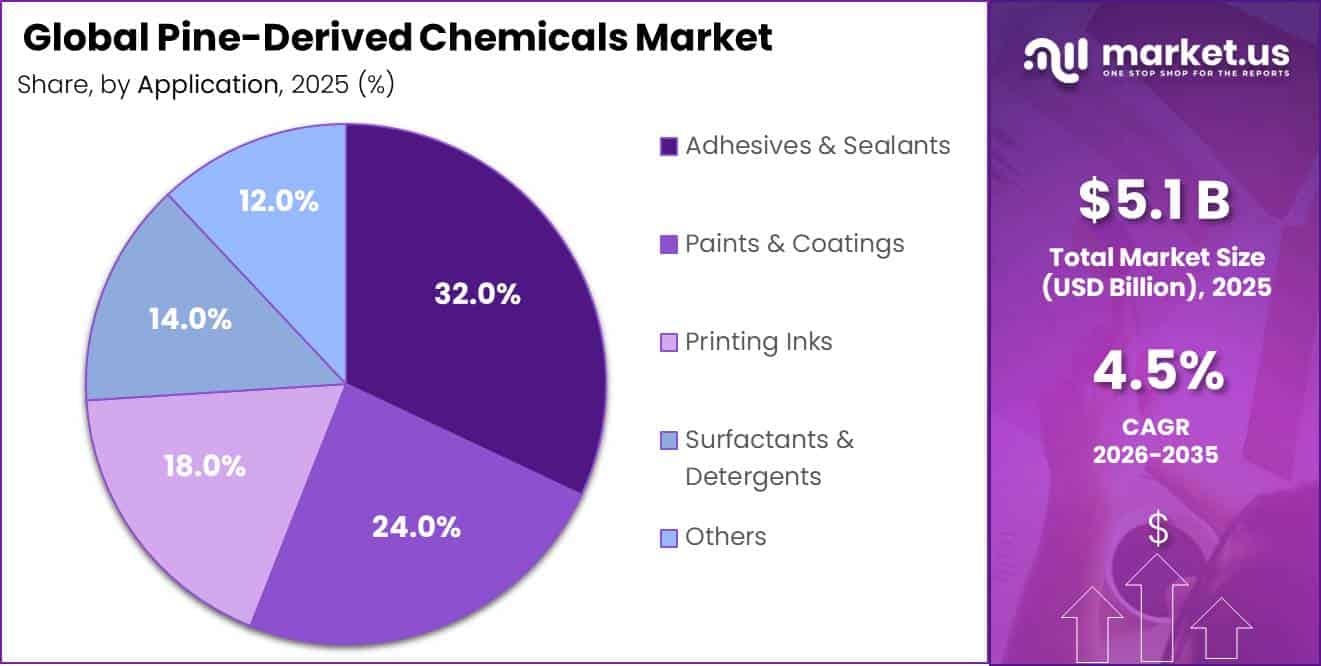
- Among the applications, adhesives & sealants held a major share in the pine-derived chemicals market, accounting for 32.00% of the market share.
- Among the end-use industries, construction held a major share in the pine-derived chemicals market, accounting for 26.00% of the market share.
- In 2025, Asia Pacific was the most dominant region in the pine-derived chemicals market, accounting for 43.20% of the total global market.
Industrial conditions remain closely linked to pulp, paper, packaging, and forest-product manufacturing. In May 2026, the American Forest & Paper Association reported that United States paper and paperboard production reached 66.3 million tons in 2025. Containerboard production totaled 36.1 million tons, while packaging paper output increased 1.7%. These operating volumes sustain kraft pulping activity, where crude tall oil and crude sulfate turpentine can be recovered and refined into higher-value chemical intermediates for industrial formulations.
- In 2026, the European Commission identified bio-based chemicals among priority lead markets under its bioeconomy strategy. The wider European bioeconomy generated €863 billion in value added, employed 17.1 million people, and is expected to attract €1-2 billion in public and private investment. This policy direction creates opportunities for pine-derived ingredients in resins, coatings, polymers, and specialty formulations.
Government-backed innovation is also supporting commercialization of bio-based chemical technologies. In April 2025, the Circular Bio-based Europe Joint Undertaking opened a €172 million funding call covering 13 topics. Within that program, €20 million was assigned to bio-based drop-in and platform chemicals using sustainable biomass conversion. Such initiatives can encourage refinery modernization, improved biomass utilization, and new pine-based product development, while stronger sustainability requirements continue to favor traceable forest feedstocks and circular production models across chemical value chains.
Type Analysis
Rosin dominates with 38.00% due to its broad use across adhesives, coatings, inks, and specialty chemicals.
In 2025, Rosin (Gum Rosin, Wood Rosin, Rosin Derivatives) held a dominant market position, capturing more than a 38.00% share. Rosin remains widely used because its tack, adhesion, film-forming, and compatibility properties support adhesives, coatings, printing inks, rubber, and other industrial formulations. Producers benefit from established pine resin supply chains and multiple derivative routes that allow rosin to be modified for different performance requirements across specialty chemical applications.
- In April 2025, according to UPM, its Lappeenranta Biorefinery produced approximately 130,000 tonnes per year of renewable diesel and naphtha using crude tall oil, a residue from pulp production. UPM also reported that its tall oil based renewable diesel reduces lifecycle greenhouse gas emissions by more than 80% compared with fossil diesel.
Tall Oil (Crude Tall Oil, TOFA, Tall Oil Rosin, Tall Oil Pitch) is the growing segment. Demand is supported by its use as a renewable forest-industry feedstock for fatty acids, rosin, fuels, coatings, lubricants, and chemical intermediates. Its integration with kraft pulp operations also supports efficient by-product recovery and gives producers opportunities to develop higher-value bio-based products across industrial applications.
Process Analysis
Kraft Process dominates with 62.00% as integrated pulp operations support efficient pine chemical recovery.
In 2025, Kraft Process held a dominant market position, capturing more than a 62.00% share. Its leadership reflects the integration of pine chemical recovery with pulp manufacturing, where crude tall oil and crude sulfate turpentine can be collected as kraft pulping co-products. This process gives producers access to industrial infrastructure, feedstock flows, and recovery systems. It also supports refining into tall oil fatty acids, tall oil rosin, turpentine fractions, sterols, and specialty chemical products for consistent production across multiple downstream industrial applications and markets.
- In May 2026, according to Stora Enso, its Skutskär production unit in Sweden had an annual pulp capacity of 515,000 tonnes and approximately 370 employees across the site.
Tapping Process is the growing segment. It produces pine oleoresin directly from living trees, which can be processed into gum rosin and gum turpentine. Interest in tapping is supported by demand for renewable pine-based raw materials and its ability to create value from managed forests without depending on pulp-mill recovery streams. This gives producers a sourcing route for resin products used across adhesives, coatings, inks, fragrances, and formulations.
Source Analysis
By-Products of Sulphate Pulping dominate with 48.00% as integrated recovery supports efficient pine chemical production.
In 2025, By-Products of Sulphate Pulping held a dominant market position, capturing more than a 48.00% share. Their leadership is supported by efficient recovery of crude tall oil, crude sulphate turpentine, and other pine-based streams generated during chemical pulping. These materials can be refined into rosin, fatty acids, sterols, pitch, and specialty intermediates, helping pulp producers create additional value from existing operations while reducing waste and improving resource utilization across integrated forest-based chemical production.
- In July 2026, according to the American Forest & Paper Association, the kraft pulping process used 3 main chemical liquors, while more than 90% of the pulping chemicals were recovered and reused within the process.
Kraft Pulp is the growing segment. Its expansion is linked to rising interest in renewable fiber processing and integrated biorefinery models. Kraft pulp mills provide a reliable industrial base for recovering pine-derived co-products alongside pulp production, allowing chemical manufacturers to access consistent feedstock streams. This integration supports efficient processing, stronger raw material utilization, and wider development of bio-based products for adhesives, coatings, inks, surfactants, and other specialty chemical applications globally today.
Application Analysis
Adhesives & Sealants dominate with 32.00% as pine-based materials support strong bonding and formulation performance.
In 2025, Adhesives & Sealants held a dominant market position, capturing more than a 32.00% share. Their leadership reflects the strong use of rosin, tall oil derivatives, and related pine-based intermediates as tackifiers, modifiers, and formulation ingredients. These materials support bonding performance, flexibility, and compatibility across packaging, construction, woodworking, labels, tapes, and industrial assembly applications. Demand also benefits from growing interest in renewable chemical inputs that can reduce reliance on conventional fossil-based formulation components.
- In August 2026, according to the United States Census Bureau, construction spending during June 2026 was estimated at a seasonally adjusted annual rate of $2,166.5 billion, while private construction spending reached $1,622.5 billion and private nonresidential construction reached $745.3 billion.
Paints & Coatings is the growing segment. Pine-derived chemicals are increasingly used in coating resins, modifiers, solvents, and performance additives where formulators seek renewable raw materials with useful adhesion, drying, film-forming, and compatibility properties. Growth is supported by demand from architectural, industrial, automotive, and protective coating applications, together with wider interest in bio-based chemistry and lower-fossil-content formulations across established and emerging industrial manufacturing supply chains globally.
End-Use Industry Analysis
Construction dominates with 26.00% as pine-based chemicals remain important across building material applications.
In 2025, Construction held a dominant market position, capturing more than a 26.00% share. Its leadership reflects the broad use of pine-derived chemicals in adhesives, sealants, coatings, resins, and related building materials. Rosin and tall oil derivatives are valued for tack, bonding, flexibility, and compatibility, supporting applications in flooring, insulation, roofing, woodworking, and structural products. Construction demand also encourages suppliers to develop renewable chemical inputs that fit performance and sustainability requirements across building-material formulations.
- In July 2026, according to the United States Census Bureau, privately owned housing starts in June reached a seasonally adjusted annual rate of 1,427,000 units, while building permits reached 1,367,000 units and single-family housing starts reached 895,000 units.
Packaging is the growing segment. Pine-derived chemicals support pressure-sensitive adhesives, labels, tapes, cartons, flexible packaging, printing inks, and protective coatings used throughout packaging production. Demand is supported by wider interest in renewable tackifiers and resins that can deliver reliable adhesion and processing performance. Their use also helps formulators broaden bio-based material choices while serving packaging manufacturers seeking consistent functionality across different substrates, converting processes, and end-product formats globally.
Key Market Segments
By Type
- Rosin (Gum Rosin, Wood Rosin, Rosin Derivatives)
- Tall Oil (Crude Tall Oil, TOFA, Tall Oil Rosin, Tall Oil Pitch)
- Turpentine (Gum Turpentine, Crude Sulphate Turpentine)
- Sterols
- Pitch
- Others
By Process
- Kraft Process
- Tapping Process
By Source
- Kraft Pulp
- Pine Trunks / Living Trees
- Aged Pine Stumps
- Dead Pine Stumps & Logs
- By-Products of Sulphate Pulping
By Application
- Adhesives & Sealants
- Paints & Coatings
- Printing Inks
- Surfactants & Detergents
- Others
By End-Use Industry
- Construction
- Packaging
- Automotive
- Personal Care & Cosmetics
- Others
Driver Analysis
Bio-based rosin tackifiers in adhesives
Rosin esters, disproportionated rosin and polymerised rosin are gaining share in hot-melt, pressure-sensitive, packaging, hygiene, construction and automotive adhesive systems because they combine renewable-carbon positioning with established tackification performance. This is commercially significant because adhesives are a formulation-driven outlet: replacing a hydrocarbon tackifier typically requires resin compatibility, softening-point control, colour stability, odour performance and long-term supply assurance rather than a simple commodity substitution.
Global oil demand is expected to plateau around 105.5 million barrels per day by 2030, but petrochemicals become the principal source of oil-demand growth from 2026; that makes renewable alternatives increasingly strategic for brand owners seeking lower fossil-feedstock exposure rather than merely low spot-price inputs. Value capture shifts toward engineered rosin esters with narrow softening-point windows, hydrogenated grades and customer-specific polymer compatibility, allowing pine-chemical suppliers to defend margins through technical service, long-term qualification and regional warehousing. =
Drivers Impact Analysis
| Driver | (~) % Impact on CAGR | Geographic Relevance | Impact Timeline |
|---|---|---|---|
| Bio-based rosin tackifiers in adhesives | +1.1 pp | North America, EU, China, India | Medium term (2–4 years) |
| Decarbonisation-led replacement of fossil feedstocks | +0.9 pp | EU core, North America, Japan, Korea | Medium term (2–4 years) |
| Tall-oil fractionation into specialty fatty-acid products | +0.7 pp | North America, Nordic EU, Brazil | Medium term (2–4 years) |
| Traceable forestry and EUDR-compliant sourcing | +0.5 pp | EU, Nordic suppliers, North America, Brazil | Short term (≤ 2 years) |
| Terpene derivatives in flavour, fragrance and health products | +0.6 pp | EU, North America, Japan, China, India | Long term (≥ 4 years) |
| Biofuel competition and pulp-mill integration economics | +0.4 pp | United States, Canada, Brazil, Nordic EU | Short term (≤ 2 years) |
Restraint Analysis
CTO diversion to renewable fuels
Crude tall oil (CTO) is becoming a strategically contested feedstock because the same fatty-acid-rich stream supports tall-oil fatty acids, rosin derivatives, dimer acids and renewable hydrocarbon fuels; the U.S. Renewable Fuel Standard’s final 2026 biomass-based diesel requirement is 8.86 billion RINs, rising to 8.95 billion RINs in 2027, with supplementary small-refinery-exemption reallocations lifting total applicable volumes to 9.07 billion and 9.20 billion RINs, respectively. This materially raises the bid ceiling that renewable diesel operators can pay for qualifying lipids and co-products, even though CTO is only one of several eligible feedstock pathways.
In Europe, final anti-dumping duties of 10.0%–35.6% on Chinese biodiesel, imposed in February 2025, reduce the availability of low-priced imported fuel and strengthen incentives for regional biofuel producers to secure domestic lipid inputs. For independent pine-chemical distillers, a hypothetical 15%–25% CTO procurement-cost escalation cannot be fully passed through in commodity tall-oil fatty acids or standard rosin esters without losing adhesive, coatings and detergent volumes; the result is working-capital pressure, lower conversion margins, shorter customer price-validity periods and delayed debottlenecking CapEx.
Restraint Impact Analysis
| Restraint | (~) % Impact on CAGR Forecast | Geographic Relevance | Impact Timeline |
|---|---|---|---|
| CTO diversion to renewable fuels | -1.2 pp | U.S., Canada, Nordic EU | Short term (≤ 2 years) |
| Pulp-mill output dependency | -0.9 pp | North America, Nordic EU, Brazil | Medium term (2–4 years) |
| Petro-resin price undercutting | -0.8 pp | China, India, ASEAN, Middle East | Medium term (2–4 years) |
| Gum-resin collection volatility | -0.7 pp | China, India, Indonesia, Vietnam, Brazil | Short term (≤ 2 years) |
| EUDR traceability cost | -0.5 pp | EU, import-linked APAC, Brazil | Short term (≤ 2 years) |
| Fragmented specialty capacity | -0.4 pp | APAC, Latin America, Africa | Long term (≥ 4 years) |
Opportunity Analysis
Traceability-as-a-service
A traceability platform that links forest origin, collector records, lot identity, processing yields, certification data, mass balance and customer declarations can become a fee-generating service line and a supplier-consolidation tool; it is an untapped opportunity because compliance is commonly treated as an overhead cost rather than monetised as an enterprise offering to smallholders, resin aggregators, traders and downstream formulators. The timing is immediate: the EU Deforestation Regulation applies to large and medium operators from 30 December 2026 and to most micro and small operators from 30 June 2027, requiring covered products entering, leaving or placed on the EU market to meet deforestation-free requirements.
A producer or trader that digitises source mapping for 5,000–20,000 collection points, attaches a unique lot identifier to each resin consignment, and supplies audit-ready due-diligence packages can convert compliance from a cost centre into differentiated access to EU buyers; a modest documentation and verification fee equivalent to 1%–3% of cargo value may be commercially acceptable if it prevents rejected shipments, costly re-routing and customer production stoppages.
Opportunity Impact Analysis
| Opportunity | (~) % Potential CAGR | Geographic Relevance | Execution Window |
|---|---|---|---|
| Low-VOC construction systems | +1.0 pp | EU, North America, India, GCC | Medium term (2–4 years) |
| Bio-based packaging additives | +0.9 pp | EU, China, Japan, North America | Medium term (2–4 years) |
| Electronics-grade rosin materials | +0.7 pp | Japan, Korea, Taiwan, China | Long term (≥ 4 years) |
| Terpene specialty-platform buildout | +0.8 pp | EU, U.S., India, Japan, China | Medium term (2–4 years) |
| Traceability-as-a-service | +0.5 pp | EU-linked APAC, Brazil, India | Short term (≤ 2 years) |
| Distillation M&A and tolling hubs | +0.6 pp | India, Southeast Asia, Latin America | Medium term (2–4 years) |
Challenges Analysis
Feedstock Traceability Digitisation
Pine-chemical producers must convert fragmented forest, tapping, aggregation, transport and distillation records into auditable digital chain-of-custody systems without disrupting procurement from thousands of small collectors, a challenge that remains operationally manageable but raises cost-to-serve and slows shipment release. The EU Deforestation Regulation takes effect for large and medium operators on 30 December 2026 and requires relevant goods placed on, sold in or exported from the EU to be deforestation-free, forcing suppliers to preserve origin, legality and due-diligence evidence across multi-tier sourcing.
For plots above 4 hectares, the operating requirement is polygon geolocation using multiple coordinate points, while sub-4-hectare plots may use a single location point; coordinates are generally expected at six-decimal precision. A processor receiving resin from 2,000–10,000 collection points may need to reconcile lot IDs, collector declarations, geospatial data, weights, moisture loss and processing yields for each intake batch, creating a likely 1%–3% uplift in administration, audit, data-capture and rejected-lot costs before scale efficiencies are achieved.
Challenges Impact Analysis
| Challenge | (~) % CAGR Friction Drag | Geographic Relevance | Mitigation Horizon |
|---|---|---|---|
| Feedstock traceability digitisation | -0.8 pp | EU-linked APAC, Brazil, India | Medium term (2–4 years) |
| Seasonal yield forecasting | -0.7 pp | China, India, Brazil, Southeast Asia | Long term (≥ 4 years) |
| Specialty-grade consistency | -0.6 pp | North America, EU, Japan, Korea, China | Medium term (2–4 years) |
| Forestry workforce renewal | -0.5 pp | North America, EU, India, ASEAN | Long term (≥ 4 years) |
| Volatile maritime logistics | -0.5 pp | Asia–EU, India–EU, Brazil–EU | Short term (≤ 2 years) |
| Fragmented emissions data | -0.4 pp | EU, North America, export-linked APAC | Medium term (2–4 years) |
Geopolitical Impact Analysis
Geopolitical Fragmentation and Trade Disruptions Reshaping Pine-Derived Chemicals Supply Chains
Current geopolitical tensions are reshaping the pine-derived chemicals market through maritime disruption, sanctions, tariff uncertainty, and sourcing pressure. UN Trade and Development reported in September 2025 that maritime transport carries over 80% of world trade, while tonnage through the Suez Canal in May 2025 remained 70% below 2023 levels. Longer routes can raise freight costs for rosin, turpentine, tall oil derivatives, and inputs.
European sanctions are changing forest-product trade flows. In July 2026, the European Commission reported that the European Union had reached its 21st sanctions package against Russia and continued prohibiting imports of wood from Russia. For pine-derived producers, these restrictions can increase origin verification and encourage diversification across pulp, resin, and forestry supply chains.
- In July 2026, the United States Trade Representative announced Section 301 tariff rates of 10% for goods from several investigated economies and 12.5% for goods from other investigated economies, with separate treatment for selected trading partners. These measures can alter landed costs where pine chemicals or related inputs fall within covered tariff lines.
These developments are encouraging producers to build multi-origin sourcing networks, maintain safety stocks, strengthen traceability, and expand refining. However, geopolitical uncertainty can still affect freight availability, feedstock pricing, qualification, and contract planning where pine resin, pulp by-products, or specialty derivatives cross several jurisdictions before final formulation.
Regional Analysis
Asia Pacific dominates with 43.20% and USD 2.20 billion, while North America emerges as the fastest-growing region.
In 2025, Asia Pacific held a dominant position in the Pine-Derived Chemicals Market, capturing more than a 43.20% share and generating USD 2.20 billion. The region benefits from large forest resources, expanding chemical manufacturing, pulp processing, and strong demand from adhesives, coatings, packaging, and construction.
- In February 2026, China’s National Bureau of Statistics reported industrial sector value added of 41,682.6 billion yuan in 2025, reflecting the scale of its manufacturing base.
North America is the fastest growing region, supported by established kraft pulp operations, packaging production, bio-based chemical innovation, and demand for renewable resins and tackifiers. In January 2026, the American Forest & Paper Association reported that United States containerboard operating rates ended 2025 above 91%, while medium production for export increased 3%. The association also stated that the United States forest products industry manufactures more than USD 435 billion in products annually, providing a downstream base for pine-derived chemicals.
Key Regions and Countries Covered
- North America
- The US
- Canada
- Europe
- Germany
- France
- The UK
- Spain
- Italy
- Russia & CIS
- Rest of Europe
- APAC
- China
- Japan
- South Korea
- India
- ASEAN
- Rest of APAC
- Latin America
- Brazil
- Mexico
- Rest of Latin America
- Middle East & Africa
- GCC
- South Africa
- Rest of MEA
Key Players Analysis
Pine-derived chemical producers focus on feedstock security, product differentiation, and downstream performance to maintain competitiveness. Kraton Corporation remains active across tall oil fatty acids, rosin esters, and turpentine-based resins, while Harima Chemicals Group combines pine chemicals with resin businesses. In 2026, Kraton raised prices on crude tall oil refinery products and derivatives by 10% to 20%, reflecting pressure from raw materials, energy, and logistics.
Portfolio restructuring is shaping competition. In January 2026, Ingevity completed the sale of its North Charleston crude tall oil refinery assets and most of its Industrial Specialties product line for $110 million at closing, with up to $19 million in contingent consideration. Kraton strengthened sustainability positioning after its Panama City facility achieved International Sustainability and Carbon Certification PLUS in January 2026. Harima Chemicals Group continued investment and portfolio realignment during 2026, supporting competition centered on specialty grades, sourcing, certification, and applications.
Market Key Players
- Ingevity Corporation
- Kraton Corporation (incl. Arizona Chemical)
- Eastman Chemical Company
- DRT (Dérivés Résiniques et Terpéniques)
- Harima Chemicals Group, Inc.
- Arakawa Chemical Industries, Ltd.
- Forchem Oyj
- WestRock Company
- Georgia-Pacific Chemicals LLC
- Lawter Inc.
- Pine Chemical Group Oy
- SunPine AB
- Foreverest Resources Ltd.
- Wuzhou Sun Shine Forestry & Chemicals Co.
- Takasago International Corporation
Key Development
- In March 2026, SunPine reported that it had further increased production rates at its Haraholmen biorefinery in Piteå after achieving a 17% production increase during 2025, strengthening its crude tall oil processing capability and renewable feedstock supply.
- In May 2026, Harima Chemicals Group announced the construction of a new resin production plant and research building at its Kakogawa site in Japan. The new plant covers approximately 750 square meters, while the research building covers around 1,400 square meters, with construction scheduled to begin in June 2026.
- In June 2026, Kraton Corporation released its 2025 Sustainability Report, introducing new sustainability targets and reporting a 2% reduction in Scope 1 and Scope 2 absolute greenhouse gas emissions compared with its 2022 baseline, while continuing development of renewable and bio-based chemical solutions.
Report Scope
| Report Features | Description |
|---|---|
| Market Value (2025) | USD 5.1 Bn |
| Forecast Revenue (2035) | USD 7.9 Bn |
| CAGR (2026-2035) | 4.5% |
| Base Year for Estimation | 2025 |
| Historic Period | 2020-2024 |
| Forecast Period | 2026-2035 |
| Report Coverage | Revenue Forecast, Market Dynamics, Competitive Landscape, Recent Developments |
| Segments Covered | By Type (Tall Oil (Crude Tall Oil, TOFA, Tall Oil Rosin, Tall Oil Pitch), Rosin (Gum Rosin, Wood Rosin, Rosin Derivatives), Turpentine (Gum Turpentine, Crude Sulphate Turpentine), Sterols, Pitch, and Others), By Process (Kraft Process and Tapping Process), By Source (Kraft Pulp, Pine Trunks / Living Trees, Aged Pine Stumps, Dead Pine Stumps & Logs, and By-Products of Sulphate Pulping), By Application (Adhesives & Sealants, Paints & Coatings, Printing Inks, Surfactants & Detergents, and Others), By End-Use Industry (Construction, Packaging, Automotive, Personal Care & Cosmetics, and Others) |
| Regional Analysis | North America – The US & Canada; Europe – Germany, France, The UK, Spain, Italy, Russia & CIS, Rest of Europe; APAC– China, Japan, South Korea, India, ASEAN & Rest of APAC; Latin America– Brazil, Mexico & Rest of Latin America; Middle East & Africa– GCC, South Africa, & Rest of MEA |
| Competitive Landscape | Ingevity Corporation, Kraton Corporation (incl. Arizona Chemical), Eastman Chemical Company, DRT (Dérivés Résiniques et Terpéniques), Harima Chemicals Group, Inc., Arakawa Chemical Industries, Ltd., Forchem Oyj, WestRock Company, Georgia-Pacific Chemicals LLC, Lawter Inc., Pine Chemical Group Oy, SunPine AB, Foreverest Resources Ltd., Wuzhou Sun Shine Forestry & Chemicals Co., Takasago International Corporation. |
| Customization Scope | Customization for segments, region/country-level will be provided. Moreover, additional customization can be done based on the requirements. |
| Purchase Options | We have three licenses to opt for: Single User License, Multi-User License (Up to 5 Users), Corporate Use License (Unlimited Users and Printable PDF) |





































