


Report Overview
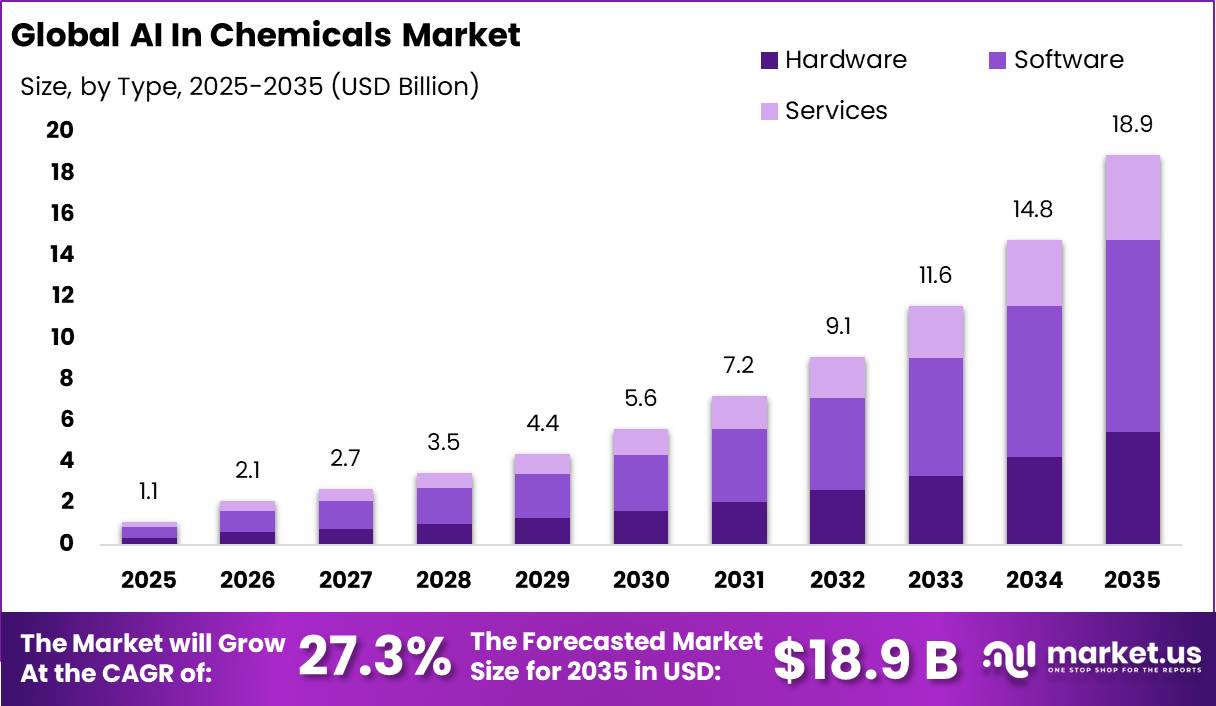
The Global AI In Chemicals Market size is expected to be worth around USD 18.9 Billion by 2035, from USD 1.1 Billion in 2025, growing at a CAGR of 27.3% during the forecast period from 2026 to 2035. In 2025, North America held a dominant market position, capturing more than a 42.70% share, holding USD 0.4 Billion revenue.
AI in chemicals is moving from pilots to plant-scale use, as producers apply machine learning, generative AI and advanced analytics to R&D, formulation, process control, maintenance, energy optimization and supply-chain planning. The industrial base is large enough to support this shift: Europe’s chemical industry reported €635 billion turnover, 1.2 million employees, and 13% global market share, while China held 46% of global chemical sales.
- The industrial case is strong because chemicals remain one of the world’s most energy-intensive sectors; the IEA states that chemicals are the largest industrial energy consumer, while global energy-related CO₂ emissions reached 37.8 Gt in 2024.
Key Takeaways
- AI In Chemicals Market size is expected to be worth around USD 18.9 Billion by 2035, from USD 1.1 Billion in 2025, growing at a CAGR of 27.3%.
- Software held a dominant market position, capturing more than a 49.20% share in the AI in Chemicals market.
- Production Optimization held a dominant market position, capturing more than a 32.80% share in the AI in Chemicals market.
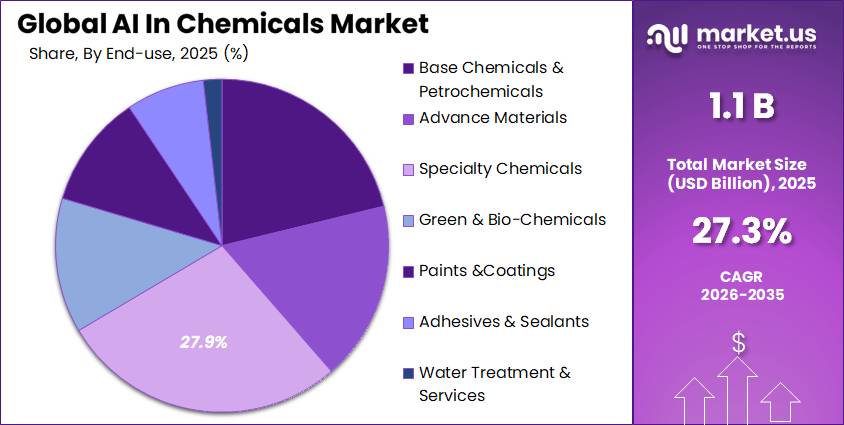
- Specialty Chemicals held a dominant market position, capturing more than a 27.90% share in the AI in Chemicals market.
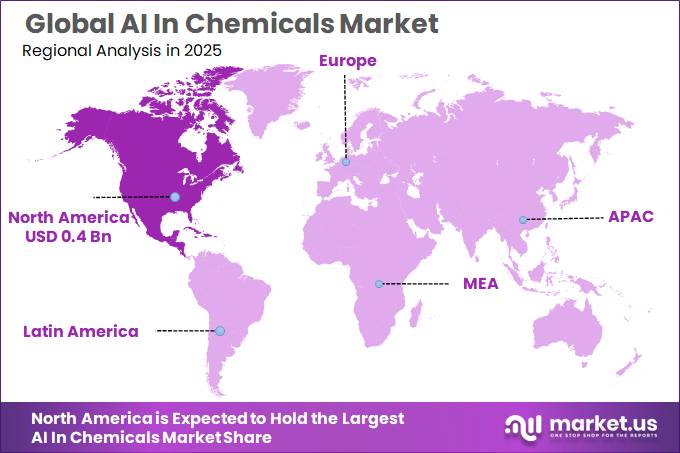
- North America held a dominant position in the AI in Chemicals market, accounting for 42.70% of the global market and reaching a value of USD 0.4 Billion.
The industrial scenario is being shaped by margin pressure, energy volatility, sustainability targets and automation needs. In the United States, chemistry generates about $673 billion annually, supports roughly 25% of U.S. GDP, and recorded $38.9 billion in capital investment, with the American Chemistry Council noting that equipment spending includes instrumentation, computers, automation and digital technologies. OECD data indicates that 20.2% of firms used AI in 2025, rising from 14.2% in 2024 and 8.7% in 2023.
Driving factors include weak demand, cost pressure, sustainability targets, skilled-labor shortages and the need to shorten innovation cycles. Cefic reported that EU27 chemical sales value decreased 2.3% in the first eight months of 2025 versus 2024, reinforcing the need for digital productivity tools. In the U.S., the chemical industry supports 547,000 jobs, $38.9 billion in capital investment and $14.8 billion in R&D investment, creating a large base for AI-enabled modernization.
Government and trusted institutional support is also strengthening the outlook. The European Commission’s InvestAI initiative targets €200 billion for AI development, including €20 billion for up to five AI gigafactories and 19 AI factories to support startups, industry and research. The IEA indicates that existing AI applications across end-use sectors could help reduce 1,400 Mt of CO₂ emissions by 2035, highlighting AI’s relevance for energy-intensive industries such as chemicals.
Honeywell agreed in May 2025 to acquire Johnson Matthey’s Catalyst Technologies business for £1.8 billion, representing about 11x estimated 2025 EBITDA, expanding its catalyst and process technology portfolio. Honeywell also announced a 2025 strategic partnership with Nutanix for virtualization solutions for Experion PKS and automation systems, with initial Nutanix-based solutions planned for release in the second half of 2025.
By Type Analysis
Software dominates with 49.20% share due to increasing adoption of AI-driven chemical process optimization and digital decision support.
In 2025, Software held a dominant market position, capturing more than a 49.20% share in the AI in Chemicals market by type of software. This leadership was mainly supported by the growing use of AI-powered platforms across chemical manufacturing, research, quality monitoring, and process management activities. Chemical companies increasingly preferred software solutions because they help improve production efficiency, reduce operational delays, and support faster decision-making through data analysis.
By Application Analysis
Production Optimization dominates with 32.80% share driven by the growing focus on improving efficiency and reducing operational waste.
In 2025, Production Optimization held a dominant market position, capturing more than a 32.80% share in the AI in Chemicals market by application. This strong position was supported by the increasing use of AI technologies to improve manufacturing efficiency, reduce process variations, and maximize output across chemical production facilities. Companies continued to adopt intelligent systems to monitor production conditions in real time and make faster operational adjustments.
By End-use Analysis
Specialty Chemicals leads with 27.90% share supported by rising demand for advanced formulations and precision manufacturing.
In 2025, Specialty Chemicals held a dominant market position, capturing more than a 27.90% share in the AI in Chemicals market by end-use. This leading position was supported by the increasing adoption of AI technologies to improve formulation accuracy, enhance product performance, and streamline production processes within specialty chemical manufacturing. Companies operating in this segment continued to invest in digital tools to accelerate innovation while maintaining quality and operational efficiency.
Key Market Segments
By Type
- Hardware
- Software
- Services
By Application
- Production Optimization
- New Material Innovation
- Operational Process Management
- Pricing Optimization
- Raw Material Demand Forecasting
- Others
By End-use
- Base Chemicals & Petrochemicals
- Advance Materials
- Specialty Chemicals
- Green & Bio-Chemicals
- Paints &Coatings
- Adhesives & Sealants
- Water Treatment & Services
- Others
Emerging Trends
Governments are pushing AI-backed modernisation
Governments are also treating AI as part of chemical-industry survival, not just a tech upgrade. In July 2025, the European Commission launched a plan to strengthen and modernise the EU chemical industry. The plan calls chemicals the EU’s fourth-largest manufacturing industry and links the sector to defence, clean tech and digital supply chains.
- In October 2025, the EU also announced a €1 billion Apply AI strategy for key industries, including manufacturing and climate science.
For chemical companies, this means more support for digital plants, safer materials, faster compliance and smarter production. In simple words, AI is becoming a practical tool to keep factories competitive, reduce waste and protect skilled jobs.
Expansion of AI-Based Predictive Manufacturing and Real-Time Industrial Intelligence Gains Momentum
The International Energy Agency reported that broader industrial deployment of AI technologies could contribute energy savings of up to 8% through improved process optimization and operational performance. In chemical manufacturing, these improvements are supporting faster maintenance decisions, better production scheduling, and stronger quality consistency.
Industrial operators are also using AI to identify equipment performance patterns and react before failures occur. Supported by government initiatives focused on digital industry and cleaner production systems, predictive manufacturing is becoming a practical investment area rather than an experimental technology. This trend is expected to continue influencing how chemical facilities improve productivity and long-term operational resilience.
Drivers
Rising Need for Energy Efficiency and Cost Control is Accelerating AI Adoption in Chemicals
One of the major driving factors for the AI in Chemicals market is the growing need to improve energy efficiency while keeping production costs under control. Chemical manufacturing is one of the most energy-intensive industrial sectors globally, which has pushed companies to look for smarter operating models. AI is increasingly being used to monitor plant conditions, predict process changes, optimize equipment performance, and reduce unnecessary energy consumption.
- According to the International Energy Agency (IEA), the chemical sector is currently the largest industrial energy consumer worldwide. At the same time, ammonia production alone contributes around 45% of emissions from primary chemical production, followed by methanol at 28% and high-value chemicals at 27%.
These figures continue to encourage chemical manufacturers to adopt intelligent technologies that can reduce process inefficiencies and improve operational output. AI-based optimization allows plants to process large volumes of operational data and make faster production decisions with fewer interruptions.
Government and Industry Focus on Digital Industrial Transformation Supports Market Growth
Another strong growth driver is the increasing support from governments and industrial bodies for digital manufacturing and industrial modernization. Across several regions, policy frameworks are encouraging industries to adopt advanced analytics, automation, and intelligent production systems to remain competitive and reduce industrial emissions.
The International Energy Agency reported in 2025 that AI adoption across industrial sectors can support meaningful operational improvements through optimization and innovation. Under wider adoption scenarios, AI-enabled applications could contribute energy savings of up to 8% in industrial operations through improved process control and operational efficiency.
As chemical manufacturers continue expanding digital infrastructure, AI tools are becoming valuable for predictive maintenance, quality monitoring, and production planning. These improvements help reduce downtime, improve resource utilization, and strengthen long-term sustainability goals.
Restraints
High Implementation Costs and Limited Digital Readiness Continue to Restrict AI Adoption in Chemicals
One of the major restraining factors for the AI in Chemicals market is the high cost and complexity involved in implementation across chemical manufacturing environments. Although AI offers benefits in production planning, predictive maintenance, and process optimization, many chemical companies still face challenges in building the required digital infrastructure. AI deployment often requires modern data systems, connected production assets, cloud integration, and specialized technical teams, which creates significant upfront investment requirements.
According to industry analysis published by IBM in 2026, chemical companies continue to face adoption barriers because AI deployment requires stronger operational integration and reliable industrial data environments. In parallel, industry assessments have shown that many AI use cases cannot deliver expected results unless organizations already have a certain level of digital maturity and technical capability. This creates a slower transition for manufacturers operating with legacy production systems and fragmented operational data.
Shortage of Skilled Workforce and Industrial Data Challenges Limit Scalable AI Deployment
Research on industrial AI adoption highlights that industrial environments often lack large, accessible datasets because operational information remains highly confidential and process-specific. This reduces the ability to train and scale AI systems effectively across facilities. Additionally, a 2026 industrial adoption study covering multiple companies found that only 1 out of 12 organizations had advanced multi-agent AI orchestration in production environments, while most remained at early stages of deployment due to verification and integration limitations.
These findings reflect broader industrial readiness challenges that also affect chemical manufacturers. Governments and industrial bodies continue supporting digital skills development and industrial modernization, but workforce capability and data quality remain practical barriers slowing wider AI adoption across the chemicals sector.
Opportunity
AI-Driven Discovery and Faster Development of Sustainable Chemicals Creates Strong Growth Opportunity
One major growth opportunity for the AI in Chemicals market is the increasing use of artificial intelligence to accelerate the discovery and development of sustainable and advanced chemical products. Traditional chemical development processes often require years of testing, multiple production trials, and high research costs. AI is creating opportunities by helping manufacturers analyze large chemical datasets, predict material behavior, and shorten development timelines.
- According to the International Energy Agency (IEA), the chemical industry accounts for around 14% of total industrial energy consumption globally, creating strong pressure to improve efficiency and develop lower-emission chemical processes.
AI is becoming an important tool to support these goals by identifying better formulations, optimizing reaction pathways, and reducing unnecessary experimentation. Government-backed industrial transformation programs and sustainability initiatives are also encouraging chemical producers to invest in digital innovation. With increasing demand for cleaner production and faster commercialization, AI-supported chemical discovery is opening new revenue opportunities and supporting long-term industry competitiveness.
Expansion of Smart Manufacturing and Industrial Digitalization Opens New Revenue Potential
According to the International Energy Agency’s Energy and AI analysis, wider use of AI-enabled industrial applications could contribute energy savings of up to 8% across industrial operations through optimization and improved process efficiency. For chemical manufacturers operating at large scale, even small improvements in energy and resource utilization can create measurable financial value.
Governments in major industrial economies continue supporting digital industrial upgrades through cleaner production and industrial innovation programs. This environment creates favorable conditions for AI providers and chemical producers to build intelligent production ecosystems, making smart manufacturing one of the strongest future growth opportunities for the AI in Chemicals market.
Regional Insights
North America dominates the AI in Chemicals market with a 42.70% share, reaching USD 0.4 Billion through strong industrial digitalization and advanced chemical innovation.
In 2025, North America held a dominant position in the AI in Chemicals market, accounting for 42.70% of the global market and reaching a value of USD 0.4 Billion. The region’s leadership was supported by its well-established chemical manufacturing ecosystem, high adoption of industrial automation, and increasing investment in artificial intelligence technologies across production and research operations.
The presence of large-scale chemical production facilities, advanced digital infrastructure, and strong industrial technology adoption created favorable conditions for AI deployment. Companies increasingly adopted data-driven manufacturing models to improve throughput, optimize energy use, and accelerate decision-making across chemical value chains. The growing use of machine learning tools and intelligent analytics platforms also supported better production planning and inventory management.
Key Regions and Countries Insights
- North America
- US
- Canada
- Europe
- Germany
- France
- The UK
- Spain
- Italy
- Rest of Europe
- Asia Pacific
- China
- Japan
- South Korea
- India
- Australia
- Rest of APAC
- Latin America
- Brazil
- Mexico
- Rest of Latin America
- Middle East & Africa
- GCC
- South Africa
- Rest of MEA
Key Players Analysis
Honeywell is strengthening its position in the AI in Chemicals market by expanding industrial automation, advanced analytics, and AI-enabled process optimization solutions. The company supports chemical manufacturers through intelligent control systems that improve production efficiency and operational visibility. In 2025, Honeywell reported annual revenue exceeding USD 38 billion, reflecting its broad industrial presence.
Xylem is expanding AI capabilities across industrial and chemical applications with a focus on intelligent infrastructure, analytics, and resource optimization. The company supports chemical operations through digital platforms designed to improve process efficiency and operational monitoring. In 2025, Xylem generated annual revenue of approximately USD 8.6 billion and continued increasing investment in smart industrial technologies.
Revvity Signals Software plays an important role in AI adoption across chemical research and laboratory environments through scientific software and advanced data analytics. Its platforms support chemical modeling, research workflows, and faster product development. Parent company Revvity reported annual revenue of around USD 2.8 billion in 2025.
Top Key Players Outlook
- BASF
- Honeywell
- Xylem
- Revvity Signals Software
- NobleAI
- Kebotix
- SandboxAQ
- Deepmatter
- Zapata AI
- Citrine Informatics
- Chemical.AI
- Polymerize
- ScienceDesk
Recent Industry Developments
In 2025, SandboxAQ strengthened its work in the AI in Chemicals sector by using its Large Quantitative Models to support chemistry, materials science, catalysts, energy, and drug discovery. The company closed a USD 450 million Series E round in April 2025, taking total funding to more than USD 950 million and reaching a reported valuation of USD 5.75 billion. On partnerships, SandboxAQ signed a 2025 agreement with Bahrain’s Mumtalakat for a 3-year program aimed at creating biotech assets worth USD 1 billion, while Reuters also noted its 2025 agreement with Saudi Aramco to improve downstream product value.
June 2025, NobleAI launched practical AI solutions for chemistry and energy, including its VIP Platform, designed to turn limited industrial data into useful predictions across chemistry, materials, and energy applications. In July 2025, Viakable also selected NobleAI to support advanced materials discovery for electrical cable manufacturing. On investment, NobleAI had earlier raised more than USD 17 million in Series A funding, backed by investors including M12 and Chevron Technology Ventures.
Report Scope
| Report Features | Description |
|---|---|
| Market Value (2025) | USD 1.1 Bn |
| Forecast Revenue (2035) | USD 18.9 Bn |
| CAGR (2026-2035) | 27.3% |
| Base Year for Estimation | 2025 |
| Historic Period | 2020-2024 |
| Forecast Period | 2026-2035 |
| Report Coverage | Revenue Forecast, Market Dynamics, Competitive Landscape, Recent Developments |
| Segments Covered | By Type (Hardware, Software, Services), By Application (Production Optimization, New Material Innovation, Operational Process Management, Pricing Optimization, Raw Material Demand Forecasting, Others), By End-use (Base Chemicals And Petrochemicals, Advance Materials, Specialty Chemicals, Green And Bio-Chemicals, Paints And Coatings, Adhesives And Sealants, Water Treatment And Services, Others) |
| Regional Analysis | North America – US, Canada; Europe – Germany, France, The UK, Spain, Italy, Rest of Europe; Asia Pacific – China, Japan, South Korea, India, Australia, Singapore, Rest of APAC; Latin America – Brazil, Mexico, Rest of Latin America; Middle East & Africa – GCC, South Africa, Rest of MEA |
| Competitive Landscape | BASF, Honeywell, Xylem, Revvity Signals Software, NobleAI, Kebotix, SandboxAQ, Deepmatter, Zapata AI, Citrine Informatics, Chemical.AI, Polymerize, ScienceDesk |
| Customization Scope | Customization for segments, region/country-level will be provided. Moreover, additional customization can be done based on the requirements. |
| Purchase Options | We have three licenses to opt for: Single User License, Multi-User License (Up to 5 Users), Corporate Use License (Unlimited User and Printable PDF) |





































