


Report Overview
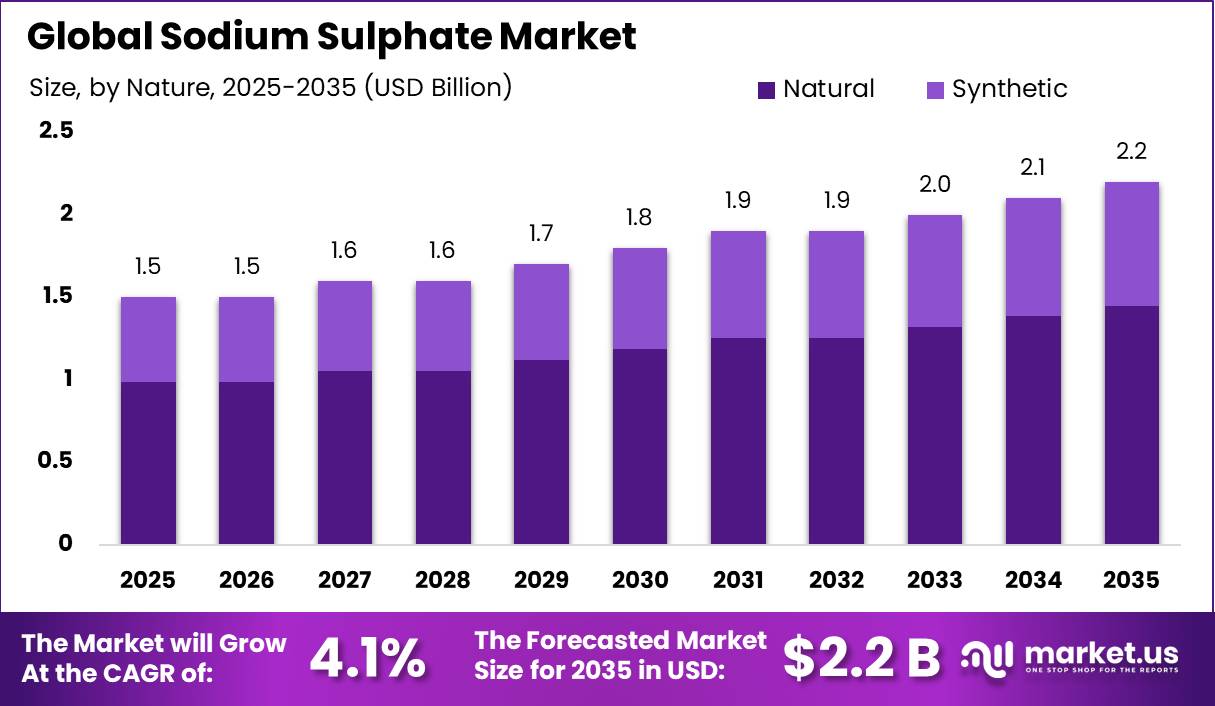
The Global Sodium Sulphate Market size is expected to be worth around USD 2.2 Billion by 2035, from USD 1.5 Billion in 2025, growing at a CAGR of 4.1% during the forecast period from 2026 to 2035. In 2025, North America held a dominant market position, capturing more than a 26.8% share, holding USD 0.4 Billion revenue.
Sodium sulphate is positioned as a mature but strategically useful inorganic chemical used in powdered detergents, glass, textiles, pulp and paper, and specialty chemical processing. Industrial demand remains tied to high-volume manufacturing rather than premium pricing, as sodium sulphate functions mainly as a filler, processing aid, fluxing agent, and intermediate chemical.
- The supply base benefits from both natural mineral sources and synthetic/by-product routes; USGS has historically estimated natural sodium sulphate production at about 4 million tons, with by-product output at 1.5–2.0 million tons, while noting that resources are sufficient for hundreds of years at prevailing consumption rates.
The industrial scenario is supported by stable downstream chemical activity. In Europe, sold production of chemicals and related products increased from €790 billion in 2023 to €830 billion in 2024, while chemical exports rose 7.0% and imports declined 1.1%, indicating a stronger external trade base for industrial chemicals. A.I.S.E. also reports the European detergents and maintenance products industry at €47.6 billion in 2024, with 95,000 direct jobs and 360,000 value-chain jobs, supporting demand for sodium sulphate as a detergent filler and processing aid.
Driving factors include detergent demand, glass manufacturing, paper-pulp chemicals, and broader circular-economy regulation. The European Commission’s 2025 chemicals action plan targets high energy costs, unfair competition, and weak demand, while proposing simplification expected to save the industry at least €363 million annually; the EU chemicals sector includes 29,000 companies, 1.2 million direct jobs, and 19 million supply-chain jobs. These measures support compliant chemical producers and may improve investment visibility in Europe.
Government initiatives are expected to influence future growth through greener chemical and cleaning-product standards. The European Commission’s Chemicals Strategy aims to protect citizens and the environment while boosting innovation for safe and sustainable chemicals, and EU Ecolabel cleaning criteria cover hazardous-substance limits, sustainable raw-material sourcing, recyclable packaging and proper-use guidance.
Future opportunities are likely to emerge from cleaner processing, specialty grades, and adjacent energy-storage chemistry. The IEA expects battery innovation to reduce average lithium-ion battery costs by 40% from 2023 to 2030, while sodium-ion batteries could cost 30% less than LFP batteries and represent a growing share of energy-storage batteries, although less than 10% of EV batteries by 2030. This does not make sodium sulphate a direct battery material in all cases, but it reinforces long-term interest in sodium-based chemical supply chains.
In 2025, Elementis PLC advanced portfolio reshaping by signing and completing the sale of its Talc business to IMI Fabi for an enterprise value of $121 million, with expected net cash proceeds of about $55 million, and announced an intended $50 million share buyback. The company said the disposal would improve adjusted operating margin by about 240 basis points and support its shift toward coatings and personal care additives.
Key Takeaways
- Sodium Sulphate Market size is expected to be worth around USD 2.2 Billion by 2035, from USD 1.5 Billion in 2025, growing at a CAGR of 4.1%.
- Natural held a dominant market position, capturing more than a 65.9% share in the global Sodium Sulphate market.
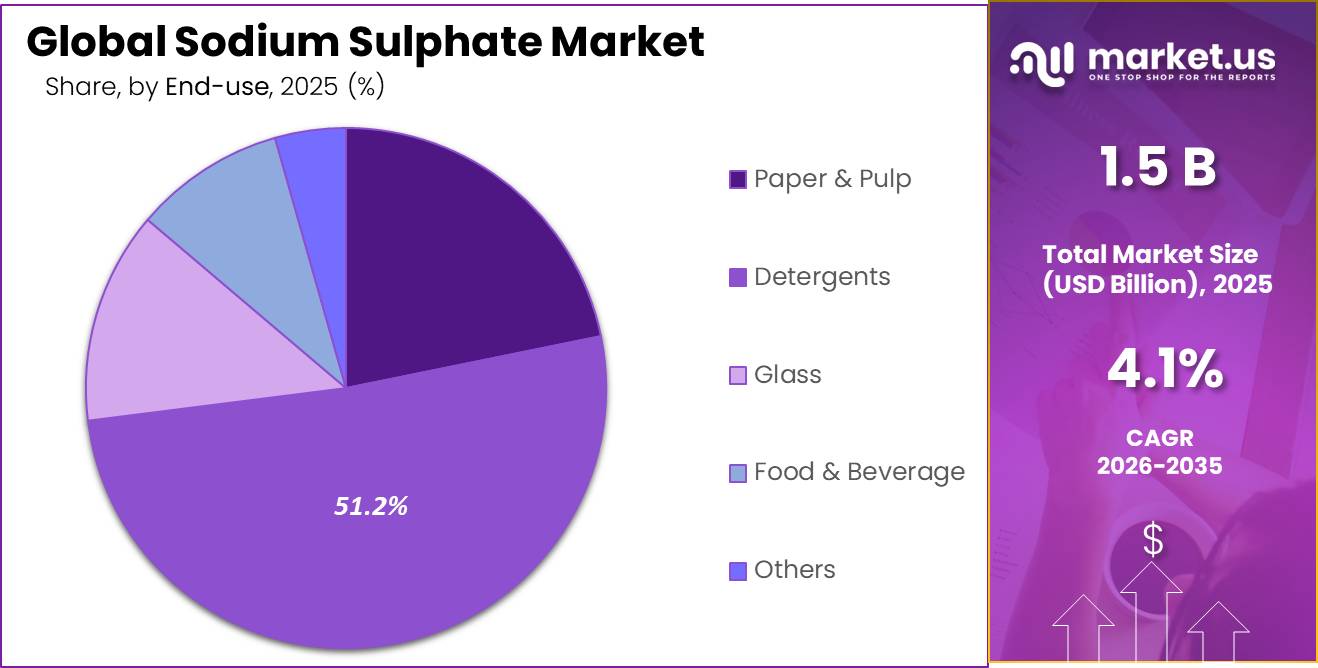
- Detergents held a dominant market position, capturing more than a 51.2% share in the global Sodium Sulphate market.
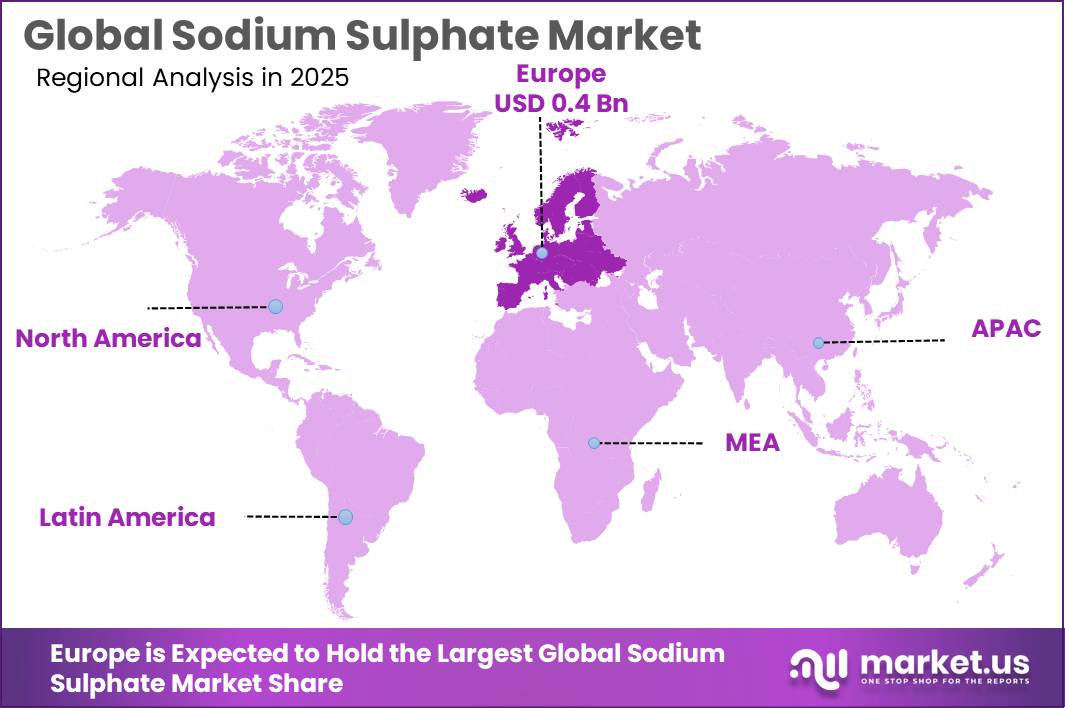
- Europe held a dominant position in the global Sodium Sulphate market, accounting for 26.8% of the total market share and reaching a valuation of nearly USD 0.4 Bn.
By Nature Analysis
Natural Sodium Sulphate dominates with 65.9% share due to rising preference for naturally sourced industrial minerals.
In 2025, Natural held a dominant market position, capturing more than a 65.9% share in the global Sodium Sulphate market. The strong presence of natural sodium sulphate is mainly linked to its easy availability from naturally occurring salt lakes, brine deposits, and mineral sources. Industries such as detergents, glass manufacturing, textiles, and pulp & paper continued to prefer naturally derived sodium sulphate because it offers stable quality and lower processing costs compared to synthetic alternatives. Many manufacturers also shifted toward natural sources to reduce chemical processing requirements and improve production efficiency.
By End-use Analysis
Detergents dominate with 51.2% share due to strong demand from household and industrial cleaning applications.
In 2025, Detergents held a dominant market position, capturing more than a 51.2% share in the global Sodium Sulphate market. The segment continued to lead because sodium sulphate is widely used as a filler material in powdered detergents, helping improve product consistency and flow properties. Rising consumption of household cleaning products, supported by growing urban populations and increasing hygiene awareness, played an important role in driving demand. Manufacturers also preferred sodium sulphate in detergent formulations because it is cost-effective and easily available in large quantities.
Key Market Segments
By Nature
- Natural
- Synthetic
By End-use
- Paper & Pulp
- Detergents
- Glass
- Food & Beverage
- Others
Emerging Trends
Growing Focus on Sustainable Glass and Textile Manufacturing Is Emerging as a Key Market Trend
One of the latest trends shaping the Sodium Sulphate market is the growing shift toward sustainable industrial production, especially in the glass and textile sectors. Manufacturers are increasingly adopting cleaner production methods and recycled raw materials to reduce environmental impact while maintaining production efficiency. Sodium sulphate continues to play an important role in glass manufacturing because it improves melting performance and helps remove impurities during production.
- According to the International Energy Agency (IEA), global solar PV additions crossed 507 GW in 2023, showing strong growth in solar panel manufacturing worldwide. Solar panels require high-quality glass, which is increasing the demand for industrial glass processing materials, including sodium sulphate.
Governments across Europe and Asia are also supporting low-carbon construction materials and renewable energy projects through sustainability policies and green building programs. This trend is encouraging glass manufacturers to modernize facilities and improve production output, creating stable demand for sodium sulphate in industrial applications during 2025 and 2026.
Textile Recycling and Eco-Friendly Dyeing Processes Are Influencing Industry Demand
Another noticeable trend in the Sodium Sulphate market is the rising focus on textile recycling and environmentally friendly dyeing processes. Sodium sulphate is commonly used during textile dyeing because it helps fabrics absorb dyes more evenly and improves color consistency. As global textile waste continues to increase, governments and textile manufacturers are investing in recycling technologies and sustainable fabric processing methods.
This policy direction is pushing textile producers to adopt controlled chemical usage and improve production efficiency. At the same time, global apparel demand remains strong, especially across developing manufacturing countries in Asia. Textile companies are increasingly modernizing dyeing units to reduce water consumption and chemical waste while maintaining fabric quality. In 2026, many textile processing facilities continued investing in efficient industrial salts and dyeing chemicals, supporting the continued use of sodium sulphate in sustainable textile manufacturing operations.
Drivers
Rising Demand for Detergents Continues to Support Sodium Sulphate Consumption
One of the major driving factors for the Sodium Sulphate market is the steady growth of the detergent and household cleaning industry. Sodium sulphate is widely used in powdered detergents as a filler because it improves product consistency and keeps the powder free-flowing during packaging and storage. As urban populations continue to increase and hygiene awareness becomes stronger, detergent consumption is also rising across both developed and developing countries.
- According to the OECD chemical assessment report, more than 1 million tons of sodium sulphate were used in detergent applications globally.
In addition, the global household cleaning products industry showed strong expansion in 2025 as consumers increased spending on laundry and cleaning products for homes, hospitals, hotels, and commercial facilities. The continued use of powdered detergents in countries across Asia, Africa, and Latin America is further supporting sodium sulphate demand. Manufacturers are also focusing on producing affordable detergent products in bulk volumes, where sodium sulphate remains an important raw material because of its low cost and easy availability.
Urbanization and Government Sanitation Efforts Are Increasing Cleaning Product Usage
Rapid urbanization and government-supported sanitation programs are also creating strong demand for sodium sulphate-based cleaning products. According to the United Nations, around 55% of the global population currently lives in urban areas, and this figure is expected to reach 68% by 2050. Growing urban populations are increasing the use of laundry detergents, industrial cleaners, and hygiene products in apartments, commercial buildings, healthcare facilities, and public spaces.
Governments in many countries are also investing heavily in sanitation and public hygiene awareness programs, which indirectly supports the cleaning chemicals industry. The World Bank reported that it invests nearly US$5 billion annually in urban development and public infrastructure projects aimed at improving living standards and sanitation systems. These developments are encouraging higher consumption of cleaning products, especially in densely populated cities.
Restraints
Environmental Regulations on Chemical Waste Disposal Are Limiting Sodium Sulphate Production
One of the major restraining factors for the Sodium Sulphate market is the growing pressure from environmental regulations related to chemical waste disposal and industrial emissions. Sodium sulphate production, especially from synthetic processes, generates industrial waste and wastewater that require proper treatment before discharge. Governments and environmental agencies across several countries are tightening pollution control rules for chemical manufacturing plants.
- According to the United States Environmental Protection Agency (EPA), the chemical manufacturing sector generated over 25 million tons of production-related waste in recent reporting years, increasing concerns over disposal and environmental impact.
In 2025, several industrial producers also experienced delays in plant expansion projects due to lengthy environmental approval procedures. These regulations are especially affecting synthetic sodium sulphate producers, where chemical processing activities are more closely monitored by environmental authorities.
Shift Toward Liquid Detergents Is Reducing Demand for Sodium Sulphate in Cleaning Products
Another important challenge for the Sodium Sulphate market is the increasing shift from powdered detergents to liquid detergent products. Sodium sulphate is mainly used in powdered detergent formulations, while liquid detergents require very little or no sodium sulphate content. As consumer preferences continue changing toward liquid and concentrated cleaning products, demand growth for sodium sulphate is gradually slowing in some developed regions.
According to the American Cleaning Institute (ACI), liquid laundry detergents account for nearly 75% of the U.S. household laundry detergent market. Consumers are increasingly choosing liquid detergents because they dissolve faster, work better in cold water, and are easier to use in modern washing machines. Government sustainability campaigns promoting water-efficient and energy-saving appliances are also indirectly supporting the use of liquid detergent formats.
Opportunity
Expanding Glass Manufacturing Industry Is Creating Strong Growth Opportunities for Sodium Sulphate
One of the biggest growth opportunities for the Sodium Sulphate market is the continuous expansion of the global glass manufacturing industry. Sodium sulphate is widely used in glass production because it helps remove small air bubbles during the melting process, improving glass clarity and quality. The increasing demand for flat glass in construction, automotive, and solar panel applications is directly supporting sodium sulphate consumption.
- According to the International Energy Agency (IEA), global solar PV capacity additions reached nearly 507 GW in 2023, marking a significant increase in solar infrastructure development.
Since solar panels require large quantities of high-quality glass, demand for glass manufacturing materials has also increased steadily. In 2025 and 2026, many countries continued investing in renewable energy projects and smart infrastructure development, especially across Asia-Pacific and the Middle East. Government programs promoting clean energy and green buildings are also helping the glass industry expand further.
Rising Textile Production Across Developing Economies Offers New Market Potential
The growing textile and apparel industry is another major opportunity area for the Sodium Sulphate market. Sodium sulphate is commonly used in textile dyeing processes to improve color absorption and ensure uniform dye distribution on fabrics. Countries such as India, Bangladesh, Vietnam, and China continue expanding textile manufacturing due to rising global clothing demand and export activities. According to the World Trade Organization (WTO), global textile exports were valued at around US$ 363 billion in recent years, showing the large scale of the industry.
Governments in developing economies are also supporting textile manufacturing through industrial policies, export incentives, and infrastructure development programs. In India, the government’s PM MITRA textile park initiative aims to strengthen large-scale textile manufacturing and improve production efficiency. Growing textile production is increasing the use of dyeing chemicals and industrial salts, where sodium sulphate remains an important processing ingredient.
Regional Insights
Europe dominates the Sodium Sulphate market with a 26.8% share valued at USD 0.4 Bn due to strong detergent and glass manufacturing industries.
In 2025, Europe held a dominant position in the global Sodium Sulphate market, accounting for 26.8% of the total market share and reaching a valuation of nearly USD 0.4 Bn. The region’s leadership is strongly supported by its well-established detergent, glass, textile, and chemical manufacturing sectors. Countries such as Germany, France, Spain, and Italy continue to maintain stable demand for sodium sulphate due to the large-scale production of powdered detergents and industrial glass products.
The regional market is also benefiting from the growth of the construction and renewable energy sectors. Increasing installation of solar panels across European countries has supported demand for high-quality flat glass, indirectly increasing the consumption of sodium sulphate used during glass manufacturing. According to European Union energy targets, member countries continue investing heavily in renewable energy infrastructure and sustainable building projects, creating favorable industrial demand for glass processing materials.
Key Regions and Countries Insights
- North America
- US
- Canada
- Europe
- Germany
- France
- The UK
- Spain
- Italy
- Rest of Europe
- Asia Pacific
- China
- Japan
- South Korea
- India
- Australia
- Rest of APAC
- Latin America
- Brazil
- Mexico
- Rest of Latin America
- Middle East & Africa
- GCC
- South Africa
- Rest of MEA
Key Players Analysis
Elementis PLC remains an important specialty chemicals manufacturer with a strong industrial materials portfolio supporting multiple end-use industries. In 2025, the company reported revenue exceeding USD 700 million across its specialty chemical operations, supported by steady industrial demand from coatings, personal care, and performance materials sectors. The company continued focusing on operational optimization and expansion of specialty ingredient production capabilities.
Lenzing AG plays a notable role in the Sodium Sulphate market through its integrated textile and fiber manufacturing operations. In 2025, the company generated revenue of more than USD 2 billion, supported by strong demand for specialty cellulose fibers and sustainable textile materials. Sodium sulphate is produced as a by-product during certain pulp and fiber processing operations, supporting industrial supply availability. The company operates production facilities across Europe, Asia, and the Americas.
Top Key Players Outlook
- Nippon Chemical Industrial CO., LTD
- Elementis PLC.
- LENZING AG
- SHIKOKU KASEI HOLDINGS CORPORATION
- Bahubali Chemical Industries
- Cooper Natural Resources
- Sun European Partners, LLP
- Sigma-Aldrich Solutions
- Tokyo Chemical Industry Pvt. Ltd.
- Jiangsu Yinzhu Chemical Group Co., Ltd
Recent Industry Developments
In 2025–2026, Tokyo Chemical Industry worked in the sodium sulphate sector mainly as a laboratory and specialty chemical supplier, not as a bulk commodity producer. Its sodium sulfate product, listed under Product No. S0566, carries CAS No. 7757-82-6, molecular weight 142.04, and purity above 99.5%, with appearance described as white or colorless powder to crystal.
In 2025–2026, Sigma-Aldrich Solutions, operating under Merck’s Life Science business, remained active in the sodium sulphate sector as a high-purity laboratory and production chemical supplier. Its sodium sulfate range includes CAS No. 7757-82-6, molecular weight 142.04 g/mol, EC No. 231-820-9, and grades such as anhydrous, ACS reagent, BioUltra, and pharmaceutical secondary standard. In 2025, Merck Group reported net sales of €21,102 million, while Life Science sales reached €8,980 million, equal to 42% of group sales.
In 2025–2026, Cooper Natural Resources worked in the sodium sulphate sector mainly through natural and co-produced sodium sulfate supply in the U.S. The company operates through sodium sulfate-focused divisions including Ozark Division and Saltex, while Saltex markets natural and co-produced sodium sulfate across the United States. Cooper Natural Resources was formed in 1996 after acquiring a West Texas sodium sulfate operation, giving it nearly 30 years of operating history in this sector.
Report Scope
| Report Features | Description |
|---|---|
| Market Value (2025) | USD 1.5 Bn |
| Forecast Revenue (2035) | USD 2.2 Bn |
| CAGR (2026-2035) | 4.1% |
| Base Year for Estimation | 2025 |
| Historic Period | 2020-2024 |
| Forecast Period | 2026-2035 |
| Report Coverage | Revenue Forecast, Market Dynamics, Competitive Landscape, Recent Developments |
| Segments Covered | By Nature (Natural, Synthetic), By End-use (Paper And Pulp, Detergents, Glass, Food And Beverage, Others) |
| Regional Analysis | North America – US, Canada; Europe – Germany, France, The UK, Spain, Italy, Rest of Europe; Asia Pacific – China, Japan, South Korea, India, Australia, Singapore, Rest of APAC; Latin America – Brazil, Mexico, Rest of Latin America; Middle East & Africa – GCC, South Africa, Rest of MEA |
| Competitive Landscape | Nippon Chemical Industrial CO., LTD, Elementis PLC., LENZING AG, SHIKOKU KASEI HOLDINGS CORPORATION, Bahubali Chemical Industries, Cooper Natural Resources, Sun European Partners, LLP, Sigma-Aldrich Solutions, Tokyo Chemical Industry Pvt. Ltd., Jiangsu Yinzhu Chemical Group Co., Ltd |
| Customization Scope | Customization for segments, region/country-level will be provided. Moreover, additional customization can be done based on the requirements. |
| Purchase Options | We have three licenses to opt for: Single User License, Multi-User License (Up to 5 Users), Corporate Use License (Unlimited User and Printable PDF) |





































