Report Overview
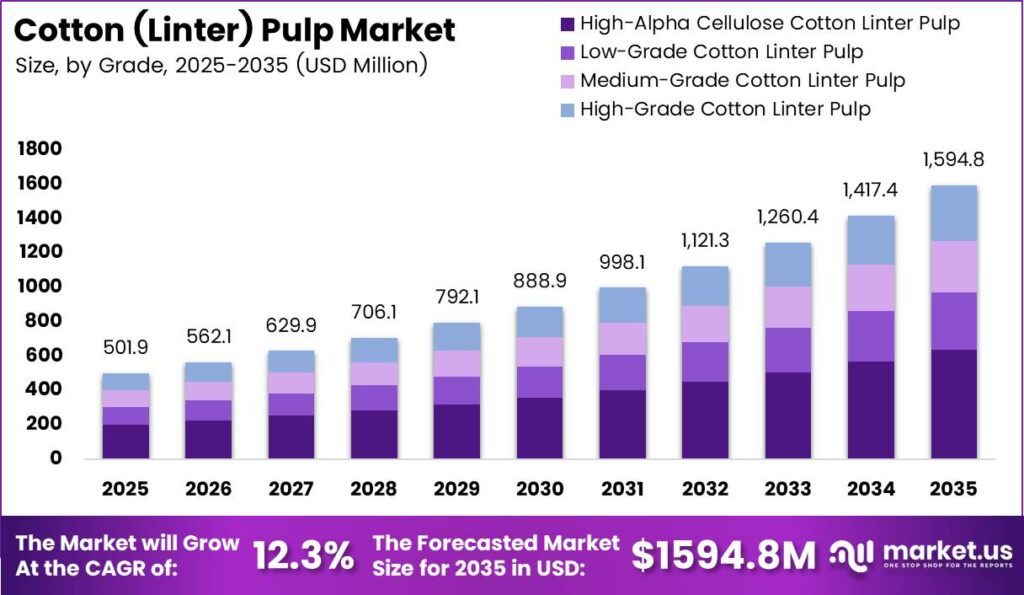
Global Cotton (Linter) Pulp Market size is expected to be worth around USD 1,594.8 Million by 2035 from USD 501.9 Million in 2025, growing at a CAGR of 12.3% during the forecast period 2026 to 2035. This trajectory reflects sustained industrial demand for high-purity cellulose across specialty chemicals, pharmaceuticals, and advanced materials manufacturing. Buyers requiring consistent alpha-cellulose content and low hemicellulose levels are locking in long-term supply agreements, rewarding suppliers with verified quality credentials and reliable output capacity.
Cotton linter pulp is a refined cellulose product derived from the short fibers attached to cottonseed after ginning, yielding pulp with alpha-cellulose content substantially higher than wood-based alternatives. The market spans multiple grade classifications, including high-alpha, medium-grade, and low-grade varieties, serving end-use industries from nitrocellulose propellant manufacturing to pharmaceutical excipients. By processing type, the structure separates bleached, unbleached, refined, and mercerized outputs, each serving distinct downstream specification requirements across global industrial supply chains.
Key Takeaways
- The global Cotton (Linter) Pulp Market was valued at USD 501.9 Million in 2025 and is forecast to reach USD 1,594.8 Million by 2035.
- The market is projected to grow at a CAGR of 12.3% during the forecast period 2026 to 2035.
- By Grade, High-Alpha Cellulose Cotton Linter Pulp dominates with a 36.00% share in 2025.
- By Alpha Cellulose Content, the Above 97% segment holds the leading share at 42.00%.
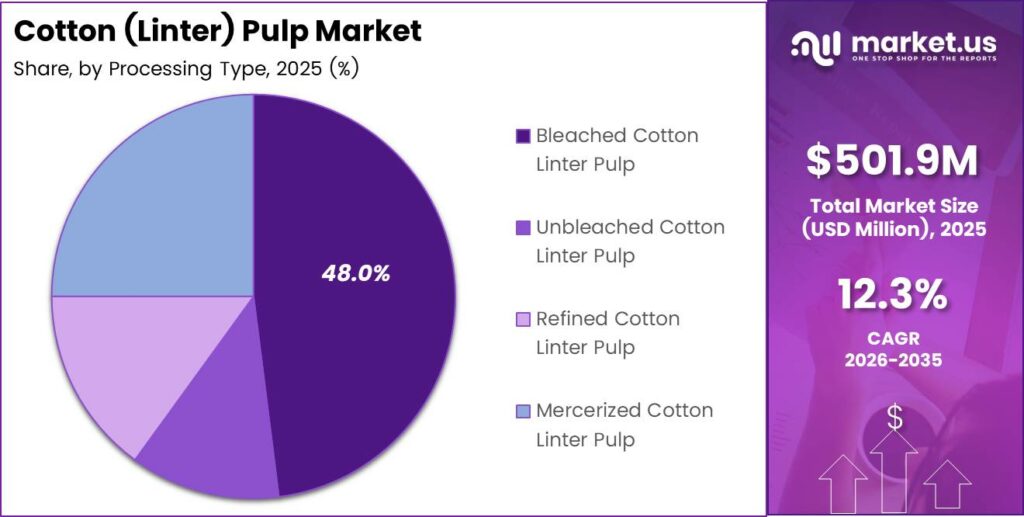
- By Processing Type, Bleached Cotton Linter Pulp leads with a 48.00% share.
- By End-Use Industry, the Chemicals segment holds the largest share at 27.00%.
- By Distribution Channel, Direct Sales is the dominant channel with a 54.00% share.
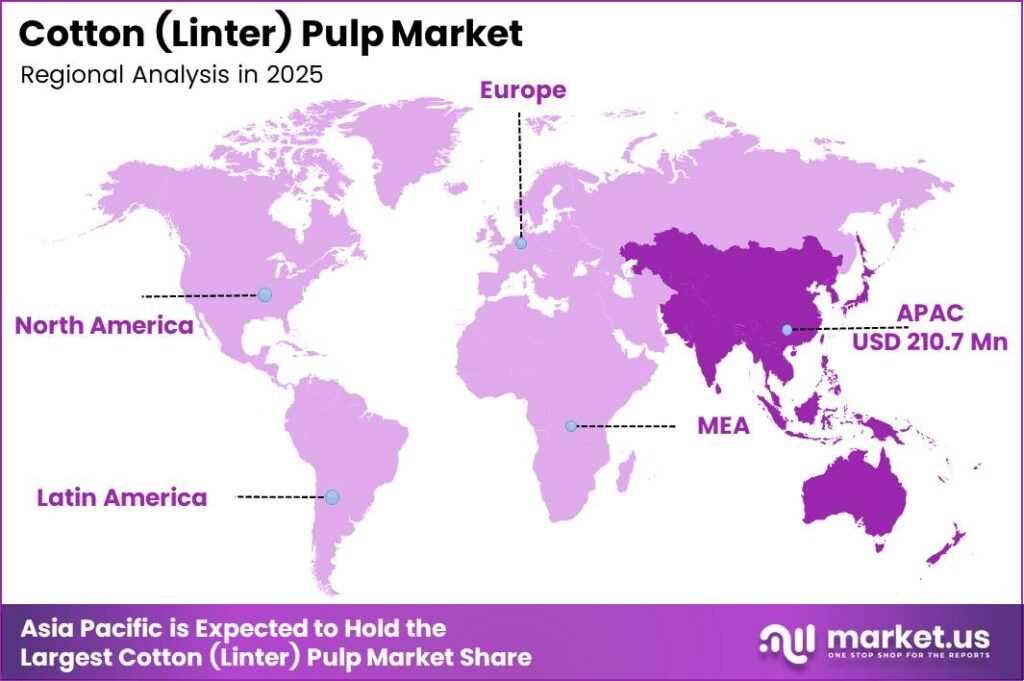
- Asia-Pacific leads all regions with a 42.00% market share, valued at USD 210.7 Million in 2025.
Government policy is reshaping supply chain structure across this market. The United States Uyghur Forced Labor Prevention Act creates direct procurement constraints for buyers sourcing from Xinjiang-origin cotton supply chains, compelling specification audits and approved-supplier list revisions. European defence-industrial policy is actively targeting nitrocellulose feedstock availability as a production bottleneck, directing procurement incentives toward qualified cellulose suppliers. These regulatory shifts reduce substitution flexibility and increase the commercial value of geographically diversified, compliance-ready supply networks.
Trade data confirms the concentration and scale of global cotton linter pulp flows. In 2024, China exported cotton linters pulp valued at USD 165.49 Million, with a reported quantity of 105,557,000 kg, establishing it as the single largest export origin. The United States followed with exports valued at USD 89.94 Million at 58,762,000 kg. This concentration in two origins means any supply disruption, regulatory restriction, or logistics bottleneck in either country creates immediate procurement exposure for buyers across Europe and Asia.
In February 2026, Hubei Jinhanjiang Refined Cotton Co., Ltd. reported installing a new roll-form production line targeting cellulose acetate, advanced materials, and battery-grade applications. This investment reflects a deliberate upgrade toward higher-specification output at a time when downstream demand for battery-grade cellulose is accelerating. Suppliers that complete grade transitions ahead of commercial demand windows position themselves for multi-year supply contracts rather than spot-market competition.
Grade Analysis
High-Alpha Cellulose Cotton Linter Pulp dominates with 36.00% due to nitrocellulose and acetate specification requirements.
In 2025, High-Alpha Cellulose Cotton Linter Pulp held a dominant market position in the By Grade segment of the Cotton (Linter) Pulp Market, with a 36.00% share. A 2025 study of commercial cotton-linter pulps measured a length-weighted mean fiber length of 1.52 mm in sample C, with long fibers representing 62% of its mass and native fines at 6.0 ± 0.2%. These structural parameters directly govern downstream acetylation consistency and nitrocellulose reaction uniformity, making fiber morphology a commercial differentiator alongside alpha-cellulose content. Buyers operating continuous esterification lines pay a measurable premium to lock in morphologically consistent, high-alpha certified lots rather than accept batch variability.
Low-Grade Cotton Linter Pulp serves cost-sensitive applications where downstream processors tolerate wider alpha-cellulose variation in exchange for lower input cost. This grade feeds commodity paper-making blends and lower-specification industrial applications where purity thresholds do not trigger lot rejection. As bleaching and refining costs rise, low-grade output volume increasingly depends on commodity paper pricing cycles rather than specialty chemical demand, exposing producers in this tier to margin pressure from wood-pulp substitution.
Medium-Grade and High-Grade Cotton Linter Pulp segments occupy the specification band between commodity and ultra-pure output, typically serving textile-grade cellulose ether manufacturing and selected pharmaceutical applications. Buyers in these tiers evaluate suppliers on consistency across batches rather than peak-purity achievement. Producers that invest in process-control instrumentation and real-time alpha-cellulose monitoring hold a structural cost advantage because they reduce off-specification rework that erodes gross margin across multi-tonne contracts.
Alpha Cellulose Content Analysis
Above 97% dominates with 42.00% due to propellant, acetate, and pharmaceutical grade mandates.
In 2025, the Above 97% segment held a dominant market position in the By Alpha Cellulose Content segment of the Cotton (Linter) Pulp Market, with a 42.00% share. GRN Cellulose specifies a minimum alpha-cellulose content of 98.5% by mass for its Grade I cotton linter pulp, illustrating the specification floor that major end-users in pharmaceuticals and specialty chemicals impose on approved suppliers. Meeting this threshold requires consistent raw material selection, controlled alkaline purification, and rigorous lot-testing protocols. Suppliers who cannot demonstrate batch-level compliance lose approved-vendor status and face requalification costs that exceed the margin on individual shipments.
The 90% to 94% and 95% to 97% content bands serve industrial cellulose ether production and viscose-grade applications where alpha-cellulose requirements are meaningful but do not reach pharmaceutical or propellant thresholds. These mid-range segments absorb supply that misses the above-97% specification ceiling, creating a secondary market within the same production run. Producers who optimize digestion conditions to push more output into the 95% to 97% band capture a price differential without the full capital investment required for above-97% certified production lines.
The Below 90% segment represents the lowest alpha-cellulose fraction, typically generated as a processing by-product rather than a primary production target. This material competes directly with low-grade wood dissolving pulp on price, limiting its commercial value for producers who bear the full cost of cotton-linter sourcing and chemical processing. Buyers in this tier treat cotton-linter origin as incidental to sourcing decisions, selecting whichever cellulose source delivers the lowest landed cost per tonne for their blending requirements.
Processing Type Analysis
Bleached Cotton Linter Pulp dominates with 48.00% due to whiteness and purity requirements across industries.
In 2025, Bleached Cotton Linter Pulp held a dominant market position in the By Processing Type segment of the Cotton (Linter) Pulp Market, with a 48.00% share. A 2025 study of cotton-linter pulps found that samples B and C generated 1.6 times and 3 times as much insoluble gel material as sample A during cellulose acetate processing, despite similar xylan concentrations of 0.8%, 0.8%, and 0.9% respectively. This finding confirms that bleaching chemistry and residual impurity profiles beyond xylan content determine downstream acetate quality, giving suppliers with documented bleaching process control a measurable commercial advantage over those competing on alpha-cellulose content alone.
Unbleached Cotton Linter Pulp retains natural coloration and serves applications where brightness is not a specification requirement, including selected industrial filtration media and non-food-contact packaging materials. This processing type eliminates bleaching chemical costs and associated effluent treatment obligations, reducing per-tonne operating cost relative to bleached output. However, its addressable market contracts as end-users across chemicals, pharmaceuticals, and specialty papers consistently specify bleached feedstocks to avoid color contamination in finished products.
Refined and Mercerized Cotton Linter Pulp grades represent targeted processing investments that unlock specific high-value downstream applications. Refined pulp serves nitrocellulose and cellulose ether synthesis where residual ash and moisture must be minimized, while mercerized pulp delivers higher reactivity for specialty derivatization. Buyers requiring these processing types typically operate long-term supply contracts with technical specifications written directly into purchase agreements, creating switching costs that reward incumbent suppliers with above-market price stability.
End-Use Industry Analysis
Chemicals dominates with 27.00% due to nitrocellulose and cellulose ether feedstock volume.
In 2025, the Chemicals segment held a dominant market position in the By End-Use Industry segment of the Cotton (Linter) Pulp Market, with a 27.00% share. In 2024, India exported cotton linters pulp valued at USD 223,020 with a reported quantity of 426,802 kg, reflecting the early-stage but commercially active role of Indian suppliers in international specialty-chemical supply chains. The chemicals end-use concentration means market revenue is sensitive to nitrocellulose demand cycles, which are themselves tied to defence procurement budgets and industrial coatings production volumes across major manufacturing economies.
Textiles and Apparel and Pharmaceuticals and Healthcare represent the next largest end-use tiers, each driven by distinct specification requirements and procurement structures. Textile-grade buyers prioritize alpha-cellulose consistency for viscose and lyocell fibre production, while pharmaceutical buyers require pharmacopoeia-grade certifications and documented supply chain traceability. Producers who invest in dual-certification pathways, qualifying the same production line for both markets, reduce capacity utilization risk when one end-use sector experiences demand softness.
Paper and Packaging, Food and Beverage, and Automotive and Aerospace segments collectively consume the remaining share, each applying cotton-linter pulp in targeted performance roles where wood-derived alternatives cannot consistently meet specification. The Automotive and Aerospace segment is the smallest but fastest-developing end-use, driven by lightweight composite materials and specialty filtration requirements. Other End-Use Industries absorb niche volumes where cotton-linter cellulose provides performance advantages over synthetic alternatives, including conductive film substrates and advanced membrane materials.
Distribution Channel Analysis
Direct Sales dominates with 54.00% due to specification complexity and long-term supply agreements.
In 2025, Direct Sales held a dominant market position in the By Distribution Channel segment of the Cotton (Linter) Pulp Market, with a 54.00% share. In 2024, Uzbekistan exported cotton linters pulp valued at USD 32.45 Million with a reported quantity of 19,468,000 kg, reflecting a national export base transacted predominantly through state-affiliated direct commercial agreements rather than third-party trader networks. In February 2026, Hubei Jinhanjiang Refined Cotton Co., Ltd. reported securing 12,000 tonnes of export orders for the first quarter, with more than 8,000 tonnes allocated to South Korea, the United States, and the European Union, and international orders representing approximately 70% of its total order book. This commercial profile confirms that direct-channel relationships drive volume and geographic reach simultaneously for leading producers.
Distributors and Traders and Pulp and Paper Merchants serve buyers who lack the purchasing scale or technical procurement capability to engage producers directly. These intermediaries absorb specification risk and logistics coordination on behalf of smaller downstream manufacturers, taking a margin in exchange for inventory management and grade-matching services. Their commercial position weakens as mid-sized buyers grow their procurement volumes and qualify for direct supply relationships, gradually compressing the addressable market for traditional trading intermediaries in this segment.
Online Business-to-Business Platforms represent the fastest-growing channel by transaction count, though volumes remain small relative to direct and trader channels. Digital procurement platforms reduce discovery costs for new buyer-supplier pairs and enable competitive tendering across multiple grade categories simultaneously. Producers that invest in digital catalog management and online specification documentation capture inquiry volume from emerging-market buyers who lack established broker relationships, converting platform visibility into long-term direct supply contracts over successive order cycles.
Key Market Segments
By Grade
- High-Alpha Cellulose Cotton Linter Pulp
- Low-Grade Cotton Linter Pulp
- Medium-Grade Cotton Linter Pulp
- High-Grade Cotton Linter Pulp
By Alpha Cellulose Content
- Above 97%
- Below 90%
- 90%–94%
- 95%–97%
By Processing Type
- Bleached Cotton Linter Pulp
- Unbleached Cotton Linter Pulp
- Refined Cotton Linter Pulp
- Mercerized Cotton Linter Pulp
By End-Use Industry
- Chemicals
- Textiles and Apparel
- Paper and Packaging
- Pharmaceuticals and Healthcare
- Food and Beverage
- Automotive and Aerospace
- Other End-Use Industries
By Distribution Channel
- Direct Sales
- Distributors and Traders
- Pulp and Paper Merchants
- Online Business-to-Business Platforms
- Other Distribution Channels
Regional Analysis
Asia-Pacific Dominates the Cotton (Linter) Pulp Market with a Market Share of 42.00%, Valued at USD 210.7 Million
Asia-Pacific commands the largest share of the global Cotton (Linter) Pulp market at 42.00%, worth USD 210.7 Million in 2025. China operates as the dominant production and export hub within the region, accounting for exports of 105,557,000 kg valued at USD 165.49 Million in 2024 alone. This export concentration means regional supply dynamics directly govern global price formation, and any Chinese production constraint or regulatory intervention creates immediate procurement exposure for buyers in Europe and South Asia who depend on this corridor for approved-grade feedstock volumes.
Europe is the fastest-growing import destination, driven by defence-industrial nitrocellulose procurement and pharmaceutical-grade cellulose demand. In 2024, the European Union imported cotton linters pulp valued at USD 98.30 Million at a reported quantity of 47,052,200 kg, reflecting deep structural dependency on external supply. The European Commission’s ammunition capacity expansion programme, targeting more than 2 million shells annually, directly increases demand for qualified cellulose feedstocks and rewards suppliers who hold pre-approved supply agreements with European nitrocellulose processors.
Latin America is emerging as a secondary import market. In 2024, Brazil imported cotton linters pulp valued at USD 29.30 Million at 16,775,400 kg, serving domestic chemicals and paper manufacturing. In October 2025, Dezhou Jinqiu Biotechnology completed construction of its 100,000-tonne refined-cotton and warehouse expansion project, adding meaningful capacity to the Asia-Pacific supply base. North America remains both a significant exporter and a structurally constrained domestic market following Georgia-Pacific’s Memphis mill closure, which removed an established specialty-grade supply source serving coatings and specialty paper buyers across the region.
Key Regions and Countries
North America
- US
- Canada
Europe
- Germany
- France
- The UK
- Spain
- Italy
- Rest of Europe
Asia-Pacific
- China
- Japan
- South Korea
- India
- Australia
- Rest of APAC
Latin America
- Brazil
- Mexico
- Rest of Latin America
Middle East and Africa
- GCC
- South Africa
- Rest of MEA
Market Dynamics
Market Opportunity Analysis - Underserved import-dependent regions and next-generation application grades offer entry points for agile producers
Europe’s structural import dependency creates a persistent commercial opening for non-Chinese certified suppliers. The EU absorbed 47,052,200 kg valued at USD 98.30 Million in 2024, yet domestic cotton-linter pulp production capacity is minimal. Suppliers who secure European pharmacopoeia and nitrocellulose-grade certifications before competitors complete qualification gain first-mover access to procurement contracts that incumbents displaced by US compliance rules can no longer reliably fill. This is a time-sensitive window because European buyers are actively diversifying approved-supplier lists.
The Pharmaceuticals and Healthcare end-use segment is underexploited relative to its quality alignment with existing high-alpha cellulose production. Microcrystalline cellulose for pharmaceutical excipients requires the same above-97% alpha-cellulose specification that the dominant segment already delivers, yet the conversion from chemical-grade supply to pharma-grade certification involves documentation investment rather than capital-intensive process change. Producers who complete pharmacopoeia certification unlock a higher-margin end-use tier from the same production infrastructure, reducing revenue concentration in chemicals without adding manufacturing complexity.
The Automotive and Aerospace end-use segment is the smallest current end-use tier but carries the highest growth potential among established application categories. Lightweight composite filtration and specialty membranes demand consistent fiber morphology data across production batches, a requirement that commodity wood-pulp alternatives cannot reliably meet. This creates a durable specification barrier that early-qualifying cotton-linter pulp producers can convert into multi-year sole-source supply agreements, insulating themselves from spot-market price competition across the forecast period.
Online Business-to-Business Platforms represent an underutilized demand-generation channel for producers targeting emerging-market buyers in Southeast Asia and Africa who lack established broker relationships. Paper opacity data from the 2025 nanocellulose study showed performance peaked at 96.35% at 40% cellulose-nanofiber loading before declining to 80.40% at 80% loading, confirming that application-specific optimization rather than maximum reinforcement is the correct commercial message for specialty paper buyers. Producers who pair digital catalog presence with application-grade performance data convert platform inquiries into qualified sales conversations rather than commodity price comparisons.
Technology and Innovation Landscape - Process chemistry and nanocellulose conversion define the next performance frontier for cotton-linter pulp producers
A 2025 study established a reproducible laboratory protocol for cotton-linter pulp production, digesting 500 g of linters with 4% sodium hydroxide at 160°C for 90 minutes at a material-to-liquor ratio of 1:5, followed by bleaching at 70°C for 60 minutes using hydrogen peroxide at 3 g/L, sodium silicate at 2 g/L, and sodium hydroxide at 1 g/L. These defined conditions establish a replicable benchmark for producers seeking to standardize pulp quality across production batches and reduce inter-lot variation in downstream acetylation or nitration reactions.
The same 2025 study converted cotton-linter pulp into cellulose nanofibers using 1% cellulase enzyme at 45°C for 1 hour at pH 4.5, followed by controlled-temperature refining at 23 ± 5°C for 30 minutes over 15 passes. This chemo-mechanical process reduced fiber diameter from 20.5 ± 2.3 µm to 126 ± 42 nm, approximately a 99% reduction, yielding a cellulose-nanofiber suspension containing 4% solids. This fiber reduction scale is commercially significant because it enables application in high-performance paper, barrier film, and composite reinforcement markets that are structurally inaccessible to conventional cotton-linter pulp.
Nanofiber reinforcement at 80% dry-weight loading increased tensile index from 5.50 to 51.96 N·m/g, approximately 9.4 times the unreinforced control. Tearing resistance rose from 160 mN to 340 mN, a 2.13-fold increase, while bursting strength advanced from 883 N to 3,727 N, approximately a 4.2-fold gain. Folding endurance increased from 1 fold to 184 folds at maximum loading, with water absorptivity declining from 381.60 g/m² to 140.20 g/m², a 63.3% reduction. These performance gains confirm that nanocellulose conversion transforms commodity cotton-linter pulp into a high-value technical material commanding premium pricing in barrier and structural paper applications.
In August 2026, Anhui Xuelong New Materials (Group) Co., Ltd. filed a patent application under CN122575870A for nanocellulose cotton pulp designed for conductive-film applications, filed in June 2026. Air resistance data from the 2025 study also showed a 34.3% increase in resistance to 28.09 seconds per 100 mL at 80% nanofiber loading, while brightness declined 31.8% from 82.43% to 56.20%, confirming that optical trade-offs require application-specific optimization. Producers who map mechanical-barrier performance gains against brightness thresholds for specific end-use specifications will develop differentiated product portfolios that command application-grade premiums rather than competing on bulk cellulose price.
Drivers
European ammunition-capacity expansion is creating qualified procurement demand for cellulose feedstocks suited to propellant-grade nitrocellulose. The European Commission announced support targeting more than 10,000 tonnes of additional annual powder capacity and more than 4,300 tonnes of explosives capacity, alongside an ammunition target of 2 million shells annually by end-2025. Its subsequent implementation report identified energetic nitrocellulose availability as a production bottleneck. Suppliers holding pre-qualified supply agreements gain first-mover access to these procurement contracts before new entrants complete the technical qualification process.
Established cellulose-ether feedstock demand from China and India provides a stable consumption base that supports continuous production investment. High-polymerization grade differentiation allows producers to capture price premiums over standard dissolving-pulp alternatives by targeting specialty applications where viscosity performance is a buyer requirement. High-purity specialty-paper consumption across Europe, Asia, and North America adds a third demand pillar that reduces revenue concentration in any single downstream application. Together these demand channels support an analyst-estimated driver contribution of 1.60 percentage points against the 12.3% baseline.
| Driver | (~) % Impact on CAGR Forecast | Geographic Relevance | Impact Timeline |
|---|---|---|---|
| Propellant-grade nitrocellulose procurement | +0.65% | Europe; North America; allied supply chains | Short term (≤ 2 years) |
| Established cellulose-ether feedstock demand | +0.35% | China; India; global derivative manufacturers | Short term (≤ 2 years) |
| High-purity specialty-paper consumption | +0.25% | Europe; Asia; North America | Medium term (2–4 years) |
| High-polymerization grade differentiation | +0.20% | Global specialty-cellulose processors | Medium term (2–4 years) |
| Industrial nitrocellulose replenishment demand | +0.15% | Asia-Pacific; global coatings and ink producers | Short term (≤ 2 years) |
Restraints
Permanent capacity withdrawal removes saleable production rather than simply slowing delivery, making it the most direct restraint on near-term market availability. Georgia-Pacific announced the permanent closure of its Memphis Cellulose mill on October 16, 2025, affecting approximately 130 mill employees and 22 technology-centre employees, with most positions expected to end by early December. The company cited challenging market conditions and had considered selling the facility. Displaced customers must replace approved supply before orders resume, creating procurement-cost pressure and potential lost shipments across specialty coatings and paper markets.
Forced-labor-related import exclusions under US legislation create compliance-driven supply chain constraints that go beyond standard trade risk. Wood-pulp substitution in price-sensitive grades exerts a structural competitive pressure on commodity cotton-linter output, while buyer specification-based lot rejection and effluent-permit production limits at water-constrained mills compound the capacity constraint. The restraint basket totals an estimated 1.50 percentage points of drag against the supplied baseline, leaving positive growth sensitivity intact but concentrating margin pressure on producers with less diversified customer bases or geographically concentrated sourcing.
| Restraint | (~) % Impact on CAGR Forecast | Geographic Relevance | Impact Timeline |
|---|---|---|---|
| Permanent merchant-pulp capacity withdrawal | -0.45% | North America; import-dependent specialty buyers | Short term (≤ 2 years) |
| Forced-labor-related import exclusions | -0.35% | United States; affected cotton-origin supply chains | Short term (≤ 2 years) |
| Wood-pulp substitution in price-sensitive grades | -0.30% | Global interchangeable dissolving-pulp applications | Medium term (2–4 years) |
| Buyer specification-based lot rejection | -0.20% | Global high-purity derivative buyers | Short term (≤ 2 years) |
| Effluent-permit production limits | -0.20% | Water-constrained and tightly regulated mill locations | Short term (≤ 2 years) |
Challenges
Cotton-based cellulose presents a processing vulnerability because high swelling in alkaline media impedes pressing even where pulp remains commercially acceptable. A study published in 2026 found greater single-fibre swelling and lye retention in cotton-based pulps than in softwood pulp under alkaline conditions. In an illustrative engineering sensitivity, increasing retained liquor from 1.0 to 1.1 tonnes per tonne of dry cellulose adds 100 kilograms of liquid requiring downstream management. If evaporation is required, the theoretical latent-heat burden is approximately 0.23 gigajoules per tonne before equipment losses or heat recovery adjustments.
Seasonal cottonseed feedstock variability, long-distance replenishment inventory balancing, specialist process-control skills scarcity, and steam and chemical-cost volatility compound this processing challenge. The challenge basket totals an estimated 1.30 percentage points of friction drag. Applying both restraint and challenge baskets as an adverse stress test reduces the supplied baseline to 9.50%, preserving positive growth while keeping operational friction separate from outright capacity loss. Producers who invest in process-specific dewatering trials and real-time liquor-retention monitoring convert this technical vulnerability into a defensible barrier against lower-cost competitors.
| Challenge | (~) % CAGR Friction Drag | Geographic Relevance | Mitigation Horizon |
|---|---|---|---|
| Alkaline swelling and pressability | -0.40% | Global cotton-pulp and derivative processors | Medium term (2–4 years) |
| Seasonal cottonseed feedstock variability | -0.30% | China; India; United States; Central Asia | Medium term (2–4 years) |
| Long-distance replenishment inventory balancing | -0.25% | Intercontinental pulp-trade corridors | Short term (≤ 2 years) |
| Specialist process-control skills scarcity | -0.20% | New and expanding specialty-pulp locations | Long term (≥ 4 years) |
| Steam and chemical-cost volatility | -0.15% | Global; purchased-energy-dependent mills | Short term (≤ 2 years) |
Opportunities
Cotton-linter suppliers can pursue untapped value by supplying tightly specified pulp to nanocellulose converters and sharing application-development economics rather than relying solely on conventional pulp contracts. ICAR-CIRCOT reports a cotton-linter-compatible pilot plant producing 10 kilograms per 8-hour shift and a process portfolio supported by 3 patents. Starch films reinforced with 1% nanocellulose achieved approximately 3-fold strength and halved oxygen permeability relative to control films, demonstrating performance potential that justifies a premium positioning strategy for qualified cotton-linter feedstocks entering advanced material supply chains.
Regional microcrystalline-cellulose supply partnerships in India and Southeast Asia, fuel-cell membrane reinforcement grades across East Asia and Europe, customer-specific toll-purification services, and integrated cottonseed-crusher pulp ventures in India, Brazil, Central Asia, and Africa represent four additional vectors for value creation. Together, all opportunity rows imply 1.50 percentage points of potential upside, taking the supplied baseline to 13.80%. Early movers who secure application-qualified supply agreements in nanocellulose and membrane grades before commercial-scale demand matures will capture multi-year contracts that are structurally difficult for late entrants to displace.
| Opportunity | (~) % Potential CAGR Upside | Geographic Relevance | Execution Window |
|---|---|---|---|
| Application-qualified nanocellulose feedstock platforms | +0.55% | India; Europe; North America; East Asia | Medium term (2–4 years) |
| Regional microcrystalline-cellulose supply partnerships | +0.35% | India; Southeast Asia; import-dependent pharmaceutical hubs | Medium term (2–4 years) |
| Fuel-cell membrane reinforcement grades | +0.25% | East Asia; Europe; North America | Long term (≥ 4 years) |
| Customer-specific toll-purification services | +0.20% | Global specialty-cellulose customers | Medium term (2–4 years) |
| Integrated cottonseed-crusher pulp ventures | +0.15% | India; Brazil; Central Asia; Africa | Long term (≥ 4 years) |
Key Company Insights
Grasim Industries Ltd. / Birla Cellulose operates from a scale advantage that few cotton-linter pulp competitors can match. The company reported cellulosic staple-fibre manufacturing capacity of 879,000 tonnes per year in FY2024-25, providing downstream integration depth that stabilizes demand across market cycles. This vertical scale insulates Grasim from spot-market price volatility and allows it to direct high-specification pulp volumes toward captive fibre production when open-market premiums contract. However, its integration depth also limits merchant-market flexibility compared with pure-play pulp producers.
Lenzing AG reported capital expenditure of EUR 141.1 million in 2025, compared with EUR 153.8 million in 2024, reflecting a deliberate reduction in new-capacity investment as the company prioritizes margin recovery over expansion. In September 2026, Hubei Jinhanjiang Refined Cotton Co., Ltd. obtained a patent for a refined-cotton alkali-soaking and impurity-removal device, signalling continued process-technology investment from mid-tier Asian producers that compete with Lenzing on specialty-cellulose quality. Lenzing’s premium brand positioning and European sustainability credentials remain its primary competitive defence against lower-cost Asian challengers pressing into high-specification application tiers.
Key Players
- Georgia-Pacific LLC
- Grasim Industries Ltd. / Birla Cellulose
- Sateri Holdings Ltd.
- Lenzing AG
- Tangshan Sanyou Xingda Chemical Fiber Co., Ltd.
- Xinjiang Zhongtai Chemical Co., Ltd.
- Shandong Silver Hawk Chemical Fibre Co., Ltd.
- Hubei Golden Ring New Materials Technology Co., Ltd.
- Jinhanjiang Refined Cotton Co., Ltd.
- Barnhardt Manufacturing Company
- Farg’ona Kimyo Zavodi LLC
- GRN Cellulose Pvt. Ltd.
- Vikarabad Pulp and Paper Mills Ltd.
- Moirai Cotton Pulp Pvt. Ltd.
- MT Royal
Recent Developments
- August 2025: Hubei Jinhanjiang Refined Cotton Co., Ltd. obtained a patent for a refined-cotton alkali-removal device, with authorization publication number CN223226387U. The equipment targets improved pressing and water removal in refined-cotton processing.
- October 2025: Georgia-Pacific LLC announced the permanent closure of its Memphis Cellulose mill and Memphis Technology and Innovation Center. The closure affected approximately 130 mill employees and 22 technology-center employees, with most positions expected to be eliminated by early December 2025. Georgia-Pacific cited challenging market conditions for the facility’s products.
- September 2026: Jinqiu Biotechnology obtained a patent for a dust-recovery device used in refined-cotton production. The design improves the precise installation and removal of the collection frame and filter screen, representing a production-equipment development rather than a new pulp-grade launch.
- October 2026: Hubei Jinhanjiang Refined Cotton Co., Ltd. obtained a patent for a refined-cotton rotary-drum drying device, with authorization publication number CN224838237U. Its design combines hot-air openings with internal cotton-loosening elements to break up clumped material during drying and improve the drying effect.
Geopolitical Impact Analysis
Trade policy enforcement is reshaping cotton-linter pulp procurement flows across North America and Europe. According to WTO trade monitoring data, US Section 301 tariffs on Chinese specialty chemicals and their precursor materials, combined with Uyghur Forced Labor Prevention Act exclusions targeting Xinjiang cotton-origin supply chains, are forcing buyers to diversify approved-supplier lists away from the dominant Chinese export corridor. These constraints affect a trade corridor that moved 105,557,000 kg of cotton linters pulp in 2024, creating immediate sourcing gaps that suppliers in Uzbekistan, India, and Brazil are positioned to partially absorb.
As reported by UNCTAD trade and logistics data, Red Sea shipping disruptions have added an estimated 10 to 14 days to Asia-to-Europe transit times, directly affecting just-in-time inventory management for European cotton-linter pulp importers who absorbed 47,052,200 kg in 2024. Extended transit windows increase working capital requirements and storage costs at European port facilities, compressing buyer margins on spot purchases. World Bank commodity price data confirms energy price volatility has raised steam and chemical input costs at pulp mills by an estimated 8% to 15% since 2022, amplifying operational cost pressure at mills already managing alkaline-swelling processing inefficiencies.
Report Scope
| Report Features | Description |
|---|---|
| Market Value (2025) | USD 501.9 Million |
| Forecast Revenue (2035) | USD 1,594.8 Million |
| CAGR (2026-2035) | 12.3% |
| Base Year for Estimation | 2025 |
| Historic Period | 2020-2024 |
| Forecast Period | 2026-2035 |
| Report Coverage | Revenue Forecast, Market Dynamics, Market Opportunity Analysis, Technology and Innovation Landscape, Competitive Landscape, Recent Developments |
| Segments Covered | By Grade (High-Alpha Cellulose Cotton Linter Pulp, Low-Grade Cotton Linter Pulp, Medium-Grade Cotton Linter Pulp, High-Grade Cotton Linter Pulp), By Alpha Cellulose Content (Above 97%, Below 90%, 90%–94%, 95%–97%), By Processing Type (Bleached Cotton Linter Pulp, Unbleached Cotton Linter Pulp, Refined Cotton Linter Pulp, Mercerized Cotton Linter Pulp), By End-Use Industry (Chemicals, Textiles and Apparel, Paper and Packaging, Pharmaceuticals and Healthcare, Food and Beverage, Automotive and Aerospace, Other End-Use Industries), By Distribution Channel (Direct Sales, Distributors and Traders, Pulp and Paper Merchants, Online Business-to-Business Platforms, Other Distribution Channels) |
| Regional Analysis | North America (US and Canada), Europe (Germany, France, The UK, Spain, Italy, and Rest of Europe), Asia Pacific (China, Japan, South Korea, India, Australia, and Rest of APAC), Latin America (Brazil, Mexico, and Rest of Latin America), Middle East and Africa (GCC, South Africa, and Rest of MEA) |
| Competitive Landscape | Georgia-Pacific LLC, Grasim Industries Ltd. / Birla Cellulose, Sateri Holdings Ltd., Lenzing AG, Tangshan Sanyou Xingda Chemical Fiber Co., Ltd., Xinjiang Zhongtai Chemical Co., Ltd., Shandong Silver Hawk Chemical Fibre Co., Ltd., Hubei Golden Ring New Materials Technology Co., Ltd., Jinhanjiang Refined Cotton Co., Ltd., Barnhardt Manufacturing Company, Farg’ona Kimyo Zavodi LLC, GRN Cellulose Pvt. Ltd., Vikarabad Pulp and Paper Mills Ltd., Moirai Cotton Pulp Pvt. Ltd., MT Royal |
| Customization Scope | Customization for segments, region / country-level will be provided. Additional customization can be done based on requirements. |
| Purchase Options | We have three licenses to opt for: Single User License | Multi-User License (Up to 5 Users) | Corporate Use License (Unlimited User and Printable PDF) |