Report Overview
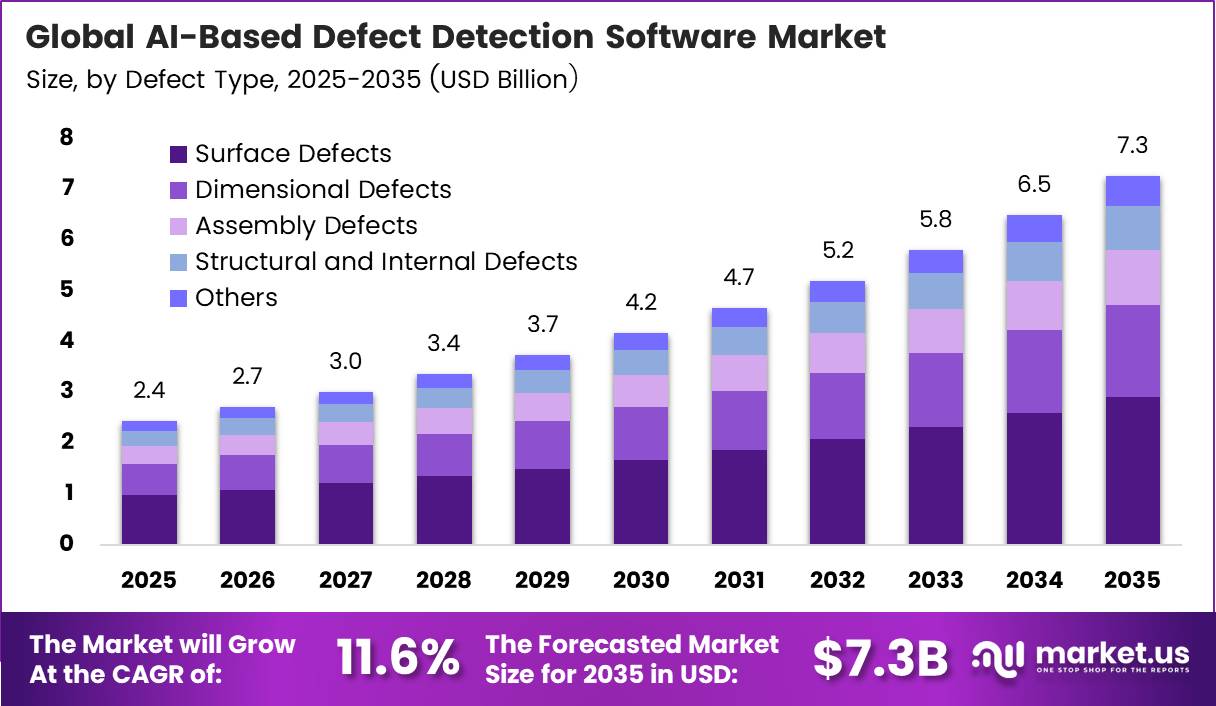
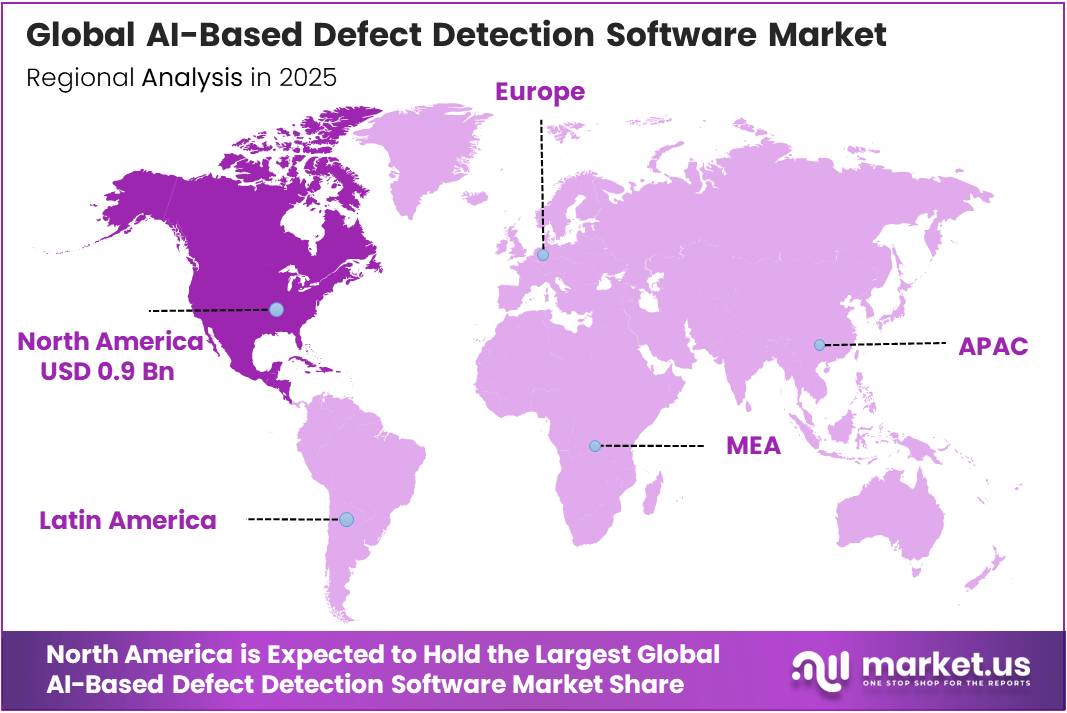
In 2025, the Global AI-Based Defect Detection Software Market was valued at USD 2.4 billion. The market is projected to grow at a CAGR of 11.6% during 2026–2035, reaching approximately USD 7.3 billion by 2035. North America dominated the global market in 2025, accounting for more than 36.5% of the total market share and generating approximately USD 0.9 billion in revenue.
Chip makers drive much of this demand. The Semiconductor Industry Association reported that global chip sales rose 25.6% to USD 791.7 billion in 2025, up from USD 630.5 billion in 2024. Logic products alone grew 39.9% to USD 301.9 billion. Every new wafer and package needs fast, accurate checks, and AI software now finds tiny flaws that human eyes and rule-based systems miss.
Factory automation adds more pull. The International Federation of Robotics reported that factories installed more than 600,000 new industrial robots in 2025, an 11% jump. That pushed the global robot stock to a record 5 million units. Each automated line creates new points where vision software must inspect parts in real time.
The North America region combines deep software skills, early cloud adoption, and strong spending on factory upgrades. The International Federation of Robotics reported that robot installations in the Americas rose 14% to 57,044 units in 2025. That shows steady investment in automated production across the US, Canada, and Mexico.
Key Takeaways
- The AI-Based Defect Detection Software Market reached USD 2.4 billion in 2025 and will reach USD 7.3 billion by 2035. The market will grow at a CAGR of 11.6% from 2026 to 2035.
- By deployment, Cloud leads with a 67.3% share.
- By defect type, Surface Defects lead with a 43.2% share.
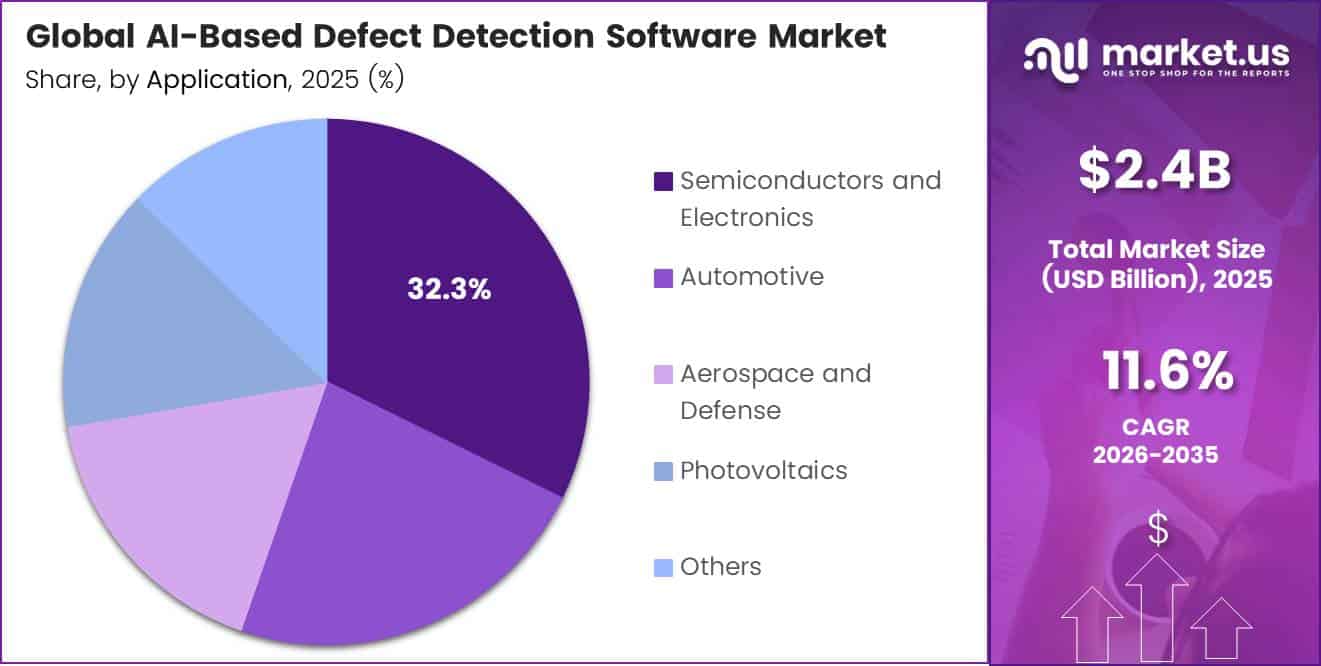
- By application, Semiconductors and Electronics lead with a 32.3% share.
- North America leads with a 36.5% share and USD 0.9 billion in revenue.
By Deployment
Cloud dominates with 67.3% due to central model training across plants.
Cloud leads because manufacturers can train one inspection model and share it across many factories without buying servers for each site. Teams also get updates and new defect libraries right away. Wide internet access supports this model. Almost three-quarters of the world’s people are now online, although 2.2 billion people remain offline.
On-Premises is the fastest-growing deployment type. Fast production lines need decisions in milliseconds, so plants run AI on edge servers next to cameras and robots. Automation levels are climbing quickly. Factories installed 542,000 industrial robots in 2024, more than double the figure of ten years earlier.
Each new robot cell adds cameras that need local inspection. Defense, medical and chip plants also keep image data on site for security reasons. These needs keep on-premises spending rising even as cloud stays the widest choice.
By Defect Type
Surface Defects dominate with 43.2% due to camera-visible scratches, dents, and stains.
Surface Defects lead because standard cameras can spot scratches, dents, stains, and coating flaws without special sensors. Users also have the largest labeled image sets for these flaws, which makes AI models accurate from the start. Electronics plants drive much of this demand. The electrical and electronics industry installed 129,000 robots in 2024, up 2%.
China’s automotive industry installed a record 78,900 robots in 2025. Brazil’s car industry installed almost 2,100 robots in 2025, up 212%. Electric vehicle packs and lighter body parts raise the safety stakes, so buyers pay more for checks below the surface.
By Application
Semiconductors and Electronics dominate with 32.3% due to nanometer-scale wafer flaw sensitivity.
Semiconductors and Electronics lead because one tiny flaw can ruin a whole chip, and fabs check wafers at every step. AI cuts false alarms and catches patterns that rule-based tools miss. Industry demand keeps rising. Logic chips alone earned $212.6 billion in 2024, and chip sales in the Americas grew 44.8%.
Photovoltaics is the fastest-growing application. Solar factories make cells in huge volumes, and micro-cracks or weak solder joints cut power output for decades. Manual checks cannot keep pace with this scale. The world installed a record 456 GW of solar capacity in 2023, and more than 1.6 TW of systems were running by early 2024.
Solar now supplies 8.3% of global electricity demand. As module makers compete on price and warranty, they use AI electroluminescence scans to catch faults early and protect thin margins.
Key Market Segments
By Deployment
- On-Premises
- Cloud
By Defect Type
- Surface Defects
- Dimensional Defects
- Assembly Defects
- Structural and Internal Defects
- Others
By Application
- Semiconductors and Electronics
- Automotive
- Aerospace and Defense
- Photovoltaics
- Others
Geopolitical Impact Analysis
Trade policy now shapes the hardware cost behind AI inspection. On January 15, 2026, the US imposed a 25% Section 232 duty on certain advanced computing chips and derivative products. The tariff exempts civil, industrial, and data center uses in the US. Still, vendors that build GPU-based edge inspection systems must now document end use to avoid the duty.
Shipping routes add delay. Most Asia-to-Europe container services still sail around the Cape of Good Hope in 2026, adding 10 to 14 days per trip. Asia-to-Europe freight rates sit 25% to 40% above pre-crisis levels. Cameras, lenses, lighting units, and industrial PCs for inspection cells come mostly from Asia. Longer lead times are delaying new line launches in Europe and on the US East Coast.
Trade volumes have swung sharply. The WTO first projected 1.9% merchandise trade growth for 2026, down from 4.6% in 2025. In October 2026, it raised the 2026 forecast to 3.9%, citing a surge in AI-related capital investment. The WTO also warned that the Middle East conflict keeps energy prices and transport costs high.
The impact splits by region. The WTO expects Asian imports to rise 9.5% and exports 9.9% in 2026. Asian factories keep buying inspection hardware and software at a fast pace while tariff risk pushes some buyers toward cloud deployment.
Regional Analysis
North America dominates the AI-Based Defect Detection Software Market, holding a 36.5% share and generating USD 0.9 billion in revenue. The US anchors this lead. It hosts major machine vision firms, cloud providers, and AI startups in one market. Cognex, based in Massachusetts, says it serves a market worth about USD 7 billion that grows at 10% to 11% a year through the cycle.
US chip, electric vehicle, and aerospace plants push hard for zero-defect output because a single missed flaw can trigger costly recalls. These buyers adopt cloud-trained deep learning models quickly. Then they push trained models to edge devices on the line. The WTO expects North American exports to rise 5.7% in 2026, while imports grow only 1.4%.
Asia Pacific is the fastest-growing region in the market. China installed 354,000 industrial robots in 2025, up 20%, and took 59% of global installations. India installed almost 10,500 robots, up 15%, to rank sixth worldwide. Japan installed 36,219 units and South Korea about 30,000. Dense electronics and solar supply chains make the region the largest base for new inspection lines.
Europe holds a strong second position, led by Germany, France, and Italy. Automotive and machinery makers drive demand for precise surface and assembly checks. The IFR reported that the EU industrial robot stock hit a record 700,000 units in 2025. However, EU installations fell 11% to 60,500 units that year, though they grew at a 3% compound rate from 2020 to 2025.
Key Regions and Countries
North America
- US
- Canada
Europe
- Germany
- France
- The UK
- Spain
- Italy
- Rest of Europe
Asia Pacific
- China
- Japan
- South Korea
- India
- Australia
- Rest of APAC
Latin America
- Brazil
- Mexico
- Rest of Latin America
Middle East and Africa
- GCC
- South Africa
- Rest of MEA
Market Dynamics
Drivers
| Driver | (~) % Impact on CAGR Forecast | Geographic Relevance | Impact Timeline |
|---|---|---|---|
| Robotized Smart-Factory Expansion | +1.4% | Global; Asia-Pacific led | Short term (2 years or less) |
| Zero-Defect Cost Pressure | +1.0% | Global manufacturing hubs | Short term (2 years or less) |
| Edge-AI Inference Adoption | +0.8% | North America, Europe, East Asia | Medium term (2 to 4 years) |
| Production Traceability Expansion | +0.6% | Europe, North America, East Asia | Short term (2 years or less) |
| Subscription Deployment Models | +0.5% | Global; digitally mature plants | Medium term (2 to 4 years) |
| Product Miniaturization Complexity | +0.3% | East Asia, North America, Europe | Medium term (2 to 4 years) |
Robotized Smart-Factory Expansion
Industrial-robot deployment is expanding the production-equipment base addressable by AI-based defect detection software: global installations reached 542,076 units in 2024, while operational robot stock approached 4.66 million units. Asia accounted for approximately 74% of new installations, and global factory robot density reached 177 units per 10,000 manufacturing workers.
This installed-base expansion is moving software procurement from bespoke inspection projects toward repeatable per-camera, per-line and multi-site subscriptions, with edge inference, centralized model monitoring and traceability modules creating recurring revenue streams.
Restraints
| Restraint | (~) % Impact on CAGR Forecast | Geographic Relevance | Impact Timeline |
|---|---|---|---|
| Upfront Integration Payback Risk | -1.0% | Global; SME-intensive regions | Short term (2 years or less) |
| Elevated CapEx Financing Costs | -0.6% | North America, Europe, emerging markets | Short term (2 years or less) |
| Production-Data Access Restrictions | -0.4% | Global regulated supply chains | Medium term (2 to 4 years) |
| Validation Liability Exposure | -0.3% | Europe, North America, Japan | Medium term (2 to 4 years) |
| Accelerator Export Controls | -0.2% | China-linked technology ecosystems | Short term (2 years or less) |
| Cybersecurity Procurement Freezes | -0.1% | Critical and regulated industries | Short term (2 years or less) |
Upfront Integration Payback Risk
Upfront integration risk remains the largest current sales restraint because AI inspection requires spending beyond software on cameras, controlled lighting, edge processors, network upgrades, production-system interfaces, and implementation services.
Higher financing thresholds intensify the constraint: manufacturers prioritize essential throughput and maintenance investments, limit AI inspection to pilot cells, demand supplier-funded proof-of-value projects and postpone enterprise rollouts. The resulting lower contract size, longer sales cycle, and heavier customization burden constrain vendor revenue conversion and margin realization.
Challenges
| Challenge | (~) % CAGR Friction Drag | Geographic Relevance | Mitigation Horizon |
|---|---|---|---|
| Cross-SKU Model Drift | -0.5% | Global multi-product manufacturing | Long term (4 years or more) |
| Legacy OT Interoperability | -0.4% | North America, Europe, Japan | Long term (4 years or more) |
| Rare-Defect Data Scarcity | -0.3% | Global high-precision industries | Medium term (2 to 4 years) |
| Vision-AI Talent Gap | -0.2% | Global; acute in industrial regions | Long term (4 years or more) |
| Operator Trust Deficit | -0.2% | Safety-critical manufacturing | Medium term (2 to 4 years) |
| Variable Imaging Conditions | -0.1% | Global brownfield facilities | Medium term (2 to 4 years) |
Cross-SKU Model Drift
Cross-SKU model drift limits scalable deployment because inspection accuracy can deteriorate when product geometry, surface finish, component orientation, supplier material, lighting conditions, tool wear, or process settings change.
Models may perform strongly on a controlled production cell but require revalidation when factories introduce new variants or modify production recipes, particularly in high-mix and low-volume environments where rare defects are underrepresented. This creates a recurring operational requirement for data capture, human review, retraining, version control, and performance monitoring.
Vendors that cannot automate these model-lifecycle tasks face rising support costs per deployment, while manufacturers may retain manual review layers that delay the full productivity and labor-saving potential of AI inspection.
Opportunities
| Opportunity | (~) % Potential CAGR Upside | Geographic Relevance | Execution Window |
|---|---|---|---|
| Closed-Loop Autonomous Quality Control | +1.0% | Global advanced manufacturing | Medium term (2 to 4 years) |
| Packaged SME Vision Services | +0.8% | India, Southeast Asia, Europe, North America | Medium term (2 to 4 years) |
| Remanufacturing Inspection Platforms | +0.6% | Europe, China, North America | Long term (4 years or more) |
| Supplier-Network Quality Analytics | +0.5% | Global automotive and electronics chains | Medium term (2 to 4 years) |
| Outcome-Based Gainshare Contracts | +0.4% | North America, Europe, East Asia | Medium term (2 to 4 years) |
| Warranty-Linked Defect Intelligence | +0.2% | Global durable-goods industries | Long term (4 years or more) |
Closed-Loop Autonomous Quality Control
Closed-loop autonomous quality control is untapped upside because most current systems identify, classify, and route defective parts but do not independently adjust machine parameters, process settings, or maintenance instructions.
The white space lies in connecting vision results with manufacturing execution systems, programmable controls, digital work instructions, and quality records to prevent recurrence rather than merely detect failure. AI inspection can materially reduce scrap, rework, production stoppages, and warranty escapes.
Capturing even a modest share of verified quality-cost savings can improve customer payback, support premium recurring pricing, and expand supplier margins as standardized control connectors and reusable models are deployed across multiple facilities.
Key Players Analysis
Tier 1 leaders include Keyence, Cognex, Siemens, and Omron. These firms have global sales networks and large balance sheets. Keyence posted net sales of JPY 1,059,145 million (about USD 7.06 billion) for the year ended March 20, 2025. It booked operating income of JPY 549,775 million, a margin above 50%. In its next fiscal year, Keyence grew net sales 10.4% to JPY 1,169.3 billion.
Cognex grew revenue 8.7% to USD 994.4 million in FY2025 and earned net income of USD 114.4 million. It spent USD 139.0 million on R&D, about 14% of revenue. That steady spending funds its deep learning inspection tools. Siemens brings industrial software scale, with group revenue of EUR 78.9 billion and net income of EUR 10.4 billion in fiscal 2025.
Tier 2 challengers hold strong niche or regional positions. Basler AG, a German camera maker, grew revenue 22% to EUR 224.5 million in 2025. Its bookings rose 22% and billings 23%. Basler guides 2026 revenue of EUR 232 million to EUR 257 million, with an EBIT margin of 6.5% to 10%.
LandingAI, Musashi AI, Averroes AI, Intelgic, DAC.digital, and Optimax compete with software-first tools. They focus on low-code model training and fast setup for mid-size plants. Musashi AI launched its Gen 2 inspection solution in October 2025 to cut deployment time and cost.
Top Key Players in the Market
- Cognex
- Keyence
- Omron
- Optimax
- DAC.digital
- Siemens
- Basler AG
- LandingAI
- Intelgic
- Musashi AI
- Averroes AI
Recent Developments
- In July 2025, Siemens completed its acquisition of Dotmatics for an enterprise value of USD 5.1 billion, expanding its total addressable market for industrial software by USD 11 billion.
- In February 2026, Siemens, a group with EUR 78.9 billion in fiscal 2025 revenue, acquired Canopus AI to add AI-powered wafer and mask metrology and inspection to its Calibre platform.
- In September 2026, Cognex agreed to acquire RealSense for about USD 500 million in an all-cash deal to expand into 3D robotic perception.
- In October 2026, Omron agreed to acquire US industrial PC maker OnLogic for USD 675 million (about JPY 110 billion) to strengthen its physical AI and edge computing business.
Report Scope
| Report Features | Description |
|---|---|
| Market Value (2025) | USD 2.4 Billion |
| Forecast Revenue (2035) | USD 7.3 Billion |
| CAGR (2026-2035) | 11.6% |
| Base Year for Estimation | 2025 |
| Historic Period | 2020-2024 |
| Forecast Period | 2026-2035 |
| Report Coverage | Revenue Forecast, Market Dynamics, Competitive Landscape, Recent Developments |
| Segments Covered | By Deployment (On-Premises, Cloud); By Defect Type (Surface Defects, Dimensional Defects, Assembly Defects, Structural and Internal Defects, Others); By Application (Semiconductors and Electronics, Automotive, Aerospace and Defense, Photovoltaics, Others) |
| Regional Analysis | North America – US, Canada; Europe – Germany, France, The UK, Spain, Italy, Rest of Europe; Asia Pacific – China, Japan, South Korea, India, Australia, Singapore, Rest of APAC; Latin America – Brazil, Mexico, Rest of Latin America; Middle East & Africa – GCC, South Africa, Rest of MEA |
| Competitive Landscape | Cognex, Keyence, Omron, Optimax, DAC.digital, Siemens, Basler AG, LandingAI, Intelgic, Musashi AI, Averroes AI |
| Customization Scope | Customization for segments, region/country-level will be provided. Moreover, additional customization can be done based on the requirements. |
| Purchase Options | We have three licenses to opt for: Single User License, Multi-User License (Up to 5 Users), Corporate Use License (Unlimited Users and Printable PDF) |