Report Overview
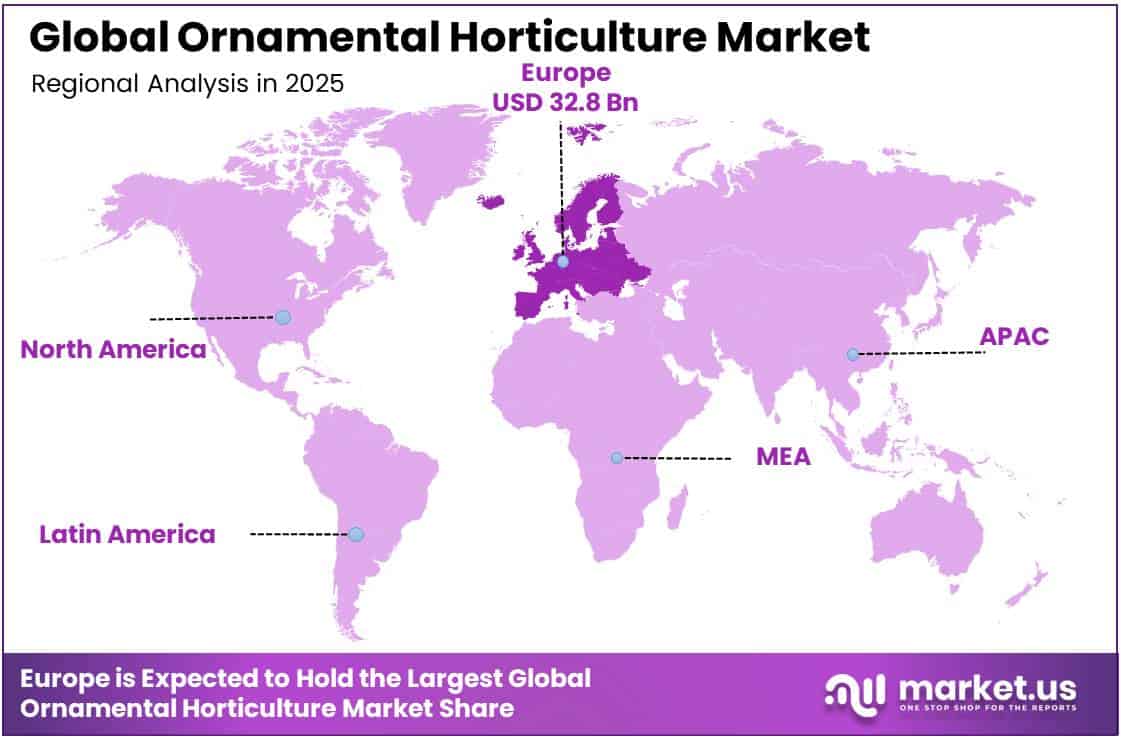
In 2025, the Ornamental Horticulture Market was valued at USD 91.16 Billion, and between 2026 and 2035, this market is estimated to register a CAGR of 3.43%, reaching about USD 127.69 Billion by 2035. Europe held a dominant market position, capturing more than a 36.0% share, holding USD 32.8 Billion in revenue.
The ornamental horticulture market, encompassing floriculture, nursery stock, cut flowers, and potted plants, represents a substantial segment of global agriculture.
- Horticulture operations in the United States sold a total of 18.3 billion dollars in floriculture, nursery, and specialty crops in 2024, with the number of horticulture operations in the United States totaling 23,060, according to the United States Department of Agriculture (USDA) National Agricultural Statistics Service (NASS). This reflects the sector’s contribution to farm income and rural employment.
Key Takeaways
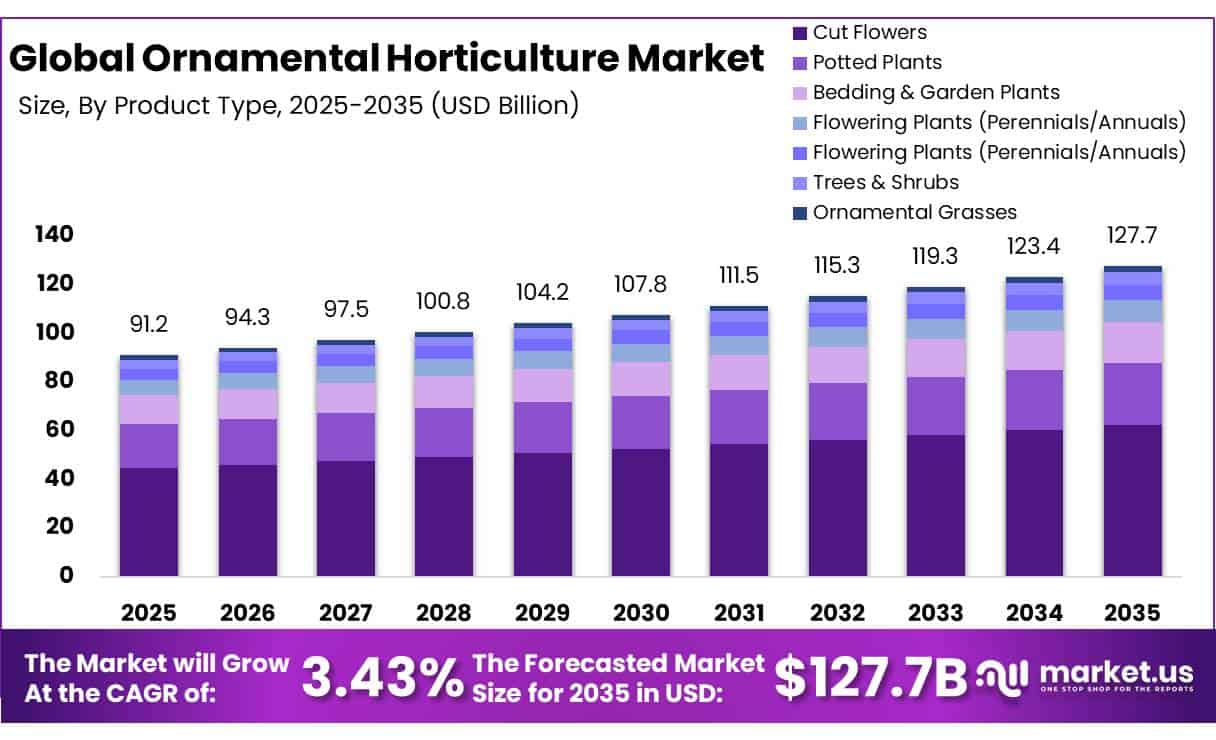
- The Global Ornamental Horticulture Market was valued at US$91.2 billion in 2025.
- The global ornamental horticulture market is projected to grow at a CAGR of 3.43% and is estimated to reach US$127.7 billion by 2035.
- On the basis of product type, cut flowers dominated the market, constituting 49.0% of the total market share.
- Based on the cultivation method, conventional/open-field cultivation dominated the market, accounting for 55.0% of the total market share.
- Based on the distribution channel, garden centers & nurseries dominated the market, accounting for 32.0% of the total market share.
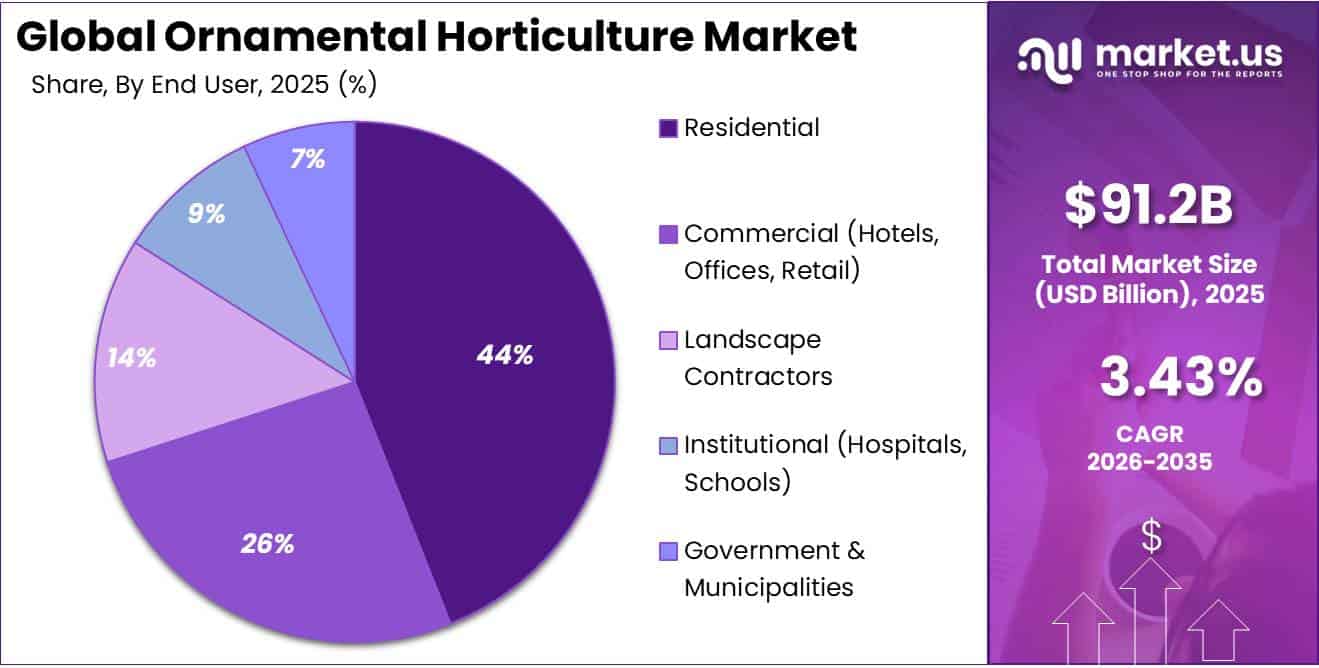
- Based on the end user, the residential segment dominated the market, accounting for 44.0% of the total market share.
- Based on the application, landscaping & outdoor decoration dominated the market, accounting for 38.0% of the total market share.
- In 2025, Europe was the most dominant region in the ornamental horticulture market, accounting for 36.0% of the global market.
Within this broader horticultural base, the total value of sales across all floriculture crops totaled 6.71 billion dollars in 2024, an increase of less than 1% from 2023, per USDA NASS data. In Europe, the European Commission’s Directorate-General for Agriculture and Rural Development reports that increasing levels of flower production and cultivation of ornamental plants give the European Union (EU) one of the world’s highest densities of flower production per hectare, accounting for 10% of total world area and 44% of world flower and pot-plant production.
Total industry expenses for United States horticultural operations were up 33% since 2019, with labor being the largest cost, accounting for 36% of total expenses in 2024, signaling sustained investment, per USDA NASS. Trade patterns reveal opportunity, as the European Commission confirms the EU is a net exporter of pot plants, conifers, and hardy perennial plants, bulbs and corms, a net importer of cut flowers and cut foliage, and has a net trade surplus for live plants and floriculture products.
Government regulation supports orderly market growth. The USDA’s Animal and Plant Health Inspection Service (APHIS) regulates the import of agricultural commodities into the United States, including live plants, plant cuttings, seeds, and cut flowers and greenery, to protect the health and value of America’s agriculture. In the EU, live plants and floriculture products fall under Regulation (EU) 1308/2013, the single common organisation of the markets in agricultural products, with the European Commission monitoring production and trade flows to maintain market stability.
By Product Type
Cut Flowers dominate with 49.0% share due to their strong demand across gifting, decoration, and landscaping applications.
In 2025, Cut Flowers held a dominant market position, capturing more than a 49.0% share of the global ornamental horticulture market. Their leading position was supported by consistent demand from households, event organizers, hospitality businesses, and commercial spaces where fresh flowers are widely used for decoration and celebrations. Cut flowers remain a preferred choice because they are available in a wide variety of colors, shapes, and seasonal options, making them suitable for different consumer preferences and occasions.
Potted Plants represented the growing segment in the ornamental horticulture market during the same period. Rising consumer interest in indoor gardening, home decoration, and workplace greenery contributed to the increasing adoption of potted plants. The segment also benefited from changing lifestyle preferences, with more consumers choosing long-lasting ornamental plants that require relatively simple maintenance compared to fresh flowers.
By Cultivation Method
Conventional / Open-Field Cultivation dominates with 55.0% share due to its established farming practices and broad crop suitability.
In 2025, Conventional / Open-Field Cultivation held a dominant market position, capturing more than a 55.0% share of the global ornamental horticulture market. The segment maintained its leadership because it remains the most widely adopted cultivation method for producing ornamental plants across large agricultural areas. Many growers continue to rely on open-field cultivation due to its familiarity, availability of agricultural land, and suitability for a broad range of flowers, shrubs, and ornamental plants.
Greenhouse / Protected Cultivation represented the growing segment in the ornamental horticulture market during the same period. The method gained wider acceptance as growers increasingly focused on producing high-quality ornamental plants under controlled environmental conditions. Interest in protected cultivation continued to rise because it offers better control over temperature, humidity, and plant health, allowing more consistent production throughout the year.
By Distribution Channel
Garden Centers & Nurseries dominate with 32.0% share due to their wide plant selection and direct customer support.
In 2025, Garden Centers & Nurseries held a dominant market position, capturing more than a 32.0% share of the global ornamental horticulture market. The segment remained the leading distribution channel because it offers consumers direct access to a wide range of ornamental plants along with guidance on plant selection and care. Homeowners, landscapers, and commercial buyers continued to prefer nurseries for purchasing healthy plants and seasonal varieties suited to local growing conditions.
Wholesale / Auction Markets represented the growing segment in the ornamental horticulture market during the same period. The segment expanded as commercial growers and large-volume buyers increasingly relied on organized trading platforms to improve supply chain efficiency and access a broader selection of ornamental products.
By End User
Residential dominates with 44% share as home gardening and decorative planting remain widely preferred.
In 2025, Residential held a dominant market position, capturing more than a 44% share of the global ornamental horticulture market. The segment maintained its leadership as homeowners continued to invest in ornamental plants for home gardens, balconies, terraces, and indoor spaces. Decorative plants remained a popular choice for improving the appearance of living spaces while creating greener home environments.
Commercial (Hotels, Offices, Retail) represented the growing segment in the ornamental horticulture market during the same period. Demand increased as hotels, office buildings, shopping centers, and retail establishments placed greater emphasis on attractive indoor and outdoor landscapes to enhance customer experience and workplace environments.
By Application
Landscaping & Outdoor Decoration dominates with 38.0% share as demand for attractive outdoor spaces continues to grow.
In 2025, Landscaping & Outdoor Decoration held a dominant market position, capturing more than a 38.0% share of the global ornamental horticulture market. The segment remained the largest application area as ornamental plants continued to be widely used in residential gardens, commercial properties, public parks, and recreational spaces. Demand was supported by ongoing efforts to improve outdoor environments through green landscaping and aesthetic planting.
Indoor Decoration / Interiorscaping represented the growing segment in the ornamental horticulture market during the same period. Growth was driven by increasing interest in enhancing indoor environments with ornamental plants across homes, offices, hotels, and retail spaces. Consumers and businesses increasingly preferred indoor greenery to improve the visual appeal of interior spaces and create more comfortable surroundings.
Key Market Segments
Product Type
- Cut Flowers
- Potted Plants
- Bedding & Garden Plants
- Flowering Plants (Perennials/Annuals)
- Foliage Plants & Indoor Plants
- Trees & Shrubs
- Ornamental Grasses
Cultivation Method
- Conventional / Open-Field Cultivation
- Greenhouse / Protected Cultivation
- Hydroponics
- Aeroponics
- Soilless / Substrate Cultivation
- Organic Horticulture
Distribution Channel
- Garden Centers & Nurseries
- Wholesale / Auction Markets
- Retail Stores (Florists, Supermarkets)
- Online Sales / E-Commerce
- Direct Sales (B2B / Landscape Contracts)
End User
- Residential
- Commercial (Hotels, Offices, Retail)
- Landscape Contractors
- Institutional (Hospitals, Schools)
- Government & Municipalities
Application
- Landscaping & Outdoor Decoration
- Indoor Decoration / Interiorscaping
- Events & Gifting
- Public Spaces & Parks