


Report Overview
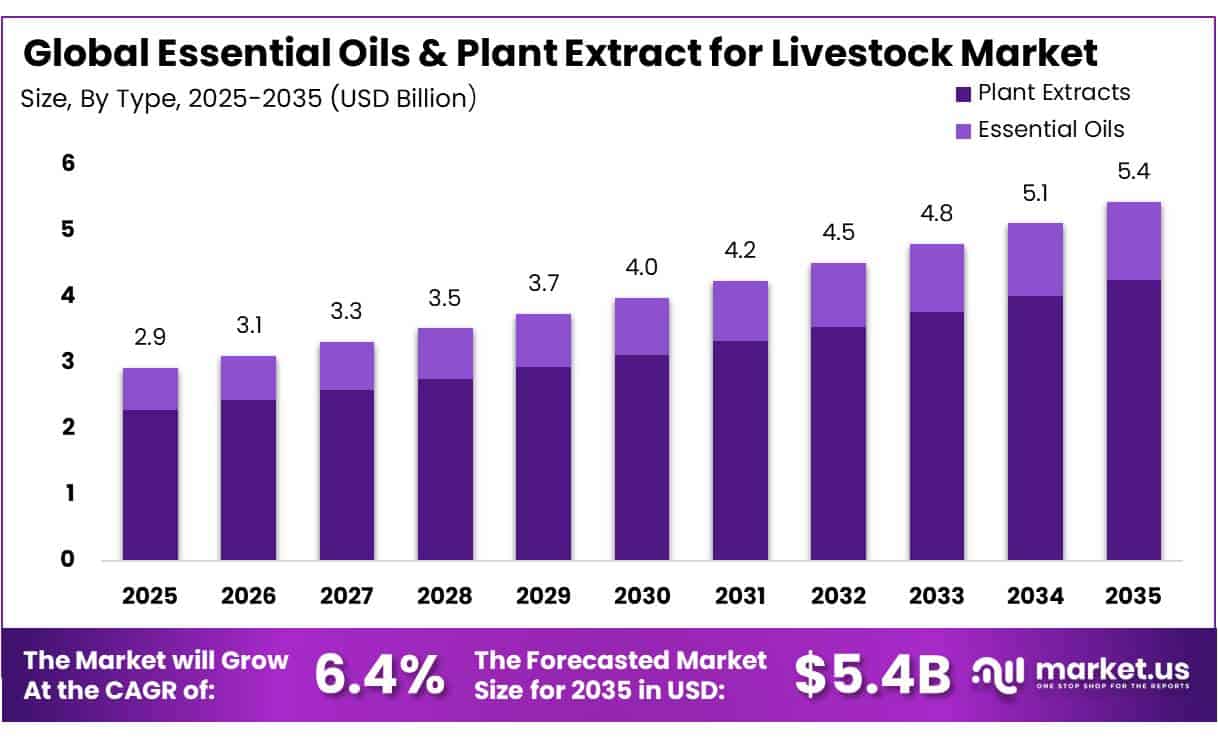
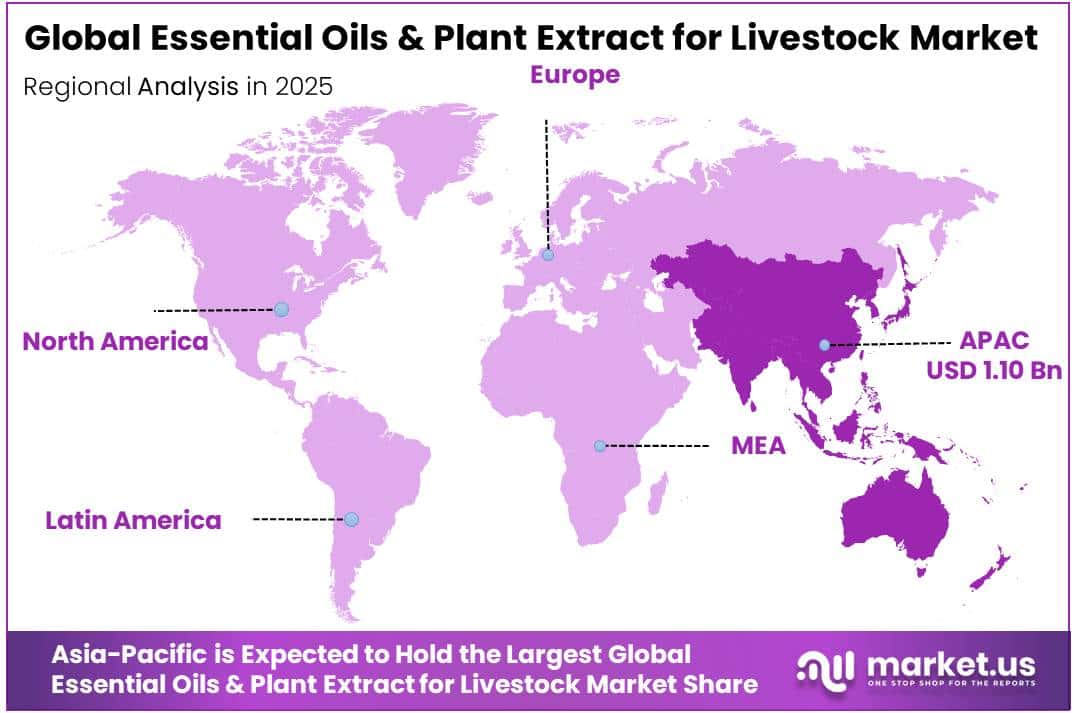
In 2025, the Global Essential Oils & Plant Extract for Livestock Market was valued at USD 2.9 Billion, and between 2026 and 2035, this market is estimated to register a CAGR of 6.4%, reaching about USD 6.4 Billion by 2035. Asia-Pacific held a dominant market position, capturing more than a 37.67% share, holding USD 1.10 Billion in revenue.
The global essential oils and plant extract for livestock market covers phytogenic feed additives derived from botanical sources, used to support animal growth performance, digestion, and immune function as natural alternatives to synthetic antimicrobial growth promoters. Rising scrutiny of antibiotic use in animal husbandry, combined with continuously expanding livestock output worldwide, has positioned phytogenic additives as an increasingly important component of feed formulation strategies across poultry, swine, ruminant, and aquaculture segments internationally.
- According to the Food and Agriculture Organization of the United Nations, world meat production reached 374 million tonnes in 2024, an increase of 7 million tonnes over 2023, while global milk production stood at 985 million tonnes, of which cattle milk accounted for 797 million tonnes, or 81% of the total. World egg production reached 100 million tonnes in 2024. This expanding livestock production base continues to widen the feed volume into which phytogenic essential oil and plant extract products can be incorporated.
A principal driving factor is sustained regulatory pressure to curb antimicrobial use in food-producing animals. The European Medicines Agency reported that sales of veterinary antibiotics across European Union, European Economic Area, and United Kingdom markets fell by 53% between 2011 and 2022, reaching the lowest level on record. This decline has accelerated adoption of phytogenic alternatives capable of supporting gut health and disease resistance without contributing to antimicrobial resistance, creating growth opportunities for standardized, bioavailable plant extract formulations in commercial feed manufacturing.
Regulatory frameworks continue to shape market access. Under Regulation (EC) No 1831/2003, the European Commission authorizes feed additives, including phytogenic substances, only after receiving a favorable scientific opinion from the European Food Safety Authority. In the United States, essential oils, oleoresins, and natural extractives are listed as Generally Recognized as Safe for animal feed use under Section 582.20 of Title 21 of the Code of Federal Regulations, administered by the Food and Drug Administration, formally supporting market access for plant-derived feed additives.
Key Takeaways
- The Global Essential Oils & Plant Extract for Livestock Market was valued at US$2.9 billion in 2025.
- The global market is projected to grow at a CAGR of 4% and is estimated to reach US$5.4 billion by 2035.
- On the basis of type, Plant Extracts dominated the market, constituting 34% of the total market share.
- Based on the form, Solid dominated the market, accounting for 67% of the total market share.
- Based on the function, Immunity dominated the market, accounting for 67% of the total market share.
- Based on the livestock, Poultry dominated the market, accounting for 56% of the total market share.
- In 2025, Asia-Pacific was the most dominant region in the essential oils & plant extract for livestock market, accounting for 67% of the global market.
By Type
Plant Extracts dominates with 78.34% share due to broad adoption for natural livestock nutrition and health support.
In 2025, Plant Extracts held a dominant market position, capturing more than a 78.34% share of the Essential Oils & Plant Extract for Livestock Market. Their leading position was supported by the growing preference for natural feed ingredients that help improve livestock health while meeting evolving feed safety and sustainability expectations. Plant extracts are widely incorporated into animal nutrition programs because they contain naturally occurring bioactive compounds that support normal digestive function and overall animal performance.
Essential Oils represented the growing segment of the market in 2025, supported by increasing interest in naturally derived feed additives that contribute to animal health and production efficiency. Their use continued to expand as livestock producers looked for feed solutions that promote balanced gut function and support immunity through plant-derived compounds.
By Form
Solid form dominates with 65.67% share due to its ease of handling, storage, and feed mixing.
In 2025, Solid held a dominant market position, capturing more than a 65.67% share of the Essential Oils & Plant Extract for Livestock Market. Its leading position was supported by its practical use in commercial feed manufacturing, where solid formulations are easier to transport, store, and blend into compound feed. Solid feed additives are widely used because they offer better handling during production and are compatible with standard feed processing systems.
Liquid represented the fastest-growing segment in 2025, driven by increasing demand for flexible feed supplementation and easier application in livestock production systems. Liquid formulations continued to gain attention because they can be applied directly through drinking water or mixed into feed, offering greater convenience in certain production environments.
By Function
Immunity dominates with 42.67% share as livestock producers prioritize stronger animal health and disease resilience.
In 2025, Immunity held a dominant market position, capturing more than a 42.67% share of the Essential Oils & Plant Extract for Livestock Market. Its leadership was driven by the growing focus on maintaining animal health through nutritional strategies that support normal immune function. Essential oils and plant extracts are increasingly included in livestock diets because they contain naturally occurring bioactive compounds that help support overall wellness.
Gut Health represented the growing segment in 2025, supported by increasing awareness of the importance of digestive health in livestock productivity and feed efficiency. Producers continued to adopt botanical feed additives that help maintain a balanced digestive system and improve overall animal performance.
By Livestock
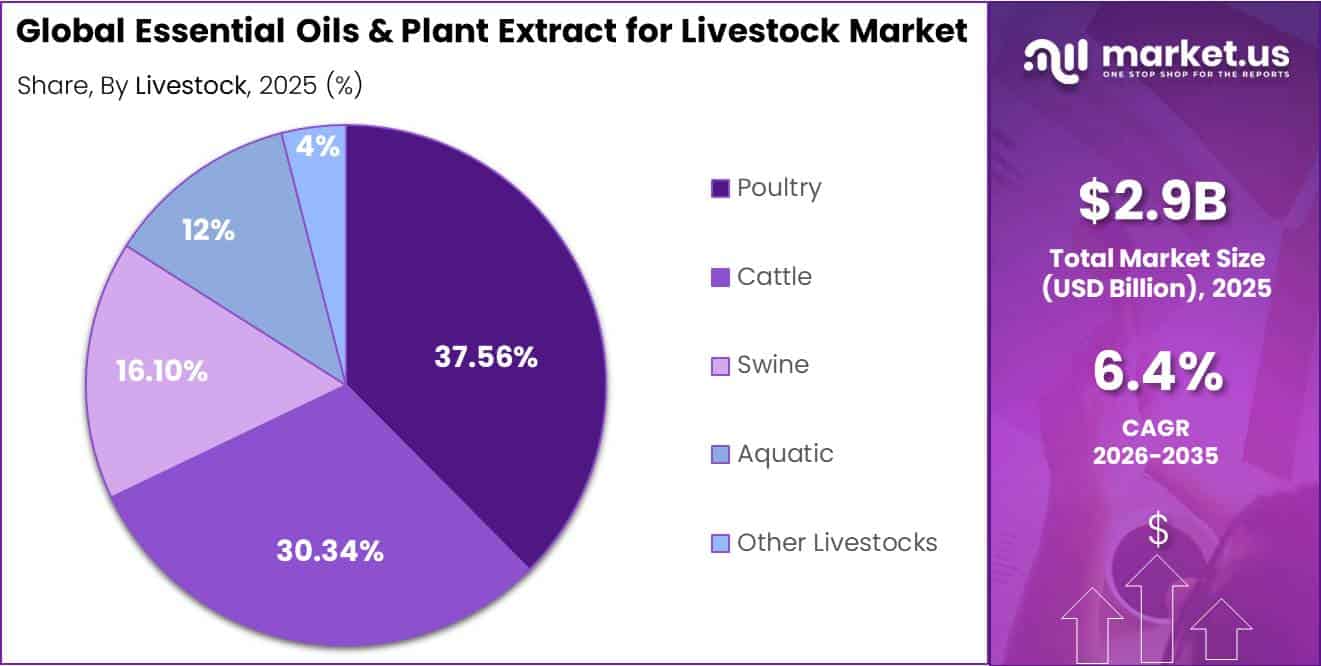
Poultry dominates with 37.56% share due to widespread use of natural feed additives in intensive production systems.
In 2025, Poultry held a dominant market position, capturing more than a 37.56% share of the Essential Oils & Plant Extract for Livestock Market. Its leading position was supported by the large-scale adoption of nutritional solutions that help maintain bird health and production performance. Essential oils and plant extracts are widely used in poultry feed because they support balanced nutrition and fit well within modern feeding programs.
Cattle represented the growing segment in 2025, driven by increasing interest in natural nutritional solutions that support herd health and productivity. Livestock producers continued to explore plant-based feed additives to improve feeding programs while aligning with evolving animal health and sustainability practices.
Key Market Segments
By Type
- Essential Oils
- Plant Extracts
By Form
- Liquid
- Solid
By Function
- Gut Health
- Immunity
- Yield
- Other Functions
By Livestock
- Cattle
- Poultry
- Swine
- Aquatic
- Other Livestocks
Driver Analysis
Antibiotic-Reduction Nutrition Programs
The European policy environment remains influential: Regulation (EC) No 1831/2003 establishes the authorization framework for feed additives, while the European Commission’s broader antimicrobial-resistance strategy includes an aspirational objective to reduce sales of antimicrobials for farmed animals and aquaculture by 50% by 2030, reinforcing commercial interest in alternatives that can support animal health without antibiotic residues.
The unit economics are compelling when efficacy is verified: a broiler integrator producing 10 million birds annually can recover meaningful value if a phytogenic program improves feed conversion ratio by 0.01–0.03, reduces mortality by 0.10–0.30 percentage points, or lowers therapeutic intervention frequency during defined stress periods; at 2.0–2.5 kg live weight per bird and feed costs of USD 0.35–0.55 per kg, a 0.02 FCR improvement can protect roughly USD 70,000–275,000 of feed expenditure per 10 million birds, depending on feed price and final weight.
This shifts supplier economics from low-margin raw-oil sales toward standardized active-compound blends, stability-protected delivery systems, microbiome-support protocols, field trials, technical service, and multi-year integrator contracts, supporting an estimated +1.8 percentage-point increment to baseline CAGR across Europe, North America, China, Brazil, and export-oriented poultry, swine, and aquaculture supply chains over the medium term.
Drivers Impact Analysis
| Driver | (~) % Impact on CAGR Forecast | Geographic Relevance | Impact Timeline |
|---|---|---|---|
| Antibiotic-Reduction Nutrition Programs | +1.8 pp | EU, North America, China, Brazil | Medium term (2–4 years) |
| Feed-Efficiency Economics | +1.5 pp | Global; China, India, Brazil, ASEAN | Short term (≤ 2 years) |
| Heat-Stress Resilience Demand | +1.3 pp | India, ASEAN, GCC, Africa, LATAM | Short term (≤ 2 years) |
| Ruminant Methane-Mitigation Programs | +1.2 pp | EU, North America, Australia, New Zealand | Long term (≥ 4 years) |
| Residue-Conscious Protein Premiumization | +1.1 pp | EU, North America, Japan, Korea, GCC | Medium term (2–4 years) |
| Precision Waterline Delivery | +1.0 pp | China, India, ASEAN, LATAM, Africa | Medium term (2–4 years) |
Restraint Analysis
Botanical Feedstock Supply Volatility
Essential-oil yields are inherently variable: oregano and thyme may yield roughly 1–4% oil by dry biomass, rosemary around 1–2%, clove roughly 10–20%, and citrus peel oil 0.3–1.0%, meaning a 20% reduction in herb or spice harvest can translate into a 25–60% increase in oil cost after distillation, transport, and extraction losses. For a supplier selling a standardized poultry phytogenic blend containing 5–20% essential oils, a 40% increase in the price of carvacrol-rich oregano oil or thymol-rich thyme oil can raise finished formulation cost by 8–18%, while integrators operating on feed margins of only USD 5–20 per tonne may accept only partial price pass-through.
Geographic concentration amplifies this risk: Mediterranean oregano and thyme, Indian spices, Chinese garlic and botanical intermediates, Brazilian citrus residues, and Latin American tannin or capsicum sources can each be disrupted independently, requiring 60–120 days of safety stock, multi-origin qualification, and more complex incoming quality control.
Suppliers that do not hedge crop exposure through contract farming, diversified sourcing, extract standardization, and forward purchasing can experience 300–800 basis points of gross-margin compression during adverse harvest cycles, while customers may delay orders or shift to cheaper acids, enzymes, probiotics, or generic additives. This agricultural and extraction-cost exposure is estimated to deduct approximately -1.5 percentage points from baseline CAGR across India, China, the Mediterranean, Latin America, and import-dependent global markets during the short term.
Restraint Impact Analysis
| Restraint | (~) % Impact on CAGR Forecast | Geographic Relevance | Impact Timeline |
|---|---|---|---|
| Botanical Feedstock Supply Volatility | -1.5 pp | India, China, Mediterranean, LATAM, global buyers | Short term (≤ 2 years) |
| Active-Compound Standardization Cost | -1.4 pp | Global; EU, North America, APAC | Medium term (2–4 years) |
| Regulatory Dossier and Claim Limits | -1.3 pp | EU, UK, North America, China, Japan | Medium term (2–4 years) |
| Encapsulation and Delivery Cost | -1.1 pp | Global intensive-livestock markets | Medium term (2–4 years) |
| Commodity Feed Price Sensitivity | -1.2 pp | China, India, Brazil, ASEAN, Africa | Short term (≤ 2 years) |
| Natural-Product Efficacy Variability | -1.0 pp | Global; poultry, swine, ruminants, aquaculture | Long term (≥ 4 years) |
Opportunity Analysis
Encapsulated Precision Phytogenics
This is not a baseline driver because the normal growth case already assumes incremental uptake of conventional oregano, thyme, garlic, rosemary, cinnamon, citrus, tannin, and saponin products, whereas the incremental growth pool requires emulsification, lipid matrices, spray-dried microcapsules, cyclodextrins, polymer coatings, beadlets, or nano-structured carriers designed around the active chemistry of carvacrol, thymol, eugenol, cinnamaldehyde, citral, rosmarinic acid, capsaicinoids, and polyphenols.
Recent work on tropical-plant essential oils highlights encapsulation as a route to protect actives and improve their functional delivery in livestock systems. A well-designed protected product can reduce processing and storage losses from an estimated 25–50% for unprotected oils to 5–15%, allowing a supplier to lower nominal dose by 15–30% while preserving effective intestinal exposure; for a poultry system using 100–300 g per tonne of feed, that improves cost-per-tonne economics by roughly USD 0.20–1.20 and creates room for a 20–50% premium relative to conventional oil blends.
The addressable commercial model includes tailored broiler, layer, piglet, dairy, beef, calf, and aquaculture grades, supported by 12–24 months of pellet-stability, release-profile, palatability, and field-ROI validation; a USD 3–10 million formulation and coating platform can generate 500–1,000 basis points more gross margin than bulk essential-oil sales when distributed through integrated nutrition programs.
Opportunity Impact Analysis
| Opportunity | (~) % Potential CAGR Upside | Geographic Relevance | Execution Window |
|---|---|---|---|
| Encapsulated Precision Phytogenics | +1.7 pp | EU, North America, China, Brazil, APAC | Medium term (2–4 years) |
| Methane-Verified Ruminant Systems | +1.5 pp | EU, North America, Australia, New Zealand | Long term (≥ 4 years) |
| Poultry Pathogen-Control Platforms | +1.4 pp | North America, EU, China, Brazil, ASEAN | Medium term (2–4 years) |
| Waterline Subscription Ecosystems | +1.3 pp | India, ASEAN, LATAM, Africa, GCC | Short term (≤ 2 years) |
| Botanical Traceability Premiums | +1.1 pp | EU, Japan, Korea, North America, GCC | Medium term (2–4 years) |
| Regional Phytogenic Roll-Ups | +1.0 pp | India, ASEAN, LATAM, Africa, Middle East | Medium term (2–4 years) |
Challenges Analysis
Bioactive Standardization Variability
As a result, two oregano-derived oils may both be commercially labeled “oregano oil” yet vary from about 20% to more than 70% carvacrol, while a 10–20% shift in active-marker concentration can require a 15–40% adjustment in use rate to deliver comparable biological exposure. Recent bioactive-feed research identifies inconsistent responses across animal species and production stages as an early challenge and notes that performance varies with diet composition, housing, health, and genetics, making generic recommendations difficult.
The manufacturing burden is substantial: maintaining a ±5–10% active-marker range often requires multi-origin blend design, GC–MS fingerprinting, HPLC testing for nonvolatile extracts, pesticide and heavy-metal screening, oxidation testing, retained-sample programs, and digital certificates of analysis; testing and corrective blending can add USD 150–1,000 per lot and 2–6% of sales cost for a specialized supplier. If batches deviate outside marker specifications, producers must either reduce dosage claims, reblend, downgrade material, or risk inconsistent customer trials that can destroy future adoption; a 3–8% batch failure, rework, or downgrade rate can erode gross margin by 300–700 basis points in premium botanical lines.
Long-term mitigation requires standardized botanical genetics, contract cultivation, chemotype mapping, real-time analytical release, predictive crop-quality models, and active-dose selling rather than crude-oil selling, but these changes require several harvest cycles and supplier-network investment. This standardization challenge is modeled to impose a -1.3 percentage-point friction drag on attainable market CAGR globally, particularly in regulated European, Chinese, Indian, and Latin American supply chains over the long term.
Challenges Impact Analysis
| Challenge | (~) % CAGR Friction Drag | Geographic Relevance | Mitigation Horizon |
|---|---|---|---|
| Bioactive Standardization Variability | -1.3 pp | Global; EU, China, India, LATAM | Long term (≥ 4 years) |
| Pelleting and Waterline Stability | -1.1 pp | Global intensive-livestock markets | Medium term (2–4 years) |
| Field-Efficacy Reproducibility Gaps | -1.2 pp | Global; poultry, swine, ruminants, aquaculture | Long term (≥ 4 years) |
| Technical Nutrition Talent Shortage | -0.9 pp | India, ASEAN, Africa, LATAM, GCC | Long term (≥ 4 years) |
| Botanical Supply-Chain Verification | -1.0 pp | Mediterranean, India, China, LATAM, global buyers | Medium term (2–4 years) |
| Multi-Market Authorization Complexity | -0.9 pp | EU, North America, China, Japan, Australia | Medium term (2–4 years) |
Geopolitical Impact Analysis
Geopolitical tensions reshape supply chains for essential oils and plant extracts used in livestock nutrition.
The ongoing geopolitical conflicts, including the Russia-Ukraine war and the disruptions around the Strait of Hormuz during 2025-2026, have increased pressure on the Essential Oils & Plant Extract for Livestock Market by raising transport costs, extending shipping times, and creating uncertainty in agricultural input supply chains. While essential oils and botanical extracts are not directly restricted in most cases, the livestock sector has been affected through higher feed production costs and logistics challenges.
The Strait of Hormuz carries around one-quarter of global seaborne oil, making it one of the world’s most critical maritime routes, and disruptions have increased freight and energy costs for agricultural supply chains. At the same time, the Gulf region accounts for 13% of global nitrogen fertilizer exports and 9% of phosphate fertilizer exports, increasing the cost pressure on livestock production as fertilizer prices influence feed crop cultivation. These developments have encouraged feed manufacturers to improve sourcing strategies and diversify raw material procurement.
During 2026, governments and international organizations continued to monitor food security risks linked to geopolitical instability. The Food and Agriculture Organization (FAO) warned that fertilizer shortages caused by regional conflict could reduce agricultural output later in 2026 and into 2027, while the World Trade Organization (WTO) reported that export restrictions affected up to 15% of global fertilizer trade following the Gulf conflict. These conditions have reinforced interest in improving supply chain resilience and increasing the use of locally available botanical ingredients where feasible.
Regional Analysis
Modular Construction Market – Regional Analysis (Asia Pacific).
Asia-Pacific is the dominating region in the global essential oils and plant extract for livestock market, holding a share of 37.67% and a valuation of USD 1.10 billion, as provided. This dominance is underpinned by the region’s position as the world’s largest livestock producing base.
According to the Food and Agriculture Organization of the United Nations, global meat production rose to 371 million tonnes in 2023, with Asia driving much of this expansion, reflecting increased pig meat production in China.
Regional growth is further reinforced by government-led regulatory action restricting antibiotic use in animal feed. The Ministry of Agriculture and Rural Affairs of the People’s Republic of China issued Announcement Number 194, withdrawing growth-promoting medical feed additives, with commercial feed producers required to stop producing antibiotic-containing growth-promoting feed from July 1, 2020.
According to the World Organisation for Animal Health Regional Representation for Asia and the Pacific, China has since pursued a national campaign to reduce veterinary antimicrobial use across its livestock sector. Such regulatory measures are accelerating the substitution of antibiotic growth promoters with natural alternatives, positioning Asia-Pacific for continued expansion in phytogenic feed additive adoption across its large-scale poultry and swine production systems.
Key Regions and Countries Covered
- North America
- The US
- Canada
- Europe
- Germany
- France
- The UK
- Spain
- Italy
- Russia & CIS
- Rest of Europe
- APAC
- China
- Japan
- South Korea
- India
- ASEAN
- Rest of APAC
- Latin America
- Brazil
- Mexico
- Rest of Latin America
- Middle East & Africa
- GCC
- South Africa
- Rest of MEA
Key Players Analysis
Manufacturers in the Essential Oils & Plant Extract for Livestock Market focus on strengthening their competitive position through product innovation, consistent raw material quality, and scientifically supported feed solutions. A major priority is the development of standardized botanical extracts and essential oil blends that help improve livestock immunity, gut health, and overall production performance while meeting evolving feed safety requirements.
Companies continue to invest in advanced extraction, purification, and formulation technologies to maintain product consistency and preserve the activity of natural compounds. They also work closely with feed manufacturers, livestock producers, and animal nutrition specialists to develop application-specific solutions for poultry, cattle, swine, and aquaculture. Expanding traceable sourcing networks for herbs and medicinal plants has become increasingly important to ensure stable raw material availability and maintain product quality across different regions.
Leading participants are also expanding production capabilities, strengthening regional distribution, and increasing technical support to improve customer relationships and market reach. Many companies emphasize research partnerships with universities, veterinary institutes, and animal nutrition organizations to validate product performance and support wider commercial adoption.
Digital quality monitoring, sustainable sourcing practices, and compliance with feed safety regulations remain important areas of investment as customers demand greater transparency throughout the supply chain. Businesses are also introducing customized botanical formulations designed for different livestock species and production systems while expanding their presence in high-growth agricultural markets.
Strategic collaborations, portfolio diversification, and continuous investment in natural feed additive technologies help companies strengthen their long-term market position. Key players operating in the market include IDENA SAS, Kemin Industries, Inc., Novus International, Inc., DSM N.V., Trouw Nutrition Hifeed BV, Phytosynthese, Provitim, Panagro Health & Nutrition, Olmix S.A., Herbarom Laboratoire, Herbavita, Orffa, Indian Herbs Specialties Pvt. Ltd., and other key players.
The Major Players in The Industry
- IDENA SAS
- Kemin Industries, Inc.
- Novus International, Inc.
- DSM N.V.
- Trouw Nutrition Hifeed BV
- Phytosynthese
- Provitim
- Panagro Health & Nutrition
- Olmix S.A.
- Herbarom Laboratoire
- Herbavita
- Orffa
- Indian Herbs Specialties Pvt. Ltd.
- Other Key Players
Key Development
- In February 2026, DSM-Firmenich announced an agreement to divest its Animal Nutrition and Health business, which includes phytogenic and botanical feed solutions, to CVC Capital Partners at an enterprise value of approximately EUR 2.2 billion, with dsm-firmenich retaining a 20% equity stake in the divested business.
- In April 2026, Trouw Nutrition, the livestock feed business of Nutreco, launched Presan Evolve, a feed additive combining a PhytoComplex derived from four plants with targeted-release butyrates, unveiled at the 9th International Conference on Poultry Intestinal Health held April 22 to 24 in Istanbul, Turkey, designed to support gut integrity and reduce chronic inflammation in high-performing broilers.
- In May 2026, EW Group entered exclusive negotiations to acquire Olmix Group, a company specializing in natural, biosourced solutions for livestock and crop farming, from Amadeite and Motion Equity Partners, aiming to strengthen EW Group’s portfolio of natural feed and biosourced solutions.
Report Scope
| Report Features | Description |
|---|---|
| Market Value (2025) | US$2.9 Bn |
| Forecast Revenue (2035) | US$5.4 Bn |
| CAGR (2026 2035) | 6.4% |
| Base Year for Estimation | 2025 |
| Historic Period | 2020-2024 |
| Forecast Period | 2026-2035 |
| Report Coverage | Revenue Forecast, Market Dynamics, Competitive Landscape, Recent Developments |
| Segments Covered | By Type (Essential Oils, Plant Extracts), By Form (Liquid, Solid), By Function (Gut Health, Immunity, Yield, Other Functions), By Livestock (Cattle, Poultry, Swine, Aquatic, Other Livestocks) |
| Regional Analysis | North America The US & Canada; Europe Germany, France, The UK, Spain, Italy, Russia & CIS, Rest of Europe; APAC China, Japan, South Korea, India, ASEAN & Rest of APAC; Latin America Brazil, Mexico & Rest of Latin America; Middle East & Africa GCC, South Africa, & Rest of MEA |
| Competitive Landscape | IDENA SAS, Kemin Industries, Inc., Novus International, Inc., DSM N.V., Trouw Nutrition Hifeed BV, Phytosynthese, Provitim, Panagro Health & Nutrition, Olmix S.A., Herbarom Laboratoire, Herbavita, Orffa, Indian Herbs Specialties Pvt. Ltd., and Other Key Players |
| Customization Scope | Customization for segments, region/country level will be provided. Moreover, additional customization can be done based on the requirements. |
| Purchase Options | We have three licenses to opt for: Single User License, Multi User License (Up to 5 Users), Corporate Use License (Unlimited Users and Printable PDF) |





































