


Report Overview
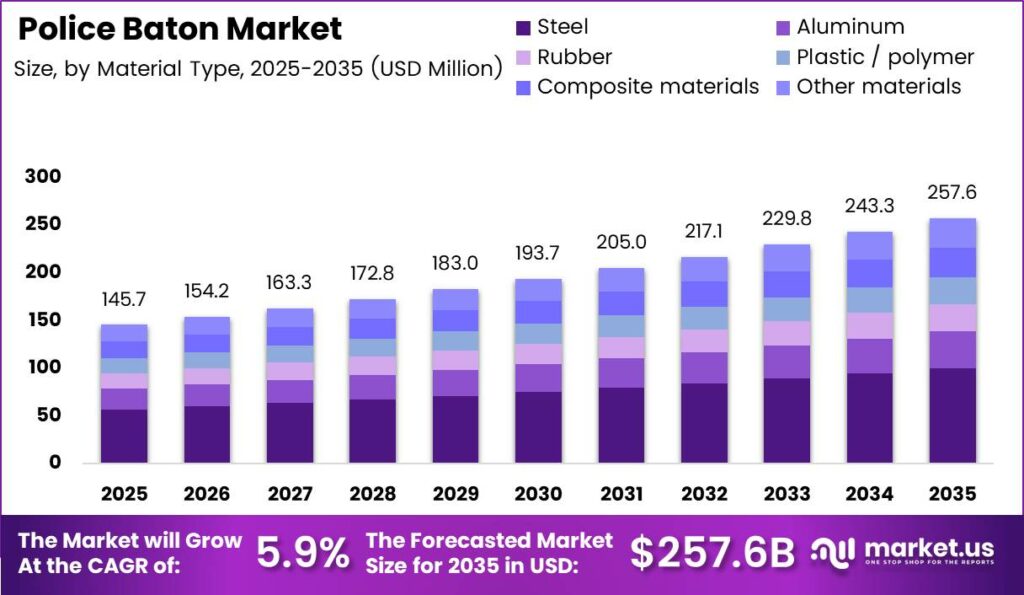
Global Police Baton Market size is expected to be worth around USD 257.6 Million by 2035 from USD 145.7 Million in 2025, growing at a CAGR of 5.9% during the forecast period 2026 to 2035.
The police baton market covers purpose-built impact tools issued to law enforcement, military, correctional, and private security personnel. Products range from fixed-length wooden and steel batons to expandable and telescopic designs. This market serves institutional buyers through government tenders, authorized distributors, and specialist security-equipment channels.
Key Takeaways
- Police Baton Market size in 2025 stands at USD 145.7 Million, projected to reach USD 257.6 Million by 2035.
- The market grows at a CAGR of 5.9% during the forecast period 2026 to 2035.
- By Product Type, Expandable batons dominate with a 38.00% share.
- By Material Type, Steel holds the leading position with a 39.00% share.
- By End User, Municipal police departments lead with a 28.00% share.
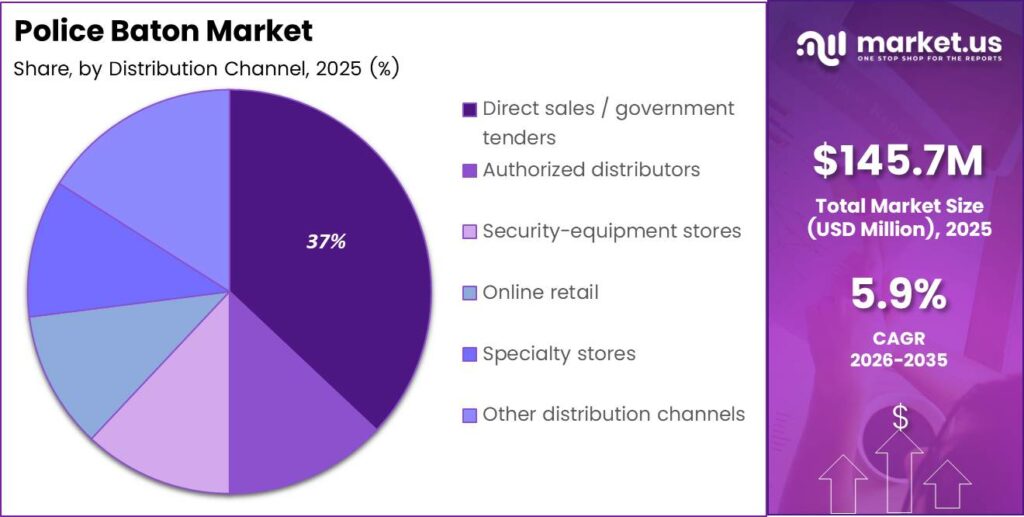
- By Distribution Channel, Direct sales and government tenders account for 37.00% of the market.
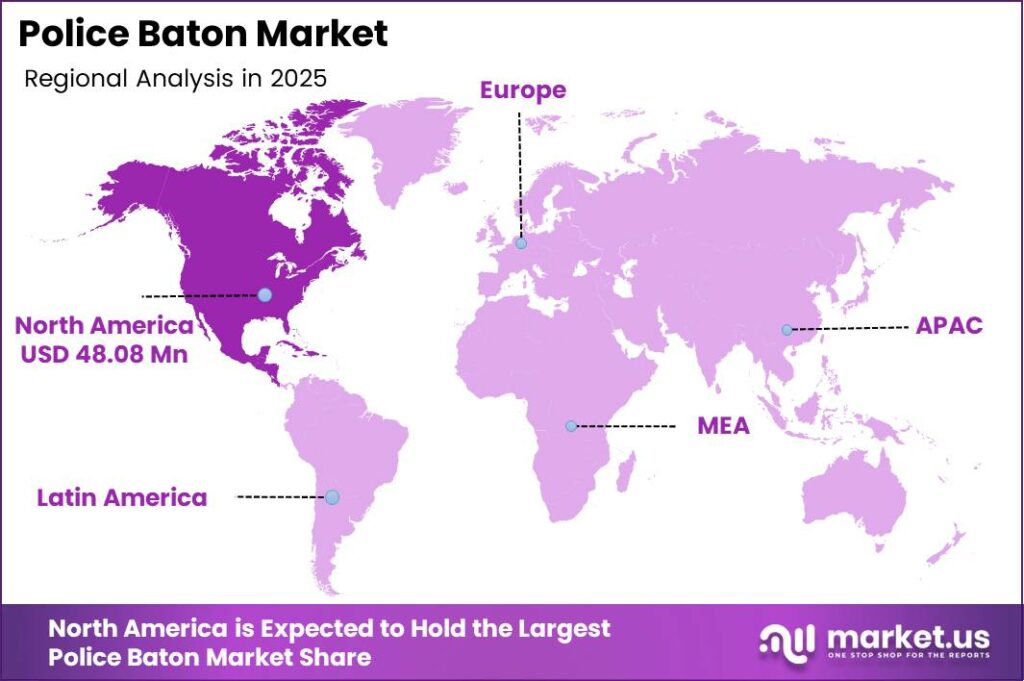
- North America is the dominant region with a 33.00% share, valued at USD 48.08 Million.
Government procurement frameworks directly shape this market. Albuquerque’s 2026 police use-of-force policy specifies a straight wooden baton approximately 30 to 36 inches long for Emergency Response Team field-force deployments. This level of specification detail forces suppliers to maintain dedicated product configurations for individual agency compliance, raising both the cost and the complexity of public-sector sales.
Specification requirements extend across unit types and materials. Albuquerque’s 2026 documentation limits the Horse Mounted Unit’s Bokken baton to an overall length of 41 inches or less, permitting only white oak or polypropylene construction. This creates parallel product lines within a single agency relationship. Suppliers that maintain compliant inventory across multiple configuration tiers hold a structural advantage in renewal and replacement orders.
Product Type Analysis
Expandable batons dominate with 38.00% due to officer portability and rapid deployment preference.
In 2025, Expandable batons held a dominant market position in the By Product Type segment of the Police Baton Market, with a 38.00% share. Officers across municipal and federal agencies prefer expandable designs because they collapse for carry and deploy in a single motion. This operational convenience drives consistent replacement and first-issue demand across established police workforces globally.
Fixed-length batons retain strong institutional preference among agencies that prioritize durability and lower unit cost over portability. Correctional facilities and military units frequently specify fixed-length models because the consistent form factor simplifies training and inventory management. This segment’s stable demand profile makes it a reliable volume contributor even as expandable designs grow their share.
Telescopic batons occupy a distinct position between expandable and fixed-length designs, offering a compromise between compactness and rigidity. European agencies in particular specify telescopic configurations for public-order roles. In January 2026, Cadre Holdings completed its acquisition of TYR Tactical, expanding its tactical equipment portfolio across law-enforcement and military customers and signaling continued consolidation among suppliers serving this segment.
Stun batons and other baton types collectively hold the remaining share in this segment. Stun batons serve niche correctional and private security applications where dual-function deterrence is a procurement requirement. Their narrower regulatory acceptance across jurisdictions limits volume growth relative to conventional impact designs.
Material Type Analysis
Steel dominates with 39.00% due to durability requirements in institutional procurement cycles.
In 2025, Steel held a dominant market position in the By Material Type segment of the Police Baton Market, with a 39.00% share. Police procurement teams consistently specify steel for duty-issue expandable and telescopic designs because its mechanical performance under repeated deployment is well-documented and acceptance-tested. This established trust in steel’s reliability creates a high re-order rate that supports recurring supplier revenue.
Aluminum offers a weight advantage over steel and serves agencies prioritizing officer comfort during extended carry. Its use is concentrated in expandable baton designs where reduced mass per unit is a specification criterion. This positions aluminum as the primary challenger to steel’s share as ergonomic procurement criteria gain traction in developed-market agency buying programs.
Rubber and plastic or polymer materials serve specialized roles, including training batons, public-order tools, and jurisdictions with restrictions on metal impact weapons. Composite materials represent an emerging category combining weight reduction with structural performance. These lower-share material categories collectively serve the remaining market volume not captured by steel or aluminum.
End User Analysis
Municipal police departments dominate with 28.00% due to their scale and frequency of equipment replacement cycles.
In 2025, Municipal police departments held a dominant market position in the By End User segment of the Police Baton Market, with a 28.00% share. Arizona Security Group’s September 2026 listing prices an 8-hour expandable-baton certification course at USD 160 per participant. This training cost adds a recurring per-officer expense on top of equipment acquisition, reinforcing the financial case for suppliers that bundle product with certification support.
State law-enforcement agencies represent the next tier of institutional demand, purchasing through multi-year framework contracts that favor suppliers with proven compliance histories. California’s Bureau of Security and Investigative Services charges a USD 44 baton-permit renewal application fee, reflecting a structured credentialing environment that sustains demand for both initial-issue and renewal-cycle equipment procurement. Security Force USA’s July 2026 guidance lists the initial permit application fee in California at USD 66, separating regulatory cost from training cost in a way that increases total per-officer onboarding expense.
Federal law-enforcement agencies and military and defense forces set national procurement specifications that cascade through the supply chain as de facto industry standards. Private security firms and correctional facilities together form the second half of this segment’s volume, with private security firms subject to jurisdiction-specific permit requirements that directly regulate their baton procurement behavior. Other end users, including customs and transport security agencies, hold the remaining share.
Distribution Channel Analysis
Direct sales and government tenders dominate with 37.00% due to institutional procurement rules and contract compliance requirements.
In 2025, Direct sales and government tenders held a dominant market position in the By Distribution Channel segment of the Police Baton Market, with a 37.00% share. Security Training Center’s California baton-training page, updated on 30 September 2026, lists an 8-hour initial course and an 8-hour renewal course at USD 120 each. The parallel structure of initial and renewal certification reflects a channel environment where compliance cycles sustain reorder activity well beyond first-issue procurement.
Authorized distributors hold the second-largest channel position, operating within supplier-approved networks that enforce pricing, product authenticity, and jurisdiction-specific delivery requirements. California’s October 2025 renewal form allows active-duty peace officers to use baton training completed within the preceding 12 months when claiming an exemption from the standard training-course requirement. This exemption pathway reduces per-renewal cost for institutional buyers and concentrates reorder volume through authorized distribution rather than retail channels.
Security-equipment stores and online retail serve the private security and individual professional market, where permit requirements rather than institutional contracts govern the purchase decision. Specialty stores and other distribution channels account for the remaining volume, primarily serving niche jurisdictions and export markets where conventional tender processes do not apply.
Key Market Segments
By Product Type
- Expandable batons
- Fixed-length batons
- Telescopic batons
- Stun batons
- Other baton types
By Material Type
- Steel
- Aluminum
- Rubber
- Plastic / polymer
- Composite materials
- Other materials
By End User
- Municipal police departments
- State law-enforcement agencies
- Federal law-enforcement agencies
- Military and defense forces
- Private security firms
- Correctional facilities
- Other end users
By Distribution Channel
- Direct sales / government tenders
- Authorized distributors
- Security-equipment stores
- Online retail
- Specialty stores
- Other distribution channels
Regional Analysis
North America Dominates the Police Baton Market with a Market Share of 33.00%, Valued at USD 48.08 Million
North America holds a 33.00% share of the global police baton market, valued at USD 48.08 Million in 2025. Large municipal and federal police establishments drive consistent replacement-cycle procurement across US jurisdictions. In November 2025, the City of Los Angeles issued a procurement solicitation specifying Peacekeeper Products International’s 26-inch Rapid Containment Baton, model 926B, with no substitute brands permitted. This single-brand specification illustrates how major North American agencies concentrate volume with approved suppliers and restrict competitive entry.
Europe represents the fastest-growing regional market, driven by public-order readiness requirements across police services in the United Kingdom and continental Europe. England and Wales maintain a workforce of approximately 146,442 full-time-equivalent police officers as of March 2025, sustaining a substantial installed base that generates recurring replacement demand independent of recruitment growth. This persistent workforce scale makes European institutional procurement a structurally reliable revenue stream for suppliers holding approved-framework positions.
Key Regions and Countries
North America
- US
- Canada
Europe
- Germany
- France
- The UK
- Spain
- Italy
- Rest of Europe
Asia Pacific
- China
- Japan
- South Korea
- India
- Australia
- Rest of APAC
Latin America
- Brazil
- Mexico
- Rest of Latin America
Middle East and Africa
- GCC
- South Africa
- Rest of MEA
Drivers
Large operational police establishments generate recurring replacement demand even when officer headcount stays flat. England and Wales recorded 147,745 full-time-equivalent officers in March 2024 and 146,442 in March 2025, a decline of 0.9%. At an analyst-assumed annual replacement rate of 8 to 12% per 100,000 issued batons, this produces 8,000 to 12,000 replacement units before any establishment growth occurs.
Expandable baton product mix, public-order equipment readiness, and existing academy training demand add combined positive pressure of +0.50 percentage points to the baseline CAGR. Police-establishment expansion in selected emerging-market jurisdictions contributes a further +0.10 percentage points over the medium term. Suppliers that align product catalogs with institutional training systems and public-order specifications are best positioned to capture this recurring volume.
| Driver | (~) % Impact on CAGR Forecast | Geographic Relevance | Impact Timeline |
|---|---|---|---|
| Installed-base replacement demand | +0.40% | Global; established police services | Short term (≤ 2 years) |
| Expandable-baton product mix | +0.25% | North America; Europe; developed Asia-Pacific | Medium term (2–4 years) |
| Public-order equipment readiness | +0.20% | Europe; Latin America; South Asia | Short term (≤ 2 years) |
| Existing academy training demand | +0.15% | Global; institutional training systems | Short term (≤ 2 years) |
| Police-establishment expansion | +0.10% | Selected emerging-market jurisdictions | Medium term (2–4 years) |
Restraints
Police equipment budgets are allocated across multiple force options, and expenditure on conducted-energy devices can displace discretionary baton upgrades. In England and Wales, restraint appeared in 77% of the 812,447 use-of-force reports recorded in the year ending March 2025. Among 644,783 reports containing relevant equipment information, 46% indicated the officer carried a conducted-energy device readily available for use.
Closed procurement frameworks, restricted civilian sales channels, and prohibited baton configurations apply combined negative pressure of −0.47 percentage points on the CAGR. Durable-product purchase deferrals add a further −0.08 percentage points among budget-constrained buyers globally. Suppliers without approved-framework positions in key markets face structurally limited access to institutional volume regardless of product quality.
| Restraint | (~) % Impact on CAGR Forecast | Geographic Relevance | Impact Timeline |
|---|---|---|---|
| Competing force-option allocation | −0.25% | United Kingdom; North America; selected European markets | Short term (≤ 2 years) |
| Closed procurement frameworks | −0.20% | United Kingdom; framework-based public buyers | Medium term (2–4 years) |
| Restricted civilian sales channels | −0.15% | Jurisdictions restricting civilian baton possession | Short term (≤ 2 years) |
| Prohibited baton configurations | −0.12% | United Kingdom; European Union; controlled trade routes | Short term (≤ 2 years) |
| Durable-product purchase deferrals | −0.08% | Global; budget-constrained police buyers | Short term (≤ 2 years) |
Challenges
Suppliers serving multiple police buyers must reconcile different product configurations and acceptance requirements. The United Kingdom’s baton framework distinguishes positive or auto-lock and straight public-order products, and specification development involves procurement teams and operational officers. In an illustrative operating model, 3 customer-specific variants requiring 2 approval rounds each create 6 sample-and-documentation cycles.
Precision process yield variability and specialist finishing supplier dependence apply combined friction drag of −0.21 percentage points. Tender volume forecasting volatility and cross-border spare-parts coordination add a further −0.11 percentage points. Suppliers that invest in controlled product platforms and reusable qualification files reduce per-customer engineering burden and improve their cost position in competitive tender environments.
| Challenge | (~) % CAGR Friction Drag | Geographic Relevance | Mitigation Horizon |
|---|---|---|---|
| Fragmented technical acceptance requirements | −0.18% | Global; multi-jurisdiction suppliers | Medium term (2–4 years) |
| Precision process yield variability | −0.12% | Global; expandable-baton manufacturing hubs | Medium term (2–4 years) |
| Specialist finishing supplier dependence | −0.09% | Europe; Asia-Pacific; North America | Medium term (2–4 years) |
| Tender volume forecasting volatility | −0.07% | Global; public-sector supply chains | Short term (≤ 2 years) |
| Cross-border spare-parts coordination | −0.04% | Import-dependent police equipment markets | Medium term (2–4 years) |
Opportunities
A supplier-operated digital inspection service connecting individual baton identifiers with inspection reminders and warranty records offers a shift from one-off hardware transactions to recurring account revenue. Under analyst assumptions, enrolling 20% of issued units at an annual service charge equal to 4% of original unit selling price generates recurring annual revenue equal to 0.8% of that installed base’s original hardware revenue.
If service delivery consumes 40% of subscription revenue, the resulting service gross margin reaches 60%, against an assumed hardware gross margin of 30%. A mature service mix of 5 to 10% of supplier revenue would lift blended gross margin by approximately 1.5 to 3.0 percentage points. Authorized repair-and-recertification networks and permitted private-security channel expansion add a combined +0.35 percentage points of contingent upside for suppliers that move early on both fronts.
| Opportunity | (~) % Potential CAGR Upside | Geographic Relevance | Execution Window |
|---|---|---|---|
| Digital inspection-service subscriptions | +0.30% | North America; Europe; developed Asia-Pacific | Medium term (2–4 years) |
| Authorized repair-and-recertification networks | +0.20% | Europe; North America; regional service hubs | Medium term (2–4 years) |
| Permitted private-security channel expansion | +0.15% | Jurisdictions permitting licensed security use | Medium term (2–4 years) |
| Adaptive ergonomic fit systems | +0.12% | Global; diverse police workforces | Long term (≥ 4 years) |
| Regional distributor consolidation | +0.08% | Fragmented regional distribution markets | Long term (≥ 4 years) |
Key Company Insights
Armament Systems and Procedures, Inc. (ASP) holds a dominant position in the expandable baton segment through a product ecosystem that pairs duty batons with training, accessories, and certification infrastructure. In June 2025, ASP launched Defender LE, a law-enforcement line covering OC pepper sprays, inert training sprays, and post-exposure decontamination products. This adjacency strategy reduces agency reliance on competing suppliers and deepens per-account revenue beyond the initial baton transaction.
Monadnock / Safariland Group combines baton manufacturing with a broad law-enforcement equipment portfolio that spans holsters, restraints, and communications devices. LJB Security Training’s December 2025 listing specifies a 4-hour basic baton course with certification valid for up to 3 years, reflecting the certification cycle that governs reorder timing across Safariland’s customer base. California’s October 2025 renewal form requires baton training completion within 6 months before permit expiry, creating a structured reorder trigger that suppliers with strong distributor networks are best positioned to capture. A USD 25 replacement permit card fee further illustrates the layered compliance cost environment that sustains ongoing engagement between agencies and their approved equipment suppliers.
Key Players
- Armament Systems and Procedures, Inc. (ASP)
- Monadnock
- Bonowi IPE GmbH
- NEXTOCH
- Smith & Wesson Brands, Inc.
- Zarc International, Inc.
- Galls, LLC
- Euro Security Products (ESP)
- DONGES SteelTec GmbH
- United Shield International Ltd.
- Paulson Manufacturing Corporation
- Combined Tactical Systems, Inc. (CTS)
- SENKEN Group Co., Ltd.
- Tianjin Armorus Textiles Co., Ltd.
- Civil Defense Supply, Inc.
- Other Key Players
Recent Developments
- January 2025 – Euro Security Products’ distributor Best Buy Sweden published testing results for the new ESP Easy-Lock telescopic baton, confirming that its push-button-closing design passed hardness, impact, mud, and cold tests.
- May 2025 – Safariland introduced the Gravity outside-the-waistband holster, featuring SafariLaminate construction, a Cordura exterior, adjustable trigger-guard retention, and compatibility with Safariland’s three-hole mounting systems.
- January 2026 – Safariland announced the launch of SafariMesh at SHOT Show, introducing a decentralized communications device supporting up to 50 users, four simultaneous talkers, AES-256 encryption, and integration with Safariland Liberator headsets.
- April 2026 – Cadre Holdings completed its acquisition of Alien Gear Holsters and certain assets of Tedder Industries through a court-supervised bankruptcy auction on April 7, adding proprietary holsters and equipment for law-enforcement, military, security, and consumer customers.
Report Scope
| Report Features | Description |
|---|---|
| Market Value (2025) | USD 145.7 Million |
| Forecast Revenue (2035) | USD 257.6 Million |
| CAGR (2026-2035) | 5.9% |
| Base Year for Estimation | 2025 |
| Historic Period | 2020-2024 |
| Forecast Period | 2026-2035 |
| Report Coverage | Revenue Forecast, Market Dynamics, Market Opportunity Analysis, Technology and Innovation Landscape, Competitive Landscape, Recent Developments |
| Segments Covered | By Product Type (Expandable batons, Fixed-length batons, Telescopic batons, Stun batons, Other baton types), By Material Type (Steel, Aluminum, Rubber, Plastic / polymer, Composite materials, Other materials), By End User (Municipal police departments, State law-enforcement agencies, Federal law-enforcement agencies, Military and defense forces, Private security firms, Correctional facilities, Other end users), By Distribution Channel (Direct sales / government tenders, Authorized distributors, Security-equipment stores, Online retail, Specialty stores, Other distribution channels) |
| Regional Analysis | North America (US and Canada), Europe (Germany, France, The UK, Spain, Italy, and Rest of Europe), Asia Pacific (China, Japan, South Korea, India, Australia, and Rest of APAC), Latin America (Brazil, Mexico, and Rest of Latin America), Middle East and Africa (GCC, South Africa, and Rest of MEA) |
| Competitive Landscape | Armament Systems and Procedures, Inc. (ASP), Monadnock / Safariland Group, Bonowi IPE GmbH, NEXTOCH / Nextorch Industries Co., Ltd., Smith & Wesson Brands, Inc., Zarc International, Inc., Galls, LLC, Euro Security Products (ESP), DONGES SteelTec GmbH, United Shield International Ltd., Paulson Manufacturing Corporation, Combined Tactical Systems, Inc. (CTS), SENKEN Group Co., Ltd., Tianjin Armorus Textiles Co., Ltd., Civil Defense Supply, Inc., Other Key Players |
| Customization Scope | Customization for segments, region/country-level will be provided. Additional customization can be done based on requirements. |
| Purchase Options | We have three licenses to opt for: Single User License, Multi-User License (Up to 5 Users), Corporate Use License (Unlimited User and Printable PDF) |





































