


Report Overview
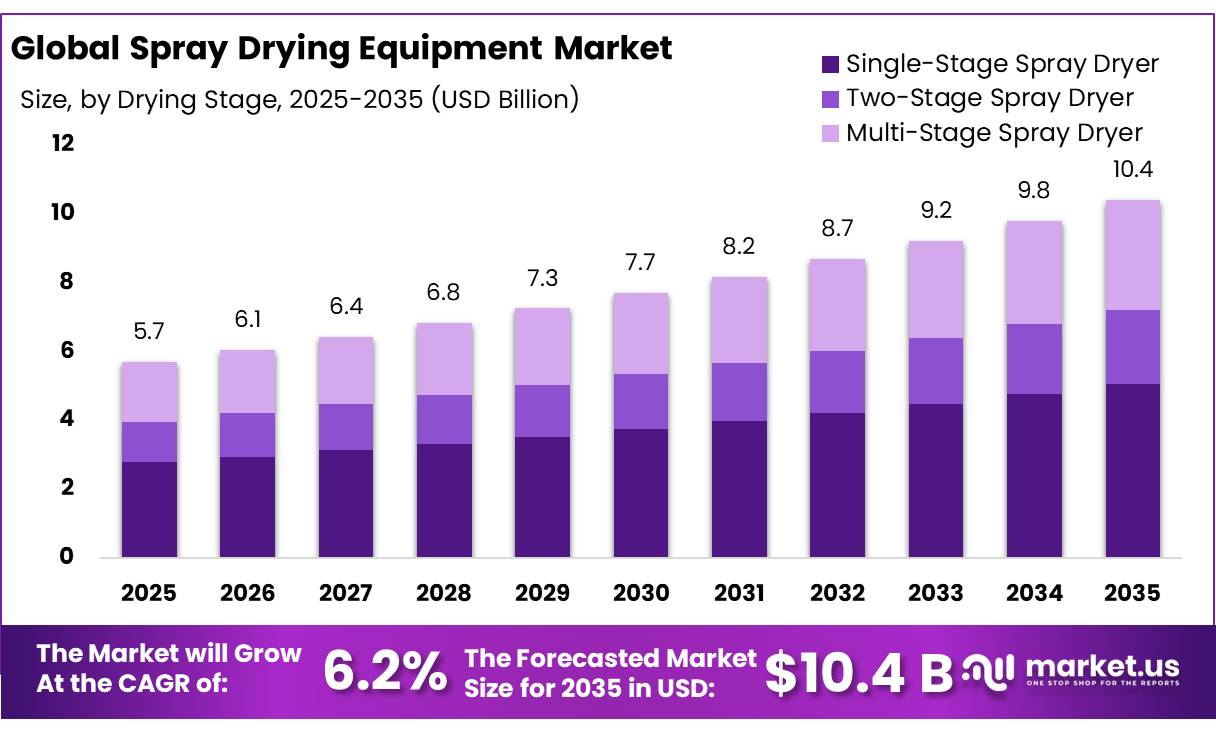
In 2025, the Global Spray Drying Equipment Market was valued at USD 5.7 billion, and between 2026 and 2035, this market is estimated to register a CAGR of 6.2%, reaching about USD 10.4 billion by 2035.
The global spray drying equipment market serves diverse sectors, including food and dairy, pharmaceuticals, nutraceuticals, chemicals, and specialty applications such as infant formula and functional foods. Single-stage, two-stage, and multi-stage drying configurations, along with product variants like rotary atomizer, nozzle atomizer, and fluidized dryers, enable precise control over particle size, moisture content, and thermal sensitivity.
Rising demand for powdered and functional foods, coupled with pharmaceutical and nutraceutical applications, drives adoption, while high capital and operational costs pose accessibility challenges. Geopolitical tensions have affected component sourcing and logistics, prompting manufacturers to adopt regional supply strategies. Integration of automation, real-time monitoring, and process optimization enhances efficiency and product consistency.
The Asia Pacific region is the largest user, benefiting from growing urbanization, rising disposable income, and expanding industrial infrastructure. Manufacturers focus on product innovation, customization, energy-efficient designs, and service support to maintain competitiveness and capture market opportunities across diverse applications.
Key Takeaways
- The global spray drying equipment market was valued at US$5.7 billion in 2025.
- The global market is projected to grow at a CAGR of 6.2% and is estimated to reach US$10.4 billion by 2035.
- On the basis of the drying stage, the single-stage spray dryer dominated the market, constituting 48.6% of the total market share.
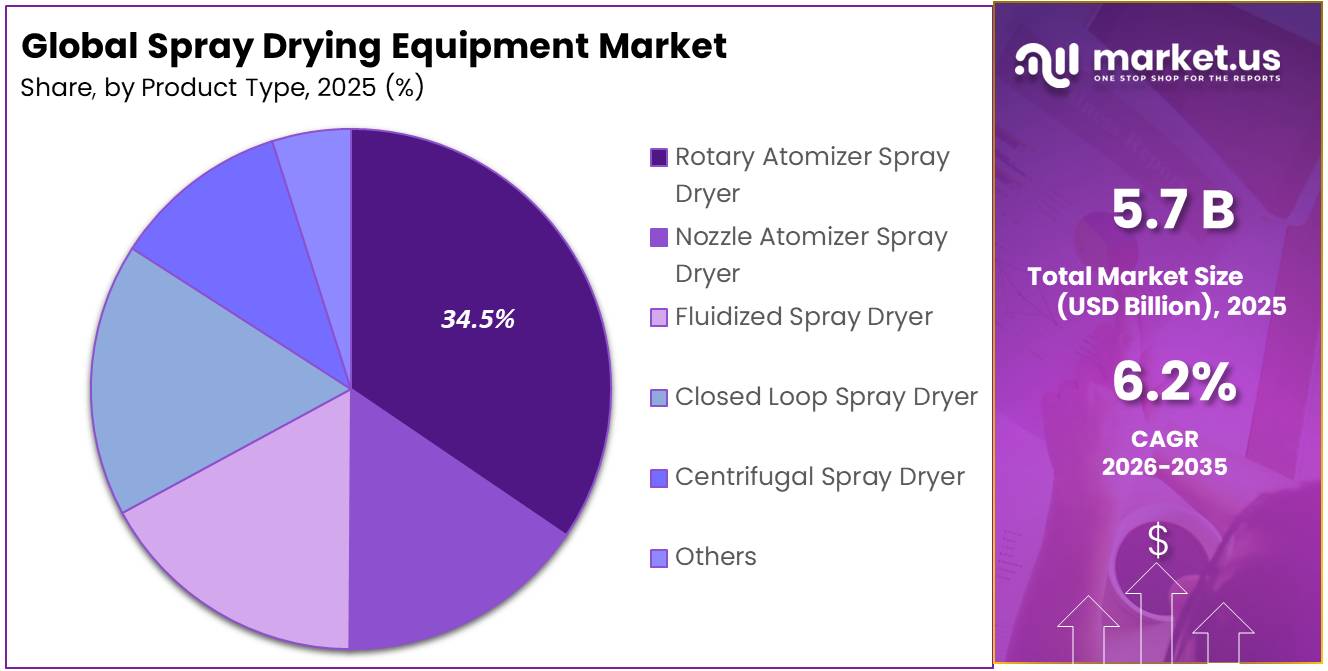
- Based on the product types, the rotary atomizer spray dryer led the market, with 34.5% of the market share.
- Based on the cycle types, the open cycle spray dryer led the market, comprising 72.3% of the total market.
- Among the applications, the food & dairy sector held a major share in the spray drying equipment market, 38.7% of the market share.
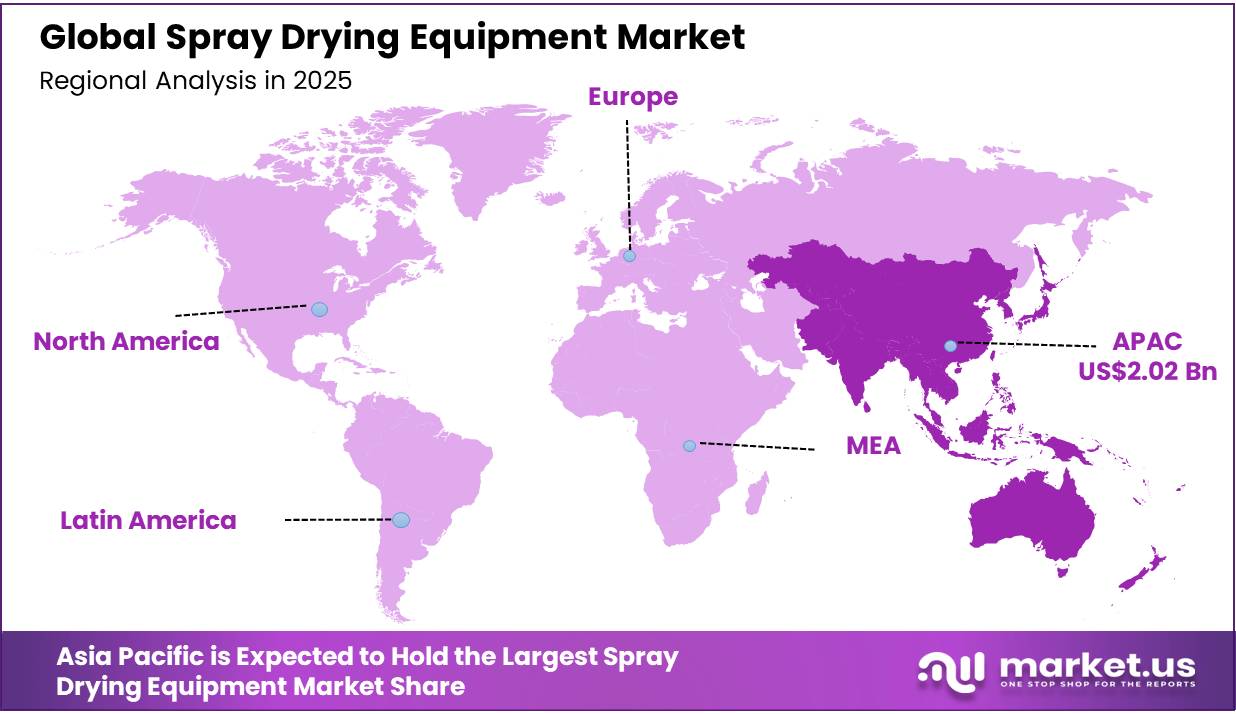
- In 2025, the Asia Pacific was the most dominant region in the spray drying equipment market, accounting for 35.6% of the total global consumption.
Drying Stage Analysis
Single-Stage Spray Dryer is a Prominent Segment in the Market.
Single-stage spray dryers hold a dominant position, accounting for 48.6% of the market, reflecting their widespread adoption across food, pharmaceutical, and chemical industries. These dryers offer a straightforward design and operational efficiency, allowing rapid conversion of liquid feed into uniform, free-flowing powders with controlled moisture content.
Their simplicity reduces installation and maintenance requirements compared to multi-stage systems, making them particularly suitable for large-scale production of milk powder, instant beverages, and pharmaceutical excipients. Regulatory compliance and quality assurance are facilitated through consistent particle size distribution and thermal stability, which are critical for heat-sensitive applications. The versatility, reliability, and cost-effectiveness of single-stage systems continue to drive their preference among manufacturers, reinforcing their leading position in the global spray drying equipment landscape.
Product Type Analysis
Rotary Atomizer Spray Dryer Held a Major Share of the Spray Drying Equipment Market.
Rotary atomizer spray dryers dominate the product type segment, accounting for 34.5% of the market, due to their capability to handle large-volume, high-viscosity feedstocks efficiently. These dryers utilize a high-speed rotating disc to atomize the liquid feed into fine droplets, enabling uniform drying and consistent particle size distribution. Their robust design supports continuous operation and is well-suited for heat-sensitive materials, including dairy powders, pharmaceuticals, and specialty chemicals.
The flexibility in controlling inlet and outlet temperatures, along with adaptability to single- or multi-stage configurations, enhances product quality and process efficiency. Additionally, rotary atomizer dryers can accommodate varying feed rates and viscosities, making them a preferred choice for large-scale industrial applications, thereby maintaining their leading position within the global spray drying equipment market.
Cycle Type Analysis
Open Cycle Spray Dryer Led the Spray Drying Equipment Market.
Open cycle spray dryers account for 72.3% of the cycle type segment, reflecting their extensive use across food, pharmaceutical, and chemical industries. These systems operate by introducing hot air directly into the drying chamber, allowing rapid moisture removal from liquid feed while ensuring efficient heat transfer. Their simpler design, lower operational complexity, and reduced maintenance requirements make them well-suited for large-scale production of powders such as milk powder, instant beverages, and pharmaceutical excipients.
Open cycle dryers provide flexibility in handling diverse feed viscosities and formulations, while maintaining consistent particle size distribution and product quality. Their reliability, energy efficiency in moderate-capacity operations, and adaptability to both single-stage and multi-stage configurations continue to drive widespread adoption, solidifying their dominance in the global spray drying equipment market.
Application Analysis
Spray Drying Equipment is Widely Utilized in the Food & Dairy Sector.
The Food & Dairy segment leads the application category, accounting for 38.7% of the market, driven by rising global demand for powdered and shelf-stable food products. Spray drying equipment is widely used to produce milk powder, whey protein, infant formula, instant beverages, and other dairy derivatives, ensuring extended shelf life, uniform particle size, and controlled moisture content. The ability to preserve nutritional value and flavor while maintaining product safety is critical for compliance with food safety regulations.
Advances in single-stage and rotary atomizer dryers, coupled with automation and real-time monitoring, have enhanced operational efficiency and product consistency in this sector. Growing consumption of functional and fortified foods, especially in emerging markets, continues to reinforce the dominant position of food and dairy applications within the global spray drying equipment landscape.
Key Market Segments
By Drying Stage
- Single-Stage Spray Dryer
- Two-Stage Spray Dryer
- Multi-Stage Spray Dryer
By Product Type
- Rotary Atomizer Spray Dryer
- Nozzle Atomizer Spray Dryer
- Fluidized Spray Dryer
- Closed Loop Spray Dryer
- Centrifugal Spray Dryer
- Others
By Cycle Type
- Food & Dairy
- Pharmaceuticals & Nutraceuticals
- Chemicals
- Infant Formula
- Functional & Plant-Based Foods
- Dietary Supplements
- Animal Feed
- Cosmetics
- Others
Geopolitical Impact Analysis
Geopolitical Disruptions and Their Implications for Global Spray Drying Equipment Supply Chains.
Geopolitical tensions have introduced measurable challenges to global supply chains for spray drying equipment, particularly in the sourcing of critical components such as high-precision atomizers, heat exchangers, and stainless steel alloys. The U.S. Department of Commerce reported that exports of specialty stainless steels to certain regions fell by approximately 12% between 2021 and 2023, driven by trade restrictions and export licensing requirements.
Similarly, the European Commission documented disruptions in industrial gas supplies, noting that imports of nitrogen and compressed air systems from key Eastern European suppliers declined by 8–10% in 2022, affecting the operation and installation of multi-stage and closed-loop drying systems.
In addition, the United Nations Conference on Trade and Development (UNCTAD) highlighted that transport and logistics bottlenecks, including container shortages and port congestion, increased lead times for capital equipment shipments by 20–30% in 2022 compared with 2019 levels. These factors have necessitated modifications in procurement strategies, including regional sourcing and inventory buffering, to maintain production continuity in food, pharmaceutical, and chemical sectors reliant on precision spray drying.
Regional Analysis
Asia Pacific Held the Largest Share of the Global Spray Drying Equipment Market.
In 2025, the Asia Pacific dominated the global spray drying equipment market, holding about 35.6% of the total global consumption. The region has emerged as the largest user of spray drying equipment, driven by rapid industrialization and increased demand for powdered food, pharmaceuticals, and specialty chemicals.
According to the Food and Agriculture Organization (FAO), per capita consumption of milk powder in China increased from 5.2 kg in 2015 to 6.1 kg in 2022, reflecting growing demand for shelf-stable dairy products. The Ministry of Health and Family Welfare, Government of India, reported that production of nutraceutical and fortified food products grew by 12% annually between 2018 and 2022, necessitating precision drying technologies.
Additionally, the United Nations Industrial Development Organization (UNIDO) notes significant expansion in chemical and pharmaceutical manufacturing facilities across Southeast Asia, where multi-stage and closed-loop spray dryers are increasingly deployed to ensure product consistency and quality. Improvements in infrastructure, including reliable electricity and water supply, support the operation of large-capacity drying systems, positioning the region as a critical hub for spray drying applications across multiple industrial sectors.
Key Regions and Countries Covered
- North America
- The US
- Canada
- Europe
- Germany
- France
- The UK
- Spain
- Italy
- Russia & CIS
- Rest of Europe
- APAC
- China
- Japan
- South Korea
- India
- ASEAN
- Rest of APAC
- Latin America
- Brazil
- Mexico
- Rest of Latin America
- Middle East & Africa
- GCC
- South Africa
- Rest of MEA
Key Players Analysis
Manufacturers of spray drying equipment focus on several strategic activities to strengthen their competitive position. Product innovation is central, with an emphasis on advanced atomization technologies, multi-stage and closed-loop systems, and automation for precise control of particle size, moisture content, and thermal sensitivity. Operational efficiency is enhanced through energy optimization, modular designs, and integration of real-time monitoring and process control.
Companies also prioritize customization, collaborating with food, pharmaceutical, and chemical producers to tailor equipment to specific formulations or regulatory requirements. Expanding service networks, including installation, maintenance, and technical training, ensures long-term client engagement. Additionally, regional manufacturing and localized supply chains are leveraged to reduce lead times, navigate trade constraints, and support rapid deployment in emerging industrial hubs, thereby improving accessibility and reinforcing market presence.
The Major Players in The Industry
- GEA Group AG
- ITT Inc. (SPX FLOW)
- Antolab Group Co., Ltd.
- ANDRITZ GROUP
- SiccaDania Group
- The Tetra Laval Group
- Changzhou Jinqiao Spray Drying and Engineering Co., Ltd.
- Pulse Drying Systems
- Buchiglas (Büchi AG)
- SSP Pvt Limited
- Yamato Scientific Co Ltd
- Larsson Starch Technology AB
- Col-Int Tech
- AKSH Engineering Systems (P) Limited
- DORST Technologies GmbH & Co. KG
- Sinitech Industries d.o.o.
- Other Key Players
Report Scope
| Report Features | Description |
|---|---|
| Market Value (2025) | US$5.7 Bn |
| Forecast Revenue (2035) | US$10.4 Bn |
| CAGR (2026-2035) | 6.2% |
| Base Year for Estimation | 2025 |
| Historic Period | 2020-2024 |
| Forecast Period | 2026-2035 |
| Report Coverage | Revenue Forecast, Market Dynamics, Competitive Landscape, Recent Developments |
| Segments Covered | By Drying Stage (Single-Stage Spray Dryer, Two-Stage Spray Dryer, and Multi-Stage Spray Dryer), By Product Type (Rotary Atomizer Spray Dryer, Nozzle Atomizer Spray Dryer, Fluidized Spray Dryer, Closed Loop Spray Dryer, Centrifugal Spray Dryer, and Others), By Cycle Type (Open Cycle Spray Dryer and Closed Cycle Spray Dryer), By Application (Food & Dairy, Pharmaceuticals & Nutraceuticals, Chemicals, Infant Formula, Functional & Plant-Based Foods, Dietary Supplements, Animal Feed, Cosmetics, and Others) |
| Regional Analysis | North America – The US & Canada; Europe – Germany, France, The UK, Spain, Italy, Russia & CIS, Rest of Europe; APAC– China, Japan, South Korea, India, ASEAN & Rest of APAC; Latin America– Brazil, Mexico & Rest of Latin America; Middle East & Africa– GCC, South Africa, & Rest of MEA |
| Competitive Landscape | GEA Group AG, ITT Inc. (SPX FLOW), Antolab Group Co., Ltd., ANDRITZ GROUP, SiccaDania Group, The Tetra Laval Group, Changzhou Jinqiao Spray Drying and Engineering Co., Ltd., Pulse Drying Systems, Buchiglas (Büchi AG), SSP Pvt Limited, Yamato Scientific Co Ltd., G. Larsson Starch Technology AB, Col-Int Tech, AKSH Engineering Systems (P) Limited, DORST Technologies GmbH & Co. KG, Sinitech Industries d.o.o., and Other Players. |
| Customization Scope | Customization for segments, region/country-level will be provided. Moreover, additional customization can be done based on the requirements. |
| Purchase Options | We have three licenses to opt for: Single User License, Multi-User License (Up to 5 Users), Corporate Use License (Unlimited Users and Printable PDF) |





































