


Report Overview
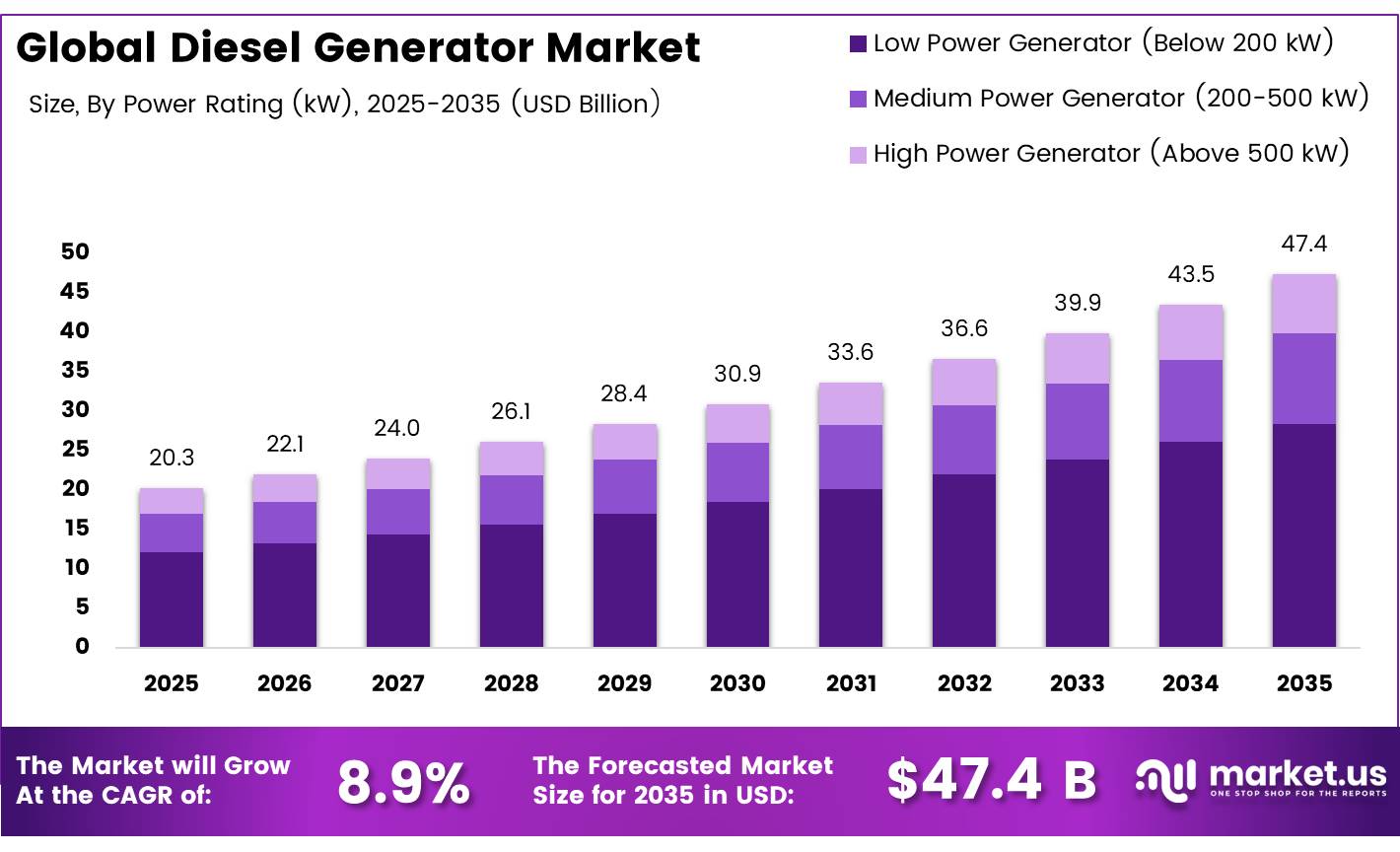
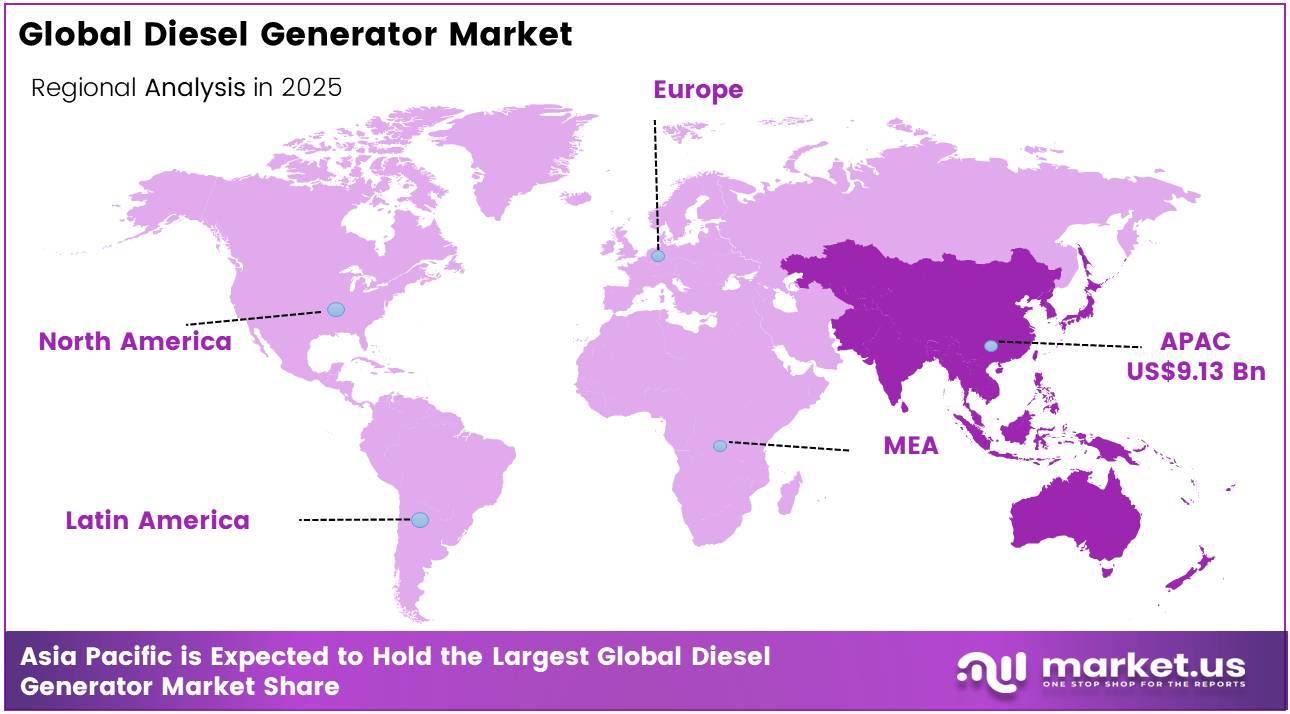
In 2025, the Global Diesel Generator Market was valued at USD 20.3 billion. The market is projected to grow at a CAGR of 8.9% during 2026 to 2035, reaching approximately USD 47.4 billion by 2035. Asia Pacific dominated the global market in 2025, accounting for more than 45% of the total market share and generating approximately USD 9.13 billion in revenue.
Diesel generators remain a critical part of the global power infrastructure by providing reliable standby and prime power support for industries where uninterrupted electricity supply is essential. These systems convert diesel fuel energy into electrical power through an internal combustion engine connected to an alternator. They are widely used across data centers, healthcare facilities, manufacturing plants, construction sites, mining operations, oil and gas facilities, and remote locations where grid reliability remains a challenge.
- According to the International Energy Agency (IEA), global electricity demand is expected to grow by around 4% annually between 2025 and 2027, adding approximately 3,500 TWh of new consumption during this period, driven by industrial expansion, electrification, and increasing data center activity.
- According to the International Energy Agency (IEA), global data center electricity consumption reached 415 TWh in 2024 and is expected to increase to 945 TWh by 2030. Because data centers require 99.999% uptime, diesel generators remain essential as emergency backup power systems. Asia Pacific held the largest market share of 45% in 2025, generating USD 9.13 billion in revenue.
The lack of electricity access in emerging economies remains another key growth driver. According to the World Bank and the UN Tracking SDG 7: Energy Progress Report 2025, around 666 million people were still without electricity in 2023, including 565 million in Sub-Saharan Africa. In many countries, diesel generators remain the primary power source for hospitals, telecom towers, commercial buildings, industrial facilities, and remote communities. Demand is also supported by growth in construction, infrastructure, and mining projects that require reliable off-grid power.
The IMF projects the Asia Pacific economy to grow by 4.4% to 4.6% annually through 2025, contributing nearly 60% of global GDP growth. The expansion of infrastructure projects, remote industrial sites, and large data center campuses continues to drive procurement and replacement of diesel generators, supporting long-term market growth.
Key Takeaways
- The global Diesel Generator market was valued at US$20.3 billion in 2025.
- The market is projected to grow at a CAGR of 8.9% and is estimated to reach US$47.4 billion by 2035.
- On the basis of portability, the Stationary Generators dominated the diesel generator market, constituting 53% of the total market share.
- Based on the power ranging, the Below 75 kVA dominated the Diesel Generator market, with a substantial market share of around 32%.
- Based on the power rating (kW), Low Power Generator (Below 200 kW) led the market, comprising 60% of the total market.
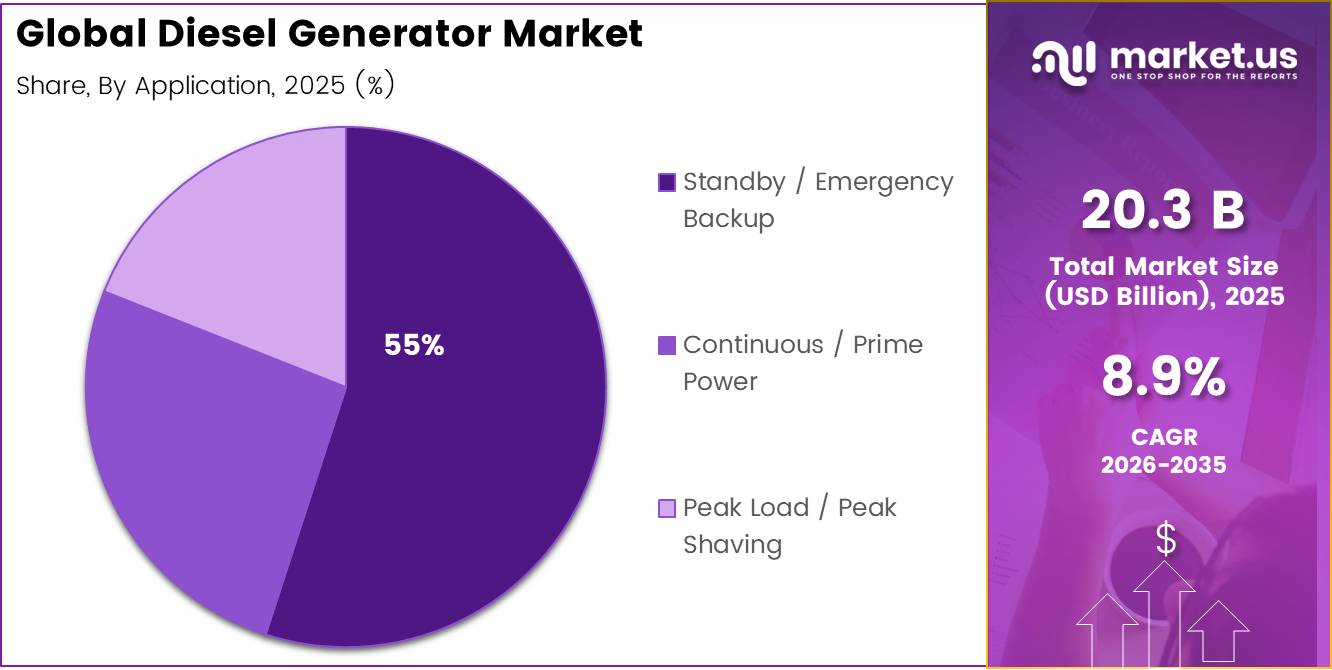
- Among the application, the Standby / Emergency Backup held a major share in the Diesel Generator market, 55% of the market share.
- Among the end user industry, the oil & gas is the most considerable within the market, accounting for around 22% of the revenue.
- In 2025, the Asia Pacific was the most dominant region in the Diesel Generator market, accounting for 45% of the total global consumption.
Portability Analysis
Stationary Generators represents dominant Segment in the Market.
The stationary diesel generator segment accounted for a dominant 53.0% market share due to rising demand from data centers, hospitals, and telecom infrastructure that require reliable, high-capacity backup power. These facilities need permanently installed generators that can start within seconds and operate continuously during grid outages.
- According to the IEA, global data center electricity demand is projected to increase from 415 TWh in 2024 to about 945 TWh by 2030, mainly driven by the rapid growth of AI and cloud computing. Under NFPA 110 and similar international standards, critical facilities must have stationary backup generators capable of supplying 100% of the electrical load within 10 seconds of a power failure. Modern AI data centers typically require 50–150 kW of power per rack and often operate with a continuous demand of 50–100 MW, making portable generators unsuitable.
The healthcare sector also supports strong demand for stationary diesel generators. According to the WHO, World Bank, and IRENA (2023), more than 1 billion people depend on healthcare facilities with unreliable or no electricity. The report also found that 64% of healthcare facilities across 63 low- and middle-income countries require reliable backup power systems. Meeting this requirement is estimated to need around USD 4.9 billion in procurement investment, with stationary diesel generators remaining the preferred solution.
Portable diesel generators reflects growing demand from construction activity and disaster response operations. According to the U.S. Federal Emergency Management Agency (2024), portable generator deployment during federally declared disasters increased notably, with diesel units preferred for extended runtime in flood and hurricane recovery operations across Gulf Coast and Atlantic regions.
Power rating (kVA) Analysis
Below 75 kVA a significant power rating.
The 75–375 kVA segment accounted for 48.0% of the market because it meets the power needs of the largest end-use sectors, including commercial buildings, telecom infrastructure, and medium-sized manufacturing facilities. This power range is suitable for operating commercial floors, hospital units, telecom towers, and industrial facilities while offering lower installation and infrastructure costs than larger high-voltage generator sets.
- According to the UNEP and GlobalABC Global Status Report for Buildings and Construction 2024/25, global building floor space is expanding by more than 5 billion square meters annually, with the highest growth in Asia, Africa, and the Middle East, where unstable electricity grids continue to drive demand for backup power systems. Commercial buildings covering 1,000–10,000 square meters typically require standby generators between 100–350 kVA to support HVAC systems, elevators, lighting, and emergency operations, placing most new commercial projects within the 75–375 kVA category.
Demand is also supported by the rapid expansion of telecom networks. According to the GSMA Mobile Economy Report 2026, mobile technologies generated USD 7.6 trillion in global economic value in 2025. The continued rollout of 5G networks, particularly across developing countries, is increasing the installation of telecom base stations, most of which require backup generators in the 20–200 kVA range to maintain uninterrupted operations in areas with unreliable power supply. In addition, generators in the 75–375 kVA range can operate as both prime and standby power sources, support single-phase and three-phase loads, and require limited site infrastructure, making them the preferred choice across a wide range of commercial and institutional applications.
The Above 750 kVA segment is the fastest growth trajectory, driven by hyper scale data center expansion and large industrial facilities. The U.S. Department of Energy’s 2024 data center energy report noted that utility-scale backup generation requirements at hyper scale facilities increasingly demanded generator sets exceeding 1,000 kVA to maintain operational continuity during grid disturbances.
Power Rating (kW) Type Analysis
Low Power Generator (Below 200 kW) Are the Most Widely Used.
The below 200 kW segment held a dominant 60.0% share of the low-power diesel generator market because it serves the largest base of off-grid and backup power users, including rural healthcare facilities, small businesses, farms, and residential communities. These generators provide a practical and cost-effective solution where grid electricity is unavailable or unreliable.
- According to the UN SDG 7 Tracking Report 2025 published by the World Bank, IEA, WHO, IRENA, and UN DESA, around 666 million people were still living without electricity in 2023, with 85% located in Sub-Saharan Africa, mainly in rural and peri-urban regions. At the current pace of electrification, nearly 645 million people are expected to remain without electricity by 2030, supporting continued demand for small diesel generators.
The healthcare sector is a major contributor to this demand. The WHO reports that 15% of healthcare facilities in Sub-Saharan Africa and 12% in South Asia have no electricity access. More than 330,000 healthcare facilities require new off-grid or backup power systems, with most needing generators in the below 200 kW category, particularly 50–150 kW units. In agriculture, the World Bank’s Farm Power and Food Security report identifies diesel generators as the primary power source for small-scale agricultural operations in remote areas. They are widely used for irrigation, post-harvest processing, and cold storage across South Asia, Southeast Asia, and Sub-Saharan Africa, creating steady and high-volume demand for generators below 200 kW.
The High Power Generator segment, above 500 kW, registers the strongest expansion momentum. The U.S. Department of Energy’s 2025 Industrial Decarburization Outlook identified heavy manufacturing and mining operations as the primary drivers of above-500 kW diesel generator procurement, with large extraction facilities in remote locations maintaining dedicated high-capacity units for operational continuity.
Application Analysis
Standby / Emergency Backup Held a Major Share of the Diesel Generator Market.
Standby and emergency backup applications accounted for a dominant 55.0% share of the diesel generator market due to the growing need for uninterrupted power across critical infrastructure. Demand is supported by stricter regulations and rising grid reliability concerns, making backup diesel generators an essential investment rather than an optional one.
- According to the North American Electric Reliability Corporation (NERC) 2025 State of Reliability Report, severe weather remained the leading cause of major power outages in 2024, including 2 major winter storms and 5 hurricanes that caused multi-day electricity disruptions across several regions. The report also highlighted a major grid event in July 2024, where a single 230 kV fault disconnected nearly 1,500 MW of data center load across 60 grid connection points, demonstrating the increasing risk of widespread power failures.
Regulatory requirements are further strengthening demand in Europe. Under Germany’s KRITIS Ordinance, aligned with the EU CER Directive 2022/2557, and the revised EN 50600 Data Center Standard introduced in September 2025, critical infrastructure operators must maintain emergency diesel generators capable of supporting full facility operations for 24 to 72 hours. The regulations also require N+1 redundancy, documented load transfer performance, and regular compliance testing.
The Peak Load and Peak Shaving segment represents the fastest-growing application category. The U.S. Energy Information Administration’s 2024 Electric Power Monthly confirmed that peak demand events are intensifying across major grid regions, prompting commercial and industrial operators to deploy diesel generator assets strategically during high-tariff peak windows to reduce electricity procurement costs.
End Use Analysis
Diesel Generators Are Mostly Utilized in the Oil & Gas.
The oil and gas sector accounted for 22.0% of the diesel generator market due to its continuous power requirements in remote and off-grid locations such as offshore platforms, drilling sites, pipeline stations, and LNG terminals. In these operations, diesel generators serve as the primary source of electricity rather than backup power.
- According to Baker Hughes’ International Rig Count, more than 900 international drilling rigs were active worldwide in early 2025, with each site typically requiring 500 kW to several MW of diesel power to operate drilling equipment, HVAC systems, communication networks, and safety infrastructure around the clock.
Additionally, the International Energy Agency reported in its World Energy Investment 2025 report that global upstream oil and gas investment reached USD 570 billion in 2025, with most spending directed toward upstream and midstream projects that rely heavily on off-grid diesel generation. The agency also estimates that upstream investment must average USD 540 billion annually through 2050 to maintain current production levels, ensuring sustained demand for diesel-powered infrastructure.
Furthermore, published offshore engineering data indicate that more than 6,500 offshore oil and gas production installations operate across 53 countries, each depending on large-capacity diesel generators as a reliable primary power source. This extensive reliance continues to support the oil and gas sector’s leading position in diesel generator demand.
Data centers is the fastest-growing end-user category. The U.S. Department of Energy’s 2025 National Data Center Energy Efficiency Report identified rapid hyper scale facility expansion across Northern Virginia, Texas, and the Pacific Northwest as a primary driver of diesel backup generation procurement, with new installations mandating multi-megawatt emergency generation capacity to satisfy uptime contractual obligations.
Key Market Segments
By Portability
- Stationary Generators
- Portable Generators
By Power Rating (kVA)
- Below 75 kVA
- 75 – 375 kVA
- 375 – 750 kVA
- Above 750 kVA
By Power Rating (kW)
- Low Power Generator (Below 200 kW)
- Medium Power Generator (200–500 kW)
- High Power Generator (Above 500 kW)
By Application
- Standby / Emergency Backup
- Continuous / Prime Power
- Peak Load / Peak Shaving
By End-User Industry
- Oil & Gas
- Residential
- Manufacturing
- Construction
- Commercial
- Telecom
- Data Centers
- Others
Drivers
The primary driver is the global buildout of hyperscale and colocation data center capacity, accelerated by AI workloads. These facilities require diesel generator sets as the non-negotiable Tier III and Tier IV standby layer, regardless of renewable commitments. A hyperscale campus at 100–300 MW IT load needs backup equal to 100–110% of that load in N+1 or 2N form. This means each site locks in 40–120 units in the 1,500–3,500 kVA range.
Procurement values reinforce the pull. Per-unit prices reach USD 300,000–900,000, and full campus fit-out runs USD 25–90 Million. Global data center construction investment hit USD 50–55 Billion annually through 2024 and 2025. Hyperscale operators disclosed combined CapEx above USD 200 Billion in 2024. This shifts vendors toward multi-year framework agreements that provide 12–36 months of forward order visibility and steady aftermarket revenue.
| Driver | (~) % Impact on CAGR Forecast | Geographic Relevance | Impact Timeline |
|---|---|---|---|
| Data Centre & Critical Infrastructure Boom Driving Standby & Prime Power Generator Procurement | +2.10% | United States, Europe, India, Southeast Asia, Middle East, Australia | Short term (≤ 2 years) |
| Chronic Grid Unreliability & Power Deficit in Sub-Saharan Africa, South Asia & Southeast Asia | +1.40% | Nigeria, Kenya, Pakistan, Bangladesh, India, Indonesia, Philippines, Vietnam | Short term (≤ 2 years) |
| Natural Disaster Frequency & Grid Resilience Investment Driving Emergency Power Demand | +0.85% | United States, Japan, Australia, Philippines, Caribbean, Southeast Asia | Short term (≤ 2 years) |
| Construction, Mining & Oil & Gas Remote Site Prime Power Requirements | +0.72% | Middle East, Africa, Latin America, Australia, Canada, Central Asia | Medium term (2–4 years) |
| Healthcare & Telecom Infrastructure Expansion in Emerging Markets Requiring Reliable Backup Power | +0.55% | Sub-Saharan Africa, South Asia, Southeast Asia, Latin America | Medium term (2–4 years) |
| Industrial & Manufacturing Capacity Expansion in Asia Pacific Requiring Continuous & Standby Power | +0.42% | India, Vietnam, Indonesia, Bangladesh, Mexico | Medium term (2–4 years) |
Restraints
The root cause is multi-jurisdictional tightening of diesel engine emission standards that bans non-compliant generator sales in major markets. This forces buyers into higher-cost tiers and strands older inventory. In the United States, EPA Tier 4 Final rules mandate DPF and SCR aftertreatment adding roughly USD 8,000–35,000 per unit. This raises the BOM cost of a 500 kVA compliant unit by an estimated 12–18% versus Tier 2 baseline.
Emerging-market rules compound the pressure. India’s CPCB norms for gensets above 19 kW phased in through 2023 to 2025 across an annual market of 500,000–700,000 units. Compliant engine sourcing carried a 15–22% unit cost premium. This squeezes distributor margins by 3–5 percentage points and accelerates consolidation toward large OEMs with captive compliant engine platforms.
| Restraint | (~) % Impact on CAGR Forecast | Geographic Relevance | Impact Timeline |
|---|---|---|---|
| Tightening Emissions Regulations (EPA Tier 4, EU Stage V, BS VI) Banning Non-Compliant Generator Sales | -1.50% | United States, European Union, United Kingdom, India, Canada, Australia | Short term (≤ 2 years) |
| Renewable Energy & Battery Storage Competition Displacing Diesel Generators in Off-Grid & Backup Applications | -0.90% | Europe, United States, Australia, India — solar-rich off-grid & C&I segments | Medium term (2–4 years) |
| ESG & Scope 1 Emission Reduction Commitments Restricting Generator Use at Corporate & Institutional Sites | -0.55% | North America, Europe, Japan, Australia — ESG-mandatory corporate sectors | Short term (≤ 2 years) |
| Diesel Fuel Price Volatility & Subsidy Reform Increasing Operational Cost for Generator-Dependent Users | -0.38% | Sub-Saharan Africa, South Asia, Southeast Asia, Latin America | Short term (≤ 2 years) |
Challenges
The structural vulnerability is extreme concentration of diesel engine manufacturing, the highest-value component at 40–55% of total generator BOM cost. A few vertically integrated OEMs in Germany, Japan, the United States, and China control allocation. Alternators add another 18–28% of BOM and sit among fewer than 6–8 global producers. This dual dependency propagates disruption into assembler schedules with lead-time hits of 8–20 weeks.
The 2021 to 2023 semiconductor shortage proved the cascade. Delivery lead times stretched from 8–16 weeks to 28–52 weeks for mid and large units. Data center and telecom programs deferred openings by 3–9 months. This exposed assemblers to penalty clauses of 0.5–2.0% of order value per delayed week. Consequently, engine dual-sourcing programs costing USD 1,500,000–5,000,000 now define competitive resilience.
| Challenge | (~) % CAGR Friction Drag | Geographic Relevance | Mitigation Horizon |
|---|---|---|---|
| Diesel Engine Component & Alternator Supply Chain Concentration | -0.85% | Global — engine sourcing concentrated in Germany, Japan, United States, China | Long term (≥ 4 years) |
| Load Bank Testing & Site Commissioning Lead Time Constraints | -0.65% | Middle East, Southeast Asia, Sub-Saharan Africa — rapid infrastructure deployment markets | Medium term (2–4 years) |
| Counterfeit Parts & Aftermarket Service Quality Erosion | -0.52% | Sub-Saharan Africa, South Asia, Southeast Asia, Latin America | Long term (≥ 4 years) |
| Skilled Service Technician Shortage in Emerging Market Deployments | -0.40% | Sub-Saharan Africa, Central Asia, Latin America, Pacific Islands | Long term (≥ 4 years) |
| Noise & Vibration Regulation Compliance Adding Enclosure Engineering Cost | -0.28% | European Union, United Kingdom, Singapore, Australia, urban North America | Medium term (2–4 years) |
Opportunities
This opportunity is untapped white space, not a current driver. As of 2025 and 2026, most vendors still sold standalone diesel units without integrated storage or solar coupling. Yet the fastest-growing demand regions carry the highest diesel cost burden of USD 1.10–1.80 per litre and solar irradiance of 1,800–2,400 kWh/m2/year. A 100 kVA unit at 50–60% load for 16 hours daily burns 20–25 litres per hour.
That fuel use generates annual costs of USD 42,000–65,000, which hybrid pairing can cut by 40–60% at a 3–5 year payback. However, fewer than 15–20% of vendors offered factory-integrated hybrid platforms. This means early movers can command ASP premiums of 35–55% and reach gross margins of 44–58%. Therefore, a platform investment of USD 5,000,000–18,000,000 unlocks a durable margin and service-revenue lead.
| Opportunity | (~) % Potential CAGR Upside | Geographic Relevance | Execution Window |
|---|---|---|---|
| Hybrid Diesel-Battery & Diesel-Solar Genset Systems for Fuel Cost Reduction & Emission Compliance | +1.60% | Sub-Saharan Africa, South Asia, Southeast Asia, Pacific Islands, Latin America | Medium term (2–4 years) |
| Generator-as-a-Service & Power Purchase Agreement Models for Emerging Market C&I Customers | +1.10% | Nigeria, Kenya, India, Indonesia, Bangladesh, Ghana, Tanzania | Medium term (2–4 years) |
| Hydrogen-Ready & HVO Dual-Fuel Retrofit Platform for ESG-Compliant Backup Power Markets | +0.80% | European Union, United Kingdom, United States, Japan, Australia | Long term (≥ 4 years) |
| Remote Monitoring & Predictive Maintenance IoT Platform Monetisation on Installed Fleet | +0.62% | Global — data centres, telecom towers, hospitals, utilities | Short term (≤ 2 years) |
| Virtual Power Plant & Demand Response Grid Services Using Aggregated Generator Capacity | +0.45% | United States, United Kingdom, Australia, Germany, Japan | Long term (≥ 4 years) |
Geopolitical Impact Analysis
Rising trade barriers and supply chain disruptions are increasing production costs across the diesel generator market. In June 2025, the U.S. increased Section 232 tariffs on imported steel and aluminum from 25% to 50%, extending the duty to derivative metal products such as engine housings, alternator frames, exhaust systems, and structural base assemblies. These components account for a significant share of diesel generator manufacturing costs.
- According to BCG, the higher tariffs are expected to add nearly USD 50 billion in annual tariff costs across the U.S. industrial sector, increasing raw material expenses for generator manufacturers. In addition, the U.S. imposed a minimum 145% tariff on many Chinese imports in April 2025, including diesel engine components, precision-cast parts, alternator windings, and electronic control units. As a result, manufacturers are shifting sourcing to India, Southeast Asia, and Mexico, a transition that typically requires 12–24 months and may increase procurement costs by 15–30% before new supply chains become fully established.
Global logistics challenges are adding further pressure to the diesel generator industry. The Red Sea shipping disruption has forced vessels to reroute around the Cape of Good Hope, adding nearly 4,000 miles per voyage. According to J.P. Morgan, container freight rates from China to Europe increased nearly 5 times, while shipping rates from China to the U.S. West Coast rose by around 140% compared with November 2023 levels. These disruptions have delayed industrial shipments, increased transportation costs, and required distributors to maintain an additional 3–5 weeks of inventory. As a result, manufacturers and contractors are facing higher working capital requirements, longer project timelines, and continued upward pressure on diesel generator prices, particularly across the Middle East and Sub-Saharan Africa.
Regional Analysis
Asia Pacific Held the Largest Share of the Global Diesel Generator Market.
Asia Pacific dominates the global diesel generator market with a 45.0% share, reflecting the region’s expansive industrial base, persistent energy access deficits across developing member economies, and large-scale infrastructure construction activity sustaining continuous generator procurement. Rapid urbanization, expanding manufacturing corridors, and chronically underdeveloped grid infrastructure across South and Southeast Asia collectively underpin the region’s structural demand superiority.
- According to the International Energy Agency, April 2025, electricity access rates across several Southeast Asian economies including Myanmar and Papua New Guinea remained below 75%, with diesel generation serving as the predominant distributed power solution across unelectrified and weak-grid territories.
- According to the Asian Development Bank, February 2025, infrastructure investment commitments across South and Southeast Asia exceeded USD 190 billion annually, with energy infrastructure commanding the largest project pipeline share across member developing economies.
The Middle East and Africa segment is the fastest-growing regional market. According to the United Nations Economic Commission for Africa, March 2025, expanding extractive industry operations and urban infrastructure development programs across Sub-Saharan Africa were driving accelerated diesel generator procurement across both prime and standby power applications.
Key Regions and Countries Covered
- North America
- The US
- Canada
- Europe
- Germany
- France
- The UK
- Spain
- Italy
- Russia & CIS
- Rest of Europe
- APAC
- China
- Japan
- South Korea
- India
- ASEAN
- Rest of APAC
- Latin America
- Brazil
- Mexico
- Rest of Latin America
- Middle East & Africa
- GCC
- South Africa
- Rest of MEA
Key Players Analysis
Diesel generator manufacturers concentrate strategic efforts on technological differentiation, emissions compliance capability, and supply chain resilience to sustain competitiveness across an increasingly regulated market environment. A central priority is continuous engine technology advancement, including development of Tier 4 Final and Stage V compliant generator sets integrating diesel particulate filters and selective catalytic reduction units meeting tightening regulatory thresholds across North American and European markets.
Manufacturers further invest substantially in dual-fuel and hybrid-ready product architectures, enabling customers to transition toward lower-emission configurations without replacing existing generation assets. Vertical integration with engine component suppliers and alternator manufacturers helps secure input material stability and improve cost control amid volatile steel, aluminum, and semiconductor pricing environments.
Strategic production capacity expansion across Asia Pacific manufacturing hubs enables alignment with concentrated regional demand from industrial and infrastructure sectors. Additionally, manufacturers emphasize digital control system development, remote monitoring capability, and predictive maintenance integration to differentiate premium offerings, while establishing long-term service agreements with critical infrastructure operators to reinforce customer retention across high-value standby and prime power segments globally.
The Major Players In The Industry
- Caterpillar Inc.
- Cummins Inc.
- Kohler Co.
- Generac Power Systems, Inc.
- Mitsubishi Heavy Industries, Ltd.
- Rolls-Royce plc (MTU)
- Wärtsilä Corporation
- HIMOINSA
- General Electric Company
- Kirloskar Electric Company Ltd.
- Mahindra Powerol Ltd.
- Yanmar Holdings Co., Ltd.
- Atlas Copco AB
- Doosan Corporation
- Aggreko plc
- Others
Key Development
- In March 2025, Cummins Inc. received EPA certification for its QSK95 Tier 4 Final diesel generator series, expanding certified high-capacity generation options for data center and industrial operators across North American markets.
- In January 2025, Caterpillar Inc. announced commissioning of an expanded generator manufacturing facility in Seguin, Texas, increasing production capacity for large-frame diesel generator sets serving oil and gas and critical infrastructure end-users.
Report Scope
| Report Features | Description |
|---|---|
| Market Value (2025) | USD 20.3 Bn |
| Forecast Revenue (2035) | USD 47.4 Bn |
| CAGR (2026–2035) | 8.9% |
| Base Year for Estimation | 2025 |
| Historic Period | 2020–2024 |
| Forecast Period | 2026–2035 |
| Report Coverage | Revenue Forecast, Market Dynamics, Competitive Landscape, Recent Developments |
| Segments Covered | By Portability (Stationary Generators, Portable Generators), By Power Rating (kVA) (Below 75 kVA, 75 – 375 kVA, 375 – 750 kVA, Above 750 kVA), By Power Rating (kW) (Low Power Generator (Below 200 kW), Medium Power Generator (200–500 kW), High Power Generator (Above 500 kW)), By Application (Standby / Emergency Backup, Continuous / Prime Power, Peak Load / Peak Shaving), By End User (Oil & Gas, Residential, Manufacturing, Construction, Commercial, Telecom, Data Centers, Others) |
| Regional Analysis | North America – The US & Canada; Europe – Germany, France, The UK, Spain, Italy, Russia & CIS, Rest of Europe; APAC- China, Japan, South Korea, India, ASEAN & Rest of APAC; Latin America- Brazil, Mexico & Rest of Latin America; Middle East & Africa- GCC, South Africa, & Rest of MEA |
| Competitive Landscape | Caterpillar Inc., Cummins Inc., Kohler Co., Generac Power Systems, Inc., Mitsubishi Heavy Industries, Ltd., Rolls-Royce plc (MTU), Wärtsilä Corporation., HIMOINSA, General Electric Company, Kirloskar Electric Company Ltd., Mahindra Powerol Ltd., Yanmar Holdings Co., Ltd., Atlas Copco AB, Doosan Corporation, Aggreko plc, Others. |
| Customization Scope | Customization for segments, region/country-level will be provided. Moreover, additional customization can be done based on the requirements. |
| Purchase Options | We have three licenses to opt for: Single User License, Multi-User License (Up to 5 Users), Corporate Use License (Unlimited Users and Printable PDF) |





































