


Report Overview
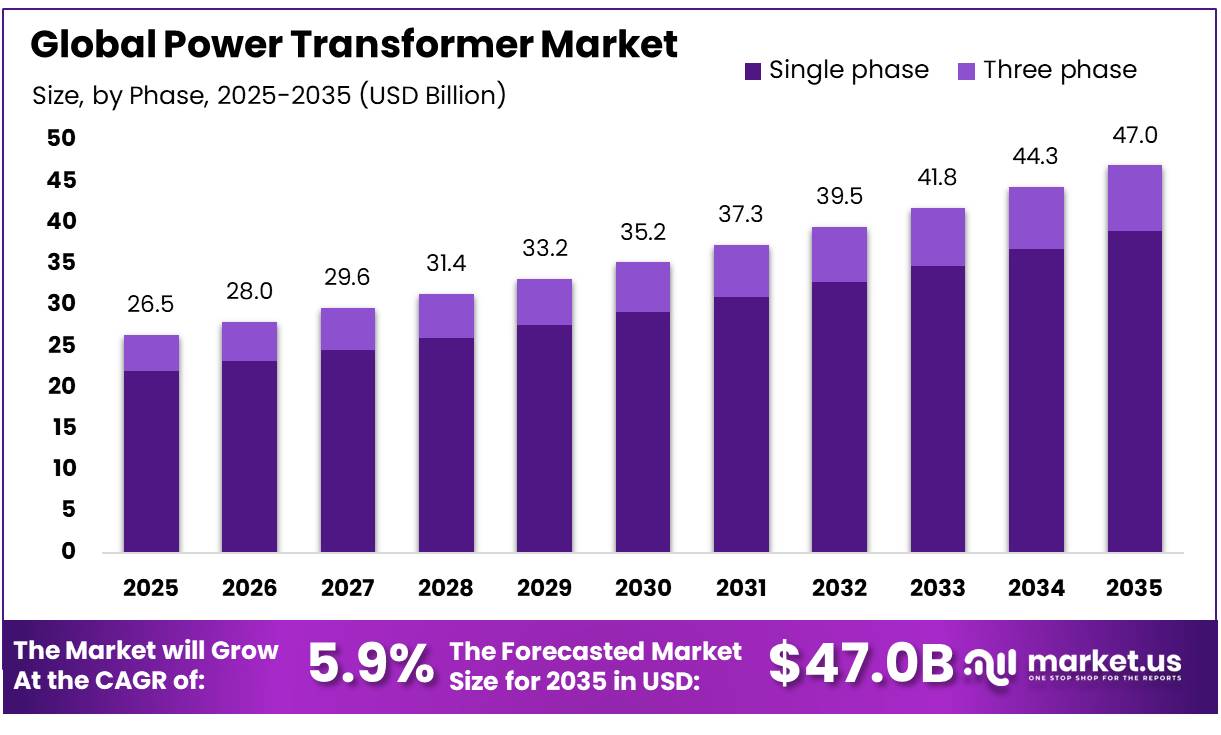
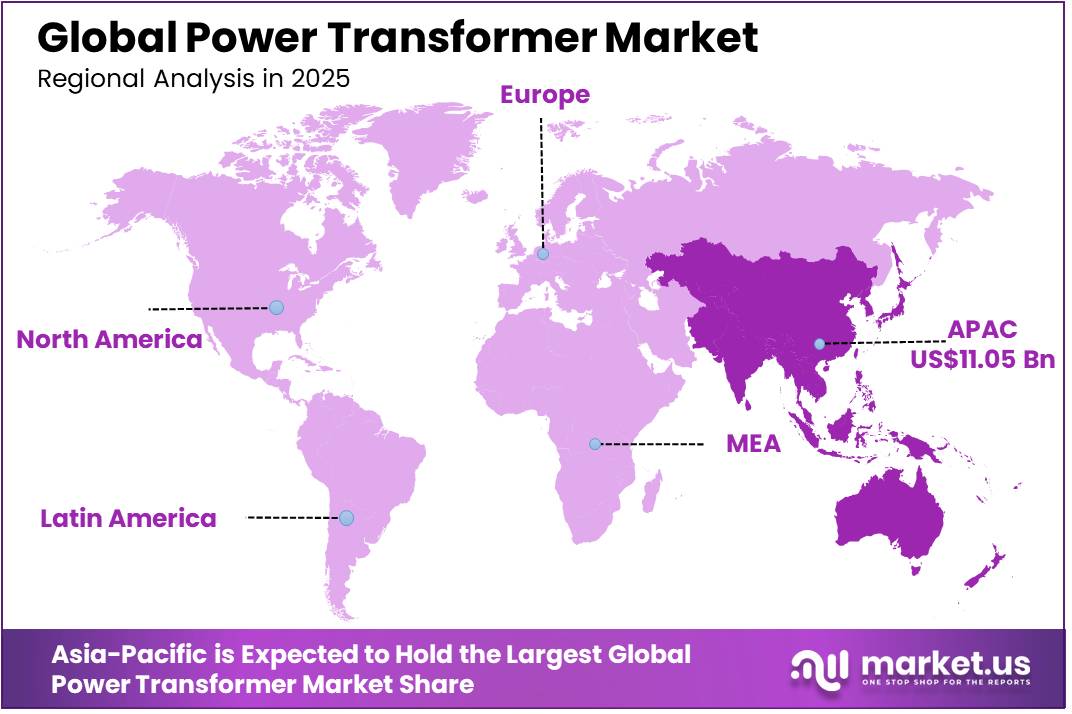
In 2025, the Global Power Transformer Market was valued at USD 26.5 billion, and between 2026 and 2035, this market is estimated to register a CAGR of 5.9%, reaching about USD 47.0 billion by 2035. In 2025, Asia Pacific led the market, achieving over 41.8% share with a revenue of USD 11.05 Billion.
Key Takeaways
- The global power transformer market was valued at USD 26.5 billion in 2025.
- The market is projected to grow at a CAGR of 5.9% and is estimated to reach USD 47.0 billion by 2035.
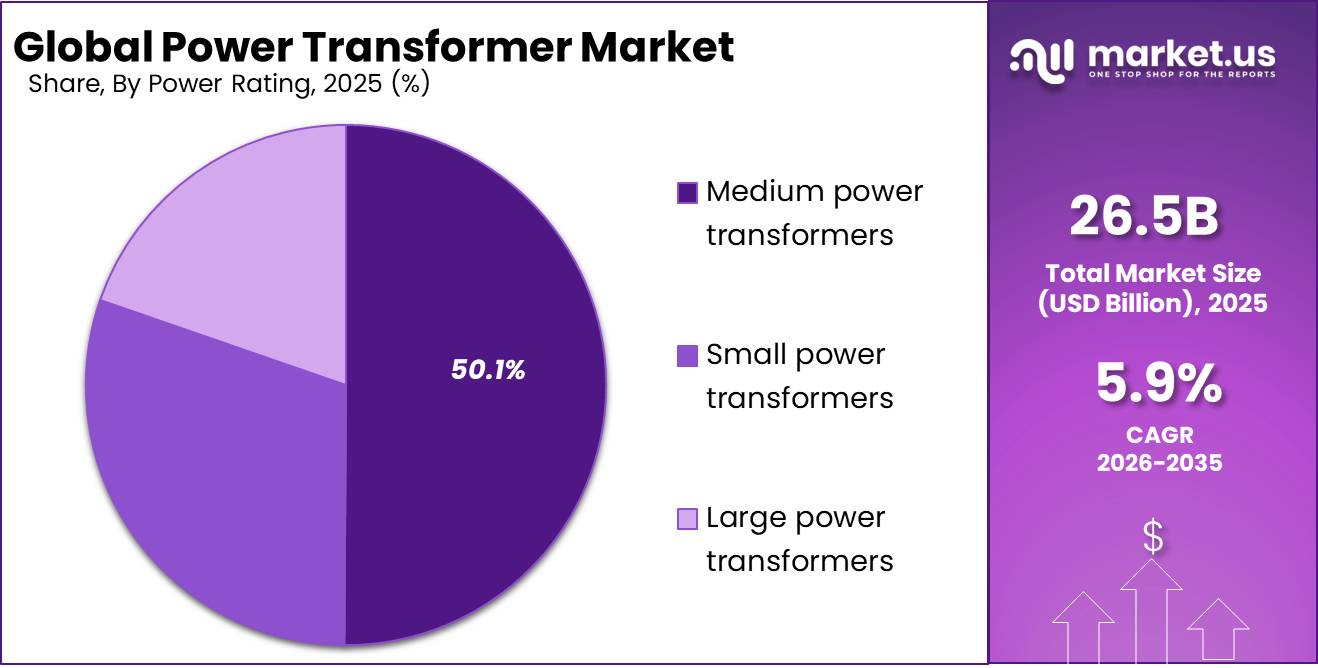
- On the basis of dominant power rating, the medium power transformers represent the absolute cornerstone of grid infrastructure, commanding a dominant 50.1% global market share due to critical substation step-down requirements.
- Based on primary cooling technology, liquid-immersive systems maintain undisputed sector leadership, with oil-cooled configurations securing 75.2% of the market through superior high-voltage thermal dissipation.
- On the basis of leading-phase configuration, the single phase topologies remain the most heavily deployed system architecture at 83.1% market share, sustained by expansive residential drop lines and rural electrification networks.
- Among the end-user segment, the utilities transmission and distribution infrastructures act as the primary engine for industry procurement, capturing a leading 50.5% share of global equipment demand.
- The Asia-Pacific region anchors the global transformer landscape, commanding a massive 41.8% market share driven by high-density urban expansions and national grid outlays.
The power transformer market is being driven by rising investments in grid modernization, renewable energy integration, and transmission infrastructure expansion. Growing electricity demand, aging grid networks, and the need for reliable power supply are increasing transformer deployment across utilities and industrial facilities. Government support for clean energy projects is also strengthening demand for high-capacity power transformers worldwide in key markets.
In May 2022 and November 2023, the European Commission stated Europe needs €584 billion by 2030 to upgrade its power grid, as 40% of distribution systems are over 40 years old. The October 2022 DAE plan adds smart tech, while the December 2025 update projects €1.2 trillion needed by 2040. This large-scale expansion effort is happening at the same time as the U.S. Department of Energy’s federal initiatives, which heavily support the building of large-capacity substations through programs funded by the Bipartisan Infrastructure Law.
- According to infrastructure and energy supply-chain assessments referenced by CISA and DOE-supported analyses, the transformer industry is experiencing supply constraints driven partly by shortages of grain-oriented electrical steel (GOES), along with manufacturing and labor bottlenecks. GOES is a critical material used in transformer cores, and combined supply pressures have extended large power transformer lead times to approximately 120–210 weeks in some markets.
Long transformer supply-chain delays are slowing important grid projects, even as utilities and governments increase investment in transmission and substation upgrades. India is a clear example, where the Central Electricity Authority has planned major transmission expansion to integrate large renewable energy capacity and meet rising electricity demand. At the same time, fast growth in data centers, industrial electrification, and clean energy projects is creating strong demand for high-capacity power transformers.
Power Transformer Market Segmentation
Power Rating Analysis
Medium power transformer represents dominant Segment in the Market.
Medium power transformers represent the dominant segment in the power transformer market, accounting for a 50.1% share due to their wide use in regional substations and main distribution systems. These transformers help to reduce high transmission voltages, usually between 66 kV and 220 kV, to lower levels suitable for sub-transmission systems. They offer a good balance between handling large amounts of power and keeping infrastructure costs manageable.
Small power transformers, which are up to 60 MVA in size, are seen as a key area with strong growth potential. This growth is mainly because of the rise in smaller, local renewable energy projects and large-scale battery storage systems. The main reasons for this growth are efforts to modernize local micro grids. However, there are still some challenges in the short term, like delays in local supply chains and limited availability of key materials, such as high-quality grain-oriented electrical steel.
Cooling Type Analysis
Oil cooled is a significant cooling type.
Oil cooled type account for 75.2% of the power transformer market, seeing continued growth because they deliver excellent thermal dissipation and strong dielectric performance, especially under high electrical stress. Their market leadership is due to technical needs in high-voltage power grids. Mineral and synthetic oils act as effective cooling fluids and also provide electrical insulation. They are commonly used in outdoor substations where high-capacity equipment is needed.
Air cooled or dry type transformers are expected to grow the fastest. The quick rise is driven by strict fire safety rules, growing urban areas, and building more infrastructure in busy cities, tall buildings, underground stations, and indoor factories near the sea or in industries. Eco-friendly transformers that use biodegradable ester fluids and smart monitoring systems are becoming a new trend. These systems use synthetic esters that break down easily and include sensors that provide real-time data. The main reasons for this trend are companies trying to reduce carbon emissions, the risks of oil spills harming the environment, and the need for real-time information on transformer temperature and health.
Phase Analysis
Single Phase is Dominant in the Power Transformer Market.
Single phase accounting for 83.1% of the power transformer market, represents the dominant material segment due to the widespread presence of light-overhead consumer drop lines, this market has a strong dominance. This is due to long-term plans for rural electrification and the common use of single-phase low-voltage distribution systems in suburban homes. These systems offer reliable step-down capabilities for local power needs, especially where building multi-phase industrial infrastructure would be too costly.
End Use Analysis
Power Transformers Are Mostly Utilized in Utilities Transmission And Distribution.
Utility transmission and distribution was the top segment, having a 50.5% market share, because utility companies have a special legal, structural, and regulatory role to safely carry high-voltage electricity from far-off power plants to areas where it’s used. To keep the power grid stable as electricity needs keep growing, utility companies around the world are spending a lot of money on big projects. These expensive investments are mostly used to replace old, weak parts of the grid and build long-distance lines that carry high-voltage electricity. Also, this area is growing because of the need to connect large renewable energy sources, like wind and solar farms. This requires installing many high-capacity transformers to handle the changing power supply from these sources.
The industrial sector, especially areas like heavy processing, mining, and manufacturing, is expected to be the fastest-growing part of the market. This area will play a key role in supporting the backlog of orders for high-voltage and medium-voltage transformers. The growth is happening because of the shift back to domestic production of industrial plants around the world, the rise of automation, and the ongoing move towards using more electricity in traditional manufacturing processes.
Key Market Segments
By Power Rating
- Medium power transformers
- Small power transformers
- Large power transformers
By Cooling Type
- Oil cooled
- Air cooled or dry type
By Phase
- Single phase
- Three phase
By End User
- Utilities transmission and distribution
- Industrial
- Commercial and residential
- Power generation and renewable projects
- Data centers and other specialized loads
Driver Analysis
Renewable evacuation and HVDC corridor expansion
Renewable integration is not just adding generation; it is forcing transmission architecture redesign, especially where gigawatt-scale wind and solar clusters are remote from load centers. The IEA has highlighted that secure energy transitions require major grid reinforcement and significantly higher demand for transformer inputs such as grain-oriented electrical steel, while the EU’s grids agenda and related package measures are explicitly aimed at removing infrastructure bottlenecks that slow renewable connection and cross-border power flows.
India is a clear 2026 example: transmission capex committed through 2032 has been cited at nearly ₹9 trillion, and Hitachi Energy’s 950 km, 6 GW HVDC project from Rajasthan to Uttar Pradesh shows the scale of renewable-evacuation assets now entering execution. This driver is especially powerful for high-voltage and ultra-high-voltage transformer classes because each renewable corridor adds demand not only for converter-transformer ecosystems and grid interconnection substations, but also for higher-spec insulation, cooling, and testing services, pushing the business mix toward premium engineered units rather than commoditized replacement volumes.
Driver Impact Analysis
| Driver | (~) % Impact on CAGR | Geographic Relevance | Impact Timeline |
|---|---|---|---|
| Grid capex acceleration across transmission and distribution | +1.9% | North America core, China, EU, India | Short term (≤ 2 years) |
| Renewable evacuation and HVDC corridor expansion | +1.6% | India, China, EU, Middle East, selected North America corridors | Medium term (2-4 years) |
| Aging transformer fleet replacement and substation renewal | +1.4% | North America core, EU, Japan, mature APAC utilities | Short term (≤ 2 years) |
| Electrification load growth from data centers, EV charging, and industry | +1.3% | US, Nordics, Ireland, China, India, GCC spill-over | Medium term (2-4 years) |
| Grid resilience and storm-hardening investment | +1.1% | US, Canada, EU coastal markets, East Asia | Short term (≤ 2 years) |
| Efficiency, domestic-content, and digital monitoring upgrades | +0.9% | US, EU, India, advanced APAC utilities | Medium term (2-4 years) |
Restraint Analysis
Efficiency-compliance redesign costs
Efficiency regulation is supportive over the long term, but in the 2026–2029 window it also acts as a restraint because compliance requires redesign, retesting, sourcing adjustments, and occasional plant retooling, all before revenue gains from higher-spec products fully normalize. The new US rule takes effect in 2029 with a five-year transition period, requires loss reductions of roughly 10–30% depending on product type and size, and still forces some manufacturers to shift a portion of production away from conventional designs, so even a moderated final rule creates engineering and certification workloads that smaller suppliers may struggle to absorb.
Restraint Impact Analysis
| Restraint | (~) % Impact on CAGR | Geographic Relevance | Impact Timeline |
|---|---|---|---|
| Long OEM lead times | -2.2% | North America core, EU, India, APAC corridors | Short term (≤ 2 years) |
| GOES / CRGO steel tightness | -1.8% | India, North America, EU, East Asia | Short term (≤ 2 years) |
| Copper, aluminum, oil inflation | -1.3% | Global, strongest in import-dependent markets | Short term (≤ 2 years) |
| Grid permitting and queue delays | -1.2% | US, EU, selected APAC corridors | Medium term (2-4 years) |
| Efficiency-compliance redesign costs | -0.9% | US core, EU spill-over, advanced APAC | Medium term (2-4 years) |
| Utility funding and tender slippage | -1.1% | Latin America, Africa, South Asia spill over | Medium term (2-4 years) |
Opportunity Analysis
HVDC and offshore specialization
Baseline market growth already assumes conventional transmission expansion, but the opportunity lies in moving up the value curve into converter-transformer, offshore-platform, and hybrid interconnection niches where engineering intensity, testing complexity, and qualification barriers are far higher than in standard grid replacement.
The IEA has highlighted that transmission investment is rising globally and that Europe, the US, China, India, and parts of Latin America are leading major grid build-outs, while Europe alone has agreed to offshore renewable targets of 86–89 GW by 2030 and much larger capacity ambitions to 2050, with hybrid offshore-HVDC concepts such as HansaLink reinforcing a pipeline for specialized transformer packages.
Opportunity Impact Analysis
| Opportunity | (~) % Potential CAGR | Geographic Relevance | Execution Window |
|---|---|---|---|
| Digital lifecycle services | +1.7% | North America core, EU, Japan, advanced APAC | Short term (≤ 2 years) |
| HVDC and offshore specialization | +1.5% | EU North Sea, India, China, Middle East corridors | Medium term (2-4 years) |
| Modular substation bundles | +1.3% | North America, India, GCC, remote APAC and Africa | Short term (≤ 2 years) |
| Data-center power blocks | +1.2% | US core, Nordics, Ireland, Middle East, India | Medium term (2-4 years) |
| Reserve, refurbish, rewind platforms | +1.0% | US, Canada, EU, mature APAC utilities | Short term (≤ 2 years) |
| Localized manufacturing roll-ups | +1.1% | India, Africa, Southeast Asia, Latin America | Long term (≥ 4 years) |
Challenges Analysis
Factory throughput gaps
India’s Ministry of Power has simultaneously finalized a transmission plan that raises national transformation capacity from 1,251 GVA in 2024 to 2,342 GVA by 2032 and expands the network to 6.48 lakh ckm at a cost of ₹9.15 lakh crore, implying that even if only a modest share of this build is delayed by factory bottlenecks, annual recognized equipment revenue can slip by 8–12 months and shave roughly 1.5 percentage points from realizable growth versus theoretical demand. Corporates, therefore need multi-year debottlenecking programs more drying/test capacity, design standardization, second-source component qualification, and tighter factory scheduling because without process-level expansion, capex announcements alone will not normalize shipment cycles.
Challenges Impact Analysis
| Challenge | (~) % Potential CAGR | Geographic Relevance | Mitigation Horizon |
|---|---|---|---|
| Factory throughput gaps | -1.5% | North America core, India, EU, APAC corridors | Medium term (2-4 years) |
| Queue-linked project delays | -1.2% | US, India, EU transmission corridors | Medium term (2-4 years) |
| Skilled engineering shortage | -1.0% | North America core, India, EU industrial hubs | Long term (≥ 4 years) |
| Import-heavy material exposure | -0.9% | US, India, Latin America, Africa | Long term (≥ 4 years) |
| Oversize transport complexity | -0.8% | North America, India, remote APAC, Africa | Medium term (2-4 years) |
| Cyber-compliance escalation | -0.7% | US, India, EU regulatory hubs, advanced APAC | Medium term (2-4 years) |
Geopolitical Impact Analysis
Geopolitical Conflict Catalyzing Global Supply Chokepoints and Emergency Replacement Supercycles.
Geopolitical changes, driven by ongoing wars and international sanctions, have disrupted long-standing supply chains for materials used in transformers. Russia’s exclusion from Western trade networks has blocked the usual flow of basic metals, pushing global manufacturers to quickly find new sources for essential parts while dealing with rising costs. At the same time, key sea routes, especially those affected by conflicts in the Middle East, have caused big problems with shipping and increased insurance costs for moving heavy industrial products.
The war in Ukraine has changed the global market for power transformers in a major way. Electrical grids, once considered just regular parts of the power system, are now main targets in both hybrid and kinetic attacks. There have been constant and intense attacks using missiles and drones, especially on high-voltage substations and transmission points. For example, there have been over 1,225 attacks on infrastructure in recent periods, which have heavily damaged local energy systems. This ongoing damage has created a huge, urgent need worldwide for large power transformers and step-down autotransformers to keep essential services running.
Regional Analysis
Asia Pacific Held the Largest Share of the Global Power Transformers.
Asia Pacific leads the global power grid infrastructure projects, holding a 41.8% market share in 2025. This dominance is due to fast industrial growth, big urban expansion, and large-scale grid connection efforts across borders. The strong market position is supported by strong national plans to increase electricity access in densely populated areas of China and India. According to population data from the World Population Review, the high number of people in this region creates a huge demand for electricity.
Key Regions and Countries Covered
- North America
- The US
- Canada
- Europe
- Germany
- France
- The UK
- Spain
- Italy
- Russia & CIS
- Rest of Europe
- APAC
- China
- Japan
- South Korea
- India
- ASEAN
- Rest of APAC
- Latin America
- Brazil
- Mexico
- Rest of Latin America
- Middle East & Africa
- GCC
- South Africa
- Rest of MEA
Key Players Analysis
The global power transformer market shows a moderately consolidated to oligopolistic structure, with a limited number of large manufacturers controlling a significant share of worldwide revenues and project deliveries. High capital requirements, strict grid compliance standards, long manufacturing cycles, and the need for advanced engineering capabilities create strong barriers for new entrants.
Major international companies such as Siemens Energy, Hitachi Energy, GE Vernova, Schneider Electric, Mitsubishi Electric Corporation, HD Hyundai Electric, and TBEA Co., Ltd. hold a strong position in utility-scale transmission and high-voltage transformer projects. These companies benefit from established global supply chains, extensive service networks, and long-term contracts with utilities, renewable energy developers, and industrial customers. Their presence is particularly strong across North America, Europe, the Middle East, and Asia-Pacific, where grid modernization and renewable energy integration continue to drive demand.
Market Key Players
- Siemens Energy
- Hitachi Energy formerly
- General Electric GE Vernova
- Schneider Electric
- Mitsubishi Electric Corporation
- Toshiba Energy Systems and Solutions
- HD Hyundai Electric Co., Ltd.
- TBEA Co., Ltd.
- Bharat Heavy Electricals Limited
- CG Power and Industrial Solutions
- ABB Ltd
- Hyundai Heavy Industries
- Hammond Power Solutions
- Kirloskar Electric Company
- Other companies
Key Development
- In June 2026, Hitachi Energy announced a around INR 2,000 crore investment for a new large power transformer factory in Karjan, Vadodara, strengthening its Indian manufacturing base and supporting rising global grid demand.
- In March 2026, GE Vernova announced a nearly USD 200 million investment in Hai Phong, Vietnam, to expand electrification manufacturing capacity and improve supply support for transmission and grid infrastructure projects.
Report Scope
| Report Features | Description |
|---|---|
| Market Value (2025) | US$26.5 Bn |
| Forecast Revenue (2035) | US$47.0 Bn |
| CAGR (2026-2035) | 5.9% |
| Base Year for Estimation | 2025 |
| Historic Period | 2020-2024 |
| Forecast Period | 2026-2035 |
| Report Coverage | Revenue Forecast, Market Dynamics, Competitive Landscape, Recent Developments |
| Segments Covered | By Power Rating (Medium power transformers, Small power transformers, Large power transformers), By Cooling Type (Oil cooled, Air cooled or dry type), By Phase (single phase and three phase), By End User (Utilities transmission and distribution, Industrial, Commercial and residential, Power generation and renewable projects, Data centers and other specialized loads) |
| Regional Analysis | North America – The US & Canada; Europe – Germany, France, The UK, Spain, Italy, Russia & CIS, Rest of Europe; APAC– China, Japan, South Korea, India, ASEAN & Rest of APAC; Latin America– Brazil, Mexico & Rest of Latin America; Middle East & Africa– GCC, South Africa, & Rest of MEA |
| Competitive Landscape | Siemens Energy, Hitachi Energy formerly, General Electric GE Vernova, Schneider Electric, Mitsubishi Electric Corporation, Toshiba Energy Systems and Solutions, HD Hyundai Electric Co Ltd, TBEA Co Ltd, Bharat Heavy Electricals Limited, CG Power and Industrial Solutions, ABB Ltd, Hyundai Heavy Industries, Hammond Power Solutions, Kirloskar Electric Company, Other companies |
| Customization Scope | Customization for segments, region/country-level will be provided. Moreover, additional customization can be done based on the requirements. |
| Purchase Options | We have three licenses to opt for: Single User License, Multi-User License (Up to 5 Users), Corporate Use License (Unlimited Users and Printable PDF) |





































