


Report Overview
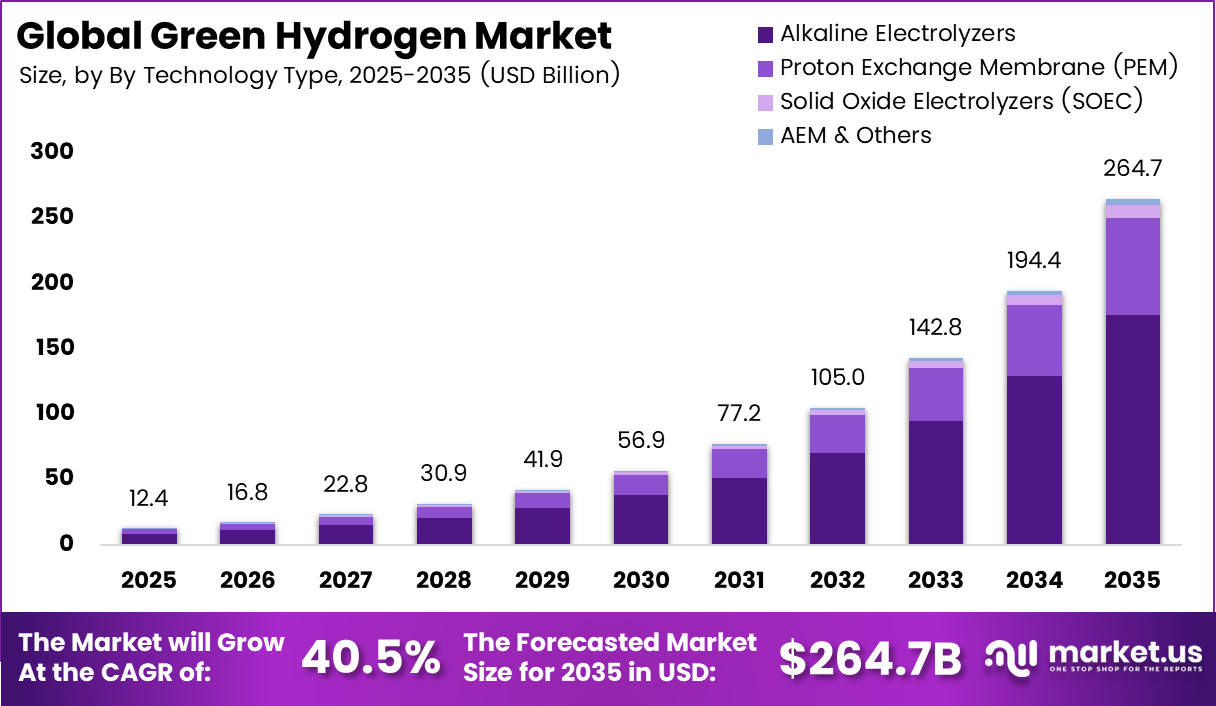
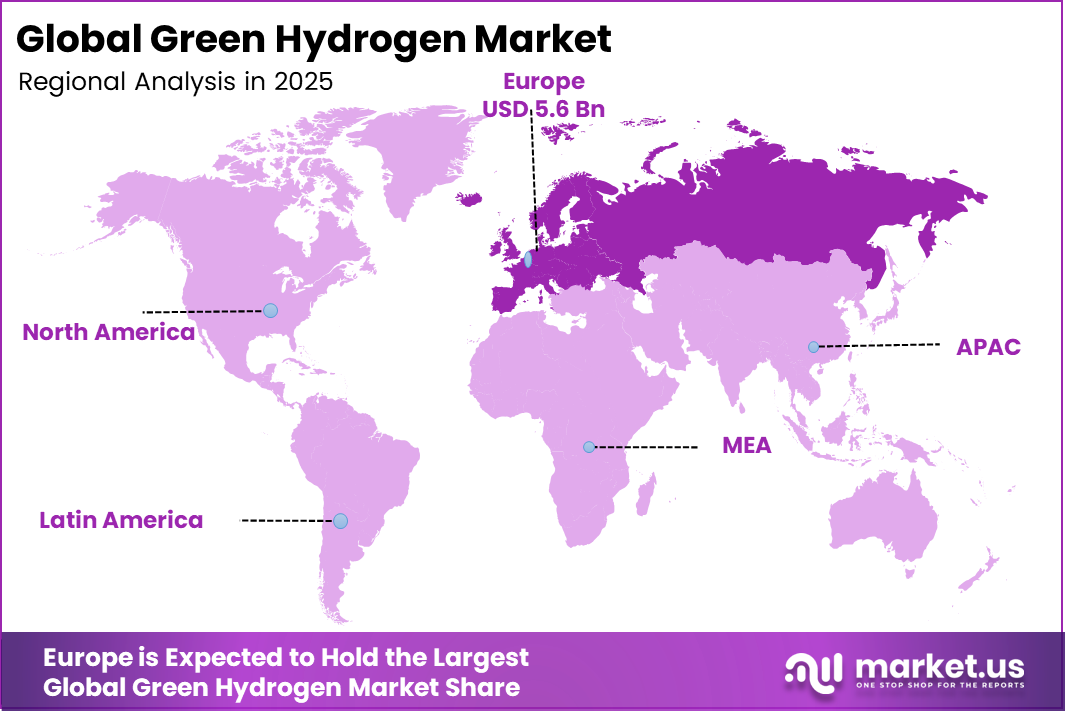
The Global Green Hydrogen Market was valued at approximately US$ 12.4 billion in 2025, and between 2026 and 2035, the market is projected to grow at a robust CAGR of 40.5%, reaching nearly US$ 264.7 billion by 2035. Europe held a dominant Market position, capturing more than a 45.2% share, holding USD 5.6 billion in revenue.
The market is gaining strong momentum as countries accelerate decarbonization efforts and transition toward low-carbon energy systems, where green hydrogen plays a critical role as a clean fuel and industrial feedstock. Green hydrogen is produced through water electrolysis powered by renewable energy sources such as wind and solar, making it a key enabler of net-zero strategies across multiple industries.
Europe continues to lead deployment through supportive policies and large-scale funding programs. Projects submitted to the EU’s 2026 hydrogen auction represented 4.3 GWe of proposed electrolyser capacity, while six renewable-hydrogen projects secured €270.6 million in grants for 381.25 MW of capacity. Their fixed-premium bids ranged from €0.33 to €1.88 per kilogram of certified renewable hydrogen.
Technology improvements are also raising efficiency and lowering costs. A 2025 floating-solar AEM electrolyser achieved energy consumption of 45.77 kWh/kg, stack efficiency of 73.3%–86.2%, system efficiency of 66%–71%, and hydrogen purity of 99.22%. Another solar-assisted system recorded 52.12 kWh/kg, 64.0% energy efficiency, 62.46% exergy efficiency, a hydrogen cost of US$5.84/kg, and a 6.9-year payback period.
Key Takeaways
- The Global Green Hydrogen Market was valued at approximately US$ 12.4 billion in 2025 and is projected to reach US$ 264.7 billion by 2035 at a CAGR of 40.5%.
- Alkaline Electrolyzers dominated the Green Hydrogen Market in 2025 with a 66.6% share, supported by industrial maturity and lower capital costs.
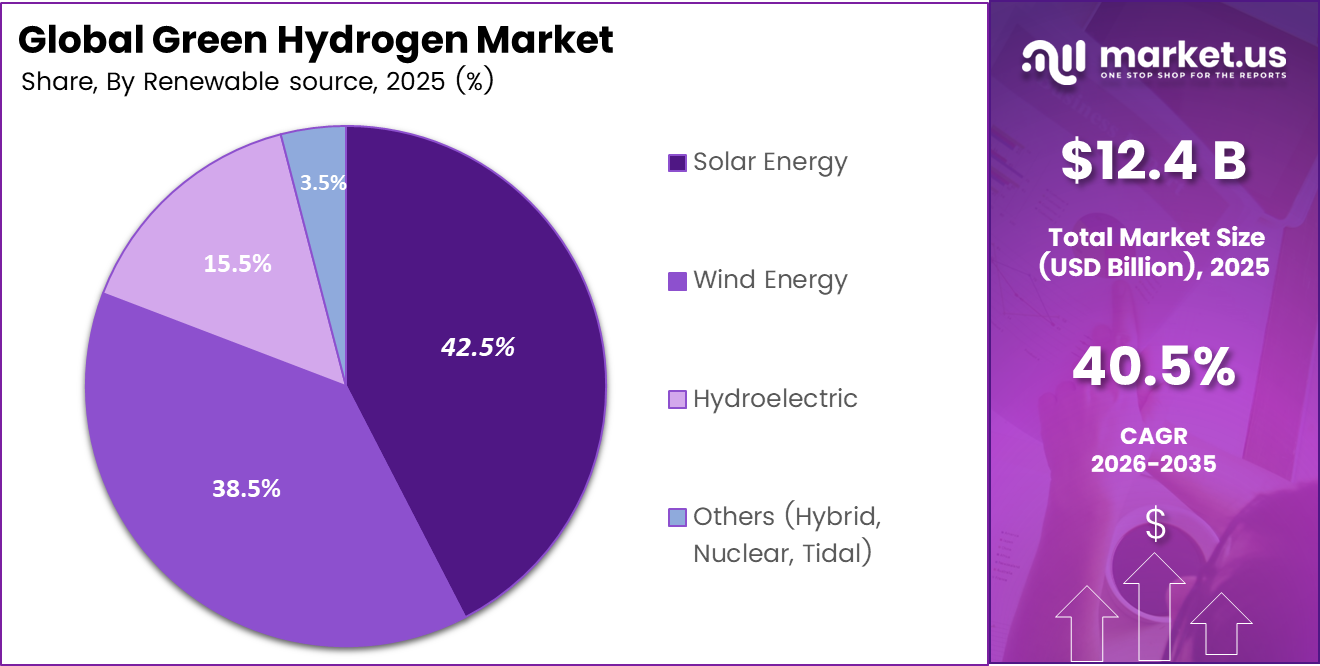
- Solar Energy led the market in 2025 with a 42.5% share, driven by declining photovoltaic costs and government incentives.
- Industrial Feedstock & Refining accounted for a 52.5% share in 2025 due to strong demand from refineries and chemical producers.
- Pipelines captured a 61.3% share in 2025, benefiting from efficient, continuous hydrogen transport to major industrial clusters.
- Europe led the global market in 2025 with a 45.2% share, generating approximately US$5.6 billion in revenue.
Technology Analysis
Alkaline Electrolyzers dominate with 66.6% due to proven, low-cost, scalable technology
In 2025, Alkaline Electrolyzers held a dominant market position in the By Technology segment of Green Hydrogen Market, with a 66.6% share. This dominance stems from decades of industrial maturity, low capital costs, and simple manufacturing processes that make the technology widely accessible. As a result, alkaline systems remain the preferred choice for large-scale green hydrogen production.
Proton Exchange Membrane (PEM) electrolyzers hold a 28.0% share, valued for their compact design, rapid response to fluctuating renewable power, and high-purity hydrogen output. These attributes attract buyers pairing electrolyzers directly with solar and wind installations. Consequently, PEM adoption is expected to accelerate as renewable integration deepens across the industry.
Solid Oxide Electrolyzers (SOEC) account for 3.8% of the market, offering superior efficiency through high-temperature operation that reduces electricity consumption per unit of hydrogen produced. Their adoption remains limited to specialized industrial and research applications due to high costs. This niche positioning suggests gradual, innovation-driven growth rather than near-term mass adoption.
Renewable Source Analysis
Solar Energy dominates with 42.5% due to abundant, low-cost, scalable solar infrastructure
In 2025, Solar Energy held a dominant market position in the Renewable Source segment of the Green Hydrogen Market, with a 42.5% share. Declining photovoltaic costs, favorable land availability, and strong government incentives support widespread solar-powered electrolysis projects globally. This trend indicates continued expansion of solar-linked hydrogen production capacity in the coming years.
Wind Energy contributes 38.5% of the market, driven by consistent offshore and onshore generation capacity that supports stable electrolyzer operation. Utilities and developers favor wind-hydrogen hybrid projects for their higher capacity factors compared to solar alone. This positions wind as a critical complement in diversified renewable hydrogen portfolios.
Hydroelectric power accounts for 15.5%, providing a stable, baseload energy source well suited for continuous electrolyzer operation in regions with established dam infrastructure. Its reliability appeals to industrial buyers seeking steady hydrogen output. However, geographic limitations constrain broader adoption outside hydro-rich regions.
End-Use Industry Analysis
Industrial (Feedstock & Refining) dominates with 52.5% due to high-volume refining and ammonia demand
In 2025, Industrial (Feedstock & Refining) held a dominant market position in the By End-Use Industry segment of the Green Hydrogen Market, with a 52.5% share. Refineries, ammonia producers, and chemical manufacturers rely heavily on green hydrogen as a feedstock to decarbonize existing processes. This strong industrial base ensures continued large-scale offtake agreements and long-term demand stability.
Mobility & Transportation is emerging as a key end-use segment, supporting fuel cell vehicles, buses, and heavy-duty trucking fleets seeking low-emission alternatives. Buyers in this segment prioritize refueling infrastructure availability and hydrogen purity standards. Growing investment in fueling networks suggests this segment will expand steadily alongside vehicle adoption.
Power & Grid Injection applications use green hydrogen for energy storage and blending into natural gas networks to balance renewable intermittency. Utilities value this flexibility for grid stability and seasonal storage needs. This structural role positions the segment as a long-term enabler of renewable energy integration.
Distribution Channel Analysis
Pipelines dominate with 61.3% due to efficient, low-cost, large-volume transport
In 2025, Pipelines held a dominant market position in the By Distribution Channel segment of the Green Hydrogen Market, with a 61.3% share. Extensive pipeline networks enable continuous, low-cost transport of large hydrogen volumes to industrial clusters and refineries. This infrastructure advantage supports pipelines as the preferred channel for high-demand, high-frequency delivery.
Cargo & Storage distribution relies on compressed or liquefied hydrogen transported via trucks, ships, and rail to reach regions lacking pipeline access. This channel appeals to buyers requiring flexible, on-demand delivery for smaller-scale or remote operations. Its flexibility makes it essential for market expansion beyond existing pipeline infrastructure.
Key Market Segments
By Technology
- Alkaline Electrolyzers
- Proton Exchange Membrane (PEM)
- Solid Oxide Electrolyzers (SOEC)
- AEM & Others
By Renewable Source
- Solar Energy
- Wind Energy
- Hydroelectric
- Others (Hybrid, Nuclear, Tidal)
By End-Use Industry
- Industrial (Feedstock & Refining)
- Mobility & Transportation
- Power & Grid Injection
- Chemicals
By Distribution Channel
- Pipelines
- Cargo & Storage
Market Dynamics
Drivers
| Driver | (~) % Impact on CAGR | Geographic Relevance | Impact Timeline |
|---|---|---|---|
| Government Policy Mandates & Sovereign Subsidy Stacks | +6.5% | Global: EU, India, US, Middle East | Short term (2 years or less) |
| Electrolyzer CapEx Deflation via Manufacturing Scale-Up | +5.8% | China, EU, India | Short term (2 years or less) |
| Renewable Energy Cost Collapse Enabling Sub-$3/kg LCOH | +4.2% | MENA, Australia, India, Latin America | Short term (2 years or less) |
| Industrial Decarbonization Mandates in Refining & Fertilizers | +3.1% | India, EU, Gulf Cooperation Council | Medium term (2 to 4 years) |
| Cross-Border Hydrogen Trade & Bilateral Supply Agreements | +2.4% | Japan, Germany, Australia, India | Medium term (2 to 4 years) |
| EU RFNBO Quota Activation Under RED III (Transport & Industry) | +1.8% | European Union | Short term (2 years or less) |
Government Policy Mandates & Sovereign Subsidy Stacks
The single most powerful active driver is the simultaneous deployment of sovereign capital across three major producing blocs within the 2023 to 2026 grounding window. India’s National Green Hydrogen Mission, gazetted on 4 January 2023, mobilized a central outlay of Rs. 19,744 crore, of which Rs. 4,440 crore is ring-fenced under the SIGHT scheme for domestic electrolyzer manufacturing incentives and Rs. 13,050 crore for production incentives, with competitive auctions under SIGHT Mode 2A already discovering green ammonia supply prices at near-commercial levels, representing a demonstrable cost-discovery mechanism at scale.
Concurrently, the US Inflation Reduction Act (enacted August 2022) introduced a tiered clean hydrogen production tax credit of up to $3/kg, fundamentally restructuring project IRR thresholds for early-FID facilities, while the EU’s REPowerEU plan embedded binding targets of 10 million tonnes of domestic and 10 million tonnes of imported renewable hydrogen by 2030.
The commercial impact is structural: project developers are now able to underwrite electrolyzer procurement and long-term renewable PPAs against legally committed subsidy cashflows, compressing the bankability risk premium by an estimated 200 to 350 basis points on project WACC and accelerating FID timelines from a multi-year deferral cycle to active disbursement, which directly widens the addressable project pipeline available for commercial execution in the 2026 to 2028 window.
Restraints
| Restraint | (~) % Impact on CAGR | Geographic Relevance | Impact Timeline |
|---|---|---|---|
| Structural Cost Premium vs. Grey & Blue Hydrogen at Unsubsidized LCOH | -5.2% | Global, most acutely in Asia-Pacific and South Asia | Short term (2 years or less) |
| High WACC & Project Finance Scarcity for Early-Stage Assets | -3.8% | India, Southeast Asia, Sub-Saharan Africa | Short term (2 years or less) |
| EU RFNBO Additionality & Hourly-Matching Compliance Burden | -2.6% | European Union and EU-exporting producers globally | Short term (2 years or less) |
| Absent Hydrogen Transport & Storage Infrastructure | -2.1% | Global: India, US, Europe | Medium term (2 to 4 years) |
| Policy Execution Risk & Subsidy Disbursement Delays | -1.5% | India and emerging markets | Short term (2 years or less) |
Structural Cost Premium vs. Grey & Blue Hydrogen at Unsubsidized LCOH
Despite rapid cost deflation, green hydrogen’s unsubsidized levelized cost of hydrogen (LCOH) remains structurally non-competitive against fossil-derived alternatives at the majority of project sites globally in 2026. Western market unsubsidized LCOH ranges from $5.00 to $7.00/kg, against grey hydrogen at $1.20 to $1.80/kg and blue hydrogen at $1.60 to $2.40/kg, a gap of 3x to 4x that is only bridged in best-resource geographies such as MENA and Australia where renewable PPAs clear at $10 to $20/MWh and LCOH can reach $2.00 to $2.50/kg at scale.
In India, even the most competitively bid SIGHT auction discovered a green hydrogen supply price of approximately Rs. 397/kg (inclusive of GST), against grey hydrogen’s prevailing cost of Rs. 150 to 200/kg, a differential of roughly 100% to 165% that places commercially unsubsidized offtake agreements beyond the appetite of industrial buyers operating on narrow processing margins.
The binding business consequence is severe: without sustained subsidy bridges or carbon pricing mechanisms that internalize the full social cost of fossil hydrogen, the commercial demand pipeline is essentially captive to government-sponsored procurement, constraining the natural market expansion rate and suppressing organic industrial adoption in the short term. An increase in WACC from 10% to 20% further compounds this by triggering up to a 73% surge in LCOH, meaning that rising financing costs can entirely negate renewable electricity cost declines achieved on the production side.
Challenges
| Challenge | (~) % CAGR Friction Drag | Geographic Relevance | Mitigation Horizon |
|---|---|---|---|
| Electrolyzer Skilled Workforce Deficit | -3.5% | Global: India, Europe, US | Long term (4 years or more) |
| PEM Critical Mineral Supply Constraints | -2.4% | Global: PEM-dominant markets | Medium term (2 to 4 years) |
| Renewable Power Intermittency & Electrolyzer Utilization Drag | -2.1% | Global: all solar and wind-dependent markets | Medium term (2 to 4 years) |
| Project-to-Materialization Attrition Gap | -1.9% | Global | Short term (2 years or less) |
| Water Resource Stress at Industrial Scale | -1.4% | India, MENA, Sub-Saharan Africa | Medium term (2 to 4 years) |
| Electrical Power Electronics Supply Chain Bottleneck | -1.2% | India and emerging markets | Short term (2 years or less) |
Electrolyzer Skilled Workforce Deficit
The green hydrogen sector’s maximum growth ceiling is being actively constrained by a structural and compounding shortfall in multi-disciplinary technical talent capable of designing, commissioning, operating, and maintaining large-scale electrolyzer systems.
Globally, the renewables-and-hydrogen workforce is projected to be short by approximately 7 million skilled workers by 2030, while India alone faces an estimated deficit of 600,000 to 2 million workers required to fulfil the National Green Hydrogen Mission’s 5 MMT/year production target, a gap documented by the Council on Energy, Environment and Water (CEEW).
The technical profiles in shortage span electrochemical engineering, power electronics commissioning (SiC-based rectifiers, solid-state transformers, high-voltage DC systems), hydrogen safety and leak-detection operations, and digital-twin systems integration, disciplines that are not produced at meaningful volume by existing vocational and engineering curricula in most producing nations. For a single 100 MW PEM project, the electrical infrastructure alone, covering transformers, rectifiers, converters, and control systems, represents Rs. 1,000 to 1,200 crore ($120 to $145 million) in procurement requiring specialized commissioning expertise that is currently supply-constrained.
Opportunities
| Opportunity | (~) % Potential CAGR | Geographic Relevance | Execution Window |
|---|---|---|---|
| Green Ammonia & Fertilizer Export Corridors | +5.5% | India, MENA, Australia to EU, Japan, South Korea | Medium term (2 to 4 years) |
| EU CBAM-Driven Green Steel & Aluminium Decarbonization | +4.1% | EU-exporting nations: India, Turkey, Ukraine | Short term (2 years or less) |
| Green Hydrogen-as-a-Service (HaaS) Monetization Model | +2.8% | Europe, India, North America | Medium term (2 to 4 years) |
| Offshore Wind-Coupled Hydrogen Production Hubs | +2.3% | North Sea, India (East Coast), Taiwan Strait | Long term (4 years or more) |
| Decentralized Hydrogen for Remote Industrial & Mining Sites | +1.6% | Australia, Africa, India (Rajasthan, Odisha) | Medium term (2 to 4 years) |
| Electrolyzer Stack Manufacturing as an Export Industry | +1.2% | India, EU (de-risking from China concentration) | Long term (4 years or more) |
Green Ammonia & Fertilizer Export Corridors
This opportunity represents genuinely untapped white space rather than a current driver: while domestic green ammonia procurement has begun under SECI’s SIGHT Mode 2A tender, which offered a total capacity of 7,24,000 metric tonnes per annum and allocated production incentives of Rs. 8.82/kg in year one, declining to Rs. 5.30/kg in year three, the scaled, fully-financed, export-contracted green ammonia trade corridor remains structurally nascent as of 2026.
India’s cumulative green ammonia production capacity by 2030 is realistically projected at 2 to 3 MMTPA, but export terminals, globally contracted long-term offtake agreements, and certified supply chains linking MENA and Australian producers to Japanese and Korean port re-gasification terminals are not yet at financial close, positioning this as an M&A and first-mover strategic capture opportunity over the 2027 to 2030 execution window.
This carbon-premium arbitrage adds a monetizable margin layer of an estimated 15% to 25% on certified green ammonia delivered into EU ports relative to conventional supply, enabling developers who lock in long-term offtake PPAs now, before competing project pipelines reach FID, to capture a durable unit-economic advantage at the cargo level that is unavailable to late entrants, representing a margin expansion pathway that does not yet appear in current baseline revenue models.
Geopolitical Impact Analysis
Geopolitical Realignment, Active Conflict Escalation, and Supply Chain Concentration Risks Reshaping the Green Hydrogen Market
Due to current geopolitical tensions spanning the prolonged Russia-Ukraine conflict, Middle East instability, and deepening strategic competition between the United States and China, the green hydrogen market is being fundamentally reshaped in terms of how it is developing, where production investments are flowing, and which supply chain architectures are being built to underpin the emerging global hydrogen trade.
The Russia-Ukraine war has had a direct and lasting impact on European green hydrogen development by dramatically accelerating the urgency and political commitment behind Europe’s push to replace Russian natural gas with domestically produced and imported clean energy alternatives. Before the conflict, Russian pipeline gas supplied approximately 40% of European natural gas consumption, a dependency that the war exposed as a critical strategic vulnerability and that has since driven the European Union to adopt the most ambitious and well-funded green hydrogen development program in the world as part of its REPowerEU energy independence strategy.
The European Commission reported that REPowerEU program commitments include EUR 200 billion in combined public and private investment targeting 10 million tonnes of domestic European green hydrogen production and an additional 10 million tonnes of green hydrogen imports annually by 2030 — a scale of policy-driven market creation that would not have materialized at this pace or at this funding level without the strategic urgency generated directly by Russia’s invasion of Ukraine and the subsequent energy security crisis it triggered across European energy markets.
Regional Analysis
Europe Held the Largest Share of the Global Green Hydrogen Market
In 2025, Europe dominated the global green hydrogen market, holding approximately 45.2% of total global consumption, driven by its deeply integrated clean energy policy framework, the most ambitious government-backed hydrogen investment programs in the world, and a heavy industrial base that is under greater regulatory pressure to decarbonize than any comparable region globally.
The continent accounts for the largest concentration of operational and under-construction green hydrogen projects worldwide, with Germany, the Netherlands, Spain, and Denmark collectively anchoring the majority of European electrolyzer deployment activity.
This policy-driven momentum translates directly into strong and growing demand for green hydrogen across industrial, mobility, and power sector applications, as European manufacturers, utilities, and governments treat green hydrogen not as a future technology option but as an immediate and necessary pillar of their energy transition strategies.
Key Regions and Countries Covered in this Report
- North America
- The US
- Canada
- Europe
- Germany
- France
- The UK
- Spain
- Italy
- Russia & CIS
- Rest of Europe
- APAC
- China
- Japan
- South Korea
- India
- ASEAN
- Rest of APAC
- Latin America
- Brazil
- Mexico
- Rest of Latin America
- Middle East & Africa
- GCC
- South Africa
- Rest of MEA
Key Players Analysis
Green hydrogen producers, electrolyzer manufacturers, and infrastructure developers focus on strengthening technological differentiation, cost reduction strategies, production scale efficiency, and end-to-end value chain integration to maintain and grow their competitive positioning in a market that is evolving rapidly and attracting an increasingly diverse and well-capitalized field of participants.
A central priority across the competitive landscape is continuous advancement in electrolyzer technology, including the development of next-generation PEM membrane electrode assemblies, high-efficiency alkaline cell stack designs, and solid oxide electrolyzer systems capable of operating at higher temperatures with improved electrical efficiency.
Major Players in the Industry
- Air Liquide S.A.
- Air Products & Chemicals Inc.
- Linde plc
- Siemens Energy AG
- ENGIE S.A.
- Nel ASA
- Plug Power Inc.
- ITM Power plc
- thyssenkrupp nucera AG
- Cummins Inc. (Accelera)
- Shell plc
- Sinopec Corp.
- John Cockerill Group
- Mitsubishi Power (MHI)
- Ballard Power Systems
Key Developments
- In June 2025, ITM Power announced the commissioning of its Gigastack electrolyzer system at a commercial-scale green hydrogen production facility in the United Kingdom, marking one of the largest single-site PEM electrolyzer deployments in European history and demonstrating the company’s ability to deliver utility-scale green hydrogen production infrastructure at a commercially viable capital cost level.
- In May 2025, Nel Hydrogen secured a long-term supply agreement with a major European ammonia producer to deliver alkaline electrolyzer systems representing more than 200 MW of installed green hydrogen production capacity, with equipment delivery and commissioning scheduled across a phased deployment program running through 2027.
Report Scope
| Report Features | Description |
|---|---|
| Market Value (2025) | US$ 12.4 Billion |
| Forecast Revenue (2035) | US$ 264.7 Billion |
| CAGR (2026–2035) | 40.5% |
| Base Year for Estimation | 2025 |
| Historic Period | 2020-2024 |
| Forecast Period | 2025-2035 |
| Report Coverage | Revenue Forecast, Market Dynamics, Policy Analysis, Competitive Landscape, Recent Developments |
| Segments Covered | By Technology (Alkaline Electrolysis, PEM Electrolysis, Solid Oxide Electrolysis), By Source (Solar, Wind, Hydropower, Others), By Application (Ammonia, Methanol, Refining, Power Generation, Transportation, Energy Storage), By End Use (Industrial, Energy & Utilities, Chemicals, Mobility, Others) |
| Regional Analysis | North America – US & Canada; Europe – Germany, UK, France, Spain, Italy, Rest of Europe; Asia Pacific – China, Japan, South Korea, India, ASEAN & Rest of APAC; Latin America – Brazil, Mexico & Rest of Latin America; Middle East & Africa – GCC, South Africa & Rest of MEA |
| Competitive Landscape | Air Liquide, Linde plc, Siemens Energy, Plug Power Inc., Nel ASA, ITM Power, Ballard Power Systems, Toshiba Energy Systems & Solutions, Mitsubishi Power, Thyssenkrupp Nucera, ENGIE, Shell plc, Equinor ASA, Adani Green Energy Ltd., NTPC Limited, and other key players |
| Customization Scope | Customization across segments, technologies, applications, and country-level analysis is available. Additional tailoring based on specific research requirements can also be provided. |
| Purchase Options | Single User License, Multi-User License (Up to 5 Users), Corporate License (Unlimited Users with Printable Report Access) |





































