


Report Overview
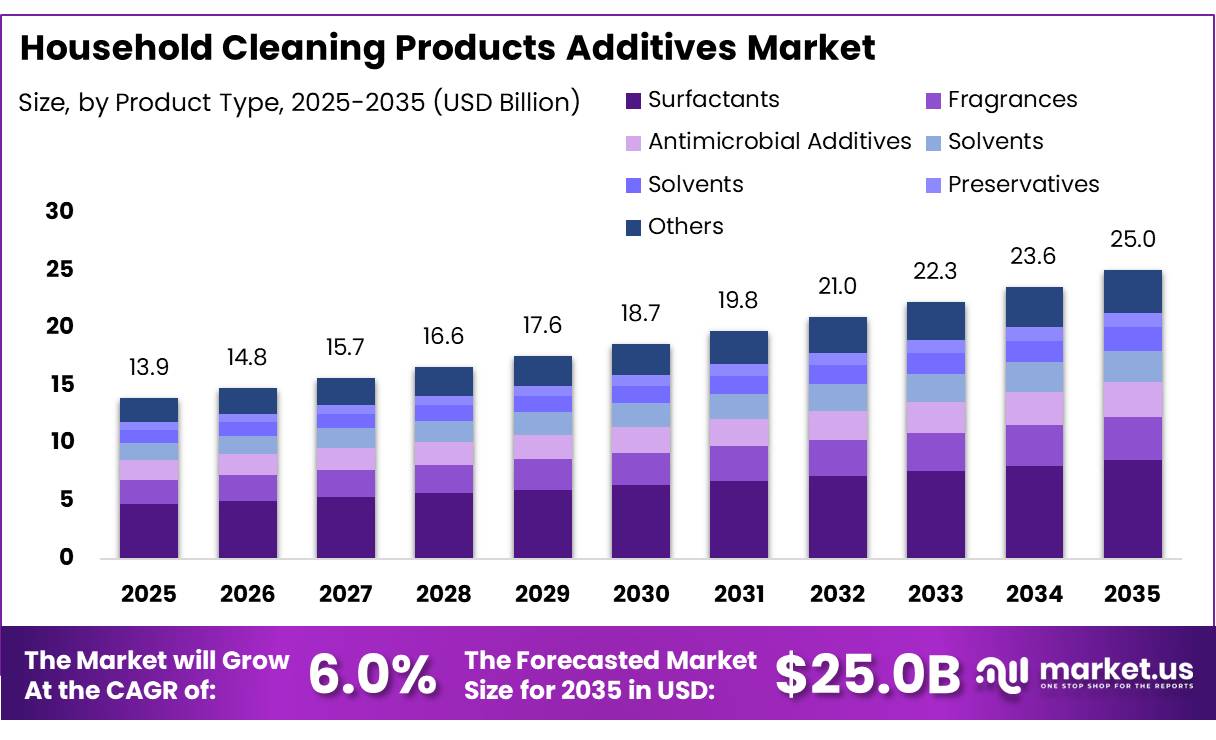
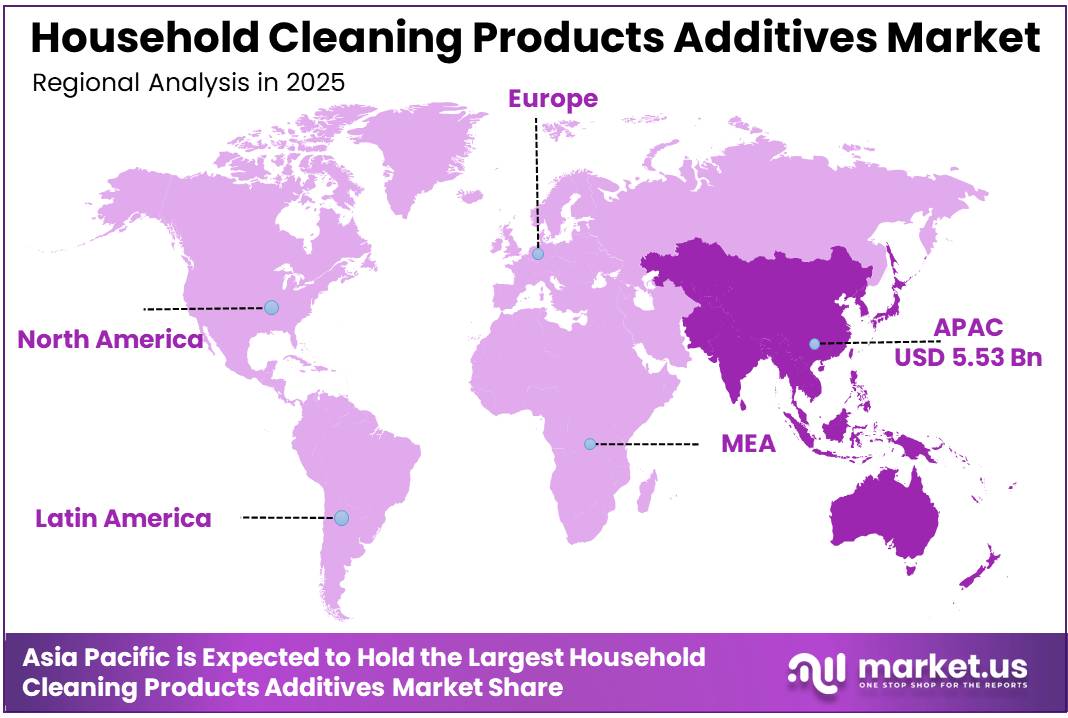
In 2025, the Global Household Cleaning Products Additives Market was valued at US$13.9 billion, and between 2026 and 2035, this market is estimated to register a CAGR of 6.0%, reaching about US$25.0 billion by 2035.Asia Pacific held a dominant market position, capturing more than a 39.70% share, holding USD 5.53 billion in revenue.
Household cleaning product additives include surfactants, solvents, preservatives, chelating agents, fragrances, antimicrobial ingredients, foam modifiers, colorants, and bleaching aids. These chemicals improve soil removal, product stability, scent, appearance, disinfection, and shelf life across laundry detergents, dishwashing products, surface cleaners, and toilet care. Industry performance depends on formulation science, ingredient compatibility, regulatory compliance, packaging efficiency, and dependable access to chemical feedstocks across manufacturing and distribution networks.
- The Council of the European Union reported that the detergents industry represented 2% of the chemical sector’s production value in 2018, reached a market value of €41.2 billion in 2020, and involved around 700 production sites.
Key Takeaways
- The global Household Cleaning Products Additives market was valued at US$13.9 billion in 2025.
- The global Household Cleaning Products Additives market is projected to grow at a CAGR of 6.0% and is estimated to reach US$25.0 billion by 2035.
- On the basis of product type, surfactants dominated the Household Cleaning Products Additives Market, constituting 1% of the total market share.
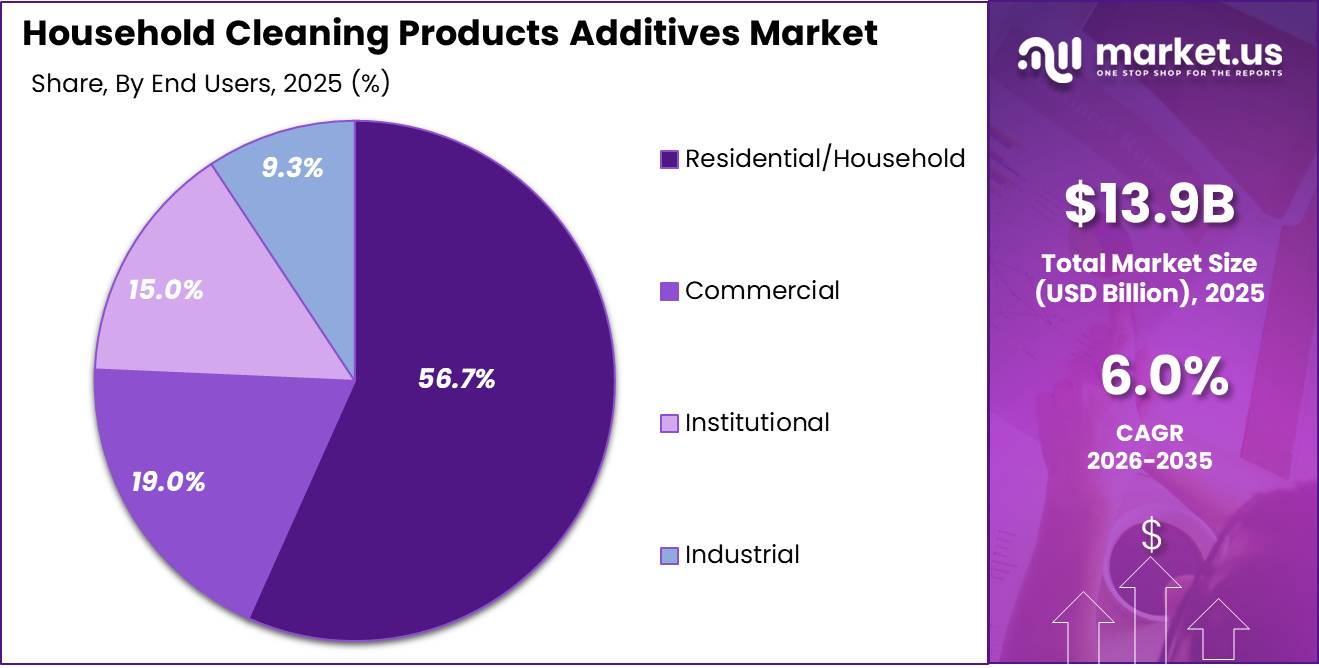
- Based on end users, the residential/household segment dominated the market, capturing 7% of the total market share.
- In 2025, Asia Pacific was the most dominant region in the Household Cleaning Products Additives Market, accounting for 70% of the total global market.
This scale supports continued demand for multifunctional additives that improve cleaning efficiency, formulation consistency, storage stability, fragrance delivery, and performance across different water and surface conditions.
Safer chemistry and concentrated formulations create strong growth opportunities for additive suppliers. In July 2025, the United States Environmental Protection Agency added 18 chemicals to its Safer Chemical Ingredients List, increasing the total to 983. The agency also reported 1,656 certified products for fiscal year 2025 and established a target of 2,300 products by September 30, 2026. These programs encourage innovation in surfactants, solvents, preservatives, polymers, colorants, and other functional ingredients with improved health and environmental profiles.
Government policy is reshaping formulation, labeling, and product transparency. In December 2025, the Council of the European Union approved updated rules for detergents and surfactants covering microbial cleaning products, refill sales, digital labeling, product passports, biodegradability, and clearer ingredient information. The United States Environmental Protection Agency separately limits impurities that do not meet Safer Choice criteria to 0.01% of the final formulation. These measures support traceability, safer substitution, transparent communication, and investment in compliant additive technologies for household and institutional cleaning applications worldwide.
Product Type Analysis
Surfactants Lead Product Demand with a 34.1% Share
In 2025, Surfactants held a dominant market position, capturing more than a 34.1% share. In December 2025, these additives remained central to household cleaning formulations because they lower surface tension and help remove grease, dirt, and stains from different surfaces. They are widely used in laundry detergents, dishwashing liquids, floor cleaners, toilet care products, and multipurpose sprays. Their ability to support wetting, foaming, emulsification, and soil suspension makes them useful across both concentrated and ready-to-use products. Manufacturers also favor surfactants because different grades can be combined to balance cleaning power, mildness, stability, and compatibility with fragrances, preservatives, and other functional ingredients.
Fragrances are expected to be the growing product type as consumers increasingly connect cleanliness with a pleasant and lasting scent. Cleaning product manufacturers are expanding fragrance choices across floral, citrus, fresh, and premium profiles to create stronger product identity and improve the user experience. Fragrances also help mask the natural odor of chemical ingredients and support product differentiation across laundry, surface care, dishwashing, and bathroom cleaning applications in competitive retail markets.
End User Analysis
Residential and Household Users Lead with a 56.7% Share
In 2025, Residential/Household held a dominant market position, capturing more than a 56.7% share. In December 2025, this segment remained the largest user of household cleaning product additives because consumers regularly purchase laundry detergents, dishwashing liquids, floor cleaners, toilet care products, and multipurpose sprays. Additives such as surfactants, fragrances, solvents, preservatives, and antimicrobial ingredients help improve cleaning performance, product stability, scent, and ease of use. Rising attention to home hygiene, convenient formats, and products designed for specific surfaces continues to support demand from households. Manufacturers also develop concentrated, refillable, and easy-to-dose formulations to meet changing consumer preferences and reduce product waste.
Commercial users are expected to be the growing segment as offices, hotels, restaurants, retail stores, and service facilities require reliable cleaning products for daily maintenance. These users value additives that support strong soil removal, odor control, product consistency, and performance across large areas. Growing demand for professional cleaning routines, concentrated formulas, and efficient products is encouraging suppliers to develop formulations suited to frequent use and varied surface conditions and schedules.
Key Market Segments
By Product Type
- Surfactants
- Fragrances
- Antimicrobial Additives
- Solvents
- Chelating Agents
- Preservatives
- Others
By End Users
- Residential/Household
- Commercial
- Institutional
- Industrial
Drivers
EU detergents compliance shift toward biodegradable, digitally traceable additives
Regulation (EU) 2026/405 entered into force on 22 March 2026 and will broadly apply from 23 September 2029, replacing the older EU detergents framework while explicitly bringing refill products, microbial cleaners, surfactants, and water-soluble films into scope. That matters for additives because the regulation removes prior derogation flexibility and requires all surfactants to meet ultimate biodegradability standards with no exceptions, while also introducing a Digital Product Passport and machine-readable compliance architecture tied to customs and central registry processes.
In practice, this shifts value away from low-cost legacy chemistry toward higher-spec surfactants, dispersants, preservatives, film-compatible auxiliaries, and documentation-ready specialty additives, especially for exporters in Asia supplying EU brands or private-label channels. The CAGR uplift estimate of about +1.4 percentage points is justified by a multi-year reformulation cycle running from 2026 through the 2029 applicability date, plus later test-related milestones for films/polymers in 2032 and certain organic substances in 2034, which extend additive replacement demand beyond the initial compliance wave.
Drivers Impact Analysis
| Driver | (~) % Impact on CAGR | Geographic Relevance | Impact Timeline |
|---|---|---|---|
| EU detergents compliance shift toward biodegradable, digitally traceable additives | +1.4% | EU core, UK alignment, export-oriented Asia suppliers | Medium term (2-4 years) |
| Cold-wash enzyme systems raising additive loading in laundry formats | +1.2% | North America, Western Europe, Japan, urban APAC | Short term (≤ 2 years) |
| Refill and concentrate formats increasing high-performance additive value per liter | +0.9% | EU, North America core, developed APAC corridors | Short term (≤ 2 years) |
| Safer-chemistry programs and retailer screening accelerating preservative/surfactant reformulation | +0.8% | US core, Canada, EU premium channels | Medium term (2-4 years) |
| Bio-based and low-carbon feedstock substitution in surfactants and builders | +1.0% | EU, North America, Brazil, Southeast Asia oleochemical chains | Medium term (2-4 years) |
| Microbial and enzyme-enabled specialty cleaners expanding functional additive mix | +0.7% | EU, North America, selected APAC metros | Long term (≥ 4 years) |
Restraints
Regulatory and labeling complexity across regions
Beyond headline frameworks such as EU detergents regulation and China’s GB 26396‑2026, suppliers must navigate a mosaic of region‑specific safety, labeling and packaging rules, including U.S. multi‑agency compliance, EU circular‑packaging and recyclability criteria, and evolving restrictions on microplastics and other substances of concern. For household cleaning additives, this regulatory fragmentation forces companies to maintain different label‑ready formulations and documentation sets for each major market, increasing per‑SKU regulatory overhead and reducing economies of scale in both production and regulatory affairs, with compliance teams often spending 20–30% of their effort managing variations rather than advancing new technologies.
Microplastics restrictions under REACH, for example, push formulators to re‑engineer certain polymers and encapsulation systems used in detergents and cleaners by defined deadlines from 2025 onward, while EU packaging rules demand recyclability and recyclate content that can affect choices around film‑forming additives, barrier agents and colorants. Meanwhile, China’s forthcoming mandatory safety specification requires alignment of raw‑material lists and safety indicators by 2027, and U.S. retail programs overlay voluntary certifications on top of statutory rules, further complicating the landscape. The net effect is a roughly 0.6 percentage‑point drag on CAGR through duplicated R&D and regulatory workstreams, longer time‑to‑market, and increased risk of delayed launches in smaller export corridors where additive suppliers may decide not to pursue compliance at all due to limited volume potential.
Restraint Impact Analysis
| Restraint | (~) % Impact on CAGR | Geographic Relevance | Impact Timeline |
|---|---|---|---|
| China mandatory safety standard (GB 26396-2026) compliance load | -1.3% | China core, export-linked APAC | Medium term (2-4 years) |
| U.S. multi-agency cleaning product compliance friction | -0.9% | US core, Canada spill-over | Short term (≤ 2 years) |
| Raw-material price volatility in key cleaning ingredients | -1.1% | India, wider APAC, LatAm | Short term (≤ 2 years) |
| Limited product differentiation and private-label pressure | -0.8% | Global, APAC and EU retail | Long term (≥ 4 years) |
| Capital allocation preference to finished goods over additives | -0.7% | Global brand owners, OEMs | Medium term (2-4 years) |
| Regulatory and labeling complexity across regions | -0.6% | US, EU, China, export corridors | Long term (≥ 4 years) |
Opportunity
Private‑label additive OEM platforms
Private‑label and OEM manufacturing models are expanding rapidly in home and personal care, with specialist manufacturers offering turnkey formulation services and scalable production that help brands launch quickly without owning full manufacturing assets. At present, many additive suppliers interact with these OEMs transactionally, selling commoditized surfactants and fragrance ingredients without capturing strategic control over the base formulations powering private‑label cleaners across large retailers.
This pivot could reduce customer acquisition costs per new private‑label client by 20–30% through standardized technology stacks, while increasing lifetime value per OEM relationship via multi‑category additive supply across retailer portfolios. If leading additive suppliers aggressively pursue private‑label and OEM platforms over the next 2–4 years, realistically targeting penetration of 10–15% of new private‑label household cleaner launches in North America, Europe, and India, the upside to CAGR is around +1.1 percentage points, supported by higher mix of specialty additives and improved economies of scale in standardized recipes.
Opportunity Impact Analysis
| Opportunity | (~) % Potential CAGR Upside | Geographic Relevance | Execution Window |
|---|---|---|---|
| Industrial & institutional cleaning adjacency | +1.6% | North America, EU, APAC metros | Medium term (2-4 years) |
| High-margin eco-premium additive tiers | +1.4% | EU core, North America, Japan | Short term (≤ 2 years) |
| Private-label additive OEM platforms | +1.1% | North America, EU retail, India | Medium term (2-4 years) |
| Data/consulting services bundled with additives | +0.9% | Global brand owners, large retailers | Long term (≥ 4 years) |
| Regional M&A roll-ups of niche additive formulators | +1.2% | Europe, North America, India | Medium term (2-4 years) |
| Emerging-market hygiene and demographic expansion | +1.0% | India, Southeast Asia, Africa | Long term (≥ 4 years) |
Challenge
Commodity and logistics cost inflation variability
Supply chain analyses for FMCG sectors in 2026 highlight rising logistics, fuel, and transportation costs as major pressure points on profit margins, alongside general global uncertainty that periodically pushes commodity and freight rates above trend lines. For household cleaning additives suppliers, these cost swings are a chronic challenge: diesel and marine fuel price volatility of 20–30% year‑on‑year can translate into 5–10% changes in delivered cost per ton for raw materials and finished additives, while container freight rates and inland haulage charges can spike enough to add USD 50–150 per ton on key routes during disruption periods.
Because customer contracts in household cleaning often lock pricing for 6–12 months, additive manufacturers must absorb a portion of these fluctuations, leading to quarter‑to‑quarter gross margin variance of 100–200 basis points and cautious investment behavior in new capacity when inflation visibility is poor, which cumulatively knocks roughly 0.9 percentage points off maximum achievable CAGR. This situation does not freeze sales—consumption of cleaners continues—but it forces continuous tactical repricing, hedging, and logistics optimization, requiring 2–4 years of structural mitigation through route consolidation, data‑driven freight planning, and diversified carrier portfolios, as well as closer alignment of contract structures with commodity indices to reduce margin shocks.
Challenges Impact Analysis
| Challenge | (~) % CAGR Friction | Geographic Relevance | Mitigation Horizon |
|---|---|---|---|
| Global supply chain volatility | -1.0% | APAC logistics, global FMCG hubs | Medium term (2-4 years) |
| Regulatory complexity and uncertainty | -0.8% | US, EU, China regulatory hubs | Long term (≥ 4 years) |
| Chemistry talent and skills shortage | -0.7% | Europe, North America, Japan | Long term (≥ 4 years) |
| Commodity and logistics cost inflation variability | -0.9% | APAC, LatAm, Africa corridors | Medium term (2-4 years) |
| Portfolio complexity across multi-channel customers | -0.6% | Global brand owners, OEMs, private label | Long term (≥ 4 years) |
| Digital and data capability gaps in additives | -0.5% | Global, especially mid-tier suppliers | Medium term (2-4 years) |
Geopolitical Impact Analysis
Trade Disruptions and Regulatory Shifts Reshape the Household Cleaning Products Additives Market
The Household Cleaning Products Additives Market is exposed to geopolitical risks because surfactants, solvents, fragrances, preservatives, and chelating agents depend on globally traded petrochemical and oleochemical feedstocks. Conflicts affecting energy-producing regions can create sudden changes in raw-material, manufacturing, and transportation costs. In the second quarter of 2026, Brent crude oil averaged US$103 per barrel, showing how geopolitical uncertainty can affect petroleum-linked chemical inputs used in cleaning formulations.
Maritime instability is also affecting the movement of chemical intermediates between Asia, Europe, North America, and the Middle East. United Nations Trade and Development reported that ship tonnage passing through the Suez Canal in early May 2025 remained 70% below the 2023 average. Longer routes around the Cape of Good Hope increase transit times, fuel use, insurance expenses, and inventory requirements for cleaning-product manufacturers.
Trade restrictions and regional supply concerns are encouraging manufacturers to use multiple suppliers, hold larger safety stocks, and source selected additives closer to production facilities. This shift creates opportunities for regional chemical distributors, contract formulators, and local producers capable of supplying customized additives in smaller volumes. Suppliers with manufacturing sites across several countries are better placed to manage port delays, tariff changes, sanctions, and temporary shortages.
Regulatory differences are creating another geopolitical challenge. The European Union approved updated detergent and surfactant rules covering biodegradability, digital labeling, refill sales, product passports, microbial cleaning products, and imported-product compliance. Manufacturers serving several regions must therefore adjust formulations, labels, testing records, and ingredient documentation for individual markets. This environment favors additive suppliers with strong regulatory expertise, transparent sourcing systems, and formulations that meet stricter safety and environmental requirements.
Regional Analysis
Asia-Pacific Leads with a 39.70% Share Valued at US$5.53 Billion
In 2025, Asia-Pacific held a dominant position in the Household Cleaning Products Additives Market, capturing 39.70% of global revenue and reaching US$5.53 billion. Regional leadership was supported by dense urban populations, expanding retail channels, and large chemical manufacturing bases across China, Japan, South Korea, and Southeast Asia. The United Nations Economic and Social Commission for Asia and the Pacific reported in March 2025 that the region had more than 2.2 billion urban residents, with its urban population projected to increase 50% by 2050.
China’s National Bureau of Statistics reported that online retail sales reached 15,972.2 billion yuan in 2025, while online sales of daily necessities increased 4.1%. China also recorded 7.5% growth in raw chemical materials and chemical products manufacturing in June 2025. These conditions support demand for surfactants, fragrances, solvents, preservatives, antimicrobial additives, and chelating agents used in laundry, dishwashing, surface-care, and toilet-cleaning formulations throughout expanding household consumer markets.
Key Regions and Countries Covered
- North America
- The US
- Canada
- Europe
- Germany
- France
- The UK
- Spain
- Italy
- Russia & CIS
- Rest of Europe
- APAC
- China
- Japan
- South Korea
- India
- ASEAN
- Rest of APAC
- Latin America
- Brazil
- Mexico
- Rest of Latin America
- Middle East & Africa
- GCC
- South Africa
- Rest of MEA
Key Players Analysis
Household cleaning product additive manufacturers compete through formulation expertise, broad ingredient portfolios, product consistency, and close relationships with cleaning product brands. Leading suppliers focus on developing high-performance surfactants, fragrances, antimicrobial additives, solvents, chelating agents, and preservation systems for specific cleaning applications. Companies strengthen their market position by offering customized ingredient combinations that improve stain removal, odor control, product stability, surface compatibility, and consumer appeal. Research and development remains important as manufacturers work on biodegradable ingredients, low-toxicity formulations, concentrated products, and additives suitable for refill systems.
Key players also invest in application laboratories, safety testing, regulatory documentation, and technical support to help customers shorten product development cycles. Partnerships with formulators, contract manufacturers, retailers, and regional distributors improve product availability across different markets. Competitive advantage increasingly depends on reliable ingredient sourcing, flexible production capacity, recognized quality standards, and the ability to respond quickly to changing consumer preferences and regulatory requirements.
Market Key Players
- BASF
- Dow
- Evonik Industries
- Clariant
- Croda International
- Solvay
- Huntsman Corporation
- Ashland
- Stepan Company
- Kao Corporation
- Galaxy Surfactants
- Sasol
- AkzoNobel
- Lonza
- Lubrizol
- Eastman Chemical Company
- Innospec
- Pilot Chemical Company
- Nouryon
- AECI
Key Development
- In March 2026, BASF Hannong Chemicals Solutions Ltd., a joint venture between BASF and Hannong Chemicals, inaugurated a new non-ionic surfactant production site at the Daesan Industrial Complex in Seosan, South Korea. The facility strengthens BASF’s regional supply network and supports growing demand for non-ionic surfactants across Asia-Pacific.
- In February 2026, Nouryon launched FinnFix PB MAX, a fully bio-based and biodegradable carboxymethylcellulose for powdered laundry detergents. The ingredient has a 100% renewable carbon index score and improves anti-redeposition performance by preventing removed soil from reattaching to fabrics.
- In March 2026, Evonik launched its Innovation Factory to accelerate the development of chemical technologies for industrial applications. Its programs include rhamnolipid biosurfactants already used in cleaning and cosmetic products, with each program designed to reach operational and production readiness within an average of five years.
Report Scope
| Report Features | Description |
|---|---|
| Market Value (2025) | US$13.9 Bn |
| Forecast Revenue (2035) | US$25.0 Bn |
| CAGR (2026-2035) | 6.0% |
| Base Year for Estimation | 2025 |
| Historic Period | 2020-2024 |
| Forecast Period | 2026-2035 |
| Report Coverage | Revenue Forecast, Market Dynamics, Competitive Landscape, Recent Developments |
| Segments Covered | By Product Type (Surfactants, Fragrances, Antimicrobial Additives, Solvents, Chelating Agents, Preservatives, and Others), By End User (Residential/Household, Commercial, Institutional, and Industrial) |
| Regional Analysis | North America – The US & Canada; Europe – Germany, France, The UK, Spain, Italy, Russia & CIS, Rest of Europe; APAC- China, Japan, South Korea, India, ASEAN & Rest of APAC; Latin America- Brazil, Mexico & Rest of Latin America; Middle East & Africa- GCC, South Africa, & Rest of MEA |
| Competitive Landscape | BASF, Dow, Evonik Industries, Clariant, Croda International, Solvay, Huntsman Corporation, Ashland, Stepan Company, Kao Corporation, Galaxy Surfactants, Sasol, AkzoNobel, Lonza, Lubrizol, Eastman Chemical Company, Innospec, Pilot Chemical Company, Nouryon, and AECI. |
| Customization Scope | Customization for segments, region/country-level will be provided. Moreover, additional customization can be done based on the requirements. |
| Purchase Options | We have three licenses to opt for: Single User License, Multi-User License (Up to 5 Users), Corporate Use License (Unlimited Users and Printable PDF) |





































