


Report Overview
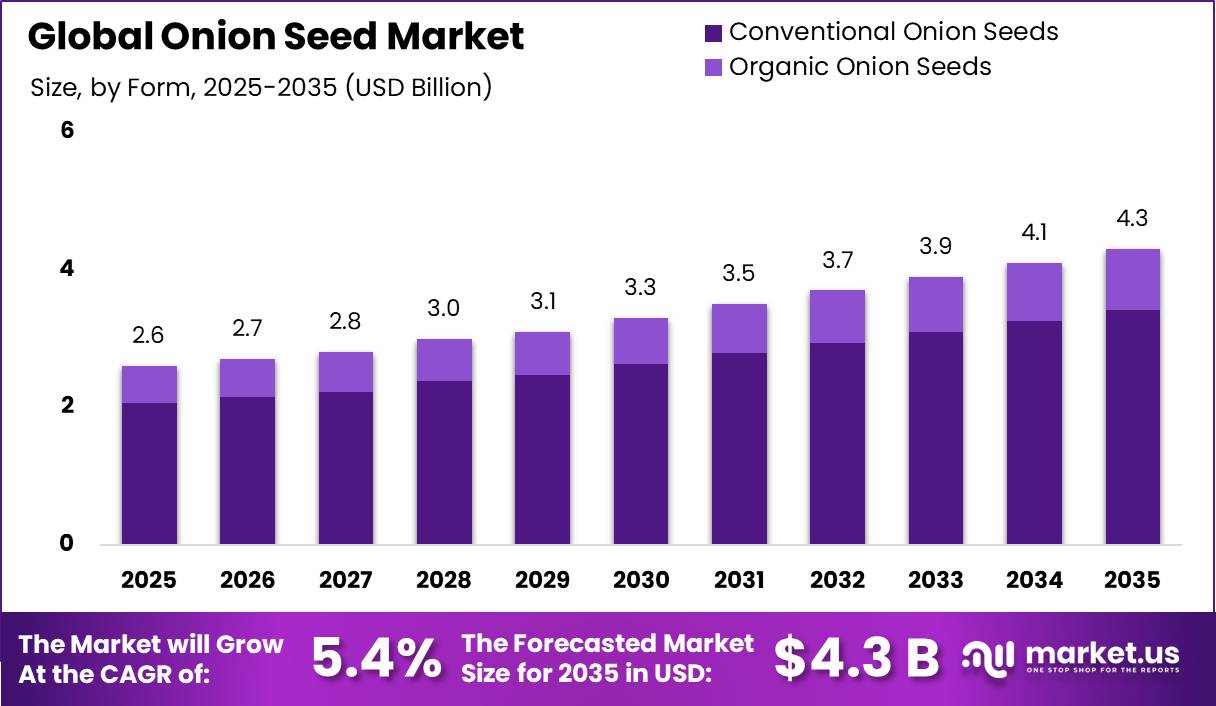
The Global Onion Seed Market size is expected to be worth around USD 4.3 Billion by 2035, from USD 2.6 Billion in 2025, growing at a CAGR of 5.4% during the forecast period from 2026 to 2035. In 2025, Asia-Pacific held a dominant market position, capturing more than a 48.3% share, holding USD 1.2 Billion revenue.
The onion seed industry is positioned within a large global vegetable value chain, as FAO reported 111 million tonnes of onions, including shallots, in 2023, making onions the second most produced vegetable after tomatoes at 192 million tonnes. Its demand base is supported by the scale of onion cultivation: FAO-linked data show world dry onion output reached 110.6 million tonnes in 2022, up 3.5% year on year and 25.4% over 10 years.
Industrial growth is supported by food-security pressure, higher vegetable consumption, and professional seed adoption. FAOSTAT covers crop data for 245+ countries and territories, showing the broad production base that supports commercial seed demand. In the United States, vegetables are classified as specialty crops, and USDA’s Specialty Crop Research Initiative provides up to US$175 million per year for research and extension, supporting innovation in crops such as onions.
Demand is being driven by food security, urban consumption, processing demand, and growers’ need to reduce crop loss. OECD-FAO states that global agricultural production growth is expected to depend mainly on productivity, with 85% of crop output growth coming from yield improvements, 10% from multiple cropping and only 5% from land expansion, supporting stronger use of improved seed genetics. In the U.S., USDA reported 2024 yellow storage onion FOB prices averaging 49 cents/lb, up 13.7%, while advertised retail prices averaged 86 cents/lb, up 1.4%, supporting grower interest in higher-yielding and storage-stable seed genetics.
Government and institutional support is also relevant. FAOSTAT covers agriculture data for over 245 countries and territories, strengthening transparency for crop planning and seed demand assessment. The OECD-FAO Outlook also projects global agricultural production to rise by around 1.4% per year, reinforcing the need for advanced seeds and agronomic inputs.
Its 2025 funding description included US$ 196,983.08 for Texas A&M AgriLife Research to study onion water-use efficiency and drought-tolerant short-day onion germplasm with commercial seed companies. The European Green Deal targets 25% of EU agricultural land under organic farming by 2030, while the organic share rose from 5.9% in 2012 to 10.8% in 2023, creating demand for certified, resilient, and lower-input vegetable seed systems.
Bayer AG remains influential in crop science, although its direct vegetable seed footprint changed after divestments. In 2024, Bayer’s Crop Science business generated about €22.3 billion in sales, while BASF Agricultural Solutions reported €9,798 million in 2024 sales and €1,938 million EBITDA before special items, showing the financial strength behind global seed and crop-input innovation.
Key Takeaways
- Onion Seed Market size is expected to be worth around USD 4.3 Billion by 2035, from USD 2.6 Billion in 2025, growing at a CAGR of 5.4%.
- Conventional Onion Seeds held a dominant market position, capturing more than a 79.5% share.
- Red Onion held a dominant m
- arket position, capturing more than a 56.8% share.
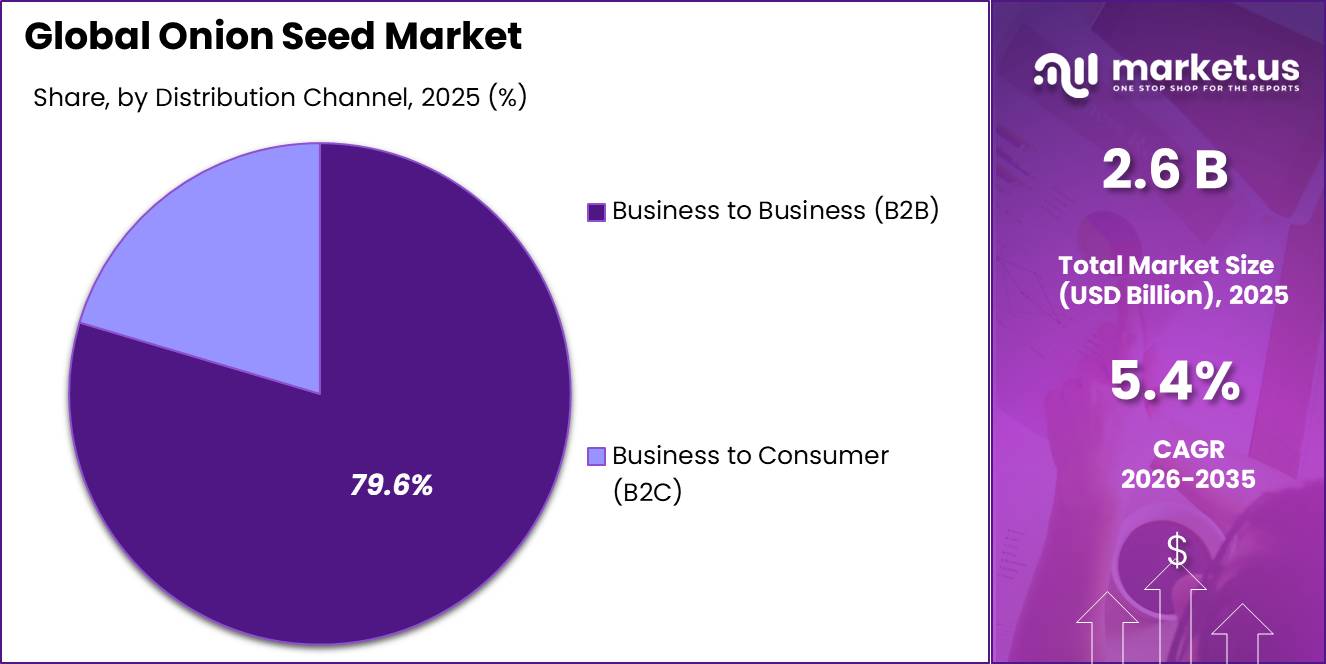
- Business to Business (B2B) held a dominant market position, capturing more than a 79.6% share.
- Business to Business (B2B) held a dominant market position, capturing more than a 79.6% share.
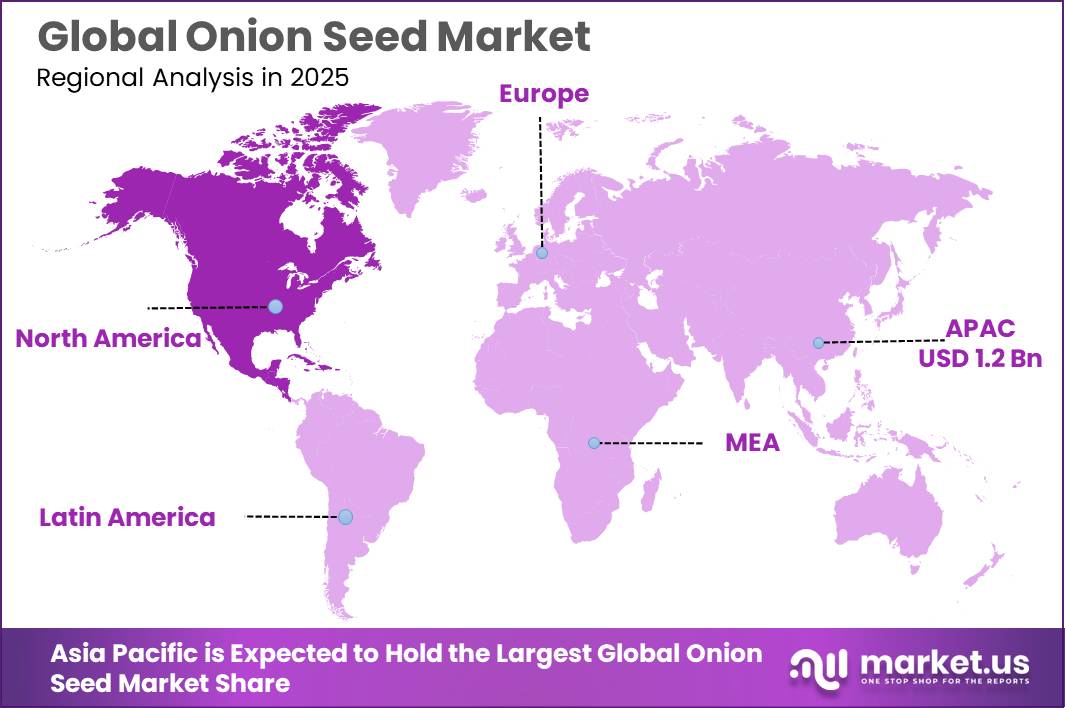
- Asia-Pacific held a dominant position in the global Onion Seed Market, accounting for 48.3% of the total market share and reaching a market value of nearly USD 1.2 Billion.
By Form Analysis
Conventional Onion Seeds dominate with 79.5% share due to their lower cost and wide farmer acceptance.
In 2025, Conventional Onion Seeds held a dominant market position, capturing more than a 79.5% share. The strong position of this segment was mainly supported by its affordable pricing, easy availability, and long-standing use among small and medium-scale farmers. Conventional onion seeds continued to be the preferred choice in many agricultural regions because they offer reliable yield performance without requiring expensive farming inputs. Farmers in developing economies especially favored these seeds due to lower cultivation costs and familiar farming practices.
By Product Type Analysis
Red Onion leads with 56.8% share driven by high daily consumption and strong farming demand.
In 2025, Red Onion held a dominant market position, capturing more than a 56.8% share. The segment remained ahead due to the high preference for red onions in household cooking, foodservice use, and processed food applications across many countries. Red onion seeds were widely cultivated because of their strong market demand, better storage capability, and adaptability to different climate conditions. Farmers continued to favor this variety as it offers stable production and consistent commercial returns throughout the year.
By Distribution Channel Analysis
Business to Business (B2B) leads with 79.6% share due to bulk seed purchases and strong distributor networks.
In 2025, Business to Business (B2B) held a dominant market position, capturing more than a 79.6% share. The segment remained the leading distribution channel as large-scale farmers, agricultural cooperatives, wholesalers, and seed distributors continued purchasing onion seeds in bulk quantities directly from manufacturers and suppliers. B2B sales channels offered better pricing, long-term supply agreements, and wider product availability, making them the preferred choice for commercial farming operations. The strong presence of organized agricultural supply chains and dealer networks further supported the growth of this segment.
Key Market Segments
By Form
- Organic Onion Seeds
- Conventional Onion Seeds
By Product Type
- Red Onion
- White Onion
- Others
By Distribution Channel
- Business to Business (B2B)
- Business to Consumer (B2C)
- Hypermarkets & Supermarkets
- Specialty Stores
- Online Channels
- Others
Emerging Trends
Rising Adoption of Hybrid Onion Seeds is Becoming a Key Trend in Modern Farming
One of the latest trends in the onion seed market is the growing use of hybrid onion seeds by commercial farmers. Growers are increasingly choosing hybrid varieties because they provide better yield, improved bulb uniformity, stronger disease resistance, and longer storage life. According to recent agricultural industry findings, hybrid onion seeds accounted for nearly 85.6% of the global onion seed market share in 2025, showing how quickly farmers are moving toward advanced seed technologies.
Government agricultural programs in countries such as India, Bangladesh, and Ethiopia are also encouraging the use of certified and hybrid vegetable seeds through subsidy schemes and farmer awareness programs. In Ethiopia, field trials showed hybrid onions producing up to 45% higher yield compared to traditional seed varieties.
Climate-Resilient and Disease-Resistant Seeds are Gaining Strong Attention
Another important trend shaping the onion seed market is the increasing development of climate-resilient and disease-resistant seed varieties. Farmers are facing rising challenges from irregular rainfall, heatwaves, water shortages, and fungal diseases, which are affecting onion crop productivity in many countries. According to agricultural studies, hybrid varieties are showing 15% to 20% longer shelf life and improved resistance against common crop diseases compared to conventional seed lines.
Governments and agricultural institutions are supporting research programs aimed at improving seed quality and reducing crop losses. Several countries are investing in sustainable farming and protected cultivation methods such as greenhouse and drip irrigation farming, which are increasing the demand for specialized onion seeds. The Food and Agriculture Organization (FAO) has also highlighted the importance of resilient seed systems in improving food security and agricultural sustainability worldwide.
Drivers
Rising Global Onion Consumption is Increasing Demand for High-Quality Onion Seeds
The growing consumption of onions across households, restaurants, and food processing industries is one of the major factors driving the onion seed market. Onions are used daily in cooking and are considered an essential vegetable in many countries, especially in Asia and the Middle East. According to the Food and Agriculture Organization (FAO), global fruit and vegetable production reached around 2.1 billion tonnes in 2023, showing continuous growth in vegetable demand worldwide.
In recent years, farmers have increasingly shifted toward hybrid and disease-resistant onion seeds to improve productivity and reduce crop losses caused by changing weather conditions. The rise in onion exports has also encouraged growers to use quality seeds that provide uniform size, better shelf life, and higher market value. Growing urban populations and higher food demand are further supporting onion cultivation in developing economies.
Government Support and Agricultural Programs are Encouraging Onion Cultivation
Government initiatives focused on improving vegetable production and farmer income are also supporting the growth of the onion seed market. Many countries are investing in better irrigation systems, seed distribution programs, and modern farming methods to strengthen agricultural output. In India, several state agriculture departments provide subsidies and training programs for vegetable farmers, including onion growers. This support helps farmers adopt improved seed varieties with higher resistance to pests and climate stress.
According to FAOSTAT, onion production globally has crossed more than 100 million tons annually, reflecting the strong importance of the crop in global agriculture. The increase in cultivated land and commercial farming activities has created higher demand for certified onion seeds. Governments are also promoting exports of fresh vegetables, which is encouraging farmers to focus on better-quality onion production.
Restraints
Unpredictable Weather Conditions are Reducing Onion Seed Yield and Crop Stability
One of the biggest restraining factors for the onion seed market is the increasing impact of unpredictable weather conditions on onion cultivation. Onion crops are highly sensitive to temperature changes, excessive rainfall, drought, and unseasonal humidity. Even small climate variations can reduce seed germination rates and damage crop quality.
According to the Food and Agriculture Organization (FAO), climate-related challenges continue to affect agricultural productivity globally, especially in vegetable farming sectors that depend heavily on seasonal weather patterns. Government agricultural departments are promoting climate-resilient farming practices and improved irrigation systems, but adoption remains slow in many rural farming areas. As weather risks continue to rise, onion seed producers are facing growing challenges in maintaining stable demand and consistent production cycles.
Rising Input Costs and Limited Farmer Profit Margins are Affecting Seed Purchases
Another major challenge for the onion seed market is the rising cost of agricultural inputs, including fertilizers, labor, irrigation, and quality seeds. Many small and medium-scale farmers operate with limited financial resources, making it difficult for them to purchase premium onion seeds every season. According to the World Bank, global fertilizer prices increased sharply during recent years due to supply chain disruptions and geopolitical pressures, which raised overall farming expenses for vegetable growers.
In countries where onion prices are unstable, farmers may shift toward cheaper seed varieties or reduce cultivation areas to manage financial risk. This directly affects demand for advanced onion seeds with improved traits such as disease resistance or higher yield potential. Governments in several agricultural economies have introduced subsidy programs and financial support schemes to help farmers manage rising cultivation expenses. However, many growers still struggle with access to affordable credit and modern farming resources.
Opportunity
Growing Demand for Processed Foods is Creating New Opportunities for Onion Seed Producers
One major growth opportunity for the onion seed market is the rising demand for processed and packaged food products across the world. Onions are widely used in frozen foods, ready-to-cook meals, sauces, soups, snacks, and fast-food items, which is increasing the need for stable onion production. According to the Food and Agriculture Organization (FAO), global vegetable production has continued to rise steadily due to growing urban populations and changing food consumption habits. This trend is encouraging farmers to adopt better onion seed varieties that offer higher yield, uniform bulb size, and longer shelf life suitable for food processing industries.
Expansion of Export Markets is Supporting Commercial Onion Farming
The growing export demand for onions is creating another strong opportunity for the onion seed market. Many countries are increasing onion imports to meet rising food demand, especially in regions where local production is limited due to climate conditions.
- According to APEDA, India exported more than 1.7 million metric tons of fresh onions during recent trade periods, showing the strong international demand for quality onions. This export growth is encouraging farmers to use certified and high-quality onion seeds that can improve productivity and meet export standards.
Regional Insights
Asia-Pacific dominated the Onion Seed Market with a 48.3% share, valued at USD 1.2 Billion, supported by large-scale onion cultivation and strong domestic demand.
In 2025, Asia-Pacific held a dominant position in the global Onion Seed Market, accounting for 48.3% of the total market share and reaching a market value of nearly USD 1.2 Billion. The region’s leadership was mainly driven by high onion production levels in countries such as India and China, which are among the world’s largest onion-producing nations.
The widespread use of onions in daily cooking across Asian countries continued to support strong cultivation activities, creating steady demand for onion seeds throughout the region. According to agricultural trade and food production statistics, India remains one of the leading onion producers globally, with large farming areas dedicated to onion cultivation every year.
Key Regions and Countries Insights
- North America
- US
- Canada
- Europe
- Germany
- France
- The UK
- Spain
- Italy
- Rest of Europe
- Asia Pacific
- China
- Japan
- South Korea
- India
- Australia
- Rest of APAC
- Latin America
- Brazil
- Mexico
- Rest of Latin America
- Middle East & Africa
- GCC
- South Africa
- Rest of MEA
Key Players Analysis
Bayer AG remains one of the leading participants in the onion seed market through its strong agricultural division and advanced seed development programs. In 2025, the company continued focusing on hybrid vegetable seeds, including onion varieties with improved disease resistance and higher yield performance. Bayer reported annual sales of more than €47 billion across its business operations, while its crop science division contributed a major share to agricultural innovation activities.
BASF SE plays an important role in the onion seed market through its agricultural solutions business and seed technology advancements. In 2025, the company continued expanding its vegetable seed portfolio with a focus on improving crop resilience and productivity. BASF generated more than €68 billion in annual revenue globally and maintained operations in over 90 countries. The company invested billions annually in innovation and agricultural research programs aimed at developing high-performance seed varieties.
Groupe Limagrain is a major agricultural seed company known for its strong vegetable seed business, including onion seed production. In 2025, the company continued strengthening its global seed portfolio through advanced breeding technologies and farmer-focused crop solutions. Groupe Limagrain reported annual sales exceeding €2.5 billion and maintained operations across more than 50 countries.
Top Key Players Outlook
- Bayer AG
- BASF SE
- Groupe Limagrain
- Sakata Seeds Corporation
- Bejo Zaden B.V.
- Syngenta AG
- Enza Zaden Beheer B.V.
- Rijk Zwaan Zaadteelt en Zaadhandel B.V.
- Takii and Co., Ltd.
- East-West Seed International B.V.
- UPL Limited
- Nong Woo Bio Co., Ltd.
- KWS SAAT SE & Co. KGaA
- Yuan Longping High-Tech Agriculture Co., Ltd.
- Namdhari Seeds Pvt. Ltd
Recent Industry Developments
In 2025, Syngenta AG strengthened its onion seed work through its Vegetable Seeds business, offering 30 crop species and 2,500+ seed products across 120+ countries. Syngenta Group reported USD 28.4 billion sales in 2025, while its Seeds business reached USD 4.8 billion, up 2% year-on-year. In 2026, the company also announced a GBP 100 million UK bioscience hub investment, supporting future crop innovation and sustainable seed development.
In 2025, Bejo Zaden B.V. remained a strong specialist in the onion seed sector, supported by more than 100 years of seed-breeding experience and core strength in onion, carrot, and brassica crops. The company works in 40+ crops, offers 1,100+ varieties, employs around 2,300 people, has 31 companies, and supplies seeds to 100+ countries. In onion seeds, Bejo focuses on new product development through short-day onion breeding, organic seed lines, disease resistance, better bulb quality, and stronger storage life.
Report Scope
| Report Features | Description |
|---|---|
| Market Value (2025) | USD 2.6 Bn |
| Forecast Revenue (2035) | USD 4.3 Bn |
| CAGR (2026-2035) | 5.4% |
| Base Year for Estimation | 2025 |
| Historic Period | 2020-2024 |
| Forecast Period | 2026-2035 |
| Report Coverage | Revenue Forecast, Market Dynamics, Competitive Landscape, Recent Developments |
| Segments Covered | By Form (Organic Onion Seeds, Conventional Onion Seeds), By Product Type (Red Onion, White Onion, Others), By Distribution Channel (Business to Business (B2B), Business to Consumer (B2C), Hypermarkets And Supermarkets, Specialty Stores, Online Channels, Others) |
| Regional Analysis | North America – US, Canada; Europe – Germany, France, The UK, Spain, Italy, Rest of Europe; Asia Pacific – China, Japan, South Korea, India, Australia, Singapore, Rest of APAC; Latin America – Brazil, Mexico, Rest of Latin America; Middle East & Africa – GCC, South Africa, Rest of MEA |
| Competitive Landscape | Bayer AG, BASF SE, Groupe Limagrain, Sakata Seeds Corporation, Bejo Zaden B.V., Syngenta AG, Enza Zaden Beheer B.V., Rijk Zwaan Zaadteelt en Zaadhandel B.V., Takii and Co., Ltd., East-West Seed International B.V., UPL Limited, Nong Woo Bio Co., Ltd., KWS SAAT SE & Co. KGaA, Yuan Longping High-Tech Agriculture Co., Ltd., Namdhari Seeds Pvt. Ltd |
| Customization Scope | Customization for segments, region/country-level will be provided. Moreover, additional customization can be done based on the requirements. |
| Purchase Options | We have three licenses to opt for: Single User License, Multi-User License (Up to 5 Users), Corporate Use License (Unlimited User and Printable PDF) |





































