Report Overview
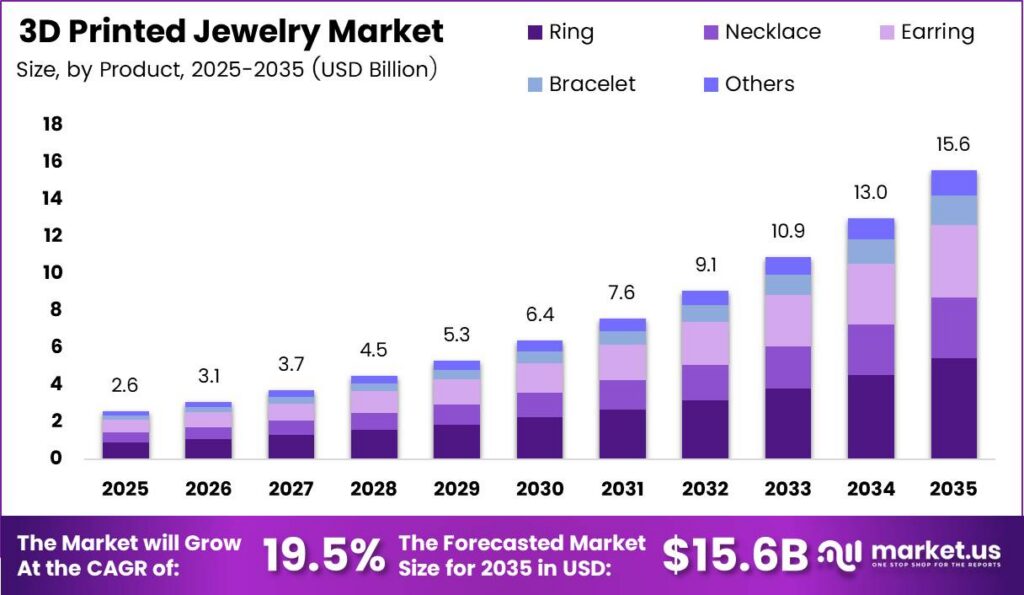
Global 3D Printed Jewelry Market size is expected to be worth around USD 15.6 Billion by 2035 from USD 2.6 Billion in 2025, growing at a CAGR of 19.5% during the forecast period 2026 to 2035. Three-dimensional printed jewelry uses digital design files and layer-by-layer printers to produce castable wax masters or finished metal ornaments. Manufacturers adopt these digital systems to cut precious metal weight and speed up custom production runs.
The market connects printer makers, resin suppliers, casting bureaus, and retail chains across bridal, luxury, and fashion segments. According to UN Comtrade, global trade in finished jewelry and parts under code 7113 totaled USD 102.36 Billion in 2025, adjusting 1.3% from USD 103.67 Billion in 2024. Therefore, exporters rely on printed hollow geometries to protect profit margins while shipping lighter gold and platinum pieces across international borders.
Key Takeaways
- Global 3D Printed Jewelry Market was valued at USD 2.6 Billion in 2025.
- Market revenue will reach USD 15.6 Billion by 2035.
- The market expands at a compound annual growth rate of 19.5% during the forecast period 2026 to 2035.
- Ring led the Product segment with a 34.89% market share in 2025 and ranks as the fastest growing product category.
- Women accounted for the largest End User share at 67.45% in 2025, while Men represents the fastest growing buyer group.
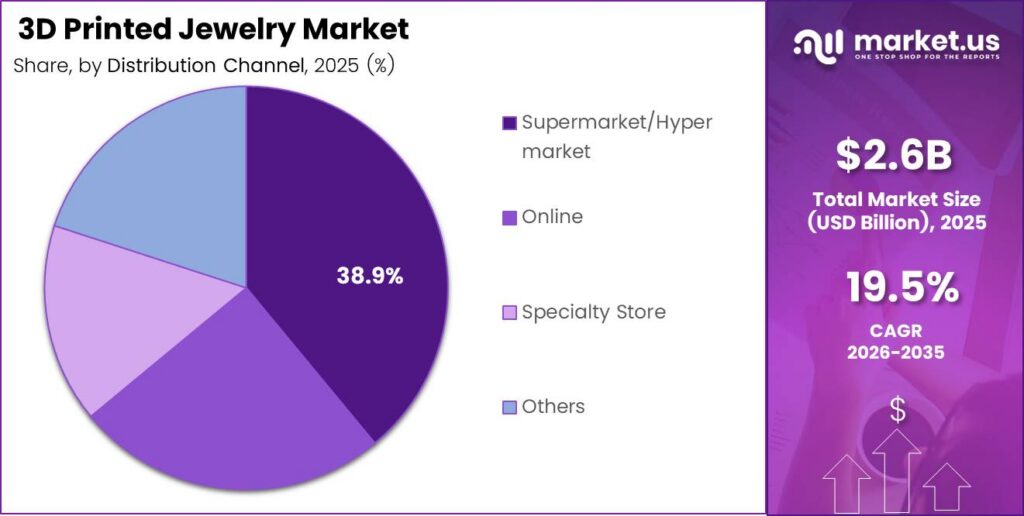
- Supermarket/Hypermarket held a 38.90% share in the Distribution Channel segment in 2025, whereas Online is the fastest growing channel.
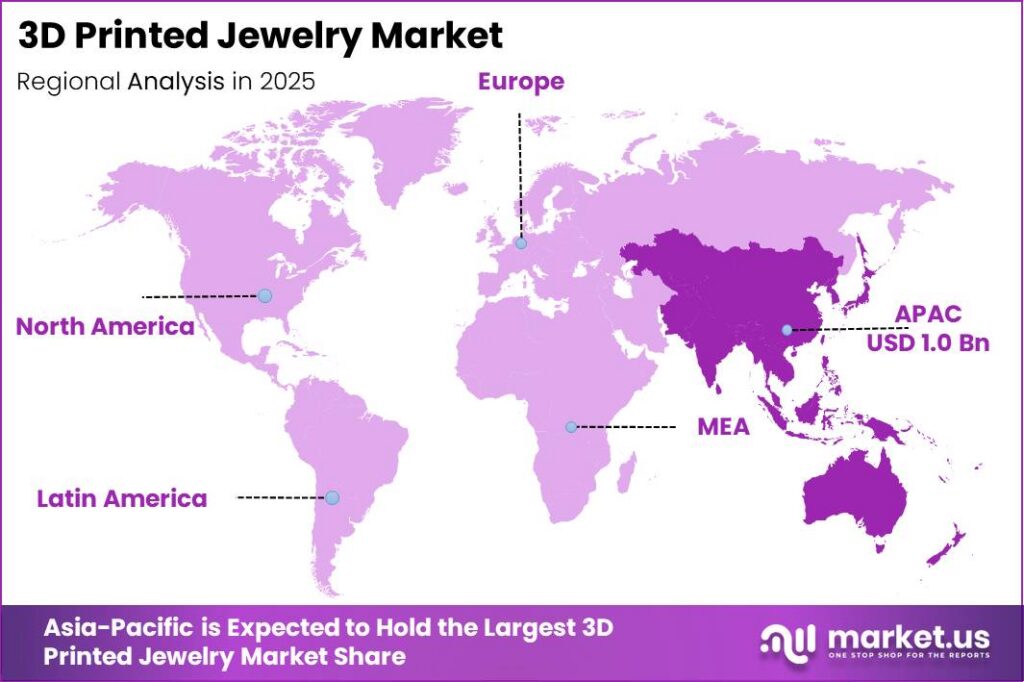
- Asia-Pacific dominated global revenue with a 38.67% share valued at USD 1.0 Billion in 2025, while Europe grows fastest through 2035.
Central bank bullion reserve policies and national hallmarking rules directly shape raw material budgets across jewelry factories. As reported by USGS, jewelry fabrication represented 40% of global gold consumption in 2025 while central banks took 21% across 3,300 metric tons of mine output . Consequently, sovereign gold buying tightens physical supply and forces commercial jewelers to invest in wax and laser printers that cut metal waste.
Supply chain leaders are pairing powder-free metal printers with ethical sourcing hubs to capture higher manufacturing margins. In June 2026, a major European metallurgy supplier and an industrial printer maker partnered to print gold and platinum batches of 410 earrings in 90 minutes at 98% to 99.5% density. This signals that direct metal printing is moving from prototyping benches onto commercial factory floors.
Asia-Pacific leads global production with a 38.67% market share in 2025, supported by dense casting clusters in India and China. Data from WIPO shows global industrial design filings rose 2.2% in 2024 as China filed 906,849 designs and India expanded filings by 44.9% . This reflects intense regional competition in original jewelry styling, which compels Asian workshops to run digital printer farms for rapid catalog turnover.
Large jewelry brands are also building automated factories that combine digital mold making with recycled precious metals. In October 2026, a global fine jewelry manufacturer opened a USD 150 Million facility in Vietnam spanning 55,000 square meters to craft 60 Million recycled gold and silver pieces yearly . As a result, mid-tier producers must upgrade to automated printing workflows or lose retail shelf space to scaled competitors.
Product Analysis
Ring dominates with 34.89% share in 2025 due to custom bridal stone setting needs.
In 2025, Ring held a 34.89% share in the Product segment of the 3D Printed Jewelry Market. NRF found that United States shoppers projected USD 7.0 Billion in Valentine’s Day jewelry spending in 2026, representing nearly 25% of USD 29.1 Billion in holiday outlays . Engagement and anniversary rings require micron-accurate prong seats and bespoke band sizing that only digital wax and resin printers deliver economically. Therefore, bridal retailers invest heavily in benchtop printers to convert custom buyers quickly.
Necklace production relies on interlocking chain links and wide collar frames that consume high volumes of precious bullion when cast solid. Based on USGS data, average platinum prices climbed 25% in 2025 while ruthenium jumped 53% and rhodium gained 24% . Rising platinum-group alloy costs force chain makers to print hollow internal lattices that preserve visual volume while cutting gram weight per necklace. Consequently, casting houses using topology-optimized necklace files protect gross margins against metal price spikes.
Earring collections demand strict bilateral symmetry and low gram weight so intricate drops do not strain the wearer’s earlobe. WIPO indicates that the 15th Edition of Locarno Class 11 organizes adornment protection across 6 subclasses led by Subclass 11-01, while Titan Company scaled beYon to 7 stores with 1,250 modular designs under INR 100,000 in November 2026 . Digital printing turns protected digital earring templates into ultra-light resin masters overnight. This creates fast inventory turns for fashion jewelers.
End User Analysis
Women dominates with 67.45% share in 2025 due to frequent seasonal self-purchasing and gifting.
In 2025, Women held a 67.45% share in the End User segment of the 3D Printed Jewelry Market. Figures from NRF show United States Mother’s Day jewelry spending reached USD 7.5 Billion in 2026 as 45% of surveyed shoppers bought jewelry out of USD 38.0 Billion in total gifts . High seasonal gifting volumes require thousands of personalized pendant, bangle, and ring SKUs that hand wax carvers cannot finish before holiday deadlines. This means retail chains depend on high-speed resin printers to prevent stockouts.
Men represents the fastest growing buyer category as younger male shoppers adopt signet rings, geometric cuffs, and heavy curb chains. According to NRF, United States Father’s Day gift spending hit USD 27.9 Billion in 2026, rising 16.3% from USD 24.0 Billion in 2025 at USD 226.58 per shopper . Men’s jewelry uses thicker cross-sections that become prohibitively expensive unless manufacturers print hollow structural cores inside the casting pattern. Therefore, brands targeting male buyers achieve higher profitability through additive manufacturing.
Custom unisex and artisan-collaborative buyers increasingly order gender-neutral architectural pieces produced through ethical, digitally assisted workshops. As reported by ILO, global fashion and accessory supply chains employ over 90 Million workers, with women representing nearly 60% globally and exceeding 70% across major Asian production hubs . Equipping traditional artisan clusters with digital CAD templates and desktop printers eliminates hazardous manual wax carving while doubling daily output per worker. Consequently, investors backing digitally upskilled workshops secure reliable ESG-compliant supply.
Distribution Channel Analysis
Supermarket/Hypermarket dominates with 38.90% share in 2025 due to high-volume club jewelry counters.
In 2025, Supermarket/Hypermarket held a 38.90% share in the Distribution Channel segment of the 3D Printed Jewelry Market. Data from US Census Bureau shows annual sales at United States warehouse clubs and supercenters under code 452311 reached USD 769.51 Billion in 2024, up 2.4% from USD 751.64 Billion . Mass-merchandise jewelry counters require standardized, defect-free batch castings at strict price caps that only multi-jet wax printer farms supply consistently. As a result, contract manufacturers with automated printing lines win recurring hypermarket vendor contracts.
Online ranks as the fastest growing retail channel because e-commerce shoppers configure ring sizes, engravings, and stone shapes directly in web browsers. US Census Bureau found that quarterly United States retail e-commerce sales rose 12.2% year-on-year to USD 340.2 Billion in Q2 2026, capturing 17.1% of total retail trade . Browser-based configurators export printable STL files straight to casting bureaus without holding pre-made gold inventory in warehouses. This creates superior working-capital efficiency for digital-first jewelry brands.
Specialty Store boutiques focus on high-ticket bridal consultations where shoppers inspect physical resin prototypes before approving final precious metal casting. Based on US Census Bureau data, United States specialty jewelry stores under code 44831 generated USD 39.53 Billion in 2024 sales across 19,897 establishments employing 106,903 staff . In-store desktop printers allow independent jewelers to print try-on wax models within hours, locking in custom bridal deposits during a second store visit. Therefore, printer vendors gain steady recurring resin sales from boutique networks.
Key Market Segments
By Product
- Ring
- Necklace
- Earring
- Bracelet
- Others
By End User
- Women
- Men
By Distribution Channel
- Supermarket/Hypermarket
- Online
- Specialty Store
- Others
Regional Analysis
Asia-Pacific Dominates the 3D Printed Jewelry Market with a Market Share of 38.67% in 2025, Valued at USD 1.0 Billion
Asia-Pacific captured 38.67% of global revenue at USD 1.0 Billion in 2025, anchored by high-volume manufacturing hubs in Surat, Mumbai, Shenzhen, and Bangkok. World Bank indicates that constant GDP per capita across East Asia and Pacific climbed to USD 13,812 in 2025 from USD 13,295 in 2024 . Rising household incomes sustain heavy wedding gold purchases while export bureaus adopt castable resin printers to produce lightweight pieces. Consequently, printer suppliers prioritize Asian service centers to capture volume resin demand.
Europe stands out as the fastest growing regional market as luxury maisons in Italy, France, Switzerland, and Austria integrate direct metal laser sintering. Figures from Eurostat show European Union retail trade volume grew 0.9% year-on-year in September 2026, supported by a 1.2% expansion in non-food discretionary retail . Steady luxury retail turnover allows European heritage brands to pass direct precious-metal printing costs onto affluent buyers seeking complex geometric pieces. This signals strong European demand for industrial multi-laser metal printers.
North America, Middle East and Africa, and Latin America expand through custom e-commerce and gold souk modernization. According to US Census Bureau, United States jewelry exports reached USD 11.7 Billion across 141 markets in 2025, led by USD 2.2 Billion to Hong Kong . As reported by World Bank, GCC economies grew 3.5% in 2025 lifting regional growth to 2.8%, while Latin America expands 2.2% in 2026 . Therefore, regional distributors build shared printing bureaus to serve independent jewelers.
Key Regions and Countries
North America
- US
- Canada
Europe
- Germany
- France
- The UK
- Spain
- Italy
- Rest of Europe
Asia Pacific
- China
- Japan
- South Korea
- India
- Australia
- Rest of APAC
Latin America
- Brazil
- Mexico
- Rest of Latin America
Middle East and Africa
- GCC
- South Africa
- Rest of MEA
Market Dynamics
Sharp precious metal price swings and digital workflow economics reshape capital allocation across global jewelry workshops. Data from USGS shows average silver prices jumped 34% to USD 38 per troy ounce in 2025 across 26,000 metric tons of mine output, triggering a 6% drop in global silver jewelry volume . Raw bullion inflation punishes traditional heavy castings while rewarding digital hollow-core printing, though high metal laser printer prices and CAD talent shortages still restrain small workshops.
Drivers
Bullion inflation forces jewelers away from heavy solid castings. LBMA gold rose from USD 2,060 per ounce in early 2024 past USD 4,000 in October 2025 as central banks bought over 1,000 tonnes annually in 2023 and 2024. Workshops in Surat, Mumbai, Shenzhen, and Dubai now print hollow lattice designs using 30% to 50% less metal. Saving 8 to 12 grams on a 22K bangle cuts retail prices by 30% to 40% for wedding buyers.
Lightweight digital production also transforms jewelry pricing from simple gram-weight markups into design-led fees. Annual reports from listed Indian jewelers in fiscal 2025 show making-charge margins rising 150 to 250 basis points as intricate printed geometries command higher craftsmanship premiums. Consequently, printed wax masters and sintered metal parts operate as margin-protecting profit centers rather than factory overhead, explaining why printing bureaus and in-house cells expanded capacity by 20% to 25% across 2024 and 2025.
| Driver | (~) % Impact on CAGR Forecast | Geographic Relevance | Impact Timeline |
|---|---|---|---|
| Record Gold Prices Pushing Lightweight Hollow Designs | +3.2% | Global, with India, China, and the Middle East leading | Short term (≤ 2 years) |
| Castable Resin Printing Replacing Hand-Carved Wax Models | +2.6% | Asia Pacific, Europe, North America | Short term (≤ 2 years) |
| Consumer Demand for Personalized Jewelry | +2.1% | North America, Europe | Medium term (2–4 years) |
| Lower Prices for Desktop SLA and DLP Printers | +1.7% | Global, with Asia Pacific leading | Short term (≤ 2 years) |
| Online Jewelry Retail Running on CAD Files | +1.4% | North America, Asia Pacific | Medium term (2–4 years) |
Restraints
Steep capital costs for precious-metal laser powder-bed fusion machines restrict direct metal adoption. Industrial systems built for gold, platinum, and silver cost USD 150,000 to USD 500,000 per unit, whereas castable resin printers cost USD 3,000 to USD 25,000. Operators must also hold precious-metal powder inventory worth 1.5 to 2 times the machine price. Mid-sized workshops making 500 to 2,000 pieces monthly need over 70% utilization for a 36 to 48 month payback.
Small family workshops in Indian clusters only achieve 25% to 40% machine utilization, while unsintered powder recovery loses 2% to 4% of metal value each build cycle. Therefore, direct metal printing accounts for well under 10% of total printed jewelry output, and buyers delay machine orders until lending rates approach 6.0% or lower. Early adopters face 300 to 500 basis points of margin compression over 2 years, pushing workshops toward external service bureaus instead.
| Restraint | (~) % Impact on CAGR Forecast | Geographic Relevance | Impact Timeline |
|---|---|---|---|
| High Cost of Precious-Metal Laser Printers | -2.4% | Global, most severe in South Asia and Africa | Medium term (2–4 years) |
| Tight Credit for Small Karigar Workshops | -1.6% | India, Southeast Asia, Latin America | Short term (≤ 2 years) |
| Hallmarking Gaps for Printed Alloys | -1.1% | India, Europe | Short term (≤ 2 years) |
| US Import Tariffs on Finished Jewelry | -1.0% | North America, India, China | Short term (≤ 2 years) |
| Shrinking Discretionary Spending in Mature Markets | -0.8% | Europe, North America | Short term (≤ 2 years) |
Challenges
Workforce skill gaps slow printer output across major manufacturing centers. India’s gems and jewelry industry employs 4 to 5 Million mostly manual artisans, yet only tens of thousands of modelers understand printable wall thickness, sprue placement, and casting shrinkage. Skill-council figures show an annual shortage of 15,000 to 20,000 trained CAD designers. Consequently, complex SKU design queues stretch 3 to 7 days even though physical printing finishes in 8 to 12 hours.
Scarcity drove experienced CAD designer salaries up 18% to 25% across 2024 and 2025, while 20% to 30% of prints require rework due to faulty file geometry. These errors cap machine throughput despite full order books. To resolve this bottleneck, large manufacturers fund internal training academies, partner with gemmological schools, and deploy AI-assisted parametric template software. Automated design tools cut modeling time per SKU by 40% to 60%, turning labor shortages into software investments.
| Challenge | (~) % CAGR Friction Drag | Geographic Relevance | Mitigation Horizon |
|---|---|---|---|
| Shortage of Jewelry CAD Talent | -1.8% | Global, most acute in India and the Middle East | Medium term (2–4 years) |
| Inconsistent Surface Finish and Porosity | -1.2% | Global | Medium term (2–4 years) |
| Design File Piracy and IP Theft | -0.9% | Asia Pacific, North America | Long term (≥ 4 years) |
| Unstable Supply of Castable Resin | -0.7% | Asia Pacific, Europe | Short term (≤ 2 years) |
| Low Wages for Traditional Artisans | -0.6% | South Asia, Southeast Asia | Long term (≥ 4 years) |
Opportunities
Monetizing digital CAD libraries through per-print licensing and subscriptions opens a high-margin revenue stream beyond physical bullion sales. Most producers currently treat print files only as internal factory assets because watermarking, DRM-locked files, and blockchain provenance remain uncommon. However, licensing carries near-zero marginal cost and yields 70% to 85% margins versus 8% to 15% net margins on made-to-order gold pieces. Charging USD 5 to USD 40 per print recoups USD 300 to USD 1,200 design costs within 30 to 60 prints.
Retailers licensing encrypted files for local printing can trim physical inventory holdings by 25% to 35% instead of stocking slow-moving size variants. Meanwhile, a jewelry house assembling a catalog of 5,000+ printable designs can lift non-bullion software and royalty revenue from nearly 0% to 10% or 15% within 4 years. Early movers building secure digital design marketplaces will insulate earnings from gold price swings while capturing global custom retail demand.
| Opportunity | (~) % Potential CAGR Upside | Geographic Relevance | Execution Window |
|---|---|---|---|
| Licensing Digital Design Libraries | +2.2% | Global, led by India, the UAE, and the US | Medium term (2–4 years) |
| On-Demand Production Close to Buyers | +1.6% | North America, Europe | Medium term (2–4 years) |
| Using Recycled and Traceable Metal Powders | +1.3% | Europe, North America | Long term (≥ 4 years) |
| Printing Platinum and Titanium Bridal Pieces | +1.0% | Japan, China, North America | Long term (≥ 4 years) |
| Shared Printing Hubs for Jewelry Clusters | +0.9% | India, Thailand, Turkey | Short term (≤ 2 years) |
Key Company Insights
3D Systems, Inc. supplies MultiJet wax printers, stereolithography platforms, and castable resins to jewelry casting houses across North America, Europe, and Asia-Pacific. 3D Systems Form 10-K SEC Filing found that full-year 2025 consolidated revenue reached USD 386.9 Million with Q4 revenue climbing 16% sequentially to USD 106.3 Million and net income hitting USD 29.9 Million . Strong balance-sheet profitability funds dedicated consumables development for high-volume precious metal casters.
Hardware upgrades continue to lower polishing labor and gold dust losses for jewelry workshops. Based on 3D Systems Official Press Release data, the company launched its MJP 300W Plus wax jewelry printer in September 2025 with 2400 by 1800 by 1800 DPI resolution and an 8-micron mode . The machine prints over 30% faster while cutting support waste by 50% and post-processing time by 60%, helping bureaus expand daily casting tree output .
Materialise NV operates one of Europe’s largest additive manufacturing software ecosystems and digital contract-printing bureaus from Leuven, Belgium, serving industrial, healthcare, and luxury design clients worldwide. Materialise NV Form 20-F SEC Filing indicates that full-year 2025 revenue totaled EUR 267.63 Million, including EUR 40.91 Million from Materialise Software alongside over 2.1 Million printed parts delivered . Recurring build-preparation software fees give Materialise durable cash flows to support luxury metal printing workflows.
Workflow automation remains central to solving CAD file errors in complex lattice jewelry production. Figures from Materialise Official Press Release show the company launched three cloud software suites named CO-AM Professional, CO-AM NPI, and CO-AM Enterprise in November 2025 . Powered by CO-AM Brix, these packages integrate over 800 geometry and build-preparation algorithms, allowing multi-printer jewelry bureaus to automate nesting, reduce failed builds, and scale distributed digital production .
Key Players
- Imaginarium
- Mirakin
- OLA Jewelry
- Boltenstern
- 3D Systems, Inc.
- RADIAN
- Materialise NV
- Stratasys
- JK3D
- Platinum Guild International
- Other Key Players
Recent Developments
2026
- October 2026: 3D Systems, Inc. completed a capacity expansion by opening a 50,000 square foot Industrial Technology Center in Littleton, Colorado, lifting its United States and European manufacturing footprint to 270,000 square feet according to 3D Systems Official Press Release .
- October 2026: Materialise NV executed an investment update on its EUR 30 Million share buyback program, expanding repurchases to 2.9% of outstanding stock while holding EUR 153.5 Million in cash reserves according to Materialise NV Official Release .
- May 2026: Flashforge completed a product launch for the WJ51C compact desktop jewelry wax printer featuring 2900 by 2900 by 1700 DPI resolution, 15 micron layers, and 3 kg monthly wax output according to Flashforge Official Release .
- March 2026: B9Creations and Würth Additive Group formed a partnership linking DLP printers under 50 micron resolution with a 192 by 108 by 320 mm build volume to encrypted Digital Inventory Services according to B9Creations Official Press Release .
2025
- November 2025: EOS GmbH completed a product launch of the EOS M4 ONYX metal laser printer featuring 6 lasers at 400 W across a 450 by 450 by 400 mm build envelope to raise throughput 50% and cut part cost 30% according to EOS GmbH Official Press Release .
- June 2025: Formlabs completed a product launch of True Cast Resin for Form 4 printers to cast jewelry patterns up to 5 mm thick with 0.03% burnout ash content and 25 micron layers according to Formlabs Official Announcement .
- June 2025: Stratasys Ltd. completed an acquisition of select high-speed resin printing intellectual property, inventory, and equipment assets from Nexa3D Inc. for USD 4.2 Million alongside registering 362,500 ordinary shares according to Stratasys SEC Form 424B3 Filing .
- May 2025: Flashforge completed a product launch of the triple-printhead WaxJet 530 industrial jewelry wax printer operating at 6.35 mm per hour to deliver 25% to 50% faster builds and 12 kg monthly wax output according to Flashforge Official Press Release .
- April 2025: Stratasys Ltd. closed a funding round via a USD 120 Million PIPE investment from Fortissimo Capital by issuing 11,650,485 new ordinary shares at USD 10.30 per share for a 10.6% premium according to Stratasys SEC Form 6-K Filing .
- April 2025: Solidscape completed a product launch by shipping its Muse benchtop 100% wax jewelry printer with 254,000 DPI jet positioning, 25 micron layers, and a 14.6 kg chassis according to Solidscape Official Release .
- April 2025: Nano Dimension Ltd. completed an acquisition of metal and polymer binder-jetting manufacturer Desktop Metal, Inc. for USD 179.3 Million in cash at USD 5.295 per share according to Nano Dimension Press Release .
- March 2025: Platinum Guild International completed a product launch of the Tùsaire direct-metal printed platinum and titanium collection with Maeve Gillies and ProGold featuring 30 pieces priced from USD 1,040 to USD 34,910 according to Platinum Guild International .
Geopolitical Impact Analysis
Trade tariff escalations and sovereign bullion accumulation directly inflate raw gold alloy costs and cross-border customs duties for printed jewelry exporters. According to WTO, world merchandise trade volume grew 4.6% to USD 26.26 Trillion in 2025, yet baseline volume growth drops to 1.9% in 2026 or 1.4% under a Middle East energy shock . As reported by IMF, global growth slows to 3.1% in 2026 with 4.7% inflation, while 10 to 30 percentage point tariff hikes risk cutting global GDP by 1.2 percentage points . Data from World Bank shows precious metal prices surged 41% in 2025 with gold rising 42% to stay over 180% above 2015 to 2019 averages in 2026 . Consequently, jewelry brands print hollow gold structures locally inside destination markets to bypass finished-jewelry import tariffs.
Maritime chokepoint conflicts and regional industrial power gaps simultaneously disrupt photopolymer resin shipments and laser sintering operating budgets. UNCTAD found that seaborne trade reached 12,720 Million tons across 920 Million TEUs in 2024 with 60% in developing Asia, while conflict rerouting added 6% to vessel ton-miles and slowed 2025 volume growth to 0.5% . Based on World Shipping Council data, containers lost at sea jumped to 1,478 out of 280 Million shipped in 2025 after Red Sea hostilities caused a 191% spike in Cape of Good Hope transits . IEA indicates that European Union wholesale electricity prices rose 10% to USD 95 per MWh in 2025, keeping industrial power double United States rates and 50% above China and India . Therefore, casters stockpile castable wax resins and shift energy-intensive sintering toward lower-cost grids.
Report Scope
| Report Features | Description |
|---|---|
| Market Value (2025) | USD 2.6 Billion |
| Forecast Revenue (2035) | USD 15.6 Billion |
| CAGR (2026-2035) | 19.5% |
| Base Year for Estimation | 2025 |
| Historic Period | 2021-2025 |
| Forecast Period | 2026-2035 |
| Report Coverage | Revenue Forecast, Market Dynamics, Market Opportunity Analysis, Technology and Innovation Landscape, Competitive Landscape, Recent Developments |
| Segments Covered | By Product (Ring, Necklace, Earring, Bracelet, Others), By End User (Women, Men), By Distribution Channel (Supermarket/Hypermarket, Online, Specialty Store, Others) |
| Regional Analysis | North America (US and Canada), Europe (Germany, France, The UK, Spain, Italy, and Rest of Europe), Asia Pacific (China, Japan, South Korea, India, Australia, and Rest of APAC), Latin America (Brazil, Mexico, and Rest of Latin America), Middle East and Africa (GCC, South Africa, and Rest of MEA) |
| Competitive Landscape | Imaginarium, Mirakin, OLA Jewelry, Boltenstern, 3D Systems, Inc., RADIAN, Materialise NV, Stratasys, JK3D, Platinum Guild International, Other Key Players |
| Customization Scope | Customization for segments, region / country-level will be provided. Additional customization can be done based on requirements. |
| Purchase Options | We have three licenses to opt for: Single User License | Multi-User License (Up to 5 Users) | Corporate Use License (Unlimited User and Printable PDF) |