


Report Overview
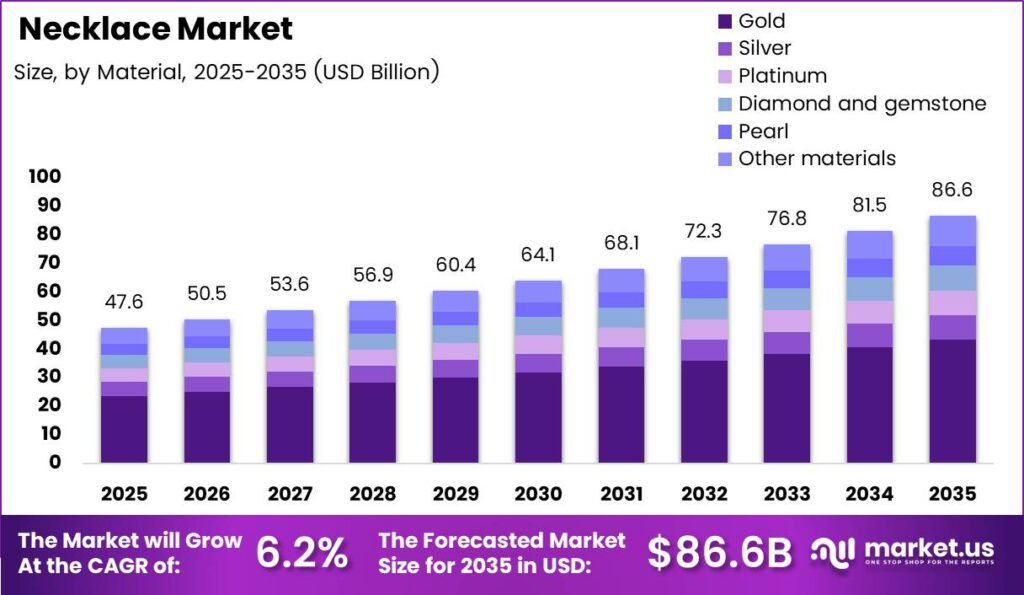
Global Necklace Market size is expected to be worth around USD 86.6 Billion by 2035 from USD 47.6 Billion in 2025, growing at a CAGR of 6.2% during the forecast period 2026 to 2035.
The necklace market encompasses all manufactured and traded necklace products spanning fine jewellery, fashion jewellery, and luxury adornment categories. It includes pendant necklaces, chain necklaces, choker necklaces, statement necklaces, beaded necklaces, and other necklace forms. Products are sold across jewelry stores, online retail, department stores, and brand-owned boutiques globally.
Key Takeaways
- The global necklace market is valued at USD 47.6 Billion in 2025 and is forecast to reach USD 86.6 Billion by 2035.
- The market grows at a CAGR of 6.2% from 2026 to 2035.
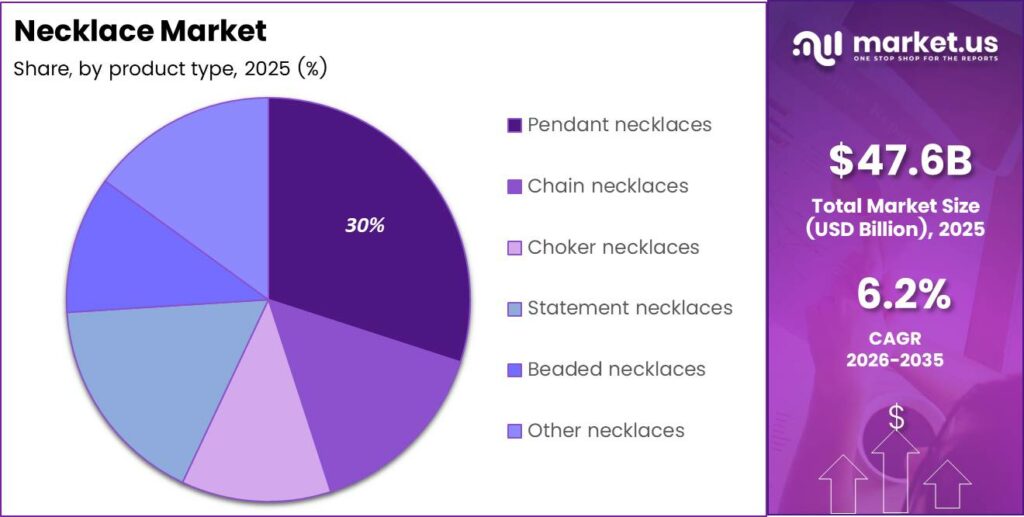
- Pendant necklaces dominate the By Product Type segment with a 30.0% share.
- Gold dominates the By Material segment with a 48.0% share.
- Mass dominates the By Price Range segment with a 45.0% share.
- Jewelry stores dominate the By Distribution Channel segment with a 42.0% share.
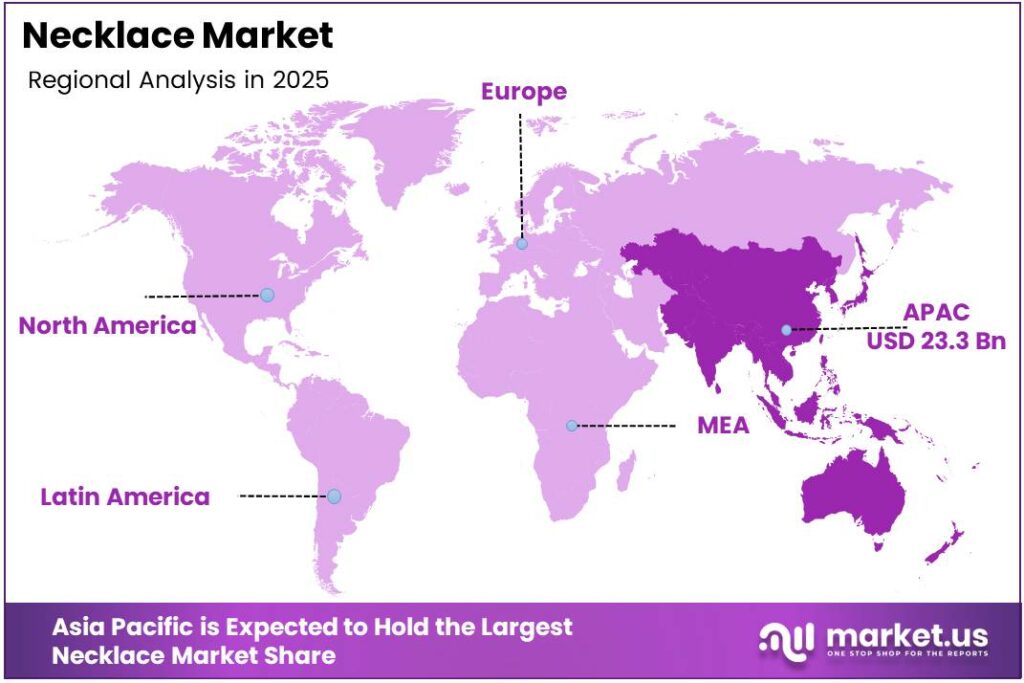
- Asia Pacific is the dominant region with a 49.0% market share, valued at USD 23.3 Billion in 2025.
Global trade in goods and services exceeded USD 35 trillion in 2025, confirming that cross-border consumption channels are deep and active. World merchandise exports reached USD 26.26 trillion in 2025, up 7% from 2024. These figures confirm that necklace brands with export-ready logistics and multi-currency pricing hold a structural advantage over domestically anchored competitors.
However, macroeconomic conditions tighten the operating environment for discretionary categories. Global growth is forecast to slow from 2.9% in 2025 to 2.5% in 2026. Export tariffs rose 10% for developed economies, 16% for developing economies, and 18% for least-developed economies in 2025. Brands that rely on cross-border sourcing or export-led revenue must reprice, reroute supply chains, or absorb margin compression.
Business e-commerce sales across 43 economies reached almost USD 27 trillion in 2022, confirming that digital channels carry substantial transaction volume in jewellery-adjacent retail. This creates a direct addressable pipeline for necklace brands investing in direct-to-consumer e-commerce. Pandora shifting all jewellery production to 100% recycled silver and gold, projected to avoid about 58,000 tonnes of greenhouse-gas emissions each year, shows that sustainability investment is now a commercial signal, not only a reputational one.
Product Type Analysis
Pendant Necklaces dominate with 30.0% due to strong gifting and personal-expression demand.
In 2025, Pendant Necklaces held a dominant market position in the By Product Type segment of the Necklace Market, with a 30.0% share. Pendant designs attract buyers across mass, premium, and luxury price tiers because a single chain can accommodate multiple interchangeable pendants, raising per-customer lifetime value. Retailers that offer modular pendant systems generate repeat traffic for pendant refreshes rather than waiting for full-necklace replacement cycles.
Chain necklaces serve as the foundational product in both fine and fashion jewellery assortments, functioning as standalone pieces and as carriers for pendant upgrades. Their consistent demand across age groups and price points makes them a stable inventory category. Pandora launched lab-grown-diamond jewellery in Spain and Italy through two flagship stores and 40 selected Italian stores, with chain-compatible designs central to that expansion.
Choker necklaces capture trend-driven buyers concentrated in North America, Europe, and East Asia, where fashion cycle responsiveness drives short replenishment windows. Their lower metal content relative to longer chain styles positions them as an accessible entry point in the fine jewellery category. This means mass-market producers can serve trend demand without carrying the working-capital risk of heavier gold styles.
Statement necklaces, beaded necklaces, and other necklace forms collectively hold the remaining share of the By Product Type segment. These categories serve distinct consumer subgroups including festival buyers, artisan-craft collectors, and occasion-specific purchasers. Their combined presence signals that the necklace market serves fragmented demand rather than one concentrated buyer profile.
Material Analysis
Gold dominates with 48.0% due to its dual role as adornment and store of value.
In 2025, Gold held a dominant market position in the By Material segment of the Necklace Market, with a 48.0% share. As reported by the USGS, U.S. gold mine production was estimated at 160 metric tons and USD 17 billion in 2025. Gold prices rose 44.4% and exceeded USD 5,000 per ounce, compressing volume demand while lifting per-unit revenue. Brands anchored in gold necklaces must actively manage inventory weight tiers and offer exchange programs to protect conversion rates.
Silver necklaces serve a structurally important role as the accessible entry category for fine-jewellery buyers, particularly in markets where gold price sensitivity is high. Data from the World Integrated Trade Solution shows Thailand supplied USD 474.481 million and 359,053 kg of silver jewellery and parts to the United States in 2023. Thailand imported USD 216.799 million of silver jewellery and parts in 2023, confirming it as both a major origin and a key processing economy for global silver necklace supply chains.
Platinum necklaces occupy a small but high-margin tier, concentrated in luxury engagement and anniversary categories where metal rarity reinforces premium positioning. Their purchase cycle is longer than gold or silver, and buyer concentration in Japan, Europe, and North America makes them sensitive to disposable income conditions in those markets. Sellers in this tier compete on craftsmanship and provenance rather than price.
Diamond and gemstone, pearl, and other material necklaces collectively hold the remaining share of the By Material segment. Japan exported USD 241.721 million and 19,343 kg of worked cultured pearls in 2023, confirming Japan as the primary supply origin for high-quality pearl necklaces globally. This concentration of supply means pearl necklace retailers face geographic sourcing risk that diversified material categories do not.
Price Range Analysis
Mass dominates with 45.0% due to broad consumer access and high purchase frequency.
In 2025, Mass held a dominant market position in the By Price Range segment of the Necklace Market, with a 45.0% share. Mass-tier necklaces serve the largest buyer pool across all geographies, driven by fashion-led purchases, gifting occasions, and everyday wear demand. Brands that build reliable supply chains in this segment can achieve high unit volumes with lower per-order risk than premium or luxury equivalents.
Premium necklaces serve buyers who seek design differentiation and material quality above mass-market standards but remain price-sensitive relative to luxury. This segment benefits from the aspirational consumer cohort in Asia Pacific and North America who trade up from mass on milestone occasions. Retailers that offer instalment payment options in this tier convert browsers into buyers more effectively than those relying on full upfront pricing.
Luxury necklaces capture the smallest share by volume but carry the highest revenue-per-unit contribution. EU exports of non-silver precious-metal jewellery reached USD 14.940 billion in 2023, with European luxury houses representing a significant portion of that figure. This means luxury necklace revenue is disproportionately concentrated in a small number of established European brands with strong heritage positioning.
Distribution Channel Analysis
Jewelry Stores dominate with 42.0% due to trust, tactile experience, and high-value purchase behaviour.
In 2025, Jewelry Stores held a dominant market position in the By Distribution Channel segment of the Necklace Market, with a 42.0% share. Physical jewellery retail provides the in-person consultation, hallmark verification, and try-on experience that buyers of high-value necklaces consistently require before committing. Retailers that invest in trained floor staff and in-store certification displays defend this channel’s share against online competition.
Online retail is the fastest-expanding channel in the necklace market, driven by improving visual merchandising technology, augmented reality try-on tools, and digital-native shopper cohorts. Brands that invest in high-resolution product photography, detailed certification documentation, and fast returns infrastructure outperform peers still relying on static catalogue listings. This channel creates the largest addressable reach for brands seeking to expand without the fixed cost of store networks.
Department stores and brand-owned boutiques collectively serve complementary buyer profiles: department stores attract cross-category shoppers who discover jewellery alongside apparel, while boutiques serve brand-loyal and gift buyers seeking curated experiences. Other channels, including airport retail and pop-up formats, hold the remaining share and serve high-spending traveller and event-driven buyer segments. Zales unveiled “The Edit” retail concept across three identified locations in December 2025, signalling that physical format innovation remains an active competitive lever.
Key Market Segments
By Product Type
- Pendant Necklaces
- Chain Necklaces
- Choker Necklaces
- Statement Necklaces
- Beaded Necklaces
- Other Necklaces
By Material
- Gold
- Silver
- Platinum
- Diamond and Gemstone
- Pearl
- Other Materials
By Price Range
- Mass
- Premium
- Luxury
By Distribution Channel
- Jewelry Stores
- Online Retail
- Department Stores
- Brand-Owned Boutiques
- Other Channels
Regional Analysis
Asia Pacific Dominates the Necklace Market with a Market Share of 49.0%, Valued at USD 23.3 Billion
Asia Pacific commands 49.0% of global necklace market revenue, valued at USD 23.3 Billion in 2025. China, India, and Southeast Asia drive this dominance through deep bridal jewellery traditions, cultural gifting norms, and a large base of middle-income consumers with rising purchasing power. Germany exported USD 1.075 billion and 11,518 kg of jewellery made from precious metal other than silver in 2023, illustrating that even European luxury supply chains depend on Asia Pacific consumption pipelines to sustain premium volume.
The Middle East represents the fastest-growing regional opportunity in the necklace market. Titan agreed to acquire 67% of Damas Jewellery’s GCC business at an enterprise value of AED 1,038 million in July 2025, confirming institutional confidence in GCC jewellery retail expansion. Thailand supplied USD 474.481 million of silver jewellery to the United States in 2023, demonstrating that Southeast Asian manufacturing hubs already serve major Western markets, creating supply chain bridges between Asia Pacific production and Middle East and North America consumption.
North America and Europe represent the primary luxury and premium necklace consumption regions outside Asia Pacific. Both regions face near-term headwinds from tariff exposure and slower consumer spending, but they sustain the highest average transaction values globally. Latin America and the Middle East and Africa regions hold smaller revenue shares but present long-term growth potential as organized jewellery retail infrastructure expands in urban centres.
Key Regions and Countries
North America
- US
- Canada
Europe
- Germany
- France
- The UK
- Spain
- Italy
- Rest of Europe
Asia Pacific
- China
- Japan
- South Korea
- India
- Australia
- Rest of APAC
Latin America
- Brazil
- Mexico
- Rest of Latin America
Middle East and Africa
- GCC
- South Africa
- Rest of MEA
Market Dynamics
Market Opportunity Analysis - Underpenetrated price tiers and emerging regions offer high-return entry points for necklace brands
The mass price tier commands 45.0% of global necklace market share but remains underserved in terms of design variety and certified quality assurance outside established retail networks. Brands that introduce hallmark-verified mass-tier necklaces through organized retail or direct-to-consumer digital channels can capture a buyer segment currently purchasing from unorganized or uncertified sellers. This shift from unorganized to certified supply is a structural revenue opportunity, not a trend-dependent one.
Online retail remains structurally underdeveloped relative to its addressable reach in the necklace market. Physical jewelry stores command 42.0% of distribution, yet digital channel infrastructure for high-value necklace categories, including virtual try-on, certification documentation, and returns management, remains incomplete across most mid-tier brands. New entrants that build frictionless online purchase experiences for necklaces priced between USD 249 and USD 4,000 address a buyer cohort that currently defaults to physical retail by necessity rather than preference.
The Middle East and Africa region holds a smaller share of current necklace market revenue but demonstrates strategic acquisition activity at scale. Titan’s AED 1,038 million enterprise-value transaction for Damas Jewellery’s GCC business confirms that organized jewellery retail in the GCC is attractive enough for large-cap acquirers to deploy significant capital. Brands that establish early retail or wholesale presence in GCC urban markets position themselves ahead of the consolidation wave now visible in deal activity.
Pearl necklaces represent a high-margin, supply-concentrated sub-segment with limited organized retail competition outside Japan and select European markets. Japan exported USD 241.721 million of worked cultured pearls in 2023, but downstream retail of pearl necklaces remains fragmented globally. Distributors and retailers that build authenticated pearl necklace collections with clear provenance documentation can command premium pricing in markets where pearl supply is available but retail presentation remains underdeveloped.
Technology and Innovation Landscape - Recycled materials, lab-grown stones, and digital production tools redefine competitive positioning in the necklace market
Pandora’s shift to 100% recycled silver and gold production, projected to avoid about 58,000 tonnes of greenhouse-gas emissions each year, establishes recycled-metal sourcing as a commercially viable and scalable production standard. This move signals that recycled-material supply chains are no longer a niche or cost-prohibitive option. Competitors that delay similar transitions risk losing sustainability-driven buyers to brands that already communicate verified recycled content.
Lab-grown diamonds are moving from experimental to mainstream in necklace collections. Pandora’s carbon-footprint labels showing approximately 90% lower environmental impact than mined stones give buyers a quantified reason to choose lab-grown alternatives. Brands that adopt transparent impact labelling on lab-grown diamond necklaces can accelerate purchase decisions among environmentally motivated buyers who previously lacked a clear comparative metric.
Pandora’s USD 150 million Vietnam crafting facility, planned for up to 60 million pieces annually, demonstrates that large-scale necklace manufacturers are investing in geographically diversified, purpose-built production infrastructure. This facility model combines precision crafting volume with lower labour cost, creating a cost structure that mass-market competitors in higher-cost manufacturing locations will struggle to match at equivalent output scale.
Malabar Group’s ₹1,000 crore integrated Hyderabad jewellery manufacturing facility reflects parallel investment in India-based production capability. As India’s domestic necklace market scales, integrated manufacturing capacity reduces import dependence and shortens lead times for bridal and occasion-driven inventory cycles. Brands that invest in domestic Indian manufacturing now position their supply chains ahead of hallmarking compliance requirements that raise the barrier to entry for imported product.
Drivers
Bridal and occasion-driven purchases remain the most reliable demand engine in the necklace market. Wedding, festival, anniversary, and milestone purchases sustain consistent sell-through across price tiers. Global gold-jewellery spending increased by 9% in 2024 even as consumption volume fell 11% to 1,877 tonnes, confirming that occasion buyers sustain value commitment when they reduce gram weight. Retailers aligned with wedding calendars protect margin mix by shifting toward design differentiation and certified provenance.
Lightweight gold design adoption and direct-to-consumer social commerce compound this structural demand. In 2025, global jewellery demand value rose 18% while volume fell 18%, confirming that lighter, higher-design-value pieces are replacing heavier formats in high-price environments. Brands using social commerce to reach buyers directly reduce distribution cost and capture first-party data that supports personalization and repeat-purchase programs.
| Driver | (~) % Impact on CAGR Forecast | Geographic Relevance | Impact Timeline |
|---|---|---|---|
| Bridal and Occasion Demand | +1.3% | India, Middle East, South Asia, North America | Short term (≤ 2 years) |
| Lightweight Gold Designs | +1.0% | India, China, Middle East, Southeast Asia | Short term (≤ 2 years) |
| Hallmarked Purity Assurance | +0.8% | India | Short term (≤ 2 years) |
| Direct-to-Consumer Social Commerce | +0.7% | North America, Europe, India, Southeast Asia | Short term (≤ 2 years) |
| Layering and Personalization Trends | +0.6% | North America, Europe, East Asia | Medium term (2–4 years) |
| Premium Gifting Recovery | +0.4% | Global urban consumer markets | Short term (≤ 2 years) |
Restraints
Record precious-metal prices act as an immediate affordability constraint across the necklace market. Gold-jewellery demand fell to 1,542 tonnes in 2025, its lowest level in the cited five-year series, after 53 new all-time gold-price highs during the year. Fabrication declined by 19% to 1,638 tonnes. Retailers in price-sensitive markets face reduced unit throughput and rising inventory-value risk as consumers defer purchases or opt for exchange programs over newly fabricated pieces.
Consumer discretionary spending pressure and compliance costs compound this effect. Mandatory hallmarking requirements in India add operational overhead for independent retailers, while import-duty exposure in North America and India raises landed cost for international necklace collections. Counterfeit premium jewellery on global online marketplaces erodes brand equity and shifts price anchors downward for legitimate sellers in affected categories.
| Restraint | (~) % Impact on CAGR Forecast | Geographic Relevance | Impact Timeline |
|---|---|---|---|
| Record Precious-Metal Prices | -1.5% | Global, especially India, China and Middle East | Short term (≤ 2 years) |
| Consumer Discretionary Spending Pressure | -0.9% | North America, Europe, urban Asia-Pacific | Short term (≤ 2 years) |
| Mandatory Hallmarking Compliance Costs | -0.6% | India | Short term (≤ 2 years) |
| Import-Duty and Tax Exposure | -0.5% | India, North America, import-dependent markets | Medium term (2–4 years) |
| Counterfeit Premium Jewellery | -0.4% | Global online marketplaces | Medium term (2–4 years) |
| Financing Constraints for Independents | -0.3% | India, Southeast Asia, Middle East | Short term (≤ 2 years) |
Challenges
Gold-price volatility is a continuing operational challenge for necklace manufacturers and retailers. Global jewellery consumption volume fell from 1,877 tonnes in 2024 to 1,542 tonnes in 2025, while demand value increased from USD 144 billion to USD 172 billion. This divergence makes revenue growth a weak proxy for unit health. Companies without bullion hedging, shorter quote-validity periods, and gram-weight-tiered demand forecasting absorb compounding working-capital pressure.
Artisan skill pipeline gaps, traceability data fragmentation, and omnichannel inventory synchronization create parallel operational risks. Cross-border returns complexity adds friction in North America, Europe, and Asia Pacific for retailers expanding online. Small-batch production economics limit margin recovery for premium and luxury necklace brands relying on handcraft production, particularly in Italy, India, and Türkiye where specialist artisan labour is concentrated but constrained in supply.
| Challenge | (~) % CAGR Friction Drag | Geographic Relevance | Mitigation Horizon |
|---|---|---|---|
| Gold Price Volatility Management | -1.0% | Global precious-metal necklace supply chain | Medium term (2–4 years) |
| Artisan Skill Pipeline Gaps | -0.7% | India, Italy, Türkiye, Thailand, China | Long term (≥ 4 years) |
| Traceability Data Fragmentation | -0.6% | Global cross-border supply chains | Medium term (2–4 years) |
| Small-Batch Production Economics | -0.5% | North America, Europe, premium urban markets | Medium term (2–4 years) |
| Omnichannel Inventory Synchronization | -0.4% | Global organized retail | Short term (≤ 2 years) |
| Cross-Border Returns Complexity | -0.3% | North America, Europe, Asia-Pacific | Medium term (2–4 years) |
Opportunities
Circular exchange and subscription models represent the most structurally underexploited opportunity in the necklace market. Consumers already exchange old gold jewellery instead of purchasing new pieces when prices rise. A structured exchange-and-membership program can reduce customer acquisition cost by an estimated 15% to 30% versus paid digital channels and reduce metal procurement exposure per sold necklace by approximately 10% to 25% where recovered metal re-enters production efficiently.
Lab-grown diamond necklaces and personalized digital design create two additional high-upside entry points. Lab-grown diamonds carry an estimated 90% lower carbon footprint than mined alternatives, which supports pricing premiums in sustainability-conscious markets. Personalized digital design tools, including virtual try-on and custom engraving configurators, convert online browsers into confirmed buyers faster than static catalogue formats, especially in North America, India, and China.
| Opportunity | (~) % Potential CAGR Upside | Geographic Relevance | Execution Window |
|---|---|---|---|
| Circular Exchange Subscription Models | +1.4% | India, China, Middle East, North America | Medium term (2–4 years) |
| Lab-Grown Diamond Necklaces | +1.1% | North America, India, China, Europe | Medium term (2–4 years) |
| Personalized Digital Design | +0.9% | Global digitally engaged consumers | Short term (≤ 2 years) |
| Men’s Fine Necklace Expansion | +0.8% | North America, Europe, East Asia, Middle East | Medium term (2–4 years) |
| Verified Recycled Metal Lines | +0.7% | Europe, North America, Japan, Australia | Medium term (2–4 years) |
| Regional Artisan Brand Roll-Ups | +0.6% | India, Italy, Türkiye, Southeast Asia | Long term (≥ 4 years) |
Key Company Insights
LVMH Moët Hennessy Louis Vuitton SE recorded €80.8 billion of revenue in 2025, giving its jewellery divisions scale advantages in sourcing, retail network investment, and brand marketing that independent necklace brands cannot match. Richemont’s Jewellery Maisons generated €16.5 billion of sales in FY2026, confirming that dedicated fine-jewellery conglomerates sustain revenue scale even during periods of gold-price volatility and macroeconomic pressure.
Pandora A/S generated DKK 32.5 billion, equivalent to €4.4 billion, of revenue in 2025. Pandora sold 107 million pieces of jewellery in 2023 and distributes through around 7,000 points of sale, including more than 2,800 concept stores globally. Pandora introduced lab-grown-diamond carbon-footprint labels showing around 90% lower footprint than mined alternatives in May 2026, positioning sustainability transparency as a direct purchase driver. Signet Jewelers operated 2,559 stores covering 4.0 million square feet as of 2 May 2026.
KAY’s Monique Lhuillier fashion-jewellery assortment ranges from USD 249.99 to USD 3,999.99, demonstrating Signet’s cross-tier pricing reach. Kering held its first Kering Generation Award X Jewelry with participation from 10 universities, academies, and startups in June 2025, signalling active pipeline investment in next-generation jewellery design talent. Tiffany supplied 27 archival and contemporary jewels for Guillermo del Toro’s film presentation in September 2025, reinforcing cultural relevance as a strategic brand asset. QWEEN secured ₹1,000 crore from Rosy Blue and Kashikey for Indian expansion in December 2025, confirming that mid-tier Indian jewellery brands attract institutional capital as the domestic market scales.
Tiffany’s high-jewellery collections demonstrate the commercial power of extreme gemstone storytelling. A Tiffany high-jewellery pendant used a green tourmaline of more than 43 carats in 2026, and one Tiffany high-jewellery necklace contained more than 58 total carats of diamonds. The Tiffany Muzo emerald acquisition secured a stone of over 10 carats sourced from the famed Muzo mines of Colombia. Graff Diamonds set a high-jewellery necklace with 150 total carats of diamonds, establishing a competitive benchmark that forces other luxury necklace producers to compete on provenance, carat weight, and cut complexity rather than price.
Key Players
- LVMH Moët Hennessy Louis Vuitton SE
- Compagnie Financière Richemont SA
- Chow Tai Fook Jewellery Group Limited
- Signet Jewelers Limited
- Pandora A/S
- Swarovski AG
- Titan Company Limited
- Tiffany & Co.
- Cartier International SNC
- Bulgari S.p.A.
- Van Cleef & Arpels
- Malabar Gold & Diamonds
- Graff Diamonds Limited
- Luk Fook Holdings (International) Limited
- Kering S.A.
Recent Developments
- December 2025 – Kering acquired an initial 20% stake in Raselli Franco Group for €115 million, strengthening its jewellery manufacturing capabilities through a staged acquisition structure.
- March 2025 – Jared launched the Vera Wang VOW collection with 38 ring styles, expanding Signet’s designer collaboration portfolio in the fine jewellery segment.
- December 2025 – Zales unveiled “The Edit” retail concept across 3 identified locations, introducing a modern physical format designed to attract a younger jewellery buyer demographic.
- August 2025 – Malabar Group launched an integrated Hyderabad jewellery manufacturing facility with ₹1,000 crore investment, expanding domestic Indian production capacity.
- May 2024 – Pandora began construction on a USD 150 million Vietnam crafting facility planned for up to 60 million pieces annually, diversifying production geography beyond its Thailand base.
- September 2024 – Richemont completed the acquisition of 100% of Vhernier, reporting €132 million in related acquisition cash outflow, adding an Italian fine-jewellery maison to its portfolio.
- May 2025 – Priority Jewels filed an IPO for up to 5,400,000 equity shares to fund working capital, technology, and manufacturing expansion in the Indian jewellery sector.
- April 2024 – Tiffany launched Blue Book 2024: Tiffany Céleste in 3 phases across spring, summer, and fall, presenting a high-jewellery collection spanning multiple seasonal activations.
Report Scope
| Report Features | Description |
|---|---|
| Market Value (2025) | USD 47.6 Billion |
| Forecast Revenue (2035) | USD 86.6 Billion |
| CAGR (2026-2035) | 6.2% |
| Base Year for Estimation | 2025 |
| Historic Period | 2020-2024 |
| Forecast Period | 2026-2035 |
| Report Coverage | Revenue Forecast, Market Dynamics, Market Opportunity Analysis, Technology and Innovation Landscape, Competitive Landscape, Recent Developments |
| Segments Covered | By Product Type (Pendant Necklaces, Chain Necklaces, Choker Necklaces, Statement Necklaces, Beaded Necklaces, Other Necklaces), By Material (Gold, Silver, Platinum, Diamond and Gemstone, Pearl, Other Materials), By Price Range (Mass, Premium, Luxury), By Distribution Channel (Jewelry Stores, Online Retail, Department Stores, Brand-Owned Boutiques, Other Channels) |
| Regional Analysis | North America (US and Canada), Europe (Germany, France, The UK, Spain, Italy, and Rest of Europe), Asia Pacific (China, Japan, South Korea, India, Australia, and Rest of APAC), Latin America (Brazil, Mexico, and Rest of Latin America), Middle East and Africa (GCC, South Africa, and Rest of MEA) |
| Competitive Landscape | LVMH Moët Hennessy Louis Vuitton SE, Compagnie Financière Richemont SA, Chow Tai Fook Jewellery Group Limited, Signet Jewelers Limited, Pandora A/S, Swarovski AG, Titan Company Limited, Tiffany & Co., Cartier International SNC, Bulgari S.p.A., Van Cleef & Arpels, Malabar Gold & Diamonds, Graff Diamonds Limited, Luk Fook Holdings (International) Limited, Kering S.A. |
| Customization Scope | Customization for segments, region/country-level will be provided. Additional customization can be done based on requirements. |
| Purchase Options | We have three licenses to opt for: Single User License, Multi-User License (Up to 5 Users), Corporate Use License (Unlimited User and Printable PDF) |





































