


Report Overview
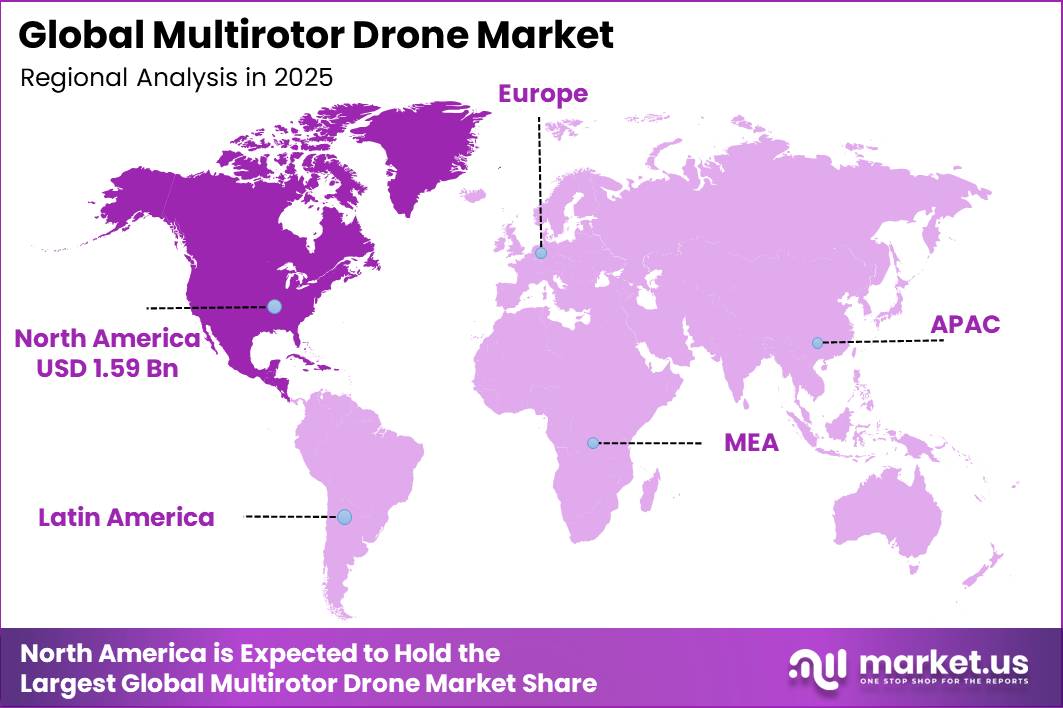
In 2025, the Global Multirotor Drone Market was valued at USD 3.9 billion. The market is projected to grow at a CAGR of 15.3% during 2026–2035, reaching approximately USD 16.0 billion by 2035. North America dominated the global market in 2025, accounting for more than 40.7% of the total market share and generating approximately USD 1.5 billion in revenue.
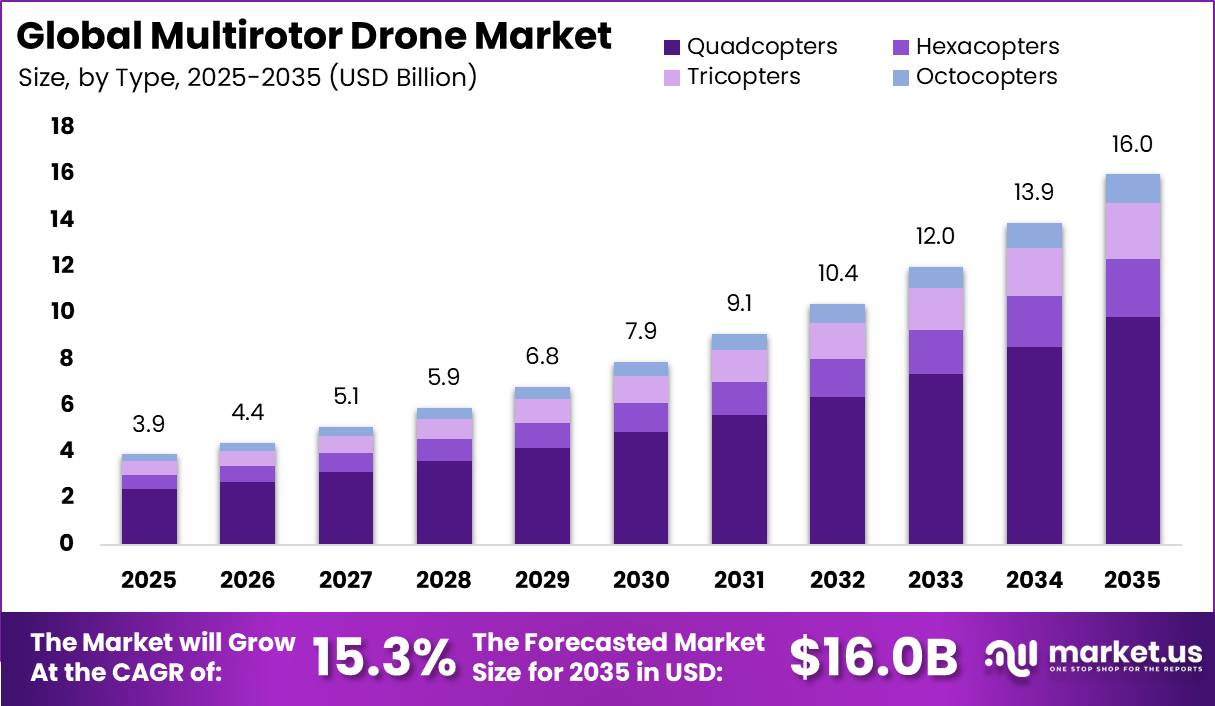
Growth is supported by rising drone use across agriculture, construction, infrastructure inspection, public safety, and defense. In the United States, the USDA reported around 1.9 million farms covering nearly 880 million acres in 2022. The average farm size reached 463 acres, creating strong demand for drones that can monitor crops, identify irrigation problems, survey large fields, and support precision spraying.
Construction also provides a major opportunity, with U.S. construction spending reaching an annual rate of USD 2.1 trillion in June 2025, including about USD 1.2 trillion in non-residential projects. Multirotor drones are useful in these applications because they can hover, capture detailed images, and inspect difficult or unsafe locations.
The FAA estimated that Part 107 commercial operators completed more than 16.6 million drone flights in 2024. By December 2024, the agency had issued 405,682 remote-pilot certificates, increasing by more than 38,000 within one year. Defense demand also remains significant, with the U.S. Department of Defense requesting USD 9.4 billion for unmanned and remotely operated aerial vehicles under its FY2026 autonomy funding.
Key Takeaways
- The Multirotor Drone Market is valued at USD 3.9 billion in 2025, projected to reach USD 16.0 billion by 2035 at a 15.3% CAGR.
- Quadcopters dominated the type segment with a 61.5% share due to stability, payload handling, and affordability.
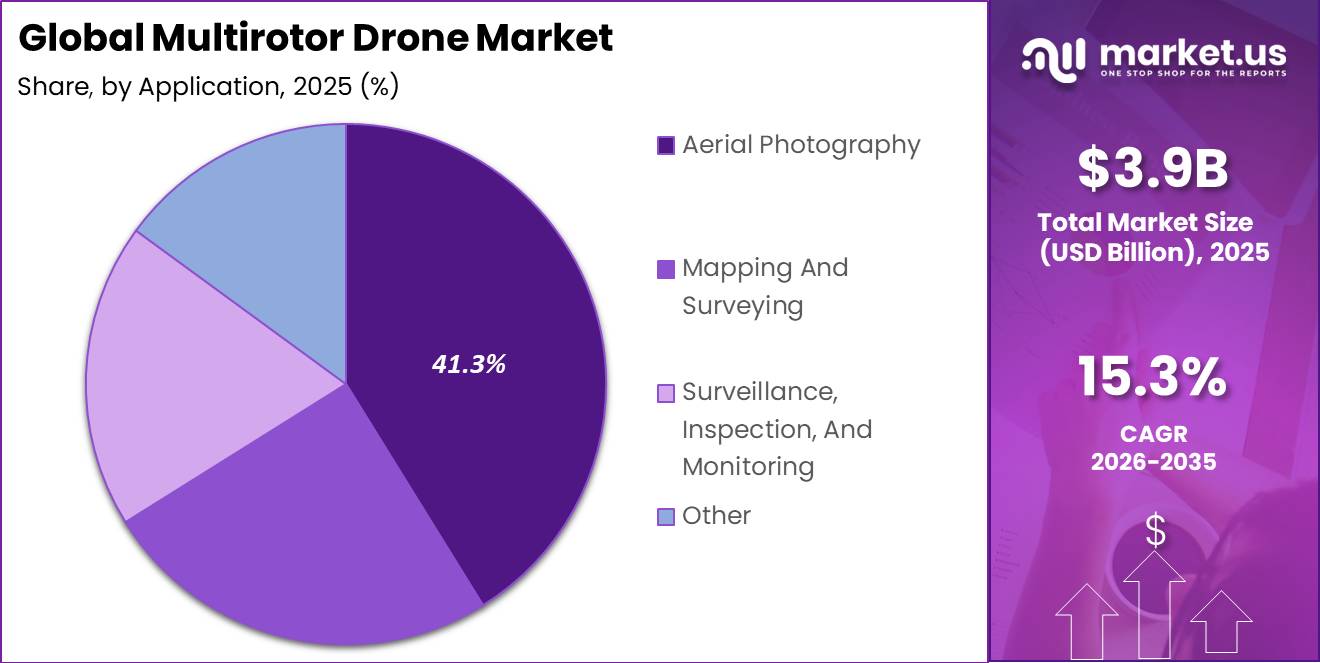
- Aerial photography led applications with a 41.3% share, driven by real estate, tourism, and media use.
- Commercial end-use held the largest share at 45.5%, supported by expanding registration and certification systems.
- North America led the market in 2025 with a 40.7% share and USD 1.5 billion in revenue.
By Type
Quadcopters held a leading position in the multirotor drone market, accounting for a 61.5% share. Their four-rotor design provides a strong balance of flight stability, payload handling, easy control, and affordable purchase cost. Quadcopters can take off and land vertically, hover at a fixed point, and operate in narrow areas without requiring a runway.
According to the U.S. Federal Aviation Administration, the commercial small drone fleet reached 842,460 units in 2023 and is projected to increase to 1.03 million units in 2025. General photography and real estate applications represented around 600,300 commercial drone units in 2023, accounting for 81.9% of the tracked market.
These applications depend heavily on stable hovering and accurate camera positioning, which are major strengths of quadcopters. Their relatively simple mechanical structure also supports faster deployment and lower operating effort compared with more complex drone platforms, strengthening their position in routine commercial operations.
By Application
Aerial Photography held a leading position in the multirotor drone market, accounting for a 41.3% market share. Its strong position is supported by wide use across real estate, tourism, events, film production, mapping, and project documentation. Multirotor drones can hover at a fixed height, maintain stable camera positioning, and capture high-resolution images from locations that may be difficult or expensive to reach using crews, cranes, or helicopters.
The U.S. Bureau of Labor Statistics reported 53,630 photographers in 2023, including 26,970 working in professional, scientific, and technical services. This represents a large commercial base that can benefit from drone-supported photography and imaging services. In Europe, the European Commission expects civil drone services, including mapping and imaging, to become part of regular business activities by 2030.
The region’s drone-services market could reach around EUR 14.5 billion and support nearly 145,000 jobs. Growing demand for image-based services continues to support multirotor drones, as their stable hovering capability improves image quality, repeatability, and operator control.
By End-Use
The Commercial segment held a leading position in the multirotor drone market, accounting for a 45.5% share. Its strong position is supported by repeated business use in property imaging, site surveys, asset inspection, mapping, security, and media production. Multirotor drones are well suited to these tasks because they can take off vertically, hover in one place, and operate close to buildings and towers.
Commercial adoption is also increasing as more countries expand formal drone registration and pilot certification systems. Transport Canada reported 111,362 registered drones in May 2025, along with 119,693 Basic Pilot Certificates and 17,404 Advanced Pilot Certificates. In the United Kingdom, the Civil Aviation Authority recorded more than 2,500 active Specific Category operational approvals in 2024.
By Payload
Camera and Imaging Systems held a leading position in the multirotor drone payload market, accounting for a 55.2% share. Their dominance is supported by the growing need for visual and sensor-based data across mapping, infrastructure inspection, agriculture, and emergency response. High-resolution RGB, multispectral, thermal, and hyperspectral cameras allow multirotor drones to collect detailed information while hovering over specific locations.
The U.S. Geological Survey reported that drone-mounted visible, multispectral, and thermal cameras achieved ground resolution ranging from 2.5 to 12 centimetres while mapping agricultural drainage networks. Its field research also found that thermal imagery identified drainage lines at 20 of 29 sites, compared with 14 sites using visible imagery.
Key Market Segments
By Type
- Quadcopters
- Hexacopters
- Tricopters
- Octocopters
By Application
- Aerial Photography
- Mapping and Surveying
- Surveillance, Inspection, and Monitoring
- Other
By End-Use
- Commercial
- Military and Government
- Consumer
By Payload
- Camera and Imaging Systems
- Control Systems
- Tracking Systems
- Others
Geopolitical Impact Analysis
Geopolitical tensions between the United States and China are becoming a major cost and supply-chain factor for the multirotor drone market, mainly because China remains an important supplier of drone components. Following the “Liberation Day” tariffs, U.S. Customs and Border Protection confirmed a cumulative 170% tariff on Chinese-origin drones as of April 2025, compared with a 25% base rate.
This means importers may face landed costs equal to about 2.7 times the original level. In July 2026, the U.S. Department of Commerce also launched a Section 232 investigation into Chinese drones and polysilicon, while drones were already subject to an additional 55% duty under existing trade measures.
Supply risks are also increasing. China’s Ministry of Commerce introduced export-license requirements covering 12 rare-earth elements and related permanent magnets through announcements made in April and October 2025. The International Energy Agency noted that these rules can apply to foreign-made components containing only 0.1% Chinese-sourced content.
China’s rare-earth magnet exports declined 6.1% month-on-month in September 2025 and were down 7.5% year-on-year during the first three quarters. Regulatory changes are adding further pressure. The U.S. Federal Communications Commission restricted imports of new foreign-made drones from December 22, 2025, while China’s export-license reviews can take up to 45 working days.
Regional Analysis
North America led the global multirotor drone market in 2025, accounting for a 40.7% revenue share and generating around USD 1.59 billion. The region’s leadership is supported by early commercial adoption, advanced airspace regulations, strong purchasing capacity, and wide drone use across photography, construction monitoring, utility inspection, agriculture, security, and emergency response.
The United States remains the main revenue contributor. The Federal Aviation Administration estimated that the commercial small-UAS fleet reached about 1.1 million aircraft by the end of 2025 and could increase to 1.5 million by 2030. This represents growth of nearly 400,000 commercial units in five years, supporting continued demand for multirotor drones, camera payloads, batteries, software, replacement parts, and maintenance services.
Asia Pacific is expected to be the fastest-growing regional market during the forecast period. The region benefits from strong electronics manufacturing and rising drone adoption across agriculture, infrastructure development, industrial inspection, mapping, media, and public-sector applications. China remains an important production base for motors, flight controllers, imaging systems, and lithium-battery components.
Key Regions and Countries
North America
- US
- Canada
Europe
- Germany
- France
- The UK
- Spain
- Italy
- Rest of Europe
Asia Pacific
- China
- Japan
- South Korea
- India
- Australia
- Rest of APAC
Latin America
- Brazil
- Mexico
- Rest of Latin America
Middle East & Africa
- GCC
- South Africa
- Rest of MEA
Market Dynamics
Drivers
| Driver | (~) % CAGR | Geographic Relevance | Impact Timeline |
|---|---|---|---|
| Commercial fleet expansion | +2.4% | North America | Short term (2 years or less) |
| Industrial visual-data demand | +1.8% | Global | Short term (2 years or less) |
| Public-safety procurement | +1.5% | North America and Europe | Medium term (2 to 4 years) |
| Precision-agriculture adoption | +1.2% | Asia Pacific and Americas | Medium term (2 to 4 years) |
| Enterprise sensor upgrades | +1.0% | Global | Medium term (2 to 4 years) |
Commercial fleet expansion
Commercial fleet growth is the strongest active driver because recurring inspection, mapping, and imaging work is shifting multirotor demand from one-time hardware purchases toward repeat fleet replacement, payload upgrades, and software-linked operations.
The FAA recorded approximately 1.1 million commercial small UAS at the end of 2025 and forecasts approximately 1.5 million by 2030, an addition of roughly 400,000 aircraft. This installed-base expansion directly supports the baseline 15.3% growth outlook.
Regulatory developments are also supporting wider enterprise adoption. FAA registration rules for aircraft above 0.5 pounds, Transport Canada’s registration requirement from 250 grams, and the U.S. Department of Transportation’s 2025 proposal for expanded beyond-visual-line-of-sight operations are helping increase formal drone deployment.
Restraints
| Restraint | (~) % CAGR | Geographic Relevance | Impact Timeline |
|---|---|---|---|
| Foreign-UAS market access limits | -2.6% | United States | Short term (2 years or less) |
| Import-duty cost escalation | -1.5% | United States | Short term (2 years or less) |
| Restricted sensitive-site operations | -0.9% | Global | Medium term (2 to 4 years) |
| Small-buyer capital constraints | -0.7% | Emerging markets | Short term (2 years or less) |
| Data-sovereignty compliance | -0.5% | Europe and North America | Medium term (2 to 4 years) |
Foreign-UAS market access limits
Foreign-UAS restrictions are the most immediate sales restraint because they can remove complete platforms and critical components from regulated procurement channels instead of only slowing adoption. The FCC added foreign-produced UAS and critical UAS components to its Covered List on December 22, 2025, while its January 2026 notice confirmed that the action covered all foreign-produced UAS and critical components.
The U.S. Department of Commerce initiated a Section 232 investigation covering drone imports in 2026, increasing uncertainty around future sourcing and import costs. World Bank is tracking global output growth of only 2.6% in 2026, which may limit the ability of smaller operators to absorb higher prices caused by compliance and supply-chain adjustments.
Challenges
| Challenge | (~) % CAGR | Geographic Relevance | Mitigation Horizon |
|---|---|---|---|
| Magnet supply concentration | -1.8% | Global | Medium term (2 to 4 years) |
| Battery endurance limits | -1.3% | Global | Medium term (2 to 4 years) |
| Airspace integration complexity | -1.0% | Global | Long term (4 years or more) |
| Cybersecurity assurance burden | -0.8% | North America and Europe | Medium term (2 to 4 years) |
| Qualified pilot availability | -0.5% | Global | Short term (2 years or less) |
Magnet supply concentration
Magnet supply concentration is a major operational challenge because brushless propulsion motors and gimbal actuators depend on high-performance rare-earth permanent magnets.
According to the IEA, China accounted for about 60% of magnet-rare-earth mining output, 91% of separation and refining output, and 94% of sintered permanent-magnet production in 2024. The IEA also identified China as the leading refiner for 19 of 20 strategic minerals, with an average share of 70%.
Supply risks increased further when China introduced export controls covering 7 heavy rare-earth elements in April 2025. These restrictions have increased uncertainty around procurement lead times and material availability.
Opportunities
| Opportunity | (~) % CAGR | Geographic Relevance | Execution Window |
|---|---|---|---|
| Drone-as-a-service platforms | +2.2% | Global | Medium term (2 to 4 years) |
| Autonomous dock networks | +1.6% | North America and Asia Pacific | Medium term (2 to 4 years) |
| Healthcare logistics missions | +1.1% | Africa and Asia Pacific | Long term (4 years or more) |
| Digital-twin data subscriptions | +0.9% | Global | Medium term (2 to 4 years) |
| Domestic-component consolidation | +0.7% | North America and Europe | Long term (4 years or more) |
Drone-as-a-service platforms
Drone-as-a-service is future upside rather than a current driver because many asset owners still buy equipment or contract isolated flights instead of committing to multi-year, outcome-based aerial-data agreements.
The FAA’s forecast of commercial UAS growth from approximately 1.1 million units in 2025 to approximately 1.5 million in 2030 creates a large potential installed base for centralized dispatch, maintenance, analytics, and compliance services.
The European Commission estimates that drone services could support 145,000 jobs by 2030, while the World Bank expects emerging-market and developing-economy growth of about 4.0% in 2026, supporting service-led adoption where upfront fleet ownership is difficult.
Converting equipment transactions into subscription contracts can improve fleet utilization by an estimated 20% to 30% and lift gross-margin potential through recurring analytics and maintenance revenue, if operators standardize pilots, payloads, and data workflows.
Key Players Analysis
Among companies with publicly available financial data, Parrot remains one of the leading listed European suppliers of professional micro-UAVs. The company reported consolidated revenue of EUR 79.8 million in 2025, with professional micro-UAVs contributing EUR 47.9 million, or 62% of total group sales.
Photogrammetry products generated another EUR 31.8 million. Professional micro-UAV revenue increased by 2% at constant exchange rates, indicating stable demand despite challenging procurement conditions. Parrot also recorded a gross margin of EUR 60.1 million, equal to 75.4% of revenue, reflecting the higher value of secure drone hardware, software, and mapping solutions.
AgEagle operates as a smaller Tier-2 specialist focused mainly on fixed-wing drones and sensor-based commercial applications. Its 2025 revenue reached USD 12.8 million, including USD 7.9 million from drones and USD 5.0 million from sensors. R&D spending totaled USD 3.6 million, representing about 28% of revenue. The company also raised USD 36.2 million through preferred-stock and warrant financing.
Quantum Systems strengthened its position as a well-funded European challenger by raising EUR 160 million in May 2025 and another EUR 180 million later in the year. Total 2025 funding reached EUR 340 million, valuing the company at more than EUR 3 billion. Intel remains an enabling technology supplier, reporting USD 52.9 billion in 2025 revenue and USD 13.8 billion in R&D, supporting AI, sensing, edge computing, and processing technologies used in autonomous drone systems.
Top Key Players in the Market
- DJI (Da-Jiang Innovations)
- Parrot SA
- Skydio Inc.
- Autel Robotics
- Yuneec International
- Intel Corporation
- AgEagle Aerial Systems Inc.
- Delair
- Quantum Systems
- Hubsan
Recent Developments
- In May 2026, Parrot reported professional micro-UAV revenue of EUR 21.3 million in Q1 2026, more than double the EUR 10.5 million in Q1 2025. The business represented 76% of group revenue, compared with 57% a year earlier.
- In February 2025, DJI introduced Dock 3, its first vehicle-mountable drone-in-a-box system, paired with Matrice 4D and 4TD drones. The aircraft provide up to 54 minutes of forward flight and 47 minutes of hovering, while offering IP55 protection and an IP56-rated dock.
Report Scope
| Report Features | Description |
|---|---|
| Market Value (2025) | USD 3.9 Billion |
| Forecast Revenue (2035) | USD 16.0 Billion |
| CAGR (2026-2035) | 15.3% |
| Base Year for Estimation | 2025 |
| Historic Period | 2020-2024 |
| Forecast Period | 2026-2035 |
| Report Coverage | Revenue Forecast, Market Dynamics, Competitive Landscape, Recent Developments |
| Segments Covered | By Type (Quadcopters, Hexacopters, Tricopters, Octocopters); By Application (Aerial Photography, Mapping and Surveying, Surveillance, Inspection, and Monitoring, Other); By End-Use (Commercial, Military and Government, Consumer); By Payload (Camera and Imaging Systems, Control Systems, Tracking Systems, Others) |
| Regional Analysis | North America – US, Canada; Europe – Germany, France, The UK, Spain, Italy, Rest of Europe; Asia Pacific – China, Japan, South Korea, India, Australia, Singapore, Rest of APAC; Latin America – Brazil, Mexico, Rest of Latin America; Middle East & Africa – GCC, South Africa, Rest of MEA |
| Competitive Landscape | DJI (Da-Jiang Innovations), Parrot SA, Skydio Inc., Autel Robotics, Yuneec International, Intel Corporation, AgEagle Aerial Systems Inc., Delair, Quantum Systems, Hubsan |
| Customization Scope | Customization for segments and region/country-level will be provided. Moreover, additional customization can be done based on the requirements. |
| Purchase Options | We have three licenses to opt for: Single User License, Multi-User License (Up to 5 Users), Corporate Use License (Unlimited Users and Printable PDF) |





































