


Report Overview
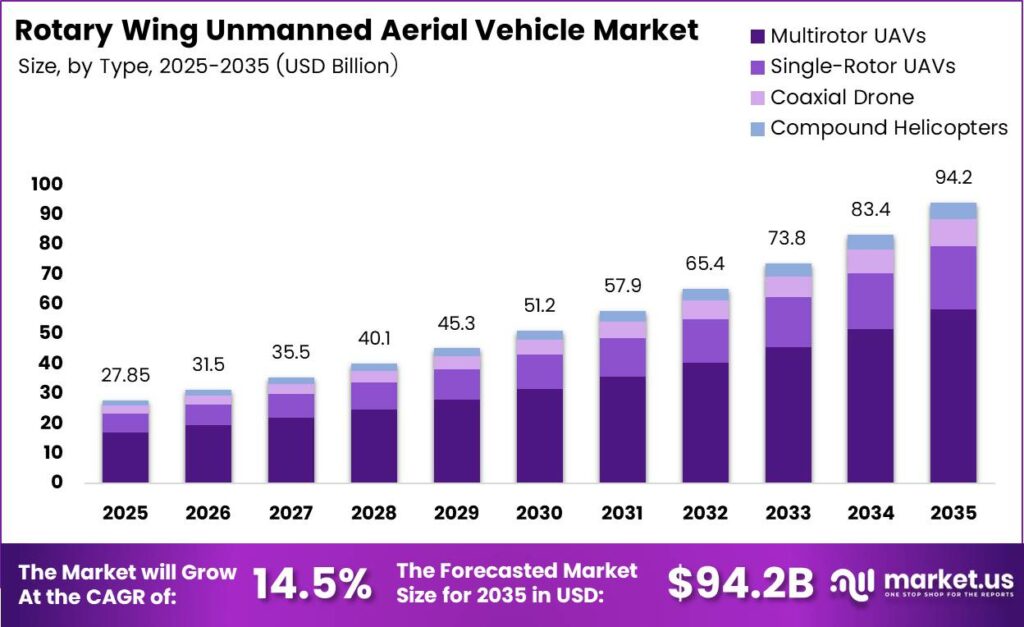
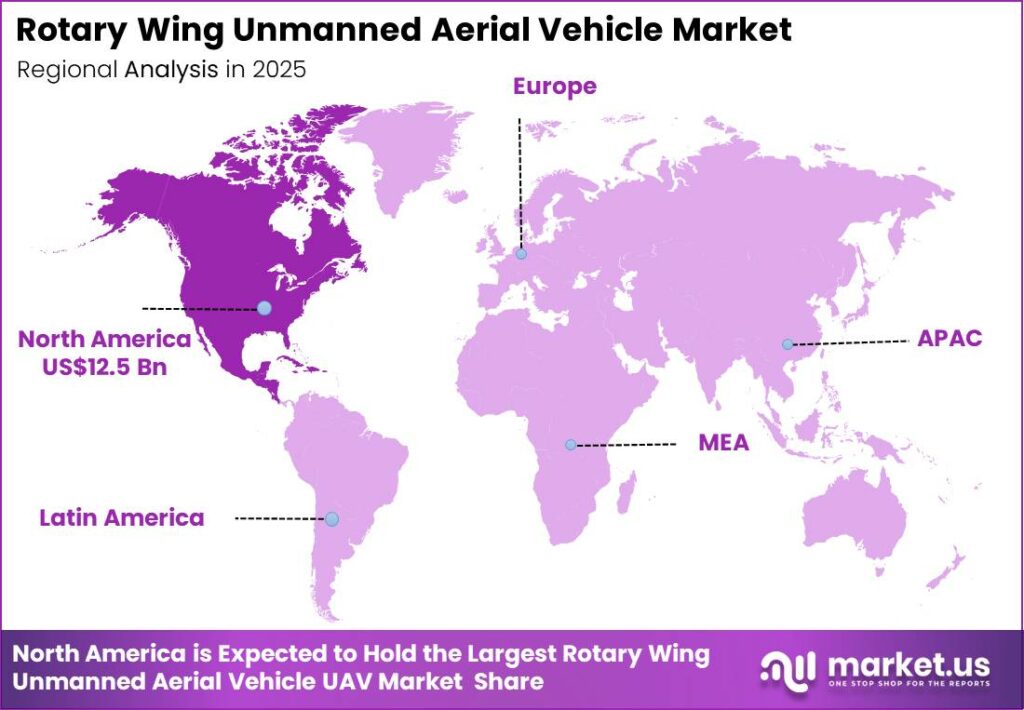
In 2025, the Global Rotary Wing Unmanned Aerial Vehicle UAV Market was valued at US$27.85 billion, and between 2026 and 2035, this market is estimated to register a CAGR of 14.50%, reaching about US$94.2 billion by 2035. North America held a dominant market position, capturing more than a 45.2% share, holding USD 12.5 billion in revenue.
The Rotary Wing Unmanned Aerial Vehicle (UAV) Market is a very important part of the unmanned systems industry. This market allows for flexible aerial operations. It is used in defence, commercial and civil applications. The wing unmanned aerial vehicle market is closely tied to the expansion of modern warfare doctrines and emergency response capabilities. The wing unmanned aerial vehicle market is useful because it can take off and land vertically. This is an advantage over fixed-wing alternatives. Defence and military organizations use the wing unmanned aerial vehicle market the most. They use rotary wing platforms for intelligence, surveillance and reconnaissance missions. The U.S. Department of Defence has increased spending on rotary systems as part of its plan to modernize systems.
The wing unmanned aerial vehicle market is important for multi-domain operations. Most of the production and technology development for the wing unmanned aerial vehicle market happens in North America and Europe. These regions have the advanced rotary wing unmanned aerial vehicle manufacturing capacity. The United States is the leader in this market because of scale military spending and a mature commercial unmanned aerial vehicle market. The Asia Pacific region is growing fast in the wing unmanned aerial vehicle market. China is increasing its production capabilities. Countries like India, Japan and South Korea are also investing in systems programs.
For instance, the FY 2025 budget for the United States Army had USD 570.655 million to be spent on Full Rate Production of AH-64E Apache Remanufacture helicopters aiming at the production objective of 812 such aircraft along with USD 69.573 million allocated to Short Range Reconnaissance, Company Level SUAS and COTS UAS acquisitions.
Key Takeaways
- The Global Rotary Wing Unmanned Aerial Vehicle UAV Market was valued at US$27.85 billion in 2025.
- The Global Rotary Wing Unmanned Aerial Vehicle UAV Market is projected to grow at a CAGR of 14.50% and is estimated to reach US$94.2 billion by 2035.
- On the basis of type, the Multirotor UAVs dominated the market, constituting 62% of the total market share.
- Based on the Rotary Wing Class, the C2 (900 g – 4 kg) dominated the Global Rotary Wing Unmanned Aerial Vehicle UAV Market, with a substantial market share of around 28.5%.
- Based on the control method, Remotely Piloted led the market, comprising 67.9% of the total market.
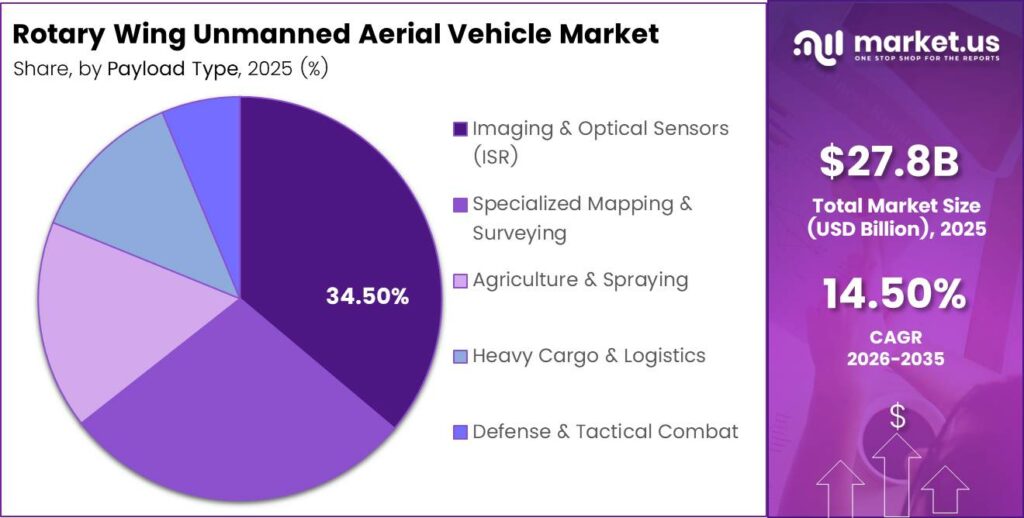
- Based on Payload Type, Imaging & Optical Sensors (ISR) led the market, comprising 34.5% of the total market.
- Among the end-uses, Military & Defence held a major share in the Global Rotary Wing Unmanned Aerial Vehicle UAV Market, 45% of the market share.
- Among the range, the Close Range (Below 50 km) is the most considerable within the market, accounting for around 38.5% of the revenue.
- In 2025, North America was the most dominant region in the Global Rotary Wing Unmanned Aerial Vehicle UAV Market, accounting for 34.1% of the total global consumption.
Type Analysis
Multirotor UAVs represent the dominant segment in the market
Multirotor UAV is the major type of segment, headed by the quadcopter segment accounting for 32.5%, because of their maneuverability, simpler mechanics, flexibility in mounting different payload types, and relatively low cost. Their ability to hover, position accurately, and operate using VTOL technique make them the ideal platform for ISR, infrastructure inspection, and first-responder applications. According to the CY 2024 Small UAS Survey Report issued by the FAA, over 16.6 million flights have been conducted in 2024 by Core Part 107 commercial operators. Multirotor airframes are the primary type of airframe among utility, energy production, real estate, and construction operators.
The fastest growing segment is the single-rotor UAV segment, attributed to higher endurance and larger payload capacity, enabling long-range missions. The FAA Aerospace Forecast predicts a total of about 1.18 million drone fleet in 2029.
Rotary Wing Class Analysis
C2 (900 g – 4 kg) a significant type
The C2 (900 g – 4 kg) segment is dominant in terms of market share (28.5%) due to its optimal combination of payload weight, operational distance, and regulatory availability for use in commercial inspections, precision agriculture, emergency response, and public safety missions. The light but capable nature of this class of drones allows for usage in both urban and semi-urban areas. According to the EASA drone regulation for 2024, drones labeled with C2 which weigh up to 4 kg can operate at a distance of five meters from people who have not been invited into the mission under the A2 subcategory.
C3 (4 kg – 25 kg) is currently the fastest-growing segment (22.3%) due to an increase in defense procurement needs and high payloads in infrastructure inspections. All drones in this segment must have a Remote Identification system in place from January 2024 onward.
Control Method Analysis
Remotely Piloted Are the Most Widely Used Method
Remotely piloted rotary wing UAVs lead as the most dominant control method with a market share of 67.9% due to their regulation-compliant nature, reliable performance, and wide acceptance among governmental, law enforcement, and business institutions around the world. Their ability to have a direct human controller and comply with established visual line-of-sight airspace rules is their main advantage that allows them to dominate the UAV market across various mission scenarios. According to the FAA’s Small UAS Survey Report, emergency services alone performed approximately 58,848 UAV mission operations in 2023 in visual line-of-sight remote control configuration only.
Autonomous and AI-controlled rotary wing UAVs are the fastest growing control method with a market share of 32.1% because of BVLOS regulatory normalization trends and increasing defense investments in unmanned autonomous systems. The BEYOND Phase 1 program carried out by the FAA in 2024 aimed to create guidelines for drones to operate based on already existing regulations instead of waivers and collect performance-based information.
Payload Type Analysis
Imaging & Optical Sensors (ISR) Held a Major Share of the Rotary Wing Unmanned Aerial Vehicle UAV Market
The largest market share belongs to Imaging & Optical Sensors with a market share of 34.5% as it consists of payloads with capabilities to generate and transmit thermal, visual, and multispectral images. Wide usage for defense surveillance and monitoring, for infrastructure inspection, for securing airport perimeters, and in other fields where public safety is paramount explains the dominant share held by this payload type. According to the FAA’s evaluation, the effectiveness of thermal and visual camera-equipped rotary wing UAS in helping airport perimeter monitoring and surveillance to spot individuals or vehicles in inaccessible locations has been well established.
Mapping & Surveying Technologies is a rapidly growing category (27%), consisting of specialized equipment capable of performing tasks like LiDAR scanning and 3D imaging. According to the USDA Natural Resources Conservation Service, use of drone LiDAR, 3D imagery, and elevation mapping in August 2024 at the Plum Bluff Emergency Watershed Project Site was followed by their announcement of incorporation of mapping and surveying drone technology into their daily conservation activities.
Range Analysis
Close Range (Below 50 km) Are the Most Widely Used Range
Close Range Rotary Wing UAVs account for the dominant share in the market (38.5%), powered by institutional adoption of close range VLOS rotary wing UAVs in public safety surveillance, infrastructure inspection, military tactical reconnaissance, and emergency operations scenarios. Regulatory acceptance of these aircraft in existing Part 107 VLOS regulatory frameworks, along with operational simplicity and platform availability, explains their continued dominance in commercial and government procurements. According to the FAA CY 2024 Small UAS Survey Report, 24% of emergency response agencies sought operational waivers in 2024 and 41% planned to seek waivers in 2025, with close range VLOS operations being the dominant mission profile among public safety, surveillance, and infrastructure inspections.
The short range segment is the fastest growing (25.0%), fueled by expansion in BVLOS regulatory frameworks allowing BVLOS missions such as cargo deliveries, emergency logistics, and border surveillance operations. The FAA Reauthorization Act of 2024 required the FAA Administrator to develop performance-based regulations regarding BVLOS operations, acceptable risk levels, pilot training, and the UAS operator certification program process, thereby directly normalizing the regulatory pathway for short-range BVLOS rotary wing UAVs in commercial and institutional missions.
End Use Analysis
The Global Rotary Wing Unmanned Aerial Vehicle UAV Market is Mostly Utilized in Military & Defense
The military and defense category represents the leading end-user segment with 45% market share in terms of ongoing and planned defense procurements within ISR, tactical reconnaissance, combat support, and battlefield logistics missions. Heightened geopolitical tension, lessons learned from conflict zone operations, as well as defense modernization programs in NATO and Indo-Pacific nations continue driving demand for highly advanced rotary wing UAV systems to new heights.
The FY 2025 Procurement Base Budget by U.S. Army alone provided USD 69.573 million for Short Range Reconnaissance, Company Level SUAS, and COTS UAS, and additionally USD 570.655 million for AH-64E Apache Remanufacture aircraft, highlighting the continuous growth trajectory and scale of investments in rotary wing UAVs within military and defense categories.
Commercial and enterprise markets are the fastest growing market with a share of 25% in real estate, utilities, and infrastructure inspections. According to the CY 2024 Small UAS Survey Report by FAA, real estate and construction are the most active segments with over 500 Core Part 107 operators operating.
Key Market Segments
By Type
- Multirotor UAVs
- Quadcopter (4 rotors)
- Hexacopter (6 rotors)
- Octocopter (8 rotors)
- Single-Rotor UAVs
- Coaxial Drone
- Compound Helicopters / Hybrid VTOLs
By Rotary Wing Class
- C0 (Below 250 g)
- C1 (250 g – 900 g)
- C2 (900 g – 4 kg)
- C3 (4 kg – 25 kg)
- C4 (25 kg – 150 kg)
- C5 (150 kg – 600 kg)
- C6 (Above 600 kg)
By Control Method
- Remotely Piloted
- Autonomous / AI-Controlled
By Payload Type
- Imaging & Optical Sensors (ISR)
- Specialized Mapping & Surveying
- Agriculture & Spraying
- Heavy Cargo & Logistics
- Defense & Tactical Combat
By Range
- Close Range (Below 50 km)
- Short Range (50–150 km)
- Medium Range (150–650 km)
- Long Range (Above 650 km)
- Hybrid Propulsion
By End Use
- Military & Defense
- Commercial & Enterprise
- Healthcare & Humanitarian Aid
- Logistics & E-Commerce
- Government & Public Safety
- Others
Market Dynamics
Drivers
Rising Defense Modernization and Commercial Adoption Drives the Rotary Wing UAV Market
The defence industry is seeing an increase in the use of rotary wing UAVs for spying and reconnaissance missions and for moving things around on the battlefield. The army, navy and air force are all using these rotary wing UAVs. According to the U.S. Army Aircraft Procurement Justification Book by the Assistant Secretary of the Army for Financial Management and Comptroller, the U.S. Army’s fiscal year 2025 base procurement budget spent $69.573 million on Short Range Reconnaissance, Company Level SUAS, and COTS UAS Procurement, while $570.655 million went to Full Rate Production of AH-64E Apache Remanufacture aircraft.
As the military gets UAVs they need more rotary wing platforms for watching from altitudes, carrying payloads and helping in combat. In 2024 more countries started buying defence UAVs because of the tensions in Eastern Europe, the Indo-Pacific and the Middle East. Similarly the use of rotary wing UAVs in search and rescue missions and for responding to disasters is increasing due to advanced multi-rotor systems that can fly for a long time and have good navigation and thermal imaging.
In the coming years the use of drones for delivering things and for logistics is going to get much bigger. Rotary wing configurations are expected to be used the most for these tasks because they can hover in place and take off and land vertically.
Restraints
Manufacturing Complexity and Regulatory Barriers Restrain the Rotary Wing UAV Market
The design, development, manufacturing, and assembly of state-of-the-art rotary wing UAVs demand special engineering know-how, intricate avionics integration, and huge capital investment, leading to numerous operational challenges along the supply chain. Production of rotary wing UAVs entails a sophisticated rotor system design, flight control software, payload loading, and airworthiness certification which calls for specialized manufacturing facilities and expertise.
- The small UAS operational survey conducted by the Federal Aviation Administration (FAA) reported that only 24% of emergency organizations in the United States had made applications for operational waiver of rotary wing drones in 2024.
Furthermore, there is an added dimension of the highly complex export control regimes in the production of rotary wing drones due to the dual nature of the aircraft. The role of the US Department of State in Wassenaar Arrangement and Missile Technology Control Regime has set certain export control rules and regulations in order to avoid accumulation of conventional unmanned aerial vehicles.
Opportunity
Expanding Regulatory Frameworks and Institutional Adoption Create Opportunities for the Rotary Wing UAV Market
The use of rotary wing UAVs is becoming more popular in areas such as public safety, precision agriculture, last-mile logistics and infrastructure inspection. This is creating a need for unmanned platforms that can take off and land vertically, navigate on their own and deliver payloads in real time across complex and constrained environments. The Federal Aviation Administration’s report of 2024 says that commercial operators flew their UAVs over 16.6 million times in 2024 while people flying for fun flew their UAVs over 21.7 million times in 2024. This shows that the use of UAVs is increasing and this is driving up the demand for rotary wing platforms in the commercial and public-use sectors.
This is leading to rotary wing UAV systems being bought and used as each new use case requires multi-rotor configurations with precise hovering, real-time imaging and autonomous mission execution capabilities. The government is also supporting the use of systems for public-sector operations, which is making institutions adopt them faster.
The Federal Aviation Administration Administrator said that delivering packages, farming, surveying from the air, public safety, recreation and testing flights are some of the key uses that will become more common as beyond line of sight operations become normal. This will create a path for rotary wing UAV manufacturers to sell their products to both commercial and institutional end-users.
Trends
Shift Toward Hybrid-Electric Propulsion, AI Autonomy, and Swarm Integration
Wing UAV developers are moving towards hybrid-electric propulsion, AI-enabled autonomous navigation and multi-rotor configurations to improve how long they can operate, reduce the need for support and make them more versatile. These improvements are needed for both defense and commercial uses. The Federal Aviation Administration 2024 survey found that 89% of emergency response organizations used aerial systems for search and rescue. 106 organizations plan to apply for BVLOS waivers in 2025. This shows that more and more rotary wing UAVs are being used for operations in public safety and emergency response.
This shift towards AI-integrated systems is changing what is required for next-generation rotary wing UAV platforms. Each new generation needs to make decisions on its own, operate for longer and rely less on human control. Government research on swarm autonomy is also pushing this trend. DARPA’s OFFSET program conducted six field experiments from 2017, focused on swarm autonomy and teamwork between humans and swarms. The goal was to develop swarm tactics for numbers of unmanned aerial and ground systems in complex urban environments.
Geopolitical Impact Analysis
Geopolitical Realignment and Supply Chain Fragmentation Reshaping Rotary Wing UAV Demand
The Russia-Ukraine conflict has changed the way we think about rotary wing drones. These unmanned systems are now a part of modern warfare. This has led to a lot of countries spending money on defense and making their own drones. In 2024, the Ministry of Defence of Ukraine gave out over 1.2 million drones. This includes over 40,000 drones that can look around and over 6,000 drones that can attack from away. They spent around USD 1.2 billion on drones in 2024. Some of this money — around USD 480 million — was for drones that can fly distances. A lot of countries are now using drones in their military. This has made NATO countries spend money on defense and buy unmanned systems.
- According to the North Atlantic Treaty Organization, all of their members spent at least 2% of their money on defense in 2025. This is an increase from 2014. European countries and Canada spent more money on defense in 2025 than they did in 2024. They spent over USD 574 billion in total.
What is happening on the battlefield shows how important rotary wing drones are. The 2024 Washington Summit Declaration said that countries like Iran and North Korea are using drones to help Russia fight. This means that countries around the world need to make their own drones to keep up. The Russia-Ukraine conflict and the use of rotary wing drones by countries like Iran and North Korea are reasons why countries need to develop their own drone capabilities.
Regional Analysis
North America Held the Largest Share of the Global Rotary Wing Unmanned Aerial Vehicle UAV Market
North America held a dominant market position, capturing more than a 45.2% share, holding USD 1.54 billion in revenue. This is evident by the U.S. Department of Defense spending an estimated USD 1 billion under the Drone Dominance initiative to procure around 340,000 small UAS for combat units over two years. The Secretary of Defense provided clear signals of sustained demand in order to promote the growth of drone industry in the country through use of private funds and flexible contractual terms. Moreover, the budget for procurement for Short Range Reconnaissance, Company Level SUAS, and COTS UAS in the 2025 base for the U.S. Army was set at USD 69.573 million.
The Asia Pacific region is experiencing the most rapid growth (30.5%) in terms of share owing to defense modernization programs in India and Japan. The Union Budget for India’s Ministry of Defence for 2025-26 is set at Rs 6.81 lakh crore, up 9.53%. This includes procurement for drones and counter-drone capabilities.
Key Regions and Countries Covered in this Report
North America
- The US
- Canada
Europe
- Germany
- France
- The UK
- Spain
- Italy
- Russia & CIS
- Rest of Europe
APAC
- China
- Japan
- South Korea
- India
- ASEAN
- Australia
- Rest of APAC
Latin America
- Brazil
- Mexico
- Rest of Latin America
Middle East & Africa
- Turkey
- South Africa
- UAE
- Israel
- Rest of MEA
Rotary wing UAV manufacturers are working to make their technology better so they can make platforms for specific missions and work well with the defense supply chain. This will help them stay competitive when it comes to selling to the government and commercial buyers. A big priority for these manufacturers is to keep improving flight systems, hybrid-electric propulsion and multi-sensor payload integration. This will make their rotary wing UAVs last longer, fly farther and be more adaptable for defense and commercial uses. Companies are also spending a lot of money on engineering for VTOL platforms and developing architectures.
These things will help them deploy their rotary wing UAVs in different situations, such as surveillance, search and rescue and logistics. By working with suppliers of avionics, propulsion systems and payloads, companies can control their technology and not have to rely on just one source for parts. This is important because export rules are always changing. The U.S. Army started a website called the UAS Marketplace in March 2026. This website is a place where companies can sell their systems to the Army and its partners. It is also a way for the Army to find new companies to work with and to get the systems they need faster.
The following are some of the major players in the industry:
- SZ DJI Technology Co., Ltd.
- Northrop Grumman Corporation
- Lockheed Martin Corporation
- AeroVironment, Inc.
- Israel Aerospace Industries Ltd. (IAI)
- Elbit Systems Ltd.
- BAE Systems plc
- General Atomics Aeronautical Systems, Inc. (GA-ASI)
- Textron Systems (Bell Textron Inc.)
- Parrot S.A.
- Autel Robotics USA LLC
- Skydio, Inc.
- Yuneec International Co., Ltd.
- EHang Holdings Limited
- Teledyne FLIR LLC
Key Development
- In December 2025, Skydio Inc. received a contract from the Program Executive Office for Aviation of the U.S. Army to purchase X10D unmanned aerial systems under the Short Range Reconnaissance program, with fielding commencing on April 2025 based on an urgent operation requirement for reconnaissance and target acquisition at the platoon level.
- In December 2025, AeroVironment was awarded a five-year IDIQ contract valued at USD 874.26 million from the U.S. Army Contracting Command that allows allies and partners to procure Groups 1 to 3 unmanned aerial systems comprising JUMP 20, P550, Puma, and Raven systems.
Report Scope
| Report Features | Description |
|---|---|
| Market Value (2025) | US$27.85 Bn |
| Forecast Revenue (2035) | US$94.20 Bn |
| CAGR (2026–2035) | 14.50% |
| Base Year for Estimation | 2025 |
| Historic Period | 2020–2024 |
| Forecast Period | 2026–2035 |
| Report Coverage | Revenue Forecast, Market Dynamics, Competitive Landscape, Recent Developments |
| Segments Covered | By Type (Multirotor UAVs, Single-Rotor UAVs, Coaxial Drone, Compound Helicopters / Hybrid VTOLs), By Rotary Wing Class (C0 (Below 250 g), C1 (250 g – 900 g), C2 (900 g – 4 kg), C3 (4 kg – 25 kg), C4 (25 kg – 150 kg), C5 (150 kg – 600 kg), C6 (Above 600 kg)), By Control Method (Remotely Piloted, Autonomous / AI-Controlled), By Payload Type (Imaging & Optical Sensors (ISR), Specialized Mapping & Surveying, Agriculture & Spraying, Heavy Cargo & Logistics, Defence & Tactical Combat, Emergency Services), By End Use (Military & Defense, Commercial & Enterprise, Healthcare & Humanitarian Aid, Logistics & E-Commerce, Government & Public Safety, Others), By Range (Close Range (Below 50 km), Short Range (50–150 km), Medium Range (150–650 km), Long Range (Above 650 km), Hybrid Propulsion) |
| Regional Analysis | North America – The US & Canada; Europe – Germany, France, The UK, Spain, Italy, Russia & CIS, Rest of Europe; APAC – China, Japan, South Korea, India, ASEAN & Rest of APAC; Latin America – Brazil, Mexico & Rest of Latin America; Middle East & Africa – GCC, South Africa, & Rest of MEA |
| Competitive Landscape | SZ DJI Technology Co., Ltd., Northrop Grumman Corporation, Lockheed Martin Corporation, AeroVironment, Inc., Israel Aerospace Industries Ltd. (IAI), Elbit Systems Ltd., BAE Systems plc, General Atomics Aeronautical Systems, Inc. (GA-ASI), Textron Systems (Bell Textron Inc.), Parrot S.A., Autel Robotics USA LLC, Skydio, Inc., Yuneec International Co., Ltd., EHang Holdings Limited, Teledyne FLIR LLC |
| Customization Scope | Customization for segments, region/country-level will be provided. Moreover, additional customization can be done based on the requirements. |
| Purchase Options | We have three licenses to opt for: Single User License, Multi-User License (Up to 5 Users), Corporate Use License (Unlimited Users and Printable PDF) |





































