


Report Overview
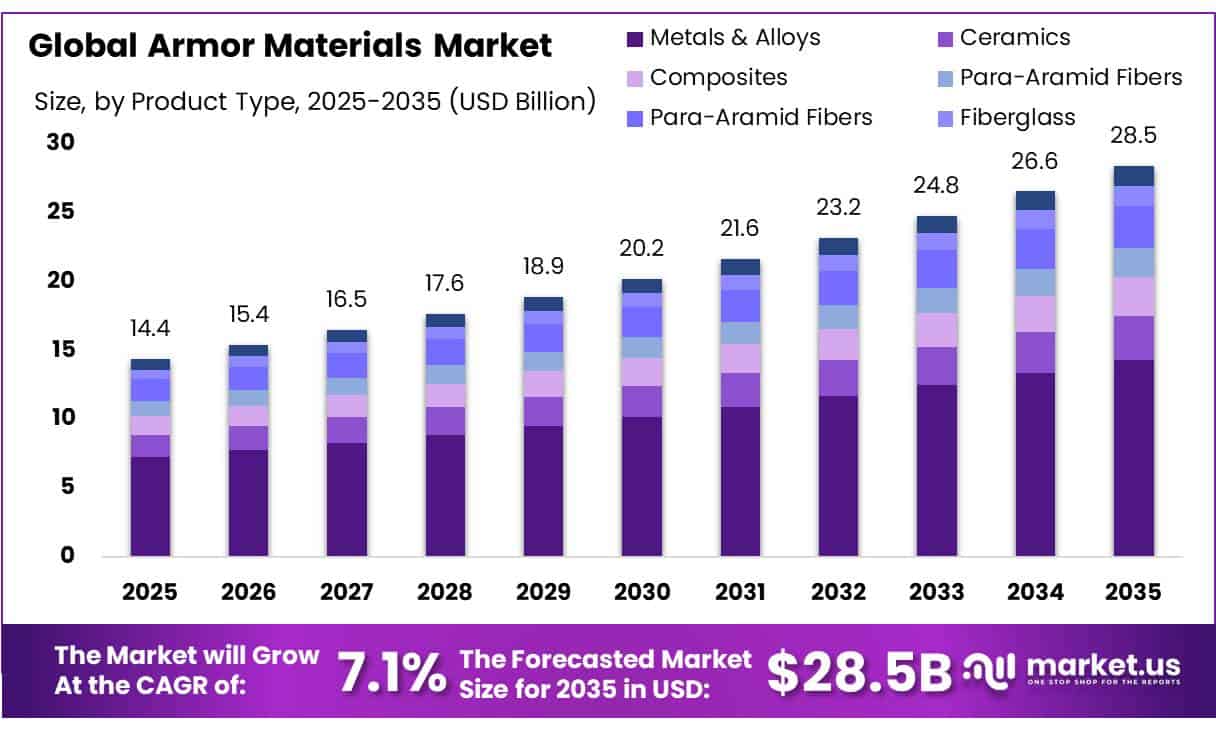
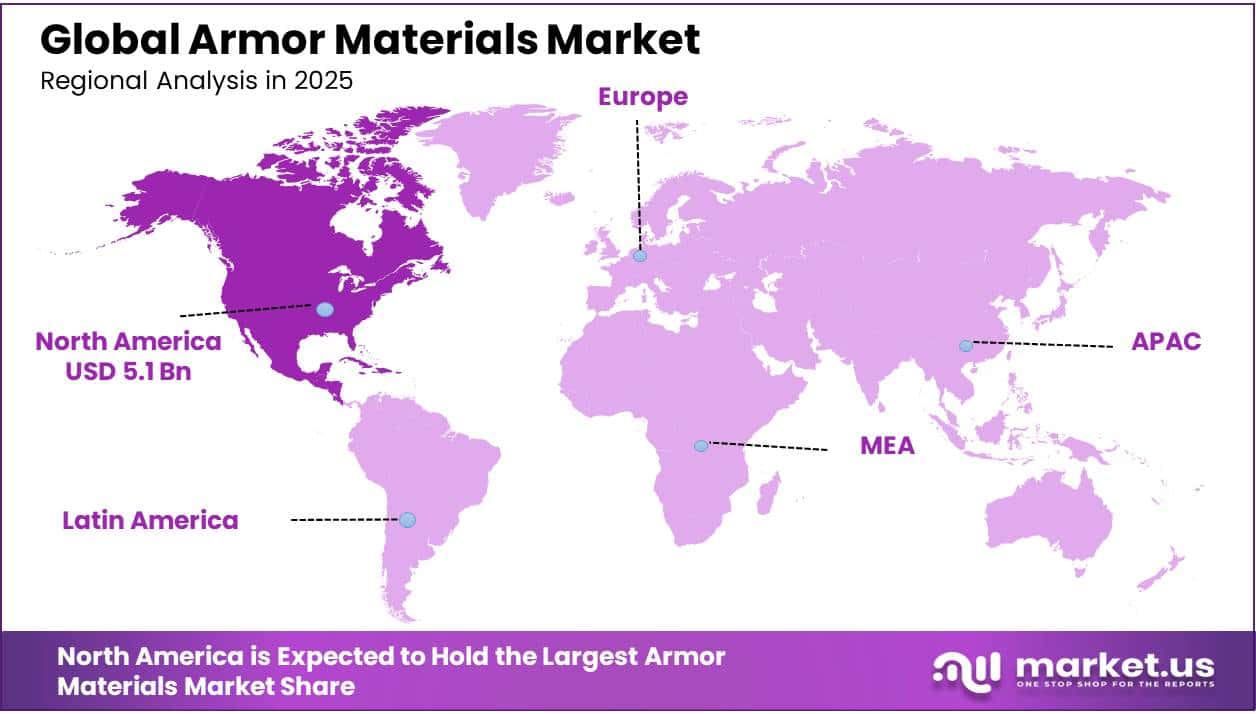
In 2025, the Global Armor Materials Market was valued at USD 14.4 billion, and between 2026 and 2035, this market is estimated to register a CAGR of 7.1%, reaching about USD 28.5 billion by 2035. North America held a dominant market position, capturing more than a 35.4% share, holding USD 5.1 billion in revenue.
Armor materials form the protective backbone of modern military vehicles, aircraft, naval platforms, body armor, helmets, and law-enforcement equipment. The industry uses advanced ceramics, high-strength steel, aluminum alloys, aramid fibers, polyethylene composites, and hybrid laminates to improve protection without adding excessive weight.
- Saint-Gobain identifies silicon carbide and boron carbide as important lightweight materials for body, vehicle, and aircraft armor, with its Forceram silicon-carbide armor having a typical density of 2.8 kg/dm³ and modulus of elasticity of 250 GPa.
The present industrial scenario is being shaped by higher defense procurement across North America and Europe. The U.S. Department of Defense’s FY2026 budget requested USD 11.6 billion for land-power modernization, covering Army and Marine Corps combat equipment such as armored vehicles and next-generation combat platforms. FY2026 Budget Overview This spending supports demand for lightweight ceramic panels, composite structures, vehicle applique armor, spall liners, and advanced metallic protection systems.
- Government standards are also pushing manufacturers toward better-performing materials. In 2025, the U.S. National Institute of Justice implemented updated NIJ Standard 0101.07 for ballistic-resistant body armor and introduced the new intermediate rifle-protection category RF2 alongside RF1 and RF3 classifications.
European procurement provides another major demand driver. The European Defence Agency reported that EU defense expenditure reached EUR 418 billion in 2025, increasing 20% from the previous year, and is projected at EUR 454 billion in 2026. Equipment procurement reached EUR 115 billion, while defense R&D expenditure is expected to rise from EUR 17 billion in 2025 to EUR 20 billion in 2026.
Material performance remains a central competitive factor. CoorsTek reports that hot-pressed boron carbide provides flexural strength of around 320–450 MPa and can withstand temperatures reaching 2,000°C, while sintered boron carbide can reach approximately 450 MPa flexural strength. Boron Carbide Technical Ceramics Such properties are important where protection, mobility, thermal stability, and lower system weight must be balanced.
Key Takeaways
- The global armor materials market was valued at USD 14.4 billion in 2025.
- The global market is projected to grow at a CAGR of 7.1% and is estimated to reach USD 28.5 billion by 2035.
- On the basis of material type, metals & alloys dominated the market, constituting 50.4% of the total market share.
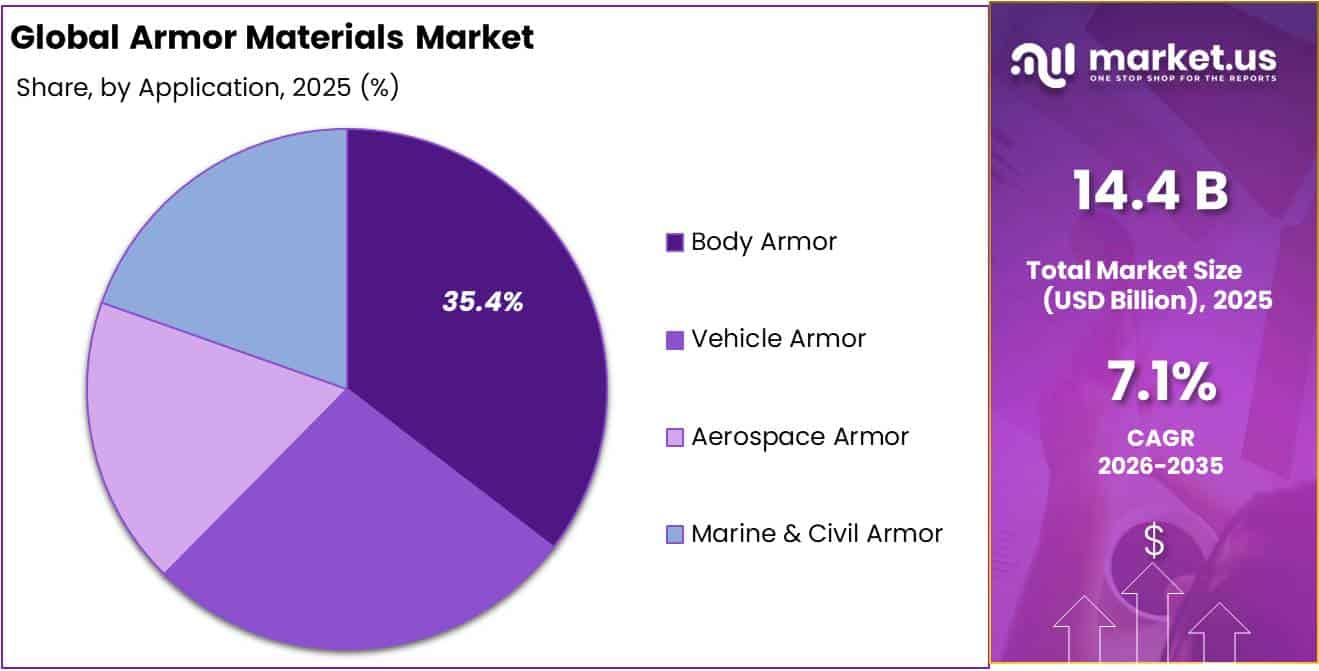
- Based on the applications, body armor led the market, comprising 35.4% of the total market.
- Among the end users, the defense sector held a major share in the armor materials market, 65.3% of the market share.
- In 2025, North America was the most dominant region in the armor materials market, accounting for 35.4% of the total global consumption.
Material Type Analysis
Metals & Alloys are a Prominent Segment in the Market.
Metals and alloys represent the dominant segment in the armor materials market, accounting for 50.4% of material utilization. Their widespread adoption is driven by high strength, structural integrity, and proven ballistic resistance across military and civil applications. Steel alloys, titanium, and aluminum-based materials are extensively used in vehicle armor, aerospace protection, and marine defense systems due to their ability to withstand high-impact projectiles and explosive forces.
The U.S. Army and Naval Surface Warfare Center have reported that hybrid metal-ceramic armor configurations enhance multi-threat resistance while maintaining operational durability. In addition, metals and alloys offer reliable compatibility with modular and multi-material armor systems, enabling customizable protection levels for diverse mission requirements, which continues to reinforce their dominant position within the global armor materials landscape.
Application Analysis
Body Armor Held a Major Share of the Armor Materials Market.
Body armor accounts for the largest share in the armor materials market, representing 35.4% of applications. Its prominence is attributed to the critical need for personal protection in military, law enforcement, and civil security operations. Advanced materials such as para-aramid fibers, UHMWPE, and hybrid composites are increasingly integrated into body armor systems to provide high ballistic resistance while reducing weight, enhancing mobility, and endurance for personnel.
The U.S. Federal Bureau of Investigation reported that over 85% of issued vests now incorporate multi-layered fiber composites to optimize protection and comfort. Similarly, the U.S. Army highlights that modular armor plates allow personnel to adapt protection levels according to mission requirements. These developments underscore body armor’s central role in operational readiness and strategic defense initiatives worldwide.
End User Analysis
Armor Materials Are Widely Utilized in the Defense Sector.
The defense sector dominates the armor materials market, accounting for 65.3% of end-user adoption. The high share is driven by the critical requirement for personnel, vehicles, and infrastructure protection in modern military operations. Advanced materials such as metals and alloys, ceramics, UHMWPE, and para-aramid fibers are extensively deployed in armored vehicles, combat helmets, and modular body armor systems to withstand ballistic threats, explosive devices, and multi-impact scenarios.
The U.S. Department of Defense reported the deployment of over 120,000 body armor units and 2,500 vehicles equipped with hybrid ceramic-metal plates between 2021 and 2023. Investments in lightweight, modular, and multi-material solutions have enhanced operational mobility, survivability, and mission readiness, underscoring the defense sector’s central role in driving the adoption of advanced armor materials globally.
Key Market Segments
By Material Type
- Metals & Alloys
- Ceramics
- Composites
- Para-Aramid Fibers
- Ultra-High-Molecular-Weight Polyethylene (UHMWPE)
- Fiberglass
- Others
By Application
- Body Armor
- Vehicle Armor
- Aerospace Armor
- Marine & Civil Armor
By End User
- Defense
- Homeland Security & Law‐Enforcement
- Civil & Commercial
Driver Analysis
NATO Rearmament Budgets
NATO’s 2025 Hague commitment to reach 5% of GDP in annual defence and security-related expenditure by 2035—comprising at least 3.5% for core defence capability requirements and up to 1.5% for resilience, infrastructure, industrial capacity, and security-related investment—creates a long-duration funding mechanism for armor-grade steel, aluminum alloys, alumina and silicon-carbide ceramics, aramid fabrics, ultra-high-molecular-weight polyethylene (UHMWPE), and vehicle survivability kits.
European NATO members spent approximately $559 billion in 2025, while 2026 outlays by European allies and Canada are expected to reach about $634 billion, or 2.53% of their combined GDP; critically, nearly every Ally except Norway is expected to meet the 20% equipment-spending benchmark in 2026, with Poland, Luxembourg, and Albania allocating about 50% of budgets to equipment.
This changes demand from episodic procurement into multi-year industrial replenishment: an armored-vehicle program commonly requires 24-48 months from material qualification to serial integration, while body-armor and add-on vehicle armor require recurring replacement orders as ballistic standards, threat profiles, and fleet utilization evolve.
Drivers Impact Analysis
| Driver | (~) % Impact on CAGR Forecast | Geographic Relevance | Impact Timeline |
|---|---|---|---|
| NATO rearmament budgets | +2.2% | Europe, North America | Long term (≥4 years) |
| Ukraine-war fleet replacement | +1.8% | Europe, North America | Medium term (2-4 years) |
| Lightweight armor substitution | +1.5% | North America, EU, APAC | Long term (≥4 years) |
| Soldier-system modernization | +1.1% | US, NATO Europe, India | Medium term (2-4 years) |
| EU local-content procurement | +1.0% | EU core, Ukraine | Medium term (2-4 years) |
| India modernization spending | +1.2% | India, South Asia, export markets | Medium term (2-4 years) |
Restraint Analysis
Tungsten Export Controls
China’s February 2025 export-control regime imposed licensing requirements on 20 tungsten-, tellurium-, bismuth-, indium-, and molybdenum-related products, converting a historically commercial raw-material procurement channel into a controlled dual-use supply chain subject to end-use review, export permits, and destination-based scrutiny; tungsten controls remained active in 2026 even as certain other Chinese export-control measures were temporarily suspended until November 2026.
The constraint is material for armor suppliers because tungsten is used in kinetic-energy penetrators, armor-piercing ammunition, high-density armor elements, cutting tools, and wear-resistant processing equipment, while China dominates both upstream mining and downstream conversion capacity. Reported Chinese tungsten exports fell by approximately 24% year over year in the first half of 2025 after licensing began, and supply-market estimates indicate a roughly 40% contraction in exports under the tighter control environment; even where these estimates vary, the direction is clear.
For armor-material manufacturers, a 15-30% increase in tungsten-bearing component cost can erase margin on fixed-price defence contracts, while alternative mines and processing capacity require two to four years to qualify and scale; the restraint therefore delays vehicle-protection kits and ammunition-related armor orders, forces higher inventory holdings, and raises the working-capital burden for suppliers unable to secure long-term strategic-mineral agreements.
Restraint Impact Analysis
| Restraint | (~) % Impact on CAGR | Geographic Relevance | Impact Timeline |
|---|---|---|---|
| Tungsten export controls | -1.3% | North America, EU, APAC importers | Medium term (2-4 years) |
| Steel and aluminum tariffs | -1.1% | North America core | Short term (≤2 years) |
| Ceramic qualification costs | -0.9% | North America, EU, APAC | Long term (≥4 years) |
| ITAR export restrictions | -0.8% | North America, NATO, APAC | Medium term (2-4 years) |
| Defense workforce shortage | -0.7% | North America, EU defense hubs | Long term (≥4 years) |
| Fragmented procurement standards | -0.6% | EU, APAC, Middle East | Long term (≥4 years) |
Opportunity Analysis
Active-Protection Armor Integration
The largest future white space is not passive armor volume alone, but the integration of ceramic, composite, spall-liner, and structural armor materials into active-protection-system (APS) architectures designed to detect, disrupt, or intercept anti-tank guided missiles, rocket-propelled grenades, and selected kinetic threats before impact; this is an opportunity rather than a current baseline driver because passive armor producers generally sell materials or panels, while APS procurement is still controlled by a narrow group of platform primes and systems integrators.
Iron Fist is available in a lighter configuration for armored fighting vehicles, infantry fighting vehicles, and logistic vehicles and a heavier configuration for main battle tanks, while Elbit reported a $127 million Iron Fist contract in 2026 and additional CV90 fleet orders emerged in January 2026 across a NATO user base that includes Sweden, the Czech Republic, Denmark, Lithuania, and Slovakia. The US Army’s three-year, $191.2 million Iron Fist-related Bradley contract, running through July 2027, indicates that APS integration is migrating from prototype evaluation toward funded fleet modernization.
Armor-material suppliers that develop “APS-ready” modular structures fragment-containment layers, radar-transparent panels, ceramic strike faces, localized blast shields, and sensor-compatible mounting structures—can move from low-margin material supply to higher-value system content, potentially raising revenue per protected vehicle by 15-30% and creating aftermarket demand for replaceable modules after interception events; the strategic window is 2026-2030 because vehicle primes are now defining architecture, interface, weight, and qualification standards that will determine which material suppliers enter future platforms.
Opportunity Impact Analysis
| Opportunity | (~) % Potential CAGR Upside | Geographic Relevance | Execution Window |
|---|---|---|---|
| Active-protection armor integration | +1.6% | North America, EU, Israel, APAC | Medium term (2-4 years) |
| EU SAFE localization | +1.4% | EU core, Ukraine, EEA | Short term (≤2 years) |
| Transparent armor expansion | +1.1% | North America, EU, Middle East, APAC | Medium term (2-4 years) |
| Critical-infrastructure protection | +1.0% | North America, EU, Middle East, APAC | Long term (≥4 years) |
| Circular armor-material recovery | +0.7% | North America, EU | Long term (≥4 years) |
| Dual-use M&A roll-ups | +0.9% | North America, EU, India | Medium term (2-4 years) |
Challenges Analysis
Sub-tier Capacity Mismatch
The central challenge is a throughput mismatch between rising prime-contractor orders and the smaller suppliers that provide armor-grade steels, ceramic powders, hot-pressed or sintered tiles, UHMWPE fibers, aramid fabrics, adhesives, backing layers, precision machining, heat treatment, and non-destructive inspection; US defence-industry assessments identify critical bottlenecks across minerals, castings, forgings, electronics, propulsion, drones, and Tier 2-Tier 4 suppliers, noting that increasing top-level production can simply shift constraints further downstream rather than solve them.
The risk is amplified by a structural reduction in supplier diversity since the Cold War, with one 2026 industry assessment estimating a decline from about 17,000 defence suppliers to roughly 5,000, while lower-tier firms often face tight liquidity, delayed payments, limited working capital, and insufficient appetite to invest in new furnaces, presses, autoclaves, cutting lines, or ballistic-test capacity before firm multi-year orders are secured.
In operational terms, a 12-18 month lead time for qualified ceramic material, combined with a 6-12 month delay for machined components or specialty fibers, can shift a nominal 24-month vehicle-delivery program into a 30-36 month schedule; suppliers must therefore build dual-source qualified bill-of-materials, reserve long-lead production slots, use supplier-financing mechanisms, and maintain 90-180 days of strategic inventory for critical inputs, accepting a 3-7% working-capital penalty in return for higher on-time delivery and contract reliability.
Challenges Impact Analysis
| Challenge | (~) % CAGR Friction | Geographic Relevance | Mitigation Horizon |
|---|---|---|---|
| Sub-tier capacity mismatch | -1.0% | North America, EU, APAC | Medium term (2-4 years) |
| Drone-threat adaptation | -1.2% | Europe, Middle East, APAC | Long term (≥4 years) |
| Ceramic quality consistency | -0.8% | North America, EU, APAC | Medium term (2-4 years) |
| Skilled workforce scarcity | -0.9% | North America, EU defence hubs | Long term (≥4 years) |
| Multi-material integration | -0.7% | Global vehicle platforms | Medium term (2-4 years) |
| Testing-capacity congestion | -0.6% | North America, EU, India | Medium term (2-4 years) |
Geopolitical Impact Analysis
Geopolitical Volatility and the Strategic Deployment of Armor Systems.
Current geopolitical tensions have prompted a significant re-evaluation of protective equipment requirements across defense and civil security forces. The U.S. Department of Defense reported that, in response to escalating threats in Eastern Europe, over 120,000 ballistic vests incorporating para-aramid fibers and modular ceramic inserts were deployed to military units in 2022.
- NATO’s Allied Command Transformation documented that over 500 armored vehicles, upgraded with hybrid ceramic-metal plates for enhanced multi-threat resistance, were dispatched to allied nations between 2021 and 2023 to reinforce rapid deployment forces. In Asia, the Indian Ministry of Defence highlighted accelerated procurement of lightweight UHMWPE and ceramic-based body and vehicle armor, with 30,000 units commissioned for border security operations along high-tension sectors.
Similarly, the U.S. Department of Homeland Security disclosed nationwide issuance of 15,000 modular armor systems to law enforcement units in response to urban security concerns related to international conflicts. These examples illustrate that geopolitical volatility directly influences material selection, modular design adoption, and rapid fielding of armor systems, emphasizing operational readiness, protection effectiveness, and adaptability to evolving threat environments.
Regional Analysis
North America Held the Largest Share of the Global Armor Materials Market.
In 2025, North America dominated the global armor materials market, holding about 35.4% of the total global consumption. North America demonstrates a prominent role in the adoption and deployment of advanced armor materials across defense and law enforcement sectors. The U.S. Department of Defense reported that over 200,000 body armor units, including UHMWPE and aramid fiber composites, were issued to military personnel between 2019 and 2022.
The U.S. Army highlighted the integration of modular ceramic-metal vehicle armor on more than 2,500 tactical vehicles to address multi-threat environments, with testing confirming protection against small arms fire and improvised explosive devices. The Federal Bureau of Investigation disclosed that more than 85% of law enforcement ballistic vests issued nationwide now utilize advanced multi-layered fiber systems for reduced weight and improved mobility.
Key Regions and Countries
- North America
- The US
- Canada
- Europe
- Germany
- France
- The UK
- Spain
- Italy
- Russia & CIS
- Rest of Europe
- APAC
- China
- Japan
- South Korea
- India
- ASEAN
- Rest of APAC
- Latin America
- Brazil
- Mexico
- Rest of Latin America
- Middle East & Africa
- GCC
- South Africa
- Rest of MEA
Key Players Analysis
Manufacturers of armor materials focus on technological innovation and product differentiation to gain a competitive edge and strengthen market presence. Emphasis is placed on developing lightweight, multi-material solutions combining metals, ceramics, and polymer fibers to enhance ballistic protection while reducing weight. Advanced manufacturing techniques, including additive manufacturing, precision layering, and vacuum-assisted compression, are implemented to improve consistency, reduce defects, and allow modular armor configurations.
Additionally, strategic collaborations with defense agencies and research institutions enable iterative testing, certification, and rapid deployment of new solutions. Compliance with stringent military and law enforcement standards ensures credibility, while investment in training and support services enhances user adoption and operational efficiency across diverse applications.
The Major Players in The Industry
- 3M
- Arconic
- ArmorSource, LLC
- ATI Inc.
- BAE Systems
- CeramTec GmbH
- CoorsTek Inc.
- CPS Technologies
- DuPont
- Honeywell International Inc.
- Koninklijke Ten Cate BV
- NP Aerospace
- Plasan
- PPG Industries, Inc.
- Röchling SE & Co. KG
- Other Key Players
Report Scope
| Report Features | Description |
|---|---|
| Market Value (2025) | US$14.4 Bn |
| Forecast Revenue (2035) | US$28.5 Bn |
| CAGR (2026-2035) | 7.1% |
| Base Year for Estimation | 2025 |
| Historic Period | 2020-2024 |
| Forecast Period | 2026-2035 |
| Report Coverage | Revenue Forecast, Market Dynamics, Competitive Landscape, Recent Developments |
| Segments Covered | By Material Type (Metals & Alloys, Ceramics, Composites, Para-Aramid Fibers, Ultra-High-Molecular-Weight Polyethylene (UHMWPE), Fiberglass, and Others), By Application (Body Armor, Vehicle Armor, Aerospace Armor, and Marine & Civil Armor), By End-User (Defense, Homeland Security & Law‐Enforcement, and Civil & Commercial) |
| Regional Analysis | North America – The US & Canada; Europe – Germany, France, The UK, Spain, Italy, Russia & CIS, Rest of Europe; APAC– China, Japan, South Korea, India, ASEAN & Rest of APAC; Latin America– Brazil, Mexico & Rest of Latin America; Middle East & Africa– GCC, South Africa, & Rest of MEA |
| Competitive Landscape | 3M, Arconic, ArmorSource, LLC, ATI Inc., BAE Systems, CeramTec GmbH, CoorsTek Inc., CPS Technologies, DuPont, Honeywell International Inc., Koninklijke Ten Cate BV, NP Aerospace, Plasan, PPG Industries, Inc., Röchling SE & Co. KGs, and Other Players. |
| Customization Scope | Customization for segments, region/country-level will be provided. Moreover, additional customization can be done based on the requirements. |
| Purchase Options | We have three licenses to opt for: Single User License, Multi-User License (Up to 5 Users), Corporate Use License (Unlimited Users and Printable PDF) |





































