


Report Overview
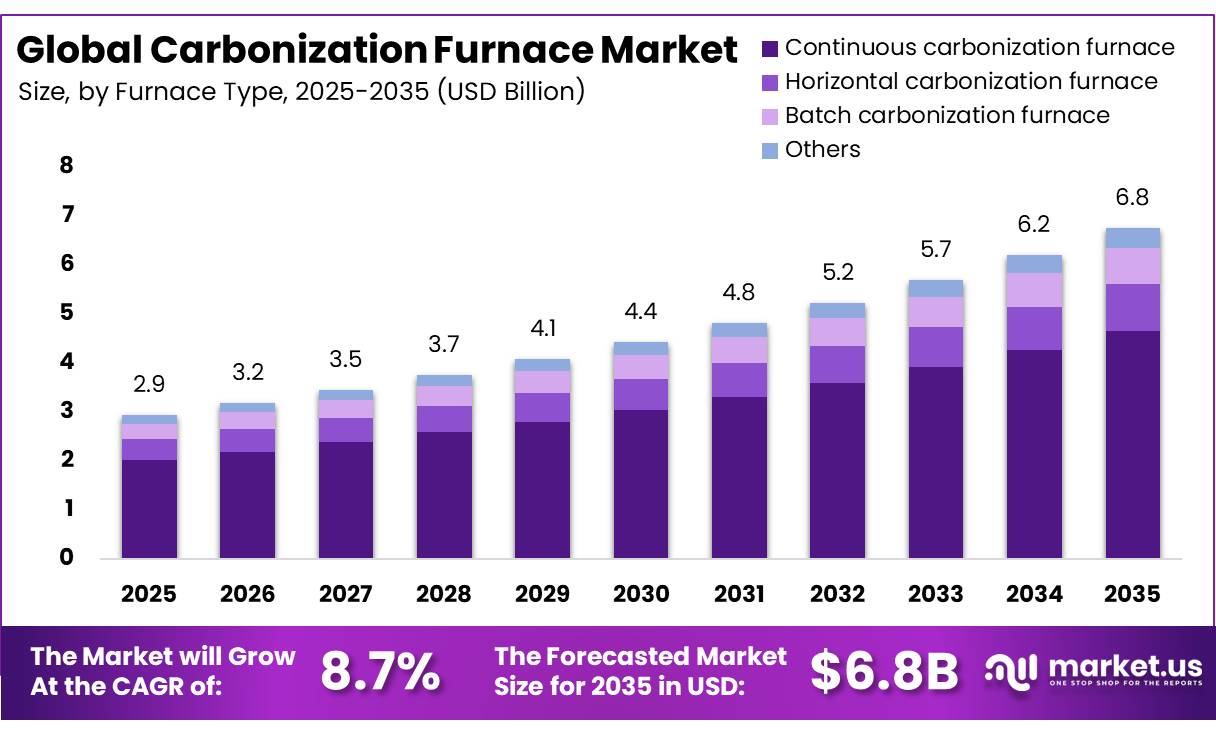
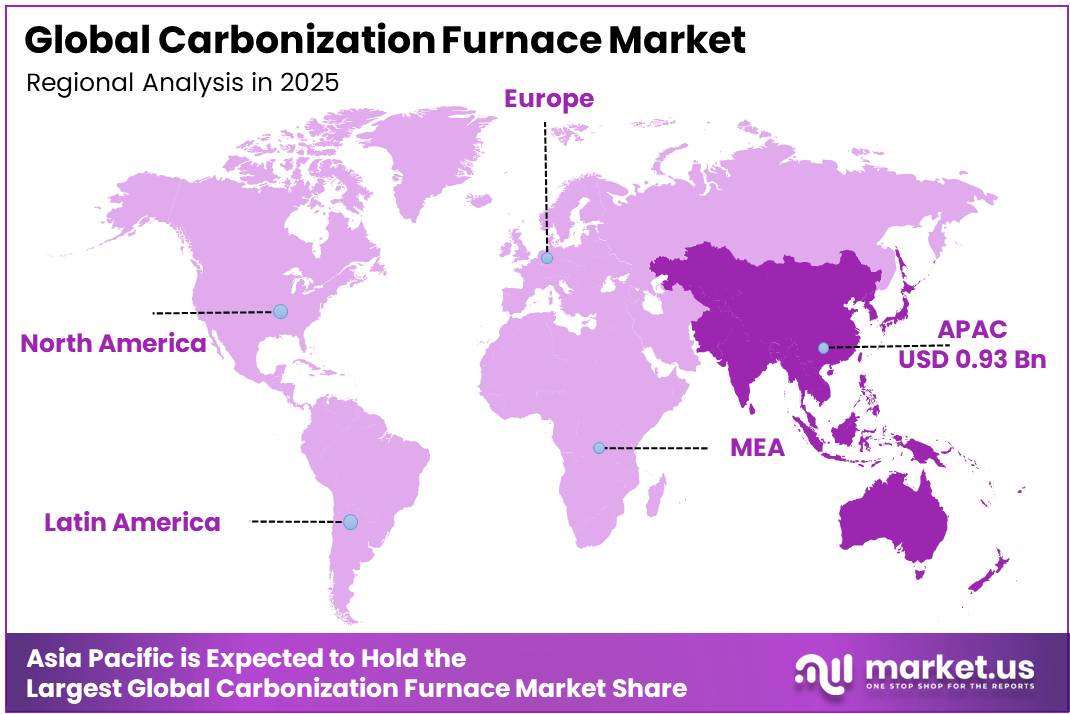
In 2025, the Global Carbonization Furnace Market was valued at USD 2.9 billion, and between 2026 and 2035, this market is estimated to register a CAGR of 8.7%, reaching about USD 6.8 billion by 2035. Asia Pacific held a dominant market position, capturing more than a 31.54% share, holding USD 0.93 billion in revenue.
Carbonization furnaces thermochemically convert forestry residues, agricultural waste, nutshells and other biomass into charcoal, biochar, combustible gases and recoverable heat under restricted oxygen. Continuous, horizontal and batch systems serve throughput, feedstock and product-quality requirements. The market sits within industrial thermal-processing equipment, linking waste management, agriculture, metallurgy and decentralized energy. Demand increasingly favors efficient furnaces with controlled temperature, lower smoke, heat recovery and consistent carbon output.
- In July 2025, the Food and Agriculture Organization estimated global wood-charcoal production at 5 million tonnes. In 2024, fuelwood supplied 22 exajoules of final bioenergy, while other vegetal materials and residues supplied 7 exajoules. These volumes create a broad feedstock and user base for carbonization equipment, particularly where producers seek to upgrade traditional kilns into enclosed, monitored and higher-yield manufacturing systems.
Key Takeaways
- The global carbonization furnace market was valued at USD 2.9 billion in 2025.
- The global market is projected to grow at a CAGR of 8.7% and is estimated to reach USD 6.8 billion by 2035.
- On the basis of furnace type, the continuous carbonization furnace dominated the market, constituting 68.79% of the total market share.
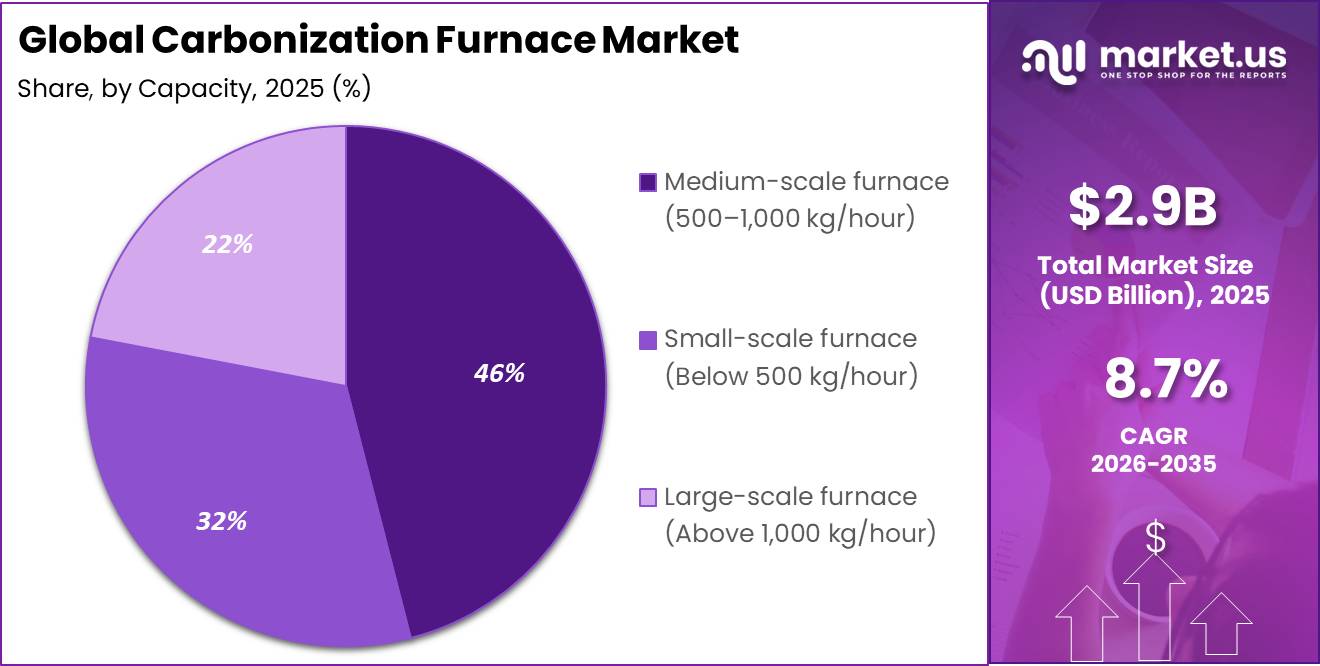
- Based on capacity, the medium-scale furnace, ranging from 500 to 1,000 kg/hour, dominated the carbonization furnace market, with a substantial market share of around 46.00%.
- Among the end-user industries, charcoal and biochar producers held a major share in the carbonization furnace market, accounting for 43.00% of the total market share.
- Based on feedstock, agricultural waste led the carbonization furnace market, comprising 39.58% of the total market.
- In 2025, Asia Pacific was the most dominant region in the carbonization furnace market, accounting for 31.54% of the total market and generating approximately USD 0.93 billion in revenue.
Growth is driven by residue utilization, demand for biochar, rural fuel production, carbon management and industrial decarbonization. Modern furnaces can improve process control, capture co-produced heat and support cleaner handling of vapors and gases. In January 2025, the United States Department of Energy announced up to USD 100 million for pilot-scale carbon-conversion technologies. Although the program covers several conversion pathways, it signals stronger public support for equipment that converts carbon-bearing streams into useful products with measurable environmental value.
Government policy is improving conditions. In February 2026, the European Commission adopted certification methodologies covering 3 permanent carbon-removal activities, including biochar carbon removal. European Union rules require eligible biochar production to heat biomass to at least 350 degrees Celsius, while certified activity periods may run for up to 10 years. These standards can encourage investment in traceable furnaces, emissions control, feedstock verification and performance. Future opportunities therefore include modular systems, automated controls, mobile units, heat integration and manufactured equipment for forestry, farming and industrial users.
Furnace type Analysis
Continuous Carbonization Furnaces Lead with 68.79% Through Efficient, Steady Production
In 2025, continuous carbonization furnace held a dominant market position, capturing more than a 68.79% share of the carbonization furnace market. Its leadership was supported by steady feedstock processing, consistent temperature control, lower labour dependence, and continuous biochar or charcoal output. The system suits commercial producers handling forestry residues, agricultural waste, and nutshell materials at regular volumes. Automated feeding, controlled oxygen conditions, heat recovery, and continuous discharge also help operators maintain uniform product quality while reducing interruptions between production cycles.
- For instance, in July 2025, according to Pacific Northwest National Laboratory, researchers published a climate-focused life-cycle assessment comparing biochar production using an ARTi pyrolysis reactor with production through a CharBoss air-curtain system, supporting closer evaluation of industrial carbonization technologies.
Horizontal carbonization furnace is the growing segment because its chamber design supports convenient loading, controlled heating, and flexible processing of different biomass materials. It is gaining attention among small and expanding producers seeking manageable installation, easier maintenance, batch flexibility, and improved operating control without adopting complex continuous production lines at scale.
Capacity Analysis
Medium-Scale Furnaces Lead with 46.00% Through Balanced Capacity and Operational Efficiency
In 2025, medium-scale furnace (500–1,000 kg/hour) held a dominant market position, capturing more than a 46.00% share of the carbonization furnace market. Its leadership was supported by a practical balance between production capacity, investment requirements, energy use, and operating flexibility. These furnaces are suitable for commercial charcoal and biochar producers processing agricultural residues, wood waste, and nutshell materials.
- For instance, in September 2025, according to the United States Forest Service, the agency highlighted CharBoss, a mobile biochar production unit developed to convert low-value woody biomass into useful biochar directly within forest working areas.
Small-scale furnace (below 500 kg/hour) is the growing segment because it offers lower installation requirements, easier operation, and flexible deployment. It is gaining acceptance among farms, rural enterprises, research facilities, and small charcoal producers seeking localized waste conversion, manageable feedstock use, and gradual production expansion.
End-user industry Analysis
Charcoal and Biochar Producers Lead with 43.00% as Commercial Output Expands
In 2025, charcoal and biochar producers held a dominant market position, capturing more than a 43.00% share of the carbonization furnace market. Their leadership was supported by demand for controlled carbonization, consistent product quality, improved feedstock conversion, and lower smoke than traditional kilns. Producers use enclosed furnaces to process wood residues, crop waste, and nutshells while recovering heat and maintaining stable temperatures. These systems also support commercial production for fuel, soil amendment, filtration, and industrial uses.
- For instance, in September 2025, according to the United States Department of Agriculture Agricultural Research Service, a cooperative research project began to develop biochar applications for soil nutrient cycling, heavy-metal absorption, soil health, and plant nutrient uptake through field-scale studies.
Agriculture is the growing segment because farms can convert crop residues and woody waste into biochar near the point of generation. Small and modular furnaces support residue management, soil improvement, moisture retention, and local circular production. Adoption is also encouraged by research evaluating practical and economically suitable biochar use in agricultural systems.
Feedstock Analysis
Agricultural Waste Leads with 39.58% as Residue Conversion Expands
In 2025, agricultural waste held a dominant market position, capturing more than a 39.58% share of the carbonization furnace market. Its leadership was supported by the availability of crop stalks, husks, shells, pruning residues, and processing by-products. Carbonization furnaces convert these materials into biochar and charcoal while reducing open disposal and creating products for soil improvement, filtration, fuel, and industrial applications. Seasonal residue generation supports localized furnace operation near farms and processing centers.
- For instance, in June 2026, according to the United States Forest Service, researchers reported an ongoing project evaluating biochar made from woody biomass for removing heavy metals from water and stabilizing contaminated soil on mined lands.
Forestry and wood waste is the growing segment because forest thinning, sawmill residues, damaged timber, and land-clearing material provide carbon-rich feedstock. Attention to wildfire-risk reduction, forest restoration, and productive use of low-value wood is encouraging furnace deployment. Mobile and modular systems can process residues closer to collection areas, lowering handling needs and supporting biochar production for environmental and agricultural uses.
Key Market Segments
By furnace type
- Continuous carbonization furnace
- Horizontal carbonization furnace
- Batch carbonization furnace
- Others
By capacity
- Medium-scale furnace (500–1,000 kg/hour)
- Small-scale furnace (Below 500 kg/hour)
- Large-scale furnace (Above 1,000 kg/hour)
By end-user industry
- Charcoal and biochar producers
- Agriculture
- Energy and power generation
- Oil and gas
- Mining and metallurgy
- Others
By Feedstock
- Agricultural Waste
- Forestry & Wood Waste
- Nutshell Waste
- Others
Driver Analysis
CRCF-linked biochar furnace demand
The strongest 2026 demand catalyst is the formalization of biochar carbon removal inside the EU Carbon Removal and Carbon Farming framework, because it changes furnace investment from a pure equipment purchase into a revenue-linked decarbonization asset. The European Commission adopted the first CRCF methodologies for permanent removals on 3 February 2026, explicitly covering biochar carbon removal, with certification schemes now able to seek recognition and the EU Buyers’ Club also advancing in 2026; that sequence materially improves bankability for carbonization furnace projects serving certified biochar pathways.
The delegated methodology sets a standardized baseline of 0 tCO2/year for BCR activities, requires biochar production facilities and storage to be located in the Union, caps BCR activity periods at 5 years, and mandates annual certification periods, which together create a repeatable compliance architecture that supports equipment financing, EPC contracting, and auditable output monetization.
Drivers Impact Analysis
| Driver | (~) % Impact on CAGR | Geographic Relevance | Impact Timeline |
|---|---|---|---|
| CRCF-linked biochar furnace demand | +2.3% | EU core, UK alignment watch, North America follow-on | Short term (≤ 2 years) |
| Waste-residue feedstock monetization | +1.8% | APAC corridors, EU, North America core, Latin America spill-over | Medium term (2-4 years) |
| Heat recovery and energy self-sufficiency | +1.5% | China, India, ASEAN, EU industrial clusters, North America | Short term (≤ 2 years) |
| Emissions-compliant kiln replacement cycle | +1.7% | EU, U.S., Japan, Korea, urbanizing APAC | Medium term (2-4 years) |
| Soil carbon and carbon-credit offtake pull | +2.0% | EU core, U.S., Canada, Australia, Brazil | Short term (≤ 2 years) |
| Higher-value industrial end-use diversification | +1.4% | EU, North America, China, Middle East industrial projects | Long term (≥ 4 years) |
Restraint Analysis
High capex and OPEX burden
High capex and operating cost intensity remains the single most powerful brake on furnace adoption, as continuous, emissions-compliant systems with integrated heat recovery, drying, and automation easily cross a USD 1.5–3.0 million installed-cost threshold for mid-scale lines and can demand 10–20% of project budgets for emissions, safety, and control systems alone, creating a capital-access gap for SMEs and operators in price-sensitive APAC and emerging markets where typical annual capex envelopes per plant sit closer to USD 0.5–1.0 million.
On the opex side, refractory replacement cycles every 3–6 years at USD 150–400 per ton, energy inputs of 100–250 kWh per tonne of dry feedstock for drying and ancillary equipment where heat integration is incomplete, and compliance-related lab testing or MRV overhead of USD 5–10 per tonne of output collectively compress EBITDA margins in early years, especially for plants operating below 60–70% utilization.
Restraint Impact Analysis
| Restraint | (~) % Impact on CAGR Forecast | Geographic Relevance | Impact Timeline |
|---|---|---|---|
| High capex and OPEX burden | -2.2% | Global, sharper in APAC & emerging markets | Short term (≤ 2 years) |
| Complex emissions permitting and compliance | -1.6% | North America core, EU, Japan, Korea, urban APAC | Medium term (2-4 years) |
| Refractory and component supply volatility | -1.3% | China, EU manufacturing hubs, global OEM chains | Short term (≤ 2 years) |
| Skilled workforce and automation gap | -1.1% | Global, pronounced in APAC, Africa, Latin America | Medium term (2-4 years) |
| Fragmented biochar standards and credit validation | -1.4% | Global, particularly developing markets | Long term (≥ 4 years) |
| Shipping, hazardous classification, and logistics friction | -1.0% | Global trade lanes, especially EU–APAC & NA–APAC | Short term (≤ 2 years) |
Opportunity Analysis
Engineered nanocarbon and advanced materials pivot
Between now and roughly 2030–2035, furnace OEMs and operators can redesign reactor profiles, atmosphere control, and post-processing to move up the value chain into nanocarbon markets that today are supplied primarily by fossil-based carbon black, CNTs, and graphite, where global carbon black consumption alone was around 13.7 Mt in 2019 with forecasts of close to USD 30–35 billion by 2030 at mid-single-digit growth rates.
If just 2–3% of this and adjacent specialty carbon demand is captured via biomass or waste-fed carbonization platforms, the incremental revenue pool could reach several billion dollars annually, allowing furnaces designed for advanced materials to earn margins 10–20 percentage points higher than commodity charcoal lines due to tighter specification, premium pricing, and IP-differentiated process windows.
Strategically, this is an opportunity because the majority of furnace market forecasts to 2035 still assume biochar and charcoal-heavy product mixes and mid-single-digit CAGR; repositioning part of the installed base toward nanocarbon-grade outputs would effectively overlay a new TAM on top of the existing market, and players that develop materials partnerships with cathode producers, semiconductor fabs, or specialty chemical firms can unlock 2–3 percentage points of CAGR upside by 2030–2035 compared with baselines that do not factor in advanced materials integration.
Opportunity Impact Analysis
| Opportunity | (~) % Potential CAGR Upside | Geographic Relevance | Execution Window |
|---|---|---|---|
| Engineered nanocarbon and advanced materials pivot | +2.4% | North America, EU, China, Japan, Korea | Medium term (2-4 years) |
| Turquoise hydrogen and carbon co-product integration | +2.1% | EU core, Middle East, North America | Long term (≥ 4 years) |
| Furnace-as-a-Service and MRV-based recurring revenue | +1.9% | Global, especially EU & North America | Short term (≤ 2 years) |
| Mobile and modular wildfire and waste-deployment platforms | +1.7% | North America, Mediterranean EU, Australia, Latin America | Medium term (2-4 years) |
| Cross-industry M&A roll-ups and platform consolidation | +1.8% | Global, with APAC manufacturing hubs | Long term (≥ 4 years) |
| Integrated nanocarbon-electronics and energy storage ecosystems | +1.6% | EU, Japan, Korea, coastal China, U.S. West Coast | Long term (≥ 4 years) |
Challenges Analysis
Complex multi-layer emissions governance
In the U.S., rules such as EPA 40 CFR 63 subpart provisions for continuous emissions monitoring hardware add USD 50,000–150,000 per furnace in instrumentation and create reporting obligations that can demand several hundred staff-hours per year, while in the EU, tightening industrial-emissions directives and lifecycle-focused policies like the Carbon Border Adjustment Mechanism increase scrutiny on volatile organic compounds, particulate, and GHGs from biomass and waste carbonization processes.
Project timelines are extended as operators must align environmental-impact assessments, construction permits, stack-testing schedules, and potential carbon-removal certification documentation, typically adding 6–9 months of regulatory navigation to otherwise 12–18 month engineering-procurement-construction cycles, and introducing a 10–20% probability of schedule slippage when standards or interpretations evolve mid-project.
Strategically, this is a challenge rather than a restraint because most jurisdictions still allow furnaces subject to compliance, but large operators need permanent regulatory affairs capacity, dynamic design standards, and modular emissions packages to adapt to changing norms, while smaller firms risk margin erosion and project de-risking delays; across the market, this governance complexity reduces achievable CAGR by around 1.4 percentage points compared with a world of simpler, harmonized rules, as some projects are deferred, resized, or slowed even though they are not legally blocked.
Challenges Impact Analysis
| Challenge | (~) % CAGR Friction Drag | Geographic Relevance | Mitigation Horizon |
|---|---|---|---|
| Complex multi-layer emissions governance | -1.4% | North America core, EU regulatory hubs, urban APAC | Medium term (2-4 years) |
| Steel, refractory, and filter-cost volatility | -1.2% | Global manufacturing hubs, APAC logistics corridors | Short term (≤ 2 years) |
| MRV and data-integration complexity | -1.0% | EU, North America, high-compliance markets | Medium term (2-4 years) |
| Distributed biomass aggregation inefficiency | -1.1% | APAC rural corridors, Latin America, Africa | Long term (≥ 4 years) |
| Persistent advanced-talent pipeline gap | -0.9% | Global, sharper in emerging industrial regions | Long term (≥ 4 years) |
| Cross-border standards and classification misalignment | -0.8% | Global trade lanes, EU–APAC, NA–APAC corridors | Medium term (2-4 years) |
Geopolitical Impact Analysis
Trade Barriers and Shipping Disruptions Reshape Carbonization Furnace Supply Chains
Current geopolitical tensions are affecting the carbonization furnace market through metal tariffs, shipping disruption, changing biomass policies, and regional manufacturing strategies. Furnace production depends on steel chambers, conveyors, motors, temperature controls, insulation, and emission-management equipment. Therefore, restrictions affecting metals, machinery components, or international transport can increase equipment costs and delay project delivery.
- In June 2025, the United States increased tariffs on imported steel and aluminium articles from 25% to 50%. This measure can raise procurement costs for furnace manufacturers using imported structural steel, fabricated components, and aluminium-based control enclosures. It may also encourage local sourcing and domestic equipment assembly, although manufacturers could face higher prices while alternative suppliers are qualified.
Maritime instability is adding another layer of uncertainty. United Nations Trade and Development reported that tonnage passing through the Suez Canal remained 70% below 2023 levels in May 2025. Longer shipping routes can delay imported furnace parts and increase freight expenses for carbonization projects dependent on overseas equipment, refractories, or automation systems.
Wider trade fragmentation is also influencing investment decisions. The World Trade Organization reported that new tariffs and other import measures affected USD 2,640 billion of global goods imports between mid-October 2024 and mid-October 2025. These pressures are encouraging carbonization furnace suppliers to develop regional production networks, source components from multiple countries, and design modular systems that can be assembled closer to biomass and biochar users.
Regional Analysis
Asia Pacific Leads with 31.54% Share and USD 0.93 Billion Revenue
In 2025, Asia Pacific held the dominant position in the carbonization furnace market, capturing 31.54% of the global market and generating approximately USD 0.93 billion in revenue. Regional leadership was supported by abundant agricultural residues, forestry waste, charcoal production, and growing demand for decentralized biomass-processing equipment. The region also has a strong manufacturing base for furnaces, conveyors, temperature controls, dryers, and heat-recovery systems.
Europe is the fastest-growing region in the carbonization furnace market. Growth is supported by stricter waste-management policies, expanding biochar applications, carbon-removal initiatives, and efforts to use forestry and agricultural residues more efficiently. Regional producers are increasingly adopting controlled carbonization systems with improved emission management, process monitoring, energy recovery, and feedstock traceability. Demand is also rising from agriculture, forestry management, industrial decarbonization, and circular-economy projects.
Key Regions and Countries Covered
- North America
- The US
- Canada
- Europe
- Germany
- France
- The UK
- Spain
- Italy
- Russia & CIS
- Rest of Europe
- APAC
- China
- Japan
- South Korea
- India
- ASEAN
- Rest of APAC
- Latin America
- Brazil
- Mexico
- Rest of Latin America
- Middle East & Africa
- GCC
- South Africa
- Rest of MEA
Key Players Analysis
Carbonization furnace manufacturers focus on thermal efficiency, feedstock flexibility, emission control, automation, and equipment durability to strengthen their competitive position. Leading participants include Beston Group Co., Ltd., Zhengzhou Shuliy Machinery Co., Ltd., Henan Sunrise Biochar Machine Co., Ltd., Fives Group, Carbolite Gero Ltd., Nabertherm GmbH, and Lindberg/MPH. Companies compete through continuous and batch furnace designs, modular production systems, heat-recovery technology, temperature-control accuracy, and customized equipment for charcoal, biochar, agriculture, metallurgy, and industrial thermal-processing applications.
In 2026, competition increasingly centred on low-emission combustion, digital process control, and regional technical support. In April 2026, Fives Group presented industrial furnace systems capable of operating with fuel mixtures containing up to 100% hydrogen, highlighting the growing importance of flexible and lower-carbon heating technologies. In June 2026, Nabertherm expanded its furnace portfolio with a combined system supporting two heat-treatment processes in one unit.
Market Key Players
- GreenPower Ltd.
- Beston Group Co., Ltd.
- Zhengzhou Belong Machinery Co., Ltd.
- Zhengzhou Shuliy Machinery Co., Ltd.
- Tianjin Mikim Technique Co., Ltd.
- Henan Chengjinlai Machinery Co., Ltd.
- Gongyi Xiaoyi Mingyang Machinery Plant
- Gongyi Sanjin Charcoal Machinery Factory
- Zhengzhou Jiutian Technology Machinery Co., Ltd.
- Henan Sunrise Biochar Machine Co., Ltd.
- Gongyi Hengchang Metallurgical Building Material Equipments Plant
- Fives Group
- Carbolite Gero Ltd.
- Nabertherm GmbH
- Lindberg/MPH
Key Development
- In February 2026, Beston Group Co., Ltd.’s BST-50 biochar production equipment received pre-approval from Isometric, while the company became one of Isometric’s first global biochar equipment partners. The approval supported digital monitoring, reporting, verification, and carbon-removal project development.
- In February 2026, Nabertherm GmbH and Ivoclar Vivadent AG announced a cooperation to develop validated sintering programs for the LHT 02/17 LB Speed furnace. The programs were designed to improve process reliability, repeatable results, and material quality during zirconium oxide processing.
- In March 2026, Beston Group Co., Ltd. completed the installation and commissioning of a BST-10 wood charcoal production system at a European sawmill. The system combined a charcoal-making machine, extended drum dryer, and rotary screening equipment to convert pine chips and sawdust into export-grade barbecue charcoal.
Report Scope
| Report Features | Description |
|---|---|
| Market Value (2025) | USD 2.9 Bn |
| Forecast Revenue (2035) | USD 6.8 Bn |
| CAGR (2026-2035) | 8.7% |
| Base Year for Estimation | 2025 |
| Historic Period | 2020-2024 |
| Forecast Period | 2026-2035 |
| Report Coverage | Revenue Forecast, Market Dynamics, Competitive Landscape, Recent Developments |
| Segments Covered | By Furnace Type (Continuous Carbonization Furnace, Horizontal Carbonization Furnace, Batch Carbonization Furnace, and Others), By Capacity (Small-scale Furnace (Below 500 kg/hour), Medium-scale Furnace (500–1,000 kg/hour), and Large-scale Furnace (Above 1,000 kg/hour)), By End-user Industry (Charcoal and Biochar Producers, Agriculture, Energy and Power Generation, Oil and Gas, Mining and Metallurgy, and Others), By Feedstock (Forestry & Wood Waste, Agricultural Waste, Nutshell Waste, and Others) |
| Regional Analysis | North America – The US & Canada; Europe – Germany, France, The UK, Spain, Italy, Russia & CIS, Rest of Europe; APAC– China, Japan, South Korea, India, ASEAN & Rest of APAC; Latin America– Brazil, Mexico & Rest of Latin America; Middle East & Africa– GCC, South Africa, & Rest of MEA |
| Competitive Landscape | GreenPower Ltd., Beston Group Co., Ltd., Zhengzhou Belong Machinery Co., Ltd., Zhengzhou Shuliy Machinery Co., Ltd., Tianjin Mikim Technique Co., Ltd., Henan Chengjinlai Machinery Co., Ltd., Gongyi Xiaoyi Mingyang Machinery Plant, Gongyi Sanjin Charcoal Machinery Factory, Zhengzhou Jiutian Technology Machinery Co., Ltd., Henan Sunrise Biochar Machine Co., Ltd., Gongyi Hengchang Metallurgical Building Material Equipments Plant, Fives Group, Carbolite Gero Ltd., Nabertherm GmbH, Lindberg/MPH. |
| Customization Scope | Customization for segments, region/country-level will be provided. Moreover, additional customization can be done based on the requirements. |
| Purchase Options | We have three licenses to opt for: Single User License, Multi-User License (Up to 5 Users), Corporate Use License (Unlimited Users and Printable PDF) |





































