


Report Overview
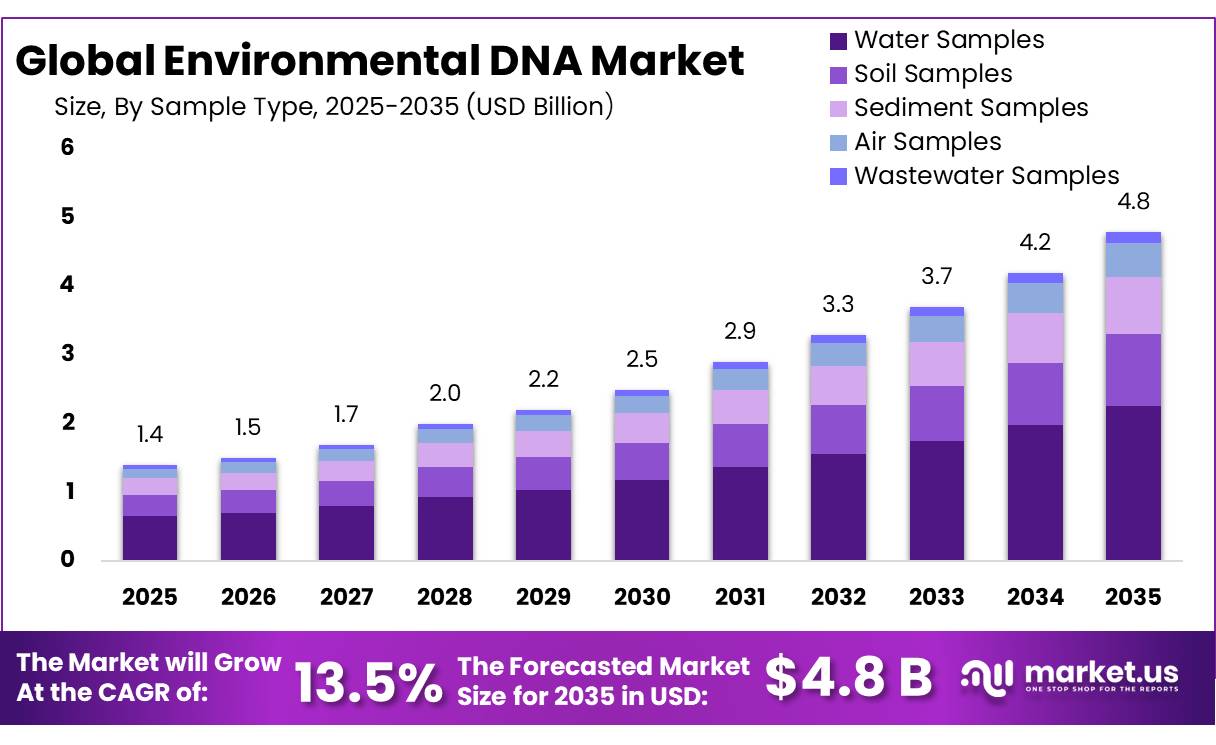
The Global Environmental DNA Market size is expected to be worth around USD 4.8 Billion by 2035, from USD 1.4 Billion in 2025, growing at a CAGR of 13.5% during the forecast period from 2026 to 2035. In 2025, North America held a dominant market position, capturing more than a 38.60% share, holding USD 0.5 Billion revenue.
Environmental DNA, or eDNA, is becoming an important tool for biodiversity monitoring, environmental assessment, aquaculture, offshore energy, conservation, and pollution impact studies. It works by collecting DNA traces from water, soil, sediment, or air instead of relying only on direct species observation. In 2025, demand strengthened as governments and industries needed faster, science-based ecosystem data. The Kunming-Montreal Global Biodiversity Framework includes 23 targets for 2030, while global policy aims to conserve 30% of land and sea by 2030, creating strong demand for measurable biodiversity tools.
Key Takeaways
- Environmental DNA Market size is expected to be worth around USD 4.8 Billion by 2035, from USD 1.4 Billion in 2025, growing at a CAGR of 13.5%.
- Water Samples held a dominant market position, capturing more than a 47.20% share.
- qPCR held a dominant market position, capturing more than a 43.50% share in the Environmental DNA (eDNA) market.
- Biodiversity Monitoring held a dominant market position, capturing more than a 33.80% share in the Environmental DNA (eDNA) market.
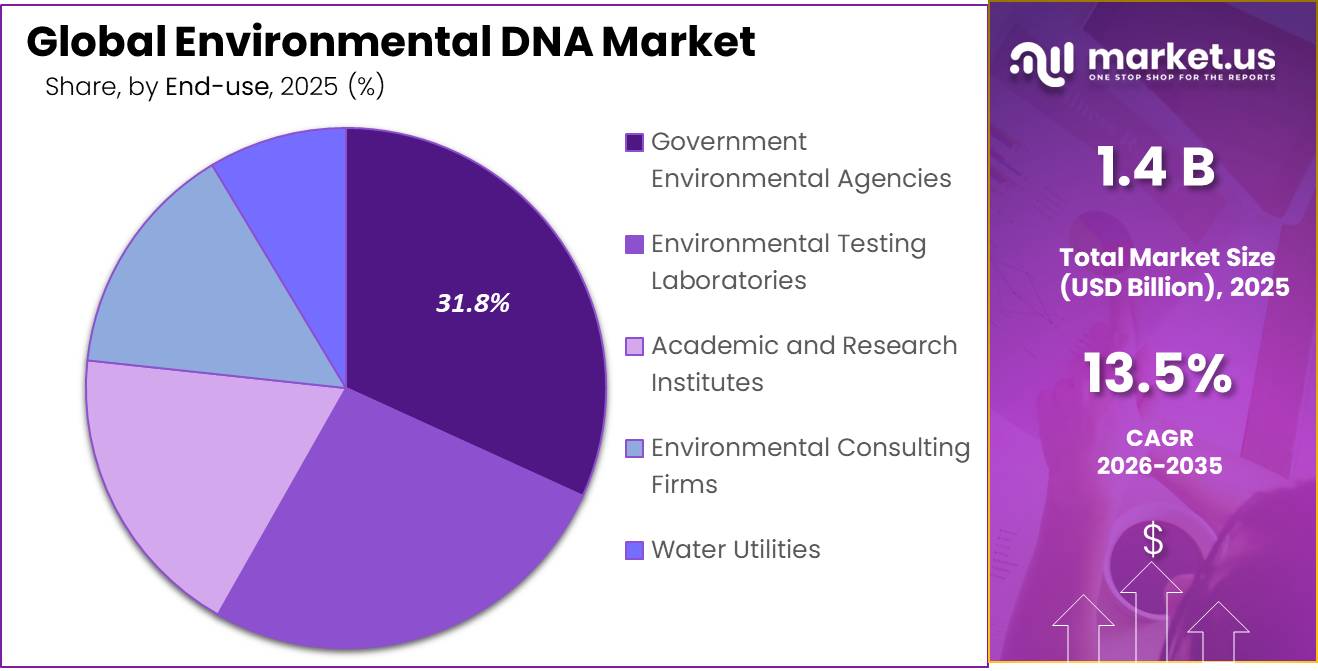
- Government Environmental Agencies held a dominant market position, capturing more than a 31.80% share in the Environmental DNA (eDNA) market.
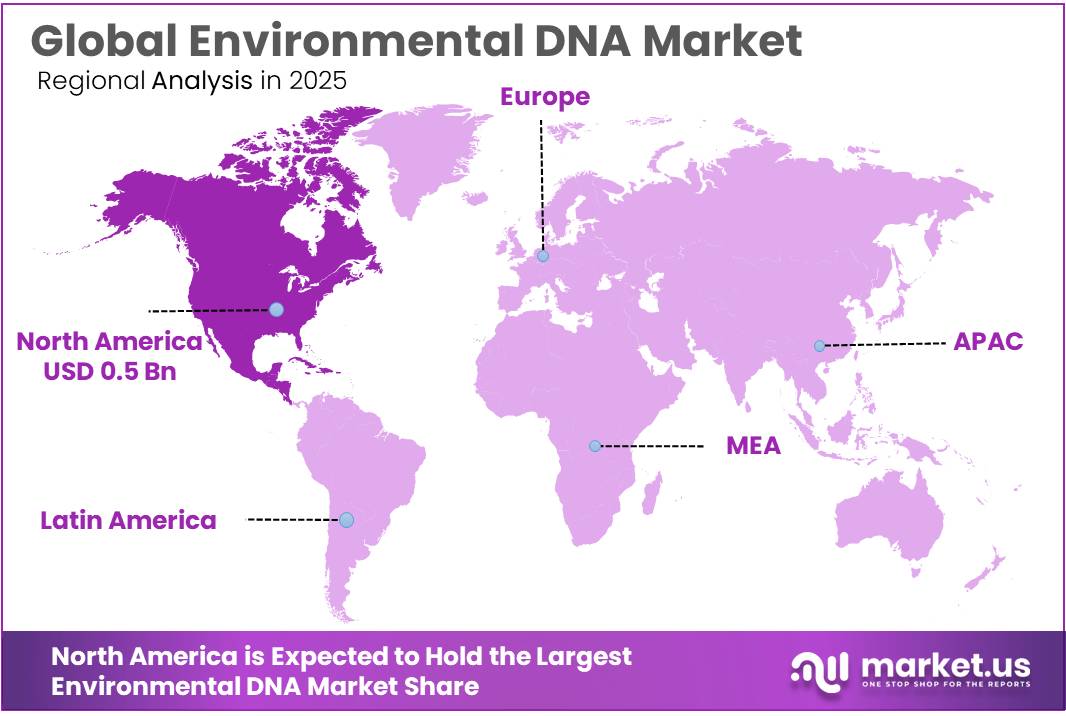
- North America held a dominant position in the Environmental DNA (eDNA) market, accounting for 38.60% of the global share and generating approximately USD 0.5 Billion.
The industrial scenario remains positive as adhesives support lightweight design, flexible packaging, building renovation, electronics assembly, and EV component bonding. In the U.S., construction spending reached USD 2,172.4 billion in April 2026, showing continued demand for sealants, flooring adhesives, insulation bonding, and panel assembly. At the same time, OECD data shows global plastic production reached 460 million tonnes in 2019, while only 9% of plastic waste was recycled, pushing packaging and consumer-goods companies to use adhesives that support recycling and circular material design.
A major demand driver is nature-related financial disclosure. By late 2025, TNFD reported more than 733 organizations across 56 countries committed to nature-related reporting, including asset managers overseeing USD 22.4 trillion in assets and listed companies with USD 9.416 trillion in market capitalization. This is pushing industries to use auditable biodiversity tools such as eDNA for site-level baselines, impact tracking, and restoration verification.
Government and global programs are also expanding the opportunity base. UNESCO’s eDNA Expeditions Phase 2 runs from June 12, 2025 to December 31, 2028, using citizen-science eDNA methods to improve marine biodiversity knowledge across World Heritage marine sites. Earlier UNESCO activity involved 250+ young volunteers, 19 countries, and 21 marine World Heritage sites, showing how eDNA can scale beyond laboratories.
eDNAtec is another important player, focused on environmental genomics for offshore, onshore, and terrestrial ecosystems. The company reports that it has sequenced more than 6 trillion DNA bases, delivered over 4 million species-level detections, and worked across more than 170 ocean projects, supporting clients in oil and gas, fisheries, aquaculture, and offshore wind. In June 2025, eDNAtec received funding through Canada’s Ocean Supercluster for a USD 2.9 million aquaculture genomics initiative with Mowi, aimed at improving salmon aquaculture monitoring.
By Sample Type Analysis
Water Samples dominate with 47.20% driven by broad environmental monitoring use
In 2025, Water Samples held a dominant market position, capturing more than a 47.20% share in the Environmental DNA (eDNA) market by sample type. This leadership was supported by the widespread use of water-based eDNA collection across biodiversity assessment, aquatic species tracking, conservation programs, and environmental monitoring activities. Water sampling continues to remain the most practical and scalable approach because genetic traces released by organisms can be collected without direct capture, reducing field effort and lowering ecosystem disturbance.
By Technology Analysis
qPCR dominates with 43.50% supported by fast and reliable detection
In 2025, qPCR held a dominant market position, capturing more than a 43.50% share in the Environmental DNA (eDNA) market by technology. Its leading position was mainly supported by its strong capability to deliver rapid, sensitive, and accurate detection of genetic material from environmental samples. qPCR remained one of the most preferred technologies because it allows researchers and monitoring agencies to identify target species efficiently without requiring direct organism collection.
By Application Analysis
Biodiversity Monitoring dominates with 33.80% due to expanding ecosystem tracking needs
In 2025, Biodiversity Monitoring held a dominant market position, capturing more than a 33.80% share in the Environmental DNA (eDNA) market by application. This strong position was supported by the growing need to monitor ecosystems more efficiently while reducing direct disturbance to natural habitats. Environmental DNA emerged as a preferred approach for biodiversity studies because it allows species identification through traces of genetic material collected from environmental sources rather than physical capture.
By End User Analysis
Government Environmental Agencies dominate with 31.80% through expanding monitoring programs
In 2025, Government Environmental Agencies held a dominant market position, capturing more than a 31.80% share in the Environmental DNA (eDNA) market by end user. Their leading position was supported by the growing use of advanced environmental monitoring methods to improve ecosystem management, biodiversity protection, and regulatory compliance. Government agencies increasingly adopted eDNA tools because they provide efficient and non-invasive ways to collect environmental information across large geographic regions.
Key Market Segments
By Sample Type
- Water Samples
- Soil Samples
- Sediment Samples
- Air Samples
- Wastewater Samples
By Technology
- qPCR
- ddPCR
- Metabarcoding
- Metagenomics
- Bioinformatics
By Application
- Biodiversity Monitoring
- Invasive Species Detection
- Endangered Species Monitoring
- Environmental Impact Assessment
- Wastewater-Based Monitoring
By End User
- Government Environmental Agencies
- Environmental Testing Laboratories
- Academic and Research Institutes
- Environmental Consulting Firms
- Water Utilities
Market Dynamics
Driver Analysis - Rising Biodiversity Monitoring Needs Accelerate Environmental DNA Adoption
Environmental DNA (eDNA) is gaining strong momentum because industries and environmental agencies are under growing pressure to measure biodiversity faster, with less ecosystem disturbance and higher data accuracy. eDNA works by collecting genetic traces left in water, soil, or air and converting them into measurable biological information without physically capturing species. This approach reduces field effort while improving detection across large ecosystems. As governments strengthen biodiversity policies and companies increase environmental disclosure practices, demand for eDNA-based monitoring continues to expand.
One of the strongest drivers is the global move toward biodiversity accountability and ecosystem restoration programs. The international biodiversity framework encourages improved species monitoring and ecosystem measurement, creating a favorable environment for eDNA deployment. Scientific studies increasingly recognize eDNA as a scalable and non-invasive monitoring solution that supports conservation and environmental reporting goals. Traditional ecological surveys often require extensive labor and repeated site visits, while eDNA enables faster collection of biodiversity evidence across aquatic and terrestrial environments.
Commercial adoption is also increasing through specialized environmental technology companies. NatureMetrics has expanded industrial biodiversity intelligence solutions using eDNA across infrastructure, energy, and environmental sectors. In January 2025, the company secured USD 25 million in Series B funding to expand its environmental DNA platform, strengthen AI capability, and scale biodiversity reporting services globally. This investment reflects rising industry confidence in DNA-based environmental assessment tools.
Restraint Analysis - Environmental DNA Results Limited by Contamination Risks
Environmental DNA (eDNA) is becoming an important tool for biodiversity monitoring, ecosystem assessment, and environmental testing because it can detect organisms from traces of genetic material found in water, soil, sediment, and air. However, one major factor slowing broader adoption is the challenge of contamination and false-positive detection. When DNA from unintended sources enters a sample during collection, transport, laboratory preparation, or surrounding environmental exposure, the final result may incorrectly indicate that a species or biological signal is present. This reduces confidence in environmental decisions and increases the need for additional validation studies.
Studies supported through scientific and government-backed monitoring frameworks show that contamination can occur even after environmental treatment processes. A 2024 study found that treated wastewater still contained detectable environmental DNA signals representing 48 different fish taxa, including native and non-native species, despite undergoing different treatment approaches. Researchers concluded that released eDNA can create misleading biodiversity signals and produce false-positive outcomes in environmental monitoring programs.
Government institutions have already recognized this challenge. The U.S. Fish and Wildlife Service published best management practices for eDNA projects that recommend strict field controls, laboratory controls, contamination tracking, and PCR validation before using results for management decisions. These initiatives highlight that while eDNA offers strong long-term potential, data quality remains a key restraint for widespread deployment.
Opportunity Analysis - Biodiversity Rules Create Strong Demand For eDNA Testing
A major growth opportunity for Environmental DNA is the rising need for fast biodiversity monitoring by industries, governments, and conservation bodies. Companies in chemicals, energy, mining, infrastructure, and water treatment are now expected to show how their operations affect nature. This creates strong demand for eDNA testing because it can detect species from water, soil, or air samples without catching or disturbing wildlife.
The opportunity is already visible in global programs. UNESCO used eDNA to map nearly 4,500 marine species across 21 World Heritage sites, showing how this method can support ocean protection at large scale. The U.S. National Aquatic eDNA Strategy also states that eDNA can be less invasive and more cost-effective than traditional animal-capture surveys, especially for protected species and sensitive habitats.
Government biodiversity targets are making this opportunity stronger. Under the Kunming-Montreal Global Biodiversity Framework, countries aim to reverse biodiversity loss by 2030, while global agreements also support protecting 30% of land and sea by 2030. This means more projects will need regular biodiversity data before permits, during operations, and after restoration.
Industry adoption is also increasing. NatureMetrics says more than 600 companies in 110 countries use its eDNA-based biodiversity services, showing that business demand is moving beyond research into commercial reporting. In 2025, NatureMetrics raised USD 25 million to expand biodiversity intelligence and eDNA services through laboratories in the UK and Canada, with a partner lab in Indonesia.
Emerging Trend Analysis - Airborne eDNA Monitoring Expands Biodiversity Detection Globally
One of the most important latest trends in Environmental DNA (eDNA) is the rapid shift from traditional water-based testing to airborne eDNA monitoring. Scientists and environmental organizations are now collecting DNA fragments directly from air samples to identify species without capturing or disturbing them. This approach is changing biodiversity tracking, ecosystem management, and environmental compliance across industrial and conservation sectors.
Chemical and life science industries are supporting this shift through advanced sequencing chemistry, molecular analysis tools, and automation platforms. According to recent industry reporting, qPCR technology represented 42.08% of environmental DNA applications in 2025, showing that highly sensitive molecular detection remains central to eDNA workflows. At the same time, airborne sample applications are projected to record the highest growth rate of around 11.0%, reflecting increasing adoption beyond aquatic ecosystems.
Research activity continues to validate the technology at larger scales. In one recent national-scale project in the United Kingdom, scientists used existing air pollution monitoring filters and identified more than 1,100 plant and animal species across 15 sampling locations using airborne eDNA methods. This demonstrated that existing environmental infrastructure can support biodiversity surveillance with lower field effort and broader coverage.
Regional Insights
North America Dominates Environmental DNA Market with 38.60% Share Valued at USD 0.5 Billion
In 2025, North America held a dominant position in the Environmental DNA (eDNA) market, accounting for 38.60% of the global share and generating approximately USD 0.5 Billion in revenue. The region maintained leadership due to its strong environmental monitoring infrastructure, early adoption of molecular testing technologies, and continuous investment in biodiversity conservation and ecosystem assessment programs.
Regional growth has also been encouraged by expanding environmental regulations and biodiversity protection initiatives. Environmental DNA technologies are increasingly integrated into habitat restoration programs, invasive species detection, aquatic ecosystem monitoring, and water quality assessments. Compared with traditional biological surveys, eDNA offers improved efficiency by reducing field labor and enabling large-scale environmental analysis using smaller sample volumes.
Key Regions and Countries Insights
- North America
- US
- Canada
- Europe
- Germany
- France
- The UK
- Spain
- Italy
- Rest of Europe
- Asia Pacific
- China
- Japan
- South Korea
- India
- Australia
- Rest of APAC
- Latin America
- Brazil
- Mexico
- Rest of Latin America
- Middle East & Africa
- GCC
- South Africa
- Rest of MEA
Key Players Analysis
NatureMetrics is one of the most recognized commercial environmental DNA companies focused on biodiversity intelligence and large-scale ecological monitoring. The company operates laboratories in 2 countries (UK and Canada) with an additional partner laboratory in Indonesia and serves organizations globally through eDNA and analytics platforms. In 2025, it secured USD 25 million Series B funding to accelerate expansion and digital biodiversity solutions. The company reports serving 600+ customers across 110+ countries, positioning itself among the largest commercial eDNA platforms globally.
Stantec has integrated environmental DNA tools into environmental consulting, ecological assessment, and infrastructure planning activities. In fiscal year 2025, Stantec reported revenue of CAD 6.3 billion, reflecting broad environmental and sustainability project growth. The company applies eDNA-based monitoring to improve species detection accuracy and reduce field survey timelines across infrastructure and environmental impact assessments.
Eurofins Genomics supports environmental DNA workflows through sequencing, PCR analysis, and genomic testing services. Parent company Eurofins Scientific reported EUR 6.95 billion revenue in 2025 and continues expanding molecular testing capabilities globally. The company supports biodiversity studies, environmental screening, and large-scale genetic identification through high-throughput laboratory infrastructure.
Top Key Players Outlook
- NatureMetrics
- eDNAtec
- EnviroDNA
- Stantec
- Eurofins Genomics
- Bureau Veritas
- Agilent Technologies, Inc. (US)
- Smith-Root
- Cramer Fish Sciences (US)
- Illumina
- PacBio
Recent Developments
In 2025, Bureau Veritas operated with about 84,000 employees across 140 countries, giving it strong reach for environmental monitoring work. Its 2025 financial reports were released in February 2026, while its sustainability services continued supporting environmental protection and biodiversity programs.
In fiscal 2025, Agilent generated USD 6.95 billion revenue and employed about 18,000 people worldwide. Its genomics portfolio includes NGS, microarrays, PCR/qPCR, automated electrophoresis, and oligo solutions, which are useful for eDNA detection and species identification. In 2026, Agilent also announced a USD 950 million all-cash acquisition of Biocare Medical to strengthen its Life Sciences and Diagnostics Markets division
Report Scope
| Report Features | Description |
|---|---|
| Market Value (2025) | USD 1.4 Bn |
| Forecast Revenue (2035) | USD 4.8 Bn |
| CAGR (2026-2035) | 13.5% |
| Base Year for Estimation | 2025 |
| Historic Period | 2020-2024 |
| Forecast Period | 2026-2035 |
| Report Coverage | Revenue Forecast, Market Dynamics, Competitive Landscape, Recent Developments |
| Segments Covered | By Sample Type (Water Samples, Soil Samples, Sediment Samples, Air Samples, Wastewater Samples), By Technology (qPCR, ddPCR, Metabarcoding, Metagenomics, Bioinformatics), By Application (Biodiversity Monitoring, Invasive Species Detection, Endangered Species Monitoring, Environmental Impact Assessment, Wastewater-Based Monitoring), By End User (Government Environmental Agencies, Environmental Testing Laboratories, Academic and Research Institutes, Environmental Consulting Firms, Water Utilities) |
| Regional Analysis | North America – US, Canada; Europe – Germany, France, The UK, Spain, Italy, Rest of Europe; Asia Pacific – China, Japan, South Korea, India, Australia, Singapore, Rest of APAC; Latin America – Brazil, Mexico, Rest of Latin America; Middle East & Africa – GCC, South Africa, Rest of MEA |
| Competitive Landscape | NatureMetrics, eDNAtec, EnviroDNA, Stantec, Eurofins Genomics, Bureau Veritas, Agilent Technologies, Inc. (US), Smith-Root, Cramer Fish Sciences (US), Illumina, PacBio |
| Customization Scope | Customization for segments, region/country-level will be provided. Moreover, additional customization can be done based on the requirements. |
| Purchase Options | We have three licenses to opt for: Single User License, Multi-User License (Up to 5 Users), Corporate Use License (Unlimited User and Printable PDF) |





































