


Report Overview
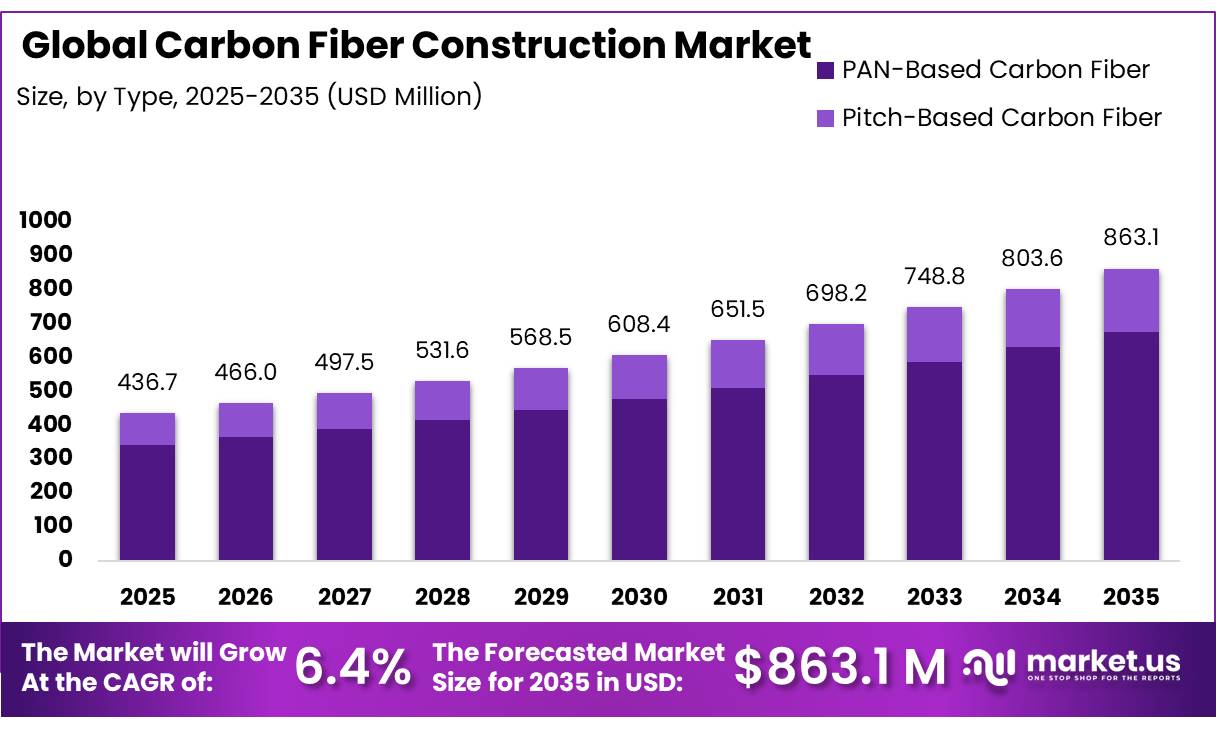
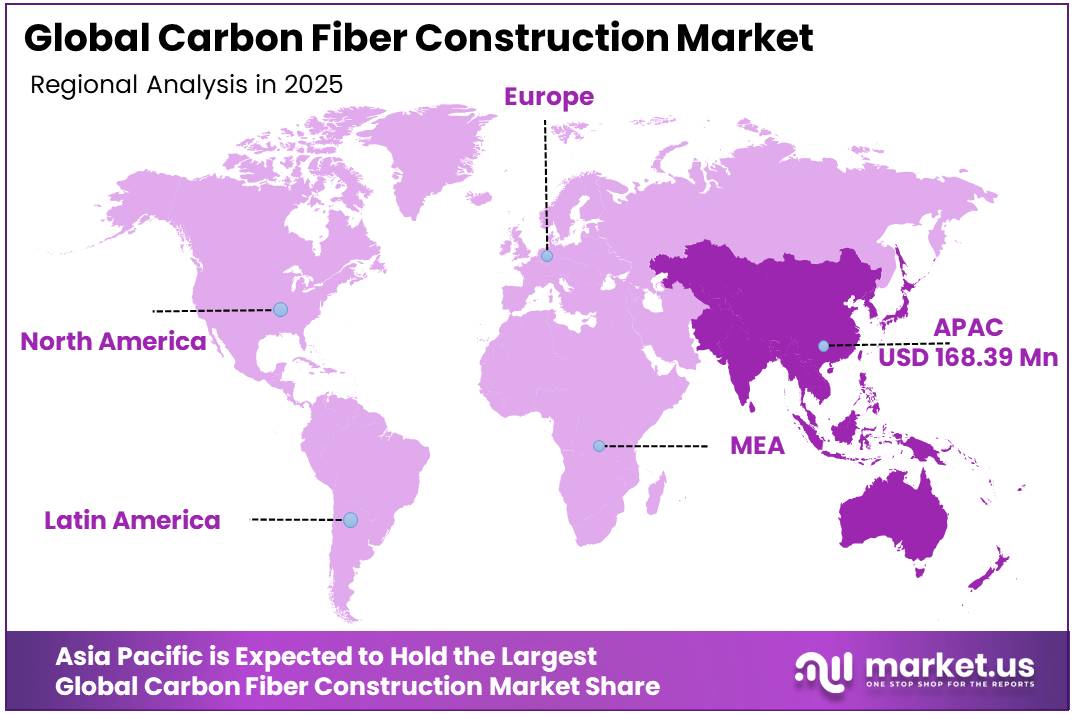
In 2025, the Global Carbon Fiber Construction Market was valued at USD 436.7 million, and between 2026 and 2035, this market is estimated to register a CAGR of 6.4%, reaching about USD 863.1 million by 2035. Asia Pacific held a dominant market position, capturing more than a 38.6% share, holding USD 168.39 million in revenue.
Key Takeaways
- The global carbon fiber construction market was valued at USD 436.7 million in 2025.
- The global carbon fiber construction market is projected to grow at a CAGR of 6.4% and is estimated to reach USD 863.1 million by 2035.
- On the basis of type, PAN-based carbon fiber dominated the market, constituting 78.5% of the total market share.
- Based on fiber type, virgin carbon fiber dominated the carbon fiber construction market, with a substantial market share of around 63.8%.
- Based on product type, carbon fiber reinforced polymer sheets and laminates led the market, comprising 28.8% of the total market.
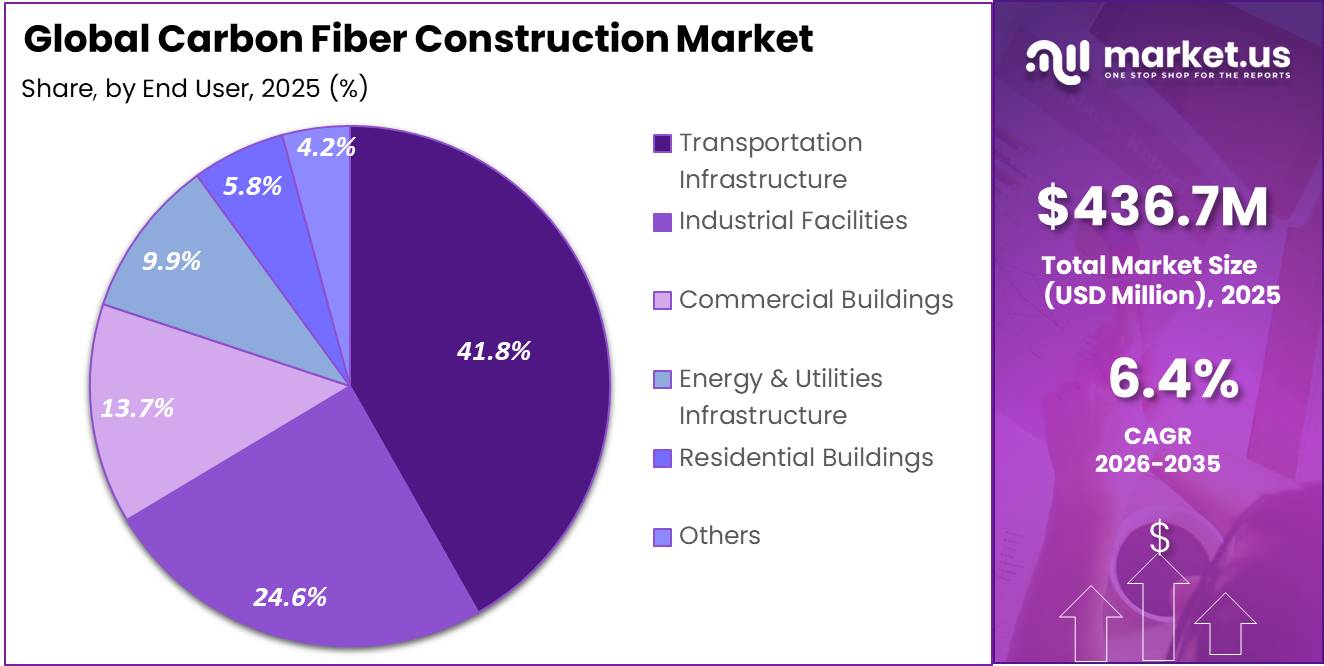
- Among the end users, transportation infrastructure held a major share in the carbon fiber construction market, accounting for 41.8% of the market share.
- In 2025, Asia Pacific was the most dominant region in the carbon fiber construction market, accounting for 38.6% of the total global market.
The carbon fiber construction industry covers carbon-fiber-reinforced polymer sheets, laminates, fabrics, rebars, tendons, cables, and strengthening systems used in buildings, bridges, tunnels, industrial plants, and energy infrastructure. These products combine high tensile performance with low weight and corrosion resistance, allowing engineers to strengthen aging structures without adding heavy steel sections or enlarging foundations. The U.S. Department of Energy states that carbon fiber composites can be half the weight of steel while offering four times greater strength.
- The U.S. Department of Transportation allocated USD 40 billion over five years through bridge programmes for repair, replacement, and resilience projects. The Federal Highway Administration also identifies lightweight construction and corrosion resistance as advantages of composite bridge decks and carbon-fiber-reinforced polymer prestressing systems.
- Demonstration projects have shown that composite bridge beams can offer service lives exceeding 100 years while reducing maintenance linked to rust, cracking, and repainting.
Demand is further supported by urban renewal, seismic upgrading, and tighter durability requirements. The European Union’s Renovation Wave targets the renovation of 35 million building units by 2030, expanding the addressable base for structural strengthening materials. In November 2024, the U.S. Department of Transportation also reported USD 1.2 billion for 39 state departments of transportation to increase the use of cleaner construction materials.
Future opportunities will emerge from automated fiber placement, prefabricated reinforcement systems, recyclable composites, and lower-cost carbon fiber production. A U.S. Department of Energy manufacturing study indicated that throughput improvements of two to four times could reduce costs by 30%–60% across selected production stages. Wider design-code acceptance, trained installers, dependable fire performance, and improved end-of-life recycling will remain essential. Suppliers offering certified systems, engineering support, rapid installation, and lifecycle savings should gain stronger adoption in transport, commercial, industrial, and utility projects.
Type Analysis
PAN-Based Carbon Fiber leads with a 78.5% share due to its strength, reliable supply, and broad structural use.
In 2025, PAN-Based Carbon Fiber held a dominant market position, capturing more than a 78.5% share. In June 2025, its leadership was supported by strong use in CFRP sheets, laminates, fabrics, rebars, and strengthening systems for bridges, buildings, tunnels, and industrial facilities. The material offers high tensile strength, low weight, fatigue resistance, and dependable bonding with resin systems. These qualities help contractors reinforce aging structures without adding heavy steel sections or placing excessive load on foundations.
Pitch-Based Carbon Fiber remained the growing segment because of its high modulus, thermal conductivity, and dimensional stability. It gained attention in specialized construction uses requiring stiffness, heat control, and long-term structural performance, particularly in industrial and energy-related infrastructure.
Fiber Type Analysis
Virgin Carbon Fiber leads with a 63.80% share due to its proven strength, consistency, and structural reliability.
In 2025, Virgin Carbon Fiber held a dominant market position, capturing more than a 63.80% share. In June 2025, its leadership was supported by wide use in CFRP sheets, laminates, fabrics, rebars, and strengthening systems for bridges, commercial buildings, industrial facilities, and transport infrastructure. The material offers dependable tensile strength, uniform quality, fatigue resistance, and strong bonding with resin systems. These properties help engineers improve structural performance while limiting added weight and installation time.
Recycled Carbon Fiber remained the fastest-growing segment as construction companies increased their focus on lower material waste and more circular production methods. It gained interest in non-critical structural components, panels, fabrics, and reinforcement products where cost efficiency and reduced environmental impact were important purchasing factors.
Product Type Analysis
Carbon Fiber Reinforced Polymer Sheets and Laminates lead with a 28.8% share due to their strength, lightweight design, and easy installation.
In 2025, Carbon Fiber Reinforced Polymer (CFRP) Sheets & Laminates held a dominant market position, capturing more than a 28.8% share. In June 2025, their leadership was supported by wide use in bridge repair, building rehabilitation, tunnel strengthening, and industrial upgrades. These products provide high tensile strength, corrosion resistance, and dependable bonding with concrete, steel, and masonry surfaces. Their thin profile allows contractors to improve structural capacity without adding heavy sections or reducing usable space.
Carbon Fiber Fabrics & Wraps remained the growing segment because they offer flexibility for columns, beams, walls, and irregular surfaces. Their use in seismic strengthening, crack control, and rapid structural repair increased across commercial, industrial, and transportation projects.
End User Analysis
Transportation Infrastructure leads with a 41.8% share because carbon fiber systems support durable, lightweight, and corrosion-resistant upgrades.
In 2025, Transportation Infrastructure held a dominant market position, capturing more than a 41.8% share. In June 2025, demand remained strong across bridges, highways, tunnels, rail structures, and airport facilities. Carbon fiber sheets, laminates, rebars, cables, and wraps help improve structural strength without adding heavy loads. Their resistance to corrosion, fatigue, and harsh weather makes them useful for extending infrastructure service life.
Industrial Facilities remained the fastest-growing segment as operators increased investment in strengthening plants, warehouses, processing units, and utility structures. Carbon fiber systems support rapid repairs, reinforce aging concrete and steel components, and help facilities continue operating with less disruption during upgrade work across major construction markets.
Key Market Segments
By Type
- PAN-Based Carbon Fiber
- Pitch-Based Carbon Fiber
By Fiber Type
- Virgin Carbon Fiber
- Recycled Carbon Fiber
By Product Type
- Carbon Fiber Reinforced Polymer (CFRP) Sheets & Laminates
- Carbon Fiber Fabrics & Wraps
- Carbon Fiber Tendons & Cables
- Carbon Fiber Rebars
- Carbon Fiber Grids & Meshes
- Others
End User
- Residential Buildings
- Commercial Buildings
- Industrial Facilities
- Transportation Infrastructure
- Energy & Utilities Infrastructure
- Others
Driver Analysis
Bridge rehab funding + FRP repair adoption
The U.S. Census Bureau estimated May 2026 highway construction spending at a $150.6 billion annualized rate, while total public construction reached $541.2 billion, preserving a large addressable pool for rehabilitation-led composite demand even in a softer aggregate construction environment. At the same time, FHWA continues to maintain formal FRP bridge-strengthening and repair pathways, which matters strategically because once a material class is embedded in bridge preservation practice, procurement shifts from “novel material approval” to “application-level engineering choice,” shortening sales cycles for wrap systems, laminates, plates, and composite structural elements.
Drivers Impact Analysis
| Driver | (~) % Impact on CAGR Forecast | Geographic Relevance | Impact Timeline |
|---|---|---|---|
| Bridge rehab funding + FRP repair adoption | +2.2% | North America core, EU transport corridors, Japan, coastal APAC | Short term (≤ 2 years) |
| Codes and standards widening FRP specification pathways | +1.8% | North America core, India, EU, Middle East | Short term (≤ 2 years) |
| Embodied-carbon compliance and renovation decarbonization | +1.5% | EU core, UK alignment markets, advanced APAC cities | Medium term (2-4 years) |
| Corrosion avoidance and lifecycle cost optimization | +2.0% | Coastal North America, Gulf states, Southeast Asia, island infrastructure | Medium term (2-4 years) |
| Public infrastructure capex sustaining premium materials niches | +1.4% | U.S. core, Canada, EU public works, select APAC | Short term (≤ 2 years) |
| Manufacturing/process improvements lowering installed cost barriers | +1.1% | China supply base, North America, EU specialty construction | Long term (≥ 4 years) |
Restraint Analysis
EU carbon border fees on embodied emissions
The introduction of the EU Carbon Border Adjustment Mechanism (CBAM), which from 2026 requires importers of cement, steel, aluminum and other high‑emission products to buy certificates priced off the EU ETS (recently fluctuating in the 60–90 EUR/tCO₂ band), structurally raises delivered costs for carbon‑intensive construction materials and any carbon fiber systems whose resin matrices or anchoring hardware are tied to these commodities, compressing project margins by 150–250 basis points on EU‑bound infrastructure packages with embodied emissions in the 0.6–1.0 tCO₂ per thousand euros of value.
For engineering firms specifying carbon fiber reinforcement, this translates into a 5–10% cost premium versus traditional steel or rebar in CBAM‑covered categories once up‑front emissions accounting, verification, and certificate surrender are included, elongating bid‑to‑award cycles by 3–6 months as contractors re‑optimize designs and financing structures. Export‑oriented producers in APAC corridors that lack domestic carbon pricing must either absorb an effective carbon levy of 40–70 EUR/tCO₂ or invest 5–7% of annual CapEx into process decarbonization just to maintain parity, which slows capacity additions and keeps realized carbon fiber construction CAGR around 2 percentage points below unconstrained scenarios as some high‑embodied‑carbon projects are postponed beyond 2030
Restraint Impact Analysis
| Restraint | (~) % Impact on CAGR Forecast | Geographic Relevance | Impact Timeline |
|---|---|---|---|
| EU carbon border fees on embodied emissions | -2.0% | EU, UK, export-dependent APAC | Medium term (2-4 years) |
| Volatile PAN precursor and energy input costs | -1.5% | North America, EU, Japan, Korea | Short–Medium term (≤ 4 years) |
| Strategic material supply-chain concentration | -1.2% | Global, esp. EU & North America | Medium–Long term (≥ 3 years) |
| Slow building code uptake for advanced composites | -1.0% | India, ASEAN, LatAm, MENA | Long term (≥ 4 years) |
| CapEx intensity of autoclave/composite facilities | -0.8% | Global, esp. emerging markets | Medium term (2-4 years) |
| Skilled labor and standards compliance gaps | -0.7% | Emerging APAC, Middle East, Africa | Short–Medium term (≤ 4 years) |
Opportunity Analysis
Public infrastructure spec-in
The market timing is supported by the fact that public construction in the U.S. is still expanding month over month, highway spending is above $150 billion annualized, and governments globally are under pressure to cut lifecycle emissions in a sector that still contributes 34% of CO2 emissions and consumes 32% of global energy, making durable low-maintenance materials more financeable within whole-life-cost frameworks.
The upside case is strongest in North America, the EU, Gulf infrastructure programs, and coastal APAC, where winning specification in even 1% of high-corrosion public infrastructure packages can create outsized material pull-through; in practical terms, shifting from post-bid substitution to spec-in could improve bid conversion by 15–25%, reduce customer acquisition cost per project by 20–30%, and expand average revenue per awarded project by 1.4–1.8x through ancillary anchors, resins, engineering, and inspection services, supporting an estimated +2.1 percentage-point CAGR uplift above baseline by 2035 if procurement codes and approved-product lists are captured early.
Opportunity Impact Analysis
| Opportunity | (~) % Potential CAGR Upside | Geographic Relevance | Execution Window |
|---|---|---|---|
| Retrofit strengthening platforms | +2.4% | North America core, EU, Japan | Short term (≤ 2 years) |
| Public infrastructure spec-in | +2.1% | North America, EU, Gulf, APAC | Medium term (2-4 years) |
| Circular recycled-CF systems | +1.9% | EU, U.S., Japan, South Korea | Medium term (2-4 years) |
| Offsite modular façade kits | +1.7% | EU, Singapore, Gulf, urban APAC | Short term (≤ 2 years) |
| Carbon-accounted premium monetization | +1.3% | EU, North America, Australia | Short term (≤ 2 years) |
| Roll-up of niche fabricators | +1.6% | North America, EU fragmented markets | Long term (≥ 4 years) |
Challenges Analysis
Precursor cost volatility
Precursor cost volatility remains a systemic drag because polyacrylonitrile (PAN) and pitch feedstocks used for construction‑grade carbon fiber continue to exhibit price swings in the 15–25% annual band, driven by fluctuating acrylonitrile and petrochemical inputs and uneven regional capacity additions, even as U.S. Department of Energy (DOE) programs target a structural cost floor of roughly 5–7 USD per pound for commodity carbon fiber versus current market levels often above 8–10 USD per pound for many grades.
This volatility propagates into construction applications where reinforcing bars, tendons, and strengthening fabrics see per‑project material cost variance of 8–12% relative to initial bids, forcing conservative design margins and value‑engineering that collectively shave around 1.4 percentage points off otherwise attainable CAGR in high‑growth segments such as bridge retrofits, seismic strengthening, and lightweight modular structures.
Strategically, developers and EPCs must respond with longer‑term offtake contracts tied to indexed feedstock baskets, diversified sourcing from North America, EU, and East Asia precursor producers, and expanded use of mixed‑material design to keep bill‑of‑materials sensitivity within a tolerable ±5% window, while manufacturers invest in alternative precursor routes and process intensification to compress cost standard deviation by at least 30–40% over the next 2–4 years.
Challenges Impact Analysis
| Challenge | (~) % CAGR Friction Drag | Geographic Relevance | Mitigation Horizon |
|---|---|---|---|
| Precursor cost volatility | -1.4% | North America, EU, East Asia | Medium term (2-4 years) |
| Energy-intensive processing | -1.2% | EU regulatory hubs, North America core | Long term (≥ 4 years) |
| Recycling & end-of-life gaps | -1.0% | EU, UK, Japan, urban APAC | Long term (≥ 4 years) |
| Skilled composites labor deficit | -0.9% | North America, EU, Middle East | Medium term (2-4 years) |
| Cross-border supply chain fragility | -1.3% | EU–Asia corridors, US–Asia lanes | Medium term (2-4 years) |
| Standards & qualification lag | -0.8% | Global construction & infrastructure | Long term (≥ 4 years) |
Geopolitical Impact Analysis
Geopolitical Realignment and Supply Chain Localization Reshaping Carbon Fiber Construction Materials
Current geopolitical tensions are reshaping the carbon fiber construction market through trade barriers, supply-chain concentration, energy-cost volatility, and localization strategies across advanced materials manufacturing. Carbon fiber used in structural strengthening, bridge rehabilitation, reinforcement systems, and prefabricated construction depends on specialized precursor, fiber, resin, and processing capacity concentrated among a limited number of producers.
In June 2026, China National Building Material Group commissioned three high-performance carbon fiber lines with annual capacities of 5,000 tonnes, 1,000 tonnes, and 600 tonnes, strengthening China’s domestic supply position and increasing competitive pressure on overseas producers. The expansion also shows how national industrial strategies are being used to secure advanced-material supply chains.
Europe’s broader localization environment is being supported by the Critical Raw Materials Act, which aims to ensure that no more than 65% of annual consumption of each strategic raw material comes from a single third country by 2030. Wider trade fragmentation is also increasing procurement uncertainty.
As of 15 October 2025, the WTO estimated that G20 import-related trade measures still in force covered approximately USD 4,015 billion, representing 22.0% of total G20 imports. These conditions are encouraging construction-material suppliers to qualify regional carbon fiber, resin, and composite-system sources. However, localized production requires high capital investment, technical certification, and longer project approval cycles, leaving manufacturers exposed to raw-material price changes, trade-policy shifts, and delayed infrastructure procurement.
Regional Analysis
Asia Pacific Leads with a 38.6% Share, Valued at USD 168.39 Million
In 2025, Asia Pacific held a dominant position in the carbon fiber construction market, accounting for 38.6% of revenue and USD 168.39 million. The region’s lead was supported by rapid transport construction, urban expansion, and rising demand for durable reinforcement materials in bridges, tunnels, high-rise buildings, and coastal infrastructure.
- China’s National Bureau of Statistics reported in February 2026 that 3,109 kilometres of new railway and 8,699 kilometres of new or rebuilt highways were completed during 2025, expanding the addressable base for lightweight structural strengthening systems.
UN ESCAP also stated in April 2025 that Asia-Pacific cities are expected to absorb 1.2 billion additional residents by 2050, increasing pressure for resilient and space-efficient infrastructure. Carbon-fiber-reinforced polymer systems are gaining relevance because they can strengthen existing concrete and steel structures without adding substantial weight. Continued regional infrastructure renewal, denser cities, and stricter durability requirements are expected to preserve Asia Pacific’s leading regional position.
Key Regions and Countries Covered
- North America
- The US
- Canada
- Europe
- Germany
- France
- The UK
- Spain
- Italy
- Russia & CIS
- Rest of Europe
- APAC
- China
- Japan
- South Korea
- India
- ASEAN
- Rest of APAC
- Latin America
- Brazil
- Mexico
- Rest of Latin America
- Middle East & Africa
- GCC
- South Africa
- Rest of MEA
Key Players Analysis
Carbon fiber construction companies focus on strengthening product performance, engineering support, and application-specific system design to remain competitive. A major priority is continuous composite innovation, including higher-strength fabrics, pre-cured laminates, anchoring systems, and resin formulations that improve bonding, load transfer, and long-term durability in structural reinforcement projects. Companies also invest in automated fiber placement, precision cutting, and standardized installation systems to reduce waste and improve project consistency.
Collaboration with engineering firms, contractors, and infrastructure owners helps suppliers secure early involvement in design specifications and increase acceptance of carbon-fiber-reinforced solutions. Strategic expansion in technical service networks allows manufacturers to support site assessment, installation training, and performance validation across multiple construction applications. In addition, leading players emphasize certification, fire resistance, environmental durability, and lifecycle performance to strengthen credibility, while developing long-term partnerships with rehabilitation contractors and public infrastructure agencies to improve customer retention and expand their position in high-value strengthening projects.
Market Key Players
- Sika AG
- Mapei SpA
- Fosroc
- Master Builders Solutions
- Fyfe
- DowAksa
- Dextra Group
- Rhino Carbon Fiber Reinforcement Products
- Chomarat Group
Key Development
- In March 2026, Mapei inaugurated its first production facility in Belgium at Grâce-Hollogne. The fully automated plant produces concrete admixtures and supports shorter delivery times, stronger local supply availability, and improved service for structural construction projects.
- In February 2025, Saint-Gobain completed its USD 1,025 million acquisition of Fosroc, a major supplier of construction chemicals and structural repair systems. The transaction expanded Fosroc’s access to Saint-Gobain’s global production, distribution, and technology network.
- In February 2025, Chomarat commissioned a new production line dedicated to unidirectional carbon-fiber reinforcements following a EUR 2 million The line processes 12K, 24K, and 50K carbon fibers and supports applications in construction, wind energy, marine structures, and advanced composites.
Report Scope
| Report Features | Description |
|---|---|
| Market Value (2025) | USD 436.7 Mn |
| Forecast Revenue (2035) | USD 863.1 Mn |
| CAGR (2026-2035) | 6.4% |
| Base Year for Estimation | 2025 |
| Historic Period | 2020-2024 |
| Forecast Period | 2026-2035 |
| Report Coverage | Revenue Forecast, Market Dynamics, Competitive Landscape, Recent Developments |
| Segments Covered | By Type (PAN-Based Carbon Fiber and Pitch-Based Carbon Fiber), By Fiber Type (Virgin Carbon Fiber and Recycled Carbon Fiber), By Product Type (Carbon Fiber Reinforced Polymer (CFRP) Sheets & Laminates, Carbon Fiber Fabrics & Wraps, Carbon Fiber Tendons & Cables, Carbon Fiber Rebars, Carbon Fiber Grids & Meshes, and Others), By End User (Residential Buildings, Commercial Buildings, Industrial Facilities, Transportation Infrastructure, Energy & Utilities Infrastructure, and Others) |
| Regional Analysis | North America – The US & Canada; Europe – Germany, France, The UK, Spain, Italy, Russia & CIS, Rest of Europe; APAC– China, Japan, South Korea, India, ASEAN & Rest of APAC; Latin America– Brazil, Mexico & Rest of Latin America; Middle East & Africa– GCC, South Africa, & Rest of MEA |
| Competitive Landscape | Sika AG, Mapei SpA, Fosroc, Master Builders Solutions, Fyfe, DowAksa, Dextra Group, Rhino Carbon Fiber Reinforcement Products, and Chomarat Group. |
| Customization Scope | Customization for segments, region/country-level will be provided. Moreover, additional customization can be done based on the requirements. |
| Purchase Options | We have three licenses to opt for: Single User License, Multi-User License (Up to 5 Users), Corporate Use License (Unlimited Users and Printable PDF) |





































