


Report Overview
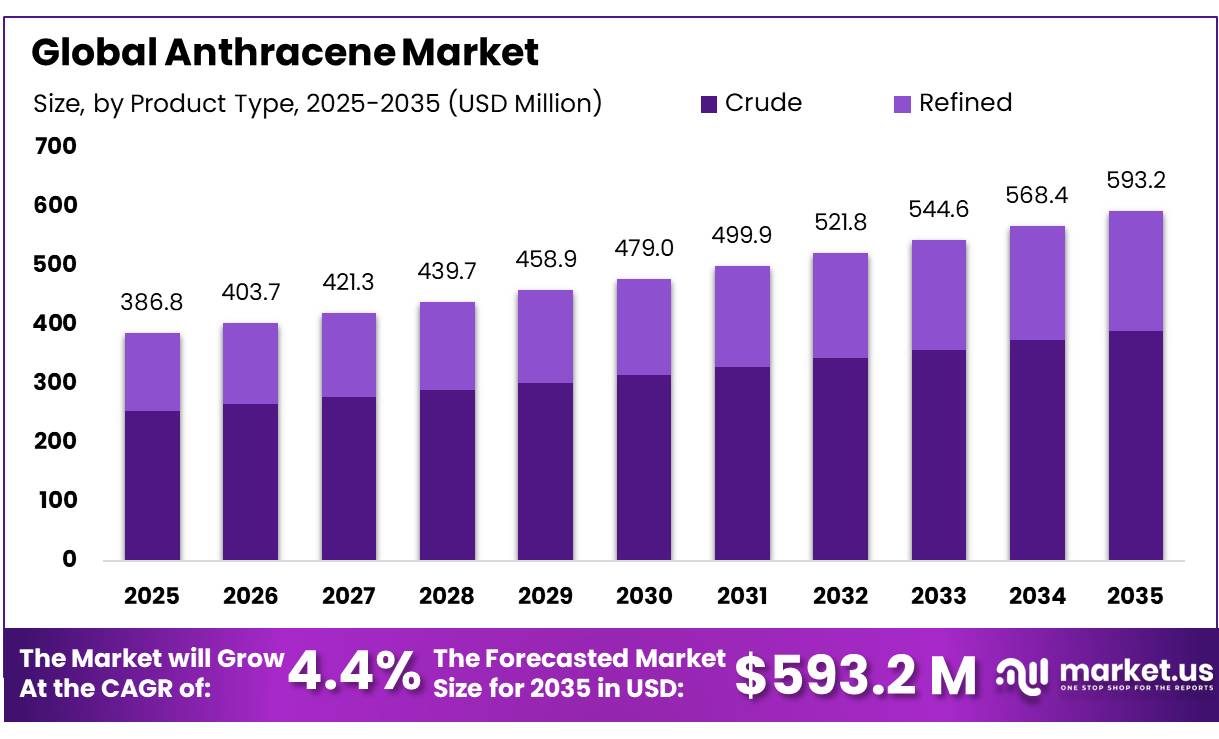
The Global Anthracene Market size is expected to be worth around USD 593.2 Million by 2035, from USD 386.8 Million in 2025, growing at a CAGR of 4.4% during the forecast period from 2026 to 2035. In 2025, Asia-Pacific held a dominant market position, capturing more than a 44.9% share, holding USD 173.3 Million revenue.
Anthracene is an industrial polycyclic aromatic hydrocarbon, C14H10, CAS 120-12-7, with molecular weight 178.23 g/mol, used mainly as a specialty intermediate rather than a bulk commodity. It is recovered from coal-tar distillation, where the anthracene-oil fraction boils around 300–360 °C and may contain about 7% anthracene before purification.
The industrial scenario remains niche and regulated. In Europe, ECHA lists anthracene as manufactured/imported at ≥1 to <10 tonnes per year, indicating limited commercial volume and stronger reliance on high-purity specialty supply chains. Kanto Chemical positions itself as a comprehensive reagent manufacturer serving R&D and production, with product categories including organics, advanced materials, analytical reagents, and electronic chemicals.
Its physical profile supports controlled industrial handling: suppliers commonly report melting around 215–220°C and boiling near 340–342°C, with very low water solubility. TCI lists >97.0% GC purity, 216–220°C melting range and 342°C boiling point for commercial anthracene.
Demand is driven by anthracene’s role in dyes, pigments, scintillation materials, photochemistry, organic synthesis, and advanced-material research. Its commercial attractiveness is supported by high-purity laboratory and specialty grades, including 97% reagent grade, 99% ReagentPlus grade, analytical-standard grades, and deuterated anthracene at 98 atom % D offered by major chemical suppliers.
OECD data further highlights environmental persistence, with anthracene-oil components showing soil dissipation values above 173 days, 131 days, and 184 days, and bioconcentration factors above 5,000 for major components.
Regulation is a key market-shaping factor. Under U.S. EPA IRIS, anthracene has an oral reference dose of 3 × 10^-1 mg/kg-day, with a NOEL of 1,000 mg/kg-day and uncertainty factor of 3,000; EPA classifies it as “not classifiable as to human carcinogenicity” due to inadequate evidence. EPA’s TRI framework also covers more than 20,000 industrial and federal facilities in the latest 2023 data release, reinforcing disclosure pressure on chemical users.
In 2025, the EU issued Regulation 2025/660 covering 18 PAHs, including anthracene, in clay targets; the rule enters force on April 22, 2025, with a market/use limit of ≤50 mg/kg, or 0.005%, from April 22, 2026.
Key Takeaways
- Anthracene Market size is expected to be worth around USD 593.2 Million by 2035, from USD 386.8 Million in 2025, growing at a CAGR of 4.4%.
- Crude held a dominant market position, capturing more than a 65.8% share.
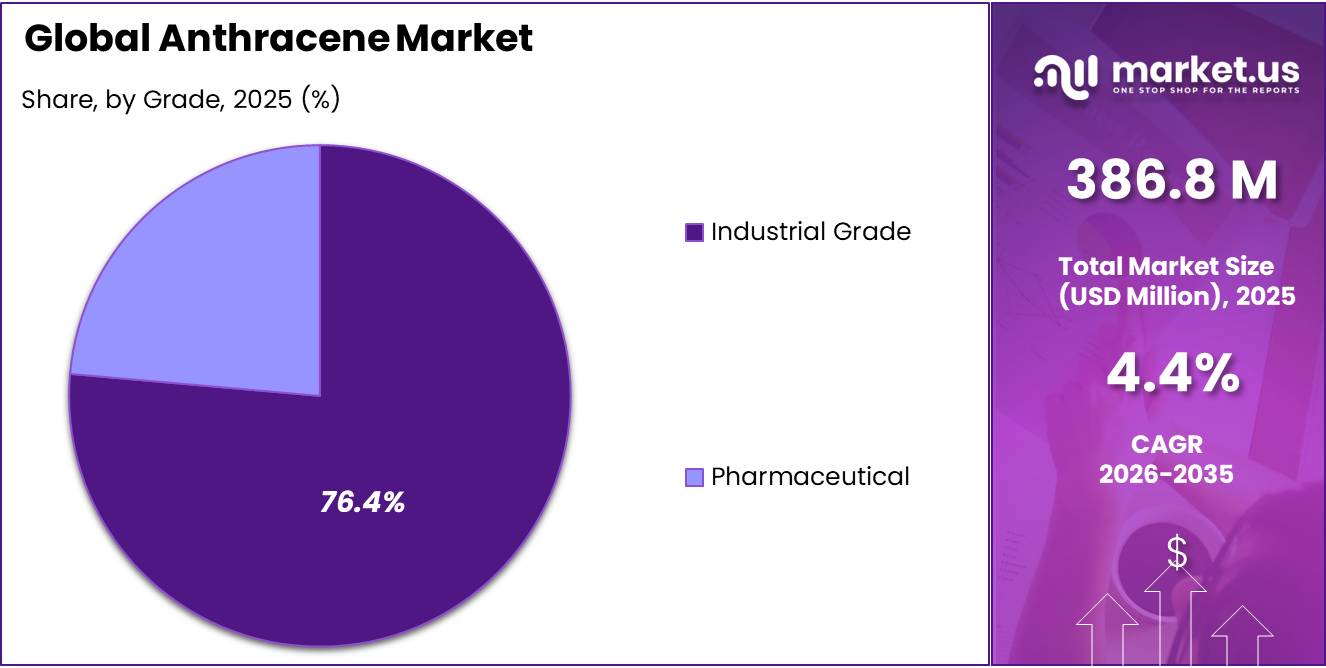
- Industrial Grade held a dominant market position, capturing more than a 76.4% share.
- Textiles held a dominant market position, capturing more than a 27.2% share.
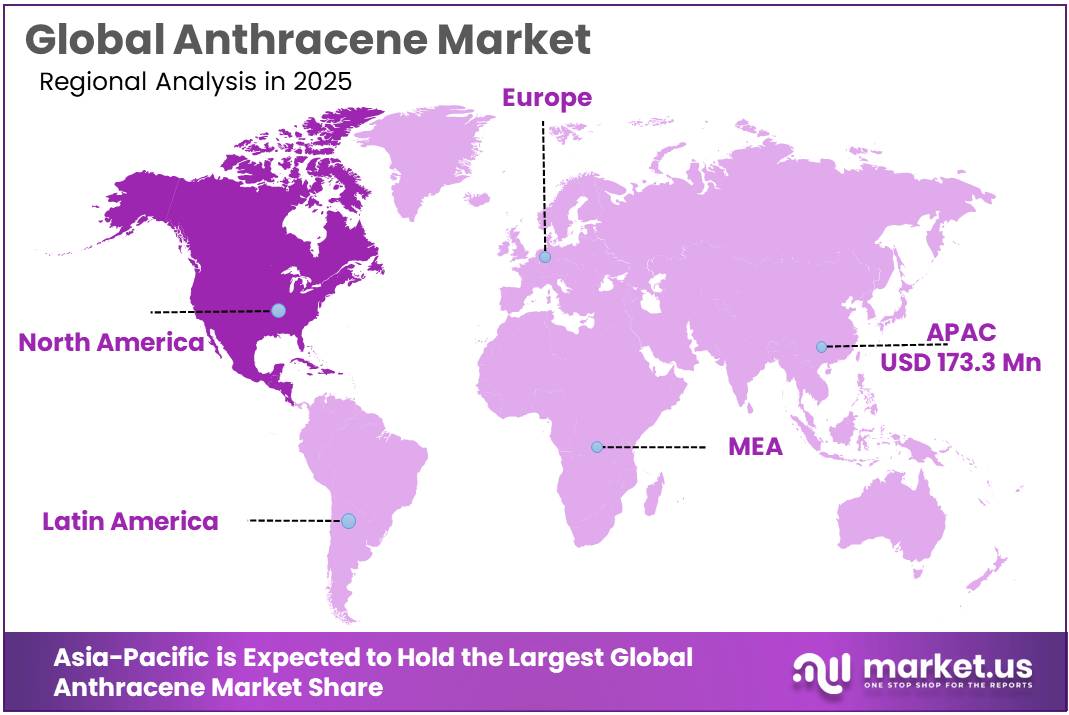
- Asia-Pacific stands as the dominating region in the anthracene market, accounting for 44.9% share with a value of 173.3 Mn.
By Product Type Analysis
Crude anthracene leads strongly with 65.8% share driven by its wide industrial use and easy availability
In 2025, Crude held a dominant market position, capturing more than a 65.8% share. This strong hold is mainly because crude anthracene is widely used as a base material in industries such as dyes, chemicals, and carbon products, where further purification is done depending on the end-use. Many manufacturers prefer crude form as it is more economical and flexible for processing into different derivatives. Its availability from coal tar processing also supports steady supply, especially in regions with established coke and steel industries.
By Grade Analysis
Industrial grade anthracene stays ahead with 76.4% share due to its strong demand in bulk applications
In 2025, Industrial Grade held a dominant market position, capturing more than a 76.4% share. This is largely because it fits well with large-scale industrial uses where ultra-high purity is not always required. Industries such as coatings, wood preservatives, and carbon black production rely heavily on industrial grade anthracene because it offers a good balance between performance and cost. Many buyers choose this grade for its practicality and consistent supply, especially in markets where price sensitivity matters.
By End Use Analysis
Textiles segment leads with 27.2% share backed by steady demand for dyes and fabric processing
In 2025, Textiles held a dominant market position, capturing more than a 27.2% share. This growth mainly comes from the strong use of anthracene in dye production, especially for coloring fabrics and improving finish quality. Textile manufacturers continue to depend on anthracene-based compounds because they provide reliable color strength and durability, which is important in large-scale fabric processing. The demand stays consistent due to ongoing clothing production and export activities in major textile hubs.
Key Market Segments
By Product Type
- Crude
- Refined
By Grade
- Industrial Grade
- Pharmaceutical
By End Use
- Textiles
- Paints and coatings.
- Chemicals
- Pharmaceuticals
- Others
Emerging Trends
Shift toward safer food processing and monitoring of PAHs is shaping anthracene trends
One of the latest trends influencing anthracene is the increasing focus on food safety, especially around compounds like polycyclic aromatic hydrocarbons (PAHs), where anthracene belongs. Food safety authorities and global organizations are paying close attention to how these compounds appear in processed food. Studies show that in food products, a group of just four PAHs (including benz[a]anthracene) can represent around 77% of total carcinogenic PAHs, which makes them a key focus for monitoring.
Because of this, governments and food regulators are tightening rules on how food is processed, especially smoked and grilled items. For example, European guidelines clearly limit total PAH levels in smoked meat to below 30 µg/kg, showing how strictly these compounds are being controlled. These rules are not just about food—they are also pushing industries to rethink how chemicals like anthracene are handled during production.
Growing role of anthracene in advanced materials and electronics
Another clear trend is the gradual shift of anthracene from traditional industries into advanced materials and electronics. While it has long been used in dyes and coatings, it is now gaining attention as a material for organic electronics. Anthracene is already being used as a semiconductor material because of its stable structure and ability to carry electrical charge efficiently.
This is important because industries are moving toward lightweight, flexible, and energy-efficient electronic devices. Anthracene-based compounds are being explored for use in organic transistors, sensors, and even light-emitting devices. As governments and industries invest in digital infrastructure and clean energy technologies, demand for such materials is slowly increasing.
Drivers
Strong demand from textile dye industry continues to push anthracene consumption
One of the biggest driving factors for anthracene comes from its role in dye manufacturing, especially for textiles. Anthracene is used to produce anthraquinone, which is a key base for making high-quality dyes that give fabrics strong and long-lasting colors. The global textile industry is huge, and this directly supports steady demand for such dye materials. For example, around 700,000 tons of dyes are produced globally every year, showing how large the dye ecosystem really is.
Out of this, the textile sector alone consumes a major portion, with nearly 800,000 tons of synthetic dyes produced annually to meet fabric coloring needs. This scale clearly shows how important chemical intermediates like anthracene are. As fashion demand rises and clothing production increases, dye consumption also grows, which indirectly boosts anthracene usage. Moving into 2026, this trend is expected to remain stable because textile production continues to expand in countries like India, China, and Bangladesh.
Government push for sustainable chemicals and cleaner production supports growth
Another key factor driving anthracene demand is the shift toward more sustainable and regulated chemical production. Governments and environmental bodies are now focusing on cleaner industrial practices, especially in textile and chemical industries where dye pollution is a concern. Many countries are introducing stricter rules on wastewater discharge and encouraging the use of safer and more efficient chemical processes.
At the same time, global agencies and policymakers are supporting innovation in eco-friendly dye production. There is a growing move toward advanced dyeing technologies and improved chemical handling systems, which rely on stable intermediates like anthracene for better efficiency. Regulations are not reducing demand; instead, they are reshaping how anthracene is used—pushing manufacturers to improve quality and reduce waste.
Restraints
Strict environmental and health regulations are limiting anthracene use
One major restraining factor for anthracene is the growing concern around environmental safety and human health. Anthracene belongs to a group of compounds called polycyclic aromatic hydrocarbons (PAHs), which are widely studied due to their harmful effects. Many of these compounds are known to be toxic, mutagenic, and carcinogenic, which makes regulators very cautious about their use in industrial processes.
Studies show that regular human exposure to PAHs through food and environment can range between 5 to 17 micrograms per day, depending on diet and surroundings. Even though anthracene itself is considered less harmful than some other PAHs, it is still grouped under regulated substances because of similar chemical behavior. Governments and agencies like the EPA and European authorities have already identified 16 priority PAHs for monitoring, which includes anthracene.
Persistence in environment and food chain raises long-term concerns
Another key challenge comes from the way anthracene and similar compounds behave in the environment. Once released, these substances do not break down easily. Instead, they persist, accumulate in soil, water, and even enter the food chain, which raises long-term safety concerns. This creates pressure not just from regulators, but also from environmental groups and public awareness.
Scientific data shows that PAHs can concentrate 100 to 10,000 times higher in sediments compared to water, making them difficult to remove once contamination happens. In addition, long-term exposure studies indicate potential cancer risks, with estimated lifetime risks reaching up to 9.61×10⁻⁴ in exposed populations, highlighting why governments are strict about controlling these chemicals.
Opportunity
Rising use in electronics and energy storage opens new growth path
One strong growth opportunity for anthracene is coming from its increasing use in advanced electronics and energy storage materials. Anthracene is not just a traditional chemical anymore—it is now being explored as a building block for organic semiconductors, which are used in flexible electronics, sensors, and display technologies.
Research shows that anthracene-based materials are already being used in devices like organic field-effect transistors and light-emitting systems because of their stable structure and efficient charge movement. These materials are important for next-generation electronics, especially where lightweight and flexible components are needed. In addition, anthracene derivatives are being studied for solar panels and organic photovoltaic cells, which are gaining attention as a low-cost alternative to traditional silicon-based systems.
Expansion in specialty chemicals and industrial applications supports steady demand
Another important growth area lies in the continued expansion of specialty chemicals where anthracene plays a key role. One of its biggest uses is in producing anthraquinone, which is widely used in dyes, coatings, and industrial chemicals. This connection keeps anthracene tied to multiple industries beyond just textiles. According to industry data, coal tar—the main source of anthracene—contains about 1.5% anthracene, ensuring a steady raw material base for large-scale production.
Anthracene is also used in coatings, wood preservatives, and as a UV tracer in electronics manufacturing, where it helps detect coating defects under ultraviolet light. These applications may seem niche, but they are widely used across construction, automotive, and electronics sectors. Governments are also supporting industrial upgrades and chemical efficiency improvements, especially in developing countries where manufacturing output is rising.
Regional Insights
Asia-Pacific leads the anthracene market with 44.9% share valued at 173.3 Mn driven by strong industrial and textile base
Asia-Pacific stands as the dominating region in the anthracene market, accounting for 44.9% share with a value of 173.3 Mn, supported by its strong manufacturing ecosystem and large-scale chemical production. The region benefits from the presence of key economies such as China, India, Japan, and South Korea, where industries like textiles, coatings, and electronics are growing steadily.
One of the biggest reasons behind this dominance is the region’s well-established coal tar processing industry, which is the primary source of anthracene. Asia-Pacific also contributes significantly to global industrial growth, with coal tar-related industries showing nearly 81.8% contribution to market growth in the region, highlighting its strong raw material base.
Key Regions and Countries Insights
- North America
- US
- Canada
- Europe
- Germany
- France
- The UK
- Spain
- Italy
- Rest of Europe
- Asia Pacific
- China
- Japan
- South Korea
- India
- Australia
- Rest of APAC
- Latin America
- Brazil
- Mexico
- Rest of Latin America
- Middle East & Africa
- GCC
- South Africa
- Rest of MEA
Key Players Analysis
SAE Manufacturing Specialties Corp plays a steady role in the anthracene market through precision manufacturing and specialty chemical support. The company operates with a strong industrial base in the U.S. and focuses on high-performance components used across aerospace and chemical sectors. The company follows a growth approach with continuous innovation and production efficiency, aligning with a global anthracene market projected to reach over USD 625.6 million by 2034.
KANTO CHEMICAL CO., INC is a major player known for its wide portfolio of chemical reagents and ultra-pure materials. Founded in 1944, the company employs around 1,062 people and offers over 50,000 chemical products, making it one of the largest reagent suppliers globally. Its role in anthracene comes from supplying high-quality chemicals used in synthesis and research.
Top Key Players Outlook
- SAE Manufacturing Specialties Corp
- KANTO CHEMICAL CO., INC
- Junsei Chemical Co., Ltd.
- Kishida Chemical Co., Ltd.
- Fisher Scientific
- Tokyo Chemical Industry Co., Ltd.
- Anward
- CHEMOS GmbH & Co. KG
- Vitas-M Laboratory Ltd.
- Santa Cruz Biotechnology, Inc.
- Coal Chem
- Choudhary Tar and Chemicals
- M/S Amichem Research Lab LLP
Recent Industry Developments
Junsei Chemical Co., Ltd. plays a consistent and reliable role in the anthracene value chain, mainly through its expertise in chemical reagents and fine chemical production. Established in 1948, the company operates from Tokyo with around 140–171 employees and a capital base of ¥100 million, showing its mid-sized but stable structure in the specialty chemicals space.
Fisher Scientific, operating under its parent Thermo Fisher Scientific, plays an important supporting role in the anthracene sector through its strong presence in laboratory chemicals, analytical tools, and research-grade reagents. As of 2025, the company reported annual revenue of USD 44.56 billion, reflecting a 3.9% year-on-year growth, and employed around 125,000–126,000 people globally, showing its massive operational scale.
Report Scope
| Report Features | Description |
|---|---|
| Market Value (2025) | USD 386.8 Mn |
| Forecast Revenue (2035) | USD 593.2 Mn |
| CAGR (2026-2035) | 4.4% |
| Base Year for Estimation | 2025 |
| Historic Period | 2020-2024 |
| Forecast Period | 2026-2035 |
| Report Coverage | Revenue Forecast, Market Dynamics, Competitive Landscape, Recent Developments |
| Segments Covered | By Product Type (Crude, Refined), By Grade (Industrial Grade, Pharmaceutical), By End Use (Textiles, Paints and coatings, Chemicals, Pharmaceuticals, Others) |
| Regional Analysis | North America – US, Canada; Europe – Germany, France, The UK, Spain, Italy, Rest of Europe; Asia Pacific – China, Japan, South Korea, India, Australia, Singapore, Rest of APAC; Latin America – Brazil, Mexico, Rest of Latin America; Middle East & Africa – GCC, South Africa, Rest of MEA |
| Competitive Landscape | SAE Manufacturing Specialties Corp, KANTO CHEMICAL CO., INC, Junsei Chemical Co., Ltd., Kishida Chemical Co., Ltd., Fisher Scientific, Tokyo Chemical Industry Co., Ltd., Anward, CHEMOS GmbH & Co. KG, Vitas-M Laboratory Ltd., Santa Cruz Biotechnology, Inc., Coal Chem, Choudhary Tar and Chemicals, M/S Amichem Research Lab LLP |
| Customization Scope | Customization for segments, region/country-level will be provided. Moreover, additional customization can be done based on the requirements. |
| Purchase Options | We have three licenses to opt for: Single User License, Multi-User License (Up to 5 Users), Corporate Use License (Unlimited User and Printable PDF) |





































