


Report Overview
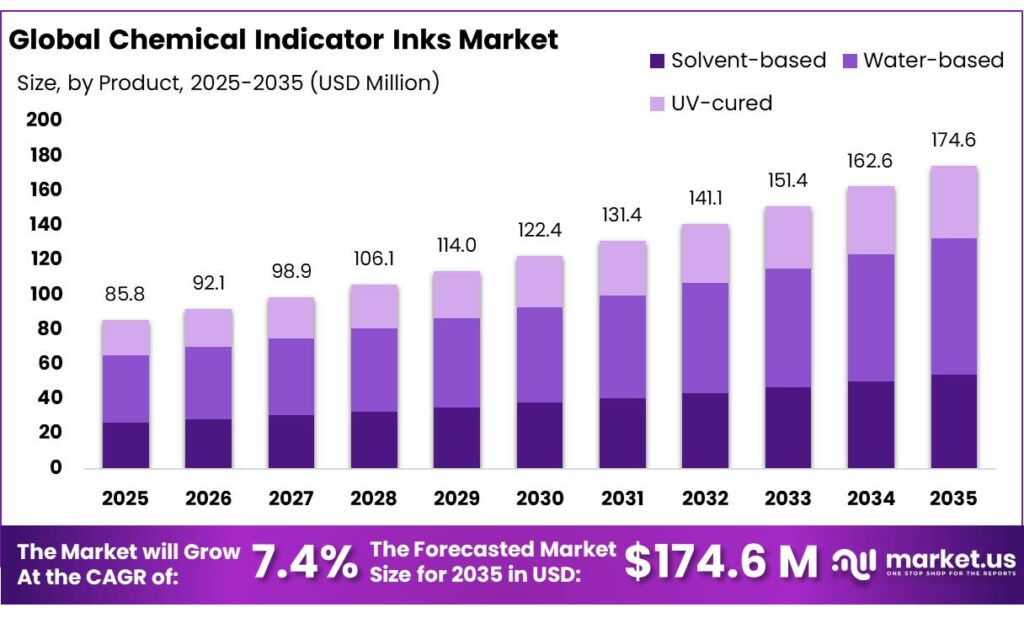
The Global Chemical Indicator Inks Market size is expected to be worth around USD 174.6 Million by 2035, from USD 85.8 Million in 2025, growing at a CAGR of 7.4% during the forecast period from 2026 to 2035. In 2025, North America held a dominant market position, capturing more than a 35.4% share, holding USD 30.3 Million revenue.
Chemical indicator inks are specialty color-change inks used on labels, tapes, strips, pouches and process packs to visually confirm exposure to sterilization or controlled processing conditions. Industrial demand is linked to healthcare sterilization, pharmaceutical packaging, food-contact safety systems and smart packaging, where rapid visual verification supports contamination control and traceability. The sector benefits from global food-safety pressure: WHO estimates 600 million foodborne illness cases and 420,000 deaths each year, while children under five account for 125,000 deaths annually.
In healthcare, CDC reports that about 1 in 31 U.S. hospital patients has at least one healthcare-associated infection on any given day, creating sustained use of sterilization indicators in hospitals and device reprocessing. FDA’s Food Code supports time–temperature control, including cooling cooked food from 135°F to 70°F within 2 hours and then to 41°F or below within 4 more hours, creating relevance for indicator technologies in food handling and packaging validation.
Driving factors include stricter traceability, sterilization assurance and regulatory documentation. The U.S. FDA Food Traceability Rule requires additional records for foods on the Food Traceability List, built around Critical Tracking Events and Key Data Elements; FDA also proposed a 30-month compliance-date extension from January 20, 2026 to July 20, 2028. These initiatives indirectly support smart labels, batch coding and indicator-based packaging systems. In Europe, food-contact materials must comply with Regulation (EC) No 1935/2004, which requires materials not to endanger health or alter food quality, taste, smell or appearance.
Food and packaging applications are becoming more relevant because FAO reports 13.2% of food is lost after harvest and before retail, while 19% is wasted at retail, food service and household levels. UNEP also estimates 1.05 billion tonnes of food waste annually, including 631 million tonnes from households. These figures strengthen the case for intelligent packaging indicators that improve shelf-life visibility, cold-chain confidence and waste reduction.
Regulation is a major driver. In the United States, FDA notes that devices are sterilized through steam, dry heat, radiation, ethylene oxide, vaporized hydrogen peroxide and other methods, while ethylene oxide remains widely used for devices that cannot tolerate alternative processes. EPA’s 2024 rule targeted around 90 commercial sterilization facilities and aimed to cut ethylene oxide emissions by about 90%, increasing demand for compliant monitoring and validation systems.
Key Takeaways
- Chemical Indicator Inks Market size is expected to be worth around USD 174.6 Million by 2035, from USD 85.8 Million in 2025, growing at a CAGR of 7.4%.
- Solvent-based held a dominant market position, capturing more than a 45.8% share.
- Steam held a dominant market position, capturing more than a 37.9% share.
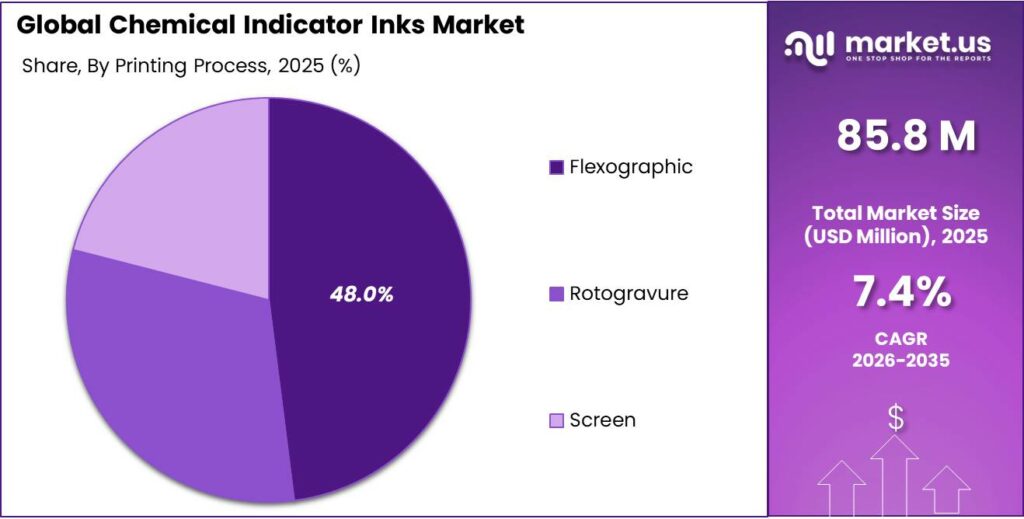
- Flexographic held a dominant market position, capturing more than a 48.1% share.
- Sterile Bags held a dominant market position, capturing more than a 23.6% share.
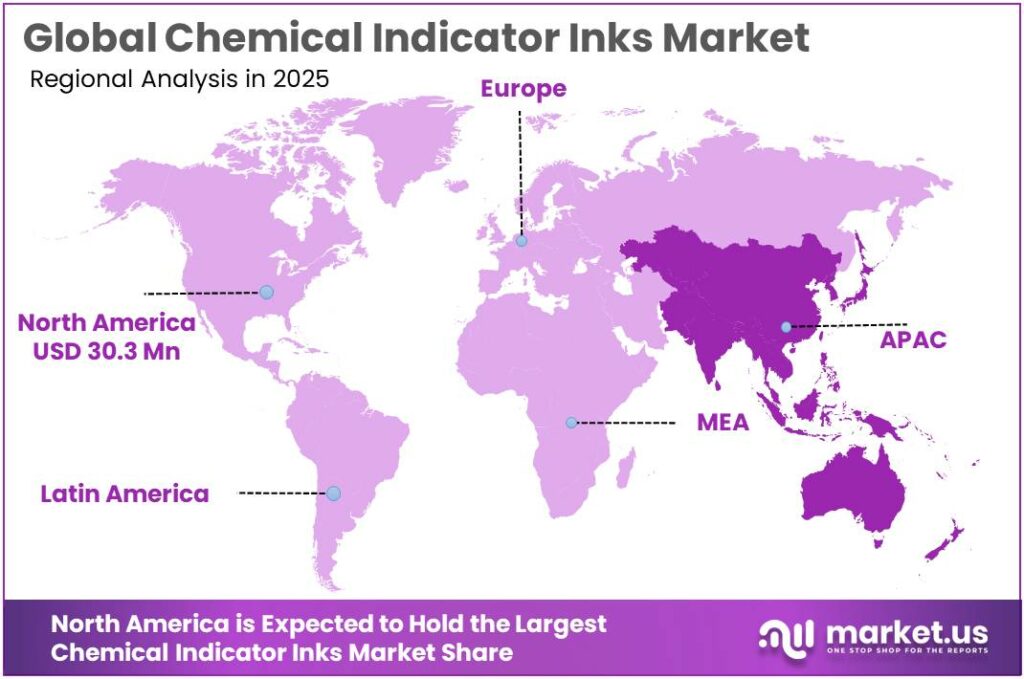
- North America held a dominant position in the Chemical Indicator Inks market, accounting for 35.4% share valued at around USD 30.3 Mn.
By Product Analysis
Solvent-based dominates with 45.8% due to its strong performance across industrial applications
In 2025, Solvent-based held a dominant market position, capturing more than a 45.8% share. This strong presence is mainly because solvent-based chemical indicator inks offer better durability and faster drying compared to other types. These inks perform well on a wide range of surfaces, especially in demanding environments like healthcare sterilization, packaging, and industrial labeling. Their resistance to moisture and chemicals makes them a reliable choice where accuracy and permanence are important.
By Sterilization Analysis
Steam leads with 37.9% as it remains the most trusted sterilization method across healthcare
In 2025, Steam held a dominant market position, capturing more than a 37.9% share. This is largely because steam sterilization is widely accepted in hospitals and labs for its effectiveness and reliability. Chemical indicator inks used in steam processes are designed to clearly show whether the right temperature and pressure conditions have been met, making them essential for safety checks. These inks are commonly used on medical packaging, instruments, and sterilization wraps.
By Printing Process Analysis
Flexographic dominates with 48.1% thanks to its speed and suitability for large-scale packaging
In 2025, Flexographic held a dominant market position, capturing more than a 48.1% share. This is mainly because flexographic printing is widely used for high-volume production, especially in packaging materials where chemical indicator inks are commonly applied. It allows fast printing on different surfaces like paper, plastic, and films, making it a practical choice for manufacturers. The process is also cost-efficient for long runs, which supports its strong adoption across industries such as healthcare packaging and sterilization labels.
By Application Analysis
Sterile Bags lead with 23.6% as they are widely used for safe and reliable medical packaging
In 2025, Sterile Bags held a dominant market position, capturing more than a 23.6% share. This is mainly because sterile bags are a common choice in hospitals and labs for storing and transporting sterilized instruments. Chemical indicator inks used on these bags help show whether proper sterilization conditions have been met, which is important for patient safety. These bags are easy to use, cost-effective, and suitable for different sterilization methods, making them widely accepted in daily medical operations.
Key Market Segments
By Product
- Solvent-based
- Water-based
- UV-cured
By Sterilization
- Steam
- Ethylene Oxide
- Vaporized Hydrogen & Plasma
- Formaldehyde
- Others
By Printing Process
- Flexographic
- Rotogravure
- Screen
By Application
- Sterile Bags
- Sterile Bottles
- IV & Blood Containers
- Prefillable Syringes
- Pouches
- Tapes
- Tags & Labels
- Others
Emerging Trends
Smart and responsive indicator inks are emerging as a key trend in food safety systems
One of the latest trends in chemical indicator inks is the shift toward smarter and more responsive formulations that can clearly show sterilization and safety conditions in real time. This trend is closely linked to the growing global concern around food safety. According to the World Health Organization, around 600 million people fall ill every year due to contaminated food, and about 420,000 deaths occur annually because of unsafe food consumption
In 2025, manufacturers are increasingly focusing on indicator inks that change color more precisely under specific temperature, pressure, or time conditions. This helps food processors and packaging companies quickly confirm whether sterilization has been properly completed. Governments and global initiatives, including the WHO Global Strategy for Food Safety 2022–2030, are also encouraging stronger monitoring systems.
Integration of food safety regulations is driving demand for compliant ink technologies
Another important trend is the growing alignment of chemical indicator inks with strict food safety regulations and international standards. Governments are now treating food safety as a major public health priority. Data shows that unsafe food leads to 33 million healthy life years lost globally each year, highlighting the long-term impact of contamination. Because of this, regulatory bodies are encouraging better traceability and validation systems across the food supply chain.
In 2025, many food companies are updating their processes to match these stricter guidelines, which includes using certified indicator inks that meet safety and environmental standards. There is also a visible shift toward low-toxicity and compliant formulations that reduce any risk of chemical migration into food packaging. By 2026, this trend is expected to strengthen as more countries adopt global frameworks like Codex Alimentarius for food safety practices.
Drivers
Rising global food production is pushing demand for reliable sterilization and safety solutions
One of the major driving factors for chemical indicator inks is the rapid growth in global food production and processing. As food volumes increase, the need for safe packaging, sterilization, and contamination control becomes more critical. According to the Food and Agriculture Organization, global cereal production reached around 3.1 billion tonnes by 2024, showing strong growth driven by higher yields and demand. At the same time, total primary crop production touched 9.9 billion tonnes in 2023, reflecting a steady rise in global food output.
This huge scale of production means that food processing, packaging, and storage systems must follow strict hygiene standards. Chemical indicator inks play an important role here, especially in sterilization labels and packaging materials, helping ensure that food products are processed under safe conditions. Governments and global bodies are also pushing food safety standards, especially in export-driven economies.
Food waste and safety concerns are increasing focus on quality control systems
Another strong driver comes from the growing concern around food loss and safety. The Food and Agriculture Organization estimates that more than 15% of food is lost during post-harvest stages, even before reaching retail markets. In addition, global estimates suggest that up to one-third of all food produced is wasted, showing a serious gap in handling and safety systems.
Chemical indicator inks are widely used in packaging, processing units, and sterilization systems to visually confirm that proper conditions have been met. This helps reduce spoilage, improves product quality, and ensures compliance with international food safety norms. By 2026, stricter food safety rules and awareness among manufacturers are pushing companies to adopt better tracking and validation tools.
Restraints
Strict chemical safety rules are slowing down adoption in food-related applications
One key restraining factor for chemical indicator inks is the growing pressure around chemical safety, especially in food processing and packaging environments. Governments and food authorities are becoming more strict about what materials can come in contact with food or be used near it. According to the Food and Agriculture Organization, around 600 million people fall ill every year due to contaminated food, showing how serious food safety risks are globally.
In 2025, many manufacturers are facing challenges in meeting these regulations, especially when their ink formulations contain solvents or compounds that may raise safety concerns. By 2026, this pressure is expected to grow further as countries continue to align with stricter global standards. While chemical indicator inks are useful for sterilization checks, companies must ensure they do not pose any contamination risk.
Rising food waste concerns limit acceptance of non-eco-friendly materials
Another restraint comes from the increasing focus on sustainability and reducing waste in the food industry. The Food and Agriculture Organization estimates that about 1.3 billion tonnes of food is wasted globally every year, highlighting inefficiencies across the supply chain.
In 2025, many food companies are trying to shift toward sustainable packaging solutions, and this indirectly affects the demand for traditional indicator inks. By 2026, stricter environmental policies and green initiatives are expected to influence purchasing decisions even more. If inks are not recyclable, biodegradable, or low in emissions, companies may hesitate to use them.
Opportunity
Growing focus on reducing food waste is creating demand for better monitoring solutions
One major growth opportunity for chemical indicator inks comes from the increasing global focus on reducing food loss and waste. Today, food safety and efficiency are becoming top priorities across supply chains. According to the Food and Agriculture Organization, nearly one-third of all food produced globally—about 1.3 billion tonnes—is lost or wasted every year. In addition, recent data shows that around 1.05 billion tonnes of food were wasted in 2022 alone, especially at retail and consumer levels.
This situation is pushing governments and food industries to adopt better safety and monitoring systems. Chemical indicator inks play a small but important role here by helping verify sterilization and packaging conditions. In 2025, many countries are strengthening food safety regulations under global goals like SDG 12.3, which aims to reduce food waste by half. Moving into 2026, companies are expected to invest more in technologies that ensure product safety and reduce spoilage during storage and transport.
Government-backed food safety programs are encouraging adoption of quality control tools
Another strong opportunity comes from increasing government initiatives focused on food safety and supply chain improvement. Global reports show that around 13% of food is lost between harvest and retail, while another 19% is wasted at the consumption stage. These losses highlight gaps in handling, storage, and quality monitoring systems. Governments are now encouraging better packaging, traceability, and sterilization practices to reduce these losses.
In 2025, food safety authorities across many regions are promoting stricter compliance standards, especially for export-quality food products. This includes the use of validation tools like chemical indicator inks that confirm whether proper sterilization conditions have been met. By 2026, with continued policy support and awareness programs, industries are expected to adopt more advanced and reliable safety indicators. This shift not only helps reduce contamination risks but also improves shelf life and product quality.
Regional Insights
North America dominates with 35.4% share, supported by strong healthcare systems and large-scale food processing industry
North America held a dominant position in the Chemical Indicator Inks market, accounting for 35.4% share valued at around USD 30.3 Mn, driven by its advanced healthcare infrastructure and highly developed food processing industry. The region, led by the United States and Canada, has a strong presence of hospitals, diagnostic centers, and sterilization facilities that require reliable monitoring systems.
Chemical indicator inks are widely used here to ensure sterilization accuracy in medical tools and packaging, which is critical for patient safety. At the same time, North America’s food sector also plays a major role in supporting demand. The region is among the world’s top producers and exporters of key agricultural products like corn, soybeans, and meat, making food safety and packaging standards extremely important.
From a data perspective, agricultural strength further highlights the need for safe processing systems. For instance, in the United States alone, corn production contributes about USD 75.8 billion as a major cash crop, reflecting the scale of food output in the region. Such large-scale production requires strict sterilization and packaging checks to maintain quality during storage and export. Moving into 2025 and 2026, regulatory frameworks in North America continue to emphasize hygiene, traceability, and compliance, especially in healthcare and food industries.
Key Regions and Countries Insights
- North America
- US
- Canada
- Europe
- Germany
- France
- The UK
- Spain
- Italy
- Rest of Europe
- Asia Pacific
- China
- Japan
- South Korea
- India
- Australia
- Rest of APAC
- Latin America
- Brazil
- Mexico
- Rest of Latin America
- Middle East & Africa
- GCC
- South Africa
- Rest of MEA
Key Players Analysis
Riken Chemical operates with over 100+ years of industry experience and has a presence in 20+ countries. The company focuses on sterilization indicator products used across healthcare and industrial sectors. It maintains multiple production facilities in Asia and supports a wide portfolio of specialty chemicals. Its indicator-related products contribute a notable share within its performance materials segment, with steady growth observed around 2025–2026 due to rising sterilization demand.
3M is a global leader operating in 70+ countries with products sold in 200+ markets. The company invests around 5–6% of annual revenue into R&D, supporting innovation in sterilization assurance solutions. Its healthcare division contributes billions in revenue, with chemical indicators forming a key niche. In 2025, 3M continues expanding its sterilization monitoring portfolio, backed by strong distribution networks and a workforce exceeding 90,000 employees globally.
NiGK Corporation is a specialized manufacturer with a strong focus on sterilization indicators and inks. The company exports to 40+ countries and maintains partnerships with healthcare providers globally. Its product line includes multiple sterilization indicator formats, supporting steam, EO, and plasma processes. In 2025–2026, NiGK continues expanding its footprint, driven by rising global demand for infection control and compliance with international sterilization standards.
Top Key Players Outlook
- Riken Chemical Co Ltd.
- 3M
- Tempil (LA-Co Industries)
- NiGK Corporation
- SteriTec Products Inc.
- Propper Manufacturing Company, Inc.
- ETIGAM BV
- Terragene SA
- GKE GmbH
- STERIS Corporation
Recent Industry Developments
In 2026, 3M is focusing on innovation and efficiency, with Q1 EPS reaching USD 2.14 (up 14%) and continued expansion in safety and industrial segments.
Riken Chemical Co., Ltd. has built a strong position in the chemical indicator inks sector by focusing on sterilization safety and precision-based ink technologies. The company operates with an estimated annual revenue of around USD 45.5 billion and continues to expand its footprint in healthcare and industrial applications.
Report Scope
| Report Features | Description |
|---|---|
| Market Value (2025) | USD 85.8 Mn |
| Forecast Revenue (2035) | USD 174.6 Mn |
| CAGR (2026-2035) | 7.4% |
| Base Year for Estimation | 2025 |
| Historic Period | 2020-2024 |
| Forecast Period | 2026-2035 |
| Report Coverage | Revenue Forecast, Market Dynamics, Competitive Landscape, Recent Developments |
| Segments Covered | By Product (Solvent-based, Water-based, UV-cured), By Sterilization (Steam, Ethylene Oxide, Vaporized Hydrogen And Plasma, Formaldehyde, Others), By Printing Process (Flexographic, Rotogravure, Screen), By Application (Sterile Bags, Sterile Bottles, IV And Blood Containers, Prefillable Syringes, Pouches, Tapes, Tags And Labels, Others) |
| Regional Analysis | North America – US, Canada; Europe – Germany, France, The UK, Spain, Italy, Rest of Europe; Asia Pacific – China, Japan, South Korea, India, Australia, Singapore, Rest of APAC; Latin America – Brazil, Mexico, Rest of Latin America; Middle East & Africa – GCC, South Africa, Rest of MEA |
| Competitive Landscape | Riken Chemical Co Ltd., 3M, Tempil (LA-Co Industries), NiGK Corporation, SteriTec Products Inc., Propper Manufacturing Company, Inc., ETIGAM BV, Terragene SA, GKE GmbH, STERIS Corporation |
| Customization Scope | Customization for segments, region/country-level will be provided. Moreover, additional customization can be done based on the requirements. |
| Purchase Options | We have three licenses to opt for: Single User License, Multi-User License (Up to 5 Users), Corporate Use License (Unlimited User and Printable PDF) |





































