


Report Overview
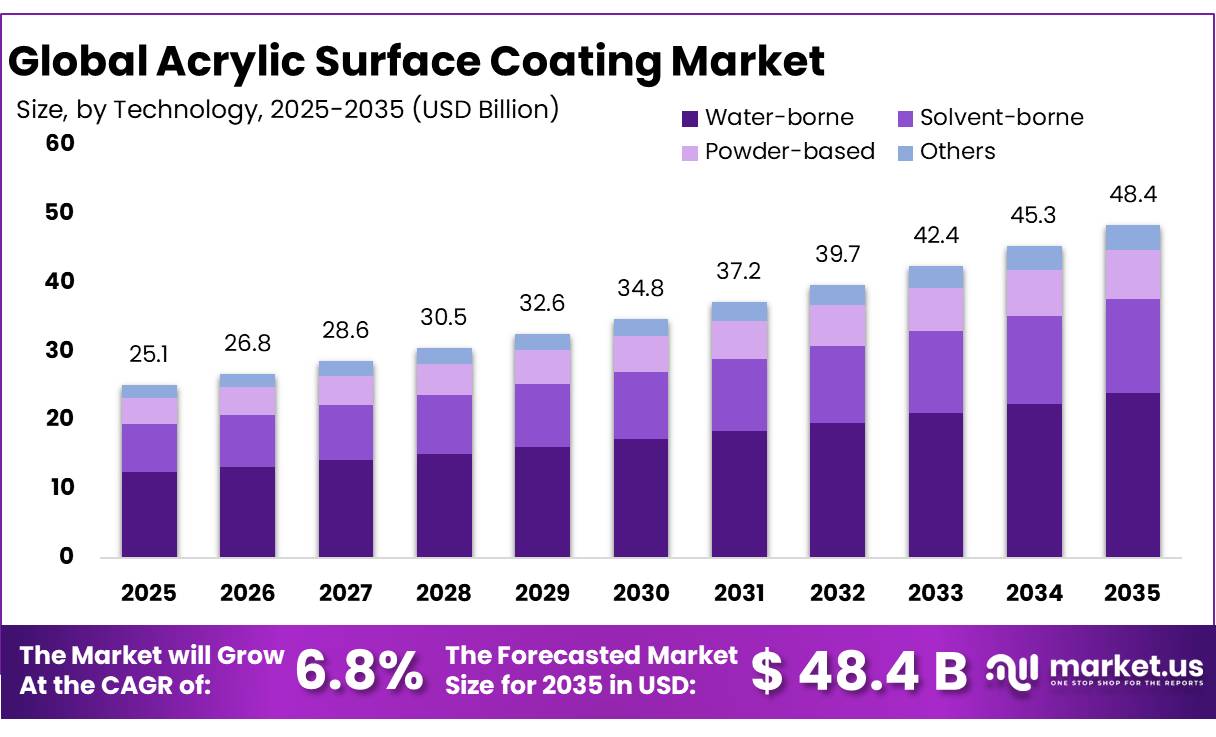
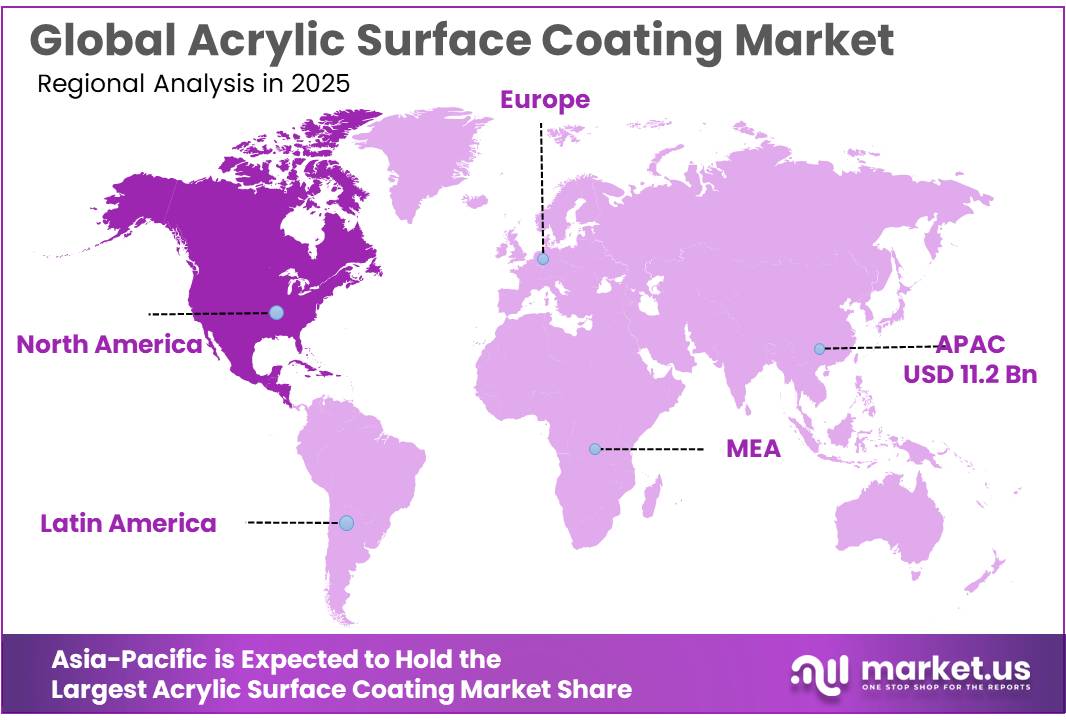
The Global Acrylic Surface Coating Market size is expected to be worth around USD 48.4 Billion by 2035, from USD 25.1 Billion in 2025, growing at a CAGR of 6.8% during the forecast period from 2026 to 2035. In 2025, Asia-Pacific held a dominant market position, capturing more than a 44.8% share, holding USD 11.2 Billion revenue.
Acrylic surface coating is positioned as a durable, waterborne and performance-oriented coating system used on construction, metal, wood, plastics, automotive, marine and industrial substrates. Its industrial relevance is supported by acrylic chemistry’s balance of adhesion, UV resistance, gloss retention, weatherability and relatively low VOC formulation potential. The sector is increasingly shaped by water-based acrylic emulsions and bio-based resin development; Dow, for example, lists a 100% acrylic emulsion for interior paints with 27% bio-based carbon content, indicating the direction of lower-carbon binder innovation.
The industrial scenario remains linked to construction renovation, infrastructure maintenance, automotive refinishing, electronics, aerospace and general industrial protection. Regulatory pressure continues to support acrylic waterborne systems, as the U.S. EPA’s architectural coatings VOC rule is estimated to reduce VOC emissions by 103,000 megagrams per year, equal to 113,500 tons per year. In Europe, building refurbishment is another structural demand driver, with the European Commission’s Renovation Wave targeting 35 million building renovations by 2030 and a doubling of annual energy-renovation rates.
In the U.S., the paint and coatings industry supported 312,000 workers, 53,700 establishments, and $31.5 billion in producer shipments in 2023, according to the American Coatings Association using government datasets. In Europe, renovation policy also supports acrylic coating demand: the European Commission’s Renovation Wave targets 35 million buildings renovated by 2030 and aims to at least double annual energy-renovation rates.
Driving factors include stricter VOC limits, infrastructure renewal, demand for longer service life, and the replacement of solvent-based coatings with waterborne acrylics. The U.S. Bipartisan Infrastructure Law authorizes $1.2 trillion for transportation and infrastructure spending, including $550 billion in new investments, which supports coating consumption in bridges, public assets, transit, utilities, and maintenance applications.
Recent 2025 developments further signal strategic momentum. AkzoNobel and Axalta announced an all-stock merger plan in November 2025 to create a coatings company with about $17 billion in revenue and $25 billion enterprise value, targeting $600 million annual cost synergies. 3M also progressed its portfolio transition by completing its PFAS manufacturing exit at the end of 2025, after previously identifying manufactured PFAS annual net sales of about $1.3 billion.
Key Takeaways
- Acrylic Surface Coating Market size is expected to be worth around USD 48.4 Billion by 2035, from USD 25.1 Billion in 2025, growing at a CAGR of 6.8%.
- Water-borne held a dominant market position, capturing more than a 49.5% share.
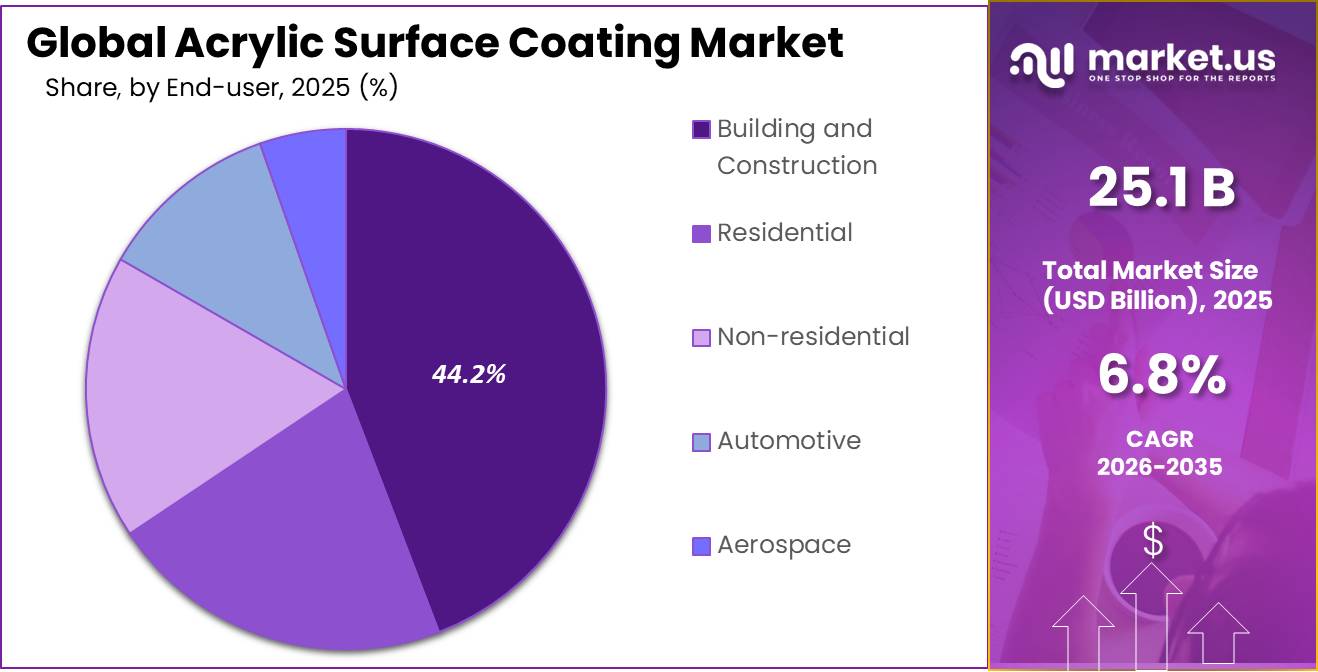
- Building and Construction held a dominant market position, capturing more than a 43.7% share.
- Asia-Pacific emerged as the dominating region in the acrylic surface coating market, accounting for 44.8% share with a value of USD 11.2 billion.
By Technology Analysis
Water-borne dominates with 49.5% driven by eco-friendly demand and regulatory shift
In 2025, Water-borne held a dominant market position, capturing more than a 49.5% share. This strong position mainly comes from the growing preference for low-VOC and environmentally safer coating solutions across industries like construction, automotive, and furniture. Governments in many regions have tightened regulations around solvent emissions, which has pushed manufacturers to shift toward water-based technologies. By 2026, the segment continues to see steady adoption as companies focus on sustainability goals while maintaining performance standards.
By End-user Analysis
Building and Construction leads with 43.7% supported by rising infrastructure and housing demand
In 2025, Building and Construction held a dominant market position, capturing more than a 43.7% share. This segment continues to grow steadily as demand for durable and weather-resistant coatings remains strong across residential and commercial projects. Acrylic surface coatings are widely used here because they offer good protection against moisture, UV exposure, and surface wear, which makes them suitable for both interiors and exteriors.
Key Market Segments
By Technology
- Water-borne
- Solvent-borne
- Powder-based
- Others
By End-user
- Building and Construction
- Residential
- Non-residential
- Automotive
- Aerospace
- Others
Emerging Trends
Smart and sustainable packaging trend shaping coating demand
One clear trend in the acrylic surface coating market is the growing shift toward smart and sustainable packaging, especially linked with food systems. According to the Food and Agriculture Organization, global cereal production is expected to reach around 3,036 million tonnes in 2025, showing how rapidly food supply chains are expanding. With this level of production, protecting food during storage and transport becomes more important than ever. This is where coatings play a quiet but important role.
By 2025 and moving into 2026, governments and global bodies are also pushing for reduced food waste. Around one-third of food produced globally is still lost or wasted due to poor handling and packaging systems. This has encouraged industries to adopt smarter packaging technologies, where coatings help extend shelf life and maintain quality. Acrylic coatings fit well here because they provide a protective barrier while remaining relatively safe and adaptable.
Rising use of eco-friendly materials driven by global sustainability goals
Another major trend is the strong push toward eco-friendly materials across industries, including food and agriculture. FAO data shows that food packaging alone used around 37.3 million tonnes of plastics in global agricultural value chains, highlighting the scale of material use and environmental pressure. Because of this, governments and international organizations are actively encouraging alternatives that reduce environmental impact. This shift is directly influencing the coating industry as well.
By 2026, many regions are focusing on circular economy models and reducing dependence on traditional plastic-heavy materials. Acrylic coatings, especially water-based ones, are gaining attention because they can be used in more sustainable systems and adapted to lower-emission standards. Policies linked to climate action and waste reduction are pushing manufacturers to rethink materials and processes. At the same time, industries connected to food production are also under pressure to adopt greener packaging and storage solutions.
Drivers
Rising construction and infrastructure growth pushing coating demand
One of the biggest drivers for acrylic surface coatings is the rapid growth in construction and infrastructure activities across the world. In 2025, the global construction industry is expected to reach around $17.04 trillion, showing strong expansion compared to previous years. This kind of scale directly increases the need for protective and decorative coatings on buildings, bridges, roads, and commercial spaces. Acrylic coatings are widely used here because they are durable, weather-resistant, and easy to apply on different surfaces.
By 2026, this demand continues to rise as countries invest more in housing and smart city projects. Government-backed infrastructure programs in developing regions are especially important, where new residential and commercial construction is happening at a fast pace. At the same time, renovation of old buildings is also adding to coating demand. Acrylic coatings fit well in both new construction and repair work, making them a reliable choice.
Environmental regulations and sustainability shift supporting acrylic coatings
Another strong driver comes from increasing environmental concerns and stricter government rules around emissions. The construction sector alone contributes about 34% of global carbon emissions and around 32% of energy use, which has pushed authorities to promote greener materials and processes. Because of this, many countries are encouraging the use of low-VOC and eco-friendly coatings, where acrylic-based solutions are gaining preference.
Governments are also promoting green building standards, which further increases the use of sustainable coating materials. For manufacturers and builders, acrylic coatings offer a good balance between performance and environmental safety. This steady shift toward cleaner and safer materials is not just a trend but a long-term change, and it continues to drive the demand for acrylic surface coatings globally.
Restraints
High environmental compliance costs limiting adoption
One major factor slowing down the growth of acrylic surface coatings is the rising cost of meeting environmental regulations. The buildings and construction sector alone contributes around 34% of global CO₂ emissions, making it a key focus area for governments and regulatory bodies. Because of this, strict rules are being introduced on emissions, chemical usage, and waste management. While acrylic coatings are considered safer than many alternatives, manufacturers still need to invest heavily in cleaner production methods, testing, and certification to meet these evolving standards.
By 2025 and into 2026, many small and mid-sized manufacturers struggle to keep up with these compliance costs. Switching to low-VOC or water-based formulations requires changes in raw materials, equipment, and processes, which adds financial pressure. Governments are promoting green construction through initiatives and policies, but the cost burden often falls on producers and end-users. This makes acrylic coatings slightly more expensive compared to some traditional options, especially in price-sensitive markets.
Volatility in raw material supply and production expenses
Another important restraint comes from fluctuations in raw material availability and cost. Acrylic coatings depend on petrochemical-based inputs, and these materials are directly affected by global supply chains and energy prices. At the same time, the construction sector itself is responsible for nearly 37% of global greenhouse gas emissions, which has led to increasing pressure on material production industries like cement, chemicals, and polymers. This pressure often results in tighter regulations and rising production costs for raw materials.
For end-users, especially in construction and industrial applications, this can lead to budget uncertainties and delayed purchasing decisions. Governments are encouraging sustainable material sourcing, but the transition is still ongoing and not fully stabilized. Until raw material supply becomes more predictable and cost-efficient, this factor will continue to act as a restraint on the steady growth of acrylic surface coatings.
Opportunity
Growing demand for sustainable food packaging creating new coating opportunities
One major growth opportunity for acrylic surface coatings is coming from the fast expansion of food production and packaging needs. According to the Food and Agriculture Organization, global wheat production alone is expected to reach about 819 million tonnes in 2025, showing how rapidly food output is increasing worldwide. As food production grows, the demand for safe, durable, and protective packaging materials also rises.
Acrylic coatings are being explored more in food-related applications because they provide moisture resistance, smooth finish, and protective layers without heavy toxicity concerns. With rising global consumption and increasing trade in food commodities, packaging becomes more important than ever. This opens up steady opportunities for acrylic coatings in areas like storage containers, transport surfaces, and food processing environments. As food demand keeps rising year by year, coatings that support safety and durability naturally gain more importance.
Shift toward bio-based and eco-friendly coatings supported by global initiatives
Another strong opportunity comes from the growing shift toward sustainable and bio-based materials. The global push for greener alternatives is visible across industries, including food and agriculture. In 2025, the biopolymer coatings market itself is valued at around USD 38 billion, showing a clear movement toward eco-friendly coating solutions. Governments and international bodies are actively promoting reduced reliance on fossil-based materials and encouraging the use of renewable resources.
Acrylic coatings, especially water-based ones, fit well into this shift because they can be adapted to meet lower emission standards. At the same time, industries connected to food production are also focusing on reducing waste and improving efficiency, which further supports the use of advanced coatings. This ongoing transition toward greener materials is not just a short-term trend, but a long-term opportunity for acrylic surface coatings to expand into newer applications.
Regional Insights
Asia-Pacific dominates with 44.8% share valued at USD 11.2 Bn driven by strong construction and industrial growth
Asia-Pacific emerged as the dominating region in the acrylic surface coating market, accounting for 44.8% share with a value of USD 11.2 billion, supported by rapid urbanization and expanding industrial activity. The region continues to lead due to its strong base in construction, automotive, and manufacturing sectors, especially in countries like China, India, and Southeast Asia. In 2025, the broader paints and coatings market in Asia-Pacific crossed nearly USD 82 billion, and further increased to around USD 86 billion in 2026, reflecting steady regional demand growth.
The dominance of Asia-Pacific is closely linked to large-scale infrastructure investments and population-driven housing demand. The region accounts for nearly 60% of global infrastructure spending, with construction output approaching USD 5.3 trillion, creating consistent demand for protective and decorative coatings. Acrylic coatings are widely used in these applications due to their durability, weather resistance, and cost-effectiveness, making them suitable for both residential and commercial projects.
Key Regions and Countries Insights
- North America
- US
- Canada
- Europe
- Germany
- France
- The UK
- Spain
- Italy
- Rest of Europe
- Asia Pacific
- China
- Japan
- South Korea
- India
- Australia
- Rest of APAC
- Latin America
- Brazil
- Mexico
- Rest of Latin America
- Middle East & Africa
- GCC
- South Africa
- Rest of MEA
Key Players Analysis
3M remains a strong player in the acrylic surface coating market with its diversified materials and coating solutions portfolio. In 2025, the company reported total revenue of around USD 24.9 billion, showing steady growth of nearly 1.5% year-on-year. Its operating margin stood close to 18.6%, reflecting stable profitability despite global cost pressures. The company also generated about USD 1.6 billion in operating cash flow in the final quarter of 2025.
Akzo Nobel NV continues to be a key coatings manufacturer with a strong focus on decorative and performance coatings. In 2025, the company recorded revenue of approximately €10.16 billion, with an adjusted EBITDA of nearly €1.44 billion and margin around 14.2%.Despite a 5% decline in revenue, the company achieved cost savings of about €98 million, improving operational efficiency.
Arkema Group plays a significant role in advanced materials and coating solutions, particularly in specialty acrylic resins. In 2025, the company reported quarterly operating profit close to €25 million, reflecting moderate but stable performance in a challenging market environment. Arkema continues to focus on high-performance materials, with specialty chemicals contributing over 50% of its revenue mix. Its strategy includes expanding sustainable solutions and bio-based coatings, which are gaining traction globally.
Top Key Players Outlook
- 3M
- Akzo Nobel NV
- Arkema Group
- Asian Paints
- BASF SE
- Berger Paints India Limited
- Dow
- Jotun
- PPG Industries Inc.
- Sika AG
- Solvay
- The Sherwin-Williams Company
Recent Industry Developments
3M is also focusing on innovation, planning to launch nearly 1,000 new products between 2025 and 2027, many linked to sustainable and high-performance materials.
Akzo Nobel NV holds a strong position through its decorative paints and performance coatings business, widely used in construction, automotive, and industrial applications. In 2025, the company reported total revenue of around €10.16 billion (≈ USD 11.49 billion), with a slight 5% decline year-on-year due to lower volumes and currency impact, but it still maintained solid profitability.
Report Scope
| Report Features | Description |
|---|---|
| Market Value (2025) | USD 25.1 Bn |
| Forecast Revenue (2035) | USD 48.4 Bn |
| CAGR (2026-2035) | 6.8% |
| Base Year for Estimation | 2025 |
| Historic Period | 2020-2024 |
| Forecast Period | 2026-2035 |
| Report Coverage | Revenue Forecast, Market Dynamics, Competitive Landscape, Recent Developments |
| Segments Covered | By Technology (Water-borne, Solvent-borne, Powder-based, Others), By End-user (Building and Construction, Residential, Non-residential, Automotive, Aerospace, Others) |
| Regional Analysis | North America – US, Canada; Europe – Germany, France, The UK, Spain, Italy, Rest of Europe; Asia Pacific – China, Japan, South Korea, India, Australia, Singapore, Rest of APAC; Latin America – Brazil, Mexico, Rest of Latin America; Middle East & Africa – GCC, South Africa, Rest of MEA |
| Competitive Landscape | 3M, Akzo Nobel NV, Arkema Group, Asian Paints, BASF SE, Berger Paints India Limited, Dow, Jotun, PPG Industries Inc., Sika AG, Solvay, The Sherwin-Williams Company |
| Customization Scope | Customization for segments, region/country-level will be provided. Moreover, additional customization can be done based on the requirements. |
| Purchase Options | We have three licenses to opt for: Single User License, Multi-User License (Up to 5 Users), Corporate Use License (Unlimited User and Printable PDF) |





































