


Report Overview
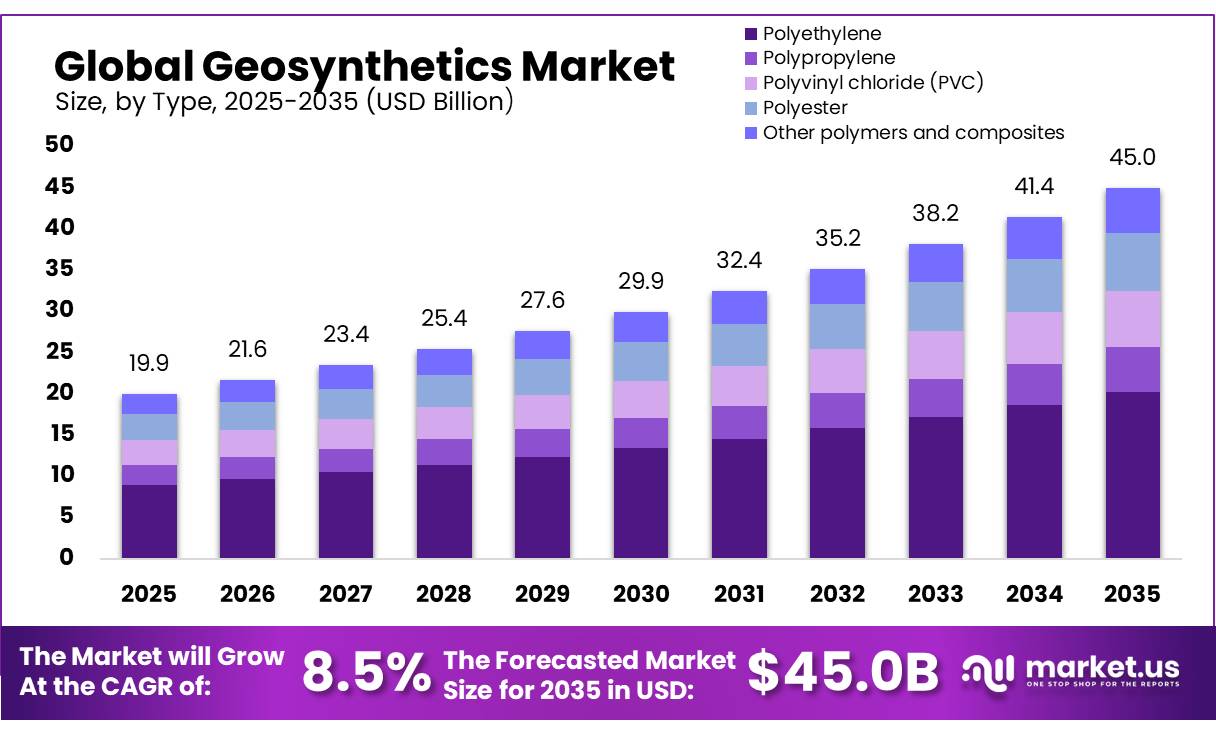
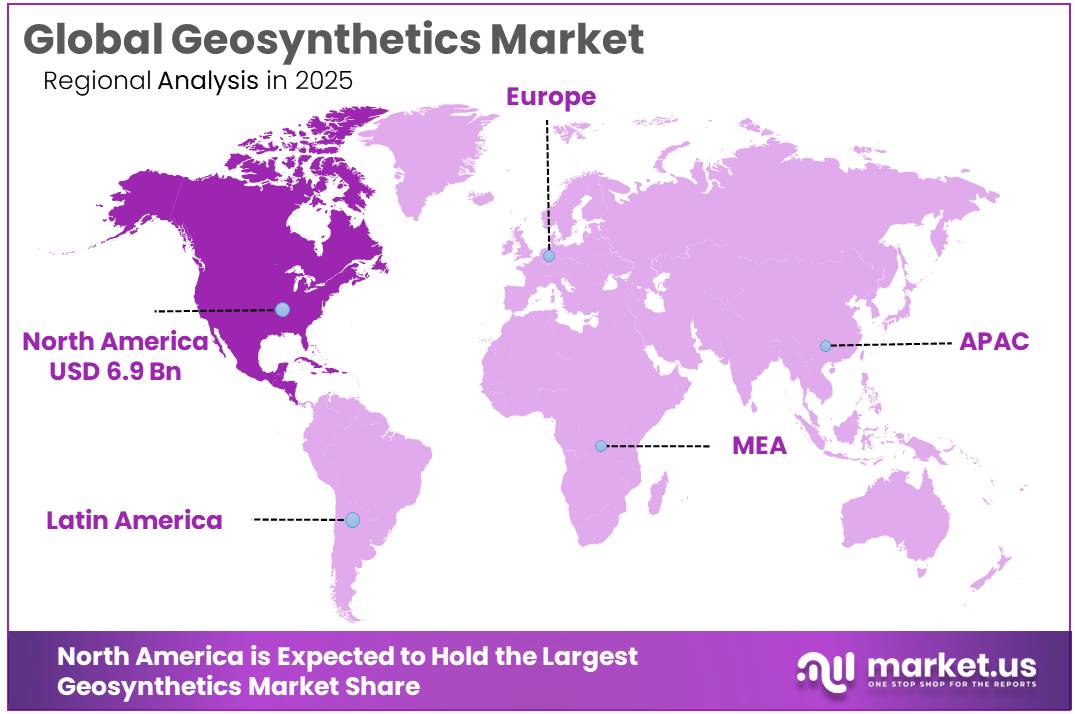
In 2025, the Global Geosynthetics Market was valued at USD 19.9 billion, and between 2026 and 2035, this market is estimated to register a CAGR of 8.5%, reaching about USD 45.0 billion by 2035. North America held a dominant market position, capturing more than a 34.8% share, holding USD 6.9 billion in revenue.
Geosynthetics are engineered polymer products used for separation, reinforcement, filtration, drainage, containment, and erosion control in roads, railways, landfills, reservoirs, mines, and coastal works. The industry includes geotextiles, geogrids, geomembranes, geonets, geocells, and geosynthetic clay liners. Demand is closely linked to civil construction because these materials can reduce aggregate use, improve soil performance, control leakage, and extend infrastructure service life.
- The industrial scenario remains supported by large public infrastructure pipelines. In June 2026, the European Union reported that its Connecting Europe Facility had a transport budget of €25.8 billion for 2021–2027.
In the United States, the Army Corps of Engineers stated that supplemental civil-works funding exceeds $46 billion across more than 1,200 water-resource projects. These programmes create opportunities for geotextiles, geomembranes, drainage composites, and erosion-control systems in highways, embankments, flood barriers, canals, and shoreline protection.
Cost efficiency is another major driver. The US Federal Highway Administration reports that geosynthetic-reinforced soil bridge systems can cost 25%–60% less than conventional alternatives. Environmental regulation also supports adoption. The US Environmental Protection Agency recorded 146.1 million tons of municipal solid waste landfilled in 2018 and requires modern landfill designs to use composite liners and leachate collection systems, directly supporting containment products.
Raw-material availability and circular manufacturing will shape future competition. Plastics Europe reported global plastics production of 430.9 million tonnes in 2024, including 41.2 million tonnes of mechanically and chemically recycled post-consumer plastics. Producers therefore have scope to expand recycled-polymer geotextiles, lower-carbon geomembranes, sensor-enabled liners, and longer-life reinforcement products.
Future growth is expected from climate-resilient transport, water conservation, mining containment, coastal defence, and stricter waste-management standards, while product certification, installation quality, polymer-price volatility, and recycling performance will remain important commercial challenges. Manufacturers that provide tested, application-specific systems and installation support should gain stronger project acceptance.
Key Takeaways
- The global geosynthetics market was valued at USD 19.9 billion in 2025.
- The global market is projected to grow at a CAGR of 8.5% and is estimated to reach USD 45.0 billion by 2035.
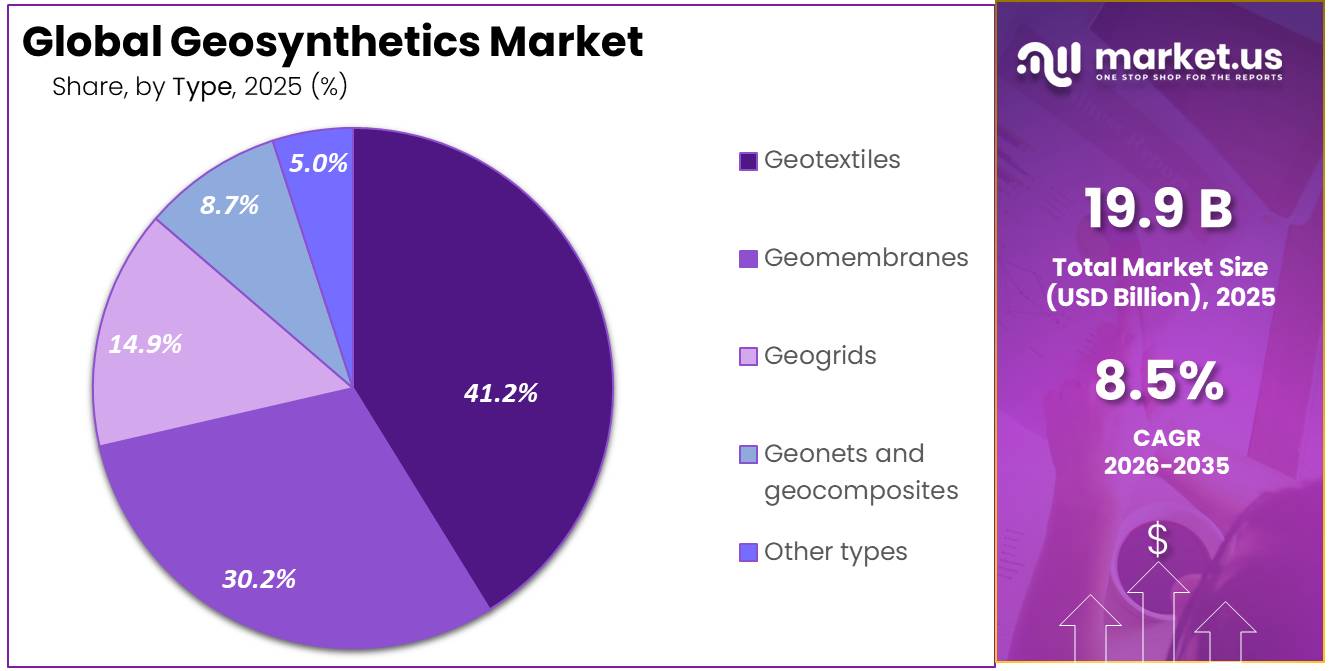
- Geotextiles are the most common type of product, making up 41.2% of the global market because they are widely used for separation, filtering, and stabilizing the ground.
- Transportation infrastructure is the biggest area where geotextiles are used, holding 35.4% of the market share. This is because governments around the world are spending a lot on building and improving roads, highways, and railways.
- Reinforcement, which is often used together with separation and filtration, makes up 35.1% of the market. It plays a key role in preventing road damage and making pavements last longer.
- Polyethylene is the most popular material, taking up 44.9% of the market. This is because it resists UV light and doesn’t react with chemicals, making it ideal for use in high-density containment systems.
- North America is the main region for this market, controlling 34.8% of the global share. This is due to ongoing work on repairing infrastructure, strict rules for protecting the environment, and big projects for building new infrastructure.
Type Analysis
Geotextiles lead with a 41.2% share due to broad use in separation, filtration, and reinforcement.
In 2025, Geotextiles held a dominant market position, capturing more than a 41.2% share. In June 2025, their strong position was supported by wide use in roads, railways, drainage systems, landfills, and erosion control projects. These materials help separate soil layers, improve filtration, strengthen weak ground, and extend the service life of infrastructure. Their easy installation, flexible design, and ability to reduce the need for natural aggregates also supported adoption across public and private construction projects. Demand remained steady as governments and contractors focused on durable, cost-efficient, and climate-resilient infrastructure.
Geomembranes emerged as the growing segment, supported by rising use in landfill liners, mining sites, reservoirs, canals, and wastewater treatment systems. Their strong barrier performance and ability to control leakage made them increasingly important in environmental protection and water-management projects across major construction markets worldwide.
Application Analysis
Transportation infrastructure leads with a 35.4% share due to its wide use in road, rail, and airport construction.
In 2025, Transportation infrastructure held a dominant market position, capturing more than a 35.4% share. In June 2025, the segment remained strong as geosynthetics were widely used in highways, rail tracks, bridges, tunnels, and airport projects. These materials improve soil stability, reduce pavement stress, support drainage, and limit erosion around transport corridors. Their ability to lower maintenance needs and extend infrastructure life also encouraged contractors and public agencies to include them in large construction programmes. Growing focus on durable roads, faster project completion, and better use of local soil further supported demand across developed and emerging economies.
Waste management remained the growing segment as landfill operators increased the use of geomembranes, geotextiles, and drainage composites. These products help control leachate, prevent soil contamination, improve liner performance, and support safer long-term landfill operations.
Function Analysis
Reinforcement leads with a 35.1% share due to its strong role in soil stabilization and structural support.
In 2025, Reinforcement held a dominant market position, capturing more than a 35.1% share. In June 2025, demand remained strong as geosynthetics were widely used to improve the load-bearing capacity of weak soils in roads, retaining walls, embankments, railways, and slope protection projects. Reinforcement products help limit ground movement, reduce settlement, and improve the long-term strength of infrastructure. Their use also allows contractors to work with locally available soil, which can lower material movement and shorten construction time.
Separation remained the growing segment as geotextiles were increasingly placed between different soil layers. This function helps prevent material mixing, improves drainage, protects pavement foundations, and supports longer service life across road and railway projects worldwide during 2025.
Material Analysis
Polyethylene leads with a 44.9% share due to its strong durability, chemical resistance, and containment performance.
In 2025, Polyethylene held a dominant market position, capturing more than a 44.9% share. In June 2025, its leadership was supported by broad use in geomembranes, drainage systems, landfill liners, mining facilities, reservoirs, and water-management projects. The material offers strong moisture resistance, low permeability, flexibility, and reliable protection against chemicals, making it suitable for demanding outdoor conditions. Its long service life and ease of installation also encouraged contractors to select polyethylene-based products for large infrastructure and environmental projects. Continued investment in waste containment, water conservation, and industrial construction strengthened its position across major markets worldwide.
Polypropylene remained the growing segment because of its lightweight structure, high tensile strength, and strong resistance to biological damage. It gained wider use in geotextiles for road construction, soil separation, filtration, erosion control, and drainage applications during 2025 projects.
Key Market Segments
By Type
- Geotextiles
- Geomembranes
- Geogrids
- Geonets and geocomposites
- Other types
By Application
- Transportation infrastructure
- Waste management
- Water management
- Civil construction
- Coastal, river, and erosion control works
By Function
- Separation
- Reinforcement
- Filtration
- Drainage
- Barrier/containment
By Material
- Polyethylene
- Polypropylene
- Polyvinyl chloride (PVC)
- Polyester
- Other polymers and composites
Drivers
Escalating global infrastructure investment
The Asia-Pacific region commands approximately 45 percent of the global geosynthetics market in 2026, making it the largest regional consumer, and its infrastructure pipeline is enormous: India alone has committed capex of ₹12.2 lakh crore in the Union Budget 2026–27, up from ₹11.21 lakh crore in 2025–26 and from just ₹2 lakh crore in FY2014–15, with new programs such as seven high-speed rail corridors, the Dankuni–Surat freight corridor, 20 new national waterways, and a new integrated East Coast Industrial Corridor all requiring extensive geosynthetic-enabled earthworks, drainage, and stabilization.
India’s National Infrastructure Pipeline, with an outlay of approximately 1.4 trillion US dollars, is accelerating highway and railway construction under programmes such as Bharatmala Pariyojana, generating structured, large-scale demand for geosynthetic reinforcement and subgrade stabilization, and CRISIL estimates India will spend approximately 1,727 billion US dollars on infrastructure in the seven years to 2030, more than double what was spent in the prior seven years.
Drivers Impact Analysis
| Driver | (~) % Impact on CAGR | Geographic Relevance | Impact Timeline |
|---|---|---|---|
| Escalating global infrastructure investment | +2.0% | APAC core, South Asia, LATAM, MENA | Short term (≤ 2 years) |
| Sustainability advantage over traditional materials | +1.5% | EU, North America, developed APAC | Long term (≥ 4 years) |
| Climate-resilience infrastructure mandates | +1.3% | Global coastal, flood-prone, APAC, LATAM corridors | Medium term (2-4 years) |
| Erosion control and EPA/regulatory enforcement | +1.1% | North America core, EU, South Asia | Medium term (2-4 years) |
| Waste containment and landfill liner regulations | +0.9% | Global; highest in South Asia, MENA, EU | Long term (≥ 4 years) |
| Road and transportation subgrade reinforcement | +0.8% | APAC, LATAM, Africa, South Asia corridors | Long term (≥ 4 years) |
Restraints
Plastic perception risk and polymer regulation scrutiny
The EU’s Single-Use Plastics Directive review, launched by a public consultation initiated on 23 December 2025, broadens scrutiny of all synthetic plastic products in the regulatory and public discourse, even though geosynthetics are engineered for multi-decade service lives and are categorically different from single-use items.
For geosynthetics manufacturers, this evolving regulatory environment necessitates investment in product stewardship programmes, recycled-content research, and lifecycle documentation, even though geosynthetics demonstrably reduce carbon footprints by an average of approximately 65 percent across 25 surveyed applications; the compliance cost and perception risk create a meaningful drag on growth momentum.
Restraint Impact Analysis
| Restraint | (~) % Impact on CAGR | Geographic Relevance | Impact Timeline |
|---|---|---|---|
| Polypropylene and polyester raw material cost volatility | -1.4% | Global; highest in North America, EU importers | Medium term (2-4 years) |
| Plastic perception risk and polymer regulation scrutiny | -1.1% | EU, UK, select APAC, MENA | Long term (≥ 4 years) |
| Import tariffs inflating polymer and product costs | -1.0% | North America core, EU, APAC importers | Medium term (2-4 years) |
| Low awareness and specification gaps in developing markets | -0.9% | Africa, MENA, smaller APAC corridors | Long term (≥ 4 years) |
| High-income market saturation limiting penetration upside | -0.8% | North America, EU, Japan, Australia | Long term (≥ 4 years) |
| Competition from traditional materials and low-cost alternatives | -0.7% | South Asia, Africa, LATAM | Medium term (2-4 years) |
Opportunity
Recycled-content and circular geosynthetics platforms
Several innovative companies are already raising the bar on recycled content in geosynthetics, using post-consumer plastics and post-industrial offcuts as fibre inputs while demonstrating equivalent or superior tensile and filtration performance to virgin-polymer products; studies show eco-friendly geosynthetics made from recycled materials and bio-based polymers offer lower lifecycle carbon footprints, directly aligning with public procurement green criteria.
If even 10–15 percent of the global geosynthetics volume—a market estimated in the mid-to-high teens of billions of dollars in 2026—is migrated to certified recycled-content variants with a 5–10 percent premium by 2032, this could translate into hundreds of millions of dollars of incremental value capture for first movers.
Opportunity Impact Analysis
| Opportunity | (~) % Potential CAGR | Geographic Relevance | Execution Window |
|---|---|---|---|
| Recycled-content and circular geosynthetics platforms | +1.1% | EU, North America, developed APAC | Medium term (2-4 years) |
| Smart sensor-embedded geosynthetics | +1.0% | EU, North America, Middle East, APAC | Long term (≥ 4 years) |
| Untapped Africa and MENA infrastructure specification | +0.9% | Sub-Saharan Africa, MENA corridors | Long term (≥ 4 years) |
| Bio-based and hybrid natural-fiber geosynthetics | +0.8% | EU, South and Southeast Asia, LATAM | Long term (≥ 4 years) |
| Prefabricated modular geosynthetic systems | +0.7% | Global EPC markets; APAC, LATAM, MENA | Medium term (2-4 years) |
| LCA/EPD-based premium specification model | +0.6% | EU, North America, multilateral-funded projects | Medium term (2-4 years) |
Challenge
Harmonised sustainability data gaps
Geosynthetics Magazine’s 2026 update reports that design calculations across 25 surveyed applications show geosynthetic solutions routinely achieving only 20–40 percent of the environmental impact of traditional designs, and that carbon audits confirm specific footprint reductions of around 30–65 percent; however, these figures are derived from project-specific LCA studies rather than standardised EPDs, and they are not systematically available across product types, grades, and chemistries.
EU procurement frameworks and ISO 21930-based EPD systems require product-category-rule-compliant declarations that include primary data from the manufacturer’s own production processes—not just industry averages—and that are verified by third-party programme operators, a process that costs 15,000–40,000 euros per product family and takes 12–24 months to complete, placing it out of reach for smaller producers and even challenging for mid-tier ones.
Challenges Impact Analysis
| Challenge | (~) % CAGR Friction | Geographic Relevance | Mitigation Horizon |
|---|---|---|---|
| Geotechnical skilled-labour deficit | -1.0% | North America, EU, APAC growth corridors | Long term (≥ 4 years) |
| Installation quality control variability | -0.9% | South Asia, LATAM, Africa, MENA | Medium term (2-4 years) |
| Fragmented and misaligned standards frameworks | -0.8% | Global multi-region OEMs and projects | Long term (≥ 4 years) |
| Supply-chain logistics to remote sites | -0.7% | Africa, APAC hinterlands, LATAM, MENA | Long term (≥ 4 years) |
| Harmonized sustainability data gaps | -0.6% | EU, North America, multilateral-funded projects | Medium term (2-4 years) |
| Long project procurement and approval cycles | -0.5% | South Asia, LATAM, MENA, Africa | Long term (≥ 4 years) |
Geopolitical Impact Analysis
Global Warfare and supply chain dislocation in Geosynthetics Market
The global geosynthetics market is experiencing serious changes because of increasing international military conflicts. These conflicts have completely changed how supply chains work and how materials are moved around. Global prices for naphtha, which is the main raw material used to make steam crackers that produce ethylene and propylene, have gone up a lot. This rapid increase in prices happened because of the wars.
Ships are now being rerouted away from usual paths to avoid dangerous areas. As a result, many important exports of basic chemicals from affected regions are facing long delays or complete stoppages. This has created a serious shortage of polymer materials for geosynthetic manufacturers. Because of this, there’s a growing trend toward using domestic suppliers and friendly countries to avoid delays.
This change in supply chains has made the cost differences between different regions bigger, making it harder for companies to manage their costs. This pressure is pushing civil engineering companies to stop using long-term fixed-price contracts and instead use short-term pricing that changes often. This is causing delays in important projects like highways, rail systems, and waste management facilities around the world.
Regional Analysis
North America leads with 34.8% and USD 6.94 billion, supported by transport, landfill, and water infrastructure investment.
In 2025, North America held a dominant position in the geosynthetics market, capturing more than a 34.8% share and reaching USD 6.94 billion. Regional demand remained strong across road construction, bridge rehabilitation, landfill lining, drainage, erosion control, and water-management projects. The U.S. Bipartisan Infrastructure Law allocated USD 91.2 billion for transit and USD 66 billion for passenger and freight rail over five years, supporting use of geotextiles, geogrids, and drainage composites.
It also provided more than USD 40 billion for bridge improvement, strengthening long-term demand for soil reinforcement and slope-stabilization systems. Asia Pacific remained an important growth region as governments expanded highways, rail networks, reservoirs, waste facilities, and coastal protection. The Asian Development Bank estimates that developing Asia requires USD 1.7 trillion in annual infrastructure investment through 2030, creating opportunities for geosynthetic materials.
Key Regions and Countries Covered
- North America
- The US
- Canada
- Europe
- Germany
- France
- The UK
- Spain
- Italy
- Russia & CIS
- Rest of Europe
- APAC
- China
- Japan
- South Korea
- India
- ASEAN
- Rest of APAC
- Latin America
- Brazil
- Mexico
- Rest of Latin America
- Middle East & Africa
- GCC
- South Africa
- Rest of MEA
Key Players Analysis
The global geosynthetics market has a unique two-part structure. At the top, there’s a small group of large, well-funded international companies that dominate the high-end market. These companies have strong market influence because they use advanced polymer technology, big production facilities, and worldwide distribution networks. On the other hand, the lower part of the market is made up of many small local companies.
The size of their operations, their focus on specific technologies, and their strong financial resources create clear barriers that keep top companies ahead of others in the market. These leading firms have the money to handle long and complicated testing processes required by different regions, like the NTPEP audits in North America or CE certifications in Europe.
These tests can take anywhere from a year to two years, and without them, local suppliers can’t get involved in big government projects that cost billions. Also, these major companies such as Solmax, Tensar International Corporation, Maccaferri, Berry Global, and Huesker Group use strategies like locking in raw material prices and signing large supply agreements to protect their profits from sudden price changes in oil, gas, or plastic materials.
Market Key Players
- Solmax
- TenCate Geosynthetics (Koninklijke Ten Cate)
- NAUE GmbH & Co. KG
- HUESKER Group
- GSE Environmental
- Officine Maccaferri
- Propex GeoSolutions
- AGRU Kunststofftechnik (AGRU America)
- Freudenberg Performance Materials
- Tensar (Tensar International)
- ACE Geosynthetics
- Tenax
- Geofabrics Australasia
- BPM Geosynthetics (Best Project Material Co., Ltd.)
- Asahi Kasei Advance
- SKAPS Industries
- Strata Geosystems (Strata Global)
- Taian Modern Plastic
- Shandong Hongxiang New Geo-Material
- Feicheng Lianyi
- Others
Key Development
- In June 2025, Solmax launched its Performance Materials platform, built from the TenCate and Propex legacy, to serve agriculture, recreation, and specialty technical textile markets with wider global reach. For investment and expansion, Solmax extended a USD 92.5 million revolving credit facility in September 2025, maturing on May 27, 2027, to support working capital, innovation, and global growth.
- In May 2025, NAUE highlighted its work on the Osojnica landfill rehabilitation in Croatia, where the site covered about 31,800 m², contained around 475,000 m³ of waste, and involved project costs of around €5.2 million, supported by about €4 million from European Structural and Investment Funds.
- Maccaferri launched MacCycle Assessment in May 2026, a free web-based LCA tool that compares concrete structures with Maccaferri solutions; early results showed up to 90% GWP reduction for TerraMesh and up to 87% reduction for Reno Mattress Plus.
Report Scope
| Report Features | Description |
|---|---|
| Market Value (2025) | USD 19.9 Bn |
| Forecast Revenue (2035) | USD 45.0 Bn |
| CAGR (2026-2035) | 8.5% |
| Base Year for Estimation | 2025 |
| Historic Period | 2020-2024 |
| Forecast Period | 2026-2035 |
| Report Coverage | Revenue Forecast, Market Dynamics, Competitive Landscape, Recent Developments |
| Segments Covered | By Type (Geotextiles, Geomembranes, Geogrids, Geonets and geocomposites, Other types), By Application (Transportation infrastructure, Waste management, Water management, Civil construction, Coastal/river/erosion control works), By Function (Separation, Reinforcement, Filtration, Drainage, Barrier/ containment), By Material (Polyethylene, Polypropylene, Polyvinyl chloride (PVC), Polyester, Other polymers and composites) |
| Regional Analysis | North America – The US & Canada; Europe – Germany, France, The UK, Spain, Italy, Russia & CIS, Rest of Europe; APAC– China, Japan, South Korea, India, ASEAN & Rest of APAC; Latin America– Brazil, Mexico & Rest of Latin America; Middle East & Africa– GCC, South Africa, & Rest of MEA |
| Competitive Landscape | Solmax, TenCate Geosynthetics (Koninklijke Ten Cate), NAUE GmbH & Co. KG, HUESKER Group, GSE Environmental, Officine Maccaferri, Propex GeoSolutions, AGRU Kunststofftechnik (AGRU America), Freudenberg Performance Materials, Tensar (Tensar International), ACE Geosynthetics, Tenax, Geofabrics Australasia, BPM Geosynthetics (Best Project Material Co., Ltd.), Asahi Kasei Advance, SKAPS Industries, Strata Geosystems (Strata Global), Taian Modern Plastic, Shandong Hongxiang New Geo-Material, Feicheng Lianyi, Others. |
| Customization Scope | Customization for segments, region/country-level will be provided. Moreover, additional customization can be done based on the requirements. |
| Purchase Options | We have three licenses to opt for: Single User License, Multi-User License (Up to 5 Users), Corporate Use License (Unlimited Users and Printable PDF) |





































