


Report Overview
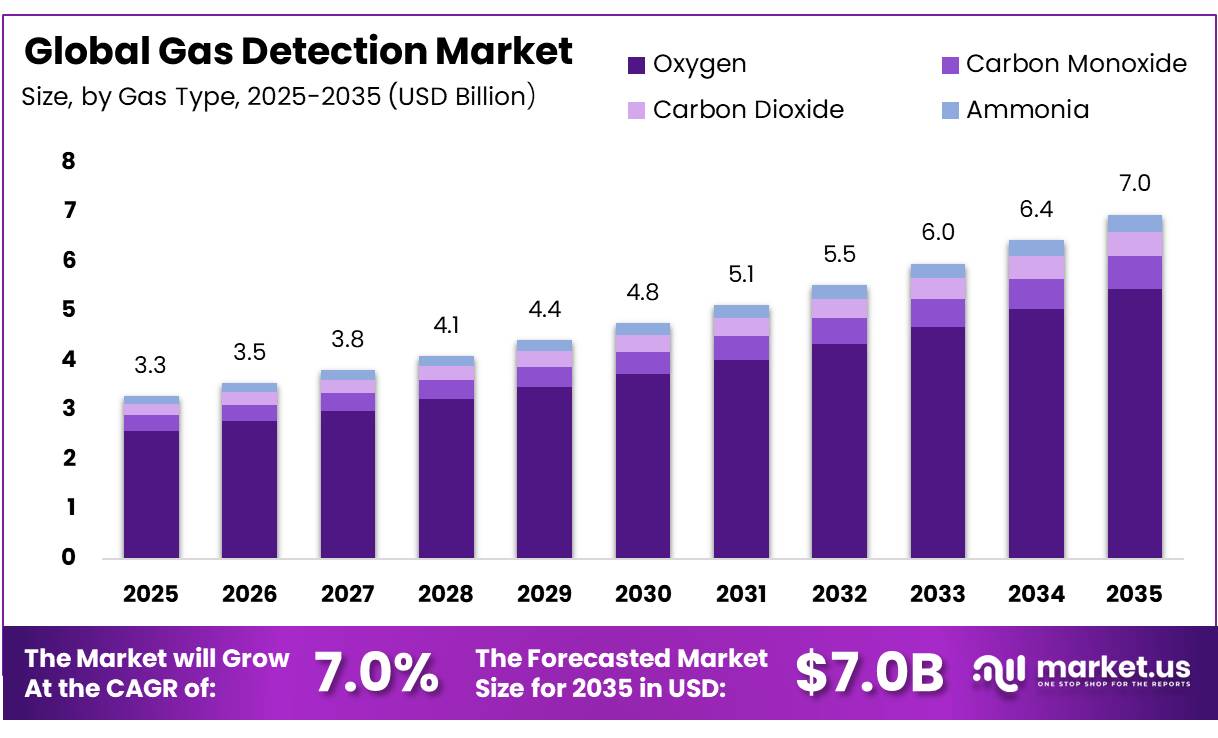
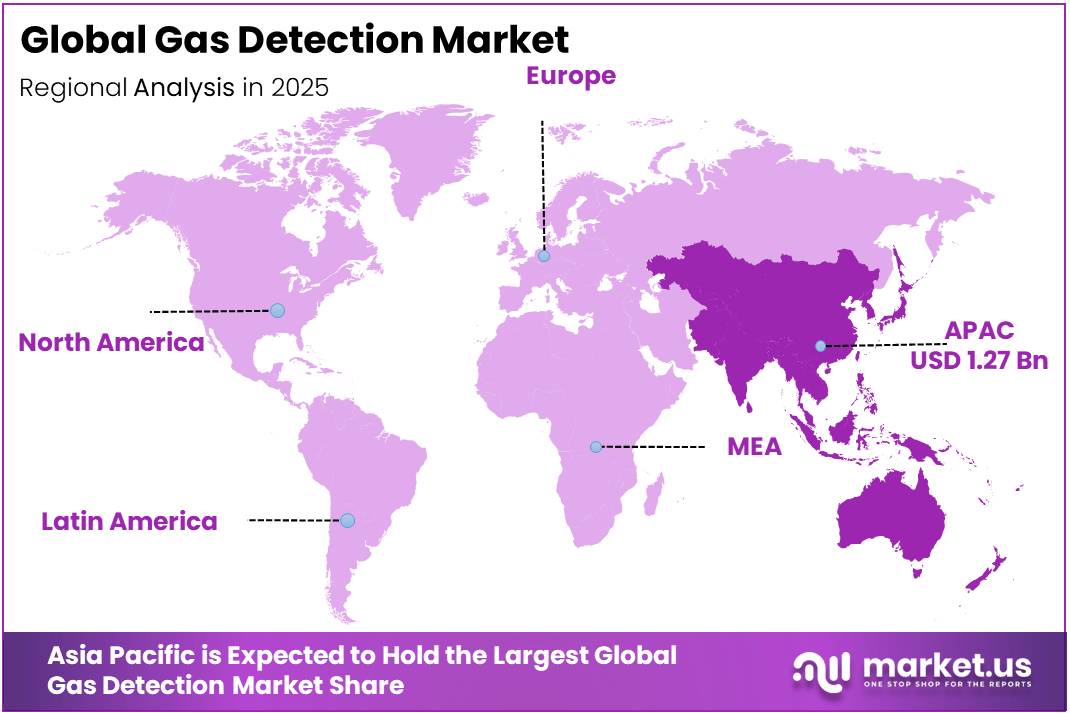
In 2025, the Global Gas Detection Market was valued at USD 3.3 billion, and between 2026 and 2035, this market is estimated to register a CAGR of 7.0%, reaching about USD 7.0 billion by 2035. Asia Pacific held a dominant market position, capturing more than a 38.6% share, holding USD 1.27 billion in revenue.
Gas detection has become a core industrial safety market within manufacturing, chemical processing, oil and gas, mining, utilities, and heavy industrial facilities. Its role is to detect oxygen deficiency, toxic gases, combustible gases, and process leaks before they become worker-safety, fire, explosion, or compliance events.
- In March 2026, the market environment remained strongly tied to workplace safety enforcement, because ILO estimates show 93 million workers die each year from work-related factors and 395 million workers suffer non-fatal work injuries.
- The industrial scenario is shaped by stricter site monitoring rules and high-risk working conditions. OSHA defines a hazardous confined-space atmosphere when oxygen falls below 5% or rises above 23.5%, and it treats flammable gas, vapor, or mist above 10% of the lower explosive limit as hazardous. OSHA’s Process Safety Management rule also covers processes involving 10,000 pounds or more of flammable gases, supporting demand for fixed and portable gas detectors in regulated facilities.
Key Takeaways
- The global gas detection market was valued at USD 3.3 billion in 2025.
- The global market is projected to grow at a CAGR of 7.0% and is estimated to reach USD 7.0 billion by 2035.
- Oxygen dominated the market, constituting 78.5% of the total market share.
- Single-Gas Detectors dominated the gas detection market, with a market share of around 52.40%.
- Fixed Gas Detector led the market, comprising 58.4% of the total market.
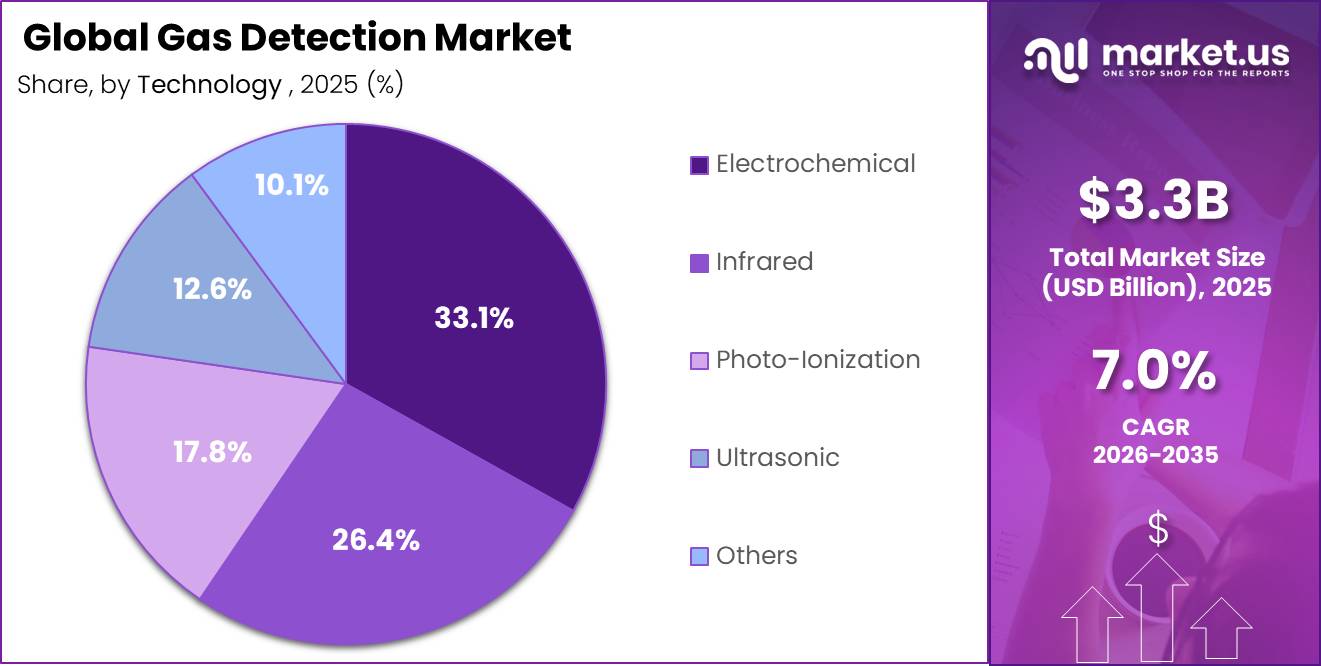
- Electrochemical was the most considerable segment, accounting for around 33.1% of the market share.
- Chemicals and Petrochemicals held a major share in the gas detection market, accounting for 48.60% of the market share.
- In 2025, Asia Pacific was the most dominant region in the gas detection market, accounting for 38.6% of the total global market.
Demand is also supported by real accident exposure across mature manufacturing economies. In January 2026, BLS reported 2.5 million nonfatal workplace injuries and illnesses in U.S. private industry during 2024, while its February 2026 fatality release recorded 5,070 fatal work injuries and a fatal injury rate of 3.3 per 100,000 full-time workers. In Europe, Eurostat reported 3,298 fatal workplace accidents and 2.82 million non-fatal accidents in 2023, with 32.0% of non-fatal accidents occurring at industrial sites.
Future growth opportunities are expected from smart factories, connected safety systems, predictive maintenance, stricter confined-space entry controls, and digital compliance records. HSE’s 2024–2025 workplace data showed 1.9 million work-related illness cases and 680,000 non-fatal injuries in Great Britain, reinforcing the need for continuous monitoring. As industries automate hazardous operations, gas detection suppliers are positioned around multi-gas sensing, wireless connectivity, real-time alarms, and facility-wide safety integration.
Gas Type Analysis
Oxygen dominates with 78.5% due to its strong use in safety monitoring and controlled work areas.
In 2025, Oxygen held a dominant market position, capturing more than a 78.5% share in the gas detection market by gas type. In June 2025, this segment remained important because oxygen monitoring is widely used in enclosed spaces, industrial units, chemical sites, and workplace safety systems. It helped facilities identify oxygen deficiency or excess levels before they created serious risk for workers or operations. Its steady use across continuous monitoring systems supported its leading position.
Carbon Monoxide emerged as the growing segment in 2025, supported by rising concern over toxic gas exposure in manufacturing, energy, parking, and confined-space environments.
Product Type Analysis
Single-Gas Detectors dominate with 52.40% due to their simple use and focused gas monitoring.
In 2025, Single-Gas Detectors held a dominant market position, capturing more than a 52.40% share in the gas detection market by product type. In June 2025, this segment led because these detectors are easy to carry, simple to operate, and suitable for workers who need direct monitoring of one specific gas. Their use remained strong in industrial safety, maintenance, mining, utilities, and confined-space checks, where quick alerts and basic handling are important.
Multi-Gas Detectors emerged as the growing segment in 2025, driven by higher demand for devices that can monitor several gases at the same time in complex work sites.
Installation Type Analysis
Fixed Gas Detector dominates with 58.4% due to its role in continuous site safety monitoring.
In 2025, Fixed Gas Detector held a dominant market position, capturing more than a 58.4% share in the gas detection market by installation type. In June 2025, this segment led as fixed systems were widely installed in plants, warehouses, refineries, laboratories, and production areas where gas risks need round-the-clock tracking. These detectors supported early warning systems and helped operators maintain safer working conditions without depending only on manual checks.
Portable Gas Detector emerged as the growing segment in 2025, supported by rising use among field workers, inspection teams, and emergency crews needing flexible and mobile gas detection.
Technology Analysis
Electrochemical dominates with 33.1% due to its reliable use in toxic gas monitoring.
In 2025, Electrochemical held a dominant market position, capturing more than a 33.1% share in the gas detection market by technology. In June 2025, this segment remained widely used because electrochemical sensors are suitable for detecting harmful gases in industrial, chemical, mining, and confined-space environments. Their strong acceptance was supported by accurate readings, compact design, and practical use in both fixed and portable detection systems.
Infrared emerged as the growing segment in 2025, supported by rising use in gas monitoring applications where stable performance, low maintenance, and detection of combustible gases were needed.
End User Analysis
Chemicals and Petrochemicals dominate with 48.60% due to high gas risk in processing facilities.
In 2025, Chemicals and Petrochemicals held a dominant market position, capturing more than a 48.60% share in the gas detection market by end user. In June 2025, this segment led because chemical plants and petrochemical facilities require continuous monitoring to manage toxic, flammable, and oxygen-related gas risks. Gas detection systems were strongly used across production units, storage areas, pipelines, and processing zones to support safe operations and reduce workplace hazards.
Oil and Gas emerged as the growing segment in 2025, driven by higher safety needs across exploration sites, refineries, offshore platforms, and pipeline operations.
Key Market Segments
Gas Type
- Oxygen
- Carbon Monoxide
- Carbon Dioxide
- Ammonia
Product Type
- Single-Gas Detectors
- Multi-Gas Detectors
Installation Type
- Fixed Gas Detector
- Portable Gas Detector
Technology
- Electrochemical
- Infrared
- Photo-Ionization
- Ultrasonic
- Others
End User
- Chemicals and Petrochemicals
- Energy & Power
- Metal and Mining
- Oil and Gas
- Manufacturing & Industrial
- Others
Driver Analysis
OSHA/MSHA confined-space and worker-safety enforcement lift for calibrated multi-gas fleets
OSHA continues to anchor demand because U.S. confined-space practice requires atmospheric testing before entry using properly calibrated instruments, covering oxygen, flammable gases and vapors, and potential toxic contaminants, while OSHA’s direct-reading monitor guidance also reinforces calibration and bump-testing discipline rather than one-time procurement behavior. That matters commercially because every compliance-heavy site tends to buy not just primary portable monitors but docking stations, bump-test consumables, calibration gas, sensor replacements, and asset-management software, turning a one-unit sale into an annuity-style installed-base model with recurring service capture.
The safety urgency is not theoretical: MSHA’s publicly tracked fatality reporting shows continued incident visibility through 2025–2026, and unofficial year-end reporting indicated 33 U.S. mining fatalities in 2025 versus 26 in 2024, a 27% increase, which strengthens procurement justification for mine gases, oxygen deficiency, and area-monitoring upgrades in hard-rock and quarry settings even when broader equipment budgets remain constrained. In forecasting terms, this driver is strongest in the next 24 months because replacement cycles can be accelerated by audit findings, calibration traceability gaps, and permit-to-work digitization, especially where buyers standardize four-gas to five-gas fleets and expand continuous personal monitoring coverage from supervisors to frontline crews.
Drivers Impact Analysis
| Driver | (~) % Impact on CAGR Forecast | Geographic Relevance | Impact Timeline |
|---|---|---|---|
| OSHA/MSHA confined-space and worker-safety enforcement lift for calibrated multi-gas fleets | +1.3% | North America core, mining-heavy LATAM spill-over | Short term (≤ 2 years) |
| Methane abatement rules in oil, gas, and LNG raise fixed and portable sensing demand | +1.6% | U.S. core, EU, GCC, LNG-linked APAC corridors | Short term (≤ 2 years) |
| EU methane and chemicals data frameworks accelerate certified continuous monitoring | +1.1% | EU core, EEA, exporters into EU energy chains | Medium term (2-4 years) |
| LNG, petrochemical, and offshore capacity additions expand hazardous-area coverage points | +1.4% | U.S. Gulf Coast, Middle East, APAC processing hubs | Medium term (2-4 years) |
| Compliance digitization shifts value from hardware-only sales to connected service models | +1.0% | North America, EU, Japan, Korea, Singapore | Medium term (2-4 years) |
| Certification complexity and hazardous-area standardization favor premium replacement cycles | +0.8% | EU core, IECEx markets, Australia, GCC, SEA | Long term (≥ 4 years) |
Restraint Analysis
Calibration compliance burden
EPA protocol calibration requirements keep accuracy assurance structurally expensive because certified gaseous calibration standards used for ambient and continuous emission monitoring must meet stringent traceability conditions, and linked operating practice in regulated monitoring environments commonly requires daily zero/span verification, with Part 60 tolerance bands effectively forcing corrective action once error exceeds 10% and Part 75 tightening that pass/fail window to 5%, while protocol gases are expected to remain within an analytical uncertainty of no more than ±2% at 95% confidence.
For gas detection OEMs and service providers, that means recurring field labor, cylinder logistics, service-van utilization, and customer downtime remain embedded in total cost of ownership, which suppresses adoption in cost-sensitive midmarket facilities and delays fleet refresh cycles as buyers extend replacement intervals by 6 to 12 months rather than absorb calibration-related OpEx escalation immediately.
Restraint Impact Analysis
| Restraint | (~) % Impact on CAGR Forecast | Geographic Relevance | Impact Timeline |
|---|---|---|---|
| Calibration compliance burden | -1.9% | North America core, EU, GCC, APAC process hubs | Short term (≤ 2 years) |
| Electronics cost inflation | -1.4% | North America core, EU, East Asia supply chain | Short term (≤ 2 years) |
| China-linked tariff exposure | -1.6% | U.S. core, Mexico export plants, China+1 APAC corridors | Short term (≤ 2 years) |
| Battery regulation redesign cost | -0.9% | EU core, UK-adjacent compliance markets | Medium term (2-4 years) |
| PFAS/material substitution risk | -0.8% | EU, EEA-linked suppliers, global component vendors | Medium term (2-4 years) |
| Industrial order-cycle slowdown | -1.2% | North America core, EU heavy industry, APAC export corridors | Short term (≤ 2 years) |
Opportunity Analysis
Methane intelligence platforms
This is an opportunity rather than a current driver because the baseline gas detection market already captures hardware demand for portable and fixed sensors, while the larger white space is the conversion of methane compliance into a recurring software-and-service revenue layer that fuses fixed detectors, mobile survey instruments, satellite alerts, and repair-verification workflows into one auditable operating system; EPA methane rules now cover existing sources nationwide, and the IEA reports more than 25 satellites providing methane insights, which creates the precondition for detector vendors to move from one-time device sales toward annual compliance subscriptions priced at roughly 12% to 20% of deployed hardware value, lifting blended gross margin by an estimated 600 to 1,000 basis points versus hardware-only portfolios and expanding service attach rates from roughly 15% today to 45% to 55% at enterprise accounts.
For operators, the commercial case is not the detector itself but lower leak-survey labor intensity, faster repair documentation, and reduced false dispatches; for vendors, this opens an adjacent TAM in analytics, recordkeeping, and managed monitoring that could reasonably equal 25% to 35% of the underlying detection hardware spend in upstream and midstream methane programs by the early 2030s, especially in North America where regulatory specificity is highest and in export-oriented hydrocarbon regions that increasingly need verified emissions data for market access.
Opportunity Impact Analysis
| Opportunity | (~) % Potential CAGR Upside | Geographic Relevance | Execution Window |
|---|---|---|---|
| Methane intelligence platforms | +2.4% | North America core, Middle East, Australia | Short term (≤ 2 years) |
| Hydrogen-ammonia safety stacks | +2.1% | EU, North America, East Asia | Medium term (2-4 years) |
| BESS off-gas detection retrofit | +1.7% | North America, EU, India, Australia | Short term (≤ 2 years) |
| Compliance-as-a-service bundles | +1.5% | North America core, EU, APAC industrial | Short term (≤ 2 years) |
| Municipal utility leak roll-ups | +1.3% | US, Canada, EU local networks | Medium term (2-4 years) |
| Confined-space connected fleet | +1.1% | US, EU, GCC, Southeast Asia | Medium term (2-4 years) |
Challenges Analysis
Calibration service intensity
Gas detection systems remain operationally burdensome because accuracy assurance is not a one-time installation issue but a recurring service obligation tied to bump testing, calibration checks, traceable test gas availability, environmental matching, and full maintenance records, all of which OSHA explicitly emphasizes for direct-reading monitors.
In practice, this creates a service-load penalty that scales faster than unit shipments: a 1,000-device installed base can require 250 to 400 verification events per month in high-risk industrial settings, field labor utilization of 0.15 to 0.25 technician-hours per device per month, calibration gas logistics costs equal to roughly 3% to 5% of annual maintenance spend, and avoidable downtime of 4 to 12 hours per detector annually when failed bump tests trigger retesting and sensor replacement cycles, which together support an estimated -1.2 percentage point CAGR friction drag versus unconstrained adoption.
Challenges Impact Analysis
| Challenge | (~) % CAGR Friction Drag | Geographic Relevance | Mitigation Horizon |
|---|---|---|---|
| Calibration service intensity | -1.2% | North America core, EU regulatory hubs, GCC process industries, APAC manufacturing belts | Medium term (2-4 years) |
| Sensor component volatility | -1.0% | APAC electronics corridors, North America assemblers, EU OEM networks | Medium term (2-4 years) |
| Certified technician shortage | -1.4% | North America core, Western Europe, advanced APAC plants, Middle East megaproject clusters | Long term (≥ 4 years) |
| Fragmented compliance regimes | -0.8% | EU regulatory hubs, North America cross-border fleets, APAC export platforms | Long term (≥ 4 years) |
| Harsh-site performance drift | -0.9% | Mining belts, offshore assets, oil & gas basins, chemical clusters, wildfire-exposed zones | Medium term (2-4 years) |
| Connectivity retrofit bottlenecks | -0.7% | Brownfield North America, EU industrial retrofits, APAC mixed-age plants | Medium term (2-4 years) |
Geopolitical Impact Analysis
Geopolitical Realignment and Electronics Supply Risks Reshaping Gas Detection Manufacturing.
Current geopolitical tensions are reshaping the gas detection market through sensor supply risks, semiconductor controls, tariff actions, and rising pressure to localize industrial safety equipment. Gas detectors depend on electrochemical sensors, infrared components, microcontrollers, alarms, displays, and calibration-related inputs. Any disruption in electronics, critical minerals, or precision components can affect production cost, delivery timelines, and supplier qualification.
In 2025, supply-chain risk became more visible as critical minerals and electronics remained closely linked to a limited number of producing and processing regions. The International Energy Agency’s May 2025 outlook highlighted supply concentration across minerals such as copper, graphite, lithium, nickel, cobalt, and rare earth elements, which are important for energy, electronics, and industrial technology supply chains.
Export-control pressure also increased across rare earths and semiconductor-linked materials. In October 2025, China expanded rare earth export restrictions and added extra checks for semiconductor users, while Reuters reported that China produces over 90% of the world’s processed rare earths and rare earth magnets. This raised concern for manufacturers using advanced electronic components and precision sensing technologies.
In parallel, the United States and Europe pushed stronger supply-chain security policies. The U.S. Section 301 action on Chinese semiconductors became effective in December 2025, with future tariff escalation scheduled from June 2027. The EU Critical Raw Materials Act also set 2030 benchmarks to reduce dependency, including no more than 65% of annual consumption from a single third country for strategic raw materials. These moves are encouraging regional sourcing, but gas detection manufacturers still face longer lead times, higher compliance checks, and added pressure to qualify alternative suppliers.
Regional Analysis
Asia Pacific dominates with 38.56% due to strong industrial safety needs and expanding manufacturing activity.
In 2025, Asia Pacific held a dominant market position in the gas detection market, capturing more than a 38.56% share, valued at USD 1.27 Bn. In June 2025, the region led due to wider use of gas detection systems in chemicals, petrochemicals, oil and gas, mining, utilities, and manufacturing facilities. Asia Pacific’s large industrial base supported continuous demand for fixed and portable detectors used to monitor toxic, flammable, and oxygen-related risks.
The International Energy Agency notes that Asia Pacific is home to more than half of the world’s population, while UNIDO reported global manufacturing output continued to grow in late 2025, supporting stronger safety-equipment needs across production hubs.
Key Regions and Countries Covered
- North America
- The US
- Canada
- Europe
- Germany
- France
- The UK
- Spain
- Italy
- Russia & CIS
- Rest of Europe
- APAC
- China
- Japan
- South Korea
- India
- ASEAN
- Rest of APAC
- Latin America
- Brazil
- Mexico
- Rest of Latin America
- Middle East & Africa
- GCC
- South Africa
- Rest of MEA
Key Players Analysis
Gas detection manufacturers focus on improving sensor accuracy, product reliability, and safety compliance to maintain competitiveness in the market. A key priority is continuous technology improvement, including the development of electrochemical, infrared, catalytic bead, and semiconductor-based detection systems that support faster response, stable performance, and better monitoring of toxic, combustible, and oxygen-related gases.
Strong distribution networks, after-sales service, and calibration support help manufacturers build customer trust across chemicals, petrochemicals, oil and gas, mining, utilities, and manufacturing sectors. Strategic focus on fixed and portable gas detectors enables companies to serve both continuous site monitoring and worker-level safety needs.
Market Key Players
- Honeywell International Inc.
- MSA
- Dragerwerk AG & Co. KGaA
- Industrial Scientific
- Halma plc
- ABB
- Teledyne Technologies
- RIKEN KEIKI CO., Ltd
Key Development
- In March 2026, Honeywell launched its 4-Series NDIR Hydrocarbon Gas Sensor for detecting flammable gases such as methane, propane, and butane. The sensor was designed for fixed and portable gas detectors used in oil and gas, mining, petrochemical, and manufacturing environments.
- In September 2025, MSA Safety debuted its ALTAIR io 6 Multigas Detector at the National Safety Congress & Expo in Denver. The six-gas detector was introduced as MSA’s first cellular-connected gas detector with an integrated pump for confined-space and sampling applications.
- In June 2026, Industrial Scientific launched iNet Insights to support connected gas detection, fleet management, instant reporting, and real-time visibility. The platform was developed to help safety teams respond faster, reduce risk, and manage incidents more effectively.
- In April 2025, RIKEN KEIKI launched the GX-6100 portable multi-gas detector. The device can detect up to six gases at the same time, including combustible gases, oxygen, hydrogen sulfide, carbon monoxide, VOCs, and ammonia, with shipping scheduled from May 2025.
Report Scope
| Report Features | Description |
|---|---|
| Market Value (2025) | USD 3.3 Bn |
| Forecast Revenue (2035) | USD 7.0 Bn |
| CAGR (2026-2035) | 7.0% |
| Base Year for Estimation | 2025 |
| Historic Period | 2020-2024 |
| Forecast Period | 2026-2035 |
| Report Coverage | Revenue Forecast, Market Dynamics, Competitive Landscape, Recent Developments |
| Segments Covered | By Gas Type (Oxygen, Carbon Monoxide, Carbon Dioxide, and Ammonia), By Product Type (Single-Gas Detectors and Multi-Gas Detectors), By Installation Type (Fixed Gas Detector and Portable Gas Detector), By Technology (Electrochemical, Photo-Ionization, Infrared, Ultrasonic, and Others), By End User (Chemicals and Petrochemicals, Energy & Power, Metal and Mining, Oil and Gas, Manufacturing & Industrial, and Others) |
| Regional Analysis | North America – The US & Canada; Europe – Germany, France, The UK, Spain, Italy, Russia & CIS, Rest of Europe; APAC– China, Japan, South Korea, India, ASEAN & Rest of APAC; Latin America– Brazil, Mexico & Rest of Latin America; Middle East & Africa– GCC, South Africa, & Rest of MEA |
| Competitive Landscape | Honeywell International Inc., MSA, Dragerwerk AG & Co. KGaA, Industrial Scientific, Halma plc, ABB, Teledyne Technologies, and RIKEN KEIKI CO., Ltd. |
| Customization Scope | Customization for segments, region/country-level will be provided. Moreover, additional customization can be done based on the requirements. |
| Purchase Options | We have three licenses to opt for: Single User License, Multi-User License (Up to 5 Users), Corporate Use License (Unlimited Users and Printable PDF) |





































