


Report Overview
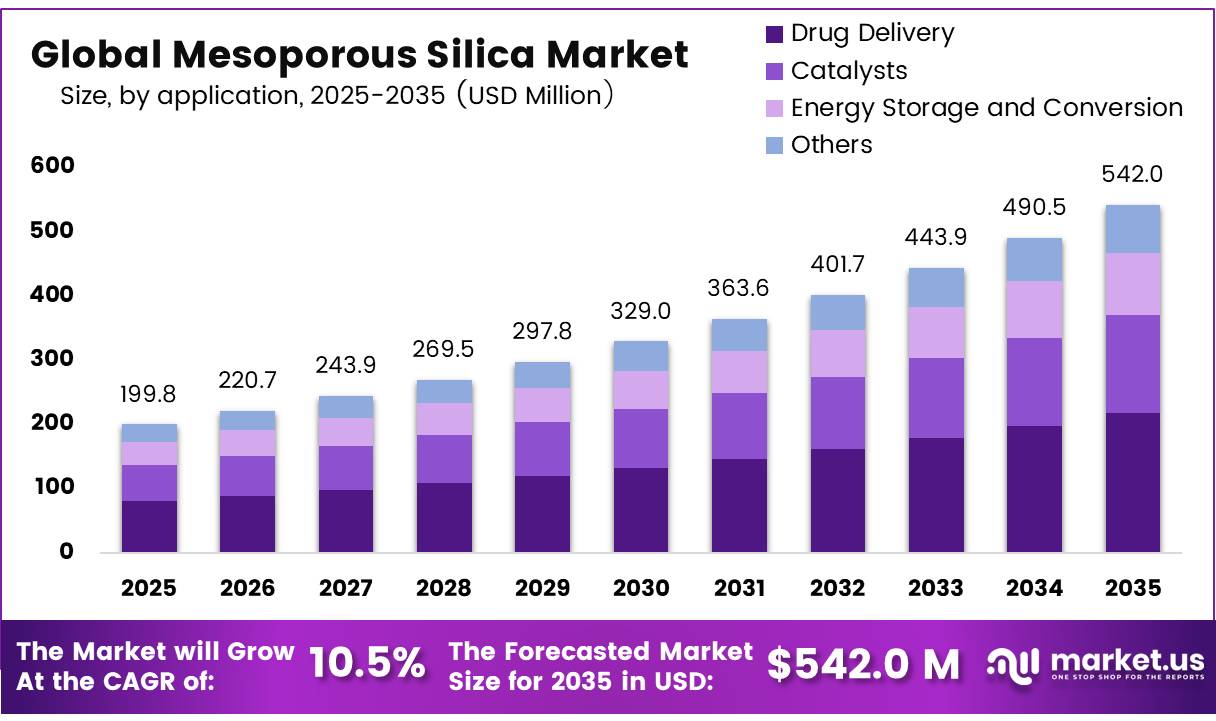
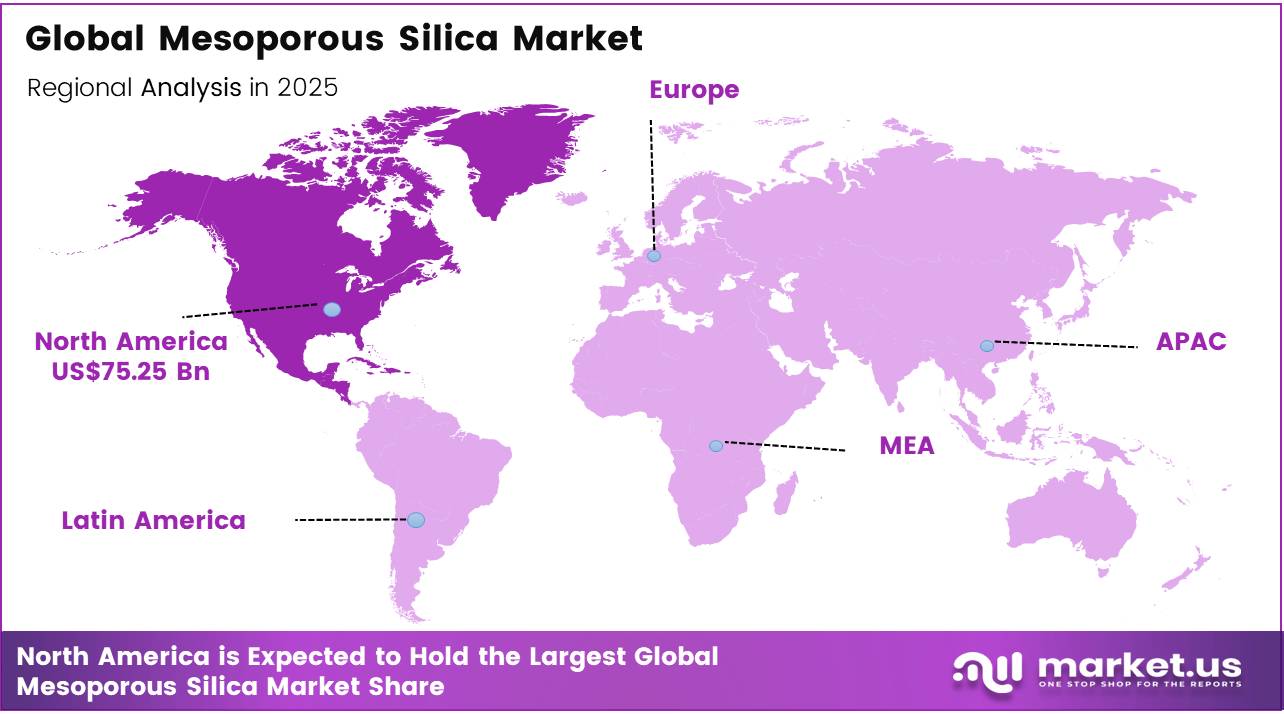
In 2025, the Global Mesoporous Silica Market was valued at USD 199.8 million, and between 2026 and 2035, this market is estimated to register a CAGR of 10.5%, reaching about USD 542 million by 2035. In 2025, North America held a dominant market position, capturing more than a 37.67% share, holding USD 75.25 million revenue.
Mesoporous silica is an advanced porous material used in drug delivery, catalysts, gas separation, sensors, coatings and water treatment. IUPAC classifies mesopores within the 2–50 nanometer range, while biomedical literature reports typical surface areas of 700–1,000 square meters per gram and pore volumes of 0.6–1.0 cubic centimeters per gram. These properties allow manufacturers to control molecular loading, adsorption and release more precisely than conventional silica.
- The industrial scenario is being shaped by pharmaceutical innovation and stricter environmental standards. The U.S. FDA approved 46 novel drugs in 2025, supporting research into carriers that improve solubility, stability and targeted delivery. IARC estimated 20.6 million new cancer cases and 9.8 million cancer deaths worldwide in 2024, strengthening interest in controlled and stimuli-responsive nanocarriers. EPA drinking-water limits remain 0.000004 milligrams per liter for both PFOA and PFOS, encouraging development of functionalized high-surface-area adsorbents.
Future opportunities are expected in precision medicine, heterogeneous catalysis, carbon capture, pollutant removal, smart diagnostics and scalable industrial separation systems. Public research funding will support commercialization, with the U.S. National Nanotechnology Initiative requesting $1.45 billion for 2026 across 10 federal agencies.
Key Takeaways
- The global Mesoporous Silica market was valued at USD 199.8 million in 2025.
- The global market is projected to grow at a CAGR of 10.5% and is estimated to reach USD 542.0 million by 2035.
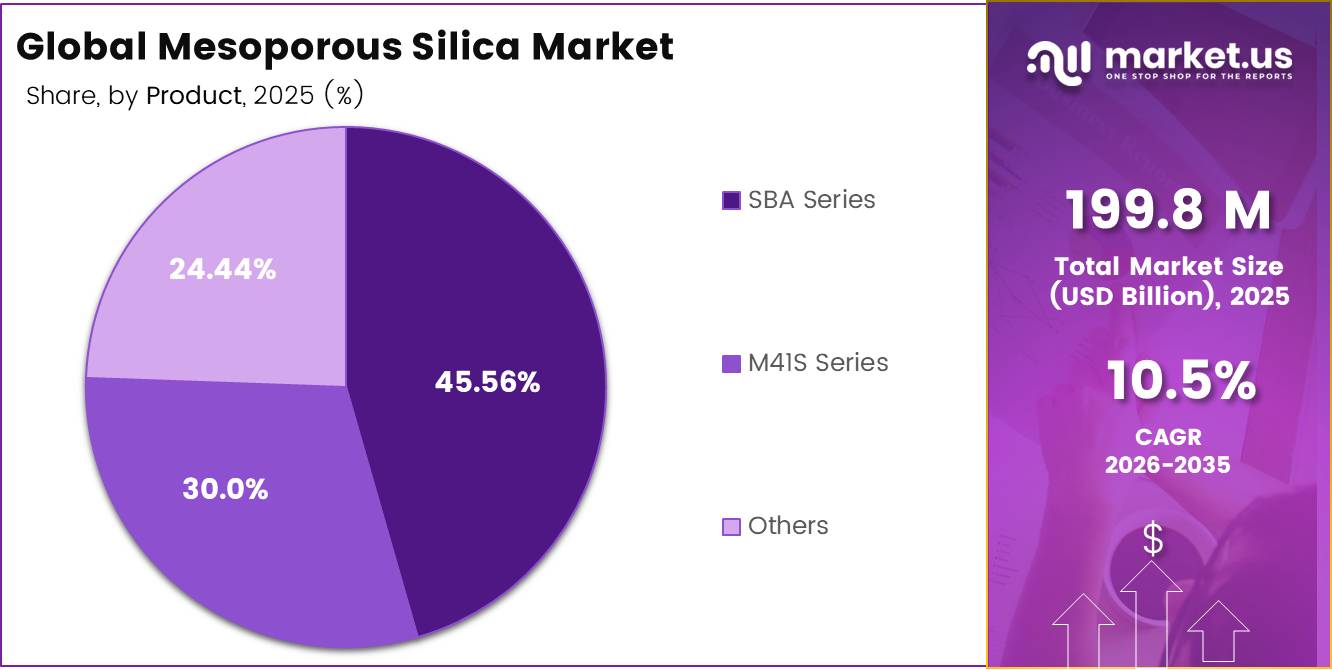
- Based on the product, SBA Series led the market, comprising 45.56% of the total market.
- On the basis of Application, the Drug Delivery dominated the market, constituting 40.23% of the total market share.
- Based on the End User, Pharmaceuticals and Biotechnology dominated the Mesoporous Silica market, with a substantial market share of around 34.56%.
- In 2025, the North America was the most dominant region in the Mesoporous Silica market, accounting for 37.67% of the total global consumption.
Product Analysis
SBA Series represents dominant Segment in the Market.
The SBA series led the mesoporous silica market with a 45.56% share, supported by its large, adjustable pores and suitability for pharmaceutical loading, catalysis and controlled release. Government-hosted research measured SBA-15 at 814 square meters per gram of surface area, an 8.6-nanometer pore size and 0.86 cubic centimeters per gram of pore volume. Another study recorded 89.2% protein-entrapment efficiency, while 95% of the loaded protein was released within 8 hours from an SBA-15 formulation. Pharmaceutical innovation supports further adoption, as the U.S. FDA approved 46 novel drugs in 2025.
The M41S series is gaining traction in adsorption, gas purification, water treatment and drug-delivery research. MCM-41 testing recorded a surface area of 1,095.2 square meters per gram, a 3.64-nanometer pore diameter and 1.22 milliliters per gram of pore volume. Environmental applications provide added potential, as EPA data identified approximately 1,900 public water systems, serving more than 26 million people, with at least one PFOA result above the federal limit.
Application Analysis
Drug delivery a significant Application.
Drug delivery held the leading position in the mesoporous silica market, accounting for 40.23% of application demand. Its strong use is supported by high drug-loading capacity, adjustable pores and controlled release. Research available through the U.S. National Institutes of Health reported dissolution levels of 96.4% for felodipine and 96.2% for furosemide. Within the first 60 minutes, furosemide release from mesoporous silica reached 69.7%–86.5%, depending on loading levels.
Catalyst applications are expanding because mesoporous silica can distribute active materials across a large surface and improve reaction efficiency. NIH-hosted research found that phosphated mesoporous silica achieved 94% sulfur-dioxide conversion, 52% hydrogen-sulfide selectivity and a 49% product yield at 220°C. The tested catalyst also provided a surface area of 533 square meters per gram.
Chemicals and petrochemicals Analysis
Pharmaceuticals and biotechnology Are the Most Widely Used material.
Pharmaceuticals and biotechnology led the mesoporous silica market with a 34.56% share. The material’s adjustable pores, large surface area and controlled-release behavior make it useful for carrying poorly soluble medicines, proteins and biological compounds. Demand is supported by active drug development, the U.S. FDA recorded 689 generic-drug approvals during fiscal 2025.
- The National Institutes of Health also awarded $35.3 billion through research grants in FY2025, while funding for research-project grants increased by 3%. These figures reflect a strong pipeline for advanced formulation and delivery materials.
Chemicals and petrochemicals are expanding their use of mesoporous silica in catalysis, molecular separation and adsorption. U.S. EIA data indicate that refinery production of petrochemical feedstocks fluctuates month to month, with recent levels in the low hundreds of thousands of barrels per day. The United States also had 130 operable refineries and processing capacity of approximately 18.16 million barrels per calendar day in 2026, supporting demand for efficient catalyst materials.
Key Market Segments
By Product
- SBA Series
- M41S Series
- Others
By Application
- Drug Delivery
- Catalysts
- Energy Storage and Conversion
- Others
By Chemicals and Petrochemicals
- Pharmaceuticals and Biotechnology
- Chemicals and Petrochemicals
- Environmental Services
- Electronics and Semiconductors
- Energy and Power
- Others
Driver Analysis
Nanomedicine Drug-Delivery Pipeline Maturation
Mesoporous silica nanoparticles (MSNs) are transitioning from a purely academic nanocarrier concept into a commercially validated drug-delivery platform, evidenced by the August 2025 FDA approval of Zenara Pharma’s product as the first FDA-approved generic equivalent in this therapeutic category, which was granted Competitive Generic Therapy designation carrying 180 days of US marketing exclusivity.
Formulation data now shows MSNs achieving drug-loading efficiencies as high as 66% with sustained-release profiles releasing only 18% of payload within the first 24 hours, a pharmacokinetic profile that materially improves on conventional nanocarrier alternatives and is driving pharmaceutical formulators to specify MSN excipients earlier in the drug-development pipeline rather than treating them as a late-stage delivery afterthought.
This shift is altering commercial dynamics for MSN suppliers, moving revenue from small-volume research-grade sales toward larger, multi-year supply agreements tied to generic and branded drug manufacturing scale-up, and because pharmaceutical formulation-to-commercialization cycles typically span 3-4 years even for generics following an approved reference pathway, this driver’s full CAGR impact is weighted toward the medium term.
Drivers Impact Analysis
| Driver | (~) % Impact on CAGR | Geographic Relevance | Impact Timeline |
|---|---|---|---|
| Nanomedicine drug-delivery pipeline maturation and FDA-track precedent | +2.7% | North America core, EU, India generics manufacturing | Medium term (2-4 years) |
| Sunscreen and cosmetics reformulation replacing nanoparticle UV filters | +2.1% | EU regulatory core, North America, APAC cosmetics hubs | Short term (≤2 years) |
| Industrial catalysis demand from biofuel and green-chemistry conversion | +1.8% | EU, North America, APAC petrochemical/biofuel corridors | Medium term (2-4 years) |
| Targeted oncology theranostics advancing through late-stage clinical trials | +1.6% | North America core, EU clinical-trial hubs | Long term (≥4 years) |
| GRAS/E551 regulatory status enabling low-friction pharma-excipient adoption | +1.3% | Global, concentrated in US/EU/India pharma manufacturing | Short term (≤2 years) |
| Environmental remediation and corrosion-inhibitor coating applications | +1.0% | EU industrial zones, North America, APAC manufacturing | Long term (≥4 years) |
Restraint Analysis
Unresolved Long-Term Biosafety and Cytotoxicity Concerns
Documented toxicity mechanisms include mechanical obstruction of blood vessels leading to multi-organ failure through ischemia, with maximum tolerated doses for unmodified mesoporous silica nanoparticles measured at only 35-65 grams per kilogram compared to 100-150 grams per kilogram for amine-surface-modified variants, indicating a roughly 2-3x safety margin gap that formulators must engineer around through costly surface-functionalization steps.
Because MSNs, as inorganic nanomaterials, resist in vivo degradation more than organic carrier alternatives, they tend to accumulate in tissues and organs, creating risk of vascular damage, congestion, edema, and hemorrhage that has been documented across multiple animal models, and the majority of current safety studies remain confined to in vitro analysis lacking the comprehensive long-term in vivo investigation regulators require before broad clinical approval.
This safety uncertainty directly extends pharmaceutical sponsors’ regulatory timelines and inflates preclinical toxicology budgets, since sponsors must commission extended biodistribution and chronic-exposure studies beyond standard nanocarrier toxicology packages, a burden expected to persist over a long-term horizon given that discrepancies between in vivo and in vitro immunoreactivity findings remain unresolved in the current research literature.
Restraint Impact Analysis
| Restraint | (~) % Impact on CAGR | Geographic Relevance | Impact Timeline |
|---|---|---|---|
| Unresolved long-term biosafety and cytotoxicity concerns limiting clinical translation | -2.6% | North America, EU clinical/regulatory hubs, APAC pharma | Long term (≥4 years) |
| EU REACH nanomaterial registration and annual notification compliance burden | -2.0% | EU core, cross-border exporters to EU | Medium term (2-4 years) |
| Batch-to-batch reproducibility failures in scale-up manufacturing | -1.8% | Global, acute in contract manufacturing across APAC/India | Medium term (2-4 years) |
| High production cost relative to conventional silica and nanocarrier alternatives | -1.5% | Global, most acute in price-sensitive APAC segments | Short term (≤2 years) |
| Lack of standardized synthesis protocol undermining regulatory reproducibility | -1.3% | Global, concentrated in US FDA and EU EMA review pathways | Long term (≥4 years) |
| Neurotoxicity and blood-brain-barrier penetration evidence raising fresh scrutiny | -1.0% | North America, EU academic/regulatory review bodies | Medium term (2-4 years) |
Opportunity Analysis
CNS and Neurodegenerative Nanomedicine Platforms Crossing the BBB
Mesoporous silica systems have been thoroughly investigated for controlled drug release due to their homogeneous pore network, large surface area, and low toxicity in well-designed formulations, and multiple in vivo and in vitro studies show that properly sized MSNs can traverse the BBB via transcytosis and endocytosis mechanisms without being hindered by drug loading, meaning transport efficiency is primarily size-dependent rather than cargo-dependent.
This opens a white space for CNS-focused pharmaceutical programs to repurpose existing or shelved neurodegenerative assets via MSN reformulation instead of inventing entirely new molecules, potentially unlocking multi-billion-dollar latent TAM in non-responding or poorly penetrant Alzheimer’s and Parkinson’s pipelines while adding only nanocarrier formulation cost on top of the existing R&D base.
Strategically, this represents a pivot from today’s peripheral-organ nanomedicine focus toward a CNS-first platform model, where mesoporous silica manufacturers can position as co-development partners in neurology franchises rather than generic excipient vendors, and because neurology drug development and regulatory pathways typically require 8–10 years from first-in-human to approval, the upside sits on a long-term execution horizon even though the BBB-crossing proof points are already available in the 2023–2025 literature.
Opportunity Impact Analysis
| Opportunity | (~) % Potential CAGR | Geographic Relevance | Execution Window |
|---|---|---|---|
| CNS and neurodegenerative nanomedicine platforms crossing the BBB | +2.7% | North America core, EU neurology hubs, Japan | Long term (≥ 4 years) |
| Fly-ash-to-mesoporous silica upcycling for low-cost, low-carbon feedstock | +2.3% | APAC (China, India), GCC, EU industrial corridors | Medium term (2-4 years) |
| CO₂ sorbent and solid amine capture using mesoporous silica scaffolds | +2.0% | GCC, EU, North America power and industrial sectors | Medium term (2-4 years) |
| MSN-based nanoscavenger therapies for Alzheimer’s and Parkinson’s | +1.8% | North America, EU, Japan aging-population hubs | Long term (≥ 4 years) |
| Industry-wide synthesis and characterization standardization consortium | +1.5% | Global, led by US/EU regulators and pharma | Medium term (2-4 years) |
| Licensing and platform deals around receptor-ligand-free brain-tumor delivery | +1.3% | North America, EU oncology centers, APAC innovators | Medium term (2-4 years) |
Challenges Analysis
GMP-Compliant Scale-Up and Defect-Free MSN Production
Comparative process analyses show that while hydrothermal methods can achieve high yields above 90% and offer good potential for industrial scale-up, they involve complex multi-step operations with sensitivity to temperature, surfactant concentration, and time, whereas template-assisted routes deliver highly ordered, customizable pore architectures but suffer from high cost and low scalability, particularly when hard templates are used.
Sol–gel approaches, although simple and lower-cost, often produce less-ordered structures and moderate yields, forcing manufacturers to choose between architectural perfection and practical scalability, and this trade-off drives up engineering overhead as process teams experiment with hybrid strategies to balance yield, order, and cost.
Quantitatively, the friction manifests as elevated batch-failure rates, higher-than-target scrap percentages, and prolonged process-validation timelines, with large-scale, defect-free MSN production still described as “an unmet challenge” even by 2025–2026 review papers, implying that the industry will need multiple years of investment in continuous-flow reactors, process-analytical technology, and in-line particle characterization before GMP-grade MSN manufacturing becomes routine rather than exceptional.
Challenges Impact Analysis
| Challenge | (~) % CAGR Friction Drag | Geographic Relevance | Mitigation Horizon |
|---|---|---|---|
| GMP-compliant scale-up and defect-free MSN production | -1.8% | North America, EU, India/APAC CDMO hubs | Long term (≥ 4 years) |
| Nanotoxicology talent and standardized assay scarcity | -1.6% | EU regulatory hubs, US, Japan | Medium term (2-4 years) |
| Multi-tech characterization reproducibility (TEM/BET/DLS/zeta) | -1.3% | Global, especially pharma-grade suppliers | Medium term (2-4 years) |
| Fragmented nanomaterial regulatory definitions and nomenclature | -1.1% | EU, US, global export corridors | Long term (≥ 4 years) |
| Process-route selection risk across sol–gel, hydrothermal, template methods | -1.0% | Global manufacturing base, APAC scale-up corridors | Medium term (2-4 years) |
| Cross-functional integration of nanotoxicology, QA, and regulatory science | -0.9% | North America, EU, APAC emerging R&D centers | Medium term (2-4 years) |
Geopolitical Impact Analysis
Geopolitical Realignment and Supply Chain Fragmentation Reshaping Mesoporous Silica Manufacturing.
Trade tensions are changing how mesoporous silica producers source equipment and serve electronics customers. The United States raised tariffs on Chinese semiconductors to 50% in 2025. Commerce Department controls also covered 24 types of semiconductor-manufacturing equipment and 3 software categories, while 140 entities were added to the Entity List. These measures can delay technology transfers and increase compliance costs for mesoporous silica used in low-k materials, sensors, catalysts and semiconductor processing. They are also encouraging manufacturers to build regional supplier networks and qualify alternative raw-material sources.
- Red Sea instability is creating a second layer of pressure through longer shipping routes and higher energy costs. U.S. EIA data show that approximately 9.1 million barrels per day, representing 11% of seaborne-traded oil, moved around the Cape of Good Hope during the first half of 2025. This was 3 million barrels per day above 2022 levels. Rerouting from the Arabian Sea to Europe can add about 15 days, affecting deliveries of silica precursors, surfactants and processing chemicals.
Overall, geopolitical uncertainty is pushing mesoporous silica producers to diversify suppliers, shorten logistics routes and strengthen regional production networks. Companies are placing greater emphasis on secure access to silica precursors, surfactants and specialized processing equipment. In the coming years, supply-chain resilience, regulatory compliance and local manufacturing partnerships are expected to become key competitive factors across pharmaceutical, chemical and electronics applications.
Regional Analysis
North America Held the Largest Share of the Global Mesoporous Silica Market.
North America led the mesoporous silica market with a 37.67% share, supported by strong pharmaceutical research, advanced manufacturing and semiconductor investment. Mesoporous silica is increasingly studied for controlled drug release, imaging and high-performance electronic materials.
- In 2025, the U.S. FDA approved novel drugs, sustaining demand for improved formulation technologies. The U.S. Department of Commerce also allocated $39 billion through the CHIPS Incentives Program, with approximately $34 billion awarded across 22 states, strengthening domestic production of semiconductors and related advanced materials.
Asia-Pacific is expanding rapidly as regional governments strengthen semiconductor capacity, nanotechnology research and pharmaceutical manufacturing. Japan’s Ministry of Economy, Trade and Industry announced more than ¥10 trillion in public financial support for AI and semiconductors through FY2030. The initiative aims to stimulate over ¥50 trillion in public and private investment and create an estimated ¥160 trillion economic spillover, opening opportunities for mesoporous silica in catalysts, sensors, low-dielectric materials and drug-delivery systems.
Key Regions and Countries Covered
- North America
- The US
- Canada
- Europe
- Germany
- France
- The UK
- Spain
- Italy
- Russia & CIS
- Rest of Europe
- APAC
- China
- Japan
- South Korea
- India
- ASEAN
- Rest of APAC
- Latin America
- Brazil
- Mexico
- Rest of Latin America
- Middle East & Africa
- GCC
- South Africa
- Rest of MEA
Key Players Analysis
Mesoporous silica manufacturers focus on strengthening technological differentiation, process consistency and application-specific product development to remain competitive. A key priority is continuous material innovation, including the development of highly ordered pore structures, surface-functionalized particles and controlled particle-size grades that improve drug loading, catalytic activity, adsorption efficiency and thermal stability.
Companies also invest in scalable sol-gel and hydrothermal production processes, as these methods support uniform pore distribution and reliable performance across pharmaceutical, chemical and environmental applications. Closer integration with silica precursor suppliers, surfactant producers and end users helps manufacturers secure material availability and control production costs. Strategic capacity expansion near pharmaceutical, semiconductor and specialty chemical clusters enables faster customer support and shorter delivery times.
Manufacturers further emphasize intellectual property protection, automated process monitoring and strict quality standardization to maintain pore size, purity and surface-area consistency at commercial scale. Long-term research collaborations with universities, drug developers and catalyst producers also help companies customize mesoporous silica grades, accelerate product qualification and strengthen their position in high-value applications.
The Major Players In The Industry
-
- Merck KGaA
- American Elements
- nanoComposix
- Taiyo International
- Mitsubishi Chemical Holding Corporation
- MKnano
- R. Grace & Co.
- AGC Chemicals Americas, Inc.
- Glantreo Ltd.
- ACS Material LLC
- Other Key Players
Key Development
- In July 2025,R. Grace & Co. advanced a Curtis Bay project covering 2 production lines. The plan expands silica-support manufacturing and modifies the MAGNAPORE catalyst line, strengthening its production base for porous silica and catalyst applications.
- In April 2025, AGC Groupscheduled 3 silica product ranges for CITE Japan 2025, including SUNSPHERE made from 100% silica, at booth A19-08 during May 14-16, expanding customer visibility across cosmetic and specialty-material applications.
Report Scope
| Report Features | Description |
|---|---|
| Market Value (2025) | USD 199.8 Bn |
| Forecast Revenue (2035) | USD 542.0 Bn |
| CAGR (2026-2035) | 10.5% |
| Base Year for Estimation | 2025 |
| Historic Period | 2020-2024 |
| Forecast Period | 2026-2035 |
| Report Coverage | Revenue Forecast, Market Dynamics, Competitive Landscape, Recent Developments |
| Segments Covered | By Product (SBA Series, M41S Series and Others), By Application (Drug Delivery, Catalysts, Energy Storage and Conversion and Others), By Chemicals and Petrochemicals (Pharmaceuticals and Biotechnology, Chemicals and Petrochemicals, Environmental Services, Electronics and Semiconductors, Energy and Power and Others) |
| Regional Analysis | North America – The US & Canada; Europe – Germany, France, The UK, Spain, Italy, Russia & CIS, Rest of Europe; APAC– China, Japan, South Korea, India, ASEAN & Rest of APAC; Latin America– Brazil, Mexico & Rest of Latin America; Middle East & Africa– GCC, South Africa, & Rest of MEA |
| Competitive Landscape | Merck KGaA, American Elements, nanoComposix, Taiyo International, Mitsubishi Chemical Holding Corporation, MKnano, W.R. Grace & Co., AGC Chemicals Americas, Inc., Glantreo Ltd., ACS Material LLC, Other Key Players. |
| Customization Scope | Customization for segments, region/country-level will be provided. Moreover, additional customization can be done based on the requirements. |
| Purchase Options | We have three licenses to opt for: Single User License, Multi-User License (Up to 5 Users), Corporate Use License (Unlimited Users and Printable PDF) |





































