


Report Overview
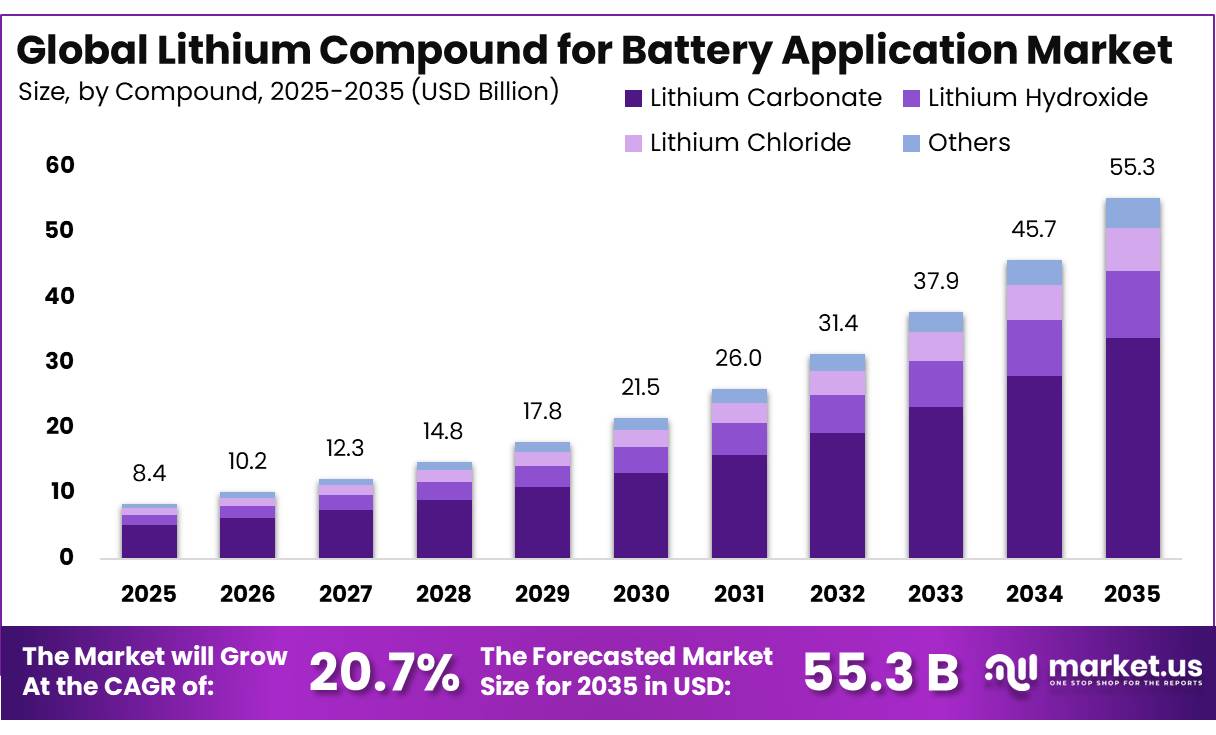
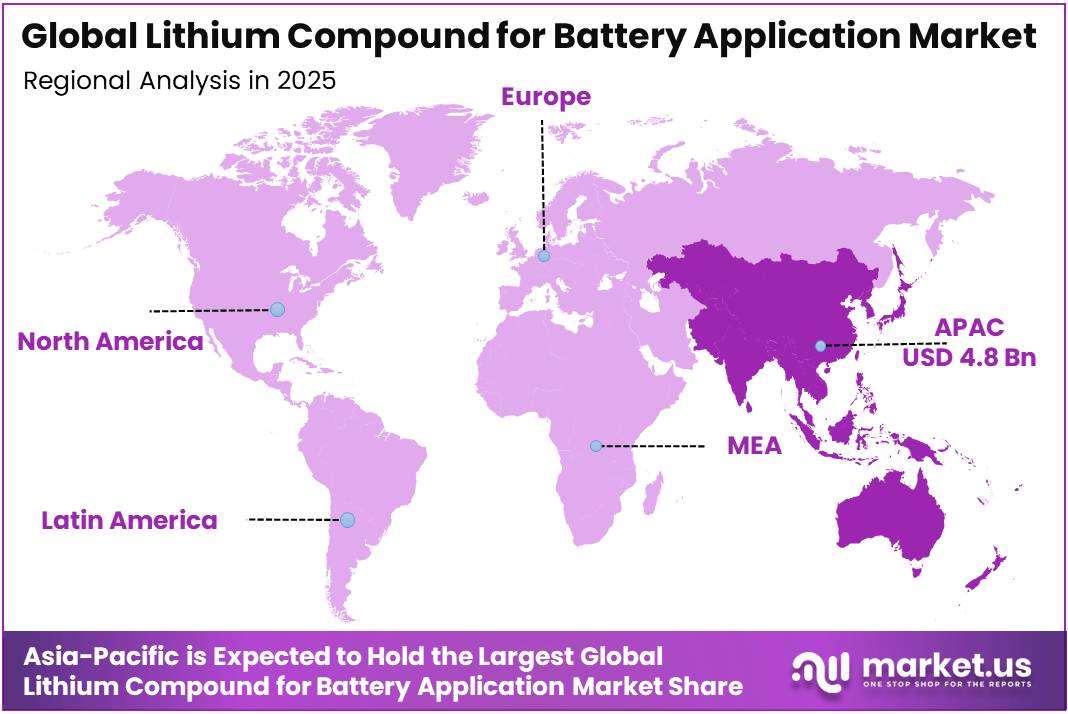
In 2025, the Global Lithium Compound for Battery Application Market was valued at USD 8.4 billion, and between 2026 and 2035, this market is estimated to register a CAGR of 20.7%, reaching about USD 55.3 billion by 2035. In 2025, Asia-Pacific led the market, achieving over 56.7% share with a revenue of USD 4.8 billion.
Lithium compounds have become essential raw materials for rechargeable batteries used in electric vehicles, stationary energy storage, consumer electronics and industrial equipment. Battery-grade lithium carbonate and lithium hydroxide are the principal compounds used to manufacture cathode materials. Lithium carbonate is widely used in lithium iron phosphate batteries, while lithium hydroxide is preferred for several high-nickel cathode chemistries. Their commercial importance continues to increase as transport electrification, renewable-energy integration and energy-security policies accelerate battery manufacturing worldwide.
- In 2025, global electric-vehicle battery deployment reached 1.2 TWh, rising by almost 30% from 2024 and exceeding the 2020 level by more than 7 times. Light-duty vehicles represented more than 85% of this deployment. Global lithium-ion battery manufacturing capacity also surpassed 4 TWh by the end of 2025, following annual growth of approximately 30%.
- However, the supply chain remains concentrated, with China accounting for more than 80% of global battery manufacturing capacity, while the European Union and the United States each represented around 6% to 7%. These conditions are encouraging battery producers to secure long-term lithium supplies and establish regional refining facilities.
Key Takeaways
- The Global Lithium Compound for Battery Application Market was valued at USD 8.4 billion in 2025.
- The market is projected to grow at a CAGR of 20.7% and is estimated to reach USD 55.3 billion by 2035.
- On the basis of compound, Lithium Carbonate dominated the market, constituting 61.2% of the total market share.
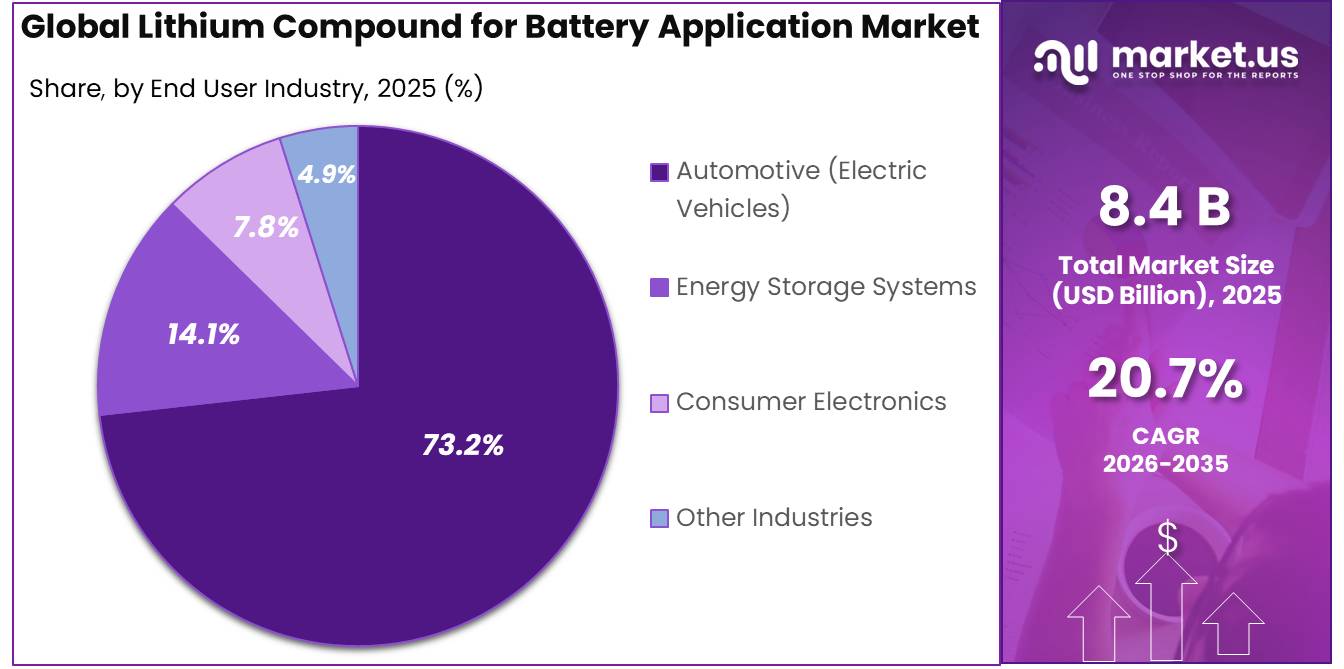
- Based on the end user industry, Automotive (Electric Vehicles) dominated the market, with a substantial market share of around 73.2%.
- In 2025, Asia-Pacific was the most dominant region in the market, accounting for 56.7% of the total global consumption.
Electric mobility remains the strongest demand driver. The International Energy Agency reported that global electric-car sales exceeded 17 million units in 2024, increasing by more than 25% and representing over 20% of total car sales. During the same year, EV battery demand exceeded 950 GWh, up 25% from 2023. Battery demand across EV and energy-storage applications reached the 1 TWh milestone. The IEA expects EV battery demand to rise above 3 TWh by 2030, supporting sustained consumption of battery-grade lithium carbonate, lithium hydroxide, lithium salts and specialty electrolyte compounds.
- In March 2026, the Department of Energy announced an additional funding opportunity of up to $500 million for critical-mineral processing, battery-material manufacturing and recycling.
Future growth opportunities will emerge from direct lithium extraction, geothermal brines, low-carbon refining and closed-loop recycling. European Union rules require lithium-based batteries to achieve 65% recycling efficiency by the end of 2025, increasing to 70% by 2030. Lithium material recovery must reach 50% by 2027. These requirements are expected to encourage investment in lithium recovery, purification and conversion technologies, creating additional supply channels while reducing dependence on newly mined material.
Compound Analysis
Lithium Carbonate Dominates with a 61.2% Share Due to Its Broad Use in Battery Manufacturing.
In 2025, lithium carbonate held a dominant market position, capturing more than a 61.2% share of the Lithium Compound for Battery Application Market. Its leadership was supported by its established use in lithium iron phosphate batteries and other widely produced cathode materials. Battery manufacturers preferred lithium carbonate because it was commercially available, compatible with mature production processes and suitable for electric vehicles, stationary energy storage systems and consumer electronics. Expanding battery plants and government-backed mineral-processing projects further supported its consumption.
- In January 2025, the U.S. Department of Energy closed a $996 million loan guarantee for the Rhyolite Ridge project, including $968 million in principal and $28 million in capitalized interest. The proposed facility is designed to produce enough lithium carbonate to support batteries for more than 370,000 electric vehicles annually.
- In February 2026, the U.S. Geological Survey estimated that global lithium production reached 290,000 metric tons in 2025, reflecting growing requirements from battery manufacturing.
Lithium hydroxide is the fastest-growing segment. In 2025 and 2026, its adoption continued to rise because it is suitable for manufacturing high-nickel cathode materials used in batteries requiring higher energy density and longer driving ranges. Battery producers increasingly considered lithium hydroxide for nickel-rich chemistries, particularly in premium electric vehicles and advanced energy-storage applications. However, lithium carbonate remained more widely used because of its established role in cost-sensitive and mass-produced battery chemistries. The International Energy Agency identifies lithium hydroxide as increasingly important for cathodes containing high levels of nickel.
End User Industry Analysis
Automotive (Electric Vehicles) dominates with a 73.2% share, supported by rising electric vehicle production.
In 2025, Automotive (Electric Vehicles) held a dominant market position, capturing more than a 73.2% share of the Lithium Compound for Battery Application Market. The segment’s leadership was supported by the large volume of lithium carbonate and lithium hydroxide required for manufacturing electric vehicle batteries. Automakers continued to expand battery-electric vehicle production, increasing demand for lithium compounds used in high-energy-density cathode materials.
- In March 2025, the U.S. Geological Survey reported that batteries accounted for 87% of global lithium usage. The agency also identified rising electric vehicle and energy storage demand as the main reason for the continued increase in lithium-ion battery requirements.
Energy Storage Systems is the fastest-growing segment in the Lithium Compound for Battery Application Market. Growth is being supported by the wider installation of utility-scale and distributed battery systems used to balance renewable electricity, manage peak demand and improve grid reliability. Lithium compounds remain important raw materials for rechargeable storage batteries because they support high energy efficiency, longer operating life and rapid charging. In 2025, increasing renewable power integration and the need for flexible electricity networks encouraged utilities and project developers to expand lithium-ion energy storage capacity.
Key Market Segments
By Compound
- Lithium Carbonate
- Lithium Hydroxide
- Lithium Chloride
- Others
By End User Industry
- Automotive (Electric Vehicles)
- Consumer Electronics
- Energy Storage Systems
- Other Industries
Driver Analysis
EU Critical Raw Materials Act Benchmarks and the ReSourceEU Funding Push
The EU Critical Raw Materials Act sets binding 2030 domestic capacity benchmarks of 10% for extraction, 40% for processing, and 25% for recycling of strategic raw materials including lithium, alongside a rule capping any single third country at 65% of the bloc’s annual supply at any given processing stage.
In 2026, the European Commission operationalized this through the ReSourceEU Action Plan, mobilizing up to €3 billion for strategic projects in 2026 alone, with €2.15 billion already earmarked for a subset of priority projects designed to reach production in the “very short term,” including a €250 million European Investment Bank commitment to Vulcan Energy’s German lithium-and-geothermal extraction project. The binding processing benchmark of 40% by 2030 implies the EU must roughly quadruple domestic lithium conversion capacity from its near-negligible current base, directly incentivizing greenfield hydroxide and carbonate refining investment inside the bloc’s borders rather than continued reliance on Chinese midstream processing.
Drivers Impact Analysis
| Driver | (~) % Impact on CAGR Forecast | Geographic Relevance | Impact Timeline |
|---|---|---|---|
| US critical mineral onshoring via Section 45X production credit | +1.6% | North America core (Nevada brine, Appalachian pegmatite belt) | Medium term (2-4 years) |
| EU Critical Raw Materials Act 2030 benchmarks plus ReSourceEU €3B 2026 funding | +1.3% | EU core; Germany, spill-over to Central/Eastern Europe | Medium term (2-4 years) |
| China’s lithium battery/cathode/graphite export-control architecture | +2.1% | APAC corridors (China supply dominance); indirect North America/EU exposure | Short term (≤2 years) |
| Domestic US lithium resource discovery | +0.9% | North America core (Carolinas, Maine, New Hampshire) | Long term (≥4 years) |
| Global EV and grid-storage demand growth | +2.8% | APAC core (China EV volume), EU adoption corridors, North America spill-over | Short term (≤2 years) |
| Black-mass and battery-recycling trade restrictions | +0.7% | EU core, Finland recycling corridor, APAC spill-over | Medium term (2-4 years) |
Restraint Analysis
Feedstock Price Volatility in Lithium Carbonate and Hydroxide Spot Markets
The root cause is the structural mismatch between hard-rock spodumene/brine supply additions and battery-grade conversion capacity, with the USGS Mineral Commodity Summaries 2026 documenting continued year-over-year price swings and a multi-year compound price trend tracked in its critical minerals price-change figure, reflecting lithium’s persistent boom-bust cycle driven by Chinese conversion overcapacity alternating with mine-level supply discipline; the quantitative bottleneck is that battery-grade lithium carbonate/hydroxide equivalent (LCE) pricing has historically swung by 40-70% peak-to-trough within 18-24 month windows, and any renewed price spike compresses cell-maker gross margins by an estimated 200-400 basis points per $1,000/tonne LCE move given lithium compounds typically represent 8-12% of cell bill-of-materials cost; the strategic business impact is that cathode and cell producers operating on fixed-price EV supply agreements absorb margin risk directly, forcing many to renegotiate index-linked pricing clauses, while smaller downstream converters with thinner balance sheets face working-capital strain and delayed expansion CapEx until price visibility stabilizes, a dynamic the USGS explicitly tracks via its 5-year compound annual price growth-rate figure for critical minerals.
Restraint Impact Analysis
| Restraint | (~) % Impact on CAGR Forecast | Geographic Relevance | Impact Timeline |
|---|---|---|---|
| US Section 301/122 tariff stacking on Li-ion cells & precursors | -2.8% | North America core (US import chain) | Short term (≤2 yrs) |
| China MOFCOM export-licensing regime on lithium battery/graphite inputs | -2.2% | Global (US, EU, APAC ex-China corridors) | Medium term (2-4 yrs) |
| Feedstock price volatility & lithium carbonate/hydroxide spot swings | -1.6% | Global, acute in APAC refining hubs | Short term (≤2 yrs) |
| EU CRMA compliance costs & permitting bottlenecks | -1.4% | EU core (Germany, Portugal, Serbia projects) | Medium term (2-4 yrs) |
| FEOC/§30D sourcing-eligibility compliance friction | -1.8% | North America core, spillover to allied APAC suppliers | Medium term (2-4 yrs) |
| Refining capacity concentration & lead-time bottlenecks outside China | -1.3% | APAC (China-dependent), NA/EU downstream | Long term (≥4 yrs) |
Opportunity Analysis
Lithium-Clay & Unconventional Brine Feedstock Monetization (U.S.)
USGS data confirms current U.S. commercial-scale production is limited to a single continental brine operation in Nevada, while measured and indicated domestic resources span underexploited claystone, geothermal brine, hectorite, and oilfield brine formations across Nevada, Utah, Arkansas, and California, cumulatively representing an estimated 8-10 million tons of lithium content not yet linked to any producing asset. This is a future opportunity rather than a baseline driver because none of these unconventional feedstocks currently contribute measurable production; capitalizing requires new extraction chemistry that is technologically distinct from the brine evaporation baseline.
A company that secures early land positions and pilots geothermal-brine co-production could target unit production costs of USD 4,500-5,800 per metric ton of lithium carbonate equivalent roughly 20-30% below conventional hard-rock spodumene conversion costs while accessing federal Bipartisan Infrastructure Law-linked funding streams (USD 1.6 billion allocated across 12 lithium projects) to de-risk capital intensity. Successful commercialization of just two to three mid-scale unconventional projects by 2032 could unlock 150,000-200,000 tons per year of incremental domestic lithium chemical supply, materially reducing the current net import reliance of over 25% of apparent U.S. consumption and creating first-mover control over a currently un-monetized 8-10 million ton resource base.
Opportunity Impact Analysis
| Opportunity | (~) % Potential CAGR Upside | Geographic Relevance | Execution Window |
|---|---|---|---|
| Regulatory-Arbitrage Recycled-Content Compliance-as-a-Service | +2.2% | EU core (Germany, France, Poland) | Medium term (2-4 years) |
| Lithium-Clay & Unconventional Brine Feedstock Monetization (U.S.) | +1.8% | North America (Nevada, Utah, Arkansas, California) | Long term (≥4 years) |
| India Downstream Refining & NCMM-Linked Roll-Up M&A | +2.6% | APAC emerging (India) | Medium term (2-4 years) |
| Direct Lithium Extraction (DLE) Licensing & Tech-as-a-Service Model | +1.5% | LatAm (Argentina, Chile), APAC (China), North America | Long term (≥4 years) |
| Second-Life / Non-EV Stationary Storage Chemical Repurposing | +1.3% | EU, North America core | Short term (≤2 years) |
| Battery-Manufacturing-Waste (BMW) Closed-Loop Feedstock Contracts | +1.9% | EU core, expanding to APAC | Medium term (2-4 years) |
Challenges Analysis
Brine-Water Resource Stress in the Lithium Triangle
The root vulnerability is hydrological: brine extraction in the Salar de Atacama and Salar del Hombre Muerto operates in closed, low-recharge basins where USGS-modeled scenarios show a near 1:-1 relationship between freshwater withdrawal and reduction in natural groundwater discharge, meaning every unit of water pumped for lithium processing directly depletes basin outflow with negligible buffering capacity; the Salar de Atacama alone holds an estimated 6.3 million metric tons of lithium content, per USGS Earthshots data, but historical monitoring found miners extracting brine faster than precipitation could replenish it, prompting Chile’s water authority to restrict new water rights and require multi-year compliance remediation of roughly 10% extraction cuts in previously overdrawn zones; this creates a quantifiable unit-economic penalty as producers must now fund deep monitoring wells, alternative direct lithium extraction (DLE) technologies with materially higher capital intensity per ton, and phased withdrawal caps that can constrain output ramp-up by multi-quarter increments even as global demand accelerates; the long-term strategic adjustment requires basin-wide water-budget modeling, cross-border regulatory alignment between Chile and Argentina, and capital reallocation toward DLE pilot-to-commercial scale-up over a horizon exceeding four years before brine-based supply can reliably decouple from water-stress ceilings.
Challenges Impact Analysis
| Challenge | (~) % CAGR Friction Drag | Geographic Relevance | Mitigation Horizon |
|---|---|---|---|
| Refining/conversion capacity bottleneck | -1.6% | China Jiangxi/Sichuan hubs, APAC conversion corridors | Medium term (2-4 yrs) |
| Brine-water resource stress | -1.1% | Chile Atacama, Argentina Hombre Muerto (Lithium Triangle) | Long term (≥4 yrs) |
| Skilled mining/process engineer shortage | -0.7% | US, Australia, India domestic mining zones | Long term (≥4 yrs) |
| Price and margin volatility | -1.3% | Global spot markets, China Jiangxi pricing benchmark | Short term (≤2 yrs) |
| Permitting and exploration lag | -0.9% | India (J&K Reasi), US Appalachian/Nevada, EU hubs | Medium term (2-4 yrs) |
| Logistics/transit and customs friction | -0.6% | India import corridors, US-Asia shipping lanes | Short term (≤2 yrs) |
Geopolitical Impact Analysis
The Iran Conflict and Its Ripple Effect on Lithium Compound Supply
The ongoing conflict involving Iran has placed new strain on the global lithium compound supply chain, even though Iran itself holds little direct stake in lithium production. The country’s position beside the Strait of Hormuz, one of the world’s most critical shipping corridors, has meant that much of the disruption has been felt through shipping and logistics rather than mining output. Energy and freight costs have risen sharply as a result, adding financial pressure across mining, refining, and battery manufacturing stages alike.
Battery-grade lithium carbonate and lithium hydroxide producers have not been spared either. Supporting materials such as separators, electrolyte solvents, and binders rely heavily on naphtha, a refined petroleum product tied closely to Middle Eastern supply routes, and pricing volatility here has cascaded into higher production costs downstream. Refiners dependent on imported sulfuric acid have faced added tightening, since China has restricted exports of the chemical to preserve domestic industrial control, a move that has left processors elsewhere scrambling for alternatives.
Buyers are responding by diversifying sourcing away from single-corridor dependency, favouring compound suppliers with domestic or regionally secure logistics. For now, prices remain sensitive to how long the conflict continues, and any further escalation could deepen cost pressure across the battery material value chain through the remainder of 2026.
Regional Analysis
Asia-Pacific Dominates the Lithium Compound for Battery Application Market
Asia-Pacific dominated the Global Lithium Compound for Battery Application Market in 2025, holding a commanding 56.7% share and generating revenue of approximately US$4.8 billion. This lead is rooted in the region’s concentration of battery-grade refining capacity, cathode production, and electric vehicle assembly across China, South Korea, and Japan. China alone anchors much of the world’s lithium carbonate and lithium hydroxide processing, while South Korean and Japanese battery makers continue to scale gigafactory output. Government-backed EV incentives, expanding domestic battery supply chains, and proximity to raw material imports from Australia and the Lithium Triangle have reinforced Asia-Pacific’s position as the primary consumption and processing hub for battery-grade lithium compounds.
Europe stands out as the fastest-growing region within the market. The region’s momentum is being driven by an aggressive push toward electric vehicle adoption, tightening emissions regulations, and a wave of new gigafactory investments across Germany, France, and Central Europe. European policymakers have also prioritised building localised battery material supply chains to reduce reliance on Asian imports, spurring fresh investment in lithium refining and recycling infrastructure. This regulatory push, paired with growing automaker demand for regionally sourced battery inputs, is accelerating consumption growth at a pace ahead of other established markets.
Key Regions and Countries Covered
- North America
- The US
- Canada
- Europe
- Germany
- France
- The UK
- Spain
- Italy
- Russia & CIS
- Rest of Europe
- APAC
- China
- Japan
- South Korea
- India
- ASEAN
- Rest of APAC
- Latin America
- Brazil
- Mexico
- Rest of Latin America
- Middle East & Africa
- GCC
- South Africa
- Rest of MEA
Key Players Analysis
Albemarle Corporation remains a major supplier of battery-grade lithium carbonate and lithium hydroxide for electric vehicles and energy-storage systems. In 2025, its Energy Storage business generated USD 2.71 billion in net sales and USD 697 million in adjusted EBITDA. Fourth-quarter Energy Storage sales reached USD 759 million, rising 23.1%, supported by a 17% increase in volume. Companywide 2025 net sales totaled USD 5.14 billion, while operating cash flow reached USD 1.3 billion, strengthening its ability to serve battery customers globally.
Rio Tinto strengthened its position in battery lithium by completing the USD 6.7 billion acquisition of Arcadium Lithium in March 2025. The acquired business was renamed Rio Tinto Lithium and combined with the Rincon project. The company targets more than 200,000 tonnes per year of lithium carbonate equivalent capacity by 2028. It also approved USD 2.5 billion to expand Rincon to 60,000 tonnes of battery-grade lithium carbonate annually, with first production expected in 2028 and a planned 40-year operating life.
SQM S.A. is one of the largest global suppliers of lithium carbonate and lithium hydroxide for battery applications. In 2025, lithium and derivative revenue reached USD 2.29 billion, representing 50.0% of total company revenue. Lithium sales volume increased to 257,900 tonnes of lithium carbonate equivalent, up about 24% from 2024. Total 2025 revenue reached USD 4.58 billion and reported net income totaled USD 588.1 million.
The Major Players in The Industry
- Albemarle Corporation
- Jiangxi Ganfeng Lithium Group Co., Ltd.
- LevertonHELM Limited
- Lithium Americas Corp.
- Lithium Argentina AG
- Mineral Resources
- PLS (Pilbara Minerals)
- Rio Tinto
- Shandong Ruifu Lithium Co., Ltd.
- SQM S.A.
- Other Key Players
Key Development
- In November 2025, Mineral Resources (MinRes) signed a binding agreement with POSCO Holdings to establish a new lithium joint venture. POSCO agreed to pay US$765 million for a 30% interest in MinRes’ operational lithium business, equal to an indirect 15% interest in both Wodgina and Mt Marion. The deal valued MinRes’ existing 50% share in the 2 mines at around A$3.9 billion, while MinRes retained a 70% interest in the new entity.
- In July 2025, Jiangxi Ganfeng Lithium Group Co., Ltd. completed the acquisition of the remaining 40% equity interest in Mali Lithium, increasing its ownership to 100% and strengthening control over the Goulamina spodumene project, which supplies raw material for battery-grade lithium compounds.
Report Scope
| Report Features | Description |
|---|---|
| Market Value (2025) | USD 8.4 Bn |
| Forecast Revenue (2035) | USD 55.3 Bn |
| CAGR (2026-2035) | 20.7% |
| Base Year for Estimation | 2025 |
| Historic Period | 2020-2024 |
| Forecast Period | 2026-2035 |
| Report Coverage | Revenue Forecast, Market Dynamics, Competitive Landscape, Recent Developments |
| Segments Covered | By Compound (Lithium Carbonate, Lithium Hydroxide, Lithium Chloride, and Others), By End User Industry (Automotive (Electric Vehicles), Consumer Electronics, Energy Storage Systems, and Other Industries) |
| Regional Analysis | North America – The US & Canada; Europe – Germany, France, The UK, Spain, Italy, Russia & CIS, Rest of Europe; APAC– China, Japan, South Korea, India, ASEAN & Rest of APAC; Latin America– Brazil, Mexico & Rest of Latin America; Middle East & Africa– GCC, South Africa, & Rest of MEA |
| Competitive Landscape | Albemarle Corporation, Jiangxi Ganfeng Lithium Group Co., Ltd., LevertonHELM Limited, Lithium Americas Corp., Lithium Argentina AG, Mineral Resources, PLS (Pilbara Minerals), Rio Tinto, Shandong Ruifu Lithium Co., Ltd., SQM S.A., Other Key Players |
| Customization Scope | Customization for segments, region/country-level will be provided. Moreover, additional customization can be done based on the requirements. |
| Purchase Options | We have three licenses to opt for: Single User License, Multi-User License (Up to 5 Users), Corporate Use License (Unlimited Users and Printable PDF) |





































