


Report Overview
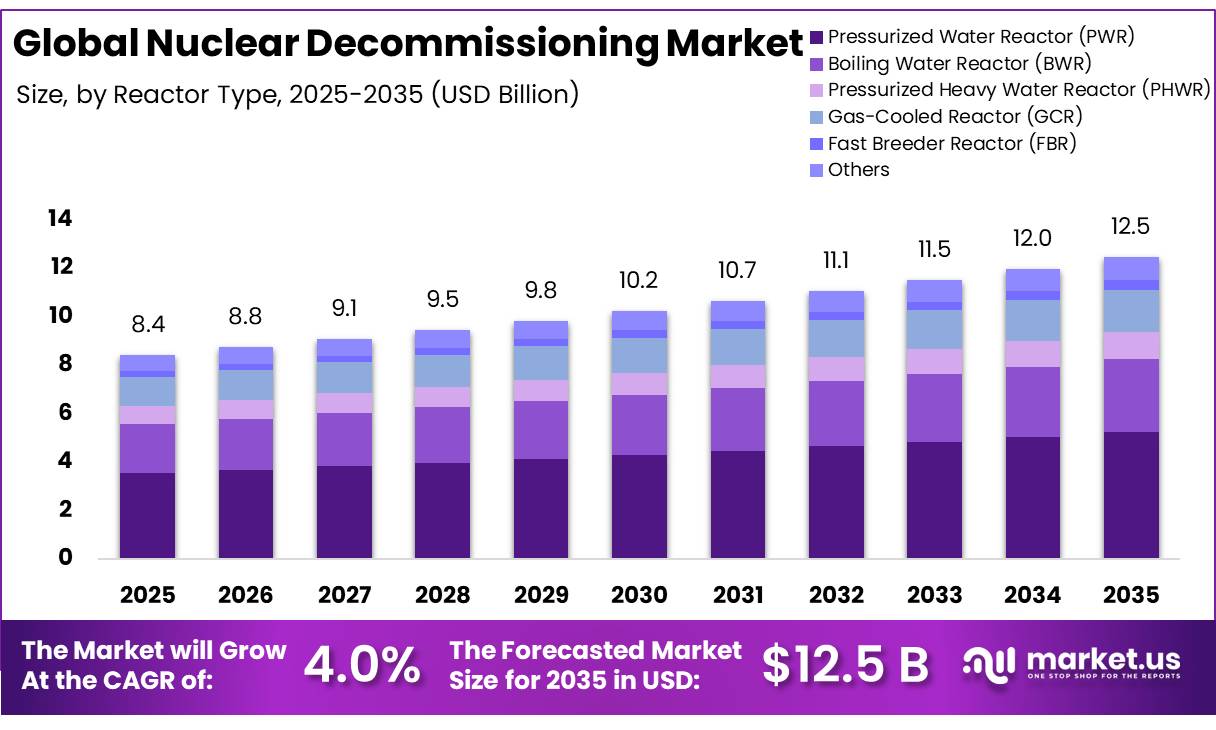
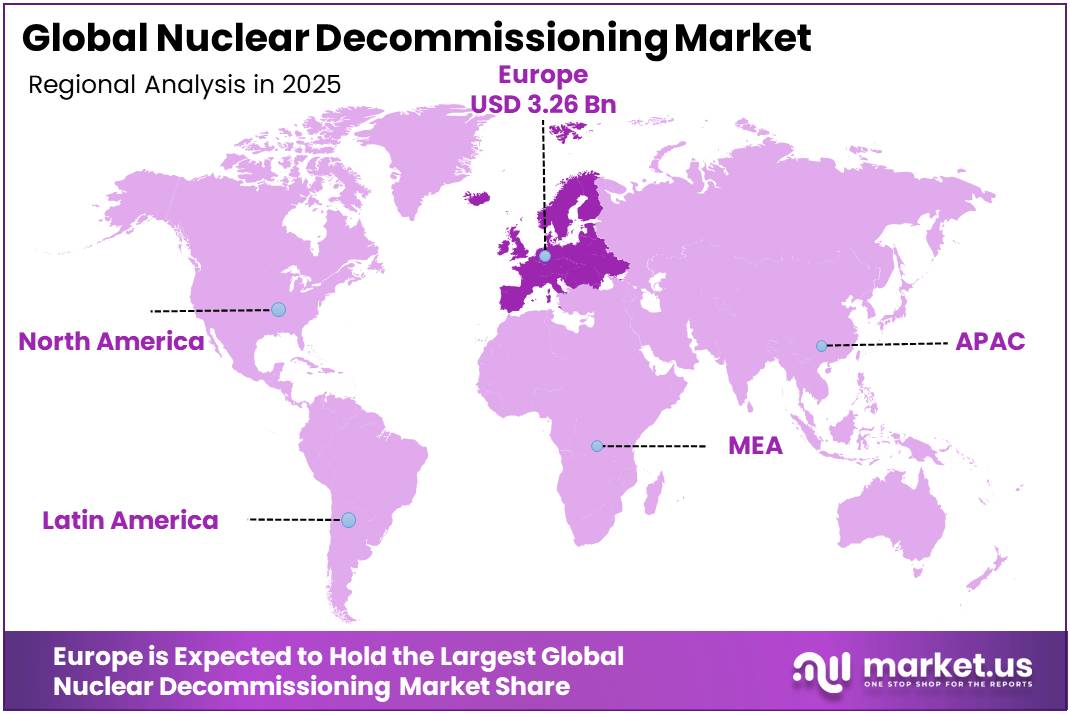
In 2025, the Global Nuclear Decommissioning Market was valued at USD 8.4 billion. Between 2026 and 2035, this market is estimated to register a CAGR of 4.0%, reaching approximately USD 12.5 billion by 2035. In 2025, Europe led the market, achieving over 38.7% share with a revenue of USD 3.26 billion.
The Nuclear Decommissioning market is a global engineering, waste management, and environmental remediation sector encompassing the safe dismantling, decontamination, and site restoration of permanently shut down nuclear power plants, research reactors, and nuclear fuel cycle facilities. Nuclear decommissioning is a legally mandated process regulated in the United States by the Nuclear Regulatory Commission, which requires all permanently shut down reactor licensees to complete decommissioning within 60 years of permanent cessation of operations by NRC, 2024.
- According to the International Atomic Energy Agency’s Power Reactor Information System (IAEA–PRIS), 220 nuclear power reactors were permanently shut down worldwide as of June 2026. The IAEA Research Reactor Database (RRDB) reported 68 research reactors under decommissioning and 457 reactors already decommissioned.
Key Takeaways
- The Global Nuclear Decommissioning Market was valued at US$8.4 billion in 2025.
- The market is projected to grow at a CAGR of 4.0% and is estimated to reach US$12.5 billion by 2035.
- Pressurized Water Reactor (PWR) is the dominant reactor type, accounting for 42.1% of the market in 2025, driven by PWR’s position as the world’s most widely deployed commercial reactor design.
- Immediate Dismantling (DECON) is the dominant decommissioning strategy at 54.6%, reflecting the growing preference for prompt site clearance and licence termination across utility operators.
- Dismantling & Demolition is the largest process stage at 34.5%, representing the most labour and capital-intensive phase of the decommissioning lifecycle.
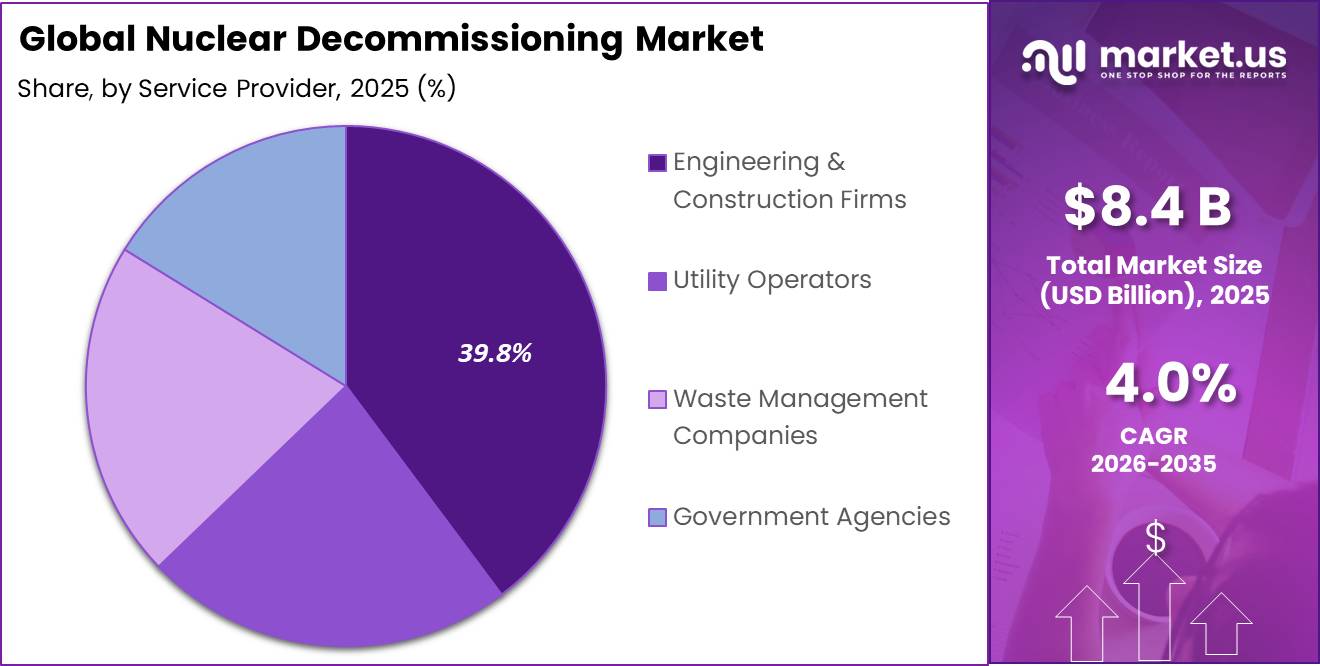
- Engineering & Construction Firms lead service provider demand at 39.8%, anchored by major EPC contractors executing complex nuclear site remediation programmes globally.
- Europe holds the largest regional share at 38.7%, driven by the most active decommissioning pipeline of any region, including Germany’s completed nuclear phase-out and extensive UK legacy site programmes.
Key end users include utility operators, engineering and construction firms, waste management companies, and government agencies across Europe, North America, and Asia Pacific. Market Key growth drivers include reactor retirements, radioactive waste management obligations, and government funding programs.
- In May 2026, the U.S. Department of Energy identified more than USD 1.5 billion in repair needs across approximately 4,300 operating facilities managed by its Office of Environmental Management, based on facility assessments conducted as of June 2025.
Market scope encompasses reactor dismantling, waste processing, site remediation, radiation monitoring, remote robotics, and engineering services. Key technologies include immediate dismantling, deferred dismantling, and entombment approaches deployed across small reactors, commercial reactors, and large multi-unit facilities. Demand is increasing among utility operators, engineering contractors, waste management providers, and government agencies as global decommissioning activity expands.
The future growth will be supported by robotic dismantling systems, digital radiation mapping, AI-enabled project management, and advanced decommissioning analytics. Emerging opportunities include small modular reactor lifecycle planning and digital waste characterization platforms. These technologies improve worker safety, reduce radiation exposure, enhance contamination assessment accuracy, optimize asset tracking, and lower project costs while shortening decommissioning timelines.
Nuclear Decommissioning Market Segmentation
Reactor Type Analysis
Pressurized Water Reactor (PWR) Represents the Dominant Segment in the Market.
In 2025, Pressurized Water Reactor (PWR) accounted for a leading 42.1% share of the market, due to PWR’s position as the world’s most widely deployed commercial reactor design accounting for the both operational and permanently shut down reactors globally. PWR decommissioning projects are the most commercially active segment of the market, with significant programmes underway across the United States, France, Germany, and Japan.
- As of December 2024, 417 reactors were operational globally with PWRs representing the dominant reactor type across the operational fleet that will eventually transition into decommissioning by IAEA. The IAEA also recorded 74 permanently shut-down PWRs with a combined net capacity of 87 GW
Gas-Cooled Reactor (GCR) is the fastest-growing reactor type segment. UK Nuclear Decommissioning Authority programme timelines, the unique technical challenges of graphite moderator and gas circuit decommissioning, and regulatory approval processes under the Office for Nuclear Regulation are the primary growth determinants for the GCR segment. Between 2026 and 2035, GCR decommissioning expenditure is expected to grow as the UK NDA’s multi-decade programme advances through active dismantling phases.
Decommissioning Strategy Analysis
Immediate Dismantling (DECON) Represents the Dominant Segment in the Market
In 2025, Immediate Dismantling (DECON) accounted for a leading 54.6% share of the Nuclear Decommissioning market. This dominance is driven by operator preference due to faster liability resolution and reduced long-term surveillance costs, subject to regulatory approval and waste management constraints. Utility operator preference for prompt liability elimination, the availability of specialist accelerated decommissioning contractors, NRC and IAEA regulatory framework requirements, and the economics of DECON versus SAFSTOR under current waste disposal and labour cost environments are the primary structural determinants.
- The U.S. NRC’s Information Digest 2024–2025 reported that 23 nuclear power reactors were in different stages of DECON or SAFSTOR, demonstrating the sizeable regulated pipeline of commercial-reactor decommissioning work.
Safe Enclosure (SAFSTOR) is the fastest-growing decommissioning strategy segment. As in SAFSTOR a facility is placed in a safe, monitored storage condition for a period before final dismantling is being adopted across European programmes where radioactivity decay reduces eventual dismantling costs and where regulatory frameworks allow extended safe storage periods. Between 2026 and 2035, European nuclear decommissioning programmes in France and the UK are expected to generate significant SAFSTOR-related monitoring, maintenance, and planning expenditure.
Process Stage Analysis
Dismantling & Demolition Represents the Dominant Segment in the Market.
In 2025, Dismantling & Demolition accounted for a leading 34.5% share of the Nuclear Decommissioning market by process stage, due to its position as the most capital and labour-intensive phase of the decommissioning lifecycle encompassing reactor pressure vessel segmentation, primary circuit removal, contaminated structural demolition, and radiological clearance of facility components. Major Dismantling & Demolition contracts represent the highest-value awards in the decommissioning market. Active decommissioning programme volumes across the U.S., UK, and Europe, the technical complexity of reactor vessel and primary circuit segmentation, contractor capacity for radiological work, and regulatory oversight of major decommissioning activities are the primary structural determinants.
- According to the Nuclear Decommissioning Authority’s Business Plan, published on 5 June 2025, the NDA planned total expenditure of £4.164 billion for the 2025/26 financial year, including £3.975 billion for on-site programmes. These programmes include nuclear hazard reduction, facility decommissioning, waste management and site remediation.
Waste Management is the fastest-growing process stage segment. Rising volumes of low-level, intermediate-level, and high-level radioactive waste generated by active decommissioning programmes are driving demand for waste characterisation, packaging, transport, and disposal services. National radioactive waste disposal facility availability, regulatory classification frameworks for decommissioning waste streams, and the volume of active dismantling generating new waste requiring processing and disposal are the primary growth catalysts.
Service Provider Analysis
Engineering & Construction Firms Represent the Dominant Segment in the Market.
In 2025, Engineering & Construction Firms accounted for a leading 39.8% share of the market, due to their central role in executing the most technically complex and highest-value phases of decommissioning including reactor vessel segmentation, contaminated structure demolition, and radiological decontamination. Technical capability in radiological work, past performance on nuclear decommissioning contracts, access to specialist workforce and equipment, and the ability to manage large-scale multi-year government decommissioning programme contracts are the primary structural determinants.
Government Agencies including the U.S. DOE’s Office of Environmental Management and the UK’s Nuclear Decommissioning Authority directly manage and fund the largest legacy nuclear facility decommissioning programmes globally. Government budget allocations for nuclear decommissioning programmes, DOE Office of Environmental Management annual appropriations, and the UK NDA’s multi-decade programme funding framework are the primary determinants.
Key Market Segments
Reactor Type
- Pressurized Water Reactor (PWR)
- Boiling Water Reactor (BWR)
- Pressurized Heavy Water Reactor (PHWR)
- Gas-Cooled Reactor (GCR)
- Fast Breeder Reactor (FBR)
- Others
Decommissioning Strategy
- Immediate Dismantling (DECON)
- Safe Enclosure (SAFSTOR)
- Entombment
Process Stage
- Planning & Licensing
- Decontamination
- Dismantling & Demolition
- Waste Management
- Site Restoration
Service Provider
- Utility Operators
- Engineering & Construction Firms
- Waste Management Companies
- Government Agencies
Driver Analysis
Public funding lock-in and regulated decommissioning financing
Nuclear decommissioning is unusually protected from cyclical capital-spending volatility because it is tied to regulatory obligations, ring-fenced programs, and sovereign or quasi-sovereign funding channels. The IAEA notes that decommissioning planning is required from initial authorization onward and must include assurance that provisions are in place to cover associated costs, while the EU explicitly anchors support through the Nuclear Decommissioning Assistance Programme and 2021-2027 regulations.
The US provides the clearest scale signal in 2026 budgeting: DOE’s FY2026 environmental management request includes $6.956 billion for defense environmental cleanup and an additional $384.957 million contribution to the Uranium Enrichment Decontamination and Decommissioning Fund, with total discretionary budget authority for the cleanup mission listed at $8.093 billion.
At the site level, Hanford’s remaining cleanup cost was reported in 2025 at up to $589.4 billion, underscoring the extraordinary long-tail addressable spend that keeps procurement pipelines active even when annual appropriations fluctuate. This justifies a +1.9 percentage-point CAGR contribution because locked-in public funding compresses demand risk, lowers cancellation probability, and supports longer contracting horizons for engineering, waste, and remediation vendors
Drivers Impact Analysis
| Driver | (~) % Impact on CAGR | Geographic Relevance | Impact Timeline |
|---|---|---|---|
| Aging reactor retirements converting into dismantling backlog | +2.2% | EU core, UK, North America, Japan | Medium term (2-4 years) |
| Public funding lock-in and regulated decommissioning financing | +1.9% | US core, EU, UK, Japan | Short term (≤ 2 years) |
| Waste handling, segmentation, and final disposal readiness | +1.6% | EU core, UK, North America, Japan, selective APAC | Medium term (2-4 years) |
| Robotics and remote operations for high-hazard retrieval | +1.4% | UK, Japan, US, advanced EU sites | Short term (≤ 2 years) |
| Site remediation and brownfield reuse economics | +1.1% | EU, UK, US, Japan | Long term (≥ 4 years) |
| Cross-border knowledge transfer and program standardization | +0.8% | UK-Japan corridor, EU, IAEA member states, APAC spill-over | Medium term (2-4 years) |
Restraint Analysis
Absence of Operational High-Level Waste (HLW) Deep Geological Repositories
This DGR deficit forces decommissioning operators globally to default to indefinite interim dry-cask storage a mode that adds USD 200–400 million in lifecycle storage costs per reactor site, extends site liability retention periods by 20–50 years beyond the physical dismantlement horizon, locks up licensed-operator capital in non-productive surveillance and security activities (estimated at USD 5–15 million per site annually), and prevents NRC/national regulator-mandated license termination, meaning decommissioning EPC contracts cannot be closed-out for full payment settlement.
For commercial project sponsors and decommissioning service providers, this uncertainty creates a CAGR-suppressing feedback loop: without a defined terminal waste-disposal route, approximately 30–40% of total decommissioning scope specifically the back-end waste removal, transport, and repository placement remains commercially uncontractable, deferring significant revenue recognition, elongating project IRRs, and suppressing the addressable market size by an estimated USD 2.5–4 billion in the near-to-medium term.
Restraint Impact Analysis
| Restraint | (~) % Impact on CAGR | Geographic Relevance | Impact Timeline |
|---|---|---|---|
| Absence of Operational High-Level Waste (HLW) Deep Geological Repositories (DGR) | -1.4% | North America (critical), EU, Japan, South Korea | Long term (≥ 4 years) |
| Chronic Skilled Workforce Shortage & Knowledge Transfer Failure | -0.9% | North America, EU, APAC corridors | Medium term (2–4 years) |
| Structural Decommissioning Trust Fund Underfunding & Cost Escalation | -0.8% | EU, North America, Emerging APAC markets | Medium term (2–4 years) |
| Multi-Layered Regulatory Complexity & Licensing Delays | -0.7% | North America (NRC), EU (national regulators), Japan | Short to Medium term (≤ 4 years) |
| Public Opposition, NIMBY Syndrome & Social License Erosion | -0.5% | EU (Germany, France, UK), North America, APAC | Medium term (2–4 years) |
| Immature Robotics & Remote Handling Technology Supply Chain | -0.4% | Global — particularly UK, France, Japan, USA | Short to Medium term (≤ 4 years) |
Opportunity Analysis
Accelerated decommissioning platforms
This is an opportunity rather than a baseline driver because reactor shutdowns already create the core market, whereas the upside comes from changing the commercial model from utility-managed, multi-decade projects to specialist-led accelerated platforms that compress active dismantling from roughly global norms of 10 years-plus to about 5–7 years, as already targeted by newer U.S. programs, thereby pulling revenue forward, increasing contractor asset turns, and enabling portfolio-scale margin capture across multiple single-unit sites.
Platform operators reduce project duration by 35–50%, they can improve labor absorption by 15–20%, cut owner overhead and surveillance costs by 10–18%, and bid on fixed-price or gain-share structures that can expand EBITDA margins by 300–500 basis points versus conventional EPC-style dismantling. Given that more than 40 U.S. power reactors have shut down, only about ten have completed decommissioning, and decommissioning trust funds in the U.S. total about $100 billion, the monetizable backlog for accelerated execution remains underpenetrated; even capturing 8–10 additional large reactor sites at average project values of $700 million to $1.2 billion could create $6–10 billion of incremental addressable revenue above baseline service demand by the early 2030s.
Opportunity Impact Analysis
| Opportunity | (~) % Potential CAGR | Geographic Relevance | Execution Window |
|---|---|---|---|
| Accelerated decommissioning platforms | +1.8% | North America core, EU | Short term (≤ 2 years) |
| Waste-value capture & metal recycling | +1.3% | EU, UK, North America, Japan | Short term (≤ 2 years) |
| Legacy fuel-cycle site roll-ups | +2.1% | UK, France, US, ex-Soviet sites | Medium term (2-4 years) |
| Robotics-led remote dismantling | +1.5% | Japan, UK, France, US, Germany | Medium term (2-4 years) |
| Spent-fuel & ISFSI lifecycle monetization | +1.2% | US core, Canada | Medium term (2-4 years) |
| Design-for-decommissioning services for SMRs/new build | +0.9% | APAC, Middle East, Eastern Europe | Long term (≥ 4 years) |
Challenges Analysis
Specialist Workforce Gaps
In execution terms, a project may fill 85% to 90% of nominal vacancies yet still suffer a 10% to 18% productivity deficit if the missing tranche includes planners, radiological protection supervisors, C&I engineers, safety-case writers, remote handling operators, or QA personnel, because each absent specialist can delay permits, package reviews, shift coverage, or commissioning handovers across dozens of dependent tasks.
The UK data point of just under 100,000 civil nuclear roles by late 2025 and the need for 24,000 additional skilled workers by 2030 illustrate how competition for transferable talent is intensifying rather than easing, and for decommissioning programs that typically run on thin windows of licensed work, this can translate into recruitment lead times of 4 to 9 months, onboarding periods of 8 to 20 weeks, overtime premiums of 15% to 30%, and subcontractor rate inflation of 10% to 18%, collectively implying about 1.2 percentage points of CAGR friction drag.
Challenges Impact Analysis
| Challenge | (~) % CAGR Friction | Geographic Relevance | Mitigation Horizon |
|---|---|---|---|
| Waste Route Bottlenecks | -1.4% | EU legacy sites, UK core, North America core, Japan | Long term (≥ 4 years) |
| Specialist Workforce Gaps | -1.2% | UK core, North America core, EU regulatory hubs | Long term (≥ 4 years) |
| Complex Site Data Deficits | -0.9% | Legacy military sites, EU brownfields, Japan | Medium term (2-4 years) |
| Robotics Scale-Up Constraints | -0.8% | High-rad zones in UK, France, U.S., Japan | Medium term (2-4 years) |
| Regulatory Sequencing Delays | -0.7% | EU regulatory hubs, North America core, APAC nuclear states | Medium term (2-4 years) |
| Cost Fund Realignment Risk | -1.0% | OECD markets, liberalized power systems, legacy public sites | Long term (≥ 4 years) |
Geopolitical Impact Analysis
Russia-Ukraine Conflict and Western Sanctions Are Disrupting Global Nuclear Decommissioning Supply Chains and Workforce Mobility.
The Russia-Ukraine conflict and resulting Western sanctions are having a noticeable impact on the global nuclear decommissioning market, particularly by disrupting established supply chains and limiting workforce mobility. Russia’s state nuclear corporation, Rosatom, has historically been a major provider of nuclear engineering expertise, equipment, and decommissioning-related technologies. However, since 2022, sanctions imposed by Western countries have largely restricted Rosatom’s participation in nuclear projects across Europe, North America, forcing operators to seek alternative suppliers.
This shift has created gaps in access to specialized equipment such as reactor cutting and segmentation tools, as well as other critical decommissioning technologies previously sourced from Russian vendors. As a result, project developers are increasingly turning to alternative suppliers in Europe, North America, and Asia, which can lead to higher procurement costs and longer project timelines.
Regional Analysis
Europe Held the Largest Share of the Global Nuclear Decommissioning Market
In 2025, Europe dominated market, holding about 38.7% of total global revenue. This regional leadership is driven by Germany’s completed nuclear phase-out, the UK’s extensive legacy Magnox and AGR fleet, France’s ageing reactor programme, and active decommissioning across Belgium, Switzerland, Sweden, and Italy.
Nuclear Restoration Services owned by the UK’s Nuclear Decommissioning Authority manages decommissioning across 13 sites, representing one of the world’s largest and most complex civil nuclear clean-up programmes. The IAEA’s Global Status of Decommissioning Phase 2 project specifically identified Germany and the UK as benchmark large national decommissioning programmes by IAEA, 2025.
In North America, the market is supported by the U.S. Department of Energy’s Office of Environmental Management legacy nuclear cleanup programme and a steady pipeline of commercial reactor decommissioning projects. The U.S. Nuclear Regulatory Commission provides continuous oversight of decommissioning activities at permanently shut-down reactor sites, ensuring strict regulatory compliance and safety standards.
Key Regions and Countries Covered
- North America
- The US
- Canada
- Europe
- Germany
- France
- The UK
- Spain
- Italy
- Russia & CIS
- Rest of Europe
- APAC
- China
- Japan
- South Korea
- India
- ASEAN
- Rest of APAC
- Latin America
- Brazil
- Mexico
- Rest of Latin America
- Middle East & Africa
- GCC
- South Africa
- Rest of MEA
Key Players Analysis
The Global Nuclear Decommissioning Market is characterized by a consolidated oligopolistic structure, with a small number of large engineering, construction, and nuclear services companies commanding the majority of high-value decommissioning contract awards globally. Bechtel, Fluor Corporation, Jacobs Engineering, Westinghouse Electric, Orano (Areva), and Serco Group represent the dominant top tier each with specialised nuclear decommissioning engineering capabilities, established regulatory relationships, and track records of major government decommissioning programme execution.
The competitive landscape is considerably more fragmented. Energy Solutions, TÜV Rheinland, and EDF Energy occupy specialised positions competing across specific reactor types, geographic markets, or process stage niches. The market rewards nuclear engineering technical capability, regulatory compliance track record, workforce radiological safety performance, and the financial strength to execute multi-decade programme contracts without performance risk. These competitive advantages are concentrated among the top six to eight global participants.
The Major Players In The Industry
- Bechtel
- Orano (Areva)
- Westinghouse Electric
- Fluor Corporation
- Jacobs Engineering
- Serco Group
- EnergySolutions
- GE Hitachi Nuclear
- Babcock International
- TÜV Rheinland
- Beijing Tsinghua Tongfang
- Rosatom
- Vinci Group
- Southern Nuclear (Vogtle Plant)
- EDF Energy
- Other Key Players
Key Development
- In May 2026, Orano and Westinghouse Electric are actively executing site remediation and facility dismantling across federal complexes. These tasks are funded under the Department of Energy’s $3 Billion Nationwide DD&R IDIQ contract pipeline running through 2030.
- In April 2026, Bechtel Corporation continues executing nuclear infrastructure cleanup and decommissioning under the U.S. Department of Energy (DOE). While supporting lifecycle engineering, no formal program isolates SMR/AMR decommissioning protocols under a specific DOE or Idaho National Laboratory (INL) initiative.
Report Scope
| Report Features | Description |
|---|---|
| Market Value (2025) | USD 8.4 Bn |
| Forecast Revenue (2035) | USD 12.5 Bn |
| CAGR (2026-2035) | 4.0% |
| Base Year for Estimation | 2025 |
| Historic Period | 2020-2024 |
| Forecast Period | 2026-2035 |
| Report Coverage | Revenue Forecast, Market Dynamics, Competitive Landscape, Recent Developments |
| Segments Covered | By Reactor Type (Pressurized Water Reactor (PWR), Boiling Water Reactor (BWR), Pressurized Heavy Water Reactor (PHWR), Gas-Cooled Reactor (GCR), Fast Breeder Reactor (FBR), Others), By Decommissioning Strategy (Immediate Dismantling (DECON), Safe Enclosure (SAFSTOR), Entombment), By Process Stage (Planning & Licensing, Decontamination, Dismantling & Demolition, Waste Management, Site Restoration), By Service Provider (Utility Operators, Engineering & Construction Firms, Waste Management Companies, Government Agencies) |
| Regional Analysis | North America – The US & Canada; Europe – Germany, France, The UK, Spain, Italy, Russia & CIS, Rest of Europe; APAC– China, Japan, South Korea, India, ASEAN & Rest of APAC; Latin America– Brazil, Mexico & Rest of Latin America; Middle East & Africa– GCC, South Africa, & Rest of MEA |
| Competitive Landscape | Bechtel, Orano (Areva), Westinghouse Electric, Fluor Corporation, Jacobs Engineering, Serco Group, EnergySolutions, GE Hitachi Nuclear, Babcock International, TÜV Rheinland, Beijing Tsinghua Tongfang, Rosatom, Vinci Group, Southern Nuclear (Vogtle Plant), EDF Energy, Other Key Players. |
| Customization Scope | Customization for segments, region/country-level will be provided. Moreover, additional customization can be done based on the requirements. |
| Purchase Options | We have three licenses to opt for: Single User License, Multi-User License (Up to 5 Users), Corporate Use License (Unlimited Users and Printable PDF) |





































