


Report Overview
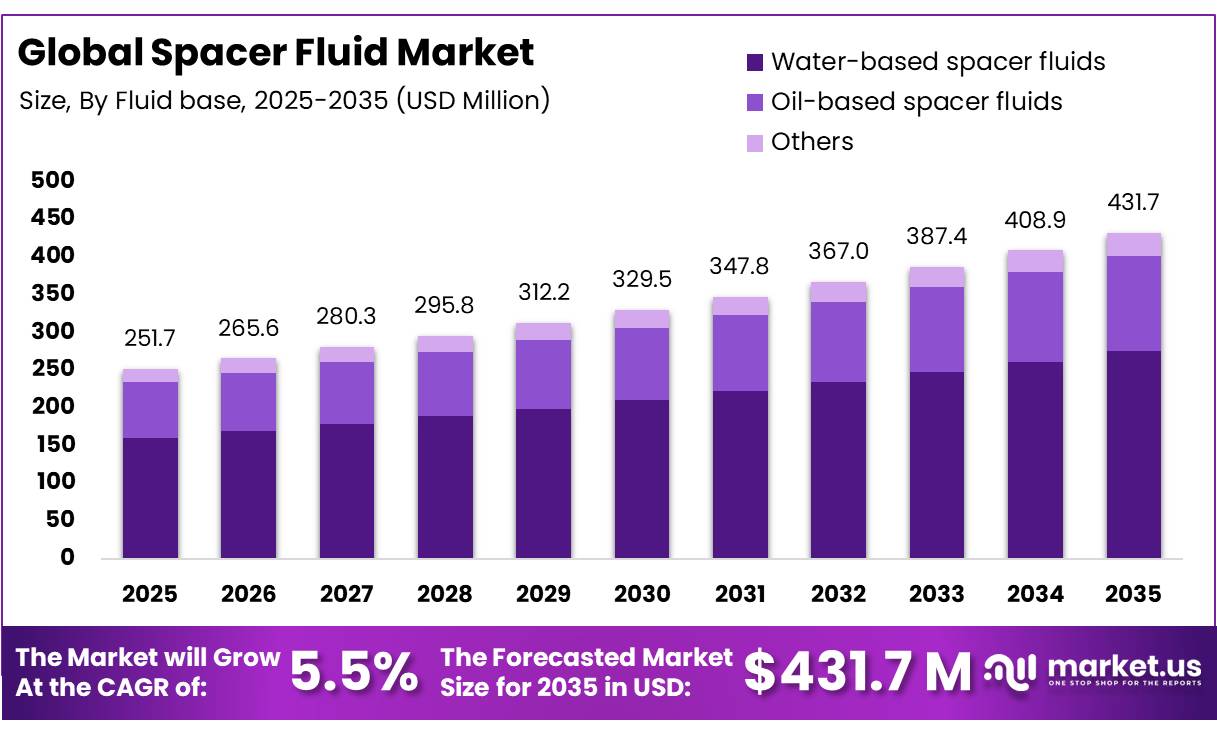
In 2025, the Spacer Fluid Market was valued at USD 251.7 Million, and between 2026 and 2035, this market is estimated to register a CAGR of 5.5%, reaching about USD 431.7 Million by 2035. North America held a dominant market position, capturing more than a 63.9% share, holding USD 160.8 Million in revenue.
Spacer fluid is a specially formulated liquid pumped between drilling mud and cement slurry during primary cementing, remedial cementing and well-abandonment operations. It prevents incompatible fluids from mixing, removes residual mud and filter cake, water-wets the casing and formation, and supports a reliable cement bond. Halliburton reports that its Tuned Prime spacer reduces crystalline silica by more than 93% and performs at temperatures up to 280°F. These requirements make rheology, density, chemical compatibility, solids suspension and environmental safety important selection factors.
- The International Energy Agency estimated global upstream oil and gas investment at about USD 570 billion in 2025, with nearly 90% of annual spending since 2019 used to offset production declines. The agency measured average post-peak decline rates of 5.6% for conventional oil fields and 6.8% for conventional gas fields.
- According to the U.S. Energy Information Administration (EIA), active rig counts drilling for oil and natural gas in the Lower 48 states fell from 750 in December 2022 to 517 in October 2025, with oil-directed rigs down 33% to 397 and natural gas-directed rigs down 23% to 120. The EIA’s November 2025 Short-Term Energy Outlook projected West Texas Intermediate crude oil averaging 51 U.S. dollars per barrel in 2026 and Henry Hub natural gas rising to 4.02 U.S. dollars per million British thermal units, shaping near-term drilling activity.
Key Takeaways
- The Global Spacer Fluids Market was valued at USD 251.7 million in 2025.
- The global spacer fluids market is projected to grow at a CAGR of 5% and is estimated to reach USD 431.7 million by 2035.
- On the basis of fluid base, Water-based Spacer Fluids dominated the market, constituting 8% of the total market share.
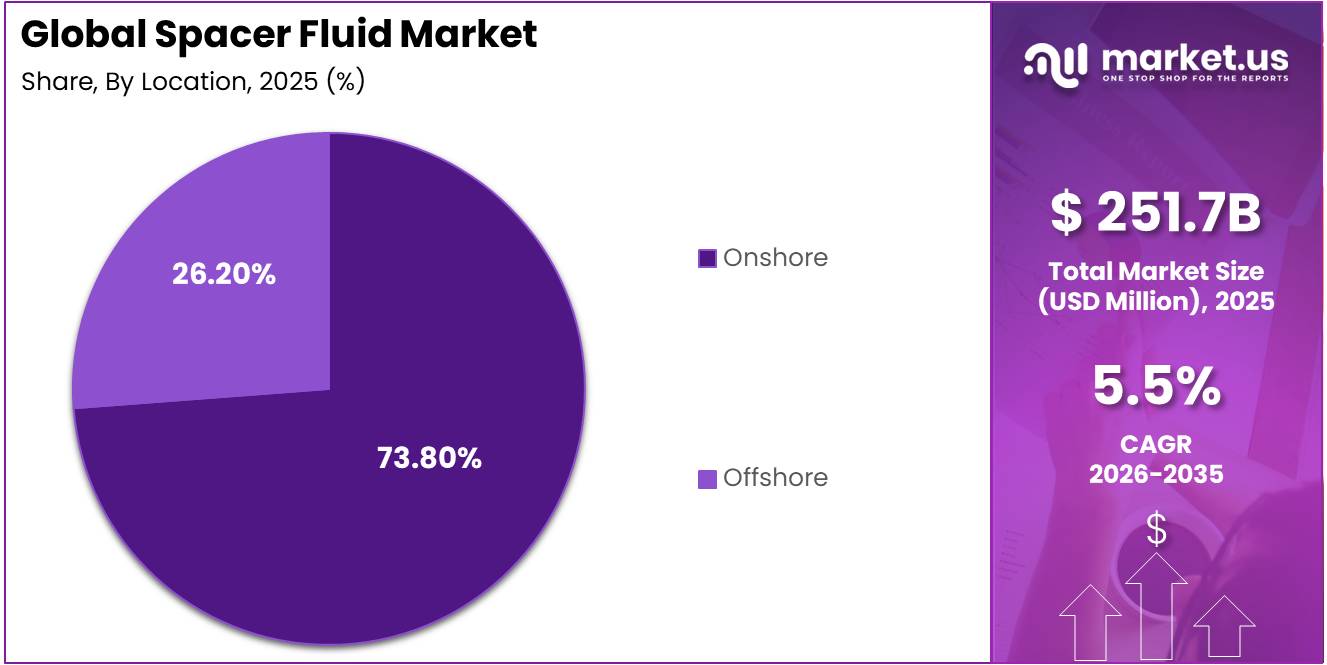
- Based on the location, Onshore dominated the market, accounting for 8% of the total market share.
- In 2025, North America was the most dominant region in the spacer fluids market, accounting for 9% of the global market.
The Gulf of America supplies approximately 14% of United States crude oil production, according to the Bureau of Ocean Energy Management (BOEM), with offshore leasing generating over 7 billion U.S. dollars for the U.S. Treasury in Fiscal Year 2024 through bonuses, rentals, and royalties. BOEM’s 2021 Assessment of Undiscovered Oil and Gas Resources estimates the region holds nearly 30 billion barrels of undiscovered, technically recoverable oil and over 50 trillion cubic feet of natural gas, sustaining long-term well construction demand.
The One Big Beautiful Bill Act (OBBBA) directs the Department of the Interior to hold at least 30 offshore lease sales in the Gulf of America and 6 in Alaska’s Cook Inlet through 2040, ensuring sustained drilling activity, per BOEM. Separately, the Bipartisan Infrastructure Law commits 4.7 billion U.S. dollars toward plugging orphaned oil and gas wells nationwide, according to the U.S. Department of the Interior, reflecting continued regulatory engagement with well construction and abandonment operations.
By Fluid Base
Water-based spacer fluids dominate with 63.8% due to their broad compatibility with conventional cementing operations.
In 2025, Water-based spacer fluids held a dominant market position, capturing more than a 63.8% share of the spacer fluid market. Their leading position is primarily attributed to their wide use in conventional oil and gas well cementing operations, where effective separation between drilling mud and cement slurry is essential for achieving reliable zonal isolation.
These spacer fluids are preferred because they are compatible with water based drilling systems, can be formulated for different well conditions, and support efficient well cleaning before cement placement. Their adoption is also supported by industry practices that emphasize operational efficiency, well integrity, and compliance with established cementing procedures issued by recognized energy authorities and industry organizations.
By Location
Onshore dominates with 73.8% as most drilling and cementing activities continue across land based oil and gas fields.
In 2025, Onshore held a dominant market position, capturing more than a 73.8% share of the spacer fluid market. Its leading position is driven by the high concentration of oil and gas drilling and well cementing activities carried out on land, where spacer fluids are routinely used to separate drilling mud from cement slurry and improve well integrity. Onshore operations generally offer easier access to equipment, lower operational complexity, and more frequent drilling campaigns compared to offshore projects, resulting in consistent demand for spacer fluids.
Offshore is expected to be the fastest growing segment during the forecast period. Growth is supported by increasing exploration and development activities in deepwater and ultra deepwater fields, where complex drilling conditions require high performance cementing solutions. Offshore wells demand reliable spacer fluids that can perform under challenging pressure and temperature conditions while improving mud removal and cement bonding.
Key Market Segments
By fluid base
- Water-based spacer fluids
- Oil-based spacer fluids
- Others
By location
- Onshore
- Offshore
Driver Analysis
Gas-led upstream spending expands cementing and displacement runs
The macro backdrop in 2026 is supportive for gas-linked well construction even as oil investment softens: the IEA indicates global energy investment is set to reach $3.3 trillion in 2025, with fossil-fuel spending around $1.1 trillion, and upstream natural-gas spending in 2026 is expected to climb 8% versus 2025 even while oil investment falls for a third consecutive year.
That matters for spacer fluids because every new gas development, LNG-linked feedgas project, and high-spec development well expands the addressable cementing and displacement workload, especially in sour-gas, offshore, and deeper completions where mud removal efficiency directly affects gas migration control and annular seal quality. The result is a +1.2 percentage-point CAGR lift concentrated in the Middle East, North America, and APAC LNG corridors, where gas monetization economics favor sustained drilling programs and repeat consumables demand over one-off project purchases.
Drivers Impact Analysis
| Driver | (~) % Impact on CAGR | Geographic Relevance | Impact Timeline |
|---|---|---|---|
| Offshore chemical substitution compliance lifts premium spacer demand | +1.4% | North Sea core, EU offshore, Norway-UK shelf | Short term |
| Gas-led upstream spending expands cementing and displacement runs | +1.2% | Middle East, North America, APAC LNG corridors | Medium term |
| Complex HPHT and extended-reach wells require higher-performance spacer packages | +1.0% | North America core, Middle East, North Sea, deepwater Brazil spill-over | Medium term |
| NPT reduction and zonal isolation economics favor engineered spacer systems | +0.9% | Global offshore and unconventional basins | Short term |
| Water-based and low-toxicity formulations gain share under discharge controls | +0.8% | EU offshore, North America, APAC offshore | Short term |
| Decommissioning, P&A, and late-life well integrity programs create repeat-use demand | +0.6% | North Sea core, Gulf of Mexico, mature Asia offshore | Long term |
Restraint Analysis
Local-content and fragmented approvals slowing product roll-outs
Local-content rules and fragmented regulatory approvals across MENA and APAC are another restraint, with national oil companies and regulators requiring increasing shares of chemicals to be locally sourced or manufactured, demanding local testing and certification, and sometimes imposing restrictions on foreign suppliers’ ability to import or deploy chemistries without partnering with domestic producers.
These frameworks, which vary basin to basin and often involve multi-agency approval pathways, slow the introduction of globally optimized spacer systems and force companies to adapt formulations to locally available feedstocks, adding 6–12 months to development and qualification cycles in some markets and increasing the fixed cost of regionalization, especially where lab infrastructure and logistics are less developed. The result is an estimated -0.8 percentage-point impact on CAGR, as delayed product launches, duplicated R&D efforts, and local partnership obligations dilute economies of scale, constrain cross-region standardization, and, in some cases, limit operators to older-generation spacer chemistries because newer systems are still navigating local-content and approval hurdles.
Restraint Impact Analysis
| Restraint | (~) % Impact on CAGR | Geographic Relevance | Impact Timeline |
|---|---|---|---|
| Specialty polymer and surfactant cost spikes | -1.3% | Global, APAC processing hubs, cost-sensitive basins | Short term |
| Offshore discharge and toxicity compliance burden | -1.1% | North Sea, EU offshore, North America offshore | Medium term |
| AI mud-models and optimized displacement reducing spacer volumes | -0.9% | Technology-led North America, EU, selected APAC | Long term |
| Local-content and fragmented approvals slowing product roll-outs | -0.8% | MENA NOCs, APAC national regimes | Medium term |
| Supply-chain insecurity and extended chemical lead times | -0.7% | Global, most acute for imported additives | Short term |
| Operator capital discipline and consolidation suppressing discretionary spend | -0.6% | North America core, international majors globally | Long term |
Opportunity Analysis
Geothermal and EGS well construction entry
Enhanced geothermal systems and next-generation geothermal drilling constitute a second white-space vertical, since these wells borrow oil-and-gas horizontal drilling techniques but operate at far higher static bottomhole temperatures, demanding spacer and cement-sheath systems engineered for thermal cycling and high-temperature rheology stability that are not standard SKUs for most oilfield-focused suppliers today.
This is a genuine pivot rather than a driver extension because commercial-scale EGS is still nascent, with only a handful of operating demonstration projects such as Fervo’s Project Red as of March 2026, meaning the addressable well count is set to scale from a near-zero base rather than growing off an existing installed platform.
With global geothermal investment expected to grow at roughly 20% annually through 2030 and geothermal drilling capital expenditure trending toward the low-double-digit billions by the early 2030s, suppliers that pre-position qualified high-temperature spacer chemistries now stand to capture disproportionate share as EGS moves from pilot to commercial deployment, supporting an estimated +1.7 percentage-point CAGR upside concentrated in North America, the EU, and the East African Rift geothermal corridor.
Opportunity Impact Analysis
| Opportunity | (~) % Potential CAGR | Geographic Relevance | Execution Window |
|---|---|---|---|
| CCS and Class VI injection-well spacer systems | +2.2% | North America core, EU, APAC emerging CCS hubs | Medium term |
| Geothermal and EGS well construction entry | +1.7% | North America core, EU, East Africa Rift corridor | Medium term |
| Digital formulation-as-a-service and outcome-based pricing | +1.4% | North America core, EU, APAC technology hubs | Long term |
| Biodegradable/bio-based spacer roll-up and M&A consolidation | +1.1% | EU, North America, APAC coastal markets | Short term |
| Localized manufacturing entry into African and Latin American basins | +0.9% | South America spill-over, Sub-Saharan Africa, MENA frontier | Long term |
| Well-integrity and P&A remediation subscription contracts | +0.7% | North Sea, Gulf of Mexico, mature APAC offshore | Medium term |
Challenges Analysis
Cyber-physical risk in petrochemical operations
Spacer-fluid manufacturing is energy-intensive and dependent on upstream chemical intermediates whose pricing can vary 15–25% year-on-year across cycles; such volatility forces suppliers to adopt more complex hedging, indexed pricing, and inventory strategies, and misalignment between contract adjustment mechanisms and real-time cost changes can compress margins or delay pricing actions by one to two quarters.
Over time, firms respond through more sophisticated risk management, diversified sourcing, and contractual redesign linking spacer pricing to transparent indices, but the sector still faces structural friction in forecasting and capital allocation, with an estimated -0.6 percentage-point drag on maximum CAGR as management bandwidth and investment budgets are partially diverted to volatility navigation rather than pure growth initiatives over a 2–4 year mitigation horizon.
Challenges Impact Analysis
| Challenge | (~) % CAGR Friction | Geographic Relevance | Mitigation Horizon |
|---|---|---|---|
| Multi-node chemical logistics complexity | -1.2% | Global, APAC–EU–NA corridors | Medium term |
| Layered offshore EHS and discharge compliance | -1.0% | North Sea, EU hubs, North America offshore | Long term |
| Digital engineering and data-science talent gap | -0.9% | North America core, EU, APAC tech hubs | Long term |
| Customer consolidation and bargaining-power concentration | -0.8% | Global majors, NOCs, North America core | Medium term |
| Cyber-physical risk in petrochemical operations | -0.7% | Global, major chemical clusters | Long term |
| Feedstock and energy price volatility management | -0.6% | Global, energy-intensive production hubs | Medium term |
Geopolitical Impact Analysis
Geopolitical Tensions Increase Operational Risks Across the Spacer Fluid Market.
The current geopolitical environment, particularly the ongoing conflict in the Middle East and continued disruptions linked to the Russia Ukraine war, has increased uncertainty across the global spacer fluid market. Spacer fluids are widely used during oil and gas well cementing, making demand closely dependent on drilling activity and the uninterrupted supply of drilling chemicals.
- According to the International Energy Agency (IEA) Oil Market Report published in March 2026, oil flows through the Strait of Hormuz, which normally handles around 20 million barrels per day, fell sharply during the conflict, while global oil supply was projected to decline by 8 million barrels per day in March 2026 due to production curtailments.
Higher transportation risks and volatile energy prices have also influenced the availability of raw materials used in spacer fluid formulations. The IEA further reported that more than 3 million barrels per day of refining capacity in the Gulf region had already shut because of attacks and export limitations, creating additional pressure on chemical supply chains. Despite these short term challenges, governments and energy producers continue to prioritize energy security by maintaining upstream investment and supporting critical drilling operations.
Regional Analysis
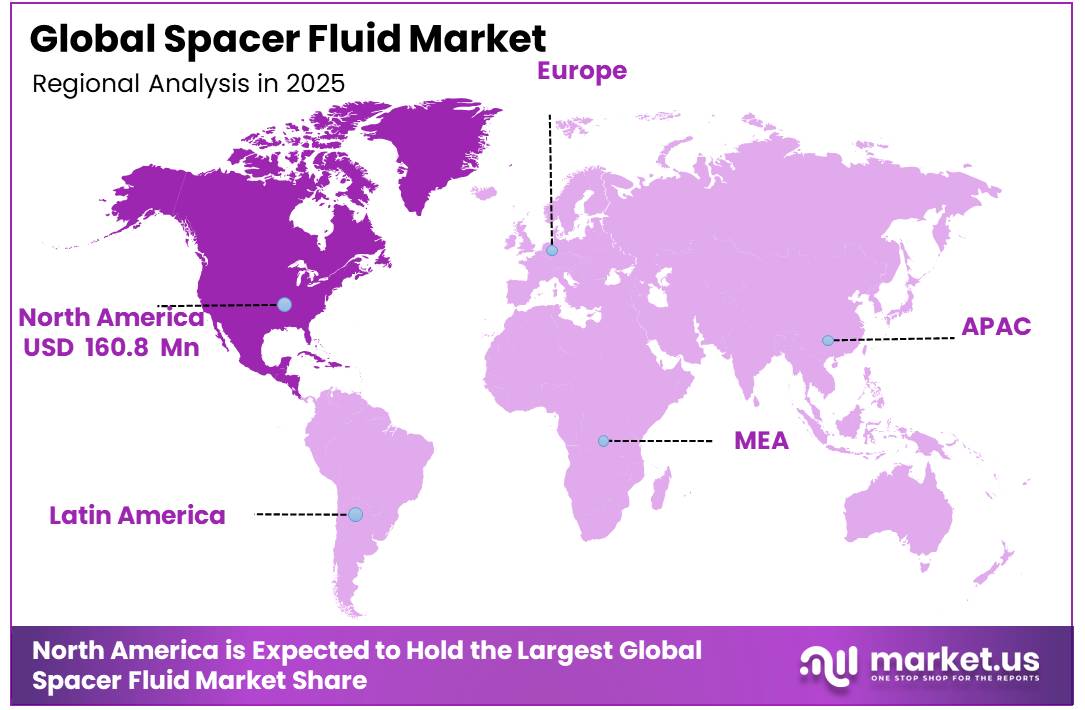
North America dominated the Spacer Fluid Market with a 63.9% share, accounting for USD 160.8 million in 2025.
In 2025, North America held the dominant position in the global Spacer Fluid Market, accounting for 63.9% of the market and reaching USD 160.8 million. The region maintains its leadership because of its extensive oil and gas drilling activities, mature well construction industry, and continued investment in upstream exploration and production. Spacer fluids are widely used across North American drilling operations to improve mud displacement, support effective cement placement, and enhance well integrity.
- According to the U.S. Energy Information Administration (EIA), U.S. crude oil production averaged 13.2 million barrels per day in 2024, reflecting sustained upstream activity that supports the consumption of drilling and cementing chemicals, including spacer fluids.
The same EIA Short Term Energy Outlook reports that U.S. crude oil production is forecast to average 13.5 million barrels per day in 2025, indicating continued drilling momentum and steady demand for well cementing solutions. North America also benefits from advanced oilfield service capabilities, widespread adoption of modern cementing technologies, and strict regulatory requirements for well integrity, particularly in offshore operations. These factors encourage operators to use high performance spacer fluids that improve cement bonding and operational efficiency.
Key Regions and Countries
- North America
- The US
- Canada
- Europe
- Germany
- France
- The UK
- Spain
- Italy
- Russia & CIS
- Rest of Europe
- APAC
- China
- Japan
- South Korea
- India
- ASEAN
- Rest of APAC
- Latin America
- Brazil
- Mexico
- Rest of Latin America
- Middle East & Africa
- GCC
- South Africa
- Rest of MEA
Key Players Analysis
The spacer fluid market remains moderately consolidated, with leading companies competing through drilling fluid expertise, cementing technology, product performance, and long term customer relationships across upstream oil and gas operations. Major participants such as SLB, Halliburton Company, Baker Hughes Company, Weatherford International plc, Aubin Group, Impact Fluid Solutions, and M&D Industries of Louisiana, Inc. focus on developing spacer fluid systems that improve mud displacement, cement bonding, and well integrity under a wide range of drilling conditions.
Manufacturers continue to invest in advanced formulations with enhanced rheology control, thermal stability, and compatibility with both water based and oil based drilling fluids. Product customization for different reservoir conditions and compliance with evolving environmental and operational standards remain key areas of differentiation across global markets.
Companies are also strengthening their competitive position through manufacturing expansion, regional distribution networks, and integrated oilfield service capabilities. Trican Well Service Ltd., Newpark Resources, Inc., CES Energy Solutions Corp., ChampionX Corporation, and National Oilwell Varco, Inc. continue to expand their technical service offerings by providing drilling, cementing, and completion fluid solutions that improve operational efficiency and reduce nonproductive time.
The Major Players in The Industry
- SLB
- Halliburton Company
- Baker Hughes Company
- Weatherford International plc
- Aubin Group
- BASF SE
- Chevron Phillips Chemical Company LLC
- Croda International Plc
- Impact Fluid Solutions
- M&D Industries of Louisiana, Inc.
- Trican Well Service Ltd.
- Newpark Resources, Inc.
- CES Energy Solutions Corp.
- ChampionX Corporation
- National Oilwell Varco, Inc.
Key Development
- In February 2026, SLB was awarded multiple offshore drilling services contracts by Mubadala Energy for the Tangkulo natural gas deepwater development in the Andaman Sea, offshore Indonesia, covering directional drilling, drilling fluids, cementing, wireline, slickline, and coiled tubing across the full well life cycle. SLB’s Well Construction division, which houses its drilling fluids and cementing business, generated revenue of 2.80 billion U.S. dollars in the first quarter of 2026, per SLB’s own results announcement.
- In February 2026, NOV Inc. reported fourth-quarter and full-year 2025 earnings, with full-year revenues of 8.74 billion U.S. dollars and fourth-quarter revenues of 2.28 billion U.S. dollars, a 5% sequential increase, reflecting continued activity across its energy equipment and well construction-related product lines.
- In May 2026, Baker Hughes announced a major contract extension with Petrobras to provide integrated well construction solutions, including fluids and cementing, across Brazil’s Santos Basin for deepwater pre-salt developments. The announcement followed Baker Hughes’ first-quarter 2026 results reported in April, which showed company-wide revenue of 6.6 billion U.S. dollars, up 2% year over year, and orders of 2 billion U.S. dollars.
Report Scope
| Report Features | Description |
|---|---|
| Market Value (2025) | USD 251.7 Mn |
| Forecast Revenue (2035) | USD 431.7 Mn |
| CAGR (2026 2035) | 5.5% |
| Base Year for Estimation | 2025 |
| Historic Period | 2020-2024 |
| Forecast Period | 2026-2035 |
| Report Coverage | Revenue Forecast, Market Dynamics, Competitive Landscape, Recent Developments |
| Segments Covered | By Fluid Base (Water-based Spacer Fluids, Oil-based Spacer Fluids, Others), By Location (Onshore, Offshore) |
| Regional Analysis | North America The US & Canada; Europe Germany, France, The UK, Spain, Italy, Russia & CIS, Rest of Europe; APAC China, Japan, South Korea, India, ASEAN & Rest of APAC; Latin America Brazil, Mexico & Rest of Latin America; Middle East & Africa GCC, South Africa, & Rest of MEA |
| Competitive Landscape | SLB, Halliburton Company, Baker Hughes Company, Weatherford International plc, Aubin Group, BASF SE, Chevron Phillips Chemical Company LLC, Croda International Plc, Impact Fluid Solutions, M&D Industries of Louisiana, Inc., Trican Well Service Ltd., Newpark Resources, Inc., CES Energy Solutions Corp., ChampionX Corporation, and National Oilwell Varco, Inc. |
| Customization Scope | Customization for segments, region/country level will be provided. Moreover, additional customization can be done based on the requirements. |
| Purchase Options | We have three licenses to opt for: Single User License, Multi User License (Up to 5 Users), Corporate Use License (Unlimited Users and Printable PDF) |





































