


Report Overview
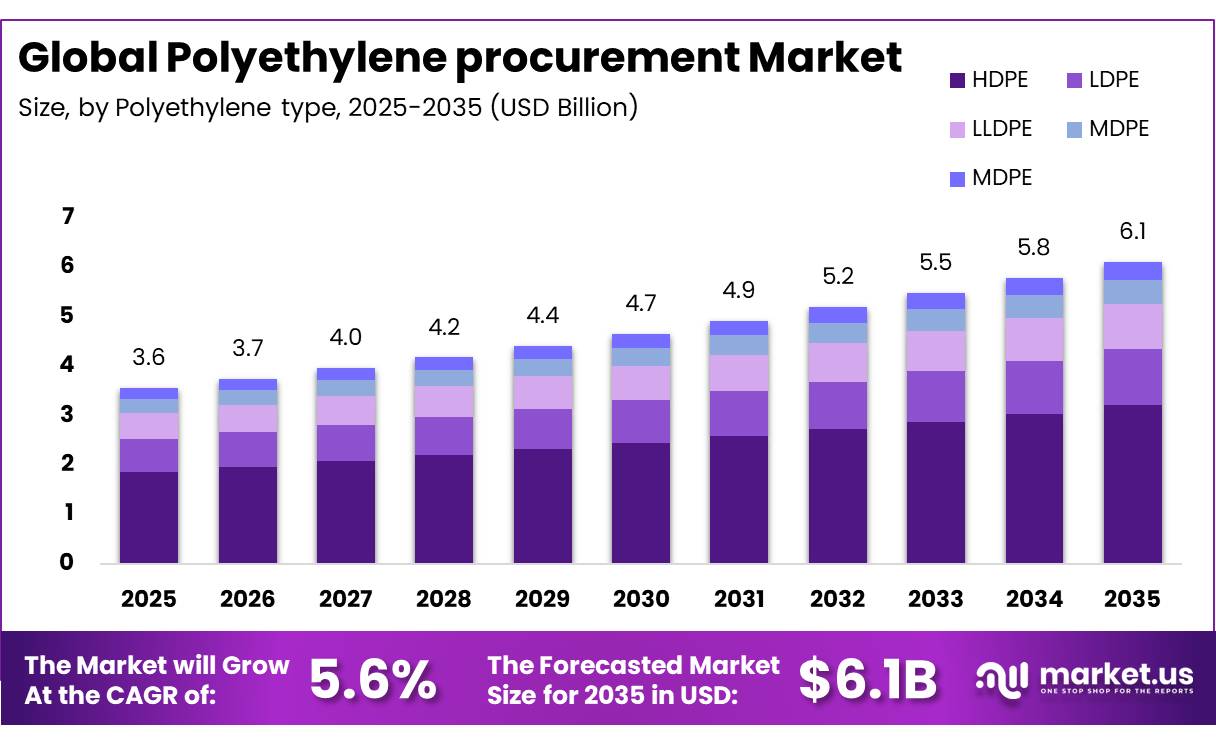
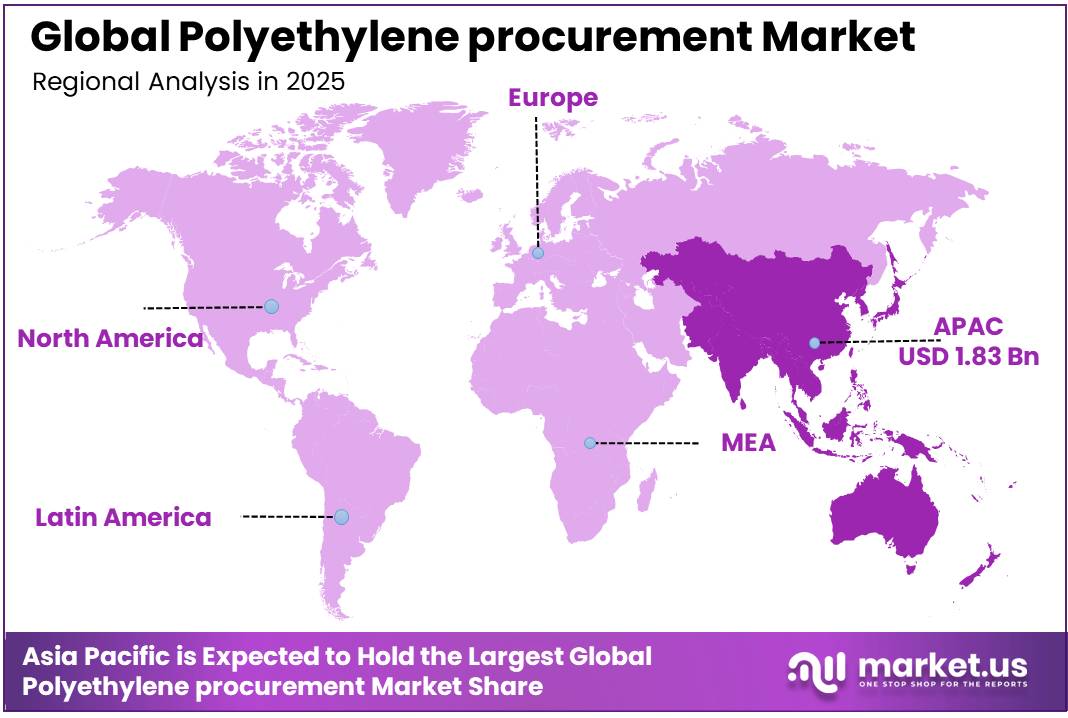
In 2025, the Global Polyethylene Procurement Market was valued at USD 3.6 billion, and between 2026 and 2035, this market is estimated to register a CAGR of 5.6%, reaching about USD 6.1 billion by 2035. Asia Pacific held a dominant market position, capturing more than a 51.50% share, holding USD 1.83 billion in revenue.
Polyethylene procurement covers the sourcing of high-density polyethylene, low-density polyethylene, linear low-density polyethylene, medium-density polyethylene and grades through direct contracts, distributors, traders, spot purchases and long-term agreements. Buyers assess resin specifications, conversion performance, freight exposure, supplier reliability and recycled-content availability. Demand is anchored in films, bottles, pipes, cables, automotive parts, household products and healthcare packaging, making procurement decisions linked to manufacturing schedules and feedstock-price movements.
- Plastics Europe reported that the European plastics sector generated EUR 398 billion in turnover during 2024, while the European Union recorded a net plastics import of 1.6 million tonnes. These conditions increase attention to regional supply security, diversified contracting and inventory planning. Procurement teams are comparing virgin and recycled polyethylene as packaging producers respond to customer and regulatory expectations.
Key Takeaways
- The global polyethylene procurement market was valued at USD 3.6 billion in 2025.
- The global market is projected to grow at a CAGR of 5.6% and is estimated to reach USD 6.1 billion by 2035.
- On the basis of polyethylene type, HDPE dominated the polyethylene procurement market, constituting 52.50% of the total market share.
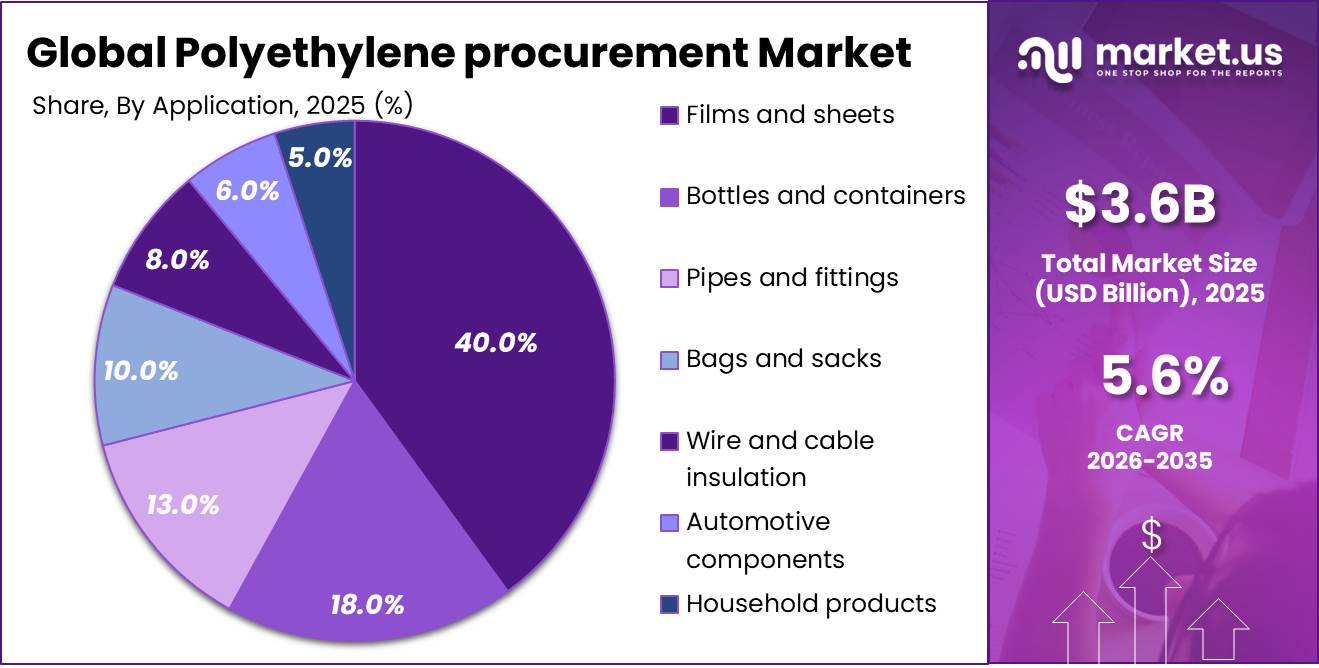
- Based on application, films and sheets dominated the polyethylene procurement market, with a substantial market share of around 40.00%.
- Among the end-use industries, the packaging industry held a major share in the polyethylene procurement market, accounting for 48.00% of the total market share.
- Based on procurement model, direct procurement led the polyethylene procurement market, comprising 44.00% of the total market.
- In 2025, Asia Pacific was the most dominant region in the polyethylene procurement market, accounting for 51.50% of the total global market share.
Market growth is driven by packaging consumption, infrastructure development, agricultural films, electrical insulation and lightweight transportation components. The European Commission states that packaging accounts for 40% of plastics used in the European Union. This concentration creates opportunities for long-term resin contracts, recycled-polyethylene qualification, traceable supply chains and digital purchasing platforms. Buyers can also gain value through grade consolidation, supplier audits, transport optimization and agreements that link pricing to feedstock or energy benchmarks.
- Government initiatives are accelerating procurement changes. European Union Packaging and Packaging Waste Regulation 2025/40 entered into force on February 11, 2025 and generally applies from August 12, 2026. It requires all packaging to become economically recyclable by 2030 and supports increased recycled-plastic use.
In July 2025, the European Commission also consulted on methods for verifying recycled content, including annual third-party verification for complex value-chain stages and verification every three years for small and medium-sized enterprises. These measures create growth opportunities for certified recyclate suppliers, compliant converters and transparent procurement systems.
Polyethylene Type Analysis
HDPE Leads with 52.50% as Buyers Prioritize Strength and Supply Reliability
In 2025, HDPE held a dominant market position, capturing more than a 52.50% share of the polyethylene procurement market. Its leadership was supported by strong demand from bottles, containers, pipes, fittings, household goods, and industrial packaging. Buyers favor HDPE for its stiffness, chemical resistance, durability, and suitability for high-volume processing. Direct sourcing and long-term supply agreements also help large converters maintain consistent resin grades, production schedules, and cost control during feedstock and freight volatility.
- For instance, in June 2025, according to Dow, the company launched INNATE TF 220, a high-density polyethylene resin developed for high-performance biaxially oriented polyethylene films and packaging designed for recyclability.
LDPE is the growing segment as demand rises for flexible films, bags, sacks, cable insulation, coatings, and squeeze packaging. Its flexibility, clarity, sealing performance, and low-temperature processing make it suitable for lightweight applications. Procurement activity is also strengthening as converters seek recyclable mono-material structures, stable film-processing performance, and reliable supplies for consumer and industrial packaging.
Application Analysis
Films and Sheets Lead with 40.00% Through Broad Packaging Demand
In 2025, films and sheets held a dominant market position, capturing more than a 40.00% share of the polyethylene procurement market. Their leadership was supported by strong demand across food packaging, industrial wrapping, agricultural films, protective liners, lamination, and consumer-product packaging. Procurement teams favour polyethylene films because they offer flexibility, moisture resistance, sealing performance, lightweight handling, and compatibility with high-speed conversion processes. Large converters also use direct sourcing and supply contracts to maintain consistent resin quality and uninterrupted production.
- For instance, in October 2025, according to LyondellBasell, the company expanded its Purell healthcare polymer portfolio in North America for applications including intravenous bottles, pharmaceutical packaging, diagnostic housings, ampoules, and laboratory products.
Bottles and containers are the growing segment as demand increases from household chemicals, healthcare, personal care, food, beverage, and industrial packaging. Polyethylene offers impact resistance, chemical durability, moulding flexibility, and reliable processing, encouraging buyers to secure suitable grades through long-term contracts and qualified distribution networks.
End-Use Industry Analysis
Packaging Leads with 48.00% as Buyers Prioritize Reliable Resin Supply
In 2025, packaging held a dominant market position, capturing more than a 48.00% share of the polyethylene procurement market. Its leadership was supported by widespread resin demand for films, bottles, containers, liners, caps, bags, and protective packaging. Procurement teams favor polyethylene because it offers moisture resistance, sealing performance, impact strength, lightweight handling, and compatibility with high-speed converting processes. Direct contracts and supplier qualification also help packaging producers maintain consistent grades, production continuity, and predictable material availability.
- For instance, in July 2025, according to Borealis, its BorSafe polyethylene pipe materials were selected for a wastewater infrastructure project in northern Türkiye, demonstrating continued use of polyethylene in durable construction systems.
Building and construction is the growing segment as polyethylene demand expands across pipes, fittings, geomembranes, vapor barriers, insulation layers, protective films, and infrastructure components. Its resistance to moisture, chemicals, corrosion, and weather exposure supports long service life. Buyers increasingly seek dependable pipe-grade resins, qualified suppliers, and long-term agreements for infrastructure and building projects.
Procurement Model Analysis
Direct Procurement Leads with 44.00% Through Supply Control and Volume Efficiency
In 2025, direct procurement held a dominant market position, capturing more than a 44.00% share of the polyethylene procurement market. Its leadership was supported by buyers seeking direct access to producers, stable resin grades, negotiated pricing, dependable volumes, and delivery schedules. This model is used by packaging, construction, automotive, agriculture, and consumer-goods manufacturers with predictable requirements. Direct contracts also improve supplier coordination, technical support, quality consistency, and planning during feedstock, energy, and freight volatility.
- For instance, in January 2025, according to Nexeo Plastics, the company entered an agreement with Shell Polymers to distribute selected high-density polyethylene injection and blow-moulding grades and linear low-density polyethylene film grades across the United States and Canada.
Distributor-based procurement is the growing segment because it offers flexible order quantities, warehousing, shorter lead times, credit support, and access to multiple resin grades. It is particularly useful for small and medium-sized converters that cannot commit to producer-level volumes. Distributors also support technical selection, inventory management, and local delivery, helping buyers respond quickly to changing production needs.
Key Market Segments
By Polyethylene type
- HDPE
- LDPE
- LLDPE
- MDPE
- Others
By Application
- Films and sheets
- Bottles and containers
- Pipes and fittings
- Bags and sacks
- Wire and cable insulation
- Automotive components
- Household products
By End-use industry
- Packaging
- Building and construction
- Automotive and transportation
- Agriculture
- Consumer goods
- Electrical and electronics
- Healthcare
By Procurement model
- Direct procurement
- Distributor-based procurement
- Trader-based procurement
- Spot purchasing
- Long-term supply contracts
Driver Analysis
EU PPWR Recycled-Content Mandates Reshaping Sourcing Mix
The EU’s Packaging and Packaging Waste Regulation (EU) 2025/40 entered into force on 11 February 2025 and becomes directly applicable across all member states from 12 August 2026, immediately restructuring how procurement teams source polyethylene by mandating that plastic packaging carry minimum recycled-content thresholds ahead of the harder 2030 and 2040 targets.
The regulation requires all packaging to be recyclable by 1 January 2030 and imposes a national per-capita packaging waste reduction obligation of 5% by 2030 and 15% by 2040 versus 2018 baselines, while draft guidance already floats derivative targets such as 30% recycled content for beverage bottles by 2030 rising to 65% by 2040.
Because compliant rPE supply remains structurally short relative to the mandated demand curve, procurement teams are being forced to lock in multi-year offtake agreements 18-24 months ahead of the August 2026 applicability date, and this compliance-driven forward-buying behavior is the primary reason this driver carries the largest incremental CAGR contribution among all forces tracked for the 2026 baseline.
Drivers Impact Analysis
| Driver | (~) % Impact on CAGR | Geographic Relevance | Impact Timeline |
|---|---|---|---|
| EU PPWR recycled-content mandates reshaping virgin vs. rPE sourcing mix | +2.9% | EU core, UK spill-over, APAC export-linked supply chains | Short term (≤2 years) |
| Feedstock volatility driving digital hedging and multi-region contract diversification | +2.4% | North America Gulf Coast, EU, Northeast/Southeast Asia | Short term (≤2 years) |
| Digital B2B procurement platforms and e-marketplace consolidation | +2.0% | Global core, concentrated in North America, EU, India | Medium term (2-4 years) |
| US Gulf Coast ethane-advantaged capacity expansion shifting global trade flows | +1.8% | North America core, Latin America and APAC import corridors | Medium term (2-4 years) |
| Shift from spot buying to index-linked and formula-based long-term contracts | +1.5% | Global, most formalized in North America and EU | Short term (≤2 years) |
| Circular economy mechanical/chemical recycling capacity build-out | +1.2% | EU core, North America emerging, APAC pilot corridors | Long term (≥4 years) |
Restraint Analysis
Structural Global Overcapacity Depressing Producer Margins
Global ethylene and polyethylene supply has outrun demand by a wide margin, with industry tracking estimating ethylene demand running approximately 15 million tonnes below earlier forecasts and propylene nearly 12 million tonnes lower, while peak capacity additions of roughly 17.5 million tonnes/year of ethylene and 13.5 million tonnes/year of polyethylene are still projected for 2027, meaning an estimated 20 million tonnes/year of ethylene capacity would need to be permanently shuttered just to restore utilization to a healthy 85% threshold.
China alone added over 5 million tonnes of new PE capacity in 2025, a roughly 16% capacity growth rate, with cumulative production through November 2025 up 18.85% year-on-year, and a further 6.15-7.29 million tonnes of new capacity, a 15-18.5% growth rate, is scheduled to come online in 2026, concentrated in the second half of the year. For procurement teams this oversupply is a double-edged restraint: while it suppresses near-term spot pricing, it simultaneously destabilizes supplier viability, as margin compression is forcing smaller and mid-sized oil-based producers toward output cuts, maintenance shutdowns, or market exit, raising counterparty and supply-continuity risk even as prices fall.
Restraint Impact Analysis
| Restraint | (~) % Impact on CAGR | Geographic Relevance | Impact Timeline |
|---|---|---|---|
| Structural global overcapacity depressing producer margins and pricing power | -3.1% | China/APAC core, EU, spill-over into North America | Long term (≥4 years) |
| Escalating anti-dumping duties and reciprocal tariffs fragmenting trade flows | -2.4% | Brazil, US, China, cross-border Latin America corridors | Short term (≤2 years) |
| EU and UK plastic packaging levies inflating landed procurement cost | -1.8% | EU core, UK, Spain-specific levy exposure | Short term (≤2 years) |
| Crude oil and naphtha feedstock cost volatility compressing hedging accuracy | -1.5% | Global, most acute in oil-linked Asia and EU producers | Medium term (2-4 years) |
| China’s aggressive coal-to-olefins capacity undercutting oil-based cost structures | -1.3% | China domestic, APAC export-linked markets | Medium term (2-4 years) |
| Certified recycled PE supply shortfall limiting compliant procurement volume | -1.1% | EU core, UK, North America emerging | Medium term (2-4 years) |
Opportunity Analysis
Overcapacity-Driven Distressed-Asset M&A Roll-Up
The structural overcapacity restraint currently compressing producer margins simultaneously creates a distinct forward-looking opportunity: well-capitalized strategic or private equity acquirers can execute a distressed-asset roll-up of smaller, sub-scale resin distributors and compounders that lack the balance-sheet resilience to survive the oversupply cycle analysts expect to persist through 2028-2029, acquiring trading books, customer relationships, and logistics infrastructure at valuations likely to be depressed 20-30% below replacement cost during the trough.
This is explicitly not a current driver because today’s baseline forecasts assume the existing fragmented distributor landscape persists rather than consolidates; the opportunity instead lies in anticipating that margin-squeezed mid-sized players will become acquisition targets precisely during 2026-2028, allowing an acquirer to build a consolidated, multi-region distribution and procurement-services platform ahead of the eventual 2028-2029 margin recovery that industry cycle-tracking already anticipates.
A successful roll-up strategy could realize procurement and logistics synergies estimated at 10-15% of combined cost base through shared warehousing, freight consolidation, and unified digital ordering infrastructure, while also inheriting established customer relationships that would otherwise take years to build organically. Because identifying, negotiating, and integrating multiple distressed targets typically requires an 18-30 month execution cycle even before realizing synergies, this opportunity sits in a medium-term window, timed deliberately to close before the anticipated 2028-2029 cyclical margin recovery re-inflates acquisition valuations.
Opportunity Impact Analysis
| Opportunity | (~) % Potential CAGR | Geographic Relevance | Execution Window |
|---|---|---|---|
| Mass-balance/ISCC PLUS certified feedstock arbitrage as a monetization layer | +2.6% | EU core, North America emerging, APAC export-linked | Short term (≤2 years) |
| AI-native procurement-as-a-service platforms replacing internal sourcing desks | +2.2% | Global core, first-mover in North America and EU | Short term (≤2 years) |
| Overcapacity-driven distressed-asset M&A roll-up of resin distributors | +1.9% | China/APAC core, EU consolidation, North America spill-over | Medium term (2-4 years) |
| Advanced pyrolysis chemical-recycling feedstock offtake partnerships | +1.7% | EU core, North America and APAC pilot corridors | Long term (≥4 years) |
| Trade-flow arbitrage desks monetizing tariff and anti-dumping fragmentation | +1.4% | Latin America (Brazil), North America, cross-border APAC | Short term (≤2 years) |
| Embedded carbon-intensity data monetization for Scope 3 compliance buyers | +1.1% | EU core, UK, North America corporate-disclosure markets | Medium term (2-4 years) |
Challenges Analysis
Ocean Freight Schedule Unreliability and Rate Swings
Global container shipping schedule reliability, the percentage of vessels arriving within their published window, rebounded to just 36% in March 2026 from 27% in February, illustrating a baseline level of unpredictability that remains far below the 70-80% reliability norms procurement teams relied on in pre-2020 planning models. Rate volatility compounds this scheduling risk: benchmark container index pricing fell to $2,107 per 40-foot container in late January 2026, a 4.7% single-week decline, illustrating swings that can move landed freight cost by mid-single-digit percentages within days and complicate any fixed-cost logistics budgeting procurement teams attempt to build into annual resin contracts.
For polyethylene buyers dependent on Asia-origin or transoceanic US Gulf Coast export volumes, this translates into buffer-inventory carrying costs rising as safety stock is extended from a traditional 4-6 week cycle to 8-10 weeks in high-volatility corridors, directly tying up working capital that would otherwise support other operational priorities.
Challenges Impact Analysis
| Challenge | (~) % CAGR Friction | Geographic Relevance | Mitigation Horizon |
|---|---|---|---|
| Chemical procurement talent and retirement gap | -1.7% | North America, EU regulatory hubs, India emerging | Long term (≥4 years) |
| Ocean freight schedule unreliability and rate swings | -1.6% | Asia-North America corridors, EU import routes | Medium term (2-4 years) |
| Fragmented grade certification and quality-variance verification | -1.3% | Global, acute in EU-Asia cross-border trade | Medium term (2-4 years) |
| Multi-region cross-currency contract reconciliation complexity | -1.0% | EU-UK-US trade corridor, APAC export markets | Short term (≤2 years) |
| Recycled-content traceability and mass-balance audit overhead | -1.2% | EU core, UK, North America emerging | Medium term (2-4 years) |
| Supplier concentration risk amid margin-driven producer consolidation | -0.9% | China/APAC core, EU, North America spill-over | Long term (≥4 years) |
Geopolitical Impact Analysis
Trade Barriers and Energy Route Risks Reshape Polyethylene Procurement Strategies
Current geopolitical tensions are reshaping the polyethylene procurement market through tariff uncertainty, disrupted shipping routes, volatile petrochemical feedstock availability, and regional sourcing strategies. Polyethylene production depends on ethylene derived mainly from oil and natural gas feedstocks. Therefore, disruptions affecting energy transportation, resin trade, or international freight can directly influence contract pricing, supplier lead times, inventory levels, and spot purchasing decisions.
In September 2025, United Nations Trade and Development reported that the Strait of Hormuz handled 11% of global trade and approximately one-third of seaborne oil. Continued security risks around this route can affect crude oil and petrochemical feedstock movements, creating uncertainty for polyethylene producers and buyers dependent on internationally traded resin.
Shipping disruption is also raising procurement pressure. By May 2025, cargo tonnage passing through the Suez Canal remained 70% below 2023 levels. Longer routes around southern Africa increase transit time, freight exposure, and safety-stock requirements for polyethylene grades moving between the Middle East, Asia, Europe, and North America.
Trade fragmentation adds further complexity. The World Trade Organization reported that tariffs and other import measures introduced between October 2024 and October 2025 affected USD 2,640 billion of global goods imports. In April 2025, the United States also introduced a general additional tariff of 10% on many imported goods. These developments encourage buyers to diversify suppliers, negotiate regional contracts, increase local warehousing, and combine long-term agreements with flexible spot procurement.
Regional Analysis
Asia Pacific Leads with 51.50% Share and USD 1.83 Billion Revenue
In 2025, Asia Pacific held the dominant position in the polyethylene procurement market, capturing 51.50% of global revenue and generating approximately USD 1.83 billion. Regional leadership was supported by large packaging, construction, agriculture, electronics, and consumer-goods manufacturing networks. The United Nations Industrial Development Organization reported that Asia and Oceania contributed 57.2% of global manufacturing value added in 2024, reinforcing the region’s importance in polyethylene demand, resin conversion, and supply-chain activity across major markets.
North America is the fastest-growing region, supported by expanding packaging production, construction demand, healthcare applications, and investment in chemical and plastics manufacturing. In June 2026, the United States Bureau of Economic Analysis reported USD 19.0 billion in new foreign direct investment expenditure across plastics and rubber products manufacturing during 2025. This investment strengthens regional conversion capacity, warehousing, distribution networks, and supplier access, encouraging procurement teams to secure polyethylene through direct contracts, distributor partnerships, and longer-term supply arrangements.
Key Regions and Countries Covered
- North America
- The US
- Canada
- Europe
- Germany
- France
- The UK
- Spain
- Italy
- Russia & CIS
- Rest of Europe
- APAC
- China
- Japan
- South Korea
- India
- ASEAN
- Rest of APAC
- Latin America
- Brazil
- Mexico
- Rest of Latin America
- Middle East & Africa
- GCC
- South Africa
- Rest of MEA
Key Players Analysis
Polyethylene suppliers focus on resin quality, production scale, feedstock integration, distribution reach, and contract reliability to strengthen their competitive position. Key participants include LyondellBasell Industries N.V., Exxon Mobil Corporation, Dow Inc., Saudi Basic Industries Corporation, China Petroleum & Chemical Corporation, INEOS Group Limited, Chevron Phillips Chemical Company LLC, Borealis AG, Braskem S.A., TotalEnergies SE, LG Chem Ltd., and Westlake Corporation. Companies compete by offering high-density polyethylene, low-density polyethylene, and linear low-density polyethylene grades with improved strength, processability, sealing, clarity, and recyclability for packaging, pipes, cables, automotive parts, agriculture, and consumer products.
In 2026, competition increasingly centred on specialized polyethylene grades, regional capacity expansion, technical support, and secure customer supply. In March 2026, Dow introduced a fully qualified cross-linked polyethylene insulation system for 525 kilovolt high-voltage direct-current cables, designed to operate at 90 degrees Celsius. In April 2026, Borouge International announced advanced cable-compound capacity expansions in Asia, Europe, and the Middle East. These developments reflect greater investment in application-specific materials, regional production capacity, and reliable access to high-performance polyethylene grades.
Market Key Players
- LyondellBasell Industries N.V.
- Exxon Mobil Corporation
- Dow Inc.
- Saudi Basic Industries Corporation—SABIC
- China Petroleum & Chemical Corporation—Sinopec
- INEOS Group Limited
- Chevron Phillips Chemical Company LLC
- Borealis AG
- Braskem S.A.
- Reliance Industries Limited
- Formosa Plastics Corporation
- TotalEnergies SE
- LG Chem Ltd.
- Lotte Chemical Corporation
- Westlake Corporation
Key Development
- In January 2026, Braskem S.A. introduced Medcol VV7040, a new bio-based low-density polyethylene grade designed for blow-fill-seal healthcare packaging. The material was developed to meet pharmaceutical requirements while providing flowability, stiffness, temperature resistance, and compatibility with renewable feedstock.
- In March 2026, TotalEnergies SE started operations at France’s first advanced plastics recycling plant at its Grandpuits site. The facility has an annual capacity of 15,000 tons and converts hard-to-recycle household plastic waste into synthetic oil for producing recycled plastics suitable for food-contact and medical applications.
- In May 2026, Saudi Basic Industries Corporation showcased expanded polyethylene offerings planned for production at the SABIC Fujian Petrochemical Complex following its scheduled startup in the second half of 2026. The development is intended to strengthen localized polymer supply and support packaging and other downstream manufacturing applications in China.
Report Scope
| Report Features | Description |
|---|---|
| Market Value (2025) | US$3.6 Bn |
| Forecast Revenue (2035) | US$6.1 Bn |
| CAGR (2026-2035) | 5.6% |
| Base Year for Estimation | 2025 |
| Historic Period | 2020-2024 |
| Forecast Period | 2026-2035 |
| Report Coverage | Revenue Forecast, Market Dynamics, Competitive Landscape, Recent Developments |
| Segments Covered | By Polyethylene Type (HDPE, LDPE, LLDPE, MDPE, and Others), By Application (Films and Sheets, Bottles and Containers, Pipes and Fittings, Bags and Sacks, Wire and Cable Insulation, Automotive Components, and Household Products), By End-use Industry (Packaging, Building and Construction, Automotive and Transportation, Agriculture, Consumer Goods, Electrical and Electronics, and Healthcare), By Procurement Model (Direct Procurement, Distributor-based Procurement, Trader-based Procurement, Spot Purchasing, and Long-term Supply Contracts) |
| Regional Analysis | North America – The US & Canada; Europe – Germany, France, The UK, Spain, Italy, Russia & CIS, Rest of Europe; APAC– China, Japan, South Korea, India, ASEAN & Rest of APAC; Latin America– Brazil, Mexico & Rest of Latin America; Middle East & Africa– GCC, South Africa, & Rest of MEA |
| Competitive Landscape | LyondellBasell Industries N.V., Exxon Mobil Corporation, Dow Inc., Saudi Basic Industries Corporation—SABIC, China Petroleum & Chemical Corporation—Sinopec, INEOS Group Limited, Chevron Phillips Chemical Company LLC, Borealis AG, Braskem S.A., Reliance Industries Limited, Formosa Plastics Corporation, TotalEnergies SE, LG Chem Ltd., Lotte Chemical Corporation, Westlake Corporation. |
| Customization Scope | Customization for segments, region/country-level will be provided. Moreover, additional customization can be done based on the requirements. |
| Purchase Options | We have three licenses to opt for: Single User License, Multi-User License (Up to 5 Users), Corporate Use License (Unlimited Users and Printable PDF) |





































