Report Overview
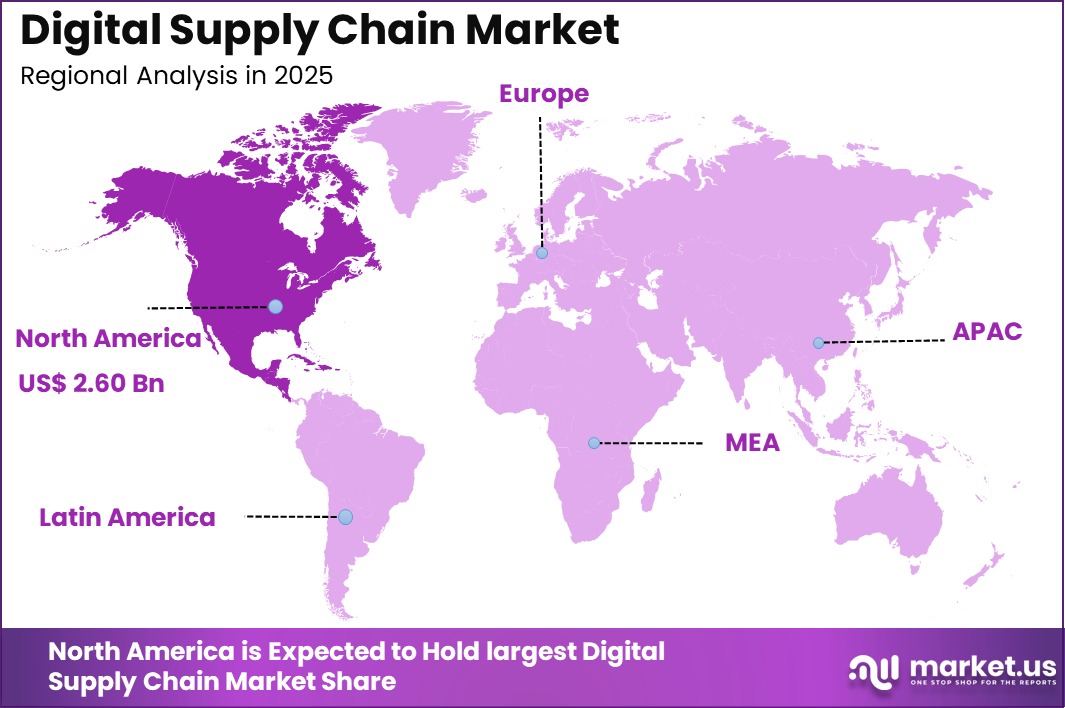
The Global Digital Supply Chain Market size is expected to be worth around USD 27.67 billion by 2035, from USD 6.78 billion in 2025, growing at a CAGR of 15.1% during the forecast period from 2025 to 2035. North America held a dominant market position, capturing more than a 38.4% share, holding USD 2.60 billion in revenue.
The Digital Supply Chain Market refers to the integration of digital technologies into traditional supply chain operations to improve visibility, efficiency, and decision-making across procurement, production, warehousing, and distribution. This market is driven by the shift from linear and reactive supply chains to connected, data-driven ecosystems. Technologies such as cloud computing, Internet of Things, advanced analytics, and automation are enabling real-time tracking and predictive planning, which are essential for modern business environments.
Top driving factors are strongly associated with the rising need for resilience and transparency across supply networks. It has been observed that more than 70% of organizations are actively investing in digital supply chain capabilities to strengthen agility and reduce operational disruptions. Frequent supply chain interruptions, coupled with rising customer expectations for faster delivery, have pushed businesses to adopt advanced systems that enable continuous monitoring and predictive planning.
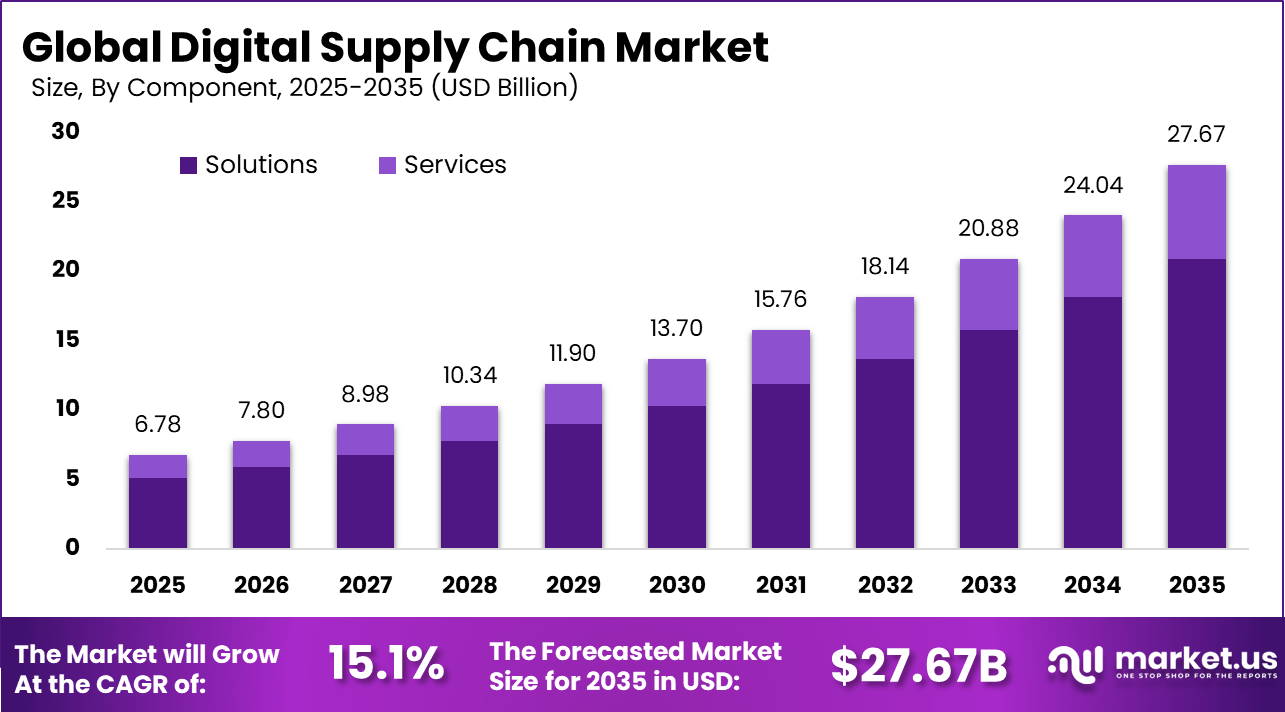
Demand analysis indicates that growing global trade complexity and increasing pressure on delivery timelines are key contributors to market expansion. Organizations implementing digital supply chain solutions have reported up to 15% reduction in operational costs and nearly 20% improvement in service performance. These measurable outcomes are encouraging adoption across industries such as manufacturing, retail, and logistics, where efficiency and speed are critical competitive factors.
The increasing adoption of technologies such as artificial intelligence, blockchain, and Internet of Things is significantly reshaping supply chain operations. Artificial intelligence is being used to improve demand forecasting accuracy, while IoT devices provide real-time tracking of goods across the supply chain. Blockchain technology enhances transparency and traceability, ensuring secure and verifiable transactions. These technologies collectively enable the development of intelligent and interconnected supply networks.
For instance, in September 2025, SAS expanded its SAS Supply Chain Intelligence portfolio with new machine‑learning models for supplier risk scoring and logistics‑cost optimization. The updates are aimed at pharma and high‑tech customers who need advanced analytics to safeguard complex, multi‑tier digital supply‑chain networks.
Key Takeaway
- In 2025, the solution segment led the digital supply chain market with a share of 75.5%, reflecting strong demand for integrated platforms.
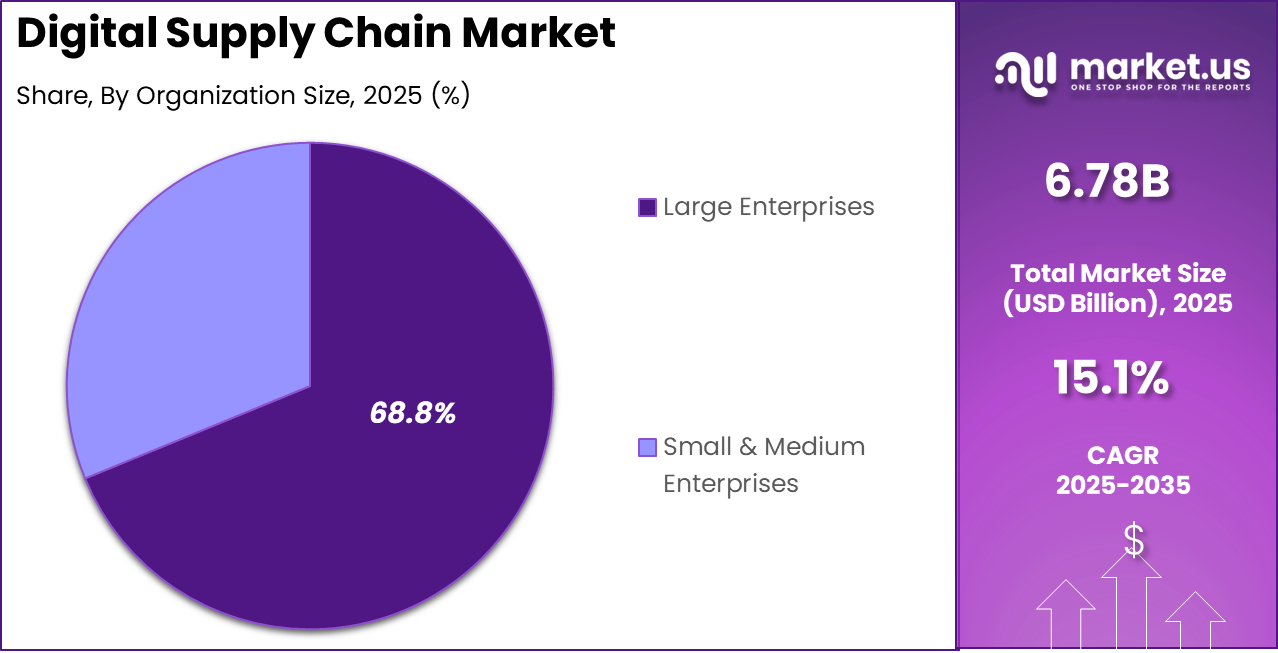
- Large enterprises accounted for 68.8% of the market, driven by higher digital investment capacity and complex supply networks.
- The retail and consumer goods sector held a leading share of 40.2%, supported by demand for real-time inventory and demand forecasting.
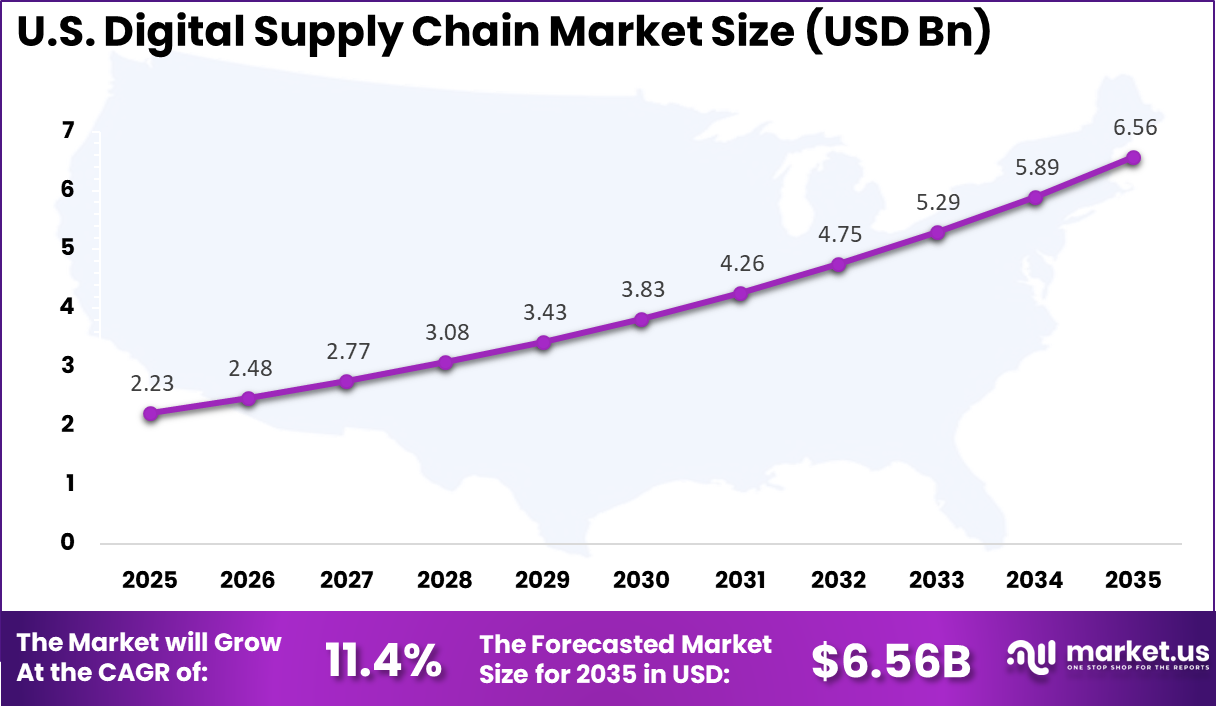
- The United States digital supply chain market was valued at USD 2.23 billion in 2025, growing at a CAGR of 11.4%.
- North America dominated globally with a market share exceeding 38.4%, supported by advanced technology adoption and strong infrastructure.
Market Growth & Investment
- More than 50% of supply chain leaders are increasing innovation investments, with many allocating over USD 1 million and some exceeding USD 10 million.
- Around 79% of organizations with high-performing supply chains report revenue growth above their industry average.
- Approximately 57% of operations and supply chain leaders have integrated Artificial Intelligence into selected functions or across operations.
- Companies investing significantly in AI-driven supply chains achieve nearly 61% higher revenue growth compared to others.
- By 2028, generative AI is expected to manage about 25% of KPI reporting within supply chain operations.
- Around 33% of companies currently use IoT-enabled capabilities, and 52% of these users report strong value creation.
- Organizations with optimized supply chains experience nearly 15% lower overall operational costs.
Advanced digital supply chains can reduce lead times and inventory levels by up to 50%. - Digitisation contributes to an increase of 3.2% in annual EBIT growth and 2.3% in annual revenue growth.
- About 96% of technology and telecom leaders state that digital tools have improved end-to-end cost visibility.
Regional Analysis
In 2025, North America accounted for 38.4% of the digital supply chain market, supported by strong technological infrastructure and early adoption of advanced supply chain solutions. The region has a well-established logistics network and high digital maturity, which encourages the use of innovative technologies.
Organizations across industries are investing in digital transformation to improve efficiency and maintain competitive advantage. This has resulted in consistent demand for advanced supply chain solutions. The regional leadership is further supported by increasing investments in automation, cloud computing, and analytics technologies.
Companies are focusing on enhancing supply chain visibility and resilience to address disruptions and changing market conditions. Government initiatives and industry standards also promote the adoption of digital technologies in supply chain operations. These factors collectively contribute to North America’s strong position in the global market.
For instance, in April 2026, MicroStrategy Incorporated in Tysons Corner advanced analytics dashboards for supply chain risk monitoring, serving major U.S. logistics firms. Their hyper-intelligent tools enable proactive decision-making, underscoring American dominance in real-time supply chain visibility platforms.
Country Analysis: United States
In 2025, the United States digital supply chain market reached USD 2.23 billion and is growing at a CAGR of 11.4%, reflecting steady expansion driven by digital transformation initiatives. The country’s large retail sector and advanced logistics infrastructure create strong demand for efficient supply chain solutions.
Enterprises are investing in technologies that improve operational visibility, reduce costs, and enhance customer experience. This has supported continuous adoption of digital supply chain systems. The growth in the U.S. market is also driven by increasing complexity in supply chain operations and rising demand for faster delivery services.
Companies are adopting automation, artificial intelligence, and data analytics to improve efficiency and responsiveness. Strong competition and evolving consumer expectations further encourage businesses to modernize their supply chains. As a result, the United States remains a key contributor to global digital supply chain market development.
For instance, in February 2026, Cloudera, Inc. from Santa Clara strengthened U.S. dominance in digital supply chains by launching advanced data platforms integrating real-time analytics with edge computing. This innovation helps manufacturers optimize inventory and predict disruptions, solidifying North America’s lead in data-driven supply chain intelligence.
Component Analysis
In 2025, The Solutions segment held a dominant market position, capturing a 75.5% share of the Global Digital Supply Chain Market. This dominance is due to the growing need for integrated tools that can manage planning, sourcing, inventory, and logistics in a single environment. Businesses are focusing on improving visibility across operations, which allows faster decisions and better coordination between teams, suppliers, and distribution networks.
Solutions also support automation and data driven planning, helping organizations reduce manual processes and improve efficiency. As supply chains become more complex, companies prefer flexible systems that can adapt quickly, support real time monitoring, and improve overall operational control across different stages.
For Instance, in March 2025, Cloudera expanded its data‑and‑AI platform to support more end‑to‑end supply chain workflows, emphasizing real‑time analytics across planning, logistics, and warehouse operations. The company has integrated stronger data lineage and governance features so businesses can build trusted supply‑chain models while running AI‑driven optimization and what‑if planning on a unified data fabric.
Organization Size Analysis
In 2025, the Large Enterprises segment held a dominant market position, capturing a 68.8% share of the Global Digital Supply Chain Market. This dominance is due to the broad operational scale of large enterprises and their need for stronger coordination across multiple business units. These organizations often manage complex supply networks spread across regions, which creates greater demand for digital systems that bring consistency, speed, and visibility to operations.
Large enterprises are also more likely to invest in advanced platforms to improve planning, logistics, and supplier management. Their larger budgets, deeper digital resources, and stronger transformation goals support faster adoption. This allows them to modernize supply chain functions more effectively and create a more connected operating environment.
For instance, in April 2026, IBM rolled out tailored versions of its cloud‑enabled supply‑chain suite for large multinational firms, emphasizing security, compliance, and cross‑regional visibility. The updates simplify integration with existing ERP and logistics systems, enabling large enterprises to standardize planning and execution practices across multiple business units and geographies.
Industry Vertical Analysis
In 2025, The Retail & Consumer Goods segment held a dominant market position, capturing a 40.2% share of the Global Digital Supply Chain Market. This dominance is due to the rapid shift toward online shopping and changing consumer expectations for faster and more flexible delivery. Retail and consumer goods companies require real time inventory tracking and efficient distribution systems to meet demand across both physical and digital channels.
The sector also faces constant pressure to manage stock levels accurately while handling frequent returns and seasonal demand changes. Digital supply chain tools help improve visibility, streamline fulfillment, and enhance customer experience, making them essential for maintaining operational balance and service quality.
For Instance, in October 2024, Infor introduced new capabilities for fast‑moving consumer goods (FMCG) and retail brands, including AI‑driven sales and operations planning, demand sensing, and warehouse optimization for high‑velocity environments. The tools are designed to help firms manage frequent product launches, promotions, and channel‑specific fulfillment requirements.
Emerging Trends Analysis
In 2025, the digital supply chain market is increasingly shaped by the adoption of connected and data-driven technologies. Organizations are integrating artificial intelligence, Internet of Things, and cloud platforms to enable real-time tracking, predictive insights, and automated workflows across supply chain operations. This transformation is allowing businesses to shift from reactive models to proactive decision-making, where disruptions can be anticipated and managed efficiently.
The focus is gradually moving toward building intelligent and adaptive supply networks that can respond quickly to changing market conditions. Another important trend is the growing emphasis on transparency and end-to-end visibility. Companies are implementing digital tools that provide continuous monitoring of inventory, logistics, and supplier performance.
Technologies such as blockchain and digital twins are being explored to improve traceability and operational control. At the same time, organizations are redesigning supply chains to be more customer-centric, ensuring faster delivery and improved service levels. These developments are supporting the evolution of more resilient and flexible supply chain ecosystems.
Growth Factors
The rapid expansion of e-commerce and increasing consumer demand for faster and more reliable delivery are key factors supporting market growth. Businesses are adopting digital solutions to streamline logistics, reduce delays, and improve order fulfillment efficiency. In addition, the rising use of connected devices and data analytics is helping organizations enhance demand forecasting and inventory optimization.
The need for greater supply chain resilience, especially after global disruptions, is further accelerating investments in digital transformation initiatives. Strong data management practices and seamless information flow are key contributors to supply chain performance improvement. About 75% of digitally transformed supply chains report better on-time delivery rates.
Leadership commitment and an adaptive organizational culture play a critical role in successful transformation efforts. Nearly 60% of companies attribute their progress to active management support that drives technology adoption. Despite challenges from legacy systems, organizations that prioritize innovation and employee readiness are better positioned to achieve long-term operational improvements.
Key Market Segments
By Component
- Solution
- Service
By Organization Size
- Large Enterprises
- Small- & Medium-sized enterprises
By Industry Vertical
- Retail & Consumer Goods
- Healthcare & Pharmaceuticals
- Manufacturing
- Food & Beverages
- Transportation & Logistics
- Automotive
- Others
Key Regions and Countries
North America
- US
- Canada
Europe
- Germany
- France
- The UK
- Spain
- Italy
- Russia
- Netherlands
- Rest of Europe
Asia Pacific
- China
- Japan
- South Korea
- India
- Australia
- Singapore
- Thailand
- Vietnam
- Rest of APAC
Latin America
- Brazil
- Mexico
- Rest of Latin America
Middle East & Africa
- South Africa
- Saudi Arabia
- UAE
- Rest of MEA
Drivers
Push for Real-Time Visibility
Organizations are increasingly focusing on real time visibility to track goods, inventory, and operations across the supply chain. This need is driven by rising customer expectations and the demand for faster decision making. Clear visibility helps reduce delays, improve coordination, and enhance responsiveness across all supply chain stages.
Improved transparency also supports better planning and risk management. When businesses can monitor movements and disruptions in real time, they can adjust quickly and avoid major losses. This capability strengthens trust across partners and ensures smoother operations, making visibility a key driver for digital supply chain adoption.
For instance, in March 2025, Cloudera expanded its data‑and‑AI platform with enhanced real‑time supply‑chain analytics for manufacturing clients, enabling end‑to‑end visibility across sourcing, logistics, and delivery. This update helps firms monitor inventory, shipments, and partner performance in near real time, supporting faster decisions and smoother operations.
Restraint
High Setup Costs
High setup costs remain a major barrier for many companies moving toward digital supply chain systems. The shift often requires investment in software, infrastructure, training, and process redesign. For smaller firms in particular, these early costs can slow adoption and create hesitation around large scale transformation efforts.
Beyond technology spending, businesses also need time and resources to integrate new systems with older platforms. This adds to implementation difficulty and increases the total cost of change. In many cases, organizations delay upgrades because the short-term financial burden appears heavier than the immediate operational return.
For instance, in November 2025, TIBCO introduced a low‑code integration toolkit for supply‑chain workflows, aiming to reduce the need for expensive custom development. The company emphasized that many clients still face high upfront costs when connecting disparate ERP, logistics, and sensor systems into a single digital backbone.
Opportunities
Rise of AI Tools
The growing use of artificial intelligence is creating strong opportunities within digital supply chains. AI tools help improve demand forecasting, optimize routes, and automate routine decisions. These capabilities allow businesses to operate more efficiently and respond quickly to changing market conditions with better accuracy and reduced manual effort.
AI also enables deeper insights through data analysis, helping companies identify patterns and improve planning strategies. As organizations continue to adopt data driven approaches, AI based solutions are expected to play a central role in enhancing productivity, reducing waste, and supporting smarter supply chain operations across industries.
For instance, in October 2025, SAP added advanced AI‑assisted planning and scenario‑simulation tools to its supply‑chain orchestration layer, enabling users to model demand shifts and disruptions before they occur. These capabilities let planners test alternative routes, production plans, and inventory strategies in real time.
Challenges
Cybersecurity Risks
As supply chains become more digital and connected, they are increasingly exposed to cybersecurity risks. Sensitive data, including supplier information and transaction records, becomes vulnerable to breaches and cyber attacks. This raises concerns about data protection and system reliability across interconnected networks and platforms.
Managing these risks requires strong security frameworks, continuous monitoring, and regular system updates. Many organizations struggle to keep up with evolving threats while maintaining smooth operations. Without proper safeguards, cyber incidents can disrupt supply chains, cause financial losses, and damage trust among partners and customers.
For instance, in February 2026, IBM’s X‑Force team reported a sharp rise in attacks targeting public‑facing supply‑chain and third‑party systems, underscoring how digital‑supply‑chain platforms can become entry points for broader breaches. The firm stressed that insecure integrations and exposed APIs heighten risk across the ecosystem.
Key Players Analysis
The Digital Supply Chain Market is supported by strong participation from enterprise technology providers that offer advanced analytics and data integration capabilities. IBM Corporation, Oracle Corporation, and SAP SE are leading with integrated platforms that enhance supply chain visibility and planning. Cloudera, Inc. and SAS Institute Inc. focus on big data analytics and predictive insights. Their solutions help enterprises optimize operations and improve decision-making efficiency.
Analytics and business intelligence providers play a key role in transforming supply chain operations. MicroStrategy Incorporated, Tableau Software, and TIBCO Software Inc. enable real-time data visualization and performance tracking. Software AG and Infor deliver cloud-based supply chain solutions. These platforms improve demand forecasting and inventory management. Their role supports faster response to market changes.
The market also includes a wide range of emerging and niche players categorized under others, contributing to innovation in digital supply chain technologies. These companies focus on AI integration, automation, and IoT-enabled tracking systems. Their solutions enhance end-to-end supply chain transparency and operational agility. Increasing demand for data-driven supply chain models is supporting their growth. Collaboration with large enterprises is also improving product capabilities.
Top Key Players in the Market
- Cloudera, Inc.
- IBM Corporation
- Infor
- MicroStrategy Incorporated
- Oracle Corporation
- SAP SE
- SAS Institute Inc.
- Software AG
- Tableau Software
- TIBCO Software Inc.
- Others
Recent Developments
- In January 2026, Infor enhanced its CloudSuite SCM with embedded AI‑driven replenishment and lead‑time forecasting, targeting mid‑market manufacturers and distributors. The upgrades make it easier for users to simulate supply‑chain disruptions and adjust safety stock and transport plans in a single digital workflow.
- In November 2025, Oracle introduced a new set of AI‑driven supply‑chain management tools under its Cloud SCM suite, focused on predicting demand shocks, optimizing inventory levels, and simulating multi‑tier supplier‑risk scenarios. These capabilities support Oracle’s push into real‑time, cloud‑native digital supply‑chain control towers.
Report Scope
| Report Features | Description |
|---|---|
| Market Value (2025) | USD 6.7 Bn |
| Forecast Revenue (2035) | USD 27.6 Bn |
| CAGR (2026-2035) | 15% |
| Base Year for Estimation | 2025 |
| Historic Period | 2020-2024 |
| Forecast Period | 2026-2035 |
| Report Coverage | Revenue forecast, AI impact on Market trends, Share Insights, Company ranking, competitive landscape, Recent Developments, Market Dynamics and Emerging Trends |
| Segments Covered | By Component (Solution, Service), By Organization Size (Large Enterprises, Small- & Medium-sized enterprises), By Industry Vertical (Retail & Consumer Goods, Healthcare & Pharmaceuticals, Manufacturing, Food & Beverages, Transportation & Logistics, Automotive, Others) |
| Regional Analysis | North America – US, Canada; Europe – Germany, France, The UK, Spain, Italy, Russia, Netherlands, Rest of Europe; Asia Pacific – China, Japan, South Korea, India, New Zealand, Singapore, Thailand, Vietnam, Rest of Latin America; Latin America – Brazil, Mexico, Rest of Latin America; Middle East & Africa – South Africa, Saudi Arabia, UAE, Rest of MEA |
| Competitive Landscape | Cloudera, Inc., IBM Corporation, Infor, MicroStrategy Incorporated, Oracle Corporation, SAP SE, SAS Institute Inc., Software AG, Tableau Software, TIBCO Software Inc., Others |
| Customization Scope | Customization for segments, region/country-level will be provided. Moreover, additional customization can be done based on the requirements. |
| Purchase Options | We have three license to opt for: Single User License, Multi-User License (Up to 5 Users), Corporate Use License (Unlimited User and Printable PDF) |