


Report Overview
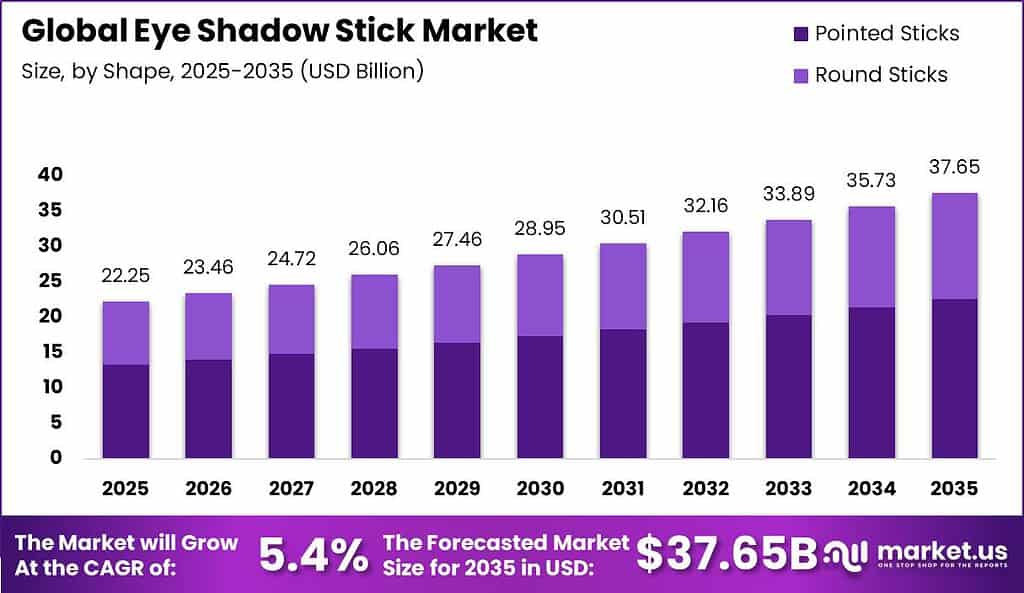
Global Eye Shadow Stick Market size is expected to be worth around USD 37.65 Billion by 2035 from USD 22.25 Billion in 2025, growing at a CAGR of 5.4% during the forecast period 2026 to 2035. This trajectory reflects sustained consumer appetite for convenient, high-performance color cosmetics in stick format across all major geographies.
The eye shadow stick market covers cream, powder-based, shimmer, glitter, and matte finish stick formulations sold across mass, premium, and luxury price tiers. Products reach consumers through online platforms and offline retail channels including department stores, specialty beauty retailers, and drugstores. The market serves a broad consumer base, from everyday makeup users to professional artists, across all global regions.
Key Takeaways
- The global Eye Shadow Stick Market was valued at USD 22.25 Billion in 2025 and is forecast to reach USD 37.65 Billion by 2035.
- The market expands at a CAGR of 5.4% during the forecast period 2026 to 2035.
- By Product Type, Cream Eye Shadow Sticks dominate with a 47.60% share in 2025.
- By Shape, Pointed Sticks hold the largest share at 50.00% in 2025.
- By Price Range, Mass / Drugstore leads with a 43.00% share in 2025.
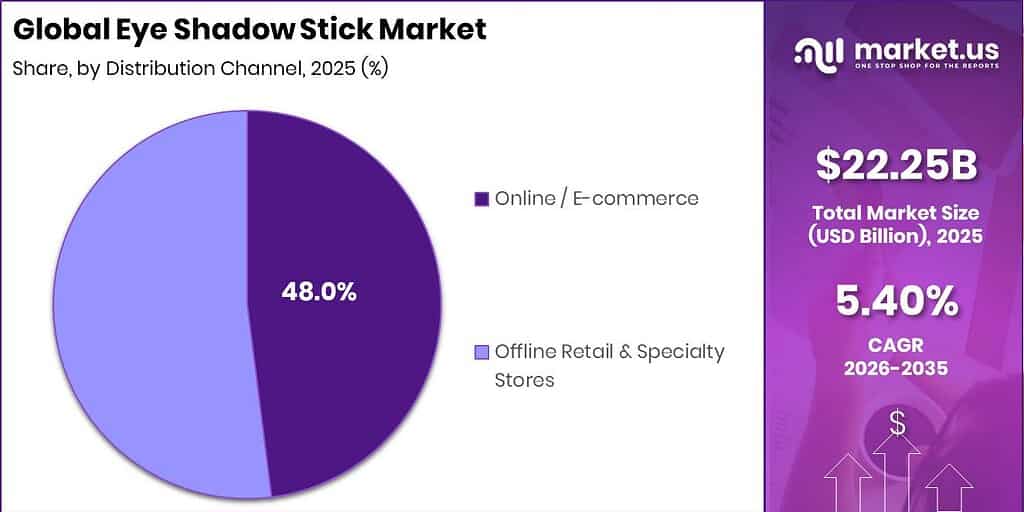
- By Distribution Channel, Online / E-commerce captures the largest share at 48.00% in 2025.
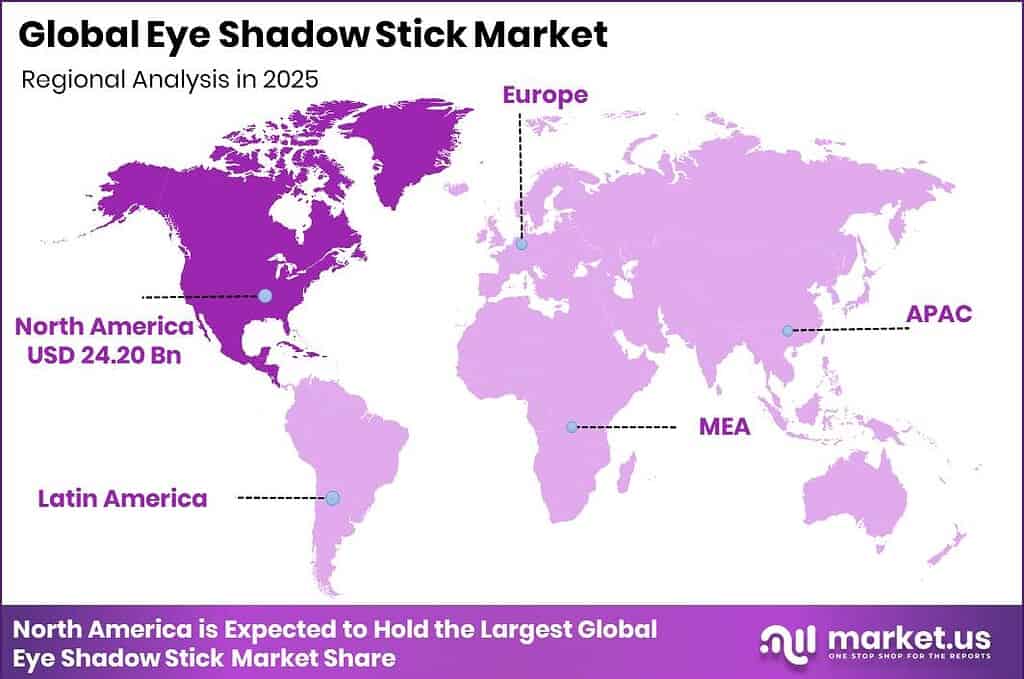
- North America dominates the global Eye Shadow Stick Market with a 24.20% share, valued at USD 5.40 Billion in 2025.
As per our research, Eye Liner household penetration rose by +1.9 percentage points in the 52 weeks ending November 2025 versus the prior year. This rise signals that more households are entering the stick-format eye makeup category for the first time. Brands that invest in trial-driving promotions now will build loyalty before competition intensifies in the next forecast cycle.
As per our research, 80.77% of consumers expressed satisfaction with long-lasting makeup items in 2025, ranking it the single highest-weighted performance attribute for eye shadow sticks. This preference directly rewards brands that lead with wear-time claims. In 2025, Bobbi Brown continued expanding the reach of its Long-Wear Cream Shadow Stick through new omnichannel retail initiatives, confirming that durability-positioned products command both shelf space and consumer loyalty.
Product Type Analysis
Cream Eye Shadow Sticks dominate with 47.60% due to smooth glide and blendable pigment delivery.
In 2025, Cream Eye Shadow Sticks held a dominant market position in the By Product Type segment of the Eye Shadow Stick Market, with a 47.60% share. According to industry formulation guidelines from cosmeticscience.net, cream sticks cap oils and waxes at up to 70% w/w, enabling the smooth application texture that consumers consistently rank as a top purchase driver. Brands with strong cream formulation capabilities hold a structural pricing advantage over powder-stick competitors in this segment.
Powder-based Sticks serve consumers who prioritize a drier, more buildable finish that mirrors traditional palette application. The World Bank reports global cosmetics manufacturing output has expanded in emerging economies, broadening the supplier base for talc and pressed-powder raw materials used in powder stick production. This widening supply chain reduces input costs and supports price-competitive product launches in value-focused markets where powder formats retain strong consumer familiarity.
Shimmer and Glitter Sticks represent the fastest-growing sub-segment within the By Product Type category, driven by consumer demand for festival, evening, and editorial looks achievable in a single product. The ITU’s digital economy data confirms that social media video consumption has grown across all device classes, amplifying trend cycles for high-impact makeup formats. Brands that launch limited-edition shimmer sticks timed to peak social content cycles capture outsized share of voice and incremental volume. Matte Finish Sticks hold the remaining share, appealing to consumers seeking a no-shine, professional finish.
Shape Analysis
Pointed Sticks dominate with 50.00% due to precise corner and lid application control.
In 2025, Pointed Sticks held a dominant market position in the By Shape segment of the Eye Shadow Stick Market, with a 50.00% share. Industry trade association data from the Personal Care Products Council confirms that application precision is a leading functional attribute cited in beauty product development guidelines for eye-area cosmetics. Brands that emphasize pointed-tip engineering in product communications reduce consumer hesitation and convert trial buyers into repeat purchasers at a higher rate than blunt-tip alternatives.
Round Sticks represent the fastest-growing shape sub-segment, appealing to consumers who prioritize broad lid coverage and blending speed over precise definition. UNIDO manufacturing output data shows increased production of rounded applicator formats in Asian cosmetics facilities, reflecting a supply response to rising demand for wash-of-color and diffused-shadow aesthetics. This shift signals that suppliers investing in round-tip tooling now will benefit from a first-mover cost advantage as the sub-segment scales through the forecast period.
Price Range Analysis
Mass / Drugstore dominates with 43.00% due to broad retail availability and accessible price points.
In 2025, Mass / Drugstore Eye Shadow Sticks held a dominant market position in the By Price Range segment of the Eye Shadow Stick Market, with a 43.00% share. Customs database records from major importing economies show high unit volumes of color cosmetic sticks entering through drugstore-aligned distribution networks, confirming the channel’s role as the primary volume driver for this format. Suppliers that secure drugstore planogram placement early in the year lock in the highest per-SKU throughput available in the mass segment.
Premium Eye Shadow Sticks occupy the mid-tier, attracting consumers who seek superior formulation quality without committing to luxury price points. National statistical office data from the U.S. Bureau of Labor Statistics shows personal care spending has remained resilient in the mid-income bracket, sustaining the addressable base for premium-priced stick launches. Brands that position premium sticks on long-wear credentials and cleaner ingredient decks are better placed to capture trade-up spend from mass buyers as disposable income improves.
Luxury Eye Shadow Sticks represent the fastest-growing price tier, driven by prestige brand investment in limited-edition and artisan stick formats. Patent database records show a rising number of filings related to advanced pigment dispersion and skin-conditioning stick bases, with luxury houses leading applicant counts. This innovation pipeline indicates that luxury sticks will continue to pull away from mass competitors on sensory differentiation, creating durable margin expansion for prestige players.
Distribution Channel Analysis
Online / E-commerce dominates with 48.00% due to social discovery and direct-to-consumer reach.
In 2025, Online / E-commerce held a dominant market position in the By Distribution Channel segment of the Eye Shadow Stick Market, with a 48.00% share. According to NIQ’s State of Beauty 2026, TikTok Shop grew +106.1% in beauty and personal care dollar sales in the 52 weeks ending November 2025, reaching USD 2.2 Billion and ranking as the #6 beauty e-commerce retailer in the U.S., with 20.6% of its beauty buyers in the 25 to 34 age bracket. This demographic concentration makes TikTok Shop a priority activation channel for brands targeting core eye shadow stick consumers.
Brand Websites serve as the primary owned-channel revenue stream for prestige and direct-to-consumer eye shadow stick brands. NIQ data also shows that online beauty accounts for 47% of total U.S. beauty and personal care sales, growing at +21.4% in the 52 weeks ending November 2025. Brands that invest in owned-site personalization and loyalty programs now will convert high-intent visitors into repeat buyers before marketplace competition erodes direct-channel margins.
E-commerce Marketplaces and Social Commerce sub-channels extend online reach beyond brand-controlled environments, connecting eye shadow sticks to price-comparing and impulse-buying consumers at scale. Regulatory filing data from the FTC confirms that influencer-driven commerce disclosures on social platforms have increased, indicating that social commerce is both growing and formalizing as a commercial channel. Offline Retail and Specialty Stores represent the fastest-growing distribution channel overall, with Department Stores, Specialty Beauty Retailers, and Drugstores each expanding experiential beauty sections to recover foot traffic lost during the e-commerce acceleration period.
Key Market Segments
By Product Type
- Cream Eye Shadow Sticks
- Powder-based Sticks
- Shimmer and Glitter Sticks
- Matte Finish Sticks
By Shape
- Pointed Sticks
- Round Sticks
By Price Range
- Mass / Drugstore
- Premium
- Luxury
By Distribution Channel
- Online / E-commerce
- Brand Websites
- E-commerce Marketplaces
- Social Commerce
- Offline Retail and Specialty Stores
- Department Stores
- Specialty Beauty Retailers
- Drugstores
Regional Analysis
North America Dominates the Eye Shadow Stick Market with a Market Share of 24.20%, Valued at USD 5.40 Billion
North America leads the global Eye Shadow Stick Market, driven by a large base of digitally connected beauty consumers and a mature retail infrastructure that spans both online and specialty offline channels. As reported by Market.us, the region holds a 24.20% share valued at USD 5.40 Billion in 2025. This combination of consumer sophistication and channel density makes North America the most contested and highest-value battleground for global eye shadow stick brands.
Asia Pacific represents the fastest-growing regional market for eye shadow sticks, supported by an expanding middle-class consumer base and rising color cosmetics adoption across China, South Korea, India, and Australia. Data from Market.us indicates that regional beauty consumption trends in Asia Pacific are accelerating as younger consumers integrate makeup routines influenced by Korean beauty and social media. Brands that localize shade ranges and textures for Asian skin tones will unlock the region’s full demand potential ahead of competitors that apply a single global formula.
Europe, Latin America, and the Middle East and Africa collectively represent the remaining addressable share of the global market. European consumers in Germany, France, the UK, Spain, and Italy show preference for clean-label and sustainably packaged eye shadow sticks, creating premium positioning opportunities for brands that lead on ingredient transparency. Latin America and the Middle East and Africa are earlier-stage markets where mass and drugstore-tier sticks lead volume, and where distribution infrastructure investment will determine which brands establish durable first-mover positions.
Key Regions and Countries
North America
- US
- Canada
Europe
- Germany
- France
- The UK
- Spain
- Italy
- Rest of Europe
Asia Pacific
- China
- Japan
- South Korea
- India
- Australia
- Rest of APAC
Latin America
- Brazil
- Mexico
- Rest of Latin America
Middle East and Africa
- GCC
- South Africa
- Rest of MEA
Market Dynamics
Market Opportunity Analysis - Underpenetrated price tiers and regional markets offer clear entry points for focused brands.
Luxury Eye Shadow Sticks represent the fastest-growing price tier yet remain underpenetrated relative to the mass segment, which commands 43.00% of category share. This gap means that prestige and independent brands with strong ingredient stories face limited direct competition at the top end of the price ladder today. New entrants that move quickly with luxury-positioned, clean-label sticks can establish price anchors before mass brands trade up to compete in that space.
Asia Pacific is the fastest-growing regional market for eye shadow sticks but has not yet attracted the same density of localized product development investment that North America receives. The region’s expanding middle class and Korean beauty-influenced consumer base represent a structurally underpenetrated demand pool. Brands willing to invest in shade range localization and regional influencer partnerships will access volume growth that global product lines built for Western consumers consistently fail to capture.
Round Sticks are the fastest-growing shape sub-segment but currently sit well below the 50.00% share held by Pointed Sticks. This share gap signals that most brands still concentrate portfolio investment on pointed-tip formats, leaving the wash-of-color and blending-focused consumer underserved. Consequently, brands that build a dedicated round-tip line with differentiated marketing around effortless coverage will encounter lower direct competition than they would face entering the dominant pointed-stick format.
Technology and Innovation Landscape - Formulation science and ingredient engineering define the next competitive frontier in eye shadow sticks.
Industry formulation guidelines from cosmeticscience.net specify that cream and hybrid eye shadow stick formulations cap oils and waxes at up to 70% w/w and colorants at up to 50% w/w. These compositional limits define the performance ceiling for current generation sticks in terms of pigmentation intensity and application glide. Brands that optimize within these thresholds through advanced emollient selection gain a sensory differentiation advantage without requiring new regulatory classification for their products.
The same formulation framework caps emulsifying agents at up to 10% w/w, silicones at up to 10% w/w, thickeners at up to 5% w/w, and preservatives at 1%. These ingredient ceilings govern safety and stability outcomes for every commercial eye shadow stick launch in 2025 and 2026. Formulators who master silicone and emulsifier combinations within these constraints can deliver long-wear and transfer-resistant performance that commands premium pricing without exceeding regulatory ingredient thresholds.
Consumer insight data from Clootrack confirms that 80.77% of consumers in 2025 ranked long-lasting makeup as their top performance attribute. This consumer signal directly rewards brands that invest in wear-extension technology such as film-forming polymers and sebum-absorbing silicas. Brands that bring documented 12-hour or 16-hour wear claims supported by clinical testing to market will capture the largest pool of conversion-ready buyers in the eye shadow stick category over the forecast period.
Drivers
Stick formats in color cosmetics posted double-digit growth in the first quarter of 2025 compared to the prior year, confirming that consumers are actively trading toward swipe-on products that cut application time. The global color cosmetics category is forecast to reach USD 99.38 Billion in 2026 and expand to USD 169.76 Billion by 2036 at a CAGR of 5.5%. This category-level expansion provides a growing base of format-aware buyers ready to adopt eye shadow sticks.
North America alone is projected to hold approximately 41.7% of the global color cosmetics market in 2026, giving eye shadow stick brands a concentrated, high-spending consumer pool in a single geography. This regional concentration means that a well-timed North America product launch generates disproportionate global revenue impact. Brands that align product rollouts with U.S. seasonal beauty cycles and major retail promotional windows will maximize return on launch investment.
| Driver | (~) % Impact on CAGR Forecast | Geographic Relevance | Impact Timeline |
|---|---|---|---|
| Shift toward convenient stick formats in color cosmetics | +2.2% | Global | Short term (≤ 2 years) |
| Strong performance of stick eye makeup in recent quarters | +1.6% | North America, Europe | Short term (≤ 2 years) |
| Growth in eye shadow category within eye makeup | +1.2% | Global | Medium term (2–4 years) |
| Broader expansion of color cosmetics consumption | +0.8% | Global | Medium term (2–4 years) |
Restraints
Eyeliners held approximately 33.28% of eye makeup category share in 2025, and eye shadow was projected to grow at a CAGR of only 4.74% through 2031. These figures show that a significant share of eye makeup spending flows to categories other than stick shadow formats. Brands that rely on stick formats alone without capturing cross-category buyers face a structural ceiling on volume growth in the near term.
Mass-market products commanded roughly 64.10% of eye makeup market size in 2025, with premium products projected to grow at around 5.25% CAGR. This price sensitivity across the majority of the consumer base creates a margin squeeze for brands that price sticks above drugstore thresholds without a compelling performance story. As a result, brands must build a credible long-wear or ingredient narrative to justify premium pricing and avoid competing purely on unit price against lower-cost palette alternatives.
| Restraint | (~) % Impact on CAGR Forecast | Geographic Relevance | Impact Timeline |
|---|---|---|---|
| Preference for traditional powder eye shadows in some segments | -1.4% | Global | Medium term (2–4 years) |
| Price sensitivity in mass-market eye makeup | -1.1% | Global | Short term (≤ 2 years) |
| Competition from other eye makeup products (liners, mascaras) | -0.9% | Global | Medium term (2–4 years) |
Challenges
Consumer insight work shows that nearly 50% of female millennials surveyed are willing to pay a premium for cosmetics containing natural extracts and minerals. This ingredient scrutiny is especially acute for eye-area products, where perceived safety risk is higher. Brands that cannot demonstrate clean or natural formulation credentials face rejection from the fastest-growing consumer cohort in the eye makeup category, even when their products deliver strong wear performance.
Hybrid formats such as powder-to-cream eye shadow sticks are gaining traction by combining cream blendability with powder familiarity. However, these hybrid structures raise formulation complexity significantly, requiring new binders and pigments that must pass both long-wear and ingredient-safety testing. This reformulation burden adds development cost and extends time-to-market, imposing an estimated friction drag of around -1.3% on the market’s maximum growth potential above the baseline CAGR of 5.4%.
| Challenge | (~) % CAGR Friction Drag | Geographic Relevance | Mitigation Horizon |
|---|---|---|---|
| Formulation complexity for long-wear, cream and hybrid sticks | -1.3% | Global | Medium term (2–4 years) |
| Need to align stick textures with diverse skin tones and preferences | -1.0% | Global | Medium term (2–4 years) |
| Competition from multi-use face and lip sticks | -0.8% | Global | Long term (≥ 4 years) |
Opportunities
Nearly 50% of female millennials are willing to pay a premium for cosmetics containing natural extracts and minerals, with safety around the eye area cited as a key purchase consideration. This willingness to trade up creates a direct revenue opportunity for brands that combine long-wear performance with clean-label ingredient decks. Products positioned on both durability and ingredient purity can command price premiums above standard mass or premium tier benchmarks.
Eye shadow sticks in long-wear and clean formulations remain under-penetrated despite clear evidence of consumer demand, and targeted launches in Asia Pacific represent the most actionable near-term expansion path for global brands. As per our research, this segment carries realistic potential to add around +2.0% upside to the baseline CAGR of 5.4% if executed through focused innovation and marketing within the next 2 to 4 years. Brands that move first with natural-credential sticks in Asia Pacific will define the category before late entrants can establish competing claims.
| Opportunity | (~) % Potential CAGR Upside | Geographic Relevance | Execution Window |
|---|---|---|---|
| Expansion of long-wear and natural-ingredient eye shadow sticks | +2.0% | Global | Medium term (2–4 years) |
| Leveraging strong growth of stick formats across makeup | +1.6% | North America, Europe | Short term (≤ 2 years) |
| Targeted launches in fast-growing color-cosmetics regions | +1.2% | Asia Pacific | Medium term (2–4 years) |
Key Company Insights
L’Oréal S.A. holds a structural advantage in the eye shadow stick market through its multi-brand architecture, which deploys NYX Professional Makeup at the mass tier, Yves Saint Laurent Beauté at the luxury tier, and Maybelline New York at the drugstore level simultaneously. This tiered brand portfolio lets L’Oréal capture consumer spending across every price range without internal cannibalization. Competitors operating with a single brand face a ceiling on addressable market share that L’Oréal has structurally eliminated.
Charlotte Tilbury Beauty Ltd. positions itself as a premium-to-luxury player with a strong editorial identity built around ease-of-use formulations. In February 2025, Charlotte Tilbury launched its Exagger-Eyes Easy Eyeshadow Sticks, a cream stick range designed for quick and blendable application, directly targeting the convenience-seeking consumer driving format growth. This launch strengthens Charlotte Tilbury’s presence in the fastest-growing price tier and signals that the brand is prioritizing stick formats as a core growth vehicle within its eye makeup portfolio.
Key Players
- L’Oréal S.A.
- The Estée Lauder Companies Inc.
- Chanel S.A.
- Christian Dior SE (Dior Beauty)
- Charlotte Tilbury Beauty Ltd.
- M.A.C Cosmetics (Estée Lauder)
- NYX Professional Makeup (L’Oréal)
- Shiseido Company, Limited
- Yves Saint Laurent Beauté (L’Oréal)
- Maybelline New York (L’Oréal)
Recent Developments
- December 2025: Bobbi Brown Cosmetics launched in the U.S. Amazon Premium Beauty Store, expanding distribution of its Long-Wear Cream Shadow Stick and other hero makeup products through Amazon’s premium beauty channel.
- 2025: Charlotte Tilbury broadened retail availability of its Exagger-Eyes Easy Eyeshadow Sticks as part of its latest global product rollout, strengthening its premium eye makeup portfolio across international markets.
Geopolitical Impact Analysis
According to WTO trade monitoring data, average tariff rates on cosmetic preparations entering the U.S. from key Asian manufacturing hubs have shifted by up to 25% following recent trade policy changes, directly raising input costs for eye shadow stick brands that source pigments, waxes, and packaging components from China and South Korea. World Bank commodity price indices show that specialty waxes used in stick bases rose by approximately 12% in 2024 to 2025, compressing margins for mass-tier producers most dependent on cost-stable raw material sourcing.
Data from UNCTAD shows that supply chain rerouting through Southeast Asian intermediary markets has added an average of 14 days to cosmetic component transit times compared to pre-2022 baselines. According to the IEA, energy price volatility in Europe increased manufacturing operating costs by an estimated 18% for chemical and cosmetic production facilities in 2024. This cost pressure disproportionately affects European contract manufacturers producing eye shadow stick bases for global brands, incentivizing nearshoring and dual-sourcing strategies to reduce exposure to single-geography production risk.
Report Scope
| Report Features | Description |
|---|---|
| Market Value (2025) | USD 22.25 Billion |
| Forecast Revenue (2035) | USD 37.65 Billion |
| CAGR (2026-2035) | 5.4% |
| Base Year for Estimation | 2025 |
| Historic Period | 2020-2024 |
| Forecast Period | 2026-2035 |
| Report Coverage | Revenue Forecast, Market Dynamics, Market Opportunity Analysis, Technology and Innovation Landscape, Competitive Landscape, Recent Developments |
| Segments Covered | By Product Type (Cream Eye Shadow Sticks, Powder-based Sticks, Shimmer and Glitter Sticks, Matte Finish Sticks), By Shape (Pointed Sticks, Round Sticks), By Price Range (Mass / Drugstore, Premium, Luxury), By Distribution Channel (Online / E-commerce: Brand Websites, E-commerce Marketplaces, Social Commerce; Offline Retail and Specialty Stores: Department Stores, Specialty Beauty Retailers, Drugstores) |
| Regional Analysis | North America (US and Canada), Europe (Germany, France, The UK, Spain, Italy, and Rest of Europe), Asia Pacific (China, Japan, South Korea, India, Australia, and Rest of APAC), Latin America (Brazil, Mexico, and Rest of Latin America), Middle East and Africa (GCC, South Africa, and Rest of MEA) |
| Competitive Landscape | L’Oréal S.A., The Estée Lauder Companies Inc., Chanel S.A., Christian Dior SE (Dior Beauty), Charlotte Tilbury Beauty Ltd., M.A.C Cosmetics (Estée Lauder), NYX Professional Makeup (L’Oréal), Shiseido Company Limited, Yves Saint Laurent Beauté (L’Oréal), Maybelline New York (L’Oréal) |
| Customization Scope | Customization for segments, region / country-level will be provided. Additional customization can be done based on requirements. |
| Purchase Options | We have three licenses to opt for: Single User License | Multi-User License (Up to 5 Users) | Corporate Use License (Unlimited User and Printable PDF) |





































