


Report Overview
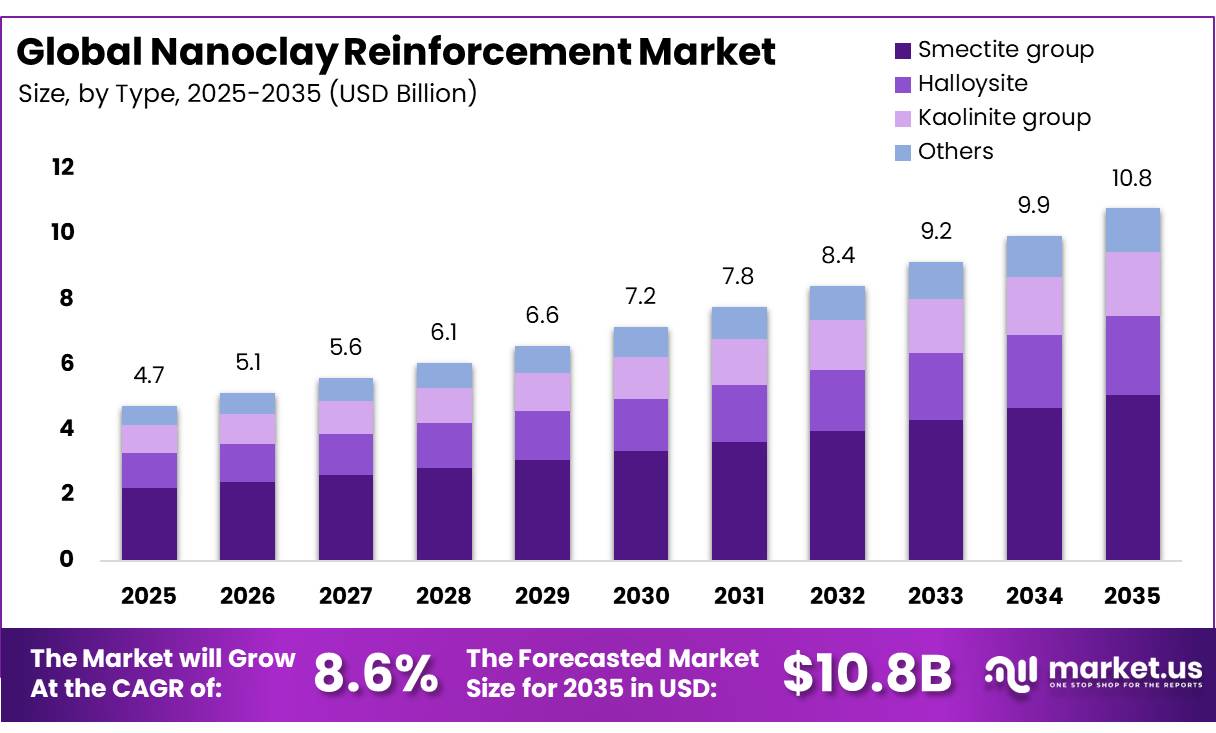
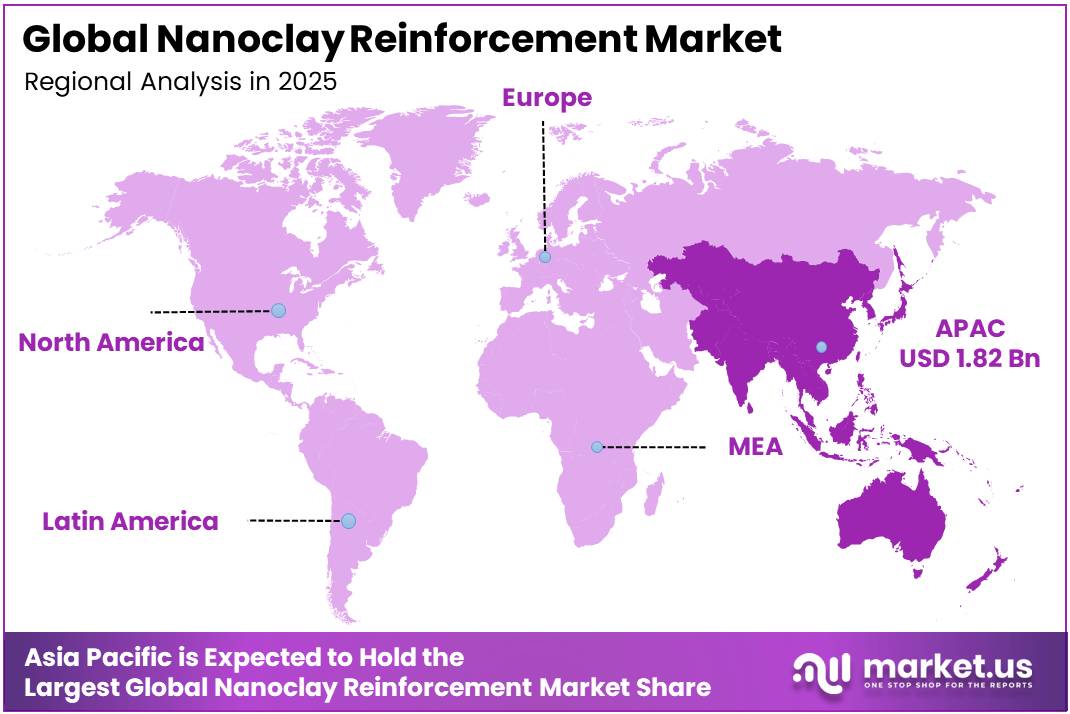
In 2025, the Global Nanoclay Reinforcement Market was valued at USD 4.7 billion, and between 2026 and 2035, this market is estimated to register a CAGR of 8.6%, reaching about USD 10.8 billion by 2035. Asia Pacific held a dominant market position, capturing more than a 38.4% share, holding USD 1.82 billion in revenue.
Nanoclay reinforcement uses nanoscale clay particles within polymers, coatings, rubber and matrices to improve strength, stiffness, barrier performance and thermal stability. The United States Environmental Protection Agency defines nanoscale materials as substances with dimensions of approximately 1 to 100 nanometers. Their surface area and interaction with surrounding materials allow manufacturers to improve performance with small filler additions, supporting lightweight packaging, automotive components, construction products and protective coatings.
- Regulatory scrutiny is important because nanoscale substances may behave differently from conventional chemicals. The United States Environmental Protection Agency reported that it has reviewed more than 160 chemical notices for nanoscale materials since 2005.
Key Takeaways
- The global Nanoclay Reinforcement Market was valued at USD 4.7 billion in 2025.
- The global Nanoclay Reinforcement Market is projected to grow at a CAGR of 8.6% and is estimated to reach USD 10.8 billion by 2035.
- On the basis of type, the smectite group dominated the nanoclay reinforcement market, constituting 47.0% of the total market share.
- Based on the matrix, polymer nanocomposites dominated the nanoclay reinforcement market, with a substantial market share of around 57.7%.
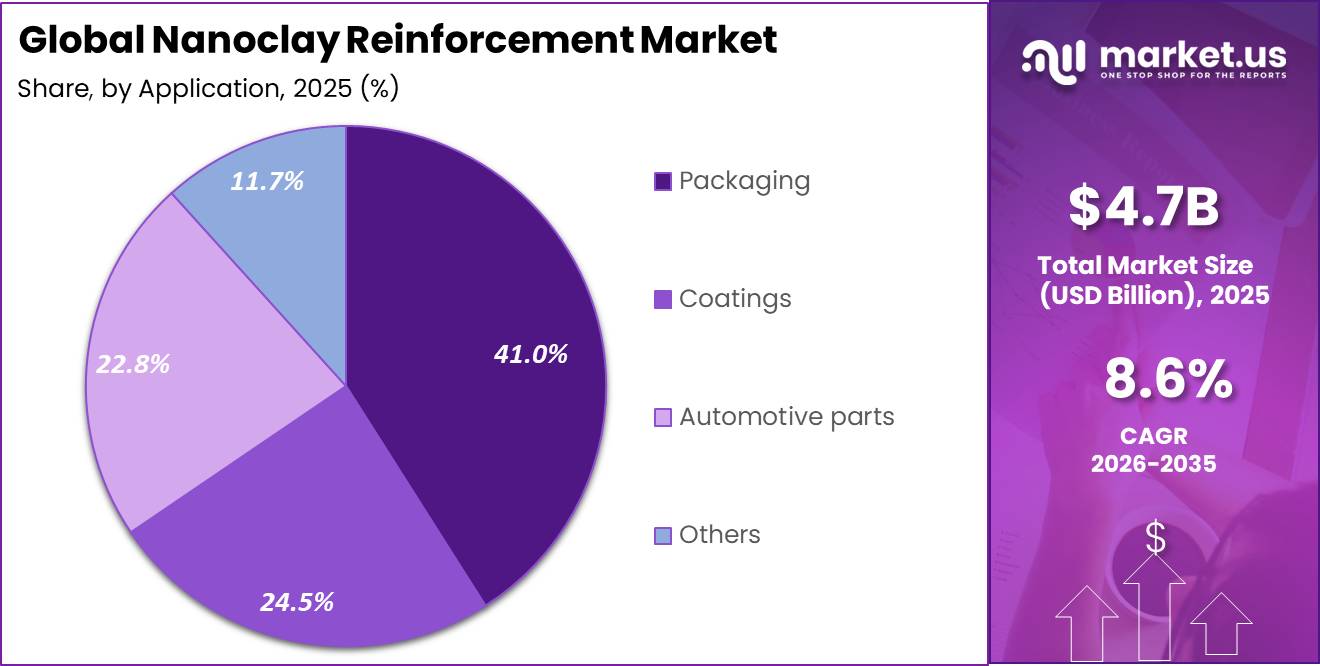
- Based on application, packaging led the nanoclay reinforcement market, comprising 41.0% of the total market.
- Among the end-uses, the automotive industry held a major share in the nanoclay reinforcement market, accounting for 38.2% of the total market share.
- Asia Pacific was the most dominant region in the nanoclay reinforcement market, accounting for 38.4% of the total market
Demand is driven by the need for lighter products, longer service life, lower material consumption and improved resistance to gases, moisture, heat and mechanical stress. Growth opportunities are visible in recyclable polymer composites, high-barrier packaging, durable coatings and lightweight mobility materials. The European Commission states that global chemicals production is expected to double by 2030, increasing the need for safer materials. It has invested EUR 319 million in Open Innovation Test Beds that help companies validate and scale advanced materials before commercial entry.
- Government initiatives are strengthening research, scale-up capacity and chemical safety. The European Innovation Council’s 2025 work programme offered more than EUR 1.4 billion for strategic technologies, including EUR 262 million for Pathfinder research and EUR 634 million for Accelerator support.
In 2025, the European Union adopted 3 chemical-assessment laws, which entered into force on January 1, 2026. These measures support chemical data, coordinated assessment and safer-by-design innovation, creating a clearer pathway for viable nanoclay reinforcement products.
Type Analysis
Smectite Group Leads the Nanoclay Reinforcement Market Through Compatibility and Broad Industrial Use
In 2025, the smectite group held a dominant market position, capturing more than a 47.0% share of the nanoclay reinforcement market. Its leadership was supported by strong swelling capacity, high surface activity, and easy dispersion across polymer systems. Smectite-based nanoclays also improved stiffness, barrier performance, thermal resistance, and dimensional stability, making them suitable for packaging, coatings, automotive parts, and construction materials. Their availability and compatibility with established compounding methods further strengthened adoption among manufacturers seeking lightweight and durable composite solutions.
- For instance, in April 2025, according to the United States National Library of Medicine, researchers developed a polylactide foam reinforced with halloysite nanoclay and polytetrafluoroethylene, improving mechanical behavior, melt strength, viscosity, and foaming performance.
Halloysite is the fastest-growing type because its natural tubular structure supports reinforcement, adsorption, controlled loading, and functional surface modification. It is gaining attention in biodegradable polymers, coatings, environmental materials, and biomedical composites. Its ability to strengthen matrices while supporting lower-impact formulations is expected to encourage wider commercial use during the forecast period.
By Metrix Analysis
Polymer Nanocomposites Lead with 57.7% as Manufacturers Seek Stronger Materials
In 2025, polymer nanocomposites held a dominant market position, capturing more than a 57.7% share of the nanoclay reinforcement market. Their leadership came from the ability of nanoclay particles to improve strength, stiffness, thermal stability, flame resistance, and gas barrier performance within polymer systems. These matrices are widely suited to packaging, automotive components, coatings, electronics, and construction products. Their compatibility with extrusion, injection moulding, and conventional processing methods also supports production without major changes to manufacturing lines.
- For instance, in April 2025, according to the European Commission’s Community Research and Development Information Service, a Circular Bio-based Europe initiative supported safe and sustainable bio-based polymers designed for commercial applications, resource efficiency, circular production, and improved end-of-life performance.
Other hybrid and green matrices are the fastest-growing segment as manufacturers increasingly combine nanoclay with bio-based polymers, natural fibres, recycled materials, and low-impact resins. These combinations can balance strength, lightweight design, renewable content, and waste reduction. Their suitability for sustainable packaging, mobility, building materials, and consumer products is encouraging formulation research and industrial adoption.
By Application Analysis
Packaging Leads with 41.0% as Nanoclay Improves Product Protection
In 2025, packaging held a dominant market position, capturing more than a 41.0% share of the nanoclay reinforcement market. Its leadership was supported by the growing use of nanoclay in polymer films, containers, trays, and flexible packaging. Nanoclay reinforcement can improve oxygen and moisture barriers, stiffness, thermal stability, and dimensional strength while allowing manufacturers to reduce material thickness. These properties help protect food, beverages, pharmaceuticals, and consumer products during storage and transportation.
- For instance, in June 2025, according to the Circular Bio-based Europe Joint Undertaking, the BIO4COAT project began developing high-performance bio-based coatings from crop residues, forestry waste, and food-industry by-products for plastics and other demanding applications.
Coatings are the fastest-growing application as nanoclay supports improved scratch resistance, corrosion protection, thermal stability, adhesion, and barrier performance. Its use in protective, architectural, automotive, and packaging coatings is expanding as manufacturers seek thinner, durable, and lower-impact surface treatments.
By End-use Analysis
Automotive Leads with 38.2% as Lightweight Materials Gain Wider Use
In 2025, automotive held a dominant market position, capturing more than a 38.2% share of the nanoclay reinforcement market. Its leadership was supported by demand for lighter, stronger, and heat-resistant vehicle components. Nanoclay improves polymer stiffness, dimensional stability, flame resistance, and barrier performance while limiting added weight. These benefits support its use in interior panels, under-the-hood parts, bumpers, dashboards, and protective components. Compatibility with established polymer processing methods also helps manufacturers integrate reinforced materials into high-volume vehicle production.
- For instance, in January 2025, according to the European Commission’s Community Research and Development Information Service, the FLAMINGo project completed work on aluminium nanocomposites for lightweight automotive parts, including steering knuckles, rear damper mounts, and rear frame profiles.
Construction is the fastest-growing end-use segment as nanoclay is increasingly added to cementitious materials, coatings, sealants, insulation, and polymer composites. It can improve mechanical strength, moisture resistance, thermal performance, fire protection, and durability. Rising interest in lightweight building systems and longer-lasting materials is supporting further testing and commercial adoption across infrastructure and building applications.
Key Market Segments
By Type
- Smectite group
- Kaolinite group
- Halloysite
- Others
By Metrix
- Polymer nanocomposites
- Coating/paint matrices
- Rubber/elastomer composites
- Other hybrid/green matrices
By Application
- Packaging
- Automotive parts
- Coatings
- Others
By End-use
- Automotive
- Construction
- Electronic components & appliances
- Marine
- Military & defense
- Others
Driver Analysis
PFAS-free food packaging barrier shift using nanoclay
The most immediate 2026 demand catalyst is the EU packaging regime tightening around hazardous chemistries, especially PFAS in food-contact packaging, with Regulation (EU) 2025/40 entering into force in February 2025 and applying from 12 August 2026. The rule sets three explicit PFAS thresholds for food-contact packaging 25 ppb for any PFAS, 250 ppb for the sum of targeted PFAS, and 50 ppm for total PFAS including polymeric PFAS creating a strong substitution window for inert mineral barrier systems such as nanoclay in coatings, multilayer films, and polymer concentrates.
Commercially, this shifts converter economics away from fluorinated barrier aids toward platelet fillers that improve tortuosity without triggering the same compliance burden, especially for exporters serving EU retail channels. Because nanoclay can improve oxygen and water-vapor resistance at low loading levels, it supports thinner film structures and broader reformulation across food trays, pouches, and wraps, which is why this driver merits the largest near-term CAGR uplift concentrated in Europe but transmitted into APAC manufacturing bases and North American brand portfolios selling into Europe.
Drivers Impact Analysis
| Driver | (~) % Impact on CAGR | Geographic Relevance | Impact Timeline |
|---|---|---|---|
| PFAS-free food packaging barrier shift using nanoclay | +2.4% | EU core, North America adoption, APAC export corridors | Short term (≤ 2 years) |
| EV battery and lightweight polymer compounding demand | +1.9% | China core, EU, U.S., Korea-Japan supply chain | Medium term (2-4 years) |
| Cement, coatings, and geotechnical performance upgrade cycle | +1.6% | APAC core, Middle East, North America infrastructure belts | Medium term (2-4 years) |
| Bioplastics barrier enhancement for PLA and hybrid films | +1.4% | EU core, North America, premium APAC packaging hubs | Short term (≤ 2 years) |
| Feedstock abundance and lower-cost mineral substitution economics | +1.2% | U.S., China, India, Turkey, Middle East spill-over | Long term (≥ 4 years) |
| Circular-material compliance and down-gauging in packaging | +1.1% | EU core, multinational FMCG supply chains, APAC converters | Medium term (2-4 years) |
Restraint Analysis
Limited formulation know‑how at downstream processors
Finally, limited formulation know‑how and technical capability at many downstream processors—especially in emerging markets and among tier‑2 and tier‑3 converters creates friction in scaling nanoclay usage beyond early adopters. Industry commentary notes that dispersion consistency, processing compatibility, and lack of awareness in traditional industries are ongoing challenges; in practice, this means that outside a relatively small circle of technically sophisticated compounders and multinational packaging or automotive suppliers, many potential users lack in‑house rheology expertise, nano‑material handling protocols, or process‑control sophistication to reliably incorporate nanoclay into existing lines.
Training programs, application labs, and technical‑service teams can mitigate this, but they require sustained vendor investment and often focus on top‑tier customers first, leaving a broad tail of smaller processors under‑served and slowing the diffusion of nanoclay into secondary and tertiary markets; this drag is sufficient to lower aggregate CAGR by a bit more than 1 percentage point compared with a scenario in which formulation know‑how was widespread from the outset.
Restraint Impact Analysis
| Restraint | (~) % Impact on CAGR | Geographic Relevance | Impact Timeline |
|---|---|---|---|
| High processing and dispersion cost | -2.3% | North America, EU, APAC converters | Medium term (2-4 years) |
| Regulatory and EHS uncertainty on nanomaterials | -1.9% | EU core, North America, selected APAC | Long term (≥ 4 years) |
| Competition from alternative nano-additives | -1.6% | Global OEMs, advanced materials hubs | Long term (≥ 4 years) |
| End-user price sensitivity in construction and packaging | -1.5% | APAC corridors, Latin America, MEA | Medium term (2-4 years) |
| Supply chain volatility for clay mining and chemicals | -1.3% | U.S., China, India, global shipping routes | Short term (≤ 2 years) |
| Limited formulation know-how at downstream processors | -1.1% | Emerging APAC, Africa, tier-2 converters | Medium term (2-4 years) |
Opportunity Analysis
Smart and active nanoclay packaging platforms
This opportunity is distinct from today’s baseline barrier‑film adoption because it focuses on fully integrated “smart/active” packaging platforms combining nanoclay’s tortuous‑path barrier with antimicrobial, colorimetric, or controlled‑release functions—that are not yet deployed at scale but are technically validated in academic and early‑stage industry work.
If a subset of global food and beverage majors migrated even 10–15% of high‑value chilled and ambient lines to nanoclay‑enabled smart packaging by 2030, incremental nanoclay demand could reach mid‑single‑digit kiloton levels, supporting 1–2 percentage points of CAGR upside versus a passive‑barrier‑only baseline.
Opportunity Impact Analysis
| Opportunity | (~) % Potential CAGR Upside | Geographic Relevance | Execution Window |
|---|---|---|---|
| Smart and active nanoclay packaging platforms | +1.8% | EU, North America, APAC premium hubs | Medium term (2-4 years) |
| Nanoclay solutions for water and soil remediation | +1.5% | APAC emerging, Africa, Latin America | Long term (≥ 4 years) |
| Healthcare, wound-care and controlled-release systems | +1.3% | North America, EU, Japan-Korea | Long term (≥ 4 years) |
| Energy storage, hydrogen barrier and insulation uses | +1.2% | North America, EU, China | Medium term (2-4 years) |
| SaaS-style application labs and licensing model | +1.1% | Global top-tier OEMs and converters | Short term (≤ 2 years) |
| Africa and frontier APAC nanoclay penetration | +1.0% | Africa, South Asia ex-India, ASEAN frontier | Long term (≥ 4 years) |
Challenges Analysis
Nonlinear lab‑to‑plant scale‑up
The most persistent operational challenge is that dispersion behavior and exfoliation energy proven on the bench do not scale linearly to production, creating a structural drag of roughly 1.5–2 CAGR points as promising programs under‑deliver once they hit real lines: lab trials often use high‑shear mixers or small twin‑screw extruders where energy input per kilogram is an order of magnitude higher than on high‑throughput production extruders, so the degree of intercalation and exfoliation measured in small‑batch studies cannot be replicated without re‑engineering screw design, throughput, and residence time.
Experimental work on polymers such as 1,4‑polybutadiene demonstrates that incomplete nanoclay dispersion can increase viscosity more than 40‑fold at 5% loading while still failing to achieve full exfoliation, illustrating how marginal dispersion gains can carry significant rheology penalties that complicate scale‑up.
Strategically, this forces nanoclay suppliers and converters into multi‑iteration development cycles often adding 12–24 months to full commercialization as they redesign screws, adjust throughput, and implement real‑time dispersion metrics, which ties up pilot capacity and engineering bandwidth and structurally caps how many new SKUs can be brought to market each year.
Challenges Impact Analysis
| Challenge | (~) % CAGR Friction Drag | Geographic Relevance | Mitigation Horizon |
|---|---|---|---|
| Nonlinear lab-to-plant scale-up | -1.7% | North America, EU, APAC industrial hubs | Medium term (2-4 years) |
| Logistics and moisture-control volatility | -1.4% | APAC logistics corridors, global shipping routes | Short term (≤ 2 years) |
| Evolving nano-regulatory complexity | -1.3% | EU regulatory hubs, North America, export-oriented APAC | Long term (≥ 4 years) |
| Nanocomposites process-engineering talent gap | -1.1% | Global, acute in emerging APAC and Africa | Long term (≥ 4 years) |
| Lot-to-lot and modifier stability variation | -1.0% | Global nanoclay processors and compounders | Medium term (2-4 years) |
| Customer integration and qualification burden | -0.9% | Automotive, packaging, construction OEM networks | Medium term (2-4 years) |
Geopolitical Impact Analysis
Trade Route Disruptions and Mineral Security Policies Reshape Nanoclay Reinforcement Supply Chains
Current geopolitical tensions are affecting the nanoclay reinforcement market through shipping disruption, mineral supply concentration, trade-policy uncertainty and regional sourcing strategies. Nanoclay production depends on industrial clay minerals, including bentonite, kaolin and montmorillonite, together with polymers, surface modifiers and chemical processing inputs. In June 2026, the United States Geological Survey reported that China produced 74 of the 77 mineral commodities assessed and ranked first globally in 39, including 14 industrial minerals. This wider mineral-processing concentration increases procurement risk for manufacturers dependent on internationally traded additives and processed materials.
- In September 2025, United Nations Trade and Development reported that Suez Canal tonnage remained 70% below its 2023 level as of May 2025. Ships were redirected around the Cape of Good Hope, extending delivery times for mineral fillers, polymer resins and chemical treatments used in nanocomposite manufacturing.
Freight volatility is creating further cost uncertainty. The Shanghai Containerized Freight Index averaged 2,496 points in 2024, representing a 149% increase from 2023, while geopolitical risks kept freight rates elevated and unstable during 2025. For nanoclay suppliers, this can increase landed costs, inventory requirements and production-planning difficulties, particularly where minerals and polymer compounds cross several borders.
These pressures are encouraging regional processing, supplier diversification and domestic material development. In March 2025, the European Commission selected 47 Strategic Projects under the Critical Raw Materials Act to strengthen regional extraction, processing and recycling capacity. Although nanoclay is not directly listed as a strategic material, this policy direction reflects a broader shift toward localized and resilient mineral-based manufacturing networks.
Regional Analysis
Asia Pacific Leads with USD 1.82 Billion, Supported by Strong Manufacturing Activity
In 2025, Asia Pacific held a dominant position in the nanoclay reinforcement market, accounting for more than a 38.4% share and generating approximately USD 1.82 billion in revenue. Regional leadership was supported by a strong manufacturing base across chemicals, packaging, automotive components, coatings, electronics, and construction materials. Nanoclay adoption is expanding as producers seek lighter composites, improved barrier performance, higher stiffness, and better thermal stability.
In 2025, the United Nations Industrial Development Organization reported that Asia and Oceania contributed 57.2% of global manufacturing value added, highlighting the region’s industrial scale. Automotive demand also supports consumption. The International Energy Agency stated that electric car production in Asia Pacific countries outside China increased by 15% in 2024 to about 1 million units.
Key Regions and Countries Covered
- North America
- The US
- Canada
- Europe
- Germany
- France
- The UK
- Spain
- Italy
- Russia & CIS
- Rest of Europe
- APAC
- China
- Japan
- South Korea
- India
- ASEAN
- Rest of APAC
- Latin America
- Brazil
- Mexico
- Rest of Latin America
- Middle East & Africa
- GCC
- South Africa
- Rest of MEA
Key Players Analysis
Nanoclay reinforcement manufacturers focus on product performance, particle dispersion, surface modification, application compatibility, and reliable mineral sourcing to strengthen their competitive position. Key participants include BYK Additives, Minerals Technologies Inc., Elementis plc, Sika AG, Evonik Industries AG, Laviosa Chimica Mineraria SpA, Nanophase Technologies Corporation, and RTP Company.
In 2026, competition increasingly centred on sustainable formulations, regional production, and additives designed for demanding industrial environments. In May 2026, BYK received recognition for DISPERBYK-2290 and DISPERBYK-2291, which support pigment and mineral-filler dispersion in construction systems with pH levels of 13 or higher.
In June 2026, the company also began producing HEUR-based RHEOBYK additives in Germany to shorten European delivery routes and improve supply reliability. Such developments show how major suppliers are using specialized products, local manufacturing, technical support, and broad distribution networks to secure customers and expand their presence in high-value nanoclay applications.
Market Key Players
- AMCOL Corporation
- BYK Additives
- Nanophase Technologies Corporation
- 3M / 3M ESPE
- Laviosa Chimic Mineraria SpA
- Inframat Corporation
- Powdermet Inc.
- Hybrid Plastics, Inc.
- Zyvex Technologies
- Nanocor Incorporated
- Sika AG
- Evonik Industries AG
- Minerals Technologies Inc.
- Elementis plc
- RTP Company
- Others
Key Development
- In January 2026, Minerals Technologies Inc. announced the expansion of its paper and packaging operations in Asia, including four new satellite plants and doubled capacity at another facility.
- In January 2026, Evonik Industries AG introduced TEGO® Dispers 695, a solvent-free hyperdispersant developed for radiation-curing and solvent-based polyurethane inks. The additive supports improved pigment dispersion, lower viscosity, shorter grinding time, and greater formulation stability across organic and inorganic pigment systems.
- In March 2026, Elementis plc announced three new formulation technologies for presentation at In-Cosmetics Global 2026, including BENTONE® LUXE DM. The clay-based gel was developed to improve stabilization, emulsification, pigment performance, and cold processing in water-in-oil and water-in-silicone formulations.
Report Scope
| Report Features | Description |
|---|---|
| Market Value (2025) | USD 4.7 Bn |
| Forecast Revenue (2035) | USD 10.8 Bn |
| CAGR (2026-2035) | 8.6% |
| Base Year for Estimation | 2025 |
| Historic Period | 2020-2024 |
| Forecast Period | 2026-2035 |
| Report Coverage | Revenue Forecast, Market Dynamics, Competitive Landscape, Recent Developments |
| Segments Covered | By Type (Smectite group, Kaolinite group, Halloysite, and Others), By Matrix (Polymer nanocomposites, Coating/paint matrices, Rubber/elastomer composites, and Other hybrid/green matrices), By Application (Packaging, Automotive parts, Coatings, and Others), By End-use (Automotive, Construction, Electronic components & appliances, Marine, Military & defense, and Others) |
| Regional Analysis | North America – The US & Canada; Europe – Germany, France, The UK, Spain, Italy, Russia & CIS, Rest of Europe; APAC– China, Japan, South Korea, India, ASEAN & Rest of APAC; Latin America– Brazil, Mexico & Rest of Latin America; Middle East & Africa– GCC, South Africa, & Rest of MEA |
| Competitive Landscape | AMCOL Corporation, BYK Additives, Nanophase Technologies Corporation, 3M / 3M ESPE, Laviosa Chimic Mineraria SpA, Inframat Corporation, Powdermet Inc., Hybrid Plastics, Inc., Zyvex Technologies, Nanocor Incorporated, Sika AG, Evonik Industries AG, Minerals Technologies Inc., Elementis plc, RTP Company, Others. |
| Customization Scope | Customization for segments, region/country-level will be provided. Moreover, additional customization can be done based on the requirements. |
| Purchase Options | We have three licenses to opt for: Single User License, Multi-User License (Up to 5 Users), Corporate Use License (Unlimited Users and Printable PDF) |





































