


Report Overview
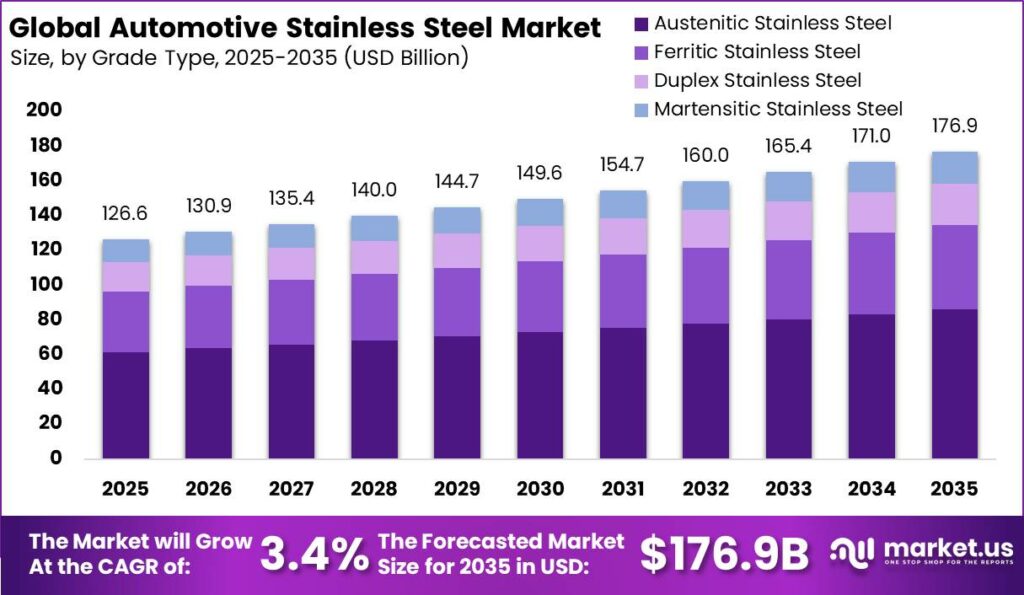
Global Automotive Stainless Steel Market size is expected to be worth around USD 176.9 Billion by 2035 from USD 126.6 Billion in 2025, growing at a CAGR of 3.4% during the forecast period 2026 to 2035. This steady expansion reflects durable demand across exhaust, structural, and emerging electric vehicle applications. Suppliers who lock in certified automotive-grade capacity now will capture the highest-margin specification work.
The market covers stainless steel grades, product forms, and components used in vehicle manufacturing. Producers supply sheets, coils, tubes, bars, and wires to Tier-1 fabricators and OEMs. Therefore, buyers evaluate corrosion resistance, formability, and cost per tonne together. This structure rewards mills that combine metallurgical control with reliable certified delivery to automotive assembly lines.
Key Takeaways
- Global market size reaches USD 176.9 Billion by 2035, up from USD 126.6 Billion in 2025 at a 3.4% CAGR.
- Austenitic Stainless Steel leads grade demand with a 48.70% share.
- Sheets and Coils dominate product form at 42.80%.
- Exhaust Systems lead application demand with 36.50%.
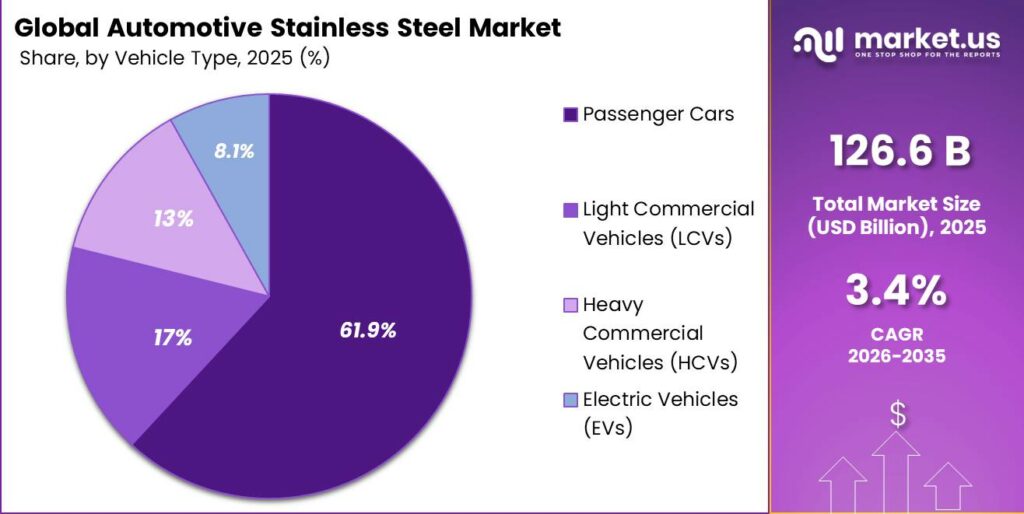
- Passenger Cars account for 61.90% of vehicle type demand.
- Cold Rolled Stainless Steel leads manufacturing process at 58.30%.
- OEM sales dominate distribution with 81.60%.
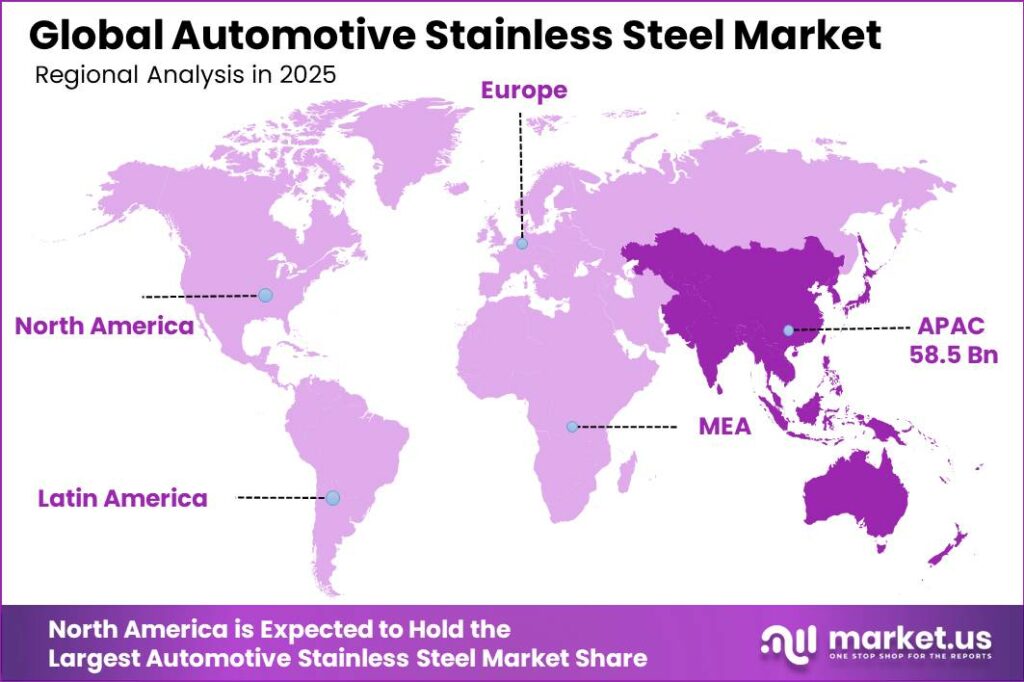
- Asia-Pacific holds the largest regional share at 46.20%, valued at USD 58.5 Billion.
Automotive Metal demand ties directly to per-vehicle steel content, and stainless plays a defined role here. As per our research, an average passenger car uses 15 to 22 kg of stainless steel. This content concentrates in exhaust and corrosion-exposed parts. Mills that certify these grades early secure repeat Tier-1 orders across model cycles.
Governments across the EU, India, and China tighten emission rules that shape grade selection. This means OEMs must lock higher-grade stainless earlier in vehicle design. As per our research, high-strength automotive stainless lets engineers cut up to 30% of material while holding structural performance. Consequently, lightweighting programmes lift value per tonne even as physical volume tightens.
Trade policy now moves supplier economics as fast as engineering does. In October 2025, EU steelmakers including ArcelorMittal and Thyssenkrupp saw share prices rise after import quota tightening proposals. This signals that protection measures directly reward domestic producers. Therefore, mills with EU capacity gain pricing power against import-exposed competitors through the forecast window.
Grade Type Analysis
Austenitic Stainless Steel dominates with 48.70% due to superior corrosion and heat resistance.
In 2025, Austenitic Stainless Steel held a dominant market position in the By Grade Type segment of Automotive Stainless Steel Market, with a 48.70% share. Data from the World Stainless Association shows global stainless output reached 62.6 million tonnes in 2024, up 7% year on year. This scale keeps austenitic grades widely available. Therefore, OEMs standardise on them for exhaust and emission parts with confidence.
Ferritic Stainless Steel serves cost-sensitive exhaust and trim roles where nickel-free chemistry cuts price exposure. It holds a 27.40% share in the grade mix. As reported by the World Stainless Association, China alone produced 39.4 million tonnes of stainless in 2024. This volume floods ferritic supply into Asian automotive chains. Consequently, buyers gain leverage, but domestic mills face sharp margin pressure.
Duplex Stainless Steel functions as the fastest-growing grade, prized for high strength in structural and load-bearing parts. It holds a 13.60% share. Figures from the World Stainless Association show fourth-quarter 2024 output reached 16.45 million tonnes globally. This rising base supports duplex scale-up. This creates room for mills that master its demanding two-phase rolling to win premium structural contracts.
Martensitic Stainless Steel anchors wear and hardness applications such as fasteners and blades, holding the remaining 10.30% share of the grade mix. As per China Iron and Steel Association trends, Chinese melt-shop output rose 7.5% in 2024. This lifts feedstock availability for hardened grades. Therefore, precision-part makers can source martensitic strip more reliably across expanding Asian supply networks.
Product Form Analysis
Sheets and Coils dominate with 42.80% due to versatile forming across vehicle parts.
In 2025, Sheets and Coils held a dominant market position in the By Product Form segment of Automotive Stainless Steel Market, with a 42.80% share. As reported by the World Stainless Association, first-half 2024 output hit 30.40 million tonnes, a 6.3% rise. This flat-product supply feeds stamping lines directly. Consequently, coil producers with automotive certification capture the widest base of orders.
Tubes and Pipes carry exhaust gases and fluids where sealed corrosion resistance matters most, holding a 24.60% share. According to the IEA, electric car sales topped 17 million units worldwide in 2024. This shift trims ICE exhaust tube demand over time. Therefore, tube makers must pivot toward EV cooling and fluid lines to defend volume.
Bars and Rods supply machined shafts, fasteners, and engine parts that need dimensional precision, holding an 18.20% share. Data from the IEA shows EV sales rose more than 25% in 2024. This growth reshapes which machined parts vehicles require. This creates openings for bar suppliers serving battery and drivetrain hardware.
Wires and Others form the fastest-growing product form, feeding springs, mesh, and small precision components, holding the remaining 14.40% share. As per IEA data, the global electric fleet neared 58 million cars by end 2024. This installed base drives demand for fine stainless wire in sensors and connectors. Therefore, wire drawers gain a durable EV-linked growth channel.
Application Analysis
Exhaust Systems dominate with 36.50% due to sustained high-temperature corrosion demands.
In 2025, Exhaust Systems held a dominant market position in the By Application segment of Automotive Stainless Steel Market, with a 36.50% share. As per OICA data, global vehicle production rose from 92.7 million units in 2024 to 96.4 million in 2025. This output base sustains exhaust stainless volume. Therefore, mills serving manifold and converter buyers hold defensible demand near term.
Structural Components use stainless for chassis and reinforcement where strength meets corrosion resistance. Figures from OICA show global vehicle output grew 3.9% year on year into 2025. This production lift raises structural stainless intake per platform. Consequently, suppliers offering high-strength grades gain share as OEMs pursue crash and durability targets together.
Fuel Tanks and Fuel Systems rely on stainless to resist fuel corrosion and pressure cycling over vehicle life. As reported by OICA, China produced 30.3 million passenger cars in 2025. This concentration anchors fuel-system stainless demand in Asia. Therefore, regional fabricators near Chinese assembly hubs hold a structural sourcing advantage on these parts.
Trim and Decorative Components use polished stainless for visible finish quality, while Battery and EV Components stand as the fastest-growing application, together holding the remaining share collectively. As per OICA data, India rose to third place in global passenger car output in 2025. This growth expands both decorative and EV-linked stainless demand. This creates entry points for mills targeting new Asian model programmes.
Vehicle Type Analysis
Passenger Cars dominate with 61.90% due to highest global production volumes.
In 2025, Passenger Cars held a dominant market position in the By Vehicle Type segment of Automotive Stainless Steel Market, with a 61.90% share. Based on OICA data, China alone built 30.3 million passenger cars in 2025. This volume concentrates stainless demand in one high-output market. Therefore, mills with Chinese supply relationships hold outsized influence over passenger car grade pricing.
Light Commercial Vehicles carry stainless in exhaust and cargo-area parts exposed to heavy use and corrosion. As per worldsteel data, an average car contains about 900 kg of steel overall. This total frames how much stainless competes within each vehicle. Consequently, LCV makers weigh stainless against cheaper steel grades on every high-volume component decision.
Heavy Commercial Vehicles demand durable stainless for large exhaust and structural assemblies built for long service. As reported by worldsteel, steel makes up roughly 65% of an average vehicle’s weight. This dominance limits stainless to specialised roles. Therefore, HCV stainless suppliers must justify premium content through proven corrosion and lifecycle savings.
Electric Vehicles form the fastest-growing vehicle type, using stainless in battery enclosures and cooling plates, holding the remaining share collectively with commercial classes. As per IEA figures, EVs exceeded 20% of new car sales in 2024. This shift redirects stainless from exhaust to battery structures. This creates a redesign opportunity for producers of thin-gauge enclosure strip.
Manufacturing Process Analysis
Cold Rolled Stainless Steel dominates with 58.30% due to superior surface finish precision.
In 2025, Cold Rolled Stainless Steel held a dominant market position in the By Manufacturing Process segment of Automotive Stainless Steel Market, with a 58.30% share. As per World Stainless Association data, Asia produced close to 60% of global stainless output. This regional weight favours cold-rolled coil supply. Therefore, precision automotive buyers concentrate sourcing where finishing capacity clusters.
Hot Rolled Stainless Steel serves thicker structural and heavy exhaust parts where tight surface finish is not essential, holding the remaining process share. As reported by the World Stainless Association, global output reached 62.6 million tonnes in 2024. This scale keeps hot-rolled feedstock abundant for downstream cold rolling. Consequently, integrated mills capture margin across both stages of the process chain.
End Use Component Analysis
Exhaust and Emission Control Systems dominate with 34.70% due to strict global emission rules.
In 2025, Exhaust and Emission Control Systems held a dominant market position in the By End Use Component segment of Automotive Stainless Steel Market, with a 34.70% share. As per OICA data, global vehicle production reached 96.4 million units in 2025. This base sustains emission-part stainless demand. Therefore, converter and manifold suppliers hold firm near-term order visibility.
Chassis and Structural Parts use stainless for corrosion-critical frame and suspension elements. Figures from OICA show output grew 3.9% year on year into 2025. This growth lifts structural stainless intake per new platform. Consequently, mills offering high-strength grades win as OEMs balance weight and durability.
Engine Components rely on stainless valves, clamps, and fasteners built for heat and pressure cycling. As reported by the IEA, EV sales rose over 25% in 2024. This shift gradually trims engine-part stainless in ICE platforms. Therefore, component makers must diversify toward hybrid and EV thermal parts.
Fasteners and Hardware supply corrosion-resistant joining parts across the vehicle, while Battery Enclosures and EV Structures rank as the fastest-growing component, together holding the remaining share collectively. As per IEA data, the global EV fleet neared 58 million cars by end 2024. This installed base drives enclosure and hardware demand. This creates a growth lane for thin-gauge structural strip producers.
Sales Channel Analysis
OEM dominates with 81.60% due to direct supply into vehicle assembly.
In 2025, OEM held a dominant market position in the By Sales Channel segment of Automotive Stainless Steel Market, with an 81.60% share. As per OICA data, China produced 30.3 million passenger cars in 2025. This assembly scale locks stainless demand into OEM contracts. Therefore, mills prioritise long-term OEM qualification over spot aftermarket sales.
Aftermarket supplies replacement exhausts, trim, and corrosion-exposed parts over a vehicle’s service life, holding the remaining channel share. Based on IEA figures, the global vehicle fleet keeps expanding past 58 million electric cars alone by end 2024. This growing parc sustains replacement demand. Consequently, aftermarket suppliers gain steady, cycle-resistant revenue independent of new-build swings.
Key Market Segments
By Grade Type
- Austenitic Stainless Steel
- Ferritic Stainless Steel
- Duplex Stainless Steel
- Martensitic Stainless Steel
By Product Form
- Sheets & Coils
- Tubes & Pipes
- Bars & Rods
- Wires & Others
By Application
- Exhaust Systems
- Structural Components
- Fuel Tanks & Fuel Systems
- Trim & Decorative Components
- Battery & EV Components
By Vehicle Type
- Passenger Cars
- Light Commercial Vehicles (LCVs)
- Heavy Commercial Vehicles (HCVs)
- Electric Vehicles (EVs)
By Manufacturing Process
- Cold Rolled Stainless Steel
- Hot Rolled Stainless Steel
By End Use Component
- Exhaust & Emission Control Systems
- Chassis & Structural Parts
- Engine Components
- Fasteners & Hardware
- Battery Enclosures & EV Structures
By Sales Channel
- OEM
- Aftermarket
Regional Analysis
Asia-Pacific Dominates the Automotive Stainless Steel Market with a Market Share of 46.20%, Valued at USD 58.5 Billion
Automotive Metal Stamping capacity clusters heavily across Asia-Pacific, which anchors regional dominance. Asia-Pacific holds a 46.20% share worth USD 58.5 Billion. As per our research, the region concentrates both stainless production and vehicle assembly. This dual strength shortens supply chains for local Tier-1 fabricators. Therefore, mills based here capture cost and delivery advantages competitors cannot match easily.
Europe stands as a fast-moving region where trade policy reshapes supply economics rapidly. In October 2025, the European Commission proposed cutting tariff-free steel import quotas by nearly 50% to protect domestic producers. This move lifts pricing power for EU mills. Consequently, European automotive stainless suppliers gain margin room as import competition narrows through the forecast period.
Key Regions and Countries
North America
- US
- Canada
Europe
- Germany
- France
- The UK
- Spain
- Italy
- Rest of Europe
Asia Pacific
- China
- Japan
- South Korea
- India
- Australia
- Rest of APAC
Latin America
- Brazil
- Mexico
- Rest of Latin America
Middle East and Africa
- GCC
- South Africa
- Rest of MEA
Market Dynamics
Market Opportunity Analysis - Underexploited EV components, hydrogen strip, and Indian localisation open entry lanes for new players
Battery and EV Components stand out as the clearest underexploited application, ranked fastest-growing yet still below the 36.50% exhaust base. This means enclosure and cooling-plate demand outpaces current supply readiness. New entrants who standardise thin-gauge enclosure strip early can lock EV platform contracts. Therefore, first movers gain durable positions before incumbents redirect exhaust-focused capacity.
Electric Vehicles as a vehicle type remain underserved despite fastest-growing status, sitting far below the 61.90% passenger car share. This gap reflects supply built for ICE architectures. Consequently, mills that requalify lines for EV structural stainless capture share as the fleet expands. This creates a redesign advantage for producers willing to invest ahead of volume.
India offers an underexploited regional lane, distinct from the 46.20% Asia-Pacific concentration led by China. As a result, localised Indian production can substitute imports for rising domestic assembly. New entrants building certified capacity near Indian OEM hubs shorten supply chains. This signals a defensible cost position against distant coil suppliers.
Technology and Innovation Landscape - Grade upgrading, lightweighting, and precision strip define the competitive frontier
Higher-grade ferritic and austenitic stainless adoption marks the leading innovation, replacing Type 409 with Type 441, 436, and 304 in exhaust systems. This shift responds to hotter emission-control operating temperatures. Manufacturers with certified alloy control capture premium specification work. Therefore, mills lacking automotive-grade metallurgy risk exclusion from the highest-value exhaust contracts.
High-strength stainless enables lightweighting, letting engineers cut up to 30% of material while holding structural performance. This capability aligns stainless with OEM weight and efficiency targets. Consequently, suppliers offering strength-optimised grades win structural and chassis programmes. This creates a technical moat against cheaper substitute metals in load-bearing parts.
FCEV bipolar plate precision strip represents the most advanced material frontier, requiring ultra-thin gauges near 0.05 mm. This demands rolling and coating capabilities few producers hold. Therefore, early investors in precision mills secure concentrated, high-margin hydrogen supply positions. This signals a long-term innovation lead for producers who commit capital now.
Drivers
The primary active driver is the progressive tightening of exhaust emission standards, most critically the EU’s Euro 7 regulation (EU Regulation 2024/1257, published 19 June 2024, applying to new passenger car type approvals from 1 July 2030) and India’s Bharat Stage VI Phase 2 real-driving emissions norms effective 1 April 2023. These rules require catalytic converter systems to sustain higher continuous operating temperatures of 900 to 1,050°C. This disqualifies lower-grade Type 409 and 439 ferritic steels in favour of Type 441, 436, and austenitic Type 304 and 316 grades.
The quantitative mechanism is a per-vehicle grade upgrade. Shifting from Type 409 to Type 441 or austenitic grades adds roughly USD 12 to 28 per vehicle in incremental material cost. Type 441 and 436 grades carry mill price premiums of 12 to 20% over Type 409 and are gaining 3 to 5 percentage points of mix share yearly. This enables certified producers to expand gross margins by 4 to 7 percentage points on automotive exhaust specification material.
| Driver | (~) % Impact on CAGR Forecast | Geographic Relevance | Impact Timeline |
|---|---|---|---|
| Exhaust System Emission Compliance Upgrades Mandating Higher-Grade Ferritic & Austenitic Stainless Steel | +1.20% | European Union, India, China, United States, South Korea, Japan | Short term (≤ 2 years) |
| Fuel Cell Electric Vehicle (FCEV) Bipolar Plate & Stack Component Stainless Steel Demand | +0.80% | Japan, South Korea, Germany, China, United States | Medium term (2–4 years) |
| Premium & Luxury Vehicle Segment Growth Driving Decorative & Structural Stainless Steel Application Expansion | +0.55% | Germany, United States, China, United Kingdom, Japan, GCC | Short term (≤ 2 years) |
| Corrosion Resistance Requirements in EV Underbody & Battery Enclosure Applications Favouring Stainless Steel | +0.48% | China, United States, Europe, South Korea | Medium term (2–4 years) |
| Global Vehicle Production Volume Growth in India & Southeast Asia Expanding Base Demand | +0.38% | India, Thailand, Indonesia, Vietnam, Mexico | Short term (≤ 2 years) |
Restraints
The root cause is architecturally absolute. Battery electric vehicles carry no exhaust system, catalytic converter, or manifold, which eliminates the category that historically drove an estimated 55 to 65% of automotive stainless demand by weight. Each BEV removes roughly 9 to 14 kg of stainless demand per converted vehicle. As BEV share exceeded 50% of monthly domestic passenger car sales in China by 2024, this demand destruction operates at the core application level, not through price alone.
The quantitative bottleneck is that no scaled BEV application replaces exhaust volume per vehicle. EV stainless uses such as battery enclosure strips (0.8 to 2.5 kg) and decorative trim (1.5 to 4 kg) total only 2.5 to 7 kg per BEV. This creates a per-vehicle deficit of 40 to 65%. Exhaust-grade ferritic lines representing 35 to 45% of automotive rolling capacity now face secular decline in high-BEV markets.
| Restraint | (~) % Impact on CAGR Forecast | Geographic Relevance | Impact Timeline |
|---|---|---|---|
| BEV Powertrain Displacement of ICE Exhaust Systems Eliminating the Largest Single Stainless Steel Application | -1.10% | Europe, China, North America — high BEV penetration markets | Short term (≤ 2 years) |
| Nickel & Chromium Alloy Price Volatility Suppressing Automotive Stainless Steel Demand Certainty | -0.65% | Global — most acute for austenitic grade procurement in Europe & North America | Short term (≤ 2 years) |
| Aluminium & Advanced High-Strength Steel Substitution in Structural & Body Panel Applications | -0.45% | Europe, United States, Japan — lightweighting-focused OEM markets | Medium term (2–4 years) |
| Section 232 Tariffs & EU Steel Safeguard Measures Distorting Import Cost Economics for Stainless Steel Trade | -0.30% | United States, European Union — import-dependent automotive stainless steel markets | Short term (≤ 2 years) |
Challenges
The structural vulnerability is sustained Chinese stainless overcapacity, which expanded from roughly 28 to 30 million tonnes of annual crude output in 2020 to an estimated 35 to 38 million tonnes by 2024. Weak domestic construction demand redirected output toward global automotive markets. Chinese ferritic coil reached Southeast Asian and Indian supply chains at prices roughly 18 to 28% below European and Japanese mill levels through 2023 to 2025. This forces Tier-1 buyers to qualify Chinese coil or accept cost disadvantage.
The EU deployed anti-dumping duties on Chinese cold-rolled stainless flat products (Council Regulation (EU) 2015/1429), yet automotive ferritic and precision grades often fall outside existing scope. Long-term adjustments require non-Chinese mills to shift toward ultra-thin FCEV strip (0.05 to 0.12 mm) and high-surface decorative coil, demanding investments of USD 80,000,000 to 250,000,000 in mill upgrades. Trade remedy filings each take 18 to 36 months to reach provisional duties.
| Challenge | (~) % CAGR Friction Drag | Geographic Relevance | Mitigation Horizon |
|---|---|---|---|
| Chinese Stainless Overcapacity & Dumping Pressure | -0.85% | Europe, United States, India, Southeast Asia, Latin America — all import-exposed markets | Long term (≥ 4 years) |
| Thin-Gauge Precision Strip Tooling & Tolerance Qualification Complexity | -0.60% | Global — most acute for FCEV bipolar plate & advanced sensor housing applications | Long term (≥ 4 years) |
| Stainless Scrap Collection & Recycled Content Certification for Auto OEM ESG Requirements | -0.42% | Europe, United States, Japan — OEMs with Science Based Targets initiative commitments | Long term (≥ 4 years) |
| Forming & Welding Compatibility Challenges with New Ultra-High-Strength Grades | -0.28% | Global — affects OEM body structure & chassis lightweighting programmes | Medium term (2–4 years) |
Opportunities
This opportunity is untapped future white space, not a current driver. As of 2025 to 2026, FCEV production stayed at an estimated 20,000 to 25,000 units annually, fewer than 0.03% of global vehicle output. Yet a single PEM stack needs about 300 to 400 bipolar plates at 0.05 to 0.10 mm thickness, consuming 15 to 30 kg of ultra-thin precision strip per vehicle. This equals a per-vehicle material value of USD 180 to 450.
National policy confirms the white space. South Korea targets FCEV output above 500,000 units annually by 2030, and China targets 1 million FCEVs by 2035. Fewer than 5 to 8 producers globally can meet the required ±2 µm thickness tolerance and coating standards. First movers secure gross margins of 55 to 70%, a 20 to 30 percentage point premium, after investing USD 100,000,000 to 350,000,000 over a 4 to 7 year ramp.
| Opportunity | (~) % Potential CAGR Upside | Geographic Relevance | Execution Window |
|---|---|---|---|
| FCEV Bipolar Plate Ultra-Thin Precision Strip Supply to Hydrogen Vehicle Programmes | +1.10% | Japan, South Korea, Germany, China, United States | Long term (≥ 4 years) |
| EV Battery Enclosure Stainless Steel Structural Frame & Cooling Plate Application Standardisation | +0.72% | China, United States, Germany, South Korea | Medium term (2–4 years) |
| Green & Low-Carbon Stainless Steel Certification for Automotive OEM Scope 3 Procurement Mandates | +0.55% | European Union, United States, Japan, South Korea — OEMs with SBTi commitments | Long term (≥ 4 years) |
| India Domestic Automotive Stainless Steel Production Localisation for Import Substitution | +0.38% | India | Medium term (2–4 years) |
Key Company Insights
Acerinox S.A. holds a strategic advantage through its integrated European and North American stainless capacity serving automotive exhaust and emission parts. As per our research, stainless steel is mainly used in exhaust systems and small components. This concentration matches Acerinox strengths in flat automotive grades. In November 2025, Acerinox supported EU tightening of steel import quotas ahead of 2026 implementation. Therefore, its policy alignment reinforces pricing power against low-cost imports.
Outokumpu Oyj builds its edge on low-carbon stainless production that meets rising OEM sustainability demands. As per our research, some passenger vehicle configurations use up to 30 kg of stainless per car in high-corrosion designs. This content rewards suppliers offering certified premium grades. Outokumpu focus on green stainless positions it for Scope 3 procurement mandates. Consequently, it gains first-mover access to environmentally screened automotive contracts across Europe.
Key Players
- Acerinox S.A.
- Outokumpu Oyj
- Aperam S.A.
- POSCO Holdings
- Nippon Steel Corporation
- JFE Steel Corporation
- Thyssenkrupp Materials Services
- ArcelorMittal
- Baowu Steel Group
- Tsingshan Holding Group
- Allegheny Technologies Incorporated (ATI)
- Sandvik AB
- AK Steel (Cleveland-Cliffs)
- Yieh United Steel Corp. (YUSCO)
- Viraj Profiles Ltd.
Geopolitical Impact Analysis
According to the WTO, global steel trade faces mounting friction as protection measures spread across major automotive markets. The European Commission proposed cutting tariff-free steel import quotas by nearly 50%, while US Section 232 tariffs hold at 25% on steel imports. These measures raise landed stainless coil costs for Tier-1 exhaust and structural suppliers. This creates sourcing uncertainty that pushes OEMs toward regionalised, higher-cost domestic stainless procurement.
As reported by UNCTAD, supply chain rerouting and shipping disruption lift logistics costs for stainless feedstock such as nickel and chromium. Red Sea diversions have added 10 to 14 days to some Asia-Europe transits, while container rates rose sharply above pre-disruption levels. These delays strain just-in-time automotive stainless delivery. Therefore, mills near assembly hubs gain a structural edge as buyers prioritise supply security over lowest unit cost.
Recent Developments
- June 2025: SSAB signed a supply agreement with Volvo Cars for SSAB Zero steel for serial automotive production.
- June 2025: Outokumpu partnered with Alstom to supply low-emission stainless steel for metro car production.
- February 2026: Aperam projected recovery in stainless steel demand driven by EU trade protection measures.
Report Scope
| Report Features | Description |
|---|---|
| Market Value (2025) | USD 126.6 Billion |
| Forecast Revenue (2035) | USD 176.9 Billion |
| CAGR (2026-2035) | 3.4% |
| Base Year for Estimation | 2025 |
| Historic Period | 2020-2024 |
| Forecast Period | 2026-2035 |
| Report Coverage | Revenue Forecast, Market Dynamics, Market Opportunity Analysis, Technology and Innovation Landscape, Competitive Landscape, Recent Developments |
| Segments Covered | By Grade Type (Austenitic, Ferritic, Duplex, Martensitic Stainless Steel), By Product Form (Sheets & Coils, Tubes & Pipes, Bars & Rods, Wires & Others), By Application (Exhaust Systems, Structural Components, Fuel Tanks & Fuel Systems, Trim & Decorative Components, Battery & EV Components), By Vehicle Type (Passenger Cars, LCVs, HCVs, EVs), By Manufacturing Process (Cold Rolled, Hot Rolled Stainless Steel), By End Use Component (Exhaust & Emission Control Systems, Chassis & Structural Parts, Engine Components, Fasteners & Hardware, Battery Enclosures & EV Structures), By Sales Channel (OEM, Aftermarket) |
| Regional Analysis | North America (US and Canada), Europe (Germany, France, The UK, Spain, Italy, and Rest of Europe), Asia Pacific (China, Japan, South Korea, India, Australia, and Rest of APAC), Latin America (Brazil, Mexico, and Rest of Latin America), Middle East and Africa (GCC, South Africa, and Rest of MEA) |
| Competitive Landscape | Acerinox S.A., Outokumpu Oyj, Aperam S.A., POSCO Holdings, Nippon Steel Corporation, JFE Steel Corporation, Thyssenkrupp Materials Services, ArcelorMittal, Baowu Steel Group, Tsingshan Holding Group, Allegheny Technologies Incorporated (ATI), Sandvik AB, AK Steel (Cleveland-Cliffs), Yieh United Steel Corp. (YUSCO), Viraj Profiles Ltd. |
| Customization Scope | Customization for segments, region / country-level will be provided. Additional customization can be done based on requirements. |
| Purchase Options | We have three licenses to opt for: Single User License | Multi-User License (Up to 5 Users) | Corporate Use License (Unlimited User and Printable PDF) |





































