


Report Overview
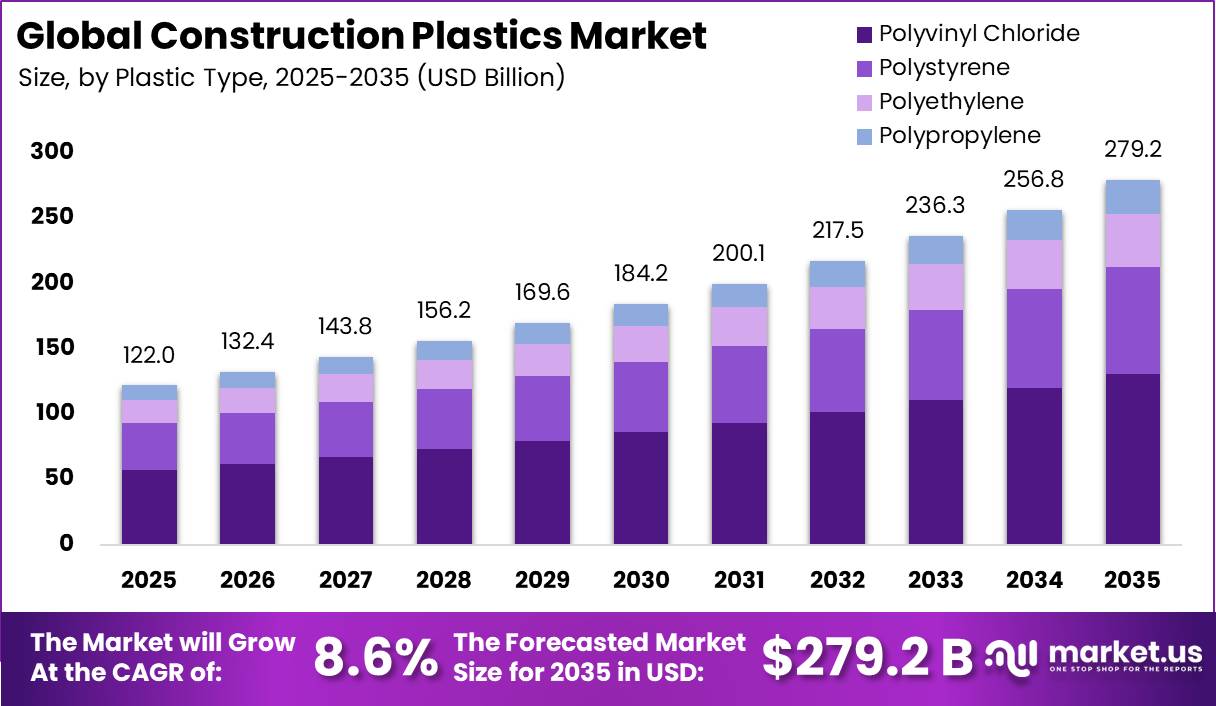
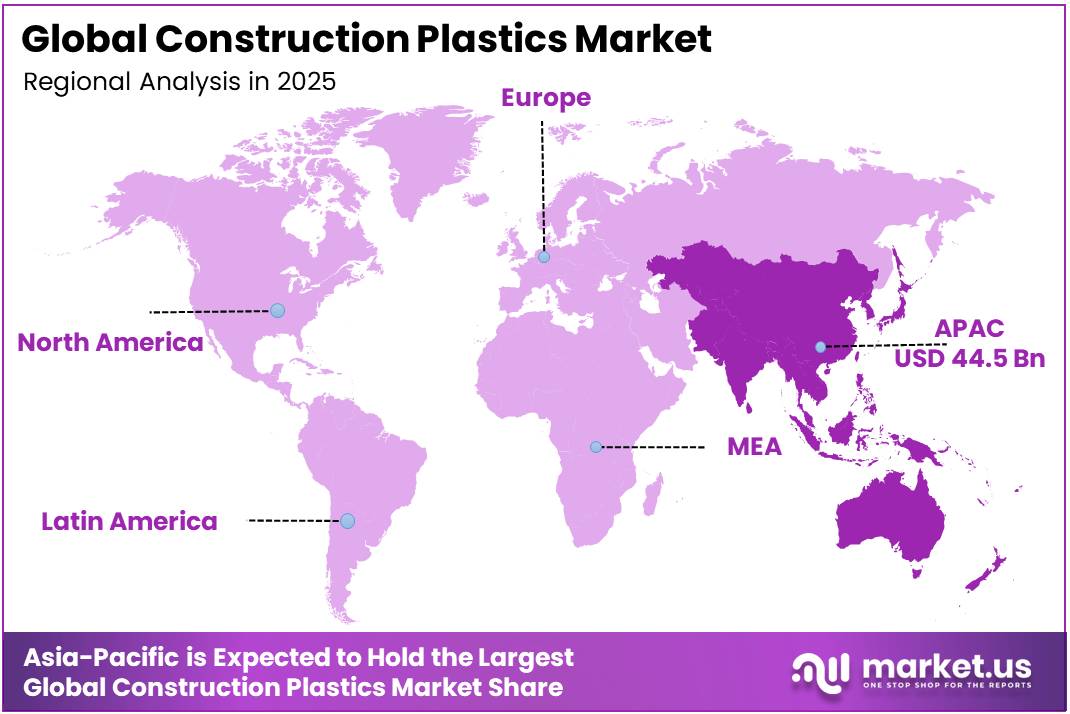
The Global Construction Plastics Market size is expected to be worth around USD 279.2 by 2035, from USD 122.0 in 2025, growing at a CAGR of 8.6% during the forecast period from 2026 to 2035. In 2025, Asia-Pacific led the market, achieving over 36.5% share with a revenue of USD 44.5 Billion.
Construction plastics include polyvinyl chloride, polyethylene, polypropylene, polystyrene, polyurethane and other polymer-based materials used in pipes, insulation, windows, doors, flooring, roofing membranes, wall panels and protective systems. These materials have become important in modern construction because they are lightweight, corrosion-resistant, durable and easier to transport and install than many traditional alternatives. Their resistance to moisture, chemicals and biological degradation supports long service life in water networks, drainage systems, electrical conduits and building-envelope applications.
- In May 2026, the United Nations Environment Programme reported that buildings and construction represented approximately 11–13% of global GDP, employed around 9% of the worldwide workforce, generated nearly 37% of global carbon dioxide emissions and consumed almost 50% of extracted materials.
Key Takeaways
- The Global Construction Plastics Market was valued at USD 122.0 billion in 2025.
- The market is projected to grow at a CAGR of 8.6% and is estimated to reach USD 279.2 billion by 2035.
- On the basis of plastic type, Polyvinyl Chloride dominated the market, constituting 46.8% of the total market share.
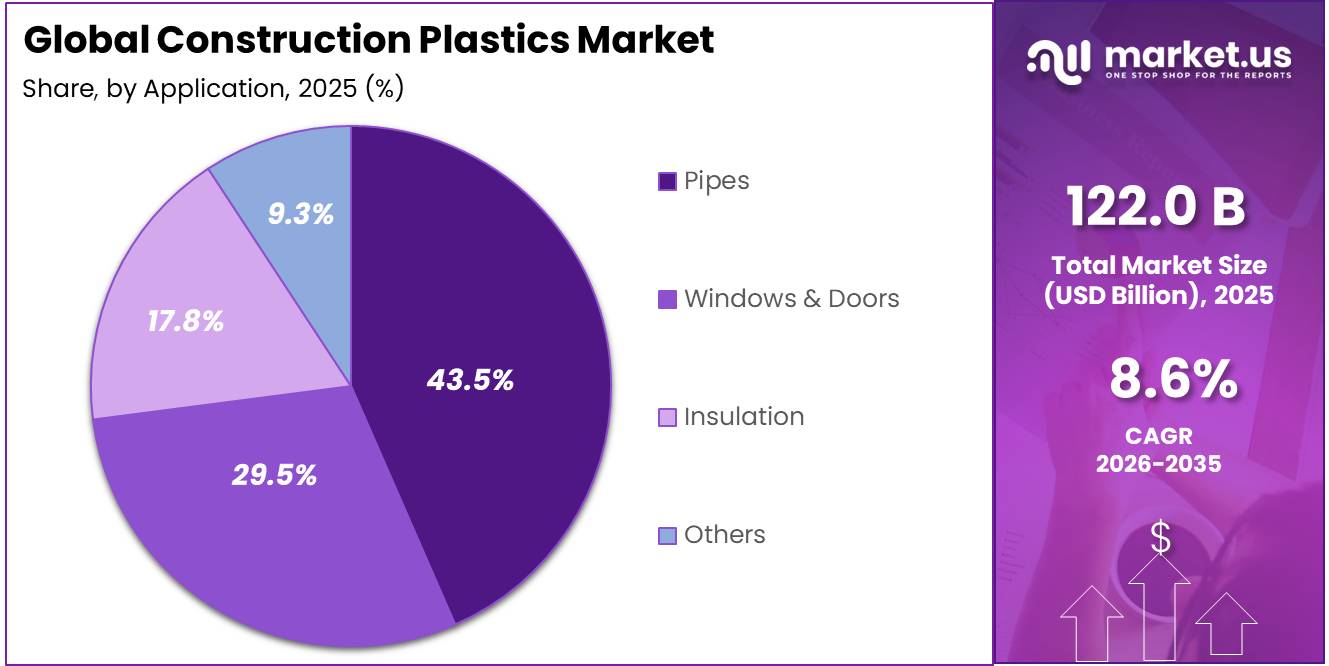
- Based on the application, Pipes dominated the market, with a substantial market share of around 43.5%.
- Based on the end user, Non-residential Construction led the market, comprising 57.7% of the total market.
- In 2025, Asia-Pacific was the most dominant region in the market, accounting for 36.5% of the total global consumption.
In September 2023, the U.S. Environmental Protection Agency reported through its Seventh Drinking Water Infrastructure Needs Survey that public water systems across the United States required USD 625 billion in capital improvements over a 20-year period. Distribution and transmission projects accounted for 67% of the total requirement, showing the extensive need to install, replace and rehabilitate water pipelines. This spending requirement supports the long-term use of PVC and polyethylene pipes because these materials offer corrosion resistance, low weight and easier installation in underground water networks.
Energy efficiency regulations are also strengthening the role of construction plastics. In 2025, the International Energy Agency reported that buildings accounted for nearly 30% of global energy demand, with residential buildings representing about 70% of building energy use. In advanced economies, space and water heating together accounted for approximately 70% of household energy consumption, highlighting the importance of effective insulation, sealed windows and thermally efficient building envelopes. Polymer insulation products, including polyurethane and expanded or extruded polystyrene, are therefore expected to benefit from renovation programmes and stricter building-energy codes.
- In 19 December 2025, the European Commission reported that circular solutions could improve the European plastics sector’s trade balance by approximately EUR 18 billion per year by 2050, while also reducing its climate-related emissions by 45%. The figure represents a potential economic benefit from plastics circularity rather than an annual investment requirement for construction value chains.
New European construction-product rules also introduce Digital Product Passports, improving traceability, safety information and whole-building carbon calculations. These measures are likely to encourage manufacturers to develop lower-carbon polymers, recycled-content products and long-life construction systems that combine technical performance with measurable environmental benefits.
Plastic Type Analysis
Polyvinyl Chloride leads with a 46.8% share due to its broad use in pipes, flooring, windows, and building systems.
In 2025, Polyvinyl Chloride held a dominant market position, capturing more than a 46.8% share of the Construction Plastics Market by plastic type. Its leading position was supported by extensive use in water and drainage pipes, electrical conduits, window profiles, roofing membranes, flooring, wall coverings, and insulation systems. Construction companies commonly prefer PVC because it is lightweight, resistant to moisture and corrosion, easy to install, and suitable for long-term applications. Demand was also supported by continuing residential and infrastructure construction activity.
- In May 2026, the U.S. Census Bureau recorded privately owned housing starts at a seasonally adjusted annual rate of 1.177 million units. This level of building activity supported the consumption of PVC-based pipes, fittings, cables, flooring, and window components across new housing projects.
Polystyrene is the fastest-growing segment in the Construction Plastics Market by plastic type. Its growth is mainly linked to increasing use of expanded and extruded polystyrene in wall insulation, roofing systems, foundations, concrete forms, and protective construction panels. The material provides low weight, thermal insulation, moisture resistance, and easy installation, making it suitable for residential and commercial energy-efficiency projects.
- In March 2026, total U.S. construction spending reached a seasonally adjusted annual rate of USD 2,185.5 billion, increasing from USD 2,173.2 billion in February. This continued construction expenditure created wider opportunities for polystyrene insulation boards and lightweight building components, particularly in projects focused on improving indoor temperature control and lowering building energy requirements.
Application Analysis
Pipes dominate the Construction Plastics Market with a 43.5% share due to their extensive use in water and drainage infrastructure.
In 2025, Pipes held a dominant market position, capturing more than a 43.5% share of the Construction Plastics Market. The segment remained strong because plastic pipes are widely used in drinking-water networks, wastewater systems, drainage lines, plumbing installations and underground utility connections. Their lightweight structure, corrosion resistance, smooth internal surface and simple installation make them suitable for both new construction and infrastructure replacement. Government investment also supported pipe demand.
- In May 2026, the U.S. Environmental Protection Agency announced nearly USD 2.9 billion in funding to identify and replace lead pipes that carry drinking water to homes. This investment directly supports demand for replacement pipes and related construction materials.
Windows & Doors is the fastest-growing segment in the Construction Plastics Market. In 2025, demand increased as builders and property owners focused on durable, low-maintenance and energy-efficient building components. Plastic window and door frames provide resistance to moisture, corrosion and changing weather conditions while offering good insulation performance. Their easy cleaning, longer service life and ability to reduce air leakage make them useful in residential and commercial renovation projects.
End User Analysis
Non-residential construction dominates with a 57.7% share due to strong demand across commercial and public infrastructure projects.
In 2025, Non-residential Construction held a dominant market position, capturing more than a 57.7% share. The segment maintained its lead because construction plastics are widely used in offices, factories, hospitals, educational buildings, warehouses and public infrastructure. Plastic pipes, insulation materials, roofing membranes, flooring and window systems are preferred due to their durability, low maintenance needs and resistance to moisture and corrosion.
- In May 2026, private non-residential construction spending in the United States reached a seasonally adjusted annual rate of USD 738.7 billion, according to the U.S. Census Bureau. Public construction spending stood at USD 541.2 billion, including USD 113.4 billion for educational construction and USD 150.6 billion for highway projects. This large level of commercial and public-sector activity supports demand for plastic pipes, insulation, roofing sheets, flooring and other construction plastic products
Residential Construction is the fastest-growing segment. Growth is supported by rising housing development, renovation activity and demand for lightweight, affordable and energy-efficient building materials. Construction plastics are increasingly used in plumbing, insulation, flooring, roofing, windows and doors because they simplify installation and help improve building performance. The segment is also benefiting from the replacement of traditional materials with durable plastic products in both new housing and home improvement projects.
Key Market Segments
By Plastic Type
- Polyvinyl Chloride
- Polystyrene
- Polyethylene
- Polypropylene
By Application
- Pipes
- Windows & Doors
- Insulation
- Others
By End User
- Non-residential Construction
- Residential Construction
Driver Analysis
Building-envelope efficiency incentives lifting insulation, membranes, and fenestration polymers
In the U.S., the DOE states that the 179D commercial buildings deduction for 2025 ranged from $0.58 to $1.16 per square foot and, under updated rules, can rise to $2.83-$5.65 per square foot depending on savings and labor conditions, while household efficiency credits can reach a total annual limit of $3,200, including up to $1,200 for envelope measures and up to $2,000 for qualifying heat-pump-related upgrades.
Those incentives directly support polymer-intensive components in the building envelope, including rigid foam insulation, vapor barriers, waterproofing membranes, spacer systems, sealants, window profiles, and low-leakage ducting, because code-compliant efficiency upgrades are usually executed as a systems package rather than a single-product purchase. The business-model implication is that plastics suppliers capture value not only from material tonnage but from specification-led premiumization, where higher R-values, moisture resistance, durability, and installation productivity justify margin expansion even if overall new-build activity grows only modestly
Drivers Impact Analysis
| Driver | (~) % Impact on CAGR Forecast | Geographic Relevance | Impact Timeline |
|---|---|---|---|
| Lead-service-line and water-network renewal boosting PVC/HDPE pipe demand | +1.4% | North America core, selective EU municipal networks | Short term (≤ 2 years) |
| Building-envelope efficiency incentives lifting insulation, membranes, and fenestration polymers | +1.2% | North America core, EU, developed APAC cities | Short term (≤ 2 years) |
| EU EPBD compliance and lifecycle-carbon disclosure shifting material mix toward high-performance plastics | +0.9% | EU core, UK alignment spill-over, premium APAC export projects | Medium term (2-4 years) |
| Sustained residential and public construction outlays supporting pipes, profiles, flooring, and cable management | +1.0% | North America core, APAC corridors, Middle East project clusters | Short term (≤ 2 years) |
| Heat-stress and cooling-load mitigation increasing use of insulation foams, reflective systems, and airtight polymer assemblies | +0.8% | Hot-climate APAC, U.S. Sun Belt, Southern Europe, Middle East | Medium term (2-4 years) |
| Foreign-investment-backed infrastructure and industrial parks expanding demand for plastic pipe, insulation, and building products | +0.7% | China clusters, wider APAC corridors, emerging-market | Medium term (2-4 years) |
Restraint Analysis
Tightening plastic pollution & microplastics regulation
The tightening of plastic pollution and microplastics regulation is emerging as one of the most direct brakes on construction plastics volume growth, with EU REACH Commission Regulation (EU) 2023/2055 restricting synthetic polymer microparticles and setting concentration thresholds of 0.01% by weight for intentionally added microplastics in many product categories, while guidance and application timelines are being reinforced through 2024–2026. In practice, construction plastics used in sealants, coatings, flooring compounds, and specialty additives will need reformulation cycles of 24–36 months per product family, typically costing mid‑sized manufacturers an incremental 2–3% of annual sales in R&D and testing outlays, plus 0.5–1.0 percentage points margin compression from higher compliant inputs and certification fees.
Based on current transition periods and enforcement regimes, this regulatory tightening is modeled to remove around 3–4% of potential demand in certain EU sub‑segments by 2030, translating into an approximate –1.8 percentage point drag on global construction plastics CAGR over 2026–2034, as EU and UK together represent ~20–25% of the formal construction market and often set de‑facto global product standards. Strategically, suppliers must absorb longer qualification lead times, higher inventory obsolescence as non‑compliant SKUs are phased out, and rising working‑capital intensity, which delays CapEx in new extrusion lines or compounding capacity and shifts the portfolio toward lower‑volume, higher‑specification materials rather than pure tonnage growth.
Restraint Impact Analysis
| Restraint | (~) % Impact on CAGR Forecast | Geographic Relevance | Impact Timeline |
|---|---|---|---|
| Tightening plastic pollution & microplastics regulation | -1.8% | EU, UK, North America core | Medium term (2–4 years) |
| Stricter emissions & hazardous-chemicals rules on PVC and resins | -1.5% | North America core, EU | Medium–Long term (2–5+ years) |
| Plastic waste management & traceability compliance burden | -1.2% | India, emerging Asia, select MEA | Short–Medium term (≤ 3 years) |
| Volatile resin and feedstock costs under climate & energy policies | -1.0% | Global, with EU & Asia manufacturing corridors | Short term (≤ 2 years) |
| Construction product sustainability standards favoring low-plastic alternatives | -1.3% | EU, UK, advanced APAC | Medium–Long term (3–6+ years) |
| Supply chain regionalization and localized compliance fragmentation | -0.9% | North America, EU, APAC corridors | Medium term (2–4 years) |
Opportunity Analysis
Circular construction plastics
The European Commission states that construction and demolition waste accounts for more than one-third of all waste generated in the EU, and OECD analysis warns that without more ambitious policies global plastic production, use, and waste could expand by 70% by 2040, which together signal a large feedstock and compliance gap that incumbent suppliers have not yet fully converted into a business model.
A realistic commercialization path is to build closed-loop profile, membrane, and non-pressure pipe platforms using selective demolition partnerships and certified recycled compounds; if recycled-content products reach just 12% to 18% of construction-plastics portfolios in the EU and premium markets, suppliers could unlock a $3 billion to $7 billion incremental TAM through green public procurement, EPD-backed tenders, and avoided carbon-cost pass-through, while lowering raw-material volatility exposure by 8% to 12% and customer acquisition costs by 10% to 20% through specification lock-in.
The +1.4 percentage-point CAGR upside is therefore tied less to volume growth than to margin-rich mix shift, because circular offerings can command 5% to 12% pricing premiums in regulated projects, raise bid win rates by 400 to 700 basis points where sustainability scoring matters, and create a secondary monetization layer through waste collection, processing tolling, and recycled-content certification services.
Opportunity Impact Analysis
| Opportunity | (~) % Potential CAGR Upside | Geographic Relevance | Execution Window |
|---|---|---|---|
| Deep-retrofit envelope plastics | +1.9% | EU core, UK, North America | Short term (≤ 2 years) |
| Water infra polymer systems | +1.6% | North America core, India, GCC | Short term (≤ 2 years) |
| Circular construction plastics | +1.4% | EU, Japan, South Korea | Medium term (2-4 years) |
| Affordable modular housing compounds | +1.8% | India, Southeast Asia, MENA, Africa | Medium term (2-4 years) |
| Smart facade and cable-management plastics | +1.2% | EU, U.S., China, advanced APAC | Medium term (2-4 years) |
| Roll-up of fragmented converters/fabricators | +1.5% | North America, EU, India | Long term (≥ 4 years) |
Challenges Analysis
Fragmented recycling & circular flows
Fragmented collection systems and under‑developed recycling infrastructure generate chronic friction for construction plastics by constraining the supply of consistent secondary feedstock and exposing firms to reputational and compliance risk without immediately eliminating demand, with government and multilateral assessments indicating that only 9–14% of total plastic waste is formally recycled in many large economies and that construction‑related plastics contribute a growing share of the remaining 86–91% mismanaged or landfilled volumes.
In India, for example, national and state‑level documents on plastic waste management note that despite the Plastic Waste Management Rules and road‑construction directives encouraging use of non‑recyclable waste, urban local bodies still operate with collection efficiencies in the 60–75% range and material recovery levels below 30%, leading construction plastics producers to face inconsistent supply of recyclate with batch‑to‑batch property variation of 10–15% in impact strength and stiffness, and cost differentials of 8–12% versus virgin material.
Across the EU and advanced Asian cities, stricter extended producer responsibility schemes and landfill taxes raise effective compliance costs by an estimated 2–3% of sales for firms with large construction plastics portfolios, while green public procurement nudges demand but simultaneously raises qualification requirements, translating to roughly a 1.1 percentage‑point drag on market CAGR as players spend 5–7% more of capex on sorting, washing and certification assets rather than purely on capacity expansion.
Over the long term, strategic mitigation requires harmonizing municipal collection standards, scaling regional mechanical and chemical recycling facilities to lift effective construction plastics recycling rates into the 35–40% range, and integrating recycled content into 25–35% of mainstream building products under clear government technical codes, a trajectory that realistically spans at least 4–6 years in most markets given permitting cycles, financing constraints and the need for performance data across thousands of installation cases.
Challenges Impact Analysis
| Challenge | (~) % CAGR Friction Drag | Geographic Relevance | Mitigation Horizon |
|---|---|---|---|
| Volatile resin feedstock costs | -1.3% | Global, oil-linked hubs | Medium term (2-4 years) |
| Fragmented recycling & circular flows | -1.1% | EU, India, urban APAC | Long term (≥ 4 years) |
| Skilled installation labor gap | -0.9% | North America, EU cores | Medium term (2-4 years) |
| Cross-border logistics & transit delays | -1.0% | Global trade corridors | Short term (≤ 2 years) |
| Tightening building & plastics codes | -0.8% | EU regulatory hubs, OECD | Long term (≥ 4 years) |
| Process automation & digitalization lag | -0.7% | Emerging Asia, MENA | Medium term (2-4 years) |
Geopolitical Impact Analysis
Middle East Conflict and Feedstock Disruption in the Construction Plastics Market.
The construction plastics market is feeling the weight of the ongoing Iran-related conflict in the Middle East, which has thrown petrochemical supply chains into disarray since early 2026 as fighting intensified and disrupted oil and petrochemical flows through the Strait of Hormuz, tightening global chemicals supply and lifting plastic and polymer prices to roughly four-year highs. Resin producers are struggling to secure naphtha and other feedstocks, and that strain is being passed straight down the chain to construction-grade PVC, polyethylene, and polypropylene.
Builders and suppliers are absorbing the fallout in real terms. Benchmark polymer prices have climbed an estimated 15% to 25% since the war began, and suppliers have pushed through increases of roughly €400 to €500 per ton on polyethylene and polypropylene, squeezing processors and contractors alike. Freight and insurance costs are climbing too, as carriers price in the added risk of shipping through contested waters. Regions leaning heavily on Middle Eastern imports are being hit hardest, while pipe, insulation, and window-and-door manufacturers are quietly rethinking sourcing strategies to stay ahead of the volatility.
Regional Analysis
Asia-Pacific Dominates the Construction Plastics Market
Asia-Pacific is established as the dominant region in the global construction plastics market, accounting for 36.5% of total market share and generating revenue of US$44.5 billion in 2025. This leadership is attributed to large-scale infrastructure development, rapid urbanization, and sustained residential and commercial construction activity across China, India, Japan, and Southeast Asian economies. Government-backed housing and infrastructure programs across the region are contributing to elevated demand for plastic pipes, insulation systems, and window and door components.
Middle East & Africa is identified as the fastest-growing region within the construction plastics market. Growth in this region is being driven by expanding construction pipelines tied to economic diversification initiatives, large-scale infrastructure and urban development projects, and rising investment in residential and non-residential building stock. Increased adoption of plastic-based piping, insulation, and building components is being observed as regional governments prioritize modernized, energy-efficient construction standards.
Key Regions and Countries Covered
- North America
- The US
- Canada
- Europe
- Germany
- France
- The UK
- Spain
- Italy
- Russia and CIS
- Rest of Europe
- APAC
- China
- Japan
- South Korea
- India
- ASEAN
- Rest of APAC
- Latin America
- Brazil
- Mexico
- Rest of Latin America
- Middle East and Africa
- GCC
- South Africa
- Rest of MEA
Key Players Analysis
DowDuPont maintains a strong position in construction plastics through polyethylene, polyurethane, insulation, coatings, sealants, and infrastructure materials. In 2025, the company generated USD 40.0 billion in net sales, including USD 11.16 billion from Industrial Intermediates and Infrastructure. During the second quarter of 2026, this segment recorded USD 3.17 billion in sales, up 14% year over year.
Asahi Kasei strengthens its construction plastics presence through insulation materials, engineering polymers, foundation systems, and high-performance building components. The group reported consolidated net sales of JPY 3,074.5 billion and operating income of JPY 231.2 billion. Its operations span 3 business sectors, around 40 countries, and nearly 300 consolidated subsidiaries. In June 2026, home-order value increased 19% year over year, while April-to-June orders rose 30%, supporting demand for polymer-based insulation and housing materials across its construction operations.
LyondellBasell supports the construction plastics market through polyethylene, polypropylene, compounds, advanced polymers, and materials used in pipes, roofing, insulation, flooring, and infrastructure products. In 2025, the company recorded USD 30.15 billion in sales and generated USD 2.3 billion in operating cash flow. It invested USD 1.9 billion through capital expenditure and ended the year with USD 8.1 billion in available liquidity. Its improvement program targets USD 1.3 billion in cumulative benefits by the end of 2026.
SABIC holds a major construction plastics position through polycarbonate, polyethylene, polypropylene, engineering thermoplastics, insulation inputs, piping materials, and durable building compounds. In 2025, the company generated SAR 116.53 billion, or USD 31.07 billion, in revenue and SAR 16.43 billion in EBITDA. It served more than 140 countries, employed over 26,000 people, held more than 10,700 patents, and introduced 148 new products. These capabilities support lightweight, weather-resistant, energy-efficient, recyclable plastic solutions for modern construction projects worldwide.
The Major Players in The Industry
- DowDuPont
- BASF SE
- Asahi Kasei Corporation
- LyondellBasell Industries Holdings B.V.
- Borealis AG
- Solvay S.A.
- Saudi Basic Industries Corporation (SABIC)
- Berry Plastics Corporation
- Total S.A.
- Other Key Players
Key Development
- In October 2025, TotalEnergies presented polymer solutions for infrastructure and construction at K 2025, supported by a global polymer network of 17 production sites with combined capacity of 6.8 million tonnes per year.
- In September 2025, Borealis expanded its distribution partnership with Tegral Materials into 4 additional markets, including Spain, Portugal, the United Kingdom and Ireland, increasing the partnership’s total European coverage from 5 to 9 countries. Through this expanded network, Tegral distributes Borealis’s 2 major polyolefin product categories, polyethylene and polypropylene.
Report Scope
| Report Features | Description |
|---|---|
| Market Value (2025) | USD 122.0 Bn |
| Forecast Revenue (2035) | USD 279.2 Bn |
| CAGR (2026-2035) | 8.6% |
| Base Year for Estimation | 2025 |
| Historic Period | 2020-2024 |
| Forecast Period | 2026-2035 |
| Report Coverage | Revenue Forecast, Market Dynamics, Competitive Landscape, Recent Developments |
| Segments Covered | By Plastic Type (Polyvinyl Chloride, Polystyrene, Polyethylene, and Polypropylene), By Application (Pipes, Windows & Doors, Insulation, and Others), By End User (Residential Construction and Non-residential Construction) |
| Regional Analysis | North America – The US and Canada; Europe – Germany, France, The UK, Spain, Italy, Russia and CIS, Rest of Europe; APAC– China, Japan, South Korea, India, ASEAN and Rest of APAC; Latin America– Brazil, Mexico and Rest of Latin America; Middle East and Africa– GCC, South Africa, and Rest of MEA |
| Competitive Landscape | DowDuPont, BASF SE, Asahi Kasei Corporation, LyondellBasell Industries Holdings B.V., Borealis AG, Solvay S.A., Saudi Basic Industries Corporation (SABIC), Berry Plastics Corporation, Total S.A., Other Key Players |
| Customization Scope | Customization for segments, region/country-level will be provided. Moreover, additional customization can be done based on the requirements. |
| Purchase Options | We have three licenses to opt for: Single User License, Multi-User License (Up to 5 Users), Corporate Use License (Unlimited Users and Printable PDF) |





































