


Report Overview
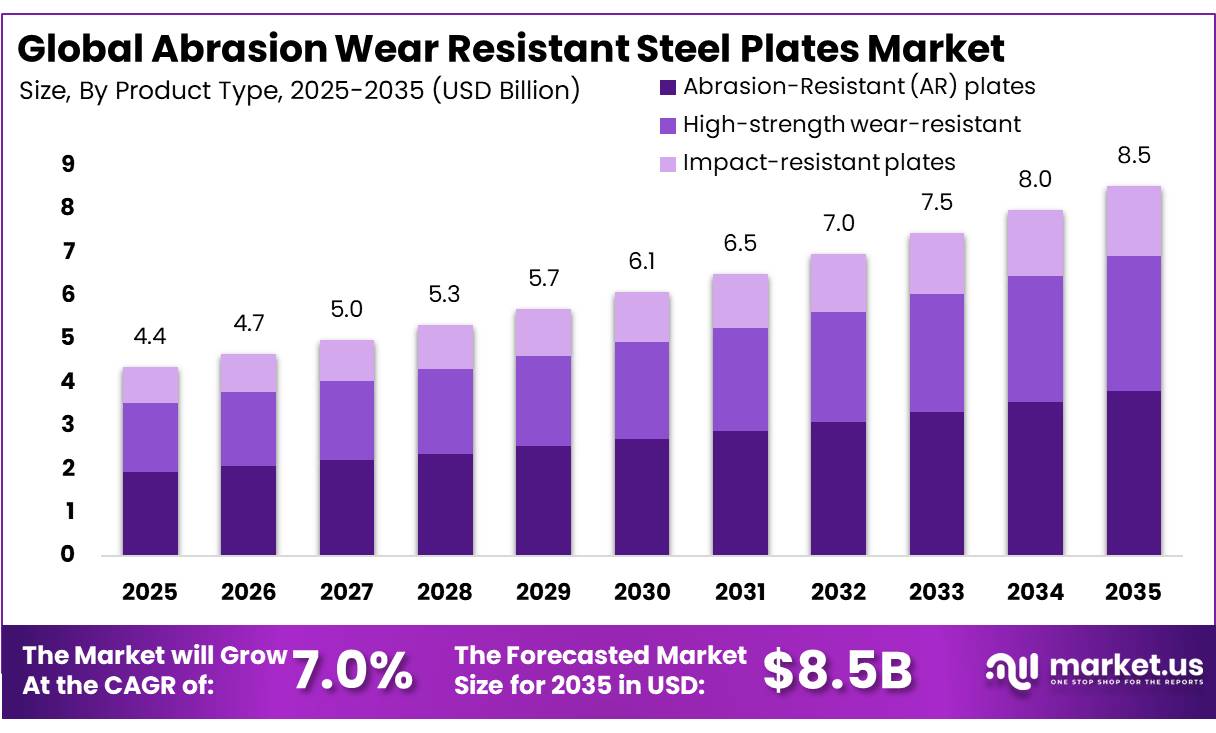
In 2025, the Abrasion Wear Resistant Steel Plates Market was valued at USD 4.4 Billion, and between 2026 and 2035, this market is estimated to register a CAGR of 7.0%, reaching about USD 8.5 Billion by 2035. North America held a dominant market position, capturing more than a 43.1% share, holding USD 1.88 Billion in revenue.
The abrasion wear resistant steel plates market comprises specialized steel products engineered to resist sliding, impact, and gouging abrasion, used primarily in mining, construction, cement, and bulk material handling equipment manufacturing. Given that iron and steel comprise about 95% of total metal tonnage produced annually worldwide, per the U.S. Geological Survey (USGS), the industry provides a substantial manufacturing base for specialty wear resistant grades. Demand for these plates is closely tied to global heavy industry activity and infrastructure investment cycles.
- Global crude steel production, the base material for wear plate manufacturing, totaled 1,849.4 million tonnes (Mt) in 2025 across the 70 countries reporting to the World Steel Association (worldsteel). Regional output remained concentrated in Asia and Oceania, which produced 99.7 Mt in December 2025, while North America produced 9.0 Mt and the European Union (EU) produced 9.9 Mt in the same month, reflecting the diverse manufacturing base supplying wear plate producers.
Key Takeaways
- The Global Abrasion Wear Resistant Steel Plates Market was valued at US$4.4 billion in 2025.
- The global abrasion wear resistant steel plates market is projected to grow at a CAGR of 7.0% and is estimated to reach US$8.5 billion by 2035.
- On the basis of product type, Abrasion-Resistant (AR) Plates dominated the market, constituting 44.5% of the total market share.
- Based on the grade, 400 HB dominated the market, accounting for 40.1% of the total market share.
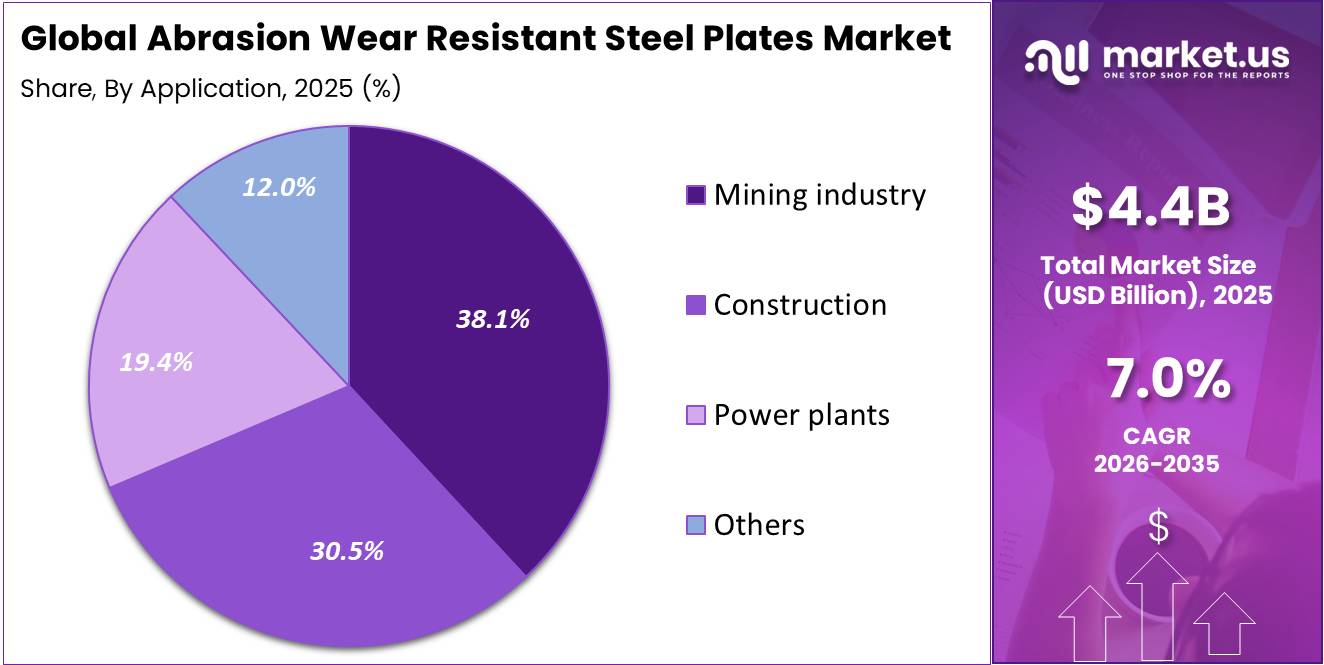
- Based on the application, Mining Industry dominated the market, accounting for 38.1% of the total market share.
- Based on the end use, Mining & Quarrying dominated the market, accounting for 45.5% of the total market share.
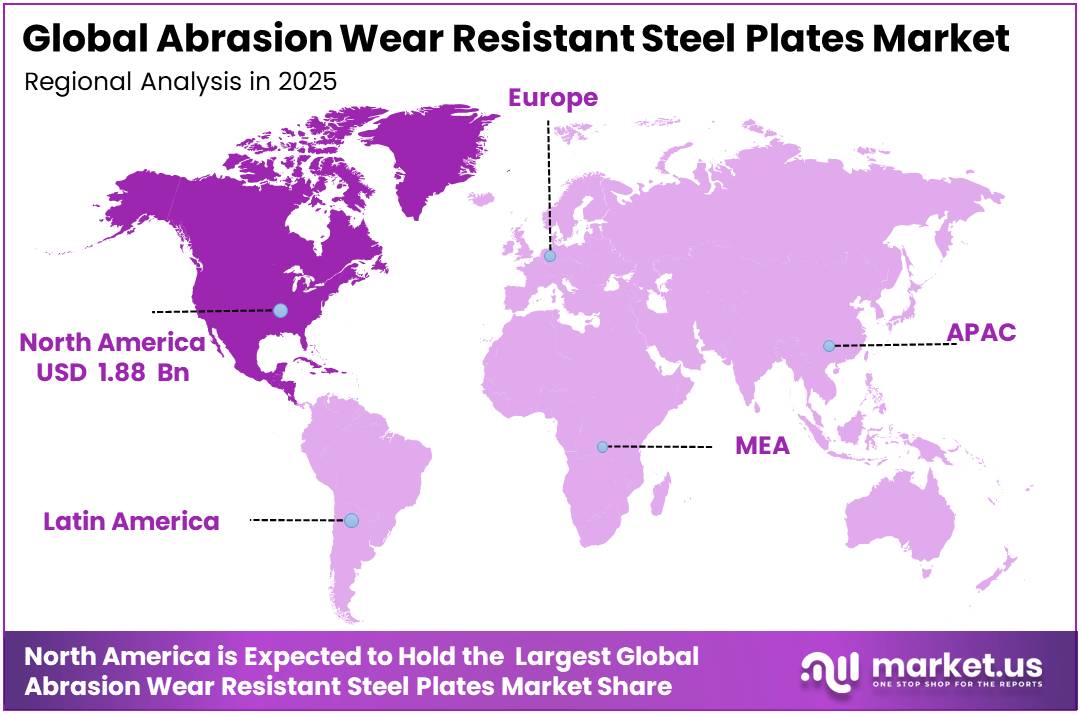
- In 2025, North America was the most dominant region in the abrasion wear resistant steel plates market, accounting for 43.1% of the global market.
Growth in the market is driven by sustained mining, quarrying, and construction equipment demand, alongside rising adoption of electric arc furnace (EAF) steelmaking, which supports lower emission production of alloyed and manganese based wear plates. Expansion of bulk material handling infrastructure and equipment replacement cycles in earthmoving and crushing applications continues to create opportunities. Producers also stand to benefit from decarbonization driven modernization of steelmaking capacity across major producing regions, supporting higher grade specialty plate output.
Government initiatives are reinforcing this manufacturing base. The European Commission’s Steel and Metals Action Plan, published 19 March 2025, supports a European steel industry spanning about 500 production sites across 22 Member States that contributes around €80 billion to the EU’s GDP and sustains over 2.6 million jobs directly and indirectly. The Plan allocates €150 million through the Research Fund for Coal and Steel for 2026 and 2027, €600 million via Horizon Europe, and targets €100 billion through an Industrial Decarbonisation Bank, including a €1 billion pilot auction in 2025.
By Product Type
Abrasion-Resistant (AR) Plates dominate with 44.5% share due to their proven durability in high-wear industrial operations.
In 2025, Abrasion-Resistant (AR) plates held a dominant market position, capturing more than a 44.5% share of the Abrasion Wear Resistant Steel Plates Market. Their strong position was supported by widespread use across industries where equipment is exposed to continuous abrasion, including mining, quarrying, construction, and material handling.
- According to information published by the World Steel Association in 2025, global steel demand continued to be supported by infrastructure and industrial activities, while government-backed mining and construction projects in several regions maintained steady demand for durable steel products.
The High-strength wear-resistant segment is projected to register the fastest growth over the forecast period. The rising focus on improving equipment efficiency, lowering maintenance requirements, and reducing operational downtime is encouraging manufacturers and equipment builders to adopt advanced high-strength wear-resistant plates.
By Grade
400 HB dominates with 40.1% share owing to its balanced wear resistance and broad industrial suitability.
In 2025, 400 HB held a dominant market position, capturing more than a 40.1% share of the Abrasion Wear Resistant Steel Plates Market. The grade maintained its leadership because it provides an effective balance between hardness, toughness, and ease of fabrication, making it suitable for a wide range of industrial applications. It is widely used in mining equipment, construction machinery, material handling systems, and heavy-duty transport components where reliable wear protection is required without sacrificing weldability or forming performance.
- According to the World Steel Association in 2025, continued industrial production and infrastructure-related steel demand supported the consumption of durable steel grades across manufacturing sectors. In addition, internationally recognized standards developed by ASTM International and ISO continued to guide the specification and quality requirements for wear-resistant steel products, supporting the widespread adoption of the 400 HB grade in industrial operations.
The 450 HB segment is expected to witness the fastest growth over the forecast period. Demand for this grade is increasing as industries seek higher wear resistance for equipment operating in more demanding environments while maintaining dependable mechanical performance. Mining operators, construction equipment manufacturers, and heavy machinery producers are increasingly selecting 450 HB plates to improve component lifespan, reduce maintenance intervals, and enhance operational efficiency.
By Application
Mining industry leads with 38.1% share driven by continuous demand for durable wear-resistant equipment.
In 2025, Mining industry held a dominant market position, capturing more than a 38.1% share of the Abrasion Wear Resistant Steel Plates Market. The segment remained the largest consumer because mining operations expose equipment to constant abrasion from rocks, minerals, and ore, creating a strong need for highly durable steel plates. Wear-resistant plates are widely used in dump truck bodies, excavator buckets, crushers, conveyors, hoppers, and loading equipment to improve service life and reduce maintenance frequency.
- According to the U.S. Geological Survey (USGS) and the International Council on Mining and Metals (ICMM), mining activities continued to support investment in equipment modernization during 2025, encouraging the use of materials that can withstand harsh operating conditions.
The Construction segment is projected to record the fastest growth over the forecast period. Rising infrastructure development and increasing use of heavy construction machinery are creating stronger demand for wear-resistant steel components that can perform reliably under demanding job-site conditions. Equipment such as excavators, bulldozers, loaders, and concrete handling machinery increasingly require durable steel plates to reduce wear and improve operational efficiency.
By End-use
Mining & quarrying dominates with 45.5% share as heavy equipment requires superior wear protection.
In 2025, Mining & quarrying held a dominant market position, capturing more than a 45.5% share of the Abrasion Wear Resistant Steel Plates Market. The segment secured the largest share because mining and quarrying operations involve constant exposure to abrasive materials such as rock, gravel, and minerals, leading to high demand for durable wear-resistant steel plates. These plates are extensively used in excavator buckets, dump truck bodies, crushers, screens, chutes, hoppers, and conveyor systems to improve equipment life and reduce maintenance requirements.
- According to the U.S. Geological Survey (USGS) and the International Council on Mining and Metals (ICMM), mining operations remained active during 2025 as the demand for essential minerals continued to support equipment replacement and modernization.
The Construction & civil engineering segment is expected to register the fastest growth over the forecast period. Expanding infrastructure projects and increasing investments in transportation, commercial development, and public utilities are driving the need for heavy construction equipment built with durable wear-resistant materials.
Key Market Segments
By Product Type
- Abrasion‑Resistant (AR) plates
- High‑strength wear‑resistant
- Impact‑resistant plates
By Grade
- 400 HB
- 450 HB
- 500 HB & above
By Application
- Mining industry
- Construction
- Power plants
- Others
By End-use
- Mining & quarrying
- Construction & civil engineering
- Energy & power
- Heavy machinery & OEMs
- Defense & specialized uses
Driver Analysis
Mining fleet renewal and ore-throughput intensity
Abrasion wear resistant plate demand is being pulled by mining’s operating logic: when ore grades deteriorate and operators push more tonnes through trucks, buckets, chutes, liners, hoppers, crushers, and transfer points, wear consumption rises faster than headline steel demand. worldsteel expects global steel demand to reach 1,724 Mt in 2026, while India alone is projected to grow steel demand by 7.4% in 2026, signalling ongoing build-out in steel-intensive sectors and supporting replacement cycles in mining and heavy equipment ecosystems.
At the same time, the IEA notes that critical-minerals mining investment growth slowed to 5% in 2024 from 14% in 2023, which does not remove demand but makes operators more ROI-focused, favoring wear plate upgrades that extend maintenance intervals rather than full greenfield overbuild. In practice, that changes the business model from simple tonnage selling toward application-engineered plate packages, because mines increasingly buy on cost-per-hour or cost-per-tonne handled; a liner lasting even 15% to 25% longer can outperform a lower-priced standard plate once shutdown cost, welding labor, and lost throughput are counted, making this the strongest medium-term demand driver for the market.
Drivers Impact Analysis
| Driver | (~) % Impact on CAGR Forecast | Geographic Relevance | Impact Timeline |
|---|---|---|---|
| Mining fleet renewal and ore-throughput intensity | +1.4% | APAC core, Australia, Latin America, Africa | Medium term (2-4 years) |
| Infrastructure, aggregates and earthmoving equipment demand | +1.1% | India core, Southeast Asia, North America, EU | Short term (≤ 2 years) |
| Shift to higher-hardness lightweight plate grades | +0.9% | North America core, EU, Japan, Korea, premium APAC | Medium term (2-4 years) |
| EU CBAM and low-carbon steel procurement realignment | +0.6% | EU core, Turkey, India, East Asia export corridors | Short term (≤ 2 years) |
| Steel input cost normalization improving buyer conversion | +0.7% | Global, strongest in import-dependent regions | Short term (≤ 2 years) |
| Aftermarket wear-part outsourcing and fabricated kit demand | +0.8% | North America, EU, Middle East, mining belts globally | Medium term (2-4 years) |
Restraint Analysis
Volatile raw material and energy costs
Volatile raw material and energy costs directly erode the investability of abrasion wear resistant plate upgrades by compressing OEM and fabricator margins and forcing end-users to defer specification changes, with iron ore benchmark references oscillating in a band that has recently seen mid-$80s to low-$100s per tonne expectations for 2026 and coking coal forecasts in the roughly $180 to $220 per tonne range depending on index methodology, alongside power tariffs for electric arc furnaces and reheat furnaces rising by mid- to high-single digits in several markets as fuel and carbon costs flow through utility bills.
This volatility amplifies working capital risk because plate buyers must fund higher inventory values and may face 10% to 20% swings in replacement kit pricing within a year, making maintenance managers revert to cheaper, lower-hardness alternatives or to patch-welding worn components rather than buying new wear plate, while steelmakers and service centers face compressed spreads between raw inputs and finished plate when spot surcharges do not fully cover cost spikes.
In turn, this dynamic slows the shift toward premium AR grades, as quotation validity periods shrink from 60–90 days to 15–30 days in some contracts, increasing friction in tendering processes and reducing conversion rates on multi-year wear-package proposals, especially in projects where budgets were locked at earlier commodity price assumptions.
Restraint Impact Analysis
| Restraint | (~) % Impact on CAGR Forecast | Geographic Relevance | Impact Timeline |
|---|---|---|---|
| Volatile raw material and energy costs | -1.3% | APAC core, EU, North America | Short term (≤ 2 years) |
| Steel logistics and port congestion | -1.0% | APAC export hubs, EU ports, US Gulf | Short term (≤ 2 years) |
| High CapEx for quench-and-temper capacity | -0.9% | India, SE Asia, MENA, Latin America | Medium term (2-4 years) |
| Skilled fabrication and welding constraints | -0.8% | North America, EU, Japan, Korea | Long term (≥ 4 years) |
| Regulatory and decarbonization cost burden | -0.7% | EU core, UK, Turkey, export-oriented Asia | Medium term (2-4 years) |
| Demand cyclicality in mining and construction | -1.1% | Global; strongest in commodity-driven regions | Medium term (2-4 years) |
Opportunity Analysis
Composite and coated AR solutions for extreme environments
Composite and coated abrasion-resistant solutions for extreme environments represent untapped white space because the current baseline driver set largely revolves around standard mining, construction, and aggregates applications, whereas future demand will increasingly arise in Arctic, offshore, chemical, and high-temperature industrial zones where simultaneous wear and corrosion are severe and existing carbon AR plates are under-optimized.
Academic and industrial reviews of protective coatings and wear-resistant systems for extreme conditions highlight environments such as offshore platforms with high salt and humidity, Arctic installations facing frozen particles blasting at up to 200 mph and temperatures approaching -100 °C, and chemical plants with aggressive media, all contexts where simple hardness is insufficient and layered solutions can extend service life by 30% to 50% versus conventional plate while enabling thinner structures and reduced maintenance windows.
Strategically, if AR steel suppliers partner with coating and surface-engineering firms to develop integrated product lines and price them at perhaps 20% to 30% above standard AR while delivering 2x maintenance-interval improvements, the margin uplift per tonne and penetration into previously underserved sectors could realistically add over one percentage point of CAGR upside globally, especially in EU and North American infrastructure, offshore wind, and petrochemical projects where extreme-environment performance is a procurement priority but plate solutions are still fragmented.
Opportunity Impact Analysis
| Opportunity | (~) % Potential CAGR | Geographic Relevance | Execution Window |
|---|---|---|---|
| Composite and coated AR solutions for extreme environments | +1.3% | EU, North America, Arctic, offshore APAC | Medium term (2-4 years) |
| Integrated lifecycle service and performance-based contracts | +1.1% | North America core, EU, Australia mining belts | Short term (≤ 2 years) |
| Expansion into recycling, waste-to-energy and circular infrastructure | +0.9% | EU, North America, urban APAC corridors | Medium term (2-4 years) |
| Digital wear monitoring and predictive maintenance platforms | +1.0% | Global tier-1 mines, cement, aggregates | Medium term (2-4 years) |
| Emerging-market local Q&T and fabrication hubs | +1.2% | India, SE Asia, Latin America, Africa | Long term (≥ 4 years) |
| High-end AR steel matrix composites for OEM differentiation | +0.8% | Japan, Korea, EU, North America | Long term (≥ 4 years) |
Challenges Analysis
Complex welding and fabrication quality control
Complex welding and fabrication quality control is a persistent challenge because abrasion wear resistant plate, often hardened to 400 HB or above, demands precise preheat, filler selection, and heat-input management to avoid cracking, loss of hardness, or distortion, and industry guidance highlights cracking in the weld metal or heat-affected zone as a major risk when welding AR plate to itself or to softer structures.
Typical shop realities involve multi-pass welds on plates ranging from 10 mm to over 80 mm, with recommended preheat temperatures that must be controlled and verified around 75–150 °C depending on thickness, and field repair procedures requiring low-hydrogen consumables such as E7018 rods and specific flux-cored wires; deviations from these regimes can raise rework rates by 10–20% and increase scrap, adding 3–5% to project labor hours and contributing to variability in installed plate performance.
Challenges Impact Analysis
| Challenge | (~) % CAGR Friction | Geographic Relevance | Mitigation Horizon |
|---|---|---|---|
| Complex welding and fabrication quality control | -1.0% | North America, EU, APAC OEM hubs | Long term (≥ 4 years) |
| Freight volatility and multi-modal logistics risk | -0.9% | APAC export corridors, EU ports, US rails | Medium term (2-4 years) |
| Digital integration and cybersecurity constraints | -0.8% | EU regulatory hubs, global tier-1 steel and mining | Medium term (2-4 years) |
| Aging workforce and specialized skills gap | -0.7% | North America core, EU, Japan, Korea | Long term (≥ 4 years) |
| Demand forecasting and inventory volatility | -0.8% | Global steel supply chains, mining belts | Medium term (2-4 years) |
| ESG compliance and sustainability reporting complexity | -0.6% | EU, UK, export-oriented Asia, LatAm | Long term (≥ 4 years) |
Geopolitical Impact Analysis
Geopolitical tensions reshape steel supply chains and raise production costs for abrasion wear resistant steel plates.
The ongoing conflicts in Eastern Europe and the Middle East continue to influence the Abrasion Wear Resistant Steel Plates Market by increasing uncertainty across steel, energy, and shipping supply chains. Steel producers are facing higher production expenses because energy is a major input in steelmaking.The OECD Steel Outlook 2026 notes that energy accounts for between 20% and 40% of total steel production costs, making steel manufacturers highly sensitive to geopolitical disruptions and fuel price movements.
- At the same time, the International Energy Agency (IEA) reported that around 20 million barrels per day of crude oil and oil products moved through the Strait of Hormuz in 2025, representing about 25% of global seaborne oil trade, highlighting the importance of stable energy transport for heavy industries.
Disruptions in this route have increased freight costs, shipping delays, and insurance premiums, affecting the delivery of raw materials and finished steel products. Mining, construction, and heavy equipment manufacturers have therefore experienced longer procurement cycles and greater focus on supply chain resilience. Many steel producers are also expanding regional sourcing and maintaining larger inventories to reduce dependence on vulnerable trade routes. Despite these challenges, continued infrastructure activity and industrial demand have helped maintain steady consumption of abrasion wear resistant steel plates across key manufacturing sectors.
Regional Analysis
Abrasion Wear Resistant Steel Plates Market – Regional Segmental Analysis: North America.
North America stands out as the dominating region in the Abrasion Wear Resistant Steel Plates Market, holding a 43.1% share and a valuation of USD 1.88 billion. This leadership position is supported by strong regional steel manufacturing and consumption.
- According to the World Steel Association (worldsteel), North America produced 9.0 million tonnes (Mt) of crude steel in December 2025 alone, reflecting a solid raw material base for downstream abrasion wear resistant steel plate production. The region benefits from an established steel industry, advanced manufacturing capabilities, and consistent demand from heavy industrial sectors that require durable wear-resistant materials.
Within the region, the United States remains the primary contributor. The American Iron and Steel Institute (AISI) reported that U.S. steel mills shipped 90,953,066 net tons of finished steel during 2025, representing a 4.9% increase compared with 86,698,917 net tons in 2024. AISI also reported that total U.S. steel imports declined 12.6% to 25,241,000 net tons in 2025, indicating greater reliance on domestic steel production. This trend supports regional wear plate manufacturers by strengthening local supply chains.
Key Regions and Countries Covered
- North America
- The US
- Canada
- Europe
- Germany
- France
- The UK
- Spain
- Italy
- Russia & CIS
- Rest of Europe
- APAC
- China
- Japan
- South Korea
- India
- ASEAN
- Rest of APAC
- Latin America
- Brazil
- Mexico
- Rest of Latin America
- Middle East & Africa
- GCC
- South Africa
- Rest of MEA
Key Players Analysis
Manufacturers in the Abrasion Wear Resistant Steel Plates Market focus on improving product performance, production efficiency, and supply chain resilience to strengthen their competitive position. A major priority is the development of advanced wear-resistant steel grades that offer higher hardness, better impact resistance, improved weldability, and longer service life in demanding industrial environments.
Companies continue to optimize heat treatment processes, alloy compositions, and rolling technologies to produce plates that perform reliably in mining, quarrying, construction, material handling, and heavy machinery applications. Investments in modern steel mills, automated production lines, and digital quality monitoring help ensure consistent mechanical properties while reducing production costs and material waste.
Leading companies including SSAB AB, ArcelorMittal, Thyssenkrupp AG, Nippon Steel Corporation (NSSMC), POSCO, JFE Steel Corporation, Tata Steel Limited, China Baowu Steel Group, Dillinger Hütte (Dillinger), Bisalloy Steel Group, Essar Steel, Nucor Corporation, United States Steel Corporation, Voestalpine AG, and Steel Authority of India Limited (SAIL) continue to expand their market presence through product innovation, regional manufacturing growth, and long-term customer partnerships.
Many producers are increasing the availability of customized wear plate solutions designed for specific industrial equipment and operating conditions. They also work closely with original equipment manufacturers (OEMs), mining companies, and construction equipment producers to deliver application-specific products that improve operational efficiency and reduce maintenance requirements.
Market Key Players
- SSAB AB
- ArcelorMittal
- Thyssenkrupp AG
- Nippon Steel Corporation (NSSMC)
- POSCO
- JFE Steel Corporation
- Tata Steel Limited
- China Baowu Steel Group
- Dillinger Hütte (Dillinger)
- Bisalloy Steel Group
- Essar Steel / Essar Steel Algoma
- Nucor Corporation
- United States Steel Corporation
- Voestalpine AG
- Steel Authority of India Limited (SAIL)
- Others
Key Development
- In February 2025, SSAB introduced Hardox 450 made from SSAB Zero, the first SSAB Zero product in its Hardox wear plate range, unveiled at Bauma 2025. The steel is produced using recycled steel powered by fossil-free electricity and biogas, resulting in fossil carbon emissions of less than 0.05 kg CO2e per kg of steel across Scope 1 and 2 of the GHG Protocol.
- In April 2025, SSAB launched Hardox HiAce, a wear plate engineered to withstand combined abrasion, corrosion, and high-heat conditions. Internal testing found that standard S304 stainless steel, which measures approximately 200 HBW in hardness, delivers corrosive wear resistance roughly 20% lower than that of Hardox HiAce.
- In June 2025, ArcelorMittal reported that its Relia wear-resistant steel range extends the service life of wear parts by 3 to 6 times compared to conventional solutions, while its XCarb recycled and renewably produced Amstrong steel delivers a carbon footprint reduction of up to 70% compared to steel made via the conventional steelmaking route.
Report Scope
| Report Features | Description |
|---|---|
| Market Value (2025) | USD 4.4 Bn |
| Forecast Revenue (2035) | USD 8.5 Bn |
| CAGR (2026 2035) | 7.0% |
| Base Year for Estimation | 2025 |
| Historic Period | 2020-2024 |
| Forecast Period | 2026-2035 |
| Report Coverage | Revenue Forecast, Market Dynamics, Competitive Landscape, Recent Developments |
| Segments Covered | By Product Type (Abrasion-Resistant (AR) Plates, High-Strength Wear-Resistant Plates, Impact-Resistant Plates), By Grade (400 HB, 450 HB, 500 HB & Above), By Application (Mining Industry, Construction, Power Plants, Others), By End Use (Mining & Quarrying, Construction & Civil Engineering, Energy & Power, Heavy Machinery & OEMs, Defense & Specialized Uses) |
| Regional Analysis | North America The US & Canada; Europe Germany, France, The UK, Spain, Italy, Russia & CIS, Rest of Europe; APAC China, Japan, South Korea, India, ASEAN & Rest of APAC; Latin America Brazil, Mexico & Rest of Latin America; Middle East & Africa GCC, South Africa, & Rest of MEA |
| Competitive Landscape | SSAB AB, ArcelorMittal, Thyssenkrupp AG, Nippon Steel Corporation (NSSMC), POSCO, JFE Steel Corporation, Tata Steel Limited, China Baowu Steel Group, Dillinger Hütte (Dillinger), Bisalloy Steel Group, Essar Steel / Essar Steel Algoma, Nucor Corporation, United States Steel Corporation, Voestalpine AG, Steel Authority of India Limited (SAIL), and other key players. |
| Customization Scope | Customization for segments, region/country level will be provided. Moreover, additional customization can be done based on the requirements. |
| Purchase Options | We have three licenses to opt for: Single User License, Multi User License (Up to 5 Users), Corporate Use License (Unlimited Users and Printable PDF) |





































